
Hand-arm vibration, often abbreviated as HAV, is a significant occupational hazard that occurs when vibration from power tools and machinery transmits directly into a worker’s hands and arms. This isn't just a minor shake; it's a constant series of tiny, high-speed impacts that, over time, can seriously damage the delicate nerves, blood vessels, and joints in the hands and arms. Understanding what causes hand-arm vibration is the first step toward preventing a debilitating and permanent condition called Hand-Arm Vibration Syndrome (HAVS).
Prolonged exposure to this vibration can lead to irreversible health effects, making it crucial for employers and workers in affected industries to recognise the sources and implement effective controls.
What Are the Primary Sources of Workplace Vibration?
So, what causes hand-arm vibration in a typical work environment? The short answer is the powerful tools and machinery people use every single day. Every time a worker grips a vibrating piece of equipment, they're exposed to potentially harmful levels of mechanical vibration. This is a daily reality across numerous sectors, including construction, manufacturing, mining, forestry, and even grounds maintenance.
The real danger isn't necessarily from a single, powerful jolt. It’s the cumulative effect of day-in, day-out exposure that poses the greatest risk. Think of it like a dripping tap slowly wearing away stone; each short burst of vibration is like a single drop. Over months and years, that relentless exposure adds up, causing micro-trauma that often goes unnoticed until the damage is severe and irreversible.
Common Tools That Pose a High Risk
It’s easy to point the finger at massive equipment like heavy-duty chipping hammers, but plenty of everyday tools contribute to a worker's vibration exposure. In Australia, the most common culprits are hand-held power tools and hand-guided machinery that workers rely on to get their job done efficiently.
We're talking about jackhammers, chainsaws, grinders, drills, impact wrenches, and needle scalers. These tools are consistently flagged as the primary sources of dangerous vibration exposure. For a deeper dive into this, Safe Work Australia has compiled detailed findings on the issue.
To give you a clearer picture, here’s a quick summary of the usual suspects.
Common Sources of Hand-Arm Vibration at a Glance
This table breaks down some of the most common tools that cause HAV, the industries where you'll find them, and the specific health risks they present.
| Tool or Machinery Type | Typical Industries | Primary Risk |
|---|---|---|
| Jackhammers & Breakers | Construction, Demolition, Mining | High-intensity impact causing rapid nerve and joint damage. |
| Grinders & Sanders | Manufacturing, Metalworking, Vehicle Repair | Sustained high-frequency vibration leading to vascular damage. |
| Impact Wrenches | Automotive, Heavy Equipment Maintenance | Sharp, percussive vibration that damages small joints and nerves. |
| Chainsaws & Strimmers | Forestry, Landscaping, Grounds Maintenance | Prolonged exposure leading to numbness and Vibration White Finger. |
Recognising these sources is the first and most important step for any manager or worker looking to build a safer workplace. The very tools that make a job possible can, if left unmanaged, make a healthy life impossible. With this understanding, we can stop just identifying the problem and start putting real, effective controls in place.
How Vibration Physically Damages the Body
To get a real sense of why hand-arm vibration is so destructive, we need to look past the tool itself and understand what’s happening inside the body. The energy from a vibrating tool doesn't just buzz on your skin; it travels deep into your hands and arms, causing a ripple effect of tiny injuries to some of the most delicate parts of your anatomy.
This damage really comes down to two key physical properties: frequency and amplitude.
Think of amplitude as the sheer power or intensity of the shake. It's the difference between a tool that gives off a gentle hum and one that rattles your bones. The higher the amplitude, the more forceful the energy being pushed into your body.
Frequency, on the other hand, is all about the speed of the vibration—how many times the tool oscillates back and forth each second. Different speeds cause different problems. Low-frequency vibrations feel like slow, heavy judders that can damage joints and bones. High-frequency vibrations are more like a rapid, sharp buzzing that’s particularly nasty for your nerves and blood vessels.
The Destructive Path Through the Body
The moment a worker grips a power tool, that vibrational energy starts its damaging journey. The forces travel from the handle into the fingers and palm, then shoot up through the wrist and into the forearm. Every step of the way, this relentless shaking is causing cumulative harm.
This concept map shows the simple but damaging progression from tool to worker.
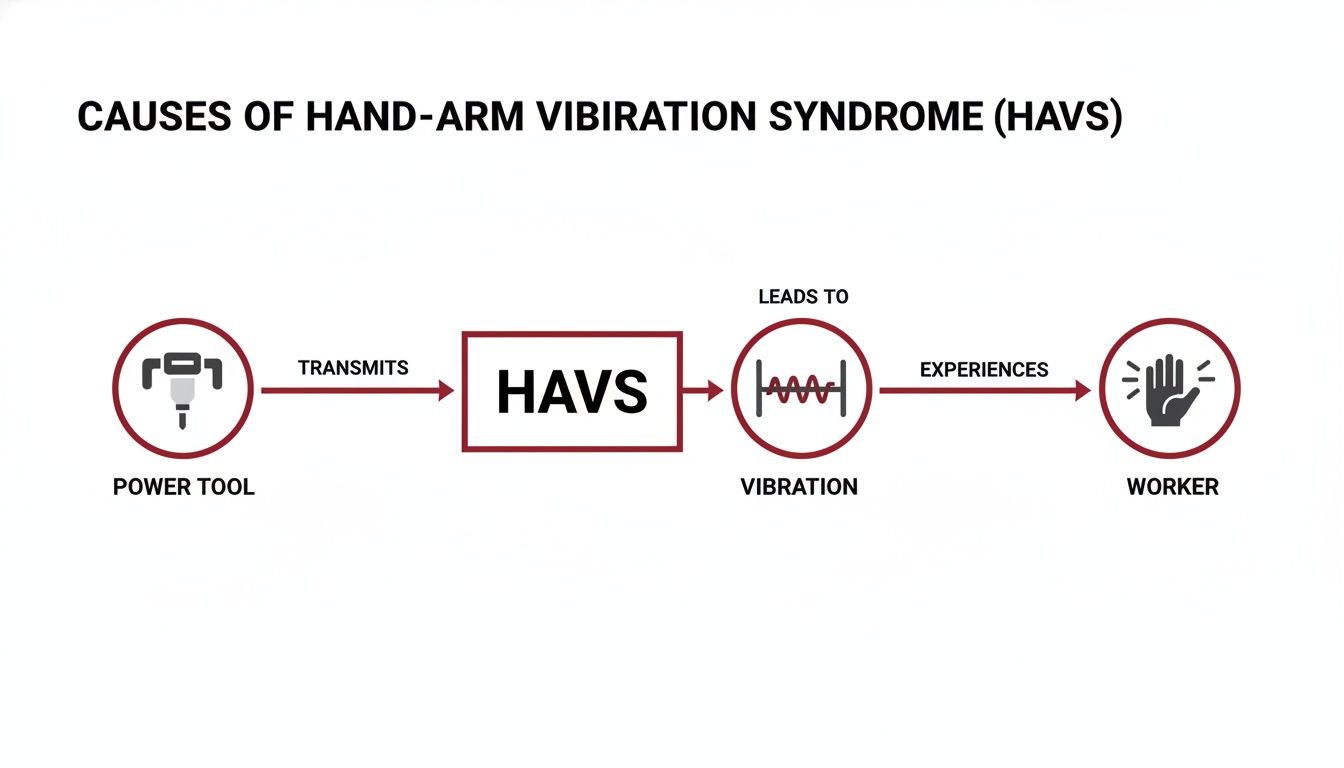
The image lays it out clearly: the power tool is the source, the vibration is the method of attack, and the worker’s body is what pays the price.
This continuous micro-trauma is exactly what leads to Hand-Arm Vibration Syndrome (HAVS). It’s not one big accident, but thousands of tiny, unseen injuries adding up over months and years. The result is a condition that’s permanent but was always entirely preventable.
Damaging Nerves and Blood Vessels
The most severe damage happens within the complex network of nerves and blood vessels in our hands and fingers. Vibration constantly irritates and inflames the delicate inner walls of the blood vessels, causing them to thicken over time.
This thickening acts like scale building up inside a pipe, restricting blood flow. In the cold, these already-compromised vessels can spasm and clamp shut, which is what causes the classic symptom known as Vibration White Finger—where fingers turn ghost-white and lose all feeling.
"I’ve lost my fine motor skills. I can’t pick up small objects, button a shirt, or use a knife and fork properly. The pain keeps me awake at night. I can’t even hold my grandchildren without fear of dropping them."
This quote from a worker suffering from HAVS really brings home the devastating, real-world impact of this internal damage.
At the same time, the vibration is also attacking the nerves. The protective myelin sheath that insulates nerve endings gets worn away, scrambling the signals sent between the hands and the brain. This neurological damage leads to:
- Tingling and Numbness: Often the first warning sign that nerve function is starting to fail.
- Loss of Dexterity: Finding it hard to do precise tasks like handling screws, doing up buttons, or using small tools.
- Reduced Grip Strength: A noticeable weakness in the hands that makes it difficult to hold things securely.
Ultimately, the reason hand-arm vibration is so dangerous is this quiet, progressive destruction of the body’s essential systems. The damage is insidious, often creeping up without anyone noticing until the symptoms become severe and, by then, irreversible. That's why understanding exactly how the harm occurs is the critical first step towards preventing it.
Key Risk Factors Beyond Just the Tool
When we think about what causes hand-arm vibration, it’s easy to point the finger at the tool—the powerful grinder, the rattling jackhammer. But that's only half the story. While the tool is the source, it's the combination of workplace conditions and individual human factors that really dictates how much damage is done.
Think of it like this: the tool creates the vibration, but the environment and the way a person works determine how much of that harmful energy actually gets absorbed into their hands and arms.
To manage the risk properly, you have to look at the whole picture: the worker, the task, and the environment. Focusing only on the equipment means you're missing huge opportunities to protect your team from permanent, life-altering injuries.
Workplace Factors That Amplify Risk
The surrounding work environment can dramatically increase how vibration affects the body. Certain conditions can turn a moderate risk into a severe one, even if the tool itself doesn't change.
Two of the biggest culprits here are temperature and posture.
- Cold Temperatures: Working in the cold is a major risk multiplier. When your body gets cold, it automatically constricts the blood vessels in your hands and fingers to keep your core warm. This reduced blood flow makes the nerves and tissues far more vulnerable to damage from vibration. A worker using a grinder outside on a cold winter morning is in a much riskier situation than someone doing the same job in a warm workshop.
- Awkward Postures: How you hold the tool matters. A lot. Awkward positions—like reaching overhead to drill or hunching over a floor polisher—force you to grip the tool much tighter just to stay in control. That death grip creates a direct, rigid bridge for vibration to travel straight into your hand and arm, massively increasing the energy transfer.
A poorly maintained tool, a cold worksite, and an awkward working position can combine to create a perfect storm for vibration-related injury, even with a tool that is rated for lower vibration levels.
These environmental risks are often missed, but they're relatively simple to fix with better work planning and controls. It's a principle that applies to other occupational hazards, too; understanding all sources of exposure is just as vital when dealing with issues like those we cover in our guide on whole-body vibration.
Human Factors in Vibration Exposure
Beyond the immediate environment, a person’s own actions and health play a massive role in their risk of developing HAVS. These "human factors" are why two people can use the same tool for the same amount of time and have completely different outcomes. It's a personal risk profile, and every employer needs to be aware of it.
The most critical human factors are grip force, daily exposure time, and personal health.
Grip Force and Trigger Time
How hard and for how long someone holds a tool are two of the most decisive factors in causing hand-arm vibration damage.
- Grip Force: As we just touched on, a tighter grip lets more vibration flood into the body. Workers need to be trained to hold tools with the lightest grip possible that still allows them to operate it safely. Anything more is a direct pathway for destructive energy.
- Trigger Time: This is the total time in a day that a worker’s hands are actually on a vibrating tool while it’s switched on. It’s often a lot shorter than a full eight-hour shift, but those minutes add up fast. For example, a worker using an impact wrench for just 15-20 minutes of total trigger time throughout the day could easily fly past the safe exposure limits.
Individual Health and Lifestyle
Finally, a person's general health has a huge say in how susceptible they are to vibration damage. Any condition that already affects blood circulation can make someone much more vulnerable.
- Smoking: Nicotine is a powerful vasoconstrictor—it narrows blood vessels and reduces circulation, just like cold temperatures do. People who smoke generally have poorer circulation to start with, putting them at a significantly higher risk of developing conditions like Vibration White Finger.
- Medical Conditions: Certain diseases that affect blood flow, such as Raynaud's disease or diabetes, can also make a worker much more sensitive to vibration.
By understanding these workplace and human factors, you can move beyond simply blaming the tool. It allows you to build smarter, person-focused safety strategies that actually work.
How to Identify and Measure Vibration Exposure
Understanding the risks of hand-arm vibration is one thing, but knowing how to measure it in your workplace is where safety truly begins. To effectively protect your team, you need a clear, practical way to assess who is at risk and by how much. This process starts with simple observation and moves towards precise measurement, giving you the solid data you need to make informed decisions.
A great first step is simply walking the floor and observing. Which tasks involve someone holding a powered tool or guiding a piece of vibrating machinery? Keep a close eye on anyone using grinders, jackhammers, impact wrenches, or chainsaws—these are notorious culprits for high vibration levels.
From there, you need to estimate their daily "trigger time." This isn't the length of their shift; it's the total time their hands are actually on a vibrating tool while it’s switched on. You'd be surprised how quickly even short, repeated bursts of work can add up to a dangerous amount of exposure over a day.
From Estimation to Precise Measurement
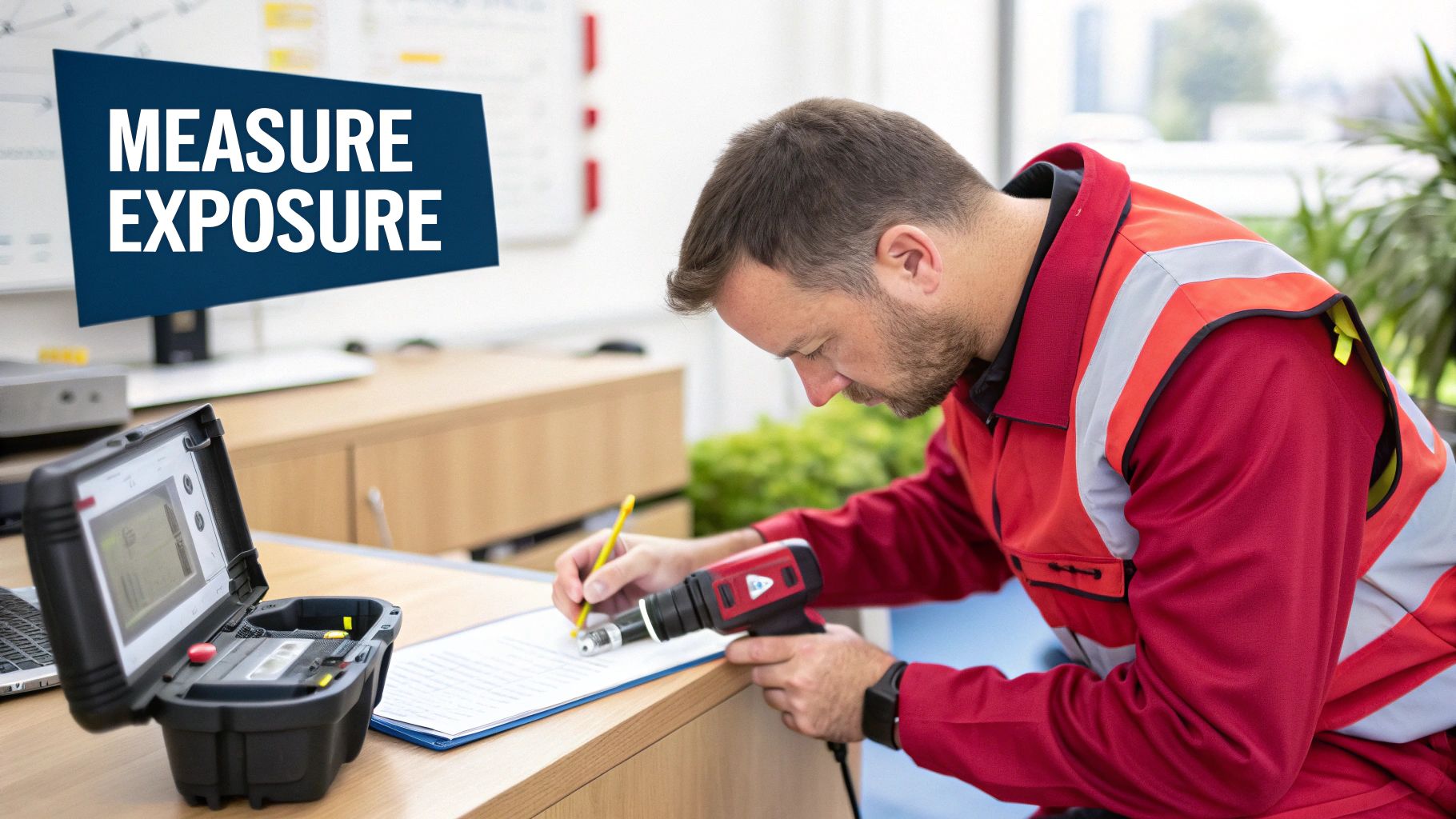
While a visual scan and a stopwatch are a good start, regulations and best practice demand hard data. That’s where professional measurement comes in. The go-to method uses a specialised device called an accelerometer.
This small sensor is attached directly to the tool's handle, where it measures the raw intensity—or magnitude—of the vibration. The readings are given in metres per second squared (m/s²), giving you an objective, scientific value for how much vibration that tool is producing for that specific task.
By combining the tool's vibration magnitude (m/s²) with the worker's daily trigger time, you can calculate their total daily vibration exposure, known as the A(8) value. This single number is the cornerstone of a legally compliant vibration risk assessment.
Professional occupational hygienists can conduct a detailed hand-arm vibration assessment, which takes all the guesswork out of the equation. This gives you accurate measurements and expert analysis, ensuring your workplace meets safety standards and providing a solid foundation for your control strategies.
Understanding Exposure Limits: The EAV and ELV
Once you've calculated the A(8) exposure value, you need to see how it stacks up against national standards. In Australia, like many other countries, this comes down to two key benchmarks: the Exposure Action Value (EAV) and the Exposure Limit Value (ELV).
These aren't just arbitrary numbers; they are legally recognised thresholds designed to protect workers from the permanent damage that vibration can cause.
- Exposure Action Value (EAV): Think of this as the first warning bell. If a worker's daily exposure is likely to hit or go over the EAV, employers are legally required to take specific action to reduce the risk.
- Exposure Limit Value (ELV): This is the hard stop. It's the absolute maximum vibration a worker can legally be exposed to on any given day. Exceeding this limit is a serious breach of safety regulations.
A good way to think about it is that the EAV is like the amber warning light on your car's dashboard—it's time to take action before a real problem develops. The ELV, on the other hand, is the red line on the rev counter. Pushing past it puts you in immediate danger of causing serious, irreversible damage.
The table below breaks down what each level means and the actions required by law.
Vibration Exposure Levels and Required Actions
| Exposure Level | Daily Exposure A(8) Value | Required Employer Actions |
|---|---|---|
| Exposure Action Value (EAV) | 2.5 m/s² | Implement a programme of technical and organisational measures to reduce exposure. Provide health surveillance for exposed workers. |
| Exposure Limit Value (ELV) | 5.0 m/s² | Exposure must not be exceeded. Immediately stop work and implement controls to prevent reoccurrence. |
Ultimately, identifying and measuring vibration exposure isn't just about ticking compliance boxes—it's about genuinely preventing harm. A thorough risk assessment allows you to stop reacting to problems and start proactively building a safer workplace. It's a systematic approach that ensures you understand the real risks and have the data to build a safety program that protects your people for the long term.
What HAVS Does to the Human Body
When a worker is exposed to vibration day after day, that risk can eventually become a life-altering reality: Hand-Arm Vibration Syndrome (HAVS). This isn't just one illness; it's a collection of debilitating conditions that permanently damage a worker’s nerves, blood vessels, and joints. The damage creeps up on you—what starts as a minor tingle can grow into a severe disability that impacts every corner of your life.
The consequences are more than just physical; they're deeply personal. Imagine losing the ability to turn a key in a lock, button your own shirt, or feel the warmth of a loved one's hand. For people with advanced HAVS, these aren't hypotheticals. This is their daily reality, which is why prevention isn't just a box to tick on a safety form—it's a moral responsibility.
The Three Ways HAVS Attacks the Body
Hand-Arm Vibration Syndrome typically goes after the body in three distinct but related ways, each with its own set of painful and disabling symptoms. Breaking them down shows exactly why catching the signs early is so important.
The syndrome’s damage can be split into:
- Vascular Damage: Affecting blood vessels and circulation.
- Neurological Damage: Targeting the nerves and the sense of touch.
- Musculoskeletal Damage: Harming muscles, bones, and joints.
Each piece of this puzzle contributes to a slow but steady loss of hand function, turning everyday tasks into huge challenges.
Vascular Damage and Vibration White Finger
The most well-known sign of HAVS is Vibration White Finger (VWF). This happens when the tiny blood vessels in the fingers get damaged. Constant vibration makes the walls of these vessels thicken, which narrows the pipeline for blood flow.
When someone with VWF gets cold or wet, these damaged vessels can spasm and clamp shut, completely cutting off the blood supply. This is what causes one or more fingers to turn a ghostly, waxy white and go totally numb. As blood eventually struggles to return, the fingers often turn a deep, painful red and throb intensely. An attack like this can last anywhere from a few minutes to over an hour, causing real pain and distress.
Neurological Damage: When the Feeling is Gone
While VWF is the most obvious symptom, the neurological damage is often what really disrupts daily life. The constant shaking from a power tool slowly strips away the protective coating—the myelin sheath—around the nerve endings in your hands and fingers.
This nerve damage brings on a whole host of sensory issues:
- Constant Tingling: A persistent “pins and needles” sensation that can ruin sleep and shatter concentration.
- Permanent Numbness: A total loss of feeling, making it impossible to handle small things like screws, nuts, or buttons.
- Loss of Dexterity: The fine motor control you need for writing, using cutlery, or even texting is severely reduced.
A worker diagnosed with advanced HAVS described the devastating impact: “I’ve lost my fine motor skills. I can’t pick up small objects, button a shirt, or use a knife and fork properly. The pain keeps me awake at night.”
This loss of sensation doesn't just make work and life harder; it’s a safety hazard. A worker might not feel a tool overheating or may end up gripping it with excessive force, making the entire problem even worse.
Musculoskeletal Damage and Other Ailments
Finally, the relentless jarring from vibration takes a heavy toll on the muscles, bones, and joints in the hands, wrists, and arms. This musculoskeletal strain leads to a general loss of grip strength, making it tough to hold tools safely or even carry a bag of groceries. Many workers end up with chronic, arthritis-like pain in their wrists and elbows.
On top of that, there's a strong link between prolonged vibration exposure and other painful conditions like Carpal Tunnel Syndrome. This is where a key nerve in the wrist gets compressed, causing more pain, numbness, and weakness. The damage from what causes hand-arm vibration is multifaceted and, tragically, permanent. The only real treatment is to prevent it from ever happening in the first place.
Practical Steps to Control Vibration Risks
Knowing what causes hand-arm vibration is the first step, but actually preventing the damage means taking a proactive, structured approach. The most effective way to protect your team is by following the hierarchy of controls—a tried-and-true safety framework that puts the most reliable solutions first. This isn't just about handing out a new pair of gloves; it's a systematic process for tackling the risk right at the source.
The framework is simple: it moves from the best control measure (getting rid of the hazard) down to the least effective (relying on PPE). Think of it as building layers of protection for your workers.
Elimination and Substitution
Without a doubt, the best way to control a risk is to get rid of it completely. Ask yourself: can we get this job done without using a vibrating tool? For example, instead of a cut-off saw, could a concrete block be split with a hydraulic press? That’s elimination—the hazard is gone, period.
If you can't eliminate it, the next best thing is substitution. This is all about swapping out a high-vibration tool for a modern, low-vibration alternative. Tool manufacturers are always improving their designs, and investing in newer, safer equipment is one of the most powerful moves you can make.
Engineering and Administrative Controls
When elimination and substitution aren't on the table, we look to engineering controls. These are physical modifications to the workplace or the equipment itself, designed to cut down vibration where it starts.
- Installing anti-vibration mounts on machinery.
- Using jigs or suspension systems to hold the workpiece so the operator doesn't have to.
- Keeping tools in top shape. Well-maintained tools with sharp blades and balanced parts vibrate far less than worn-out ones.
Next up are administrative controls, which focus on changing how people work. These are absolutely vital for managing exposure when the tool itself can't be changed.
- Job Rotation: Limit an individual's "trigger time" by rotating them between vibrating and non-vibrating tasks throughout the day.
- Scheduled Breaks: Enforce regular breaks away from vibrating tools to give hands and arms time to recover.
- Training: Make sure your team understands the risks, can spot the early symptoms of HAVS, and knows how to use a light but firm grip.
To effectively implement these strategies, it is essential to understand comprehensive workplace safety procedures and legal requirements. This foundational knowledge ensures your control measures are not only practical but also fully compliant with regulations.
Personal Protective Equipment (PPE)
The last line of defence is Personal Protective Equipment (PPE), which in this case means anti-vibration gloves. But it's crucial to understand their limitations. These gloves are not a substitute for the controls we’ve just discussed. While they can help reduce some high-frequency vibration, they're often useless against the damaging low frequencies that many power tools produce.
Sometimes, bulky gloves can even make things worse by forcing workers to grip the tool even tighter, which actually increases the vibration transferred to their hands. They should only ever be used as part of a robust, multi-layered control program.
For complex situations where assessing the risk and implementing controls is tricky, getting expert advice is key. Bringing in professional occupational hygiene consultants is a critical step to ensure you're truly providing the highest level of protection for your team.
Your Hand-Arm Vibration Questions, Answered
Even after getting a handle on the basics of hand-arm vibration, a few common questions always seem to pop up. Let's tackle them head-on to clear up any confusion and make sure the most important points stick.
Can Hand-Arm Vibration Syndrome Be Cured?
In a word, no. Unfortunately, once Hand-Arm Vibration Syndrome (HAVS) sets in, the damage to nerves and blood vessels is usually permanent. There’s no turning back the clock.
The best you can do is stop all exposure to harmful vibration immediately to keep the condition from getting worse. While some symptoms can be managed with medical help, this really hammers home why prevention and early detection are so critical. Once the damage is done, it’s done for good.
Are Anti-Vibration Gloves a Silver Bullet?
Not even close. Think of anti-vibration gloves as the absolute last line of defence, not a primary solution. They should never replace proper risk controls.
While they might dampen some high-frequency vibrations, they often do very little to block the damaging low frequencies that many power tools churn out. Worse yet, some gloves can actually make the problem worse by forcing workers to grip their tools even tighter, which just helps the vibration travel more efficiently into their hands. They should only ever be used as one small part of a much bigger vibration control plan that prioritises safer tools and better work habits.
How Quickly Can Someone Develop HAVS?
There's no single timeline for developing HAVS; it really depends on the person and the job. The key factors are the vibration levels of the tools, how long someone is using them each day (the "trigger time"), and individual factors like a person's circulation.
In some extreme cases with very high-vibration tools, symptoms can show up in less than a year. For most workers, though, the damage builds up slowly over many years of regular exposure. The main takeaway is that there's no "safe" grace period when you're working without the right controls.
Does Vibration Affect More Than Just Hands and Arms?
Absolutely. While this guide is focused on hand-arm vibration, it’s not the only type to worry about. Operating heavy machinery or even just standing on a vibrating platform can expose workers to whole-body vibration (WBV).
WBV is a different beast altogether and comes with its own set of health problems, such as:
- Chronic lower back pain
- Neck and shoulder issues
- Digestive problems
Just like HAVS, WBV needs its own specific risk assessment and control measures to keep workers safe from long-term harm.
Protecting your team from the permanent damage of HAVS requires more than just guesswork—it demands an expert assessment and a forward-thinking safety strategy. The specialists at OccHygiene provide comprehensive hand-arm and whole-body vibration assessments to help you pinpoint risks, stay compliant, and put effective controls in place. Secure your workplace by partnering with our occupational hygiene experts today.


