
A hand-arm vibration assessment is a systematic process used to identify, measure, and control the risks associated with using vibrating tools in the workplace. This assessment is the cornerstone of preventing Hand-Arm Vibration Syndrome (HAVS), a debilitating and permanent condition caused by prolonged exposure to such vibrations. Understanding and implementing a thorough assessment protocol is not just a matter of compliance but a fundamental aspect of ensuring long-term worker health and safety.
Why a Hand-Arm Vibration Assessment Is Crucial
Consider the distinct tingling or buzzing sensation in your hands and arms after operating a powerful tool like a jackhammer, grinder, or even a heavy-duty sander. This feeling is the direct transfer of vibrational energy from the tool into your body. While this sensation might seem temporary, repeated daily exposure can lead to severe and irreversible damage to nerves, blood vessels, and joints. A formal hand-arm vibration assessment is the first and most critical step in mitigating this danger and preventing long-term harm.
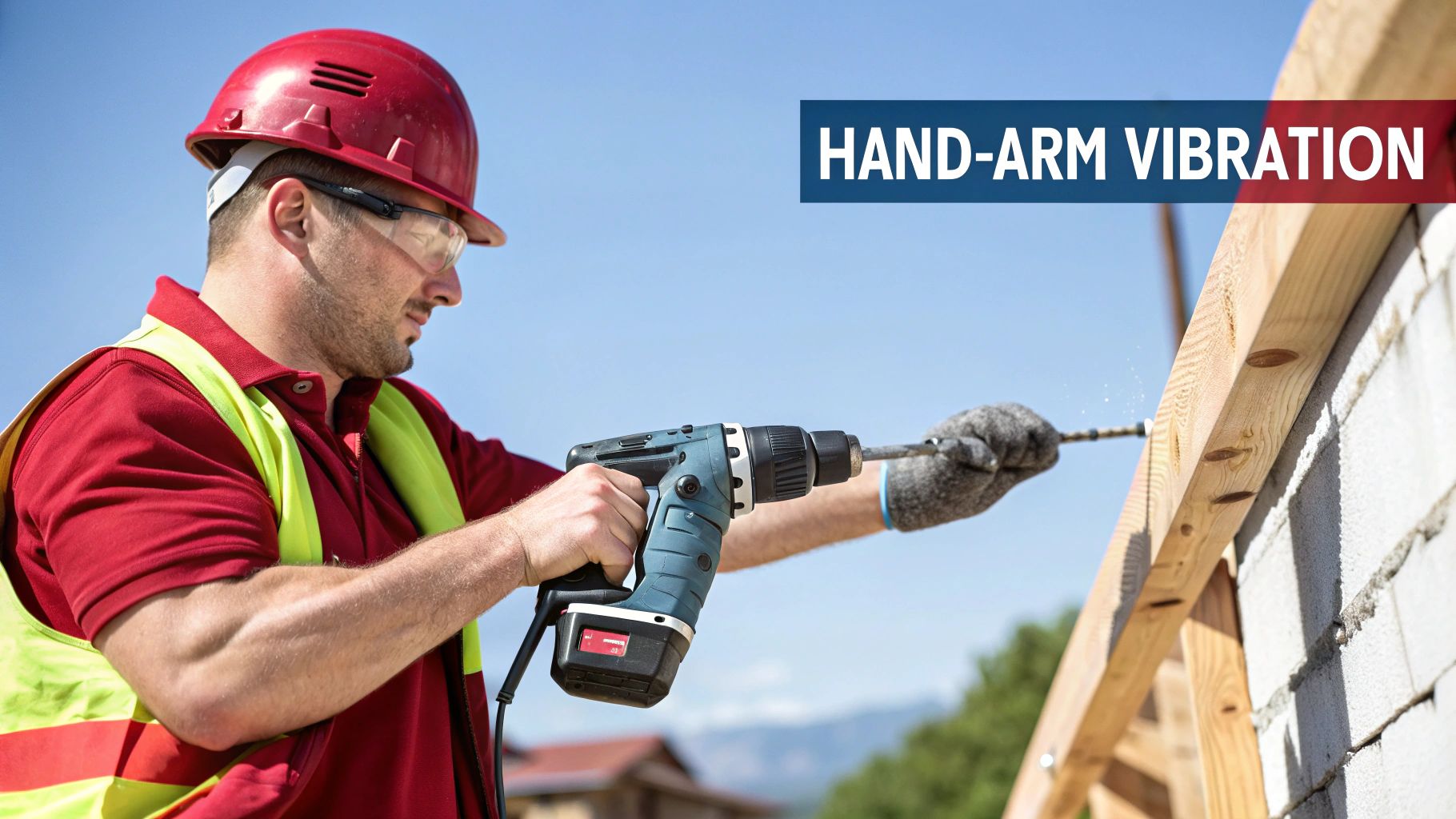
This process is far more than a procedural box-ticking exercise; it represents a core component of an employer's duty of care. Across Australia, workers in industries such as construction, mining, manufacturing, forestry, and grounds maintenance regularly use vibrating tools. Without proper risk management, the likelihood of these workers developing HAVS is significantly high, leading to life-altering health consequences and substantial business liabilities.
The True Cost of Neglecting Vibration Risks
The consequences of failing to properly assess and control hand-arm vibration are severe, impacting both the wellbeing of workers and the operational stability of a business. Ignoring this hazard can trigger a cascade of negative outcomes that extend far beyond minor physical discomfort.
- Permanent Worker Injury: HAVS manifests through a range of debilitating symptoms, including persistent numbness, constant pins and needles, a significantly weakened grip, and chronic pain. In advanced stages, the condition causes permanent damage to nerves and blood vessels, severely impairing a person's ability to perform not only their job but also simple everyday tasks.
- Reduced Productivity: It is challenging to maintain productivity when hand function is compromised. Workers suffering from HAVS often experience a loss of fine motor skills and grip strength, which can lead to slower work, an increase in errors, and a general decline in operational efficiency.
- Legal and Financial Penalties: Failure to manage workplace hazards like hand-arm vibration can result in substantial fines, legal proceedings, and a significant increase in workers' compensation claims. A robust assessment and control plan is the most effective defence against these legal and financial repercussions.
A thorough hand-arm vibration assessment is about more than just compliance. It’s a proactive investment in your team's wellbeing, protecting their long-term health and the stability of your business.
Ultimately, a professionally conducted hand-arm vibration assessment provides the objective data necessary to protect your workforce. It forms the foundation for creating a safe working environment, ensuring that the tools essential for business operations do not compromise the health of your most valuable asset: your employees. To gain a broader understanding of creating safe work environments, you can explore the fundamental principles of what is occupational hygiene in our detailed guide.
Getting to Grips with Vibration Exposure
Before a proper assessment of hand-arm vibration can be conducted, it is essential to understand the specific factors being measured. The concept can be likened to a daily 'dose'—there is a finite amount of vibration an employee can safely be exposed to before the risk of serious, long-term harm escalates dramatically.
This daily dose is not determined solely by the power of the tool. Instead, it is a combination of two critical factors that interact to define the overall risk. A comprehensive understanding of both is the first step in any effective assessment.
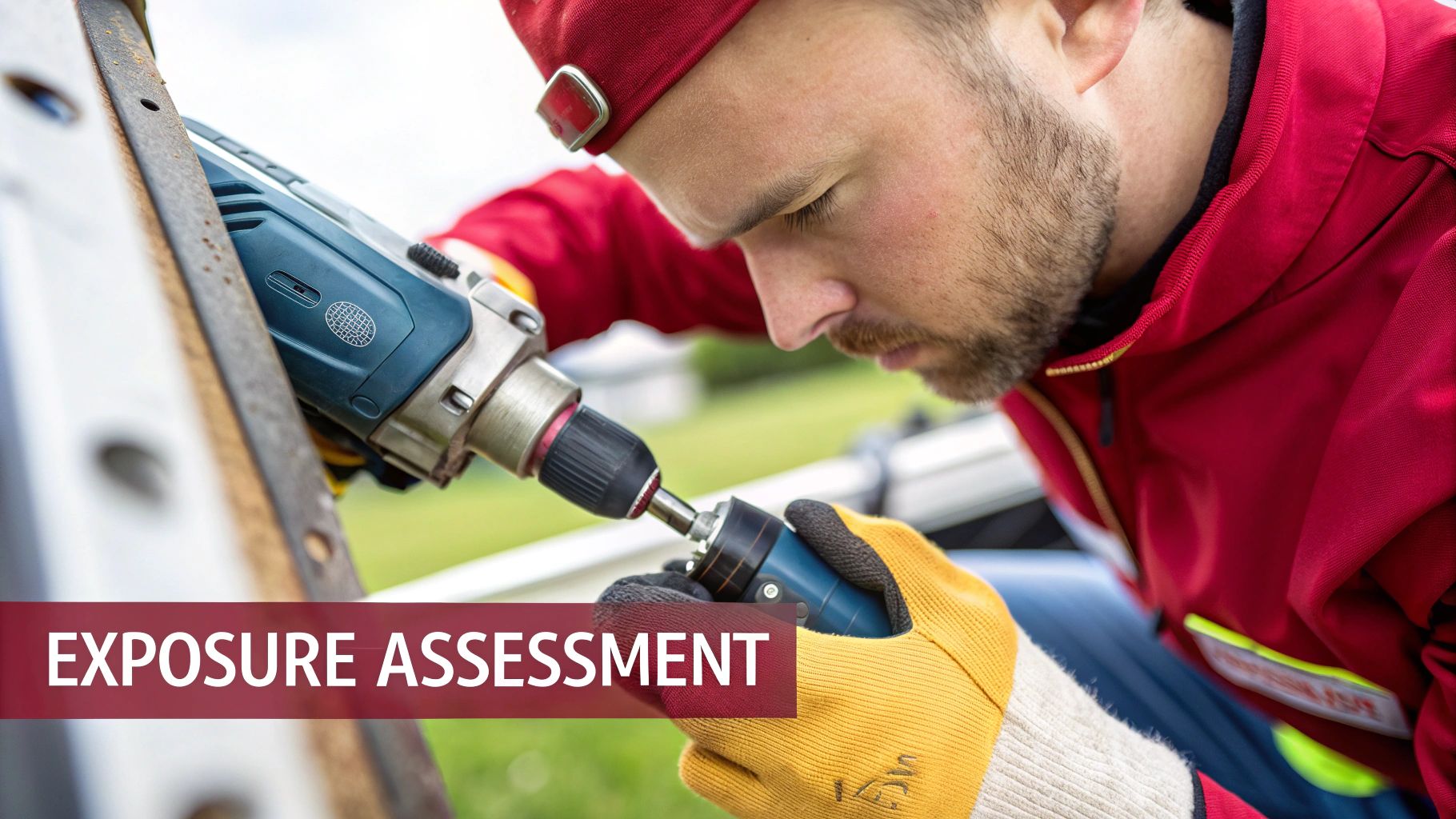
The Two Pillars of Vibration Exposure
Every single hand-arm vibration assessment fundamentally boils down to evaluating the interplay between these two components. They represent the core elements of the risk profile.
-
Vibration Magnitude: This is the intensity of the vibration, scientifically measured in metres per second squared (m/s²). To conceptualise this, consider the vast difference in shaking between a small orbital sander and a heavy-duty pneumatic breaker. The breaker's magnitude is significantly higher, transmitting a much greater amount of vibrational energy into the operator's hands and arms.
-
Exposure Duration: This refers to the total time an employee's hands are in contact with a vibrating tool during a workday. It is crucial to note that this is not the entire shift length but the cumulative 'trigger time'—the sum of all minutes and hours the tool is actively operating.
A tool with a very low vibration magnitude may be safe for extended use over several hours. Conversely, a high-magnitude tool could expose a worker to a hazardous level of vibration in just a few minutes, pushing them beyond safe limits very quickly.
Making Sense of It All with the A(8) Value
So, how are these two distinct factors—magnitude and duration—combined into a practical, usable metric? This is achieved through a standardised value known as the daily vibration exposure value, or A(8).
This single, powerful number integrates both the vibration magnitude and the exposure duration, normalising the total exposure over a standard eight-hour workday.
This standardisation is what makes the A(8) value so effective. It provides a level playing field, allowing for direct comparison of risks from entirely different tools, tasks, and work patterns. It offers a clear and consistent method for quantifying the daily 'dose' of vibration that workers are receiving.
In essence, the A(8) value answers one simple question: "What is this worker's total vibration dose for the day?" This single metric lets you easily check daily exposures against legal safety limits to see if action is needed.
However, a significant challenge for Australian workplaces is the inherent uncertainty in these measurements. Guidance from Safe Work Australia highlights that A(8) measurements can have uncertainties ranging from 20% above to 40% below the actual exposure. This range can widen even further if assessments rely on manufacturer-supplied data rather than direct, on-site measurements.
Capturing Vibration from Every Angle
Vibration is not a simple, unidirectional force. It is a complex, multi-directional phenomenon, with forces acting simultaneously in various directions, particularly from common sources like the power tools like drills and hammers found on any work site.
To obtain an accurate representation of this, a professional hand arm vibration assessment must employ a triaxial measurement system. This involves placing a sophisticated 3D sensor on the tool's handle to measure vibration along three distinct axes:
- X-axis: Side-to-side motion
- Y-axis: Forward-and-backward motion
- Z-axis: Up-and-down motion
By simultaneously measuring the magnitude on all three axes, an assessor can calculate a total vector sum, or total vibration value. This provides a complete and realistic picture of the energy being transferred into the worker's body. An assessment that fails to measure all three axes will be incomplete and could dangerously underestimate the true hazard.
Making Sense of Australian Regulations and Global Standards
For many employers in Australia, navigating the specific legal requirements for Hand-Arm Vibration (HAV) can be confusing. The primary reason for this is that Australia does not currently have its own specific, nationwide exposure limits formally written into the Work Health and Safety (WHS) legislation.
However, this absence of a specific number should not be mistaken for an absence of responsibility. An employer's duty of care under WHS law is unequivocal: you must identify hazards, assess the associated risks, and implement effective controls to ensure worker safety. In the context of HAV, this means there is a legal obligation to manage the risk, even without a specific Australian standard to reference.

This raises a critical question: if there is no local limit, what does a 'safe' level of exposure look like? How can a business demonstrate that it is taking all reasonably practicable steps to protect its team? Fortunately, global best practices provide a clear, evidence-based, and defensible roadmap.
Why We Look to Europe for Guidance
In the absence of domestic regulations, Australian industries have widely adopted the robust and well-established framework used across Europe as a reliable benchmark. The European Union's Control of Vibration at Work Regulations 2005, which originates from Directive 2002/44/EC, offers a logical, data-driven methodology for managing HAV risks.
This standard is not an arbitrary set of numbers. It provides two crucial thresholds that form the foundation of any effective hand arm vibration assessment and control program. These values are scientifically grounded, directly linked to specific levels of risk, and trigger clear and specific employer actions.
By adopting this globally recognised standard, businesses can build their safety procedures around a practical and proven framework. It helps define clear safety objectives and establishes a definitive line for when intervention is required. This approach is a critical part of upholding the duty of care and aligning with the principles of Australian workplace safety standards.
The Two Key Numbers You Need to Know
The European directive is effectively summarised by two key values. Both are measured as a daily exposure level, expressed as A(8). Understanding the meaning of each value—and the actions it mandates—is fundamental to managing HAV risk.
-
The Exposure Action Value (EAV)
- This is set at 2.5 m/s² A(8).
- The EAV should be viewed as the initial warning flag. It represents the point at which the risk of harm becomes significant, and employers are legally required to begin implementing control measures to reduce exposure.
- Reaching this value does not necessitate stopping work, but it does activate a specific set of management responsibilities.
-
The Exposure Limit Value (ELV)
- This is set at 5.0 m/s² A(8).
- The ELV is the absolute, non-negotiable daily maximum. Under no circumstances should a worker’s exposure exceed this level.
- It acts as a hard ceiling designed to prevent extreme, short-term overexposures that can cause rapid and severe damage.
This two-tiered system is both logical and practical. The EAV serves as a proactive trigger for risk management before the situation becomes critical, while the ELV provides a firm upper limit to guarantee worker safety.
To clarify, the following table breaks down the European benchmarks that have become the de facto standard for good practice in Australia.
International HAVS Exposure Benchmarks (EU Directive 2002/44/EC)
This table summarises the key exposure values and the required employer actions, often used as a benchmark in Australia.
| Value Type | Exposure Level (A(8)) | Required Employer Action |
|---|---|---|
| Exposure Action Value (EAV) | 2.5 m/s² | Implement a control program (e.g., low-vibration tools, job rotation) and provide health surveillance for at-risk employees. |
| Exposure Limit Value (ELV) | 5.0 m/s² | Immediately reduce exposure to below the limit. Identify the cause and implement preventative measures to stop it from happening again. |
Following this framework provides a clear, actionable, and defensible safety plan for managing HAV risks in any Australian workplace.
What to Do When You Hit These Values
The significance of these values lies not just in the numbers themselves, but in the specific actions they trigger. A well-executed hand arm vibration assessment will precisely identify where your workers' exposure levels fall, thereby dictating the necessary next steps.
If an assessment indicates that exposure is likely to exceed the Exposure Action Value (EAV) of 2.5 m/s², you are required to:
- Roll out a Control Program: This involves introducing practical measures to reduce vibration exposure to a level as low as is reasonably practicable. This may include adopting different work methods, sourcing superior low-vibration tools, or implementing job rotation schedules.
- Provide Health Surveillance: Offer regular, structured health checks to all at-risk employees. This is essential for detecting the early signs of HAVS and intervening before the condition progresses.
- Inform and Train Your People: Ensure that workers fully understand the risks of HAV, are trained on the control measures in place, and feel empowered to report any symptoms they experience.
If exposure ever exceeds the Exposure Limit Value (ELV) of 5.0 m/s², you must:
- Take Immediate Action: The primary responsibility is to reduce the worker's exposure to below the limit immediately.
- Find Out Why: A thorough investigation must be conducted to determine the cause of the overexposure, and robust measures must be implemented to prevent any recurrence.
How to Conduct a Practical Hand Arm Vibration Assessment
How does one transition from understanding the theory and regulations to actually assessing the risks faced by workers? A comprehensive hand-arm vibration assessment is a systematic process, typically beginning with a preliminary estimate and progressing to precise, on-site measurements for a definitive evaluation.
The initial step often involves reviewing the vibration data provided by the tool manufacturer, which is usually found in the instruction manual or on their website. While this serves as a useful starting point for an initial screening, it is vital to recognise its limitations.
Manufacturer data is collected under ideal laboratory conditions. It does not account for the real-world variables of a worksite, such as the age and condition of the tool, the specific material being worked on, operator technique, or environmental factors. Consequently, manufacturer data should only be used for a preliminary risk screening, not as the basis for a final assessment.
Moving to Accurate On-Site Measurement
For a truly reliable and defensible hand-arm vibration assessment, it is imperative to conduct direct measurements on-site, where the work is actually performed. This is the only method to capture the true exposure levels that employees experience on a daily basis.
This process involves using specialised equipment designed to measure the complex, triaxial forces at play. It ensures that the assessment is based on concrete, real-world evidence rather than an idealised figure from a laboratory report.
The core of this process relies on specific sensors and monitors that gather live data. The two main types of equipment used are:
- Accelerometers: These are compact sensors that are securely attached directly to the handle or body of a power tool. They measure the tool's vibration intensity in real-time across three axes (x, y, and z), providing a complete and accurate picture of its movement.
- Personal Vibration Dosimeters: These are modern, wearable devices that an employee can wear on their wrist or body. They continuously log vibration exposure throughout the entire workday, delivering incredibly detailed data that helps identify which specific tasks contribute most to a person's total daily dose.
This visual provides an excellent breakdown of the fundamental steps involved in a direct measurement assessment.
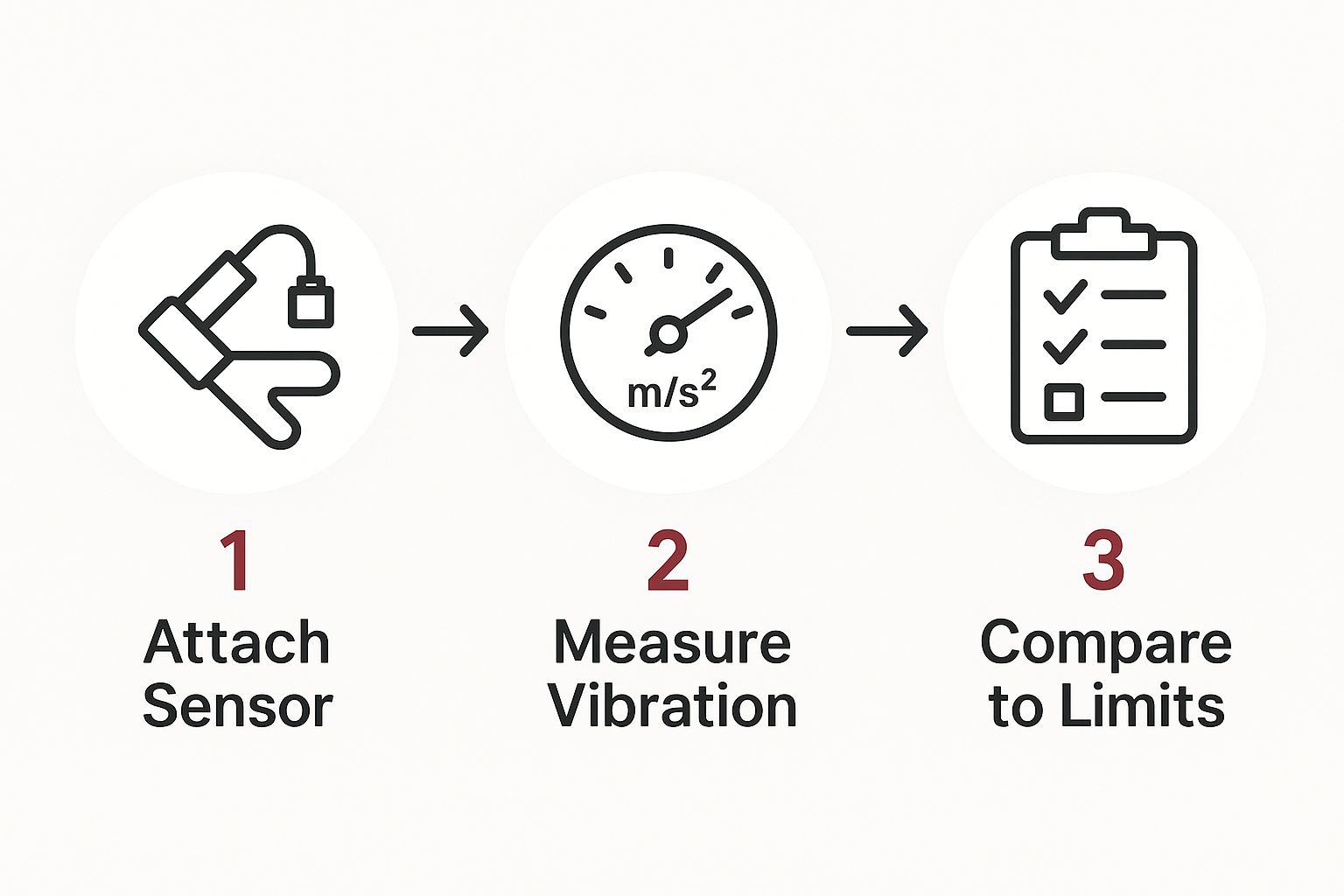
As the infographic illustrates, a practical assessment involves attaching a sensor, taking a precise measurement while the tool is in normal use, and then comparing that real-world data against established safety limits to determine the level of risk.
Gathering Reliable Data in the Real World
The primary objective of direct measurement is to capture an accurate snapshot of a typical workday. This should not be a staged event. Measurements must be taken while employees are performing their routine tasks to ensure the data accurately reflects real-world operational conditions.
In Australia, it is estimated that approximately 3.8% of the workforce is exposed to hand-arm vibration levels that exceed safe thresholds. Modern instruments like the SV 103 Personal Human Vibration Exposure Meter, which workers wear on the job, are invaluable for this type of assessment. These devices provide detailed data on vibration across all three axes of movement, helping to pinpoint high-risk activities and verify the effectiveness of control measures.
It is important to remember that two workers using the exact same tool can experience vastly different vibration exposures. Factors such as their individual technique, grip strength, and the tool's maintenance history can significantly influence the final reading.
Combining Technical Data with Human Insights
While technical measurements form the backbone of a robust hand-arm vibration assessment, the numbers alone do not tell the complete story. To gain a truly comprehensive understanding, this quantitative data must be supplemented with qualitative insights gathered directly from the workforce.
This is accomplished through two simple yet crucial activities:
- Observing Work Practices: Spend time observing how employees use their tools. Note whether they are applying excessive force, holding the tool at an awkward angle, or using it for purposes it was not designed for. These observations provide critical context that can explain unexpectedly high vibration readings.
- Interviewing Employees: Engage in direct conversation with your team. Ask them about the duration they use each tool on an average day (their ‘trigger time’) and whether they experience symptoms such as tingling, numbness, or discomfort. Their firsthand accounts are an indispensable piece of the risk assessment puzzle.
By combining precise instrumental data with on-the-ground observations and genuine employee feedback, a holistic and accurate picture of your HAV risk can be created. This comprehensive approach is the foundation for developing control measures that are truly effective. If the data reveals complex exposure patterns, engaging professional occupational hygiene consultants can provide the expert analysis required to properly interpret the results and formulate a targeted safety plan.
So, You've Done Your Assessment. Now What? Putting Controls in Place
A thorough hand-arm vibration assessment is an excellent starting point, but the real work begins when you act on its findings. Simply identifying a problem is not the same as solving it. The objective is to systematically reduce the risk, and the most effective method for this is the hierarchy of controls.
This is a step-by-step approach that prioritises the most effective and reliable solutions first. Imagine building a fortress to protect your workers: you begin with the strongest, highest walls before considering a moat or posting a guard. Relying on a single, weaker defence leaves everyone vulnerable.
Start at the Top: Can You Eliminate or Substitute the Risk?
The most powerful way to manage any hazard is to eliminate it completely. This is elimination, and while it may not always be feasible, it should always be the first question asked.
For example, instead of a worker using a hand-held concrete breaker for an extended period, could a small, remote-controlled demolition robot perform the task? Or could a metal component be cast into its final shape, thereby eliminating the need for grinding with a vibrating tool? Such solutions design the vibration risk out of the process entirely.
If elimination is not possible, the next most effective control is substitution. This involves replacing a high-vibration tool or process with a lower-vibration alternative that achieves the same outcome.
- Modernise Your Toolkit: Implement a policy to research and invest in modern, low-vibration tools. Many manufacturers now design equipment with integrated dampening systems specifically to reduce vibration.
- Change the Process: Could a hydraulic press be used to install a component instead of a rattling pneumatic impact wrench? Sometimes, adopting a different method can significantly reduce vibration levels.
A smart purchasing policy is one of the most effective controls you can have. When you make low vibration a non-negotiable criterion for buying new tools, you steadily improve safety over time without needing a massive, costly overhaul.
Bolster Your Defences with Engineering Controls
When elimination and substitution are not viable options, the focus shifts to physically modifying the equipment or the work environment. These are known as engineering controls, and they create a physical barrier between the worker and the source of vibration.
A key advantage of engineering controls is that they are not dependent on human behaviour—they are built directly into the system.
Practical examples include:
- Anti-Vibration Mounts: Adding specialised rubber mounts to a bench grinder can prevent vibration from travelling through the workbench and into the operator’s hands and arms.
- Better Tool Handles: Many tools can be retrofitted with specially designed anti-vibration handles that absorb a significant portion of the energy before it reaches the person holding it.
- A Solid Maintenance Schedule: A poorly maintained tool vibrates more. This is a fact. A strict maintenance program that includes sharpening blades, balancing moving parts, and replacing worn-out components is a crucial engineering control. It ensures tools operate as the manufacturer intended, minimising excess vibration.
Managing Exposure with Administrative Controls
Next in the hierarchy are administrative controls. These measures do not reduce the vibration itself but instead alter how and when people work to limit their total exposure. This is where the data from your assessment becomes particularly valuable.
Common administrative strategies include:
- Job Rotation: Avoid assigning one person to a high-vibration task for an entire day. Develop a schedule that rotates workers between high-vibration and low-vibration activities. This distributes the exposure and helps prevent any single employee from reaching dangerous levels.
- Mandatory Breaks: Enforce scheduled breaks away from vibrating tools. This is not about reducing productivity; it is about providing the body with crucial time to recover and mitigating cumulative damage.
- Clear Information and Training: Ensure every worker understands the risks of HAVS, knows how to operate tools correctly to minimise vibration, and feels comfortable reporting early symptoms without fear of reprisal. Modern approaches using augmented reality for training your workforce can make these safety procedures much clearer and more effective.
The Final Layer: Personal Protective Equipment (PPE)
At the very bottom of the hierarchy—representing the last line of defence—is Personal Protective Equipment (PPE), such as anti-vibration gloves. It is absolutely critical to understand that PPE is the least effective control and should never be used as the primary solution.
Anti-vibration gloves can create a false sense of security. Their protective capability is limited, particularly against the low-frequency vibrations that cause the most damage to nerves and blood vessels. They should only ever be used to supplement the more effective controls already in place.
By systematically working down this hierarchy, you can build a resilient and multi-layered safety system. This approach allows you to effectively manage the risks identified in your hand-arm vibration assessment and genuinely protect the long-term health and wellbeing of your team.
Common Questions About Hand-Arm Vibration Assessments
When addressing the issue of hand-arm vibration, several practical questions frequently arise. Here are some of the most common inquiries from safety managers and employers, with clear answers to help you develop a robust safety plan.
How Often Do We Need to Do an Assessment?
An initial assessment is essential as soon as workers begin using vibrating tools. However, this is not a one-time "set and forget" exercise. Your assessment is a dynamic document that must accurately reflect current workplace conditions.
As a general rule, a formal review of the assessment should be conducted at least every two years. More importantly, it must be revisited immediately if any significant changes occur.
Such changes include:
- Introducing new power tools with different vibration characteristics.
- Altering work patterns, which could result in increased daily exposure times for some workers.
- An employee reporting symptoms consistent with Hand-Arm Vibration Syndrome (HAVS).
Regular reviews are the only way to ensure that your safety measures remain effective and relevant.
Can We Just Use the Manufacturer's Vibration Data?
Using the vibration data provided by a tool's manufacturer can be a reasonable starting point. It is useful for a quick, initial screening to identify which tools are likely to pose the greatest risk. However, this information must be treated with caution.
Manufacturer data is collected in a controlled, ideal laboratory setting. It does not account for the realities of a dynamic worksite, where factors like the following can significantly alter vibration levels:
- The age of the tool and its maintenance history.
- The material being worked on (e.g., drilling into reinforced concrete versus soft pine).
- The individual operator's technique and grip.
Therefore, for any task where a genuine risk is identified, relying solely on manufacturer data is inadequate. The only way to obtain a true and accurate picture of your team's exposure is through direct, on-site measurement.
Are Anti-Vibration Gloves Enough to Control the Risk?
Anti-vibration gloves should be considered the last line of defence, not the primary solution. Their ability to protect workers is often limited, especially against the low-frequency vibrations that are most damaging to nerves and blood vessels.
Relying solely on anti-vibration gloves can give everyone a false sense of security. It’s absolutely essential to focus on better controls first, like swapping out a high-vibration tool for a better one or rotating jobs to limit exposure time.
While these gloves can provide some benefit by keeping hands warm and dry, which supports good circulation, they are never an acceptable substitute for a comprehensive risk control strategy based on the hierarchy of controls.
When Do We Need to Start Health Surveillance?
Health surveillance is a formal program of health checks conducted by a qualified medical professional. It becomes a mandatory requirement once your hand-arm vibration assessment indicates that employees are regularly exposed at or above the Exposure Action Value of 2.5 m/s² A(8).
The purpose of health surveillance is twofold. Firstly, it helps to detect the early signs and symptoms of HAVS, allowing for timely intervention before serious or permanent damage occurs. Secondly, it serves as a critical feedback mechanism, helping to verify whether the control measures you have implemented are effectively protecting your workforce.


