
Think of an occupational hygiene consultant as a kind of workplace health detective. Their job is to get ahead of potential health hazards, figuring out what could harm employees long before it ever has the chance. It’s a scientific field, focused on anticipating, recognising, evaluating, and controlling all sorts of risks, from chemical exposures to dangerous noise levels.
Decoding the Role of Workplace Health Detectives
Picture your workplace as a complex ecosystem. You might have a safety officer who makes sure everyone follows the obvious rules, like wearing hard hats or using safety guards on machinery. An occupational hygiene consultant, on the other hand, investigates the invisible threats—the subtle dangers that can lead to long-term illness or serious injury down the track.
While the discipline itself can seem complex, its goal is straightforward: protect the health of your workers. Instead of just reacting after an incident happens, these specialists are all about prevention. They use precise scientific measurement and analysis to truly understand the risks hiding in plain sight.
The Proactive Approach to Health and Safety
At the heart of their work is a four-step process: anticipate, recognise, evaluate, and control (AREC). This isn’t just about ticking boxes for compliance; it’s about building a genuinely safe culture. Here’s what that looks like in practice:
- Anticipating Hazards: Before a new process is rolled out or a new chemical is brought on-site, a consultant looks into the future. They predict the potential health risks, which means safety measures can be built right into the system from day one.
- Recognising Existing Risks: They’ll walk through your site, carrying out detailed assessments to pinpoint hazards you might have missed. It could be anything from poor ventilation in a workshop to the ergonomic strain on workers at a packing station.
- Evaluating Exposure Levels: This is where the science really comes in. Using specialised equipment, they measure exactly what your employees are being exposed to. It’s not guesswork. They gather hard data on noise levels, air quality, chemical concentrations, and more.
- Controlling the Dangers: Armed with that data, they develop practical, effective control strategies. These solutions could be major engineering fixes like installing new exhaust systems, or simpler administrative changes like rotating staff through different tasks.
This methodical approach ensures every decision is backed by solid evidence, not just assumptions. When you understand what an occupational hygienist does, you can shift your business from a reactive safety posture to a proactive, health-first strategy.
An occupational hygiene consultant provides the scientific backbone for your Work Health and Safety (WHS) program, turning abstract risks into measurable data and actionable solutions. Their expertise is crucial for preventing occupational diseases, not just workplace accidents.
In Australia, the Australian Institute of Occupational Hygienists (AIOH) is the key professional body for the field. Established in 1980, the AIOH now has over 1,000 members dedicated to protecting worker health across the country. They are instrumental in shaping government policy and championing the importance of creating healthier work environments for everyone.
What An Occupational Hygiene Consultant Actually Does For You
Think of an occupational hygiene consultant as a detective for workplace health. They offer a highly specialised set of services that go far beyond a standard safety check-up, using science to pinpoint and control hidden health hazards in your workplace. Their work is built on three key pillars: rigorous assessment, precise monitoring, and practical, hands-on education.
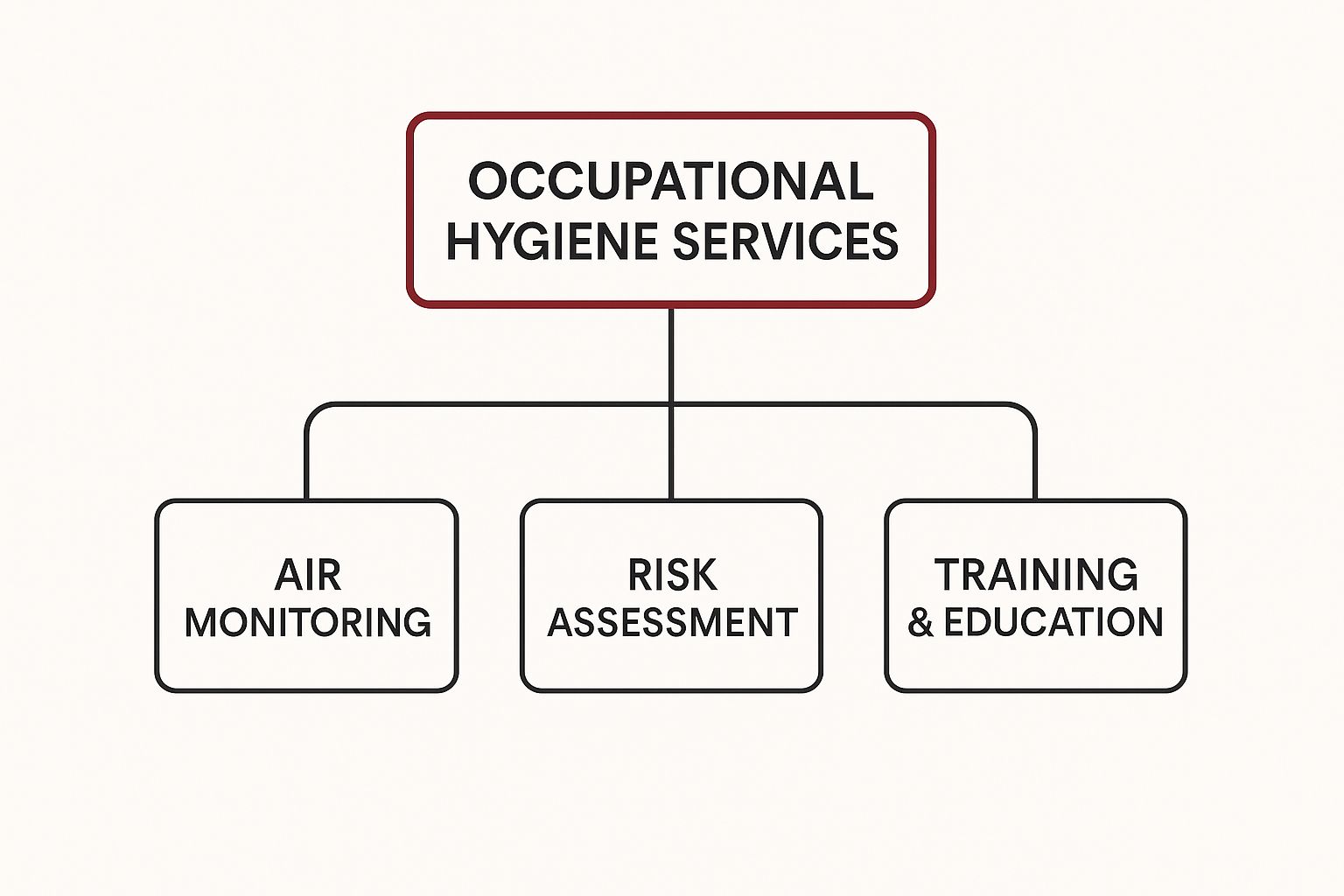
This process isn’t just about ticking boxes; it’s about creating a genuinely healthy work environment from the ground up, based on solid data and expert insight.
Health Risk Assessments: The Foundational Blueprint
Before you can fix a problem, you have to understand it inside and out. That’s why the first step is almost always a comprehensive Health Risk Assessment (HRA). This isn’t a quick walk-through with a clipboard; it’s a deep dive into your specific operations, materials, and day-to-day work practices. It’s about building a strategic map of your workplace’s unique health landscape.
Imagine a workshop that fabricates stone benchtops. An experienced consultant would immediately zero in on the use of engineered stone, flagging the high risk of exposure to respirable crystalline silica (RCS). They would then meticulously analyse every part of the process—from the initial cutting and grinding to the final polishing and clean-up—to identify exactly when and where workers are most exposed. This foundational assessment is what gives you the critical data to make informed decisions.
Specialised Monitoring: Making The Invisible, Visible
Once potential risks are on the radar, the next step is to measure them. This is where the science really comes into play. Occupational hygiene consultants use precise, calibrated equipment to quantify exposure levels, taking all the guesswork out of your safety management. They turn abstract dangers into hard numbers, comparing them directly against Australian legal standards.
To give you a clearer picture, here is a breakdown of some of the most common services they provide and the specific problems they solve.
Key Occupational Hygiene Services and Their Purpose
| Service Area | Hazard Addressed | Example Application |
|---|---|---|
| Airborne Contaminant Monitoring | Dust, fumes, vapours, gases (e.g., silica, asbestos, welding fumes, solvents) | Attaching personal air pumps to a welder for their full shift to measure their exact exposure to harmful fumes. |
| Noise Exposure Surveys | Excessive noise leading to permanent hearing damage. | Using dosimeters on factory floor workers to map noise hotspots and measure individual daily noise doses. |
| Chemical Hazard Management | Improper storage, handling, or use of hazardous chemicals. | Assessing a cleaning company’s chemical inventory to ensure correct handling procedures and controls are in place. |
| Vibration Assessment | Hand-Arm Vibration (HAV) or Whole-Body Vibration (WBV) from power tools and heavy machinery. | Measuring the vibration levels from a jackhammer to determine safe usage times for construction workers. |
| Thermal Stress Monitoring | Heat or cold stress in demanding environments. | Monitoring workers in a foundry or a commercial freezer to prevent heat stroke or hypothermia. |
These services are vital for protecting your team. For example, ensuring clean air is a massive part of a consultant’s job, and you can explore some of the solutions they might recommend by reading about the various https://occhygiene.com.au/methods-for-improving-indoor-air-quality/.
By transforming invisible threats into concrete numbers, occupational hygiene consultants provide undeniable evidence of risk. This objective data empowers businesses to invest in the right controls, protecting both their employees and their legal standing.
Practical Controls And Training: Turning Data Into Action
Great data is useless if it just sits in a report. A key part of a consultant’s job is to translate those findings into a practical action plan. They don’t just point out problems; they give you a clear, prioritised roadmap with solutions that are tailored to your specific operations and budget.
This roadmap is often built around the Hierarchy of Controls, a framework that prioritises the most effective solutions first:
- Elimination: Can we get rid of the hazardous process or substance completely?
- Substitution: Can we swap it out for a safer alternative?
- Engineering Controls: Can we install physical barriers, like better ventilation or machine guards, to isolate the hazard?
- Administrative Controls: Can we change work practices, like rotating staff or limiting time on a task, to reduce exposure?
- Personal Protective Equipment (PPE): As the last line of defence, what specific gear is needed to protect workers?
Finally, a good consultant ensures these changes stick by providing targeted training for everyone, from management to the shop floor. This empowers your whole team to understand the risks, use the new controls properly, and actively contribute to a safer culture. Staying compliant with legal standards is a non-negotiable part of this process, a topic covered well in this A Guide to Workplace Safety Regulations. With the right guidance, safety stops being a policy on a shelf and becomes a core part of how you do business every single day.
Why Investing in Hygiene Consultants Makes Business Sense
Bringing in an occupational hygiene consultant isn’t just another line item on the safety budget; it’s a savvy business move that delivers a clear and significant return. When you shift your thinking from simply ticking compliance boxes to proactively managing workplace health, you’re actually strengthening your company’s financial footing, operational efficiency, and long-term reputation.
Look at the big picture. The cost of getting expert advice is a drop in the ocean compared to the immense, and often hidden, costs of doing nothing.

This investment pays you back in three crucial ways. It shores up your legal standing, slashes direct financial losses, and ultimately fosters a more focused and productive team. Each of these benefits builds on the last, creating a stronger, healthier, and more profitable business from the ground up.
Fortifying Your Legal and Financial Defences
The most direct payoff is staying on the right side of the law. Australia’s Work Health and Safety (WHS) regulations are a complex beast, and the penalties for getting it wrong are genuinely staggering. Fines for breaches, especially those involving nasties like silica dust or asbestos, can soar into the hundreds of thousands of dollars, not to mention the very real risk of prosecution.
Think of an occupational hygiene consultant as your expert guide through this regulatory maze. They ensure your operations don’t just meet but exceed legal standards. Their scientific monitoring and meticulous reports give you the hard evidence needed to prove you’ve done your due diligence, acting as a powerful shield against crippling legal and financial blows.
But it goes beyond just avoiding fines. There are plenty of other direct costs that an expert can help you minimise:
- Workers’ Compensation Claims: By getting ahead of health hazards, you naturally see fewer—and less severe—claims. This directly leads to lower insurance premiums over time.
- Absenteeism and Sick Leave: It’s simple: a healthier workplace means fewer people calling in sick. Chronic exposure to even low-level contaminants can cause respiratory problems and other illnesses that keep your people at home.
- Staff Turnover: Nobody wants to work in a high-risk environment. Investing in your team’s health and safety shows you value them, which boosts morale and helps you keep good people, cutting down on the endless cycle of recruitment and training costs.
Boosting Productivity and Operational Excellence
A healthy workforce is a productive workforce. It’s just that simple. When your employees aren’t worried about excessive noise, poor air quality, or physical strain, they can put all their focus on the job at hand. This translates directly into fewer mistakes, higher quality work, and better efficiency across the board. The link is undeniable.
It’s a bit like maintaining a high-performance engine. You wouldn’t run your most valuable machinery into the ground; you service it to prevent breakdowns and ensure it runs at its best. Investing in the health of your work environment does the same for your people. A consultant can pinpoint subtle stressors—things like poor lighting, stuffy air, or ergonomic issues—that you might not even notice but which are quietly draining productivity every single day.
Investing in occupational hygiene isn’t just about dodging negatives; it’s about creating positives. A safe, healthy environment is a direct contributor to your bottom line through improved morale, heightened focus, and greater operational efficiency.
Case Study: A Manufacturing Firm’s Smart Investment
Let’s look at a real-world example. A mid-sized metal fabrication company in regional Australia was seeing a frustrating increase in minor injuries from manual handling and repetitive tasks. Unsurprisingly, their workers’ comp premiums were also on the rise. They decided to bring in occupational hygiene consultants to carry out a full ergonomic risk assessment of their production line.
The consultants didn’t just walk through and make notes; they used specialised tools to measure the physical demands of each role. They quickly identified several high-risk tasks that were putting significant strain on workers’ backs and shoulders.
Based on these concrete findings, the firm made a few targeted changes:
- Engineering Controls: They installed adjustable workbenches and some simple mechanical lifting aids at the worst choke points on the line.
- Administrative Controls: They introduced a job rotation system so no single worker was stuck doing the same high-strain task all shift long.
- Targeted Training: The consultant delivered practical, hands-on training for all staff on proper lifting techniques and body mechanics.
The results within a year were impressive. Musculoskeletal injury claims plummeted by over 60%, and their insurance provider reduced their premiums at the next review. The bonus? Absenteeism dropped, and production output actually went up. The initial investment paid for itself in under 18 months and bolstered their reputation as an employer who cares, making it far easier to attract skilled workers.
Overcoming Modern Workplace Health Challenges
For all the progress we’ve made, the modern workplace is still rife with complex and often invisible health hazards. An occupational hygiene consultant doesn’t just deal with the obvious dangers of the past; they’re on the front line tackling the evolving risks of today. Think subtle chemical exposures in a high-tech lab or the ever-present dangers on a busy construction site.
This relationship is much deeper than a simple compliance check. It’s a true partnership. It involves navigating tough conversations, justifying essential spending, and championing a safety culture that becomes part of the company’s DNA, from the top down. Consultants are often the critical link between what science tells us is safe and what a business sees as practical.
The Battle Against Invisible Killers Like Silica Dust
One of the most urgent threats in Australia right now is exposure to respirable crystalline silica (RCS). This microscopic dust, kicked up when cutting materials like stone, concrete, or brick, is a serious menace, especially for those in construction and stonemasonry. It’s a silent hazard that can lead to devastating and fatal lung diseases.
This is where an experienced consultant really shows their value. They don’t just take an air sample and call it a day. They dive deep into the entire workflow to pinpoint exactly where and when exposure levels spike. From there, they develop practical control strategies—maybe it’s recommending specific on-tool dust extractors, or advising on wet-cutting techniques that stop the dust before it ever gets airborne.
Effective hygiene management is a strategic collaboration. It requires a consultant who can not only identify the scientific risks but also successfully advocate for the practical solutions needed to protect workers, even when faced with resistance.
Navigating Budget and Buy-In Hurdles
Getting these controls in place often hits two major walls: getting management on board and securing the budget. This is where a consultant’s expertise becomes indispensable. They can build a powerful business case that reframes safety not as a cost, but as a crucial investment in your people, your productivity, and your legal protection.
In Australia, occupational hygiene consultants play a vital role in tackling risks like RCS, which impacts over 300,000 workers in the construction sector alone. Research consistently shows that a lack of management commitment and tight budgets are the biggest roadblocks to implementing effective safety measures. You can read more about overcoming these workplace safety barriers from PMC.
Fostering a Proactive Safety Culture
At the end of the day, tackling modern health challenges requires more than just new gear; it requires a fundamental shift in attitude. A good consultant is a catalyst for building this proactive safety culture. They bring the hard data and expert guidance that gets everyone, from the boardroom to the workshop floor, pulling in the same direction.
This also means looking at other factors that affect employee wellbeing. For example, things like air quality and temperature, often overlooked, are critical. This article on how HVAC maintenance can impact employee comfort and productivity explores this connection further. By finding practical, cost-effective solutions and clearly explaining the why behind them, consultants help weave health and safety into the very fabric of the business, turning it from a chore into a shared value.
How to Choose the Right Hygiene Consultant
Picking the right occupational hygiene consultant is a huge decision. It directly affects the health of your team and your company’s legal standing. This isn’t just about ticking a box; it’s about finding the right expert for your unique workplace. To get it right, you need a clear, methodical approach to make sure you find a professional with the skills and experience to tackle your specific challenges.
Think of it like hiring a specialist doctor. You wouldn’t see a heart surgeon for a broken leg. In the same way, you need a consultant whose expertise lines up perfectly with your industry’s risks, whether that’s chemical exposure in a manufacturing plant or noise hazards on a construction site.
Defining Your Scope of Work
Before you even think about looking for consultants, your first job is to nail down exactly what you need. A vague brief only gets you generic, unhelpful proposals. You need to map out a detailed scope of work that clearly states your goals, the hazards you know or suspect are present, and what a successful outcome looks like to you.
Is your main goal to comply with new silica dust regulations? Or maybe you need a complete noise survey across the entire factory floor? The more specific you are, the better. This clarity not only helps you find the right specialist but also ensures potential consultants can give you an accurate and relevant quote.
A solid scope of work should cover:
- The specific workplace areas or processes that need assessing.
- The known hazards you want looked at (e.g., certain chemicals, noise levels).
- Your desired outcomes, like a risk assessment report, a compliance audit, or a new safety program.
- Any deadlines or operational constraints they need to work around.
Verifying Credentials and Experience
Once you’ve got a clear scope, it’s time to vet the candidates. In Australia, certain qualifications and memberships are non-negotiable indicators of a consultant’s competence and commitment to professional standards. Don’t be shy about asking for proof of their credentials; a real professional will have them ready.
Keep an eye out for these key markers of expertise:
- Certified Occupational Hygienist (COH): This is the gold standard certification from the Australian Institute of Occupational Hygienists (AIOH). It means the consultant has met tough academic and hands-on experience requirements and is committed to staying current.
- Membership in the AIOH: Being an AIOH member shows a consultant is actively involved in their professional community and stays up-to-date with the latest industry knowledge and ethics.
- Relevant Industry Experience: Always ask for case studies or references from businesses in your field. A consultant who has spent years in the mining industry will have a far deeper grasp of its specific risks than someone whose background is mostly in office ergonomics.
Choosing a consultant is a partnership, not just a transaction. Look for someone who is not only technically brilliant but also an excellent communicator—someone who can explain complex scientific data in a way your team can actually understand and act on.
Critical Questions to Ask Potential Consultants
With a shortlist of qualified people, it’s time to dig a little deeper with some structured interviews. The questions you ask should go beyond their CV and get into their methods, communication style, and how they approach problems. This is your chance to see how they think and if their style will mesh with your company culture. To get a better handle on what they do day-to-day, you can explore the role of occupational hygienists in promoting workplace safety in our detailed guide.
Here’s a checklist of questions to help guide the conversation:
- Problem-Solving Methodology: “Can you walk me through your typical process for a risk assessment, from the first site visit to the final report?”
- Industry-Specific Experience: “What’s your experience with [your specific hazard, e.g., welding fumes, lead exposure] in a [your industry] setting?”
- Reporting Style: “What does your final report look like? Does it give us a clear executive summary and a prioritised list of actions we can take?”
- Communication and Training: “How do you explain your findings to different people, from the board of directors to the workers on the floor?”
- Ongoing Support: “Do you offer support after the project is done to help us put your recommendations into practice?”
By following this structured approach—defining your needs, checking credentials, and asking the right questions—you can confidently choose the right occupational hygiene consultants to become a trusted partner in protecting your most valuable asset: your people.
Where it All Began: Australia’s Hygiene Pioneers
Occupational hygiene isn’t some new-age concept. It’s a serious, scientific discipline that’s been built over decades by dedicated experts committed to keeping people safe at work. Here in Australia, the entire field rests on the shoulders of pioneers who laid the groundwork for the standards and professional training we rely on today.
Understanding this history is key. It helps you appreciate the sheer depth of knowledge that goes into a modern hygiene assessment. The profession wasn’t born in a boardroom; it was forged by scientists and academics who witnessed the terrible toll of workplace hazards and knew there had to be a better, more systematic way to prevent them.
From Theory to Practice: Building a Safer Australia
In the early days, the challenge was massive. It wasn’t just about identifying hazards; it was about building the entire infrastructure to train specialists and create a legitimate profession. These pioneers were the ones who developed Australia’s very first occupational exposure limits—the scientific benchmarks that tell us what a “safe” level of a contaminant actually is.
They didn’t just write a rulebook. They created the whole system for measuring, analysing, and controlling workplace health risks. This also meant establishing the first postgraduate university programs to formally train the next generation of hygienists, ensuring the profession would be built on a solid foundation of scientific principles.
The work of Australia’s hygiene pioneers transformed workplace safety from a reactive, often tragic, process into a proactive, evidence-based science. Their legacy is the structured, data-driven approach that consultants use today to prevent illness before it starts.
One of the giants of this era was Anthony ‘Tony’ Findlay. He was a driving force behind the development of Australia’s occupational exposure standards. Back in 1961, he became the first scientific member of the Occupational Health Committee within the National Health and Medical Research Council (NH&MRC).
Findlay went on to chair critical committees that established rational, science-backed systems for exposure standards. His work was absolutely crucial in creating the foundational training infrastructure for the occupational hygiene consultants we have today. To dive deeper, you can explore the legacy of Australian hygiene pioneers from the AIOH.
Your Questions, Answered
Stepping into the world of occupational hygiene can feel a bit daunting, and it’s natural to have questions. We’ve put together some straightforward answers to the queries we hear most often, helping you get a clearer picture of how a consultant can fit into your business.
When Should I Bring in a Consultant?
Honestly, the best time to call an occupational hygiene consultant is before you think you have a problem. It’s always smarter—and cheaper—to be proactive rather than reacting to an injury or a regulator’s notice.
Think about hiring an expert when you’re bringing in new chemicals or machinery, or if you’re in a high-risk industry like manufacturing or construction. It’s also a must if you need to meet specific Work Health and Safety (WHS) exposure standards. And, of course, if your team starts reporting health issues that might be linked to their work, that’s your cue to get a proper scientific assessment done, fast.
What’s the Difference Between an Occupational Hygienist and a WHS Officer?
It’s a great question, as both roles are vital for a safe workplace, but they focus on different things. Your WHS Officer is your generalist, looking after the big picture of safety policies, procedures, and overall compliance across the site.
An occupational hygienist, on the other hand, is a specialist who zooms in on the health hazards. They’re the scientists who use highly specific methods and calibrated gear to measure exactly what your team is being exposed to—be it dust, noise, fumes, or vibration. They provide the hard data and scientific evidence that a WHS officer then uses to create and verify safety strategies that actually work.
You could think of it like this: a WHS officer is like your GP, managing your overall health and wellness. The occupational hygienist is the specialist—the surgeon or cardiologist—called in to diagnose and treat a very specific, complex issue.
What Does a Good Consultant’s Report Look Like?
A truly useful report from an occupational hygienist isn’t just a dump of numbers and charts; it should be a practical, easy-to-follow guide for making your workplace safer. It needs to be written for normal people to understand, but still have all the scientific detail required to prove compliance.
A solid report will always include:
- An Executive Summary: A quick, clear snapshot of the main findings and the most important things you need to do.
- Scientific Methodology: A rundown of how the testing was done and what equipment was used, so you know the results are credible.
- Clear Findings: The results of the assessment, laid out simply and compared directly against the legal Australian exposure standards.
- Prioritised Recommendations: A realistic, ordered list of actions you can take. This should cover everything from engineering fixes to changes in work practices, all tailored to your business and budget.
Ultimately, the report should give you the confidence and clarity to take meaningful action, protecting your people and keeping your business on the right side of the law.
At Anitech Ltd Pty, our team of expert occupational hygiene consultants brings the scientific know-how and practical advice you need for a genuinely safe and healthy workplace. We work alongside businesses all over Australia to pinpoint, assess, and manage workplace health risks. To build a stronger safety culture grounded in science, find out more at https://occhygiene.com.au.


