
For many Australians, the term asbestos in roofing feels like a problem from a bygone era. However, the reality is that asbestos-containing materials are a very real and present issue for countless properties built before the national ban in 2003, particularly those constructed before 1990. Asbestos-cement (AC) materials were once a cornerstone of the Australian construction industry, prized for their durability, fire resistance, and affordability. If your home or commercial building predates this period, there’s a significant chance its roof contains this hazardous material. Understanding how to identify potential asbestos roofing and manage it safely isn't just a good idea—it's essential for protecting your health and meeting legal obligations.
The Hidden Hazard: Why Asbestos Roofing Was So Common
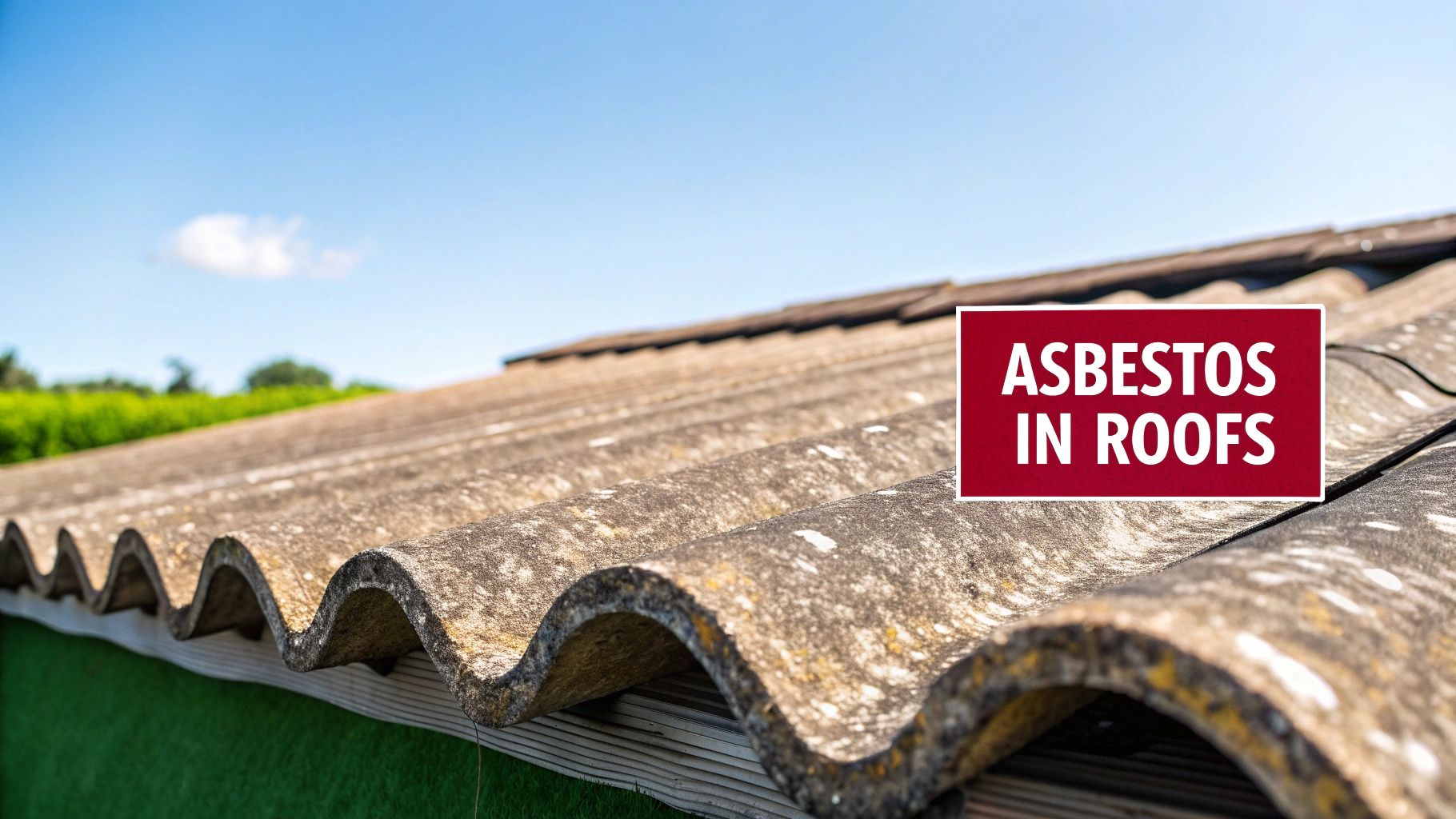
Imagine a building material that was hailed as a miracle product. It was cheap, incredibly tough against Australia's harsh weather, surprisingly lightweight, and completely fireproof. For a country in the middle of a massive post-war building boom, these qualities were game-changers. That’s the story of asbestos, and it’s why it became so deeply embedded in the fabric of buildings all over the nation, from suburban homes to industrial warehouses.
Asbestos-cement sheeting, particularly the iconic corrugated 'super six' style, quickly became a default choice for roofing. It was practical, affordable, and could be manufactured and installed quickly enough to keep pace with a rapidly growing population. Its widespread use was built on these perceived benefits, long before the devastating health risks of asbestos exposure were properly understood and regulated.
Australia's Unfortunate Legacy with Asbestos
Australia’s history with asbestos is profound. We weren't just using it; we were one of the highest per-capita consumers in the world. In the 1950s, Australia had the world's highest asbestos use rate, hitting a staggering peak of 704,425 metric tonnes between 1970 and 1979 alone. A huge portion of this went into construction, with roofing being a primary end product. You can delve deeper into this in this detailed research on Australia's asbestos use and its health impacts.
This historical context explains why finding asbestos in an older roof isn't a rare surprise but a common reality for property owners today. It's a legacy issue that requires careful management.
Types of Asbestos Used in Roofing Materials
The term 'asbestos' refers to a group of six naturally occurring minerals, but in Australian construction, three main types were predominantly used. Understanding these helps clarify what might be in your roof.
- Chrysotile (White Asbestos): This was by far the most common type, comprising about 95% of the asbestos found in buildings. Its fine, curly fibres blended perfectly with cement to create strong, durable sheets.
- Amosite (Brown Asbestos): Known for its harsh, spiky fibres, amosite was often used for insulation boards but also found its way into some cement sheeting due to its excellent heat resistance.
- Crocidolite (Blue Asbestos): Considered the most dangerous type, blue asbestos fibres are incredibly fine and brittle, making them easily inhaled. Despite the known risks, its superior strength meant it was still used in some high-density products.
Most asbestos roofing you'll encounter is a chrysotile-cement mix. However, blends containing amosite or even crocidolite are not unheard of. The critical takeaway is that all forms of asbestos are carcinogenic, and there is no safe level of exposure to its fibres.
The danger isn't that asbestos is simply present. The real risk begins when its microscopic fibres are released into the air—which happens when the material is broken, drilled, cut, or deteriorates over time.
This is the crucial distinction. A stable, well-maintained asbestos roof might pose a low immediate risk. But a roof that is cracked, weathered, or damaged can quickly become a serious health hazard. The journey of asbestos from celebrated "wonder material" to a recognised killer is why proper identification and risk management are so critical.
How to Spot Potential Asbestos in Your Roof
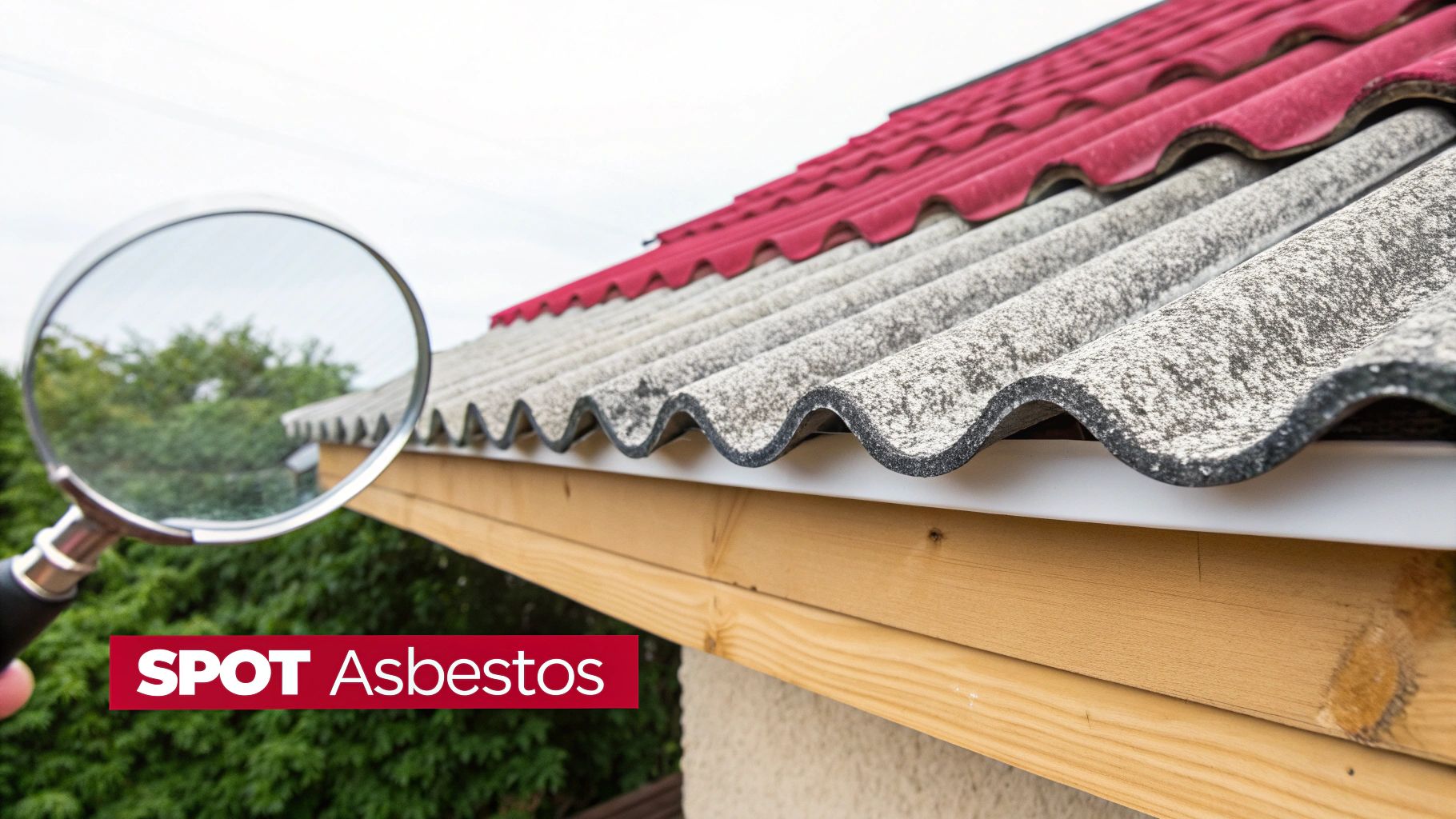
Identifying potential asbestos in roofing is an exercise in careful observation, not interaction. You are looking for tell-tale signs, but it’s critical to remember this is a "look, don't touch" activity. You cannot confirm asbestos by sight alone, and the golden rule is to never disturb, break, or handle any material you suspect may contain it.
The most common suspect in Australia is asbestos-cement (AC) sheeting. The single biggest clue is the age of your building. If your property was constructed before 1990, the likelihood of it containing asbestos products is very high.
Visual Clues to Look For
From a safe distance on the ground, you can look for a few classic giveaways associated with older asbestos-cement sheets. These won't give you a definitive answer, but they can certainly raise a red flag.
- Distinct Profile: The classic corrugated profile, often called "super six," is a major indicator. It’s defined by its large, deep, wavy ridges.
- Surface Texture: Observe the surface. Does it have a slightly dimpled or mottled texture, a bit like a golf ball? That’s a common feature of old AC sheeting.
- Colour and Weathering: The sheets are typically light grey, though they often darken over time with moss, lichen, or grime. Look for signs of ageing—it might appear brittle, and you may see fibrous textures where it's chipped or broken.
- Fasteners: Note how the sheets are fixed. Older sheets were often secured with dome-headed bolts or screws, which may show signs of rust.
It's also helpful to know what to contrast it with. Modern fibre-cement products are generally thinner, feel smoother, and will often have markings on the underside confirming they are asbestos-free. Of course, telling them apart from the ground is a job for a trained eye. You can learn more about how asbestos is identified by professionals.
Crucial Safety Warning: A visual check is only for suspicion, not confirmation. It is physically impossible to see microscopic asbestos fibres. The only way to know with 100% certainty is to have a sample professionally taken and tested by a NATA-accredited laboratory.
Why You Must Never Disturb Suspect Roofing
Let's be crystal clear: if you suspect your roof contains asbestos, leave it alone. Activities that seem harmless can release a cloud of dangerous, invisible fibres into the air.
At all costs, avoid these actions:
- High-Pressure Washing: This is incredibly dangerous. It blasts the surface, aggressively ripping asbestos fibres from the cement matrix and releasing them into the air and surrounding environment.
- Sanding or Grinding: Any abrasive work will create a huge amount of hazardous dust.
- Drilling or Cutting: The moment you break the sheet's surface, you release fibres that were previously locked in place.
- Walking On The Roof: Old asbestos sheeting becomes extremely brittle with age. Walking on it not only risks releasing fibres when it cracks but also poses a serious fall hazard.
Think of an intact asbestos roof as a sleeping bear. Left alone, it's not an immediate threat. But the moment you disturb it—by cutting, breaking, or hitting it with high-pressure water—it becomes an active danger. The purpose of a visual check is simply to gather enough clues to decide if it’s time to call in a professional for the next step: sampling and testing. It’s a cautious approach that keeps you, your family, and your neighbours safe.
Understanding the Health Risks of Asbestos Fibres
An asbestos roof that’s in good condition and left undisturbed is generally stable. The real trouble begins the moment it's disturbed. That’s when it transforms from a benign-looking building material into a serious health threat. Everyday actions, like DIY maintenance or cleaning, can unleash a long-term danger for anyone in the vicinity.
The hazard mechanism is simple. Asbestos roofing consists of millions of tiny, strong fibres locked inside a cement matrix. When you cut, drill, saw, or use a high-pressure hose on it, you shatter that matrix. This releases countless microscopic, needle-like fibres into the air. These fibres are invisible to the naked eye, weigh almost nothing, and can remain airborne for days, drifting with the slightest breeze.
The danger begins when these fibres are inhaled. Once inside the lungs, their sharp, durable nature allows them to embed deep into the lung tissue and the delicate lining of the chest (the pleura). Because they are inorganic minerals, the human body cannot break them down or expel them. They are there permanently.
The Long-Term Consequences of Exposure
Once lodged in the lungs, these fibres trigger a chronic inflammatory response. The immune system repeatedly tries to attack the foreign invaders but fails, causing ongoing irritation that leads to scarring and, eventually, genetic damage to the surrounding cells. This is a slow, insidious process, which is why asbestos-related diseases have such a frighteningly long latency period—it can take anywhere from 20 to 50 years after exposure for symptoms to appear.
This significant time lag is what makes asbestos so treacherous. A seemingly quick repair job on an old roof today could be the trigger for a devastating health diagnosis decades in the future.
The primary diseases caused by inhaling asbestos fibres are:
- Asbestosis: This is a chronic, non-cancerous lung disease where extensive scarring (pulmonary fibrosis) causes the lungs to become stiff, progressively reducing their ability to expand and making it harder to breathe.
- Lung Cancer: Asbestos exposure significantly increases the risk of developing lung cancer. For smokers, the risk is multiplied synergistically.
- Mesothelioma: A rare, aggressive, and almost invariably fatal cancer that affects the thin membrane lining the chest (pleura) or abdomen (peritoneum). It is almost exclusively caused by asbestos exposure.
The most important thing to remember is this: there is no known safe level of exposure to asbestos fibres. Every single fibre inhaled contributes to your cumulative lifetime risk.
Australian Regulations and Your Legal Responsibility
Given these severe dangers, Australia has implemented some of the world's most stringent asbestos regulations. Under state and territory Work Health and Safety (WHS) laws, property owners, managers, and employers have a clear legal duty of care. You must ensure asbestos is managed safely to protect workers, occupants, and the public from exposure.
This isn't just a recommendation; it's a legal obligation. You cannot ignore potential asbestos in roofing. The law requires you to identify asbestos-containing materials, assess the risk they pose, and implement control measures. Any work involving more than a small amount of non-friable asbestos must be performed by a licensed professional.
During removal projects, ongoing checks like professional asbestos air monitoring are often mandatory to verify that the air is safe for reoccupation. Ignoring these rules can lead to substantial fines and serious legal consequences, particularly if your actions result in someone else's exposure.
Asbestos Roof Management: Repair, Encapsulate or Replace?
So, professional testing has confirmed you have asbestos in your roofing. This is a pivotal moment, presenting a choice between two primary strategies: managing the asbestos in situ or removing it entirely. The right decision will affect not just your budget but also the long-term safety and value of your property.
The correct path depends entirely on the current condition of your roof and your future plans for the property. A stable, solid asbestos-cement roof poses a very different challenge to one that's already cracked, weathered, and deteriorating.
The risk assessment process begins by evaluating the roof's condition, as the flowchart below illustrates.
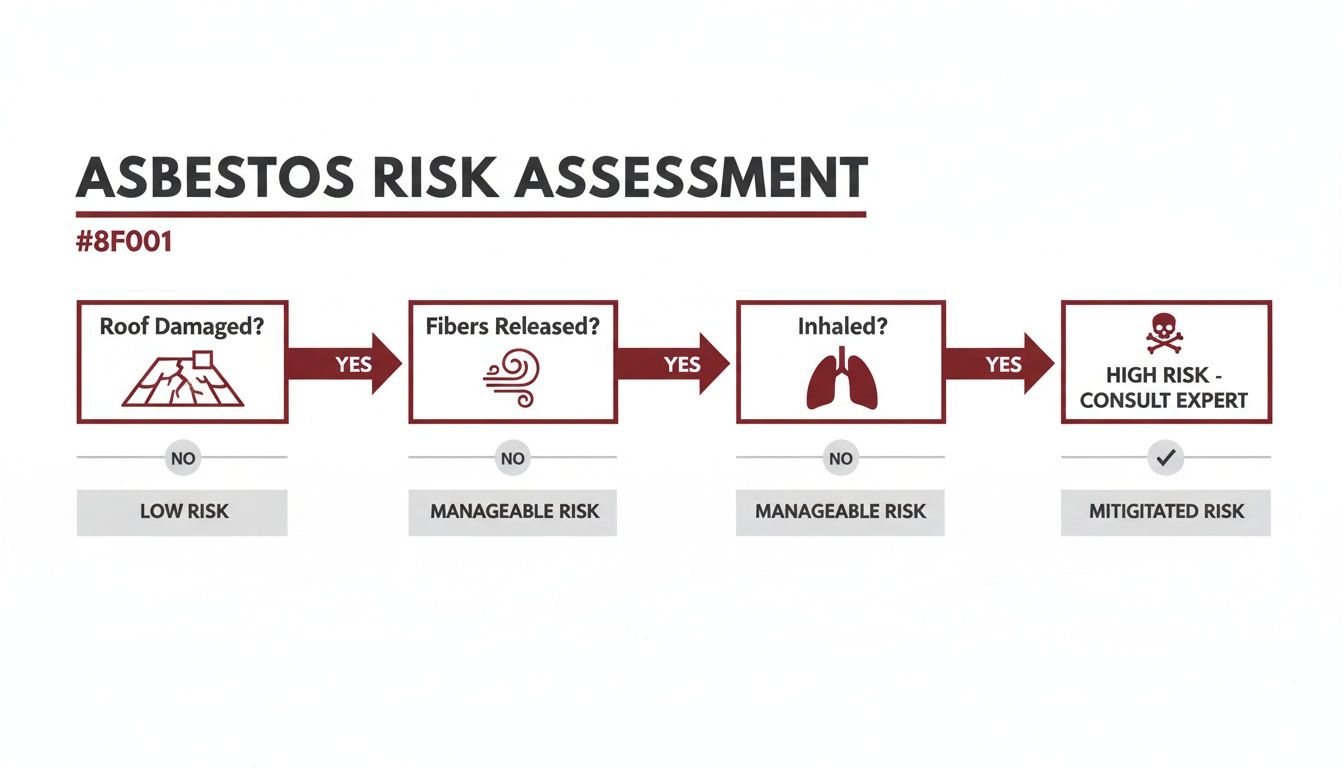
As you can see, the moment the material becomes damaged, the risk level escalates significantly. Damage is the primary pathway for dangerous fibres to be released into the air.
Option 1: Safe Maintenance and Encapsulation
If your asbestos roof is in good condition—free from major cracks, breaks, or severe weathering—then managing it in place might be a viable option. This approach focuses on containment, and the most common method is encapsulation.
Think of encapsulation as applying a protective shield over the entire roof. A specialised sealant is applied, which penetrates the asbestos-cement sheets. It works by binding the asbestos fibres together, locking them securely within the cement matrix so they cannot escape. This sealant then cures to form a tough, weatherproof membrane over the surface.
This process effectively puts the asbestos risk to sleep, preventing fibre release from daily weathering or minor impacts.
Encapsulation is a recognised and safe management strategy that directly addresses the health hazard by containing asbestos fibres. It turns a potential risk into a controlled and stable situation, often at a fraction of the cost of removal.
This option offers clear advantages:
- Cost-Effective: It is almost always significantly cheaper than a full removal and replacement, which involves high disposal fees and strict safety protocols.
- Minimal Disruption: The work is less intrusive and can be completed much faster, meaning less hassle for occupants.
- Extends Roof Life: The new sealed coating protects the old roof from UV damage and water ingress, extending its functional lifespan.
However, encapsulation is not a "set and forget" solution. It's a long-term management plan that requires periodic inspections to ensure the protective coating remains intact and effective.
Option 2: Licensed Removal and Replacement
The second, and more permanent, solution is to have the asbestos roofing completely removed and replaced with a modern, safe material. This is the only way to permanently eliminate the hazard from your property. If your roof is already brittle, leaking, or damaged, removal is not just an option—it's often the only responsible choice.
This is unequivocally not a DIY project. In Australia, the removal of more than 10m² of non-friable asbestos must be performed by a licensed professional. They follow strict safety protocols mandated by Safe Work Australia, which include establishing exclusion zones, using specialised personal protective equipment (PPE), and having the site certified as safe by an independent assessor upon completion.
While it costs more upfront and causes more disruption, a full removal provides major benefits:
- Total Peace of Mind: Once the asbestos is gone, it’s gone. You will never have to worry about it again.
- Increased Property Value: Removing the "asbestos" label can make your property far more attractive to potential buyers and may be necessary for certain types of financing or future development.
- Freedom for Future Work: Want to install solar panels, skylights, or perform other renovations? With the asbestos removed, you can undertake any work on your roof without complicated and expensive safety measures.
When weighing your options, the debate often mirrors the one laid out in a good roof repair vs replacement guide, but with the added complexity of a hazardous material.
Asbestos Roof Management Options: Maintenance vs Removal
To help you decide, here’s a straightforward comparison of the two main strategies. There's no single "right" answer; the best choice really hinges on your roof's condition, your budget, and your long-term plans.
| Consideration | Safe Maintenance (Encapsulation/Sealing) | Licensed Removal and Replacement |
|---|---|---|
| Initial Cost | Lower. Significantly less expensive upfront than a full replacement. | Higher. Involves labour, new materials, and specialised disposal fees. |
| Hazard Status | Managed. The asbestos remains but is safely contained and monitored. | Eliminated. The hazard is permanently removed from the property. |
| Property Value | Neutral impact. May require disclosure to future buyers. | Positive impact. Increases property value and buyer appeal. |
| Disruption | Minimal. The process is relatively quick with less noise and mess. | Significant. Can be noisy, disruptive, and may require temporary relocation. |
| Future Work | Restricted. Any future roof work (e.g., solar panels) is complex. | Unrestricted. You can modify or renovate the roof freely. |
| Long-Term Plan | Management. Requires ongoing inspections and potential re-coating. | Permanent Solution. No further asbestos-related costs or worries. |
| Best For | Good-condition roofs where budget is a primary concern. | Damaged roofs or when planning major renovations or selling. |
Ultimately, choosing between maintaining and removing an asbestos roof is a significant decision. You need to weigh the short-term costs against the long-term benefits and risks. For a truly informed recommendation tailored to your specific situation, the best next step is always to consult with a qualified occupational hygienist or a licensed asbestos professional.
Finding and Hiring a Licensed Asbestos Professional
Once you confirm you have asbestos in your roofing, you have officially moved out of the DIY realm and into the world of certified experts. This is not a task for a weekend warrior. The health risks are immense, and Australian regulations are some of the strictest in the world for good reason.
Hiring the right team isn't just a formality—it's the single most critical decision you'll make to ensure the job is completed safely, legally, and effectively.
Your first point of contact should ideally be an independent occupational hygienist. Think of them as the impartial scientists of the process. Their role is to provide an expert, unbiased assessment of the risk, conduct testing, and help you develop a safe management plan. Because they have no commercial stake in the removal itself, their advice is completely objective.
After understanding the full scope, your focus can shift to finding a licensed asbestos removalist. The diligence you apply here is crucial. In many ways, the process mirrors what you’d do for any major construction project; in fact, there are some great general tips on how to find a good, licensed roofing contractor that also apply here.
Understanding Asbestos Removal Licences
In Australia, asbestos removal licences are not one-size-fits-all. The type of licence a contractor holds dictates exactly what kind of asbestos-containing material they are legally permitted to handle.
- Class A Licence: This is the highest level of certification. A professional with a Class A licence is qualified to remove all types of asbestos, including the high-risk friable kind (material that can be crumbled by hand) as well as non-friable materials.
- Class B Licence: This licence covers the removal of non-friable asbestos only. The common corrugated asbestos-cement sheets on many roofs are considered non-friable when in good condition. This means a Class B licence is often sufficient for a standard asbestos roof removal.
For a typical corrugated asbestos roof, a Class B licensed team is usually appropriate. However, if that same roof is badly damaged or has deteriorated to the point where the sheets could easily crumble, the situation changes. The job could be reclassified as a friable asbestos risk, which would then require a Class A contractor.
Your Vetting Checklist: Questions to Ask Every Contractor
Before signing any contract, you must vet every potential contractor thoroughly. A professional and reputable company will welcome your questions as a sign of a diligent client. Treat this process like a job interview.
Be ready with this checklist:
- Licensing and Certification: "Can I see a copy of your current asbestos removal licence? I would also like to see the training certifications for the supervisors who will be on my property."
- Insurance Coverage: "Could you provide your certificate of currency for public liability insurance? It is crucial that it specifically covers asbestos-related work." Many standard policies contain an asbestos exclusion clause.
- Removal and Safety Plan: "How will you protect my family and neighbours? Can you walk me through your process for setting up the work zone, decontamination, and preventing fibre spread?"
- Waste Disposal Method: "Which licensed facility will you use for waste disposal? Will I receive copies of the waste transport certificates as proof of legal disposal?"
- Air Monitoring and Clearance: "Will an independent party conduct air monitoring during the removal? Will an independent assessor issue a formal clearance certificate when the job is complete?" This is a non-negotiable step to confirm the area is safe for reoccupation.
- References and Experience: "Can you provide references from recent roofing jobs similar to this one?"
If a contractor seems hesitant or cannot provide clear, confident answers to these questions, consider it a major red flag. A true professional will have these protocols established and all the necessary paperwork readily available.
Hiring the right team is about much more than just getting a new roof; it’s about protecting the health of everyone in and around your property. An experienced occupational hygienist can be an invaluable partner, helping you understand the technical requirements and ensuring the removalist you hire meets the highest safety standards. To learn more, check out our guide on the role of an occupational hygienist in asbestos management.
Taking the time to find a qualified, meticulous, and transparent professional is what delivers true peace of mind.
Common Questions About Asbestos in Roofing Answered
When you're dealing with a potential asbestos roof, it's natural to have many questions. Even after you understand the basics, the practicalities can be confusing. Let's address some of the most common queries we hear from property owners.
Can I Just Paint Over My Asbestos Roof?
Yes, painting is a legitimate management technique known as encapsulation. When your roof is still in good condition, a professional paint application can seal the surface, effectively locking in the asbestos fibres and preventing their release from weathering.
However, this is not a standard DIY paint job. The absolute golden rule is never to sand, scrape, or use a high-pressure washer on an asbestos roof for preparation. These actions are incredibly dangerous and will release asbestos fibres into the air. A professional will use specific, low-impact cleaning methods before applying a durable sealant designed for this purpose. Remember, this is a management strategy, not a permanent solution like removal.
How Much Does Asbestos Roof Removal Cost in Australia?
The cost of removing an asbestos roof varies significantly across Australia, with no single fixed price. Several factors influence the final quote:
- Size of the Roof: The total square meterage is the largest cost factor.
- Accessibility: A steep, multi-storey roof is more complex and requires more extensive safety setups, increasing labour costs.
- Condition of the Material: If the roofing is badly degraded, it requires more careful handling and stricter controls, which can increase the price.
- Your Location: Labour rates and disposal fees differ between states and even between metropolitan and regional areas.
As a rough guideline, you might expect to budget between $50 and $150 per square metre. This should cover removal by a licensed professional, proper wrapping and transport of waste, legal disposal fees, and the essential independent clearance certificate. It is always wise to obtain at least three detailed quotes from licensed removalists before making a decision.
Is It Safe to Collect Rainwater from an Asbestos Roof?
This is a common question, particularly for rural properties relying on tank water. Health authorities, including the World Health Organization, agree that the primary danger from asbestos is inhaling airborne fibres. The risk from ingesting asbestos fibres in water is considered to be exceptionally low.
Therefore, while a stable, well-maintained asbestos-cement roof is unlikely to pose a significant risk to your rainwater, the material does degrade over time. For complete peace of mind, especially if it is your family's drinking water source, the best long-term strategy is to replace the roof with a modern, non-asbestos material.
While the scientific consensus is that ingestion risk is minimal, many homeowners opt for replacement. It completely removes any lingering doubt and guarantees the long-term safety of their water supply.
What Should I Do If I Accidentally Break a Piece?
Accidents happen. Dropping a tool or bumping a sheet can cause a small break, and it's easy to panic. The most important thing is to act calmly and safely to prevent fibre release.
If you cause a small crack or break, follow these steps immediately:
- Stop all activity. Do not create more disturbance.
- Gently wet the area. Use a spray bottle with a light mist to wet the broken piece and any visible dust or debris. This helps suppress the fibres.
- Carefully pick up the fragment and any visible pieces. Place them directly into a heavy-duty plastic bag.
- Seal the bag tightly with tape, then place it inside a second plastic bag (double-bagging). Label it clearly with "DANGER: ASBESTOS WASTE."
If the damage is more than a small chip, or if you feel uncertain at any point, do not take a risk. Isolate the area and call a licensed asbestos professional immediately to handle the clean-up.
Navigating asbestos regulations and safety protocols can be overwhelming. Anitech provides expert occupational hygiene services across Australia, ensuring your property is managed safely and in compliance with all legal requirements. From initial testing and risk assessment to the final clearance inspection after removal, our team is here to provide clarity and confidence.
Get in touch today to discuss how we can help with your asbestos management needs.
Learn more about our occupational hygiene services at occhygiene.com.au


