
At its core, a plant risk assessment is a structured method for examining your machinery and equipment, identifying potential failures, and implementing effective controls to ensure personnel safety. It is a mandatory component of Australian Work Health and Safety (WHS) legislation, but more importantly, it forms the bedrock of a genuinely secure workplace. The objective is to be proactive, preventing incidents before they have an opportunity to occur.
Getting a Grip on Your Workplace Safety Obligations
To cultivate a safer organisational culture, it is essential to first understand the scope of a plant risk assessment. Under WHS law, the definition of 'plant' is exceptionally broad. It encompasses far more than just the large, fixed machinery anchored to the factory floor.
The term covers a vast array of equipment. This includes everything from the handheld power drill used by the maintenance team to portable generators, sophisticated robotic arms, and massive industrial presses. If an item is a piece of machinery or equipment utilised for work, it requires a comprehensive risk assessment.
Consider this assessment as your strategic plan for identifying and managing potential dangers before they result in injury, illness, or significant financial loss from damage. It is not merely a procedural formality; it is about embedding a practical, safety-first mindset into every facet of your operations.
Why This is More Than Just Paperwork
Neglecting thorough plant risk assessments can lead to severe consequences, ranging from catastrophic equipment failures and life-altering injuries to substantial financial penalties. The fundamental purpose is to establish a work environment that is, as far as is reasonably practicable, devoid of health and safety risks. However, the advantages extend well beyond simple legal compliance.
A robust plant risk assessment process delivers numerous benefits:
- Protect Your People: Primarily, you are actively identifying and controlling hazards, which directly reduces the likelihood of workplace injuries.
- Prevent Expensive Downtime: An unmanaged risk culminating in equipment failure can halt production, leading to lost revenue and unforeseen emergency repair costs.
- Boost Your Efficiency: The assessment process often illuminates opportunities to improve workflows or streamline maintenance schedules, enhancing operational effectiveness.
- Cover Your Legal Bases: It provides documented evidence that you are diligently fulfilling your WHS responsibilities.
A well-executed plant risk assessment is more than a safety measure; it's a critical business tool that fosters a resilient, productive, and responsible organisation. It shifts the focus from reacting to incidents to preventing them entirely.
The principles of risk evaluation are well-established and have been refined over several decades. For instance, Australia’s plant health risk assessment framework has evolved since the early 2000s to incorporate detailed quantitative methodologies. The Department of Agriculture, Fisheries and Forestry employs mathematical modelling to evaluate threats from pests and diseases.
While the context differs, the fundamental objective aligns with workplace safety: proactive risk management. One can even browse their database of pest risk analyses to observe these principles in action at a national level. This type of detailed, methodical approach is a cornerstone of our broader understanding of occupational hygiene and workplace safety.
How to Actually Do a Plant Risk Assessment
Let's transition from theory to practical application on the factory floor, where a risk assessment truly demonstrates its value. This is not a superficial, box-ticking exercise; it is a systematic approach to converting ambiguous safety concerns into concrete actions that protect your team.
The entire process can be viewed as a continuous cycle: identify the hazard, implement controls, and then review the effectiveness of those controls. Safety is not a one-time task but an ongoing commitment to improvement.
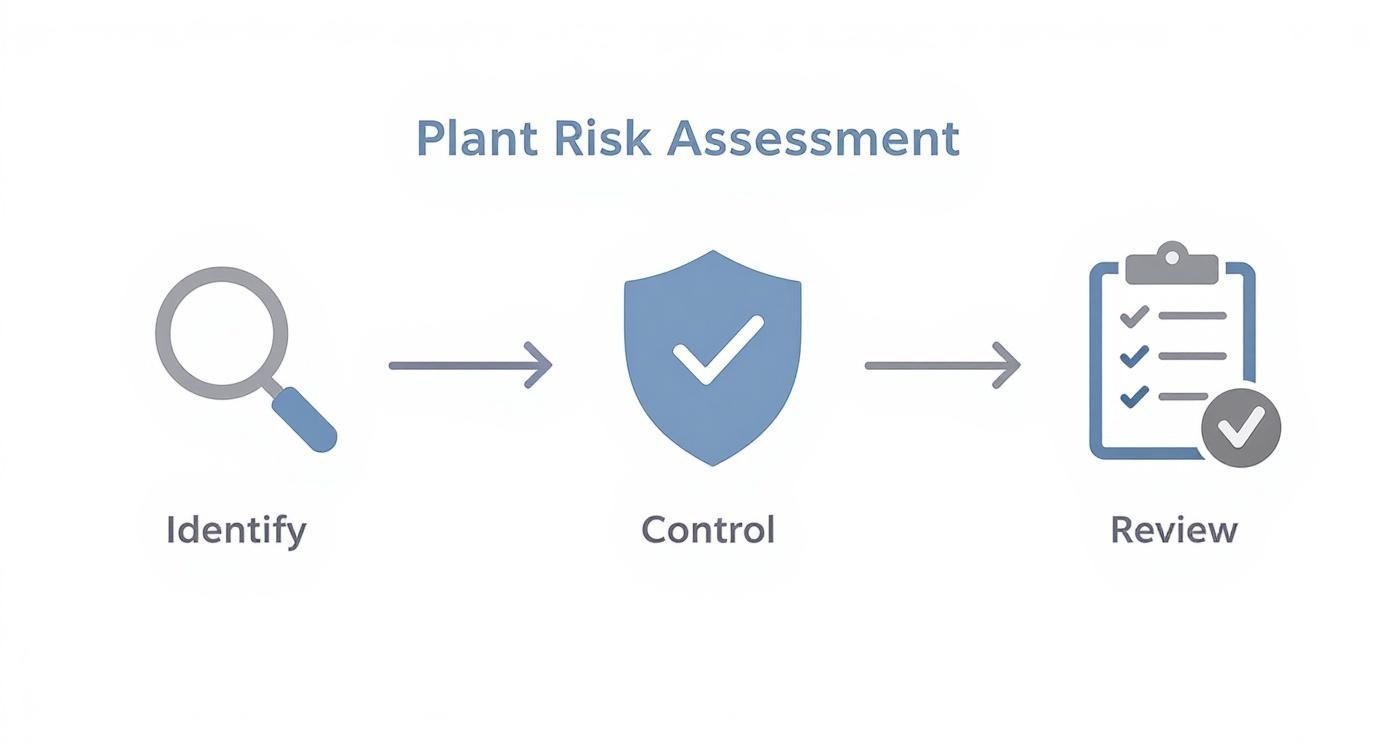
As illustrated, a comprehensive assessment is not a singular event. It is a continuous loop of refinement that ensures your safety measures remain relevant and effective over time.
First, Nail Down Your Scope
Before commencing any hazard identification, you must clearly define the parameters of your assessment. Attempting to evaluate an entire facility in a single effort is a recipe for failure, leading to overwhelm and the omission of critical details.
A more effective strategy is to break the task down into manageable segments. You could scope your assessment to:
- A single piece of gear: Such as a newly installed hydraulic press or a recently modified conveyor belt.
- A specific work area or process: For example, the entire packaging line from start to finish, or the raw materials receiving bay.
- A particular task: This could involve routine maintenance on a machine or specific cleaning procedures that utilise hazardous chemicals.
Defining your scope at the outset maintains focus. It prevents the assessment from becoming an unmanageable project and ensures that high-risk areas receive the detailed scrutiny they require.
Time for Some Real Detective Work: Finding the Hazards
With your scope clearly defined, it is time to engage in thorough investigation. Hazard identification involves more than a simple walkthrough with a clipboard. You must delve deeply to uncover both the obvious dangers and those that are less apparent. The fundamental question to answer is, "What could realistically go wrong here?"
To obtain a complete picture, you need to gather information from multiple sources. Often, the most valuable insights come from the people on the floor. They possess intimate knowledge of the machinery's idiosyncrasies, the informal workarounds that have developed, and the near-misses that were never formally reported.
However, your investigation should not end there. Other valuable sources of information include:
- Manufacturer’s Manuals: These documents are not merely for storage. They contain crucial safety information, operating limits, and maintenance schedules that cannot be overlooked.
- Past Incident Reports: Review historical records of accidents, injuries, and close calls. These will highlight recurring problems and systemic weaknesses.
- Talk to Your Team: Engage in meaningful conversations with operators, maintenance crews, and supervisors. Ask open-ended questions like, "What part of this job makes you feel uneasy?" or "What is the most frustrating aspect of using this machine?"
A thorough investigation also means examining the internal workings of the machinery. For instance, understanding the intricacies of motor protection is vital. If your knowledge needs refreshing, a practical guide to the protection of motors can provide the technical detail required to identify potential failures before they occur.
Analysing and Prioritising What Matters Most
Once you have compiled a comprehensive list of potential hazards, the next step is to prioritise them. Not all hazards carry the same level of threat. A logical method for sorting them is essential, and this is where a risk matrix becomes an indispensable tool. It provides a simple yet powerful framework for making sense of complex information.
A risk matrix helps you evaluate two key factors for each identified hazard:
- Likelihood: How probable is it that this event will occur?
- Consequence: If it does occur, what will be the severity of the outcome?
By plotting these factors on a grid, you can quickly classify risks as low, medium, high, or extreme. This immediately clarifies where to direct your efforts. A hazard with a high likelihood and catastrophic consequences (such as an unguarded rotating shaft) demands immediate attention, while an issue with low likelihood and minor consequences can be addressed later.
A risk matrix transforms subjective feelings about danger into a clear, prioritised action plan. It ensures you are addressing the most significant threats first, thereby optimising the use of your time, capital, and resources.
Putting Effective Controls in Place
With your risks prioritised, the final step is to implement controls to either eliminate them or reduce them to an acceptable level. The industry gold standard for this is the Hierarchy of Controls. This framework compels you to consider solutions from the most effective down to the least effective.
You should always aim to implement controls as high up this pyramid as is reasonably practicable.
- Elimination: The most effective control. Can you remove the hazard completely? An example would be automating a manual task that poses a high ergonomic risk.
- Substitution: Can you replace a hazardous substance or process with a safer alternative? Consider replacing a toxic, solvent-based cleaner with a non-toxic, water-based one.
- Engineering Controls: This involves making physical changes to the workplace to isolate people from the hazard. Installing machine guards, adding local exhaust ventilation, or implementing an emergency stop button are all classic examples.
- Administrative Controls: This involves changing how people work. This includes developing safe work procedures, using job rotation to limit exposure to a hazard, and displaying clear warning signs.
- Personal Protective Equipment (PPE): This is the last line of defence, not the first choice. When no other control can adequately manage the risk, equipment like gloves, safety glasses, and hard hats becomes essential.
Following this structured process provides a robust foundation for your safety strategy. When combined with regular reviews and audits, it becomes a dynamic system that adapts to changes in your workplace. This approach aligns perfectly with a formal workplace health and safety audit, which is designed to verify that these processes are not only documented but are effectively implemented in practice.
Meeting Australian WHS Compliance Obligations
A comprehensive understanding of your legal responsibilities is the foundation of any effective plant risk assessment. In Australia, the model Work Health and Safety (WHS) Act establishes clear, non-negotiable duties for all parties involved. This legislation is designed to ensure that safety is not just a policy statement but a legally binding standard. Navigating this framework is crucial for protecting both your workforce and your business.
At the apex of this structure is the Person Conducting a Business or Undertaking (PCBU). This term generally refers to the company itself. The PCBU holds the primary duty of care, a significant legal obligation. This means you must ensure, so far as is reasonably practicable, that you are not exposing workers or others to health and safety risks arising from your business operations.

This duty extends across the entire lifecycle of your plant and equipment—from acquisition and installation through operation, maintenance, and eventual decommissioning. It is not a task that can be completed and forgotten; it requires continuous vigilance and proactive management.
The Role of Company Officers
The responsibility does not end with the PCBU. Company officers, such as directors and senior executives, have their own specific legal duties. They are legally mandated to exercise due diligence to ensure the company is fulfilling its WHS obligations. This is not a passive role where one can simply assume that safety matters are being handled; it requires active involvement.
Due diligence requires officers to take reasonable steps to:
- Acquire and maintain up-to-date knowledge of work health and safety matters.
- Gain a thorough understanding of the business operations and the specific hazards and risks involved.
- Ensure the business has appropriate resources and processes in place to manage those risks.
- Verify that those resources and processes are being utilised and are effective.
Failure to meet these requirements can result in significant personal liability. This underscores the importance of leadership's active participation in the plant risk assessment process.
Under Australian WHS law, ignorance is no excuse. Officers must proactively verify that safety systems are not only in place but are functioning as they should. This reinforces the simple fact that true safety leadership starts at the very top.
Specific Duties for High-Risk Plant
The WHS Regulations become even more specific when addressing certain types of machinery classified as "high-risk plant." This category typically includes items such as boilers, pressure vessels, certain types of cranes, and amusement devices. If your business utilises any of this equipment, you are subject to additional compliance requirements.
One of the most significant is plant registration. Certain items of high-risk plant must be formally registered with the relevant state or territory WHS regulator before they can be used. This process ensures that the equipment's design has been appropriately verified and that it is safe to operate.
Furthermore, design verification is mandatory for specific plant. This requires a competent person—typically a certified engineer—to formally confirm that the design complies with all relevant technical standards and is fundamentally safe. Maintaining meticulous records of these verifications is not just good practice; it is your evidence of compliance in the event of a regulatory inspection.
The Importance of Documentation and Records
Your plant risk assessment documentation serves as a legal record, not just internal paperwork. These documents are your proof that you have systematically identified hazards, assessed the associated risks, and implemented appropriate control measures. In the event of an incident, regulators will invariably request to see them.
Comprehensive record-keeping should always include:
- Details of the specific plant that was assessed.
- The hazards identified and the risks assessed.
- The control measures implemented and their scheduled review dates.
- Records demonstrating consultation with workers.
- Maintenance logs, inspection reports, and training records.
Consider it this way: organised systems are your strongest defence. For example, maintaining a detailed restaurant health inspection checklist is a key component of WHS compliance in the food service industry, demonstrating how simple tools can form part of a much larger safety system. It is this structured approach that proves you have fulfilled your duties with due care and diligence.
Tailoring Your Assessment to Your Industry
A generic, one-size-fits-all approach to plant risk assessment is ineffective. The hazards present on a large-scale mine site are fundamentally different from those within a sterile pharmaceutical manufacturing facility. For your assessment to be truly effective, it must be tailored to your specific context—your machinery, your processes, and the unique environment in which your team operates daily.
Merely completing a generic template will not suffice. The real work—and the real value—lies in adapting the core principles of risk management to your specific sector. This is the difference between a safety plan that remains on a shelf and one that actively prevents injuries. A document that disregards the on-the-ground reality is not only useless; it is dangerous, as it creates a false sense of security.
The objective is to move beyond a general understanding of plant safety and develop a deep, practical knowledge of the risks inherent to your specific operation. Let’s explore what this looks like across some of Australia's key industries.
Manufacturing and Production Lines
In any manufacturing environment, the interaction between people and machinery is continuous. Production targets create pressure, and the high speed of automated lines introduces hazards that demand highly specific controls. It is a dynamic, fast-paced setting.
A primary area of focus must be machine guarding. It is not sufficient to simply have a guard in place; it must be the correct guard for the specific machine and task. A fixed guard may be ideal for a permanently enclosed drive belt, but an interlocked guard is necessary for a robotic cell where workers require access. Your risk assessment must probe deeply and ask critical questions: Are the current guards effective, or are they being bypassed to save time? This is a significant red flag.
Another critical element is your lockout/tagout (LOTO) system. This is far more than a simple switch; it is a non-negotiable, systematic process to completely de-energise equipment before any maintenance or cleaning begins. A proper plant risk assessment will stress-test your LOTO procedures for various scenarios:
- Robotic Cells: How are all energy sources—electrical, pneumatic, hydraulic—being isolated? Are any being overlooked?
- Conveyor Systems: What physical measures prevent someone from restarting a conveyor while a worker is clearing a jam downstream?
- Pressing and Cutting Machinery: Are you using energy-dissipating blocks to prevent heavy components from falling due to gravity after power has been cut?
The best risk controls in manufacturing are the ones that are designed to fit seamlessly into the workflow, not fight against it. When safety feels intuitive and practical, people are far more likely to follow the procedures.
Mining and Heavy Mobile Equipment
The sheer scale of plant in the mining sector presents a unique set of challenges. We are dealing with harsh environments, massive equipment, and consequences of failure that can be catastrophic. A risk assessment in this context must consider not only the machinery itself but also the rugged, ever-changing terrain on which it operates.
Heavy mobile equipment—such as haul trucks, excavators, and loaders—is a major source of risk. Assessments must extend beyond standard pre-start checklists to thoroughly investigate:
- Operator Visibility: Are blind spots adequately covered by the correct combination of cameras, sensors, and mirrors? Critically, are the site’s traffic management plans being consistently followed?
- Vibration Exposure: Operating heavy machinery for extended periods can lead to serious, long-term health issues for operators. A formal whole-body vibration assessment is not optional; it is a critical component of understanding and controlling this real-world risk.
- Stability on Uneven Ground: Rollovers are a significant and ever-present danger. The assessment must confirm that the equipment in use is appropriate for the specific gradients and ground conditions of that part of the site.
Conveyors on a mine site represent another high-risk area. These systems can extend for kilometres, creating numerous nip points, rotating parts, and sources of stored energy. A detailed assessment should focus on ensuring adequate guarding along the entire length, confirming that emergency stop systems like lanyard pull-cords are functional and accessible, and verifying that isolation procedures for maintenance are rigorously enforced.
Food and Pharmaceutical Processing
In industries such as food and pharmaceuticals, safety and hygiene are inextricably linked. The plant must not only be safe for operators but also be designed to prevent any form of product contamination. This creates a unique intersection of WHS and quality control.
Pressure vessels and systems, including steam boilers, autoclaves, and storage tanks, are ubiquitous and contain significant amounts of stored energy. An assessment must verify that they are correctly registered with the regulator, are inspected according to schedule, and have fully functional pressure relief devices. It is also essential to confirm that operators have been properly trained to understand the dangers of stored energy.
Another key area is Clean-in-Place (CIP) systems, which introduce their own chemical and thermal hazards. A thorough risk assessment for a CIP skid would need to analyse:
- Chemical Handling: Are the procedures for handling concentrated caustic and acid solutions safe and clear? Is the team provided with—and consistently using—the appropriate chemical-resistant PPE?
- Thermal Hazards: Are pipes and vessels adequately insulated? Burns from high-temperature cleaning cycles are a common and preventable injury.
- Confined Space Entry: What procedures are in place if a tank requires manual cleaning? Are you adhering to full, compliant confined space entry protocols every time?
By drilling down into these industry-specific scenarios, your plant risk assessment transforms from a generic compliance document into a powerful tool for building a genuinely safer workplace.
Factoring Climate Change into Your Risk Planning
A contemporary plant risk assessment must extend beyond the day-to-day operational hazards within your facility. In Australia, our changing climate is introducing a new layer of risk that directly threatens your equipment, infrastructure, and operational continuity. Ignoring these environmental threats is no longer a viable option for building a resilient business.
The primary challenge is to translate broad climate predictions into tangible risks on your factory floor. You must begin to ask practical questions. For example, how will more frequent and intense heatwaves impact the cooling systems of your most critical machinery?
What is your contingency plan when a 40-degree heatwave pushes that equipment beyond its specified operating range, significantly increasing the likelihood of a breakdown?

This proactive mindset must also be applied to other climate-driven events, such as extreme rainfall and flooding. You need to re-evaluate the location of your main electrical switchboards or backup generators. A location once considered safe may now fall within a one-in-100-year flood plain.
Integrating Climate Threats into Your Framework
The most effective approach is to integrate climate-related scenarios directly into your existing risk assessment framework. This is not about starting from scratch but about enhancing your current process to be more forward-looking and intelligent.
Begin by identifying the most significant climate hazards for your specific location and operation. This could involve examining:
- Extreme Heat: How does it affect equipment cooling, the safety of outdoor workers, and the potential for increased fire risk?
- Flooding: Conduct a thorough review of your site drainage, the vulnerability of ground-level equipment, and the potential for supply chain disruptions due to impassable roads.
- Bushfires: Evaluate the risk to your buildings and outdoor storage areas, and also consider how poor air quality could affect both your workforce and sensitive HVAC systems.
- Severe Storms: What is the potential for wind damage to your structures? How would a prolonged power outage impact production, and what is your backup plan?
The scale of these emerging threats is immense. Australia's National Climate Risk Assessment has already identified 63 nationally significant climate risks affecting a wide range of systems. The report clearly indicates that hazards like heatwaves, floods, and bushfires will become more frequent and severe, placing unprecedented pressure on our infrastructure. You can read more about these national findings on the Grant Thornton website.
A forward-looking plant risk assessment doesn't just manage the hazards of today; it anticipates and prepares for the environmental realities of tomorrow. Building climate resilience is now a core component of responsible risk management.
Once you begin treating climate change as a foreseeable hazard, you can develop genuinely robust control measures. This might involve upgrading ventilation systems, physically relocating critical electrical equipment to higher ground, or creating solid contingency plans for inevitable supply chain disruptions. This type of strategic foresight is what will ensure your safety measures—and your entire operation—are prepared for future challenges.
Common Questions About Plant Risk Assessment
Even with a well-defined process, you are likely to encounter challenges during a plant risk assessment. Obtaining clear, straightforward answers is key to maintaining momentum and ensuring your assessment is both practical and compliant.
This section addresses some of the most frequently asked questions from professionals on the ground. Use it as a quick reference guide to navigate common points of confusion before they impede your progress.
How Often Should I Review a Plant Risk Assessment?
A risk assessment is not a static document. It is a living tool that must evolve with your workplace. Under WHS regulations, you are legally obligated to conduct a formal review whenever there is a significant change.
What constitutes a significant change? This could include several scenarios:
- Bringing in new plant or equipment. A new machine introduces new, unassessed hazards.
- Modifying existing plant. Even a minor alteration can change a machine's behaviour and its associated risks.
- An incident or near-miss. This is a clear indicator that your current controls may be inadequate.
- A safety representative requests a review. This is an essential part of the worker consultation process.
Beyond these specific triggers, it is considered good practice to schedule a full review of your assessments every one to two years. For high-risk machinery, it is advisable to shorten this interval to annually, or even semi-annually, to proactively manage potential issues.
What Is the Difference Between a Hazard and a Risk?
This distinction often causes confusion, but understanding it is fundamental to the entire process. A clear grasp of these terms makes your assessment more precise and effective.
A hazard is anything with the potential to cause harm. For example, an unguarded rotating shaft on a motor, a puddle of oil on the floor, or a machine that generates excessive noise are all hazards. It is the source of the danger.
A risk, conversely, is the likelihood of that hazard causing harm, combined with the severity of that harm. The unguarded shaft (the hazard) presents an extreme risk if located at waist height in a busy walkway. However, the same hazard might pose a much lower risk if it is enclosed within a locked, restricted-access cabinet. Your task is to identify the hazards and then evaluate the real-world risk they create.
It's a simple but powerful shift in thinking: You identify hazards, but you control risks. This focus ensures you're putting your energy into the situations most likely to cause serious harm.
Who Is Actually Qualified to Do an Assessment?
The regulations state that a "competent person" must carry out the assessment, a term that can seem ambiguous. This does not necessarily mean you must engage an external consultant for every assessment.
A competent person is someone who possesses the appropriate combination of knowledge, training, and practical experience to perform the task correctly. In practice, the most effective assessments are typically a collaborative effort. This team should include:
- The operators: They have unparalleled knowledge of the equipment's quirks and operational challenges.
- Supervisors: They provide a broader perspective on workflow and production demands.
- Maintenance staff: They possess an intimate, technical understanding of the machinery.
- A WHS professional: They contribute expertise in the risk assessment process and legal compliance requirements.
For highly complex or high-risk plant—such as pressure vessels or specialised cranes—engaging a chartered engineer or another subject matter expert is not just advisable; it is a critical component of exercising due diligence.
Can I Just Use a Generic Checklist?
A generic checklist can serve as a useful starting point. It can help you remember to look for common hazards like missing guards, faulty emergency stops, or poor ergonomic design. However, it should never constitute your entire assessment.
Every workplace is unique. A checklist developed in an office cannot possibly account for the specific ways your team interacts with machinery, the unique layout of your facility, or the new hazards that emerge when different pieces of equipment are used in conjunction. Use a checklist as a guide, but remember that the most valuable insights come from observing work as it happens, walking the floor, and speaking with the people who are actually performing the tasks.
A thorough plant risk assessment is a critical component of your WHS management system. If you need expert guidance to ensure your processes are robust and compliant, our team can help. Learn more about our occupational hygiene and safety services.


