
A whole body vibration assessment is a specialised, methodical process used to accurately measure the vibrations that pass through a worker's entire body, typically from the seat of a vehicle or a vibrating floor. This assessment is an essential safety procedure for workplaces in high-risk sectors like transport, mining, and construction, where the prevention of long-term health issues, particularly chronic back pain, is a critical priority. This guide will walk you through what whole body vibration is, how it's measured according to Australian standards, and the practical steps employers must take to protect their workforce from this often-underestimated hazard.
What Is Whole Body Vibration and Why Does It Matter?
Imagine the deep, continuous rumble experienced while sitting in a truck cabin, standing on an active construction site, or operating heavy industrial machinery. This pervasive physical shaking is known as Whole Body Vibration (WBV). It is the mechanical energy that is transferred into the human body from a vibrating surface. While many workers might dismiss this sensation as a normal part of the job, WBV is officially recognised as a serious and significant occupational hazard with cumulative effects.
The primary danger does not stem from a single instance of exposure but from the repeated, daily accumulation of these vibrations. Over extended periods, the body, and especially the spinal column, is forced to act as a natural shock absorber, a function for which it was not designed to perform continuously. This sustained mechanical stress is what eventually leads to major health problems, which can take many months or even years to fully manifest. A comprehensive whole body vibration assessment is the only reliable way to quantify this risk and implement effective controls before irreversible harm occurs.
Common Sources in Australian Industries
In Australia, several key industries consistently expose their workforce to potentially hazardous levels of WBV. The combination of the nature of the work, the specific machinery used, and the terrain or ground conditions creates high-risk operational environments. Identifying these primary sources is the foundational step in understanding the critical need for a formal whole body vibration assessment.
High levels of WBV are commonly found in sectors such as:
- Mining: Operators of heavy machinery like dozers, excavators, and haul trucks are subjected to intense vibrations from massive engines while navigating rough and unpredictable terrain.
- Transport and Logistics: Long-haul truck drivers, bus operators, and forklift drivers spend prolonged hours seated, absorbing continuous vibrations throughout their shifts.
- Construction: Anyone operating heavy equipment, including graders, rollers, and other earth-moving machinery, is directly exposed to significant vibration levels.
- Agriculture: Tractor and harvester operators frequently work long and demanding hours on uneven or unpaved ground, resulting in a substantial accumulation of vibration exposure.
The Hidden Health Costs of Vibration
The most significant concern associated with WBV is its well-established link to long-term, debilitating health conditions. It is a major contributing factor to musculoskeletal disorders, which consistently represent one of the most common and costly categories of work-related injuries in Australia. Extensive research has demonstrated a clear causal relationship between prolonged WBV exposure and chronic lower back pain, degenerative spinal conditions, and even damage to the nervous system.
Whole Body Vibration is a silent but significant risk. The link between daily exposure and chronic health conditions like debilitating back pain is well-documented, making assessment a fundamental part of workplace health and safety, not just a compliance task.
This means that what may seem like minor daily stiffness can progressively develop into a permanent, life-altering medical condition. Such an outcome can deprive a worker of their ability to perform their job and severely diminish their overall quality of life. For a business, this risk translates directly into increased workers' compensation claims, significant losses in productivity, and the operational challenges of managing a workforce affected by preventable injuries.
A professional whole body vibration assessment provides the necessary tools to manage this risk proactively. It transforms an invisible hazard into quantifiable, objective data that empowers employers to take decisive action to protect their most valuable asset: their people.
Getting to Grips with Australian Vibration Standards
Navigating workplace safety regulations can often feel like deciphering a complex code, especially when delving into the technical specifics of a whole body vibration assessment. Fortunately, Australia has established clear and comprehensive guidelines designed to protect individuals—both workers and the general public—from excessive vibration exposure. These standards offer a reliable and structured framework for measuring, assessing, and controlling vibration effectively.
The primary reference document for this purpose is Australian Standard AS 2670.2. This standard serves as the foundational text for evaluating how vibration impacts human health and comfort within buildings. Its purpose is to establish a distinct line between acceptable and unacceptable levels of vibration, ensuring that activities such as construction do not unreasonably disrupt the lives of those in nearby areas.
Crucially, this standard is not a rigid, one-size-fits-all set of rules. It is intelligently designed to recognise that context is paramount. For instance, a certain level of vibration might be perfectly acceptable in a factory during working hours, but that same level would be entirely unacceptable in a quiet residential home in the middle of the night.
How AS 2670.2 Protects Public Comfort
AS 2670.2 provides specific methodologies for evaluating vibration in a variety of settings. It details the precise methods for measuring different types of vibrations—whether continuous, intermittent, or sudden shocks—within the 1 to 80 Hz frequency range, which is the range to which humans are most sensitive. The standard's practical genius lies in its ability to tailor exposure limits based on the type of building and the time of day.
- Sensitive Environments: In locations like hospitals or high-tech laboratories, the vibration limits are exceptionally strict because even a minute tremor could interfere with delicate equipment or disrupt a patient's recovery.
- Residential Buildings: The regulations are more stringent at night to ensure people can sleep undisturbed. During daytime hours, a slightly higher level of vibration is deemed acceptable.
- Commercial and Industrial Sites: In these zones, the limits are more relaxed, as a higher level of background vibration is generally expected as part of the normal environment.
These distinctions are what make the standard so effective and practical. They reflect a genuine commitment to safeguarding public wellbeing, as detailed in AS 2670.2, 'Evaluation of human exposure to whole-body vibration,' which has been the guiding document since 1990.
To provide concrete benchmarks, AS 2670.2 specifies precise vibration values. The table below offers a snapshot of these acceptance criteria.
AS 2670.2 Vibration Acceptance Criteria Overview
This table summarises the different acceptable vibration levels based on building type and time of day as outlined in the Australian Standard.
| Building Type | Time of Day | Preferred Vibration Value (m/s²) | Maximum Vibration Value (m/s²) |
|---|---|---|---|
| Critical Working Areas (e.g., labs) | Day/Night | 0.0036 | 0.0072 |
| Residential | Day | 0.005 | 0.01 |
| Residential | Night | 0.0035 | 0.007 |
| Offices | Day/Night | 0.01 | 0.02 |
| Workshops | Day/Night | 0.02 | 0.04 |
As this table illustrates, the acceptable limits can vary significantly. What is perfectly permissible in a workshop could be completely unacceptable in a residential area at night.
Introducing the Vibration Dose Value
So, how does one measure something that is constantly changing? The standard provides an ingenious tool for this challenge: the Vibration Dose Value (VDV).
The simplest way to understand the VDV is to think of it as a "daily vibration budget." Every tremor, jolt, or shudder experienced throughout the day "spends" a portion of this budget. A faint, continuous hum might only use a tiny fraction, whereas a sudden, sharp jolt could consume a large chunk in an instant. The VDV is a cumulative score that aggregates all these events, but it cleverly assigns more weight to the jarring shocks that are most likely to cause annoyance.
The core idea behind the Vibration Dose Value is that the total effect of vibration exposure is what matters. A single, large jolt can be just as disruptive as a lower level of vibration that continues for hours. VDV captures this cumulative impact.
If the total VDV for the day exceeds the "budget" set by the standard, it serves as a clear warning flag. This single, comprehensive number allows an expert to conduct a meaningful whole body vibration assessment and provide a definitive "yes" or "no" as to whether the exposure is acceptable.
Guidance Beyond the Standard
While AS 2670.2 is the technical cornerstone, other regulatory bodies offer practical advice on its application. For example, the NSW Environment Protection Authority (EPA) has developed its own guidelines for assessing vibration from construction sites to ensure the public is not unreasonably disturbed. This guidance uses the principles from AS 2670.2 and demonstrates how to apply them in real-world scenarios.
Together, these regulations form a robust framework for managing and controlling vibration. They ensure that all parties, from builders to factory operators, are conscious of their impact on the surrounding community. This commitment to clear, enforceable rules is a vital component of the broader Australian workplace safety standards, which are fundamentally about protecting people from harm. By understanding and adhering to these standards, companies can conduct their operations efficiently while also acting as responsible corporate citizens.
How to Measure Whole Body Vibration Exposure in the Workplace
While general standards are in place for public comfort—such as the gentle rumble on a train—the domain of occupational health and safety demands a much more precise focus for a whole body vibration assessment. In this context, the objective is not merely to prevent annoyance; the ultimate goal is to protect workers from the cumulative physiological damage that can lead to long-term, irreversible injury. Safe Work Australia provides explicit guidance on this matter, outlining specific metrics that translate raw vibration data into practical, actionable safety information.
The entire assessment process is designed to culminate in one crucial number: A(8). This single metric is the cornerstone for understanding and managing a worker's daily risk from WBV exposure.
What is the A(8) Vibration Dose?
The A(8) value can be thought of as the total "vibration dose" an individual absorbs over a standard eight-hour workday. It is an exceptionally effective method for standardising exposure, which allows for direct, apples-to-apples comparisons of risk across different jobs, types of machinery, and even varying shift lengths. For instance, a short but intense period of vibration from a piece of heavy earthmoving equipment could yield the same A(8) value as a much longer shift spent driving a truck over a moderately bumpy road.
This metric effectively cuts through the complexity of fluctuating vibration levels throughout the day. It provides a single, clear, final number that answers the most critical question: is this worker's daily exposure within safe limits?
To accurately calculate the A(8) value, a proper assessment must measure movement in three distinct directions, as the human body does not respond to all vibrations in the same way.
- Z-axis: This represents the classic up-and-down jolting motion that travels directly up the spine.
- X-axis: This measures front-to-back movement, such as the lurching sensation felt when a vehicle suddenly accelerates or brakes.
- Y-axis: This accounts for the side-to-side shuffling or swaying motion.
Specialised equipment is used to measure each of these axes simultaneously. The raw data is then processed through frequency weighting filters, which is a critical step. These filters adjust the measurements to account for how damaging vibrations are at different frequencies, as some frequencies are far more harmful to the human body than others. The final A(8) value is calculated from these weighted, three-dimensional measurements.
The Action and Exposure Limit Values
Once the A(8) value has been calculated, it is compared against two critical safety thresholds established by Safe Work Australia. For any employer, these values represent non-negotiable lines in the sand.
Safe Work Australia's approach is detailed in their official guidance, which you can read in full on their website for a deep dive into how they measure and assess vibration.
The protocols establish two key benchmarks:
-
Exposure Action Value (EAV): 0.5 m/s² A(8)
This is the initial red flag. If a worker's daily dose reaches or exceeds this level, the employer is legally obligated to take action to reduce the risk. It does not mean work must cease immediately, but it does signify that a formal control plan is now mandatory. -
Exposure Limit Value (ELV): 1.15 m/s² A(8)
This is the absolute maximum permissible exposure. A worker must never be exposed to vibration at or above this level. Exceeding the ELV constitutes a serious breach of health and safety legislation and indicates an immediate and unacceptable risk of harm.
Crossing the Exposure Action Value of 0.5 m/s² is the official trigger for proactive risk management. It’s the point where you must shift from simply monitoring to actively implementing control measures to protect your workers' health.
It is helpful to think of these values in the same way as speed limits. The EAV is like a "school zone ahead" sign—a clear warning to slow down and proceed with much greater caution. The ELV is the absolute speed limit that cannot be legally exceeded under any circumstances.
A comprehensive whole body vibration assessment is what provides the "speedometer reading" needed to determine precisely where a worker's exposure lies. Obtaining this quantitative data is the essential first step toward creating a safer, healthier, and ultimately more productive work environment.
Choosing the Right Equipment for Vibration Monitoring
Executing a successful whole body vibration assessment is entirely dependent on using the correct, specialised tools. Much like a professional photographer requires a high-end camera to capture a crystal-clear image, a safety expert needs precision-engineered equipment to measure vibration accurately. Using inappropriate or uncalibrated gear will not just produce slightly skewed numbers—it can invalidate the entire assessment, leaving significant health risks completely unidentified and unmanaged.
At the core of any professional vibration monitoring kit, three essential components work in perfect harmony: the accelerometers, a data logger, and the analysis software.
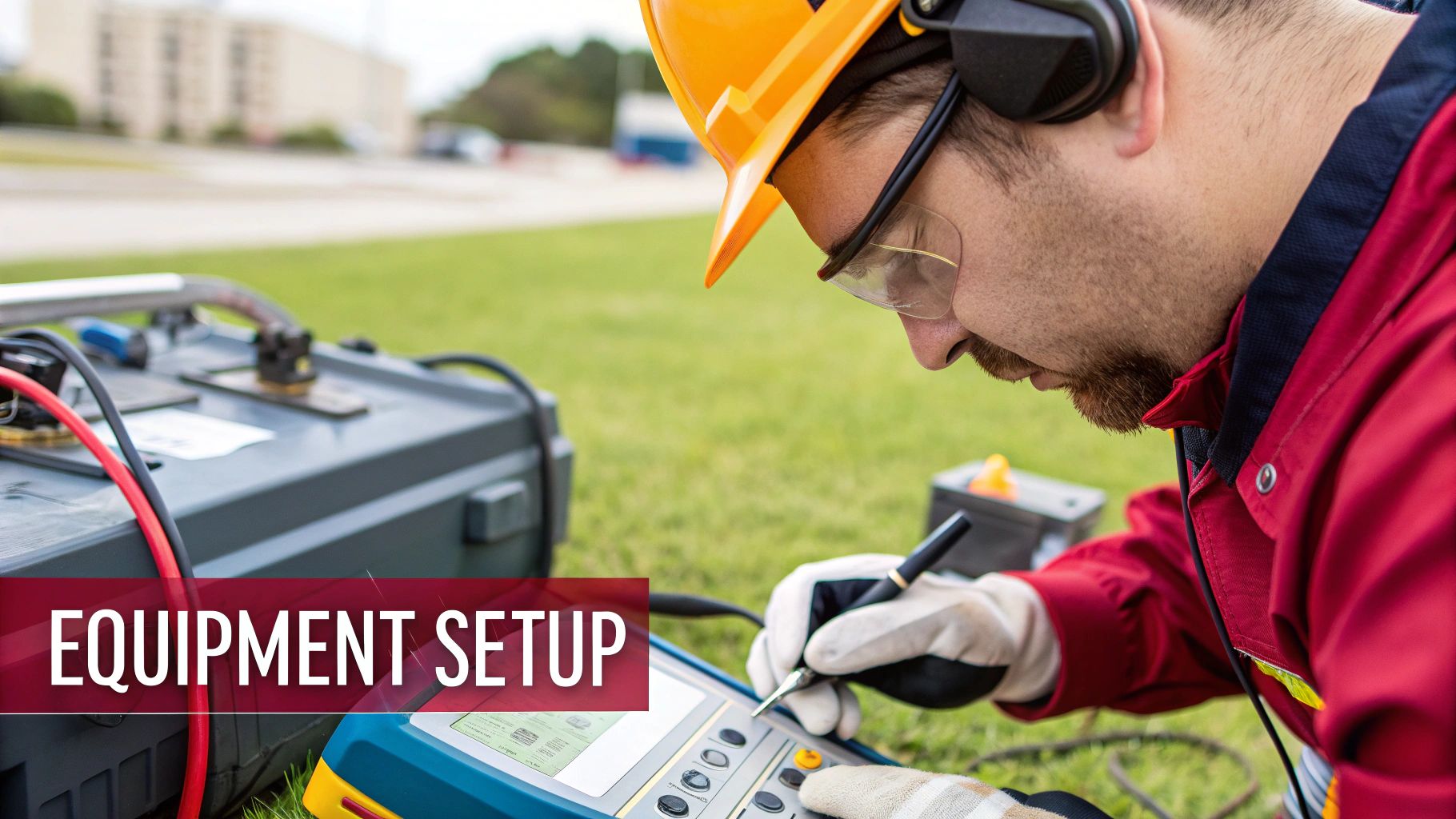
The setup can be compared to a professional audio recording system. The accelerometer acts as the high-fidelity microphone, capturing every subtle nuance of the vibration. The data logger functions as the digital recorder, capturing this signal with no loss of quality. Finally, the software serves as the mixing desk, where the raw data is meticulously broken down to identify critical frequencies and calculate the final, legally compliant exposure levels.
The Key Components of Your Toolkit
You cannot simply use any generic sensor; this task demands highly specialised equipment. A tri-axial accelerometer is an absolutely indispensable component. This is a single, sophisticated sensor capable of measuring vibration in all three directions simultaneously—up-and-down (z-axis), front-to-back (x-axis), and side-to-side (y-axis). Capturing this multi-directional data is the only way to correctly calculate the A(8) value as mandated by Australian standards.
The data logger must be powerful enough to record all three signals at a high frequency, ensuring that no important details are missed. The analysis software is where the critical processing occurs, applying the correct frequency weightings to transform the raw data into meaningful metrics, such as the Vibration Dose Value (VDV) and the daily exposure A(8).
A standard professional kit typically includes:
- Tri-Axial Accelerometers: These are the sensors that perform the primary task, sensitive enough to capture the full range of relevant vibrations.
- Mounting Adapters: The method of attaching the sensor is critical. This usually involves a purpose-built seat pad for vehicle operators or floor mounts for standing workers. The correct adapter ensures that the measurement reflects the vibration actually entering the person's body.
- Data Logger/Analyser: This is the central processing unit of the operation, recording all data from the accelerometer. Many modern units have integrated software, allowing for initial on-site checks.
- Analysis Software: Back in the office, this software is used to conduct a deep dive into the data, generate detailed reports, and compare the results against national exposure limits.
An uncalibrated accelerometer is like an untuned guitar—it will make a noise, but the result will be completely meaningless. Regular, certified calibration is your guarantee that the data you collect is accurate, reliable, and legally defensible.
Why Sensor Choice and Calibration Are Critical
Selecting the appropriate sensor and ensuring it is properly calibrated are arguably the two most crucial steps in the entire process. A seat pad accelerometer is the ideal tool for assessing a truck driver's exposure, but it is entirely unsuitable for a worker standing on a vibrating platform. The guiding principle is simple: the sensor must always be placed at the primary point where the vibration enters the body.
Furthermore, calibration is non-negotiable. This is the process of verifying the accelerometer's accuracy against a known, certified vibration source. Without regular calibration, the entire whole body vibration assessment is built on an unreliable foundation. It is a mandatory requirement for any professional assessment and a cornerstone of quality control in any serious vibration monitoring program. This rigorous approach ensures that when a high reading is recorded, you can be confident that it represents a real risk, not merely a sensor malfunction.
How to Conduct an Assessment and Analyse Data
Conducting a successful whole body vibration assessment is a far more involved process than simply attaching a sensor and pressing ‘record’. It is a systematic procedure that transforms raw, physical motion into clear, actionable data regarding worker safety. This journey begins with meticulous planning in the field and concludes with detailed analysis back at the office, with each step building upon the previous one to create a comprehensive and accurate picture of the risk.
The process commences with a critical planning phase. This involves identifying precisely which tasks, machinery, and job roles are most likely to result in significant vibration exposure. An excellent starting point is to review incident reports or health surveillance data to identify areas where workers have previously reported issues such as back pain or other musculoskeletal symptoms.
This initial investigative work helps to focus the assessment where it is most needed. It ensures that the measurements capture typical, everyday working conditions, rather than just an unrepresentative snapshot of the best or worst moments of a shift.
Setting Up for Success
Once you have identified where and when to conduct the measurements, the practical setup can begin. This involves placing a tri-axial accelerometer at the main point of contact between the worker and the vibrating surface. In most cases, this means using a specially designed seat pad placed directly on an operator’s chair.
It is absolutely vital that the sensor is positioned correctly and that the worker sits or stands on it exactly as they would during their normal work duties. From there, you will configure the data logger to record the vibration signals across all three axes (x, y, and z).
For a proper whole body vibration assessment, the measurement should cover a significant portion of the task. A good rule of thumb is to record for a minimum of 20 minutes to obtain statistically reliable data. If a single long session is not feasible, several shorter, repeated measurements can be taken and combined during the analysis phase.
Turning Raw Signals into Meaningful Metrics
The true value of the assessment is unlocked during data analysis. The raw vibration signals from the accelerometer are essentially a long, complex stream of numbers. To make any sense of them, they must be processed to calculate the key metrics recognised by Australian standards: the daily exposure A(8) and the Vibration Dose Value (VDV), the latter being particularly important when shocks and jolts are a significant component of the exposure.
A crucial step in this process is frequency weighting. This can be compared to a sophisticated equaliser on a stereo system. The human body is much more susceptible to damage from vibrations at certain frequencies. Frequency weighting is a digital filter that gives more emphasis to the most harmful frequencies and less to those that are not as damaging.
At its heart, data analysis in a WBV assessment is about translating complex vibration physics into a simple risk indicator. By applying frequency weighting and calculating the A(8) value, we can directly compare a worker's exposure to the national safety limits.
For whole-body vibration, specific weighting curves are used (such as Wk for the vertical z-axis and Wd for the horizontal x- and y-axes). This ensures that the final exposure value accurately reflects the genuine physiological risk to the worker.
This structured flow—from capturing the raw signal to interpreting the final result—is what transforms a technical measurement into a powerful tool for enhancing workplace safety.
To provide a clearer picture, here is a breakdown of the entire assessment process from start to finish.
Whole Body Vibration Assessment Process
| Stage | Key Activities | Critical Considerations |
|---|---|---|
| 1. Planning & Scoping | Identify high-risk tasks, roles, and machinery. Review incident reports and worker feedback. | Ensure the measurement period reflects a typical workday. Avoid measuring only "best" or "worst" case scenarios. |
| 2. Measurement & Setup | Position tri-axial accelerometer (e.g., seat pad). Configure data logger. | Correct sensor placement is non-negotiable. The worker must perform their tasks as they normally would. |
| 3. Data Collection | Record vibration for a representative duration (min. 20 minutes). | Document all activities, ground conditions, and machine speeds during the measurement to add context to the data. |
| 4. Data Analysis | Apply frequency weighting (Wk, Wd). Calculate A(8) and VDV values from raw data. | Incorrect weighting will lead to inaccurate risk assessment. Use software that complies with AS 2670.1. |
| 5. Interpretation & Reporting | Compare A(8) value to national exposure action and limit values. | The numbers tell a story. Link the results back to the specific tasks that contribute most to the daily dose. |
| 6. Action & Mitigation | Develop and implement control measures if exposure values are exceeded. | Prioritise controls based on the hierarchy of control—elimination, substitution, engineering, admin, PPE. |
This structured approach ensures that every assessment is thorough, reliable, and ultimately useful for making informed safety decisions.
Interpreting the Results for Safety Decisions
After all the data has been processed, you are left with clear, concise figures. The A(8) value represents the worker's total daily vibration dose, which can be directly compared against the national Exposure Action Value of 0.5 m/s² and the Exposure Limit Value of 1.15 m/s².
If the A(8) value exceeds the action level, it is a clear signal that control measures must be implemented. If it is approaching the limit value, immediate and decisive action is essential. This data-driven approach removes the guesswork from safety management, allowing you to confidently prioritise interventions—such as upgrading seats, improving road surfaces, or introducing job rotation—and ensuring that your efforts are targeted squarely at the most significant risks.
Practical Strategies to Control Vibration Exposure
Once you have completed a whole body vibration assessment and the data indicates a risk, the focus must shift from measurement to mitigation. The primary objective is straightforward: reduce worker exposure to levels below the established safety limits.
In Australia, the hierarchy of controls provides an excellent framework for this process. It is a core concept in Work Health and Safety (WHS) legislation and is designed to prioritise the most effective and reliable solutions first. It should be viewed not as a simple list but as a strategic roadmap, starting with high-impact solutions that eliminate the hazard entirely and then working down to less effective controls.
In most situations, an effective control plan will not rely on a single solution. It is typically a well-considered combination of different strategies that, when implemented together, create a genuinely safer working environment.
Elimination and Substitution
Positioned at the top of the hierarchy are the two most powerful types of controls.
First, elimination. This involves asking the most fundamental question: can we remove this vibrating task altogether? For example, this might mean introducing automated guided vehicles (AGVs) to handle materials in a warehouse, thereby completely eliminating the need for a human to operate a forklift in that specific area.
If elimination is not feasible, the next best option is substitution. This is about replacing high-vibration equipment with a better, lower-vibration alternative. A classic example in the mining and construction sectors is retiring an old, bone-rattling dozer and investing in a modern machine. Newer models featuring advanced suspension systems and well-isolated cabins can reduce vibration exposure by up to 50%.
Engineering and Administrative Controls
When the source of the vibration cannot be eliminated or substituted, you must get creative. This is where engineering controls come into play—physically modifying the equipment or the environment to isolate people from the hazard. This is often where some of the most significant and immediate improvements can be made.
A few common engineering solutions include:
- Installing vibration-dampening seats: A high-quality, air-suspension seat is not a luxury; it is a critical piece of engineering that can drastically reduce the vibrations reaching an operator.
- Improving road surfaces: It may sound basic, but maintaining smooth haul roads on a mine site or well-kept pathways in a factory makes a massive difference. Fewer bumps and jolts directly translate to less vibration at the source.
- Keeping machinery in top condition: Regular, routine maintenance is essential. Properly inflated tyres and fully functional suspension systems are non-negotiable for keeping vibration levels in check.
Next in the hierarchy are administrative controls, which focus on changing the way people work. These are crucial for managing any residual risk that cannot be fully engineered out. A common tactic is job rotation, where workers are cycled between high-vibration and low-vibration tasks to ensure no one exceeds their daily exposure limit. For example, a grader operator might spend three hours on the machine and then switch to a less intense, ground-based task for the remainder of their shift.
It is worth noting that these same principles apply to other types of vibration risks. We cover this in more detail in our guide on how to conduct a hand-arm vibration assessment.
An effective control strategy is rarely a single solution. It is typically a blend of well-maintained equipment, carefully planned work schedules, and a well-informed workforce.
Beyond these formal controls, simple, practical health advice plays a significant role. Educating workers about preventing lower back pain through improved posture and specific exercises empowers them to take an active role in protecting their own health. By weaving all these measures together, you can systematically address the identified risks and, most importantly, safeguard the wellbeing of your team.
Common Questions About WBV Assessment
As we conclude this guide, you may still have a few practical questions. Let's address some of the most common inquiries to ensure everything is perfectly clear.
What's the Difference Between Whole Body and Hand Arm Vibration?
It is easy to confuse these two types of vibration, but they are fundamentally different in how they affect the body and the health risks they pose.
Whole Body Vibration (WBV) is the type of vibration that is transmitted through the seat or feet, affecting the entire body. Driving a truck or operating heavy earthmoving machinery are classic examples. The primary health risk associated with WBV is the development of long-term, chronic back pain and other musculoskeletal disorders.
Hand-Arm Vibration (HAV), in contrast, is much more localised. It is the vibration experienced when using handheld power tools such as jackhammers, chainsaws, or grinders. This type of exposure can lead to a debilitating condition known as Hand-Arm Vibration Syndrome (HAVS), which causes damage to the nerves and blood vessels in the hands and fingers. Because these two hazards are so different, they are governed by their own unique standards, measurement techniques, and control methods.
How Often Should a WBV Assessment Be Done?
There is no single, rigid rule stipulated in legislation that mandates testing every "X" number of years. The key is to begin with an initial, comprehensive assessment to establish a solid baseline of the risks associated with different jobs and machines within your workplace.
A new assessment becomes absolutely critical whenever things change. Think new machinery, a different way of doing a job, or if workers start reporting aches and pains that could be linked to vibration.
As a matter of good practice, it is advisable to review your risk assessments every few years regardless. This ensures that your control measures are still effective and continue to keep your team safe.
Can I Just Use a Smartphone App to Measure WBV?
In short, the answer is no. While it might seem like a convenient and cost-effective shortcut, a smartphone app is not a suitable tool for conducting a proper, compliant WBV assessment.
While a phone's internal sensors can detect vibration, they lack the sensitivity, accuracy, and specific frequency response required for a reliable measurement. Most importantly, they cannot be calibrated to meet the stringent requirements of Australian Standards.
For any assessment that needs to be legally defensible and trusted by regulatory bodies, you must use calibrated, professional-grade equipment. A smartphone app might serve as an interesting experiment, but its results are entirely unsuitable for making serious health and safety decisions.
Is Health Surveillance Required for WBV Exposure?
Yes, it is often a requirement. If your risk assessment identifies that workers are exposed to vibration levels that pose a genuine risk to their health, implementing a health surveillance program becomes a key part of your responsibility under WHS regulations.
This typically involves arranging regular check-ups with an occupational health professional. These check-ups are designed to monitor for the early warning signs of musculoskeletal issues or other health problems before they can develop into serious, long-term injuries. It is a proactive measure to protect your workforce and a vital component of any robust WBV management plan.
At Anitech Ltd Pty, we provide expert occupational hygiene services to help you navigate the complexities of workplace safety. Our scientific approach ensures your whole body vibration assessment is accurate, compliant, and provides actionable insights to protect your team. Learn more about how we can support your business.


