
A workplace health and safety audit is essentially a deep-dive, systematic review of your organisation's safety management systems, its procedures, and the actual work environment itself. The goal is to pinpoint potential hazards, get a real sense of risk levels, and make sure everything lines up with legal standards before something goes wrong. It's so much more than a box-ticking exercise; it's a vital tool for building a genuinely resilient safety culture.
Why a Safety Audit Is More Than a Checklist
Let's get one thing straight: a workplace health and safety audit isn't just about satisfying regulators. Think of it as a proactive health check for your entire safety culture. It's hands-down the most effective way to uncover hidden risks and systemic weaknesses long before they escalate into costly, and sometimes tragic, incidents. A thorough audit doesn't just protect your employees—it protects the very foundation of your business.
When done right, an audit gives you a clear, objective snapshot of what’s really happening on the ground, away from the jargon in the manual. It forces you to ask the hard questions: Are our safety procedures actually being followed every day? Is the equipment properly maintained, or are we cutting corners? Does the team feel safe enough to report hazards without worrying about getting in trouble? The answers to these questions reveal the true health of your safety program.
The Real-World Impact of Proactive Audits
The consequences of dropping the ball on workplace safety are stark and sobering. Recent statistics from Safe Work Australia paint a grim picture: over the last decade, more than 1,850 Australian workers have died from work-related injuries. On top of that, over 1.14 million serious workers’ compensation claims were lodged.
These aren't just abstract figures; they represent families, communities, and businesses that have been permanently scarred by preventable incidents. Adopting a preventative, safety-first mindset—and verifying it with regular audits—is one of the smartest investments any business can make. To really grasp this, it helps to look at foundational documents like these crucial health and safety policy examples that form the backbone of a company's safety commitment.
A safety audit forces you to look beyond the immediate task and evaluate the system that supports it. It’s not about catching people doing something wrong; it’s about discovering why it was possible for something to go wrong in the first place.
This process is a cornerstone of any robust safety management system. It's about weaving safety into the fabric of every decision, rather than treating it as an afterthought.
Safeguarding Your Business Reputation and Bottom Line
Beyond the undeniable human cost, workplace incidents inflict serious financial and reputational damage. The direct costs, like workers' compensation and medical bills, are often just the tip of the iceberg. It's the indirect costs that can really cripple a business.
Think about the ripple effect of a single safety failure:
- Operational Downtime: Production grinds to a halt during investigations, leading to lost revenue and blown project deadlines.
- Legal and Regulatory Fines: Breaches of Work Health and Safety (WHS) laws can result in crippling penalties for both the company and its directors.
- Increased Insurance Premiums: A poor safety record inevitably leads to higher insurance costs, eating directly into your profitability.
- Damaged Reputation: A major incident can shatter trust with customers, investors, and the community, making it incredibly difficult to attract and retain good people.
A comprehensive workplace health and safety audit acts as a powerful shield against these threats. It systematically uncovers compliance gaps and operational hazards, giving you the chance to implement corrective actions before it’s too late. This isn't just about preventing harm; it's about demonstrating due diligence and fostering a culture of care that strengthens your entire business. This proactive mindset is a core principle in the field of occupational hygiene, which focuses on anticipating and controlling workplace hazards.
How to Prepare for a Successful Safety Audit
A successful workplace health and safety audit kicks off long before an auditor ever sets foot on your site. Honestly, getting your house in order beforehand is the real secret. It's what separates a stressful, last-minute scramble from a smooth review that actually makes your workplace safer. Think of it as laying the groundwork so the audit can uncover genuine opportunities to improve, not just tick boxes.
If you rush this initial phase, you’re bound to miss things. Details get overlooked, information is incomplete, and the whole exercise becomes far less valuable. A bit of structured preparation ensures the audit is focused, efficient, and delivers results you can actually act on.
Assemble Your Audit A-Team
First things first, you need to pull together a solid internal team. This is absolutely not a job to be dumped solely on the safety manager. A truly effective audit needs a mix of perspectives to get a complete, 360-degree view of what’s really happening on the ground.
This group will be your task force—they'll be the ones chasing up documents, liaising with different departments, and acting as the main point of contact for the auditor. A great team usually includes:
- A Manager or Two: You need senior people who can sign off on resources and drive any changes that come out of the audit.
- Your Safety Officer: This is your in-house expert who lives and breathes the legislation and your own safety systems.
- People from the Floor: Get a few workers from different areas. They know the daily tasks, the unofficial workarounds, and the real-world hazards that are never written down in a manual.
- Maintenance or Engineering Crew: These folks know the true condition of your machinery, equipment, and the building itself.
Getting this blend of people in a room is pure gold. You get the high-level strategic view balanced with the critical, granular details from the people doing the work. For more complex sites, don't be afraid to bring in outside help. For instance, if you’re dealing with things like airborne dust or chemical fumes, getting advice from professional occupational hygiene consultants is a smart move.
Define a Clear and Realistic Audit Scope
With your team assembled, it's time to get specific about the audit's scope. Trying to audit everything all at once is a recipe for disaster—it's overwhelming and you won't do any of it well. You need to be strategic about what this particular workplace health and safety audit is meant to achieve.
Are you aiming for a comprehensive, wall-to-wall review of the entire operation? This is often necessary for major certifications or compliance checks. Or maybe you just need to zero in on a specific high-risk area, like your chemical storage, a particular production line, or your manual handling procedures.
Defining a clear scope stops "audit creep"—that all-too-common situation where an inspection goes off on tangents and loses focus. It keeps your time and resources pointed at the areas where they’ll make the biggest difference.
A tight scope acts as a roadmap for everyone involved. It clearly lays out the physical areas, the work processes, and the specific legal standards being reviewed, making sure your team and the auditor are on the same page from day one.
Gather Your Essential Documentation
Now you can start pulling together all the necessary paperwork. An auditor needs to see hard evidence that your safety management system is a living, breathing part of your business, not just a dusty folder on a shelf. Having this stuff organised and ready to go shows you’re prepared and have nothing to hide.
Here’s a quick checklist of the documents you’ll want to have on hand:
- Past Audit Reports: Show a history of improvement and that you've followed up on previous recommendations.
- Incident and Near-Miss Logs: These give a clear picture of recurring problems and how well your investigation process works.
- Risk Assessments & Safe Work Procedures (SWPs): This is the core proof of how you identify and control hazards.
- Training Records: You need to show that your people are properly trained and competent for their roles.
- Equipment Maintenance Logs: This is the evidence that your machinery is regularly inspected and safe to use.
- Emergency Plans and Drill Records: Proof that your team knows what to do when things go wrong.
Getting these documents sorted out before the audit saves a huge amount of time later on. It frees the auditor up to spend more time on-site, observing work and talking to your people—which is often where the most valuable insights come from.
Alright, you've done the prep work, gathered the documents, and have your game plan. Now it's time to get out on the floor. This is where the rubber meets the road—the on-site inspection.
The real goal here is to see how work actually gets done, not just how the manual says it should be done. Anyone can tick a box on a checklist. The real skill is in understanding why things are the way they are. Spotting an unguarded machine is easy. Finding out the guard was taken off because it slows production by 15%? That’s digging into a systemic issue. You're moving from treating a symptom to curing the disease.
The on-site part of the audit is the critical link between planning and action, as you can see below.
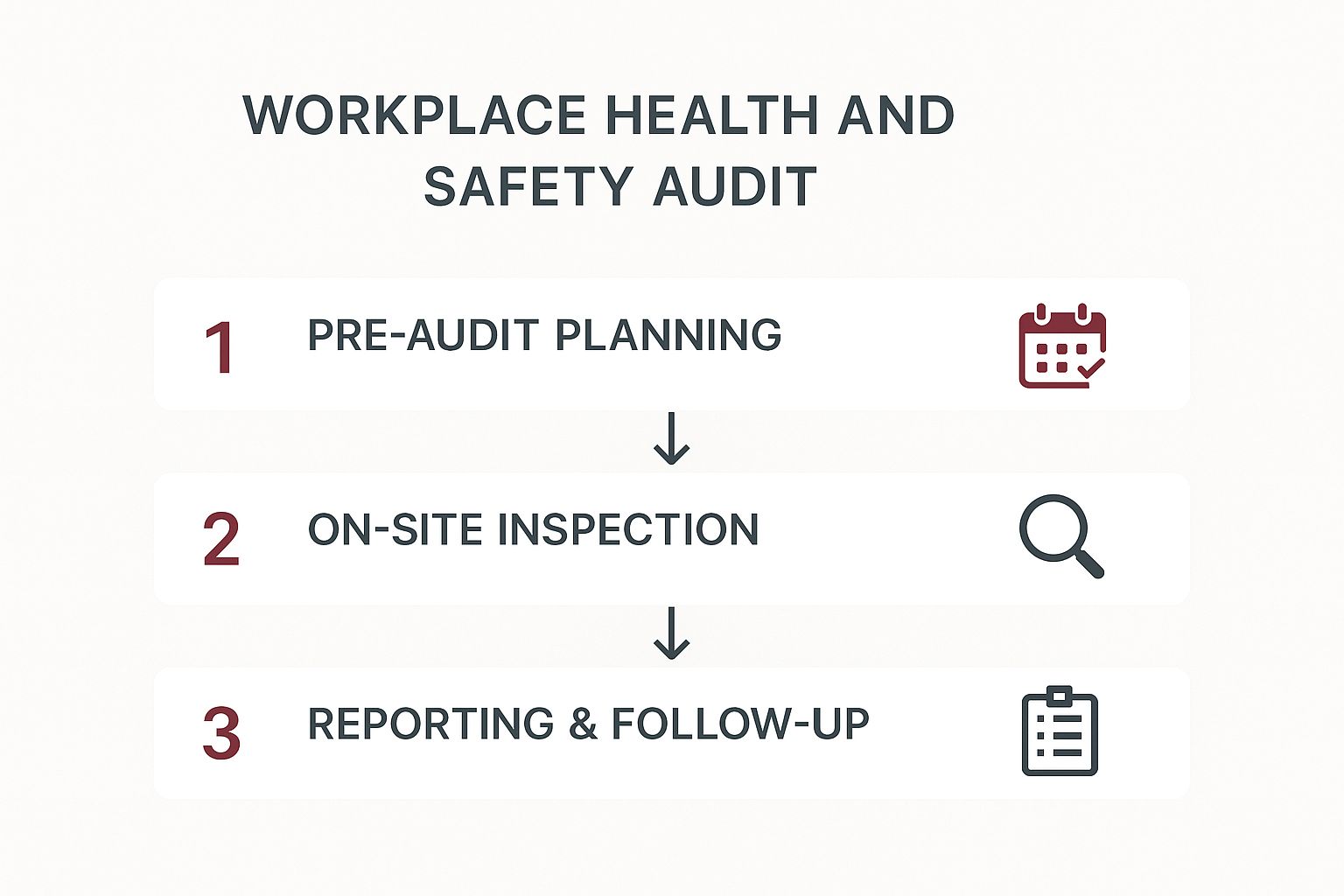
This visual really drives home that a proper workplace health and safety audit isn't a one-off event. It's a continuous cycle where each step feeds into the next, all aimed at making the workplace genuinely safer.
Be a Fly on the Wall
Some of the best insights you'll ever get come from simply observing the normal rhythm of the workday. The moment you announce a major inspection, people's behaviour can change. Suddenly, everyone is following the rules perfectly. It's a natural reaction, but it can hide the very risks you need to uncover.
Your best bet is to be a quiet observer. Walk the site methodically. Don't just zero in on the high-risk machinery; wander through the storage areas, check the walkways, even pop into the offices. Watch how people move and interact with their workspace. Are they using makeshift shortcuts? Are fire exits blocked with a pallet "just for a minute"? These are the everyday risks that often become invisible to the people who see them daily.
Talk to the Experts: Your Employees
Let's be clear: your employees are the true experts on their jobs. They know which machine is always acting up, the informal workarounds everyone uses, and the near-misses that never get reported. Getting them to share this knowledge is absolutely critical.
Forget stuffy, formal interviews. That just puts people on the defensive. Instead, aim for casual chats while they're at their workstation. Ask open-ended questions that get them talking:
- "Can you just walk me through your process here?"
- "What's the most frustrating part of this particular task?"
- "Ever had any close calls in this area?"
The key is to listen more than you talk. An offhand comment like, "Oh, that guard is a pain, we usually just leave it off," is a massive red flag. It's a goldmine of information you'll never find in a safety manual.
The point of these conversations is to gather insights, not to play the blame game. As soon as your team sees you're genuinely trying to make their jobs safer—not catch them doing something wrong—they'll become your biggest asset in spotting hazards.
In Australia, a recent review of workplace audits found a common blind spot: businesses often only do them once a year and fail to involve the people on the frontline. This approach is bound to miss the day-to-day risks that only your team would know about.
A Systematic Eye for Detail
While you want to avoid a "tick-and-flick" mentality, you still need a structured way to make sure nothing gets missed. A good on-site inspection breaks the workplace down into a few key components.
To give you a clearer idea, here’s a breakdown of the typical areas I focus on during an inspection.
Key Focus Areas During an On-Site Audit
| Focus Area | What to Inspect | Common Non-Compliance Issues |
|---|---|---|
| Physical Hazards | Walkways, stairs, flooring, cabling, and general housekeeping. | Blocked walkways, trailing cables, uneven surfaces, poor lighting. |
| Chemical Safety | Storage cabinets, labelling, container integrity, availability of Safety Data Sheets (SDS). | Unlabelled containers, incorrect storage (e.g., flammables near ignition sources), missing or outdated SDS. |
| Machine Guarding | Guards, interlocks, emergency stops on all machinery with moving parts. | Missing or disabled guards, broken E-stops, lack of 'lockout/tagout' procedures for maintenance. |
| Emergency Preparedness | Exit routes, fire extinguishers, first aid kits, assembly points. | Obstructed exits, expired extinguishers, incomplete first aid supplies, signage that's unclear or missing. |
| Work Processes | Observation of tasks, use of PPE, manual handling techniques, adherence to Safe Work Procedures (SWPs). | PPE not being worn correctly (or at all), improper lifting, shortcuts that deviate from established SWPs. |
This table isn't exhaustive, but it provides a solid framework to ensure you're systematically covering the most critical areas where things can go wrong.
Beyond the obvious physical stuff, you're also observing how the work is actually being done. Do people's actions match the Safe Work Procedures you reviewed earlier? Are they using the right PPE for the task, or has it been forgotten?
Finally, don't forget the environment itself. Check things like the lighting, noise levels, and ventilation. Poor indoor air quality, for example, is a serious long-term health risk that often flies under the radar. We've actually put together a detailed guide on methods for improving indoor air quality that's worth a read. This part of the audit helps you spot the slower, more insidious hazards that impact health over time.
Turning Your Audit Findings Into a Report That Drives Action
Let's be honest. The real value of a safety audit isn't found in the checklists you tick off or the photos you take. It's in the story that all that data tells. After you've walked the floor, talked to the team, and gathered your notes, you're left with a mountain of information. The next, and most critical, part of the job is turning that raw data into a clear, compelling report that actually gets things done.
A dense, overly technical document will just end up collecting dust on a shelf. All that effort, wasted.
Your goal is to create a practical guide that gives leadership the clarity they need to make smart decisions. It needs to be direct, easy to digest, and laser-focused on solutions. Always remember who you're writing for—they're busy people who need to quickly understand what's wrong and what it's going to take to fix it.
Structuring Your Report for Maximum Impact
A well-structured report is an effective one. Resist the temptation to just dump your findings in chronological order. Instead, you need to organise everything logically, guiding the reader from the big picture right down to the nitty-gritty details. This way, even the busiest executive can skim the key takeaways in a few minutes.
From my experience, a powerful report always has four key parts:
- Executive Summary: Think of this as the one-page snapshot. It should summarise the most critical findings and your highest-priority recommendations. It's often the only part a senior leader will read in full.
- Methodology and Scope: A quick, no-fluff explanation of how, when, and where you conducted the audit. This sets the boundaries and clarifies what was (and wasn't) covered.
- Detailed Findings: This is the heart of the report. Here, you lay out the evidence for each issue you identified, complete with photos and specific examples.
- Prioritised Recommendations: An actionable list of what needs to be done. The key here is to categorise your recommendations by urgency and potential impact.
This structure respects everyone's time while still providing the depth needed for the managers and teams who will be implementing the changes.
Writing for a Leadership Audience
When you're presenting findings to management, you have to speak their language. Sure, a missing machine guard is a safety issue. But to them, it's also a business risk. Your job is to frame your findings in terms of their potential impact on the business—operationally, financially, and reputationally.
For instance, instead of just writing, "Inadequate chemical storage," try phrasing it like this: "Improper storage of flammable liquids in the main workshop presents a significant fire risk. This could trigger a complete production halt, result in major asset loss, and expose the company to significant regulatory fines." See the difference? You've connected a safety gap directly to tangible business consequences, which builds a much stronger case for taking immediate action.
The best audit reports don't just point out problems; they build a compelling business case for solving them. When you link safety improvements to risk reduction, operational continuity, and the bottom line, you elevate the conversation from a compliance chore to a strategic imperative.
This shift in mindset is crucial. You're not just a safety inspector; you're a trusted risk advisor helping to protect the entire organisation.
Categorising Findings by Severity
Not all risks are created equal. A cluttered walkway is a problem, no doubt, but it doesn't carry the same immediate threat as an unserviced high-pressure vessel. To help management focus their attention and resources where they're needed most, you absolutely must categorise your findings by severity.
This risk-based approach is the cornerstone of any effective workplace health and safety audit report. A simple and incredibly effective system uses a three-tier model:
- Critical: These are the showstoppers. Issues that pose an immediate and severe risk of fatality, serious injury, or catastrophic equipment failure. They're often a direct breach of safety legislation and demand immediate action. Think exposed live wiring or a faulty E-stop on a major piece of machinery.
- Major: These findings represent a significant hazard that could easily lead to a recordable injury or illness if ignored. This could be something like a consistent failure to use required PPE in a high-noise area or noticing a pattern of blocked fire exits across the site.
- Minor: These are lower-risk issues or what I like to call opportunities for improvement. While not immediately dangerous, they can contribute to an incident over time or signal a creeping complacency in the safety culture. Examples might include outdated signage, minor housekeeping issues, or gaps in training records.
By clearly labelling every single finding with one of these categories, you provide an instant visual cue. It directs attention and resources to the biggest dangers first, transforming your report from a long, overwhelming list of problems into a clear, actionable roadmap for creating a safer workplace.
From Report to Resolution: Driving Continuous Improvement
The workplace health and safety audit process doesn't really end when you file the report. In fact, that's where the real work begins. Think of the audit report as your roadmap; now it's time to actually make the journey and turn those recommendations into tangible safety improvements.
This final phase is all about action. It’s about taking what you've found and building a solid plan, tracking your progress, and weaving these lessons into the DNA of your company culture. Without this follow-through, even the most detailed audit is just a box-ticking exercise.
Building a Powerful Corrective Action Plan
Once the report is finalised, your first job is to build a Corrective Action Plan (CAP). This isn't just another to-do list. A proper CAP is a formal, strategic document that puts names and dates next to every issue found during the audit.
A strong CAP breaks down each recommendation into clear, manageable tasks. For every single item, it needs to spell out:
- Who is responsible? Name a specific person, not just a department. This creates clear ownership and means someone is accountable for getting it done.
- What needs to be done? Be specific. "Fix machine guard" is too vague. "Fabricate and install a new steel mesh guard on the main press, compliant with AS 4024" leaves no room for guesswork.
- When is the deadline? Set realistic but firm deadlines. This adds a sense of urgency and stops important safety fixes from falling to the bottom of the pile.
- How will success be measured? Define what "done" actually looks like. It could be a photo of the completed repair, an updated training record, or a supervisor's sign-off.
This structured approach turns your audit from a reactive chore into a proactive tool for genuinely improving workplace safety.
A Corrective Action Plan moves your organisation from knowing what's wrong to knowing who will fix it, by when, and how. It's the essential bridge between a finding and a resolution, making continuous improvement a deliberate and measurable process.
This focus on continuous improvement is what safety experts have been saying for years. Looking at workplace safety data, it's clear that audits are a powerful strategic tool for Australian businesses. The best practice is to constantly review incident reports, audit results, and training effectiveness to sharpen your safety strategies and focus on the areas that will make the biggest difference.
Verifying Solutions and Fostering a Safety Culture
Just because a task is marked as 'complete' on the CAP doesn't mean the job is over. The next crucial step is verification. You have to go back and check that the solution has been implemented correctly and is actually working. This might mean a quick follow-up inspection or just a conversation with the team on the floor.
This verification loop is vital. It closes the circle, confirming the fix is effective and preventing the same hazard from popping up in your next workplace health and safety audit.
Ultimately, the goal is to use these insights to create a cycle of continuous improvement. An audit might show that a specific procedure is always being ignored. This isn't just about non-compliance; it's a chance to learn. Maybe the procedure is clunky and impractical, or perhaps the training didn't stick.
This is where you might need to develop new or better procedures. Knowing how to create SOPs that your team will actually use is a game-changer here, ensuring new safety measures are truly embedded. By using what you learn from audits to refine training, update policies, and get employees involved, you build a safety culture that gets stronger over time.
Got Questions About WHS Audits? We've Got Answers
Even with a detailed plan in hand, you're bound to have questions when you start digging into the nitty-gritty of a workplace health and safety audit. Getting clear answers to these common queries can turn a daunting task into a genuinely useful process. Here are some of the most frequent questions we hear from organisations just like yours.
How Often Should We Be Doing a WHS Audit?
This is the big one, and the honest answer is, "it depends." There’s no magic number that works for every business. The right frequency for your workplace health and safety audit really comes down to your specific environment and the risks involved.
For businesses in higher-risk sectors—think construction, manufacturing, or mining—an in-depth audit every year is a solid benchmark. But for lower-risk places like a typical office, you might be fine with a comprehensive review every two or three years.
That said, some events should trigger an immediate audit, no matter when your last one was:
- After a serious incident or a major near-miss. You need to know what went wrong, and why.
- Following big operational changes, like bringing in new machinery or introducing different chemical processes.
- When WHS legislation changes in a way that impacts how you work.
The trick is to stop thinking of audits as just a date on the calendar. They’re a dynamic tool for managing risk as it evolves.
Internal vs. External Audits: What's the Difference?
Knowing when to use an internal audit versus an external one means you're always using the right tool for the job. They both play a crucial, but different, role in keeping your workplace safe.
An internal audit is carried out by your own people—perhaps a dedicated safety officer or even a committee of staff from different departments. These are brilliant for regular check-ups. They help build a sense of ownership among your team and are great for spotting and fixing smaller issues quickly before they become big ones.
An external audit, on the other hand, brings in an independent expert. This gives you a completely fresh, unbiased perspective, free from internal blind spots or the classic "but we've always done it this way" mentality. You'll need an external audit for formal certifications, like ISO 45001 and occupational hygiene, or when you want a truly objective measure of your safety performance.
It's not about choosing one or the other. The best strategy is to use them together. Regular internal audits keep your safety systems ticking over, while an external audit every so often validates all your hard work and offers those deeper, impartial insights.
How Can We Get Truly Honest Feedback From Our Team?
This is the secret sauce. A successful audit hinges on getting genuine buy-in from your employees. If they think it's an exercise in catching them out, you won't get the on-the-ground information that matters most. It all comes down to trust.
Start by being crystal clear about the "why" behind the audit. Make it obvious that the goal isn't to point fingers but to make their work environment safer for everyone. Frame it as a team effort to find solutions together.
When it comes time for the on-site part of the audit, skip the stuffy, formal interviews. Instead, have natural conversations with people right where they work. Ask open-ended questions like, "What's the one thing that slows you down or feels unsafe about this task?" It’s a far less intimidating way to get candid feedback about the day-to-day realities of their job. Reassuring them that their input is confidential and will be used to make positive changes is absolutely essential.
A thorough workplace health and safety audit is your best defence in protecting both your people and your business. For expert guidance and professional occupational hygiene services designed for your industry's unique challenges, you can trust the team at Anitech. See how our scientific approach can strengthen your safety systems by visiting us at https://occhygiene.com.au.
Article created using Outrank


