
Imagine knowing how to spot a danger zone before you even step inside. That’s really what asbestos awareness training is all about. It’s not about turning you into a licensed removalist overnight. Instead, it’s about giving you the critical know-how to identify potential asbestos, truly understand the massive health risks, and know exactly what to do to prevent exposure. Think of it as your first line of defence against a silent, invisible killer.
Why Asbestos Awareness Training Is So Important
You can think of asbestos awareness training as first aid for building safety. It gives you the essential skills to recognise a serious hazard and react the right way, protecting yourself and everyone around you. For Australia's tradies, site managers, and anyone who sets foot in buildings constructed before the nationwide ban in 2004, this knowledge isn't just helpful—it's a non-negotiable part of a safe career.
The legacy of asbestos is woven into the very fabric of Australia's built environment. It’s in the 'fibro' sheeting on countless suburban homes, the insulation in commercial buildings, old vinyl tiles, and even decades-old sealants. When these materials are left alone, the risk is fairly low. But the moment they are drilled, cut, sanded, or broken, they release a cloud of microscopic fibres into the air.
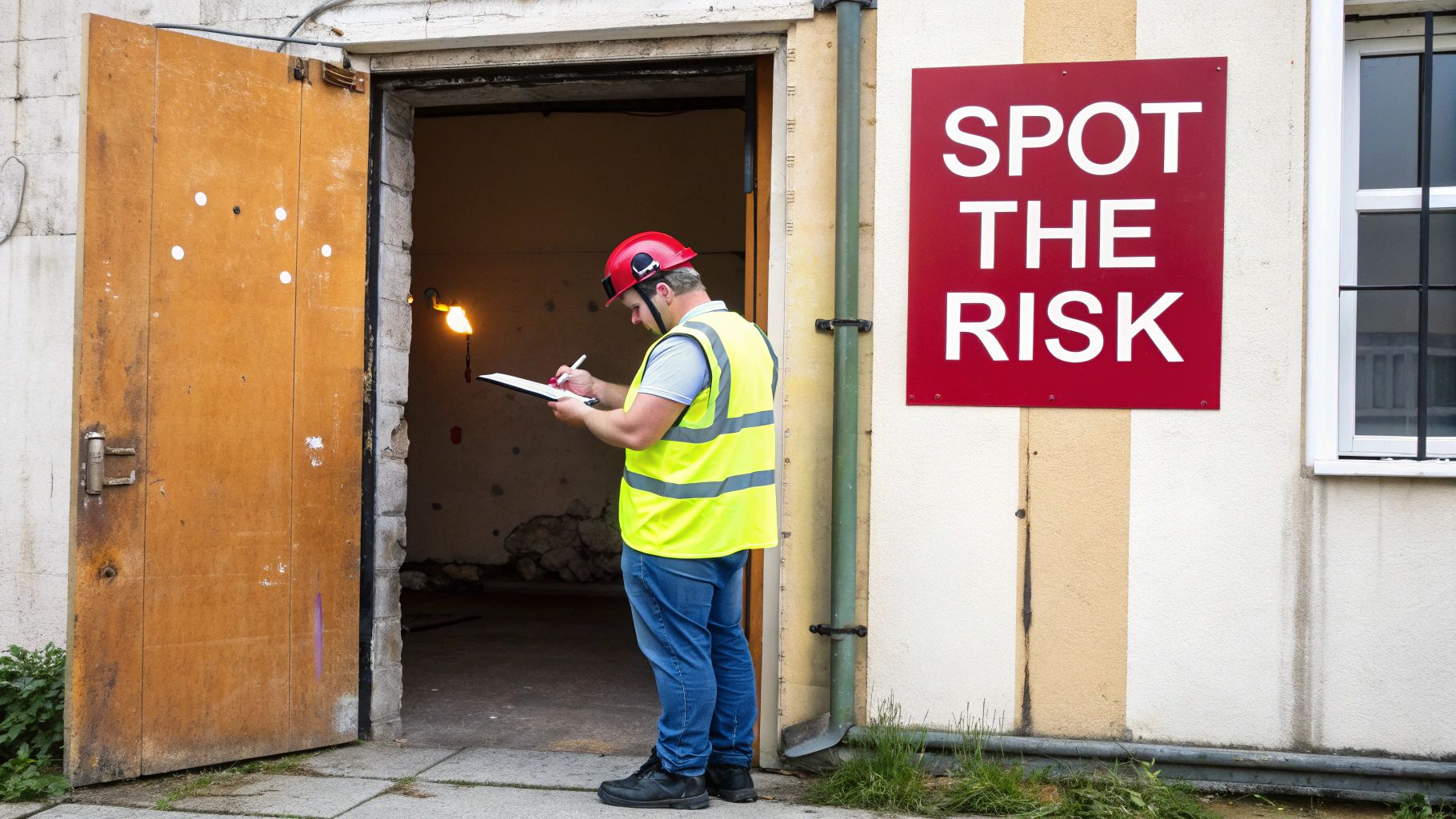
Understanding the Invisible Threat
Unlike a cut from a tool or a fall from a ladder, the damage from asbestos exposure is dangerously delayed. Those tiny fibres can get lodged in the lungs and sit there, dormant, for decades before causing fatal diseases like mesothelioma, asbestosis, and lung cancer. It’s this long latency period that creates a false sense of security, making proactive education the only effective way to stay safe.
And it's not just a problem on professional worksites. Experts have been warning that the peak of asbestos-related diseases among DIY home renovators—people who unknowingly disturbed asbestos during a weekend project—may not have even hit yet. This just goes to show how critical broad public awareness and proper training really are.
This is precisely why professional training is so vital. It closes the gap between guessing and knowing, teaching workers how to identify suspected materials and, most importantly, follow the correct procedure—which always starts with stopping work and reporting the discovery immediately.
A Foundation of Safety and Compliance
Beyond keeping people safe, completing asbestos awareness training is a cornerstone of legal compliance in Australia. Work Health and Safety (WHS) regulations put a strict duty of care on employers and PCBUs (Persons Conducting a Business or Undertaking) to manage asbestos risks properly. Part of that legal duty is making sure any worker who could reasonably encounter asbestos is properly trained.
Training empowers workers not just to protect themselves, but to actively contribute to a safer work environment for everyone on site. It transforms the workforce from potential victims of exposure into vigilant guardians of collective safety.
Meeting this obligation is fundamental to upholding high https://occhygiene.com.au/australian-workplace-safety-standards/, where preventing harm is always the top priority. When you equip your team with this knowledge, you're not just ticking a box; you're showing a real commitment to their safety, cutting the risk of costly project shutdowns, and protecting your business from serious legal trouble.
The Practical Benefits of Being Prepared
The value of this training filters down into daily operations, offering real-world advantages that go way beyond simple compliance. Before you get into the specifics of a course, it’s a good idea to figure out what your team already knows and where the gaps are. A thorough training needs assessment is the perfect tool for this.
Once your team is trained, you'll notice a few key changes:
- More Confident Workers: They can walk onto jobs in older buildings knowing what to look for, which cuts down on anxiety and guesswork.
- Smarter Risk Assessments: A trained eye can spot potential hazards that others would easily miss, leading to better risk management on the fly.
- The Right Emergency Response: Knowing exactly what to do—and what not to do—if asbestos is accidentally disturbed can stop a minor incident from becoming a major health disaster.
- A Stronger Safety Culture: When everyone on site speaks the same language of safety, it reinforces best practices and makes everyone responsible for looking out for each other.
At the end of the day, asbestos awareness training is an investment in people's lives. It gives them the essential knowledge needed to navigate the hidden dangers in countless Australian buildings, ensuring that today's work doesn't lead to a devastating diagnosis decades down the track.
Who Legally Needs Asbestos Training in Australia?
Getting your head around legal obligations is the first real step towards making a workplace safe and compliant. In Australia, it’s not just a question of who should get asbestos training, but who legally must have it under our national Work Health and Safety (WHS) laws.
The rules are black and white, and the buck stops with the 'duty holder'—what the law calls a PCBU, or a Person Conducting a Business or Undertaking.
A PCBU has a fundamental duty of care to protect the health and safety of their workers and anyone else at the workplace. This means they are legally required to spot foreseeable hazards (like asbestos in any building constructed before 2004) and then take solid steps to get rid of or minimise the risks. A huge part of that legal duty is providing the right information, instruction, and, most importantly, training.
This responsibility isn't just for demolition crews or licensed asbestos removalists. The net is cast much wider to catch anyone who could be put in harm's way.
What Does ‘Reasonably Likely’ Exposure Actually Mean?
The key phrase in the WHS regulations is that training must be given to any worker who is 'reasonably likely' to be exposed to asbestos while doing their job. This isn't some vague legal term; it's an intentionally broad definition meant to cover a massive range of trades and occupations, many of which might not seem high-risk at first glance.
Think of it this way: if a worker's job could disturb the fabric of an older building, they're at risk. We're talking about everyday tasks like drilling a hole for a new power point, cutting into a wall to get to a leaky pipe, or even just replacing an old light fitting. Each of these simple jobs could release a cloud of deadly asbestos fibres if the material isn't spotted and handled correctly.
This means that a huge number of Australian tradies need asbestos awareness training.
To help clarify, here's a quick guide to some of the key roles where this training isn't just a good idea—it's essential.
Roles Requiring Mandatory Asbestos Awareness Training
| Profession / Trade | Common Tasks Involving Asbestos Risk | Reason for Training Requirement |
|---|---|---|
| Electricians & Data Cablers | Drilling through walls, ceilings; running cables in service ducts or roof spaces. | High likelihood of disturbing asbestos cement (AC) sheeting, insulation boards, or lagging. |
| Plumbers & Gasfitters | Cutting into walls/floors; accessing pipes that may be lagged with asbestos. | Risk from AC sheeting, pipe insulation (lagging), and old gaskets in plant rooms. |
| Carpenters & Joiners | Renovations, repairs, or installations in older buildings; sanding or cutting 'fibro'. | Directly interacting with building materials like wall linings, eaves, and flooring underlay. |
| HVAC Technicians | Working on old heating/cooling systems; replacing ducts or gaskets. | Old insulation, gaskets, and brake linings in HVAC units frequently contain asbestos. |
| Painters & Decorators | Sanding or preparing surfaces; stripping old textures or paints. | May disturb asbestos in textured coatings, vinyl flooring, or underlying 'fibro' sheeting. |
| Maintenance & Facility Staff | Conducting general upkeep, repairs, and inspections in pre-2004 buildings. | Regularly encounter a wide variety of asbestos-containing materials during routine work. |
This table is just the starting point. The rule is simple: if your work involves touching the structure of a building built before 2004, you are 'reasonably likely' to encounter asbestos.
The Alarming Gap Between Knowing and Doing
While the law is clear, making sure every single at-risk worker gets proper training before they step on site is another story. The reality on the ground can be pretty confronting.
A 2022 National Asbestos Awareness Survey revealed some shocking figures. While four out of five tradies said they'd had some kind of asbestos training at work, only a quarter had completed a formal, dedicated asbestos course. Even more worrying? Just half were confident they got that training before they were potentially exposed. You can dig into the complete findings on the Asbestos Safety and Eradication Agency website.
This data shows a dangerous gap between what should be happening and what actually is. Workers are walking into high-risk situations without the basic knowledge to keep themselves safe.
It's not good enough for training to happen eventually. It must be a proactive first step, completed before a worker ever picks up a tool on a site where asbestos could be lurking. Awareness is your first and most powerful line of defence.
A Clear Path for Employers
For any employer or business owner, the law provides a clear roadmap. Your first job is to do a risk assessment and figure out which of your people fall into that 'reasonably likely' category.
If you have staff in any of the trades listed above, or doing similar work in pre-2004 buildings, then providing accredited asbestos awareness training isn't just 'best practice'—it's a non-negotiable legal requirement.
Failing to train your team doesn't just put them in grave danger; it opens up your business to serious penalties under WHS law. By investing in proper training, you build a safety-first culture, lock in your compliance, and give your people the one skill that matters most: the ability to spot a hazard and stop work before it's too late.
What You'll Actually Learn in an Asbestos Awareness Course
Think of an asbestos awareness course less like a lecture and more like being handed a practical toolkit for staying safe on the job. The whole point is to cut through the myths and give you real-world skills to confidently navigate older Australian worksites, where asbestos is often a hidden legacy.
The training is designed to give you the competence to spot potential dangers before they become a problem. It’s about moving beyond abstract warnings and learning what to do—and what not to do—when you’re face-to-face with suspect materials.
How to Spot Common Asbestos-Containing Materials
A huge part of any good course is teaching you how to recognise the usual suspects—the common asbestos-containing materials (ACMs) lurking in buildings put up before 2004. This isn't just about knowing what a big sheet of 'fibro' looks like; it's about training your eyes to see the risk where others might miss it.
You'll get familiar with identifying materials like:
- Cement Sheeting ('Fibro'): That classic Aussie building material used everywhere from wall cladding and roofing to eaves and fences.
- Insulation: Often hidden away in roof spaces, wall cavities, or wrapped around old pipes and boilers.
- Vinyl Floor Tiles and Backing: Many older vinyl floors had asbestos mixed in to make them more durable.
- Sealants, Adhesives, and Textured Coatings: Think 'popcorn ceilings' or the sealants used around old bathrooms and kitchens.
Knowing how to visually spot these materials is your first line of defence against accidental exposure.
This knowledge is more critical than you might think. For years, a significant number of tradies and the general public have felt they're flying blind when it comes to identifying these hazards.
A landmark 2014 report from the Asbestos Safety and Eradication Agency (ASEA) revealed a startling statistic: four in ten tradespeople and members of the public felt they needed more information on how to identify asbestos. This shows just how vital the skills taught in an asbestos awareness training course really are. You can read the full ASEA research summary for yourself.
The "Why": Understanding the Health Risks and History
To truly respect the danger, you have to understand the consequences. The course covers the devastating health effects of breathing in asbestos fibres, explaining how they can lead to fatal diseases like mesothelioma, asbestosis, and lung cancer—often decades after the exposure happened. This isn't about scare tactics; it's about providing the crucial context that underlines why every single safety procedure must be followed, no exceptions.
You'll also get a bit of a history lesson on asbestos use in Australia. Understanding why it was once hailed as a 'miracle fibre' and used in over 3,000 different products helps you predict where you’re likely to find it today.
How to Use Asbestos Registers and Management Plans
A key part of working safely is knowing how to use the site's documentation. Proper asbestos awareness training teaches you how to find, read, and make sense of an asbestos register. This isn't just paperwork; it’s a legally required map of the worksite, detailing the location, condition, and type of any known or suspected ACMs.
You'll learn what the different codes and comments mean so you can use the register to plan your work safely, making sure you don't accidentally disturb something you shouldn't. This skill turns a compliance document into a practical, day-to-day risk management tool.
What to Do When Things Go Wrong: Emergency Procedures
This might be the most important lesson of all: what to do if the worst happens. What’s the plan if you or a coworker accidentally drill into an asbestos wall sheet? In that moment, panic is your enemy, and doing the wrong thing can make a bad situation a hundred times worse.
The course gives you a clear, step-by-step emergency plan. It’s a simple protocol to follow:
- Stop Work Immediately: This is the absolute first thing you do.
- Isolate the Area: Cordon it off to stop anyone else from walking into a contaminated zone.
- Report to Your Supervisor: Follow the proper chain of command immediately.
- Minimise Fibre Spread: This can include simple things like shutting down nearby air conditioning units.
This isn't just theory. It's a practical, repeatable procedure that gives you a calm, methodical response in a high-stress situation. Having a clear protocol means you can manage an accidental disturbance safely and effectively, protecting yourself and everyone else on site.
Choosing the Right Asbestos Training Method
Picking the right asbestos awareness training involves more than just looking at the course outline. How the information is delivered is just as crucial. The reality is, not every training format is going to work for every team or every situation. You need to weigh up practical things like your team's schedule, your budget, and the specific kinds of asbestos hazards they're likely to encounter on the job.
In Australia, you’ve basically got three main options: online courses, traditional face-to-face workshops, and training that’s customised for your specific workplace. Each has its own set of pros and cons. Getting your head around these differences is the key to choosing a format that actually builds genuine competence, not just one that ticks a compliance box.
A good training course equips your team with a clear decision-making process for when they come across materials they suspect contain asbestos.

This flowchart shows the critical on-site decision: if the material looks intact, report it. If it's damaged or crumbling, you treat it as an immediate danger.
Online E-Learning Courses
Online asbestos awareness training has exploded in popularity, and it’s easy to see why. The biggest drawcard is its unmatched flexibility. Your team can log in and complete the modules whenever it suits them, from wherever they are. This makes it a fantastic solution for businesses with remote workers, complex shift schedules, or teams spread across different locations.
It's also usually the most budget-friendly option, as you're not paying for things like venue hire or travel time. The flip side, of course, is the lack of a live instructor. For learners who thrive on asking questions as they pop into their head, this can be a real drawback.
Face-to-Face Classroom Sessions
There's a lot to be said for the classic classroom setup. It provides a structured learning environment where interaction is front and centre. The main advantage here is having direct access to an expert trainer. This is where your team can get instant clarification on tricky topics and benefit from group discussions where they can share their own on-the-job experiences.
These sessions are great for building a shared understanding and making sure everyone gets the same message at the same time. The main hurdles are usually logistical – trying to get everyone in the same room at the same time can be a challenge, and costs can add up with venue hire and trainer fees.
One of the most powerful aspects of face-to-face training is the ability to ask those tricky, site-specific questions and get an immediate, expert answer. That’s something a self-paced online course just can’t replicate.
This kind of direct feedback is gold when it comes to really cementing complex safety procedures.
Customised On-Site Training
For training that's as relevant as it gets, nothing beats bringing an expert to your workplace. On-site training is all about tailoring the content to the exact environment your team works in day in, day out.
With this approach, the trainer can use real-world examples right from your own site. Imagine being able to point to specific insulated pipes in a plant room or old fibro sheeting in a workshop and discuss the risks on the spot. It makes the learning incredibly practical and much more likely to stick.
Here’s a quick rundown:
- Pro: The content is 100% relevant to your team’s daily tasks and immediate surroundings.
- Pro: It causes minimal disruption to your operations, as no one needs to travel off-site.
- Con: This is generally the most expensive option, so it’s often best for larger groups where the cost per head is more justifiable.
- Con: You'll need to have a suitable, quiet space available on-site to run the classroom-based parts of the session.
Ultimately, the best asbestos awareness training method comes down to your unique circumstances. A small, tight-knit team might get the most value from a face-to-face workshop. A large national company might find online training is the only practical way to go. And for a high-risk site like an old manufacturing plant, the targeted, hands-on approach of on-site training is often invaluable. Take a good look at your team's needs, your budget, and your operational reality before you make the call.
Keeping Your Team's Asbestos Training Up-to-Date
Finishing an asbestos awareness training course is a great first step, but it’s certainly not the last. Think of it like a first-aid certificate; you learn the essential skills, but you need regular refreshers to ensure you can act correctly and confidently when it matters most. Keeping those skills sharp is an ongoing commitment.
Once a worker successfully finishes their training, they’ll receive a Statement of Attainment. This is their official proof of competence. But asbestos safety isn't a 'set and forget' skill. Knowledge fades, new techniques are developed, and best practices are refined. That's exactly why regular refresher training is a cornerstone of Australia's Work Health and Safety (WHS) framework.

Why Refresher Courses Aren't Just 'Nice to Have'
The whole point of a refresher course is to keep a worker’s knowledge sharp and reliable. Forgetting how to spot a friable asbestos material or fumbling an emergency response because your memory is rusty can lead to disaster. These top-up courses are designed to reinforce what your team already knows and get them up to speed on any new legislation or industry standards.
Now, you won't find a single, hard-and-fast expiry date for asbestos awareness certificates that applies nationwide. But don't let that fool you. WHS regulators across all states and territories make it very clear that knowledge needs to be kept current.
Under WHS law, a PCBU has a primary duty of care to do everything 'reasonably practicable' to keep workers safe. In the real world, providing periodic refresher training is seen as a fundamental part of fulfilling that duty, especially when your team works in buildings constructed before 2004.
As a solid rule of thumb, industry best practice is to refresh asbestos awareness training at least every two years. For those in high-risk roles—think demolition, plumbing, or electrical work where they might disturb old materials frequently—an annual refresher is the smarter and safer approach.
The Employer's Duty: Good Records are Good Defence
A PCBU’s job isn't done just because the training session is over. WHS law requires you to keep clear, accessible records of all the training your employees have received. This isn't just paperwork for its own sake; these records are your proof that you’ve done the right thing by informing, instructing, and training your people.
If there’s ever an incident on site or a WHS inspector drops by, you’ll need to produce these documents. Not having them can lead to hefty fines and shows a serious gap in your safety systems. Proper record-keeping demonstrates your commitment to a safe workplace and is a crucial part of your legal protection. This principle of meticulous documentation is vital for all safety procedures, which is something we explore further in our guide on respirator fit testing importance, legislation and compliance.
A Simple Checklist for Your Training Records
Keeping an organised training register is non-negotiable. For every employee who completes asbestos awareness training, make sure your records capture these key details:
- Employee’s Full Name and Role: So you know exactly who was trained.
- Name of the Registered Training Organisation (RTO): Note the accredited provider that ran the course.
- Title of the Course Completed: Be specific, e.g., "Asbestos Awareness Training" or the official course code.
- Date of Completion: The day they officially passed the training.
- Copy of the Statement of Attainment: Keep a digital or hard copy of their certificate safely on file.
- Scheduled Refresher Date: Be proactive! Put the next training date in the calendar (one or two years out) so it never gets overlooked.
Setting up this simple system gives you a solid framework for managing compliance over the long haul and proves your genuine commitment to the health and safety of your entire team.
Frequently Asked Questions About Asbestos Awareness Training
Here are some of the most common questions we get asked about asbestos training. We've put together some straightforward answers to clear up any confusion and help you get it right.
How Long Is an Asbestos Awareness Certificate Good For?
This is a really common point of confusion. The official Statement of Attainment for asbestos awareness doesn't have a hard-and-fast national expiry date printed on it, which leads many to believe it's a "one-and-done" deal.
That's not the case. WHS regulators expect a worker's knowledge to be fresh and relevant. Because of this, the accepted industry standard is to complete refresher training every one to two years. This ensures everyone’s skills stay sharp and they’re kept in the loop on any new regulations or best practices. For anyone working in a role where they’re more likely to come across asbestos, an annual refresher is the smartest and safest approach.
Is Online Asbestos Awareness Training Legit?
Yes, it absolutely is. As long as the course is delivered by a legitimate Registered Training Organisation (RTO), online training is a perfectly valid way to meet your legal duties. It's a fantastic, flexible option for businesses with staff working across different sites or for those needing a cost-effective solution.
However, the final call always rests with the PCBU (Person Conducting a Business or Undertaking) for their specific site. In high-risk environments, an employer might decide that face-to-face training is necessary to allow for practical, hands-on demonstrations and direct Q&A with an expert.
What’s the Difference Between Awareness and Removal Training?
It's vital not to mix these two up—they are completely different qualifications for entirely different jobs. A good analogy is the difference between knowing basic first aid versus being a qualified paramedic.
- Asbestos Awareness Training: This is all about risk avoidance. It teaches you how to spot materials that might contain asbestos, understand the dangers, and know exactly what to do if you find or disturb them: stop work immediately and report it.
- Asbestos Removal Training: This is a specialised, high-level qualification that requires a license. It’s for the professionals who are trained to physically handle, contain, and dispose of asbestos materials according to strict, legally-mandated procedures. Only a licensed professional can perform this work.
Can You Really Be Fined for Not Having This Training?
Without a doubt. Failing to provide asbestos awareness training to workers who could realistically encounter asbestos on the job is a major breach of Australia's Work Health and Safety (WHS) laws.
Don't underestimate the consequences. WHS regulators can and do issue hefty fines for non-compliance. These penalties can hit both the business (PCBU) and its individual officers, like directors and managers. Neglecting this training puts your people at risk and opens your business up to serious financial and legal trouble.
At the end of the day, proper training isn't just about ticking a box; it's your best defence against the devastating health risks of asbestos.
Partner with a trusted safety provider to ensure your team has the knowledge they need to work safely and with confidence. Expert-led training programs are designed to go beyond simple compliance and help you build a genuine culture of safety. Visit us at https://occhygiene.com.au to see how we can help protect your people and your business.


