
Effective oil mist monitoring is a critical component of workplace safety, measuring the microscopic droplets of oil suspended in the air of industrial environments like factories and workshops. For any business utilising metalworking fluids, industrial lubricants, or heavy-duty oils, this process is far more than a simple compliance task—it is an essential practice for protecting worker health. Consistent inhalation of these fine mists can lead to severe, long-term respiratory diseases and debilitating skin conditions, making proactive air quality management non-negotiable.
What is Oil Mist, and Why is it So Dangerous?
Imagine the fine, lingering haze after using an aerosol spray—this provides a good mental picture of oil mist in an industrial setting. It is a common, often invisible byproduct of routine industrial processes such as CNC machining, parts grinding, or the lubrication of large-scale equipment. While it may seem harmless, this airborne oil represents a significant occupational health risk.
The primary danger lies in the microscopic size of the oil droplets. Typically ranging between 1 and 10 micrometres, they are small enough to easily bypass the body's natural filtering mechanisms in the nose and throat. Consequently, they can travel deep into the delicate tissues of the lungs, where the most serious health problems begin.
The Health Problems Lurking in the Air
Long-term exposure to oil mist can trigger a cascade of health issues. These conditions are often insidious, developing slowly over months or years, which underscores the importance of proactive monitoring. The principal health risks include:
- Occupational Asthma: A severe allergic reaction in the lungs that causes wheezing, chest tightness, and significant difficulty breathing.
- Chronic Bronchitis: A persistent inflammation of the bronchial tubes, leading to a chronic, mucus-producing cough.
- Hypersensitivity Pneumonitis: A serious immune system response causing lung inflammation, which can result in permanent lung scarring.
- Dermatitis: When the oil mist settles on the skin or workers handle oily components, it can cause painful rashes, irritation, and other inflammatory skin conditions.
The smallest particles pose the greatest threat. Droplets under 5 micrometres can penetrate the deepest parts of the lungs, where they can cause the most significant and lasting damage.
More Than Just a Health Hazard
Beyond the direct health impacts, uncontrolled oil mist creates other significant problems in the workplace. A fine, slick film of oil can coat floors, walkways, and equipment, creating a serious slip-and-fall hazard.
This oily residue can also interfere with machinery and seep into electrical controls, increasing the risk of equipment malfunction and even fire—particularly when working with straight oils that have a lower flash point.
This is where the core principles of occupational safety and hygiene become paramount. Managing airborne contaminants is fundamental to operating a safe and productive business. For those new to this field, understanding what is occupational hygiene is an excellent starting point for any safety manager.
Ultimately, oil mist monitoring is not just about regulatory compliance. It is about protecting your employees from an invisible hazard, maintaining a safe worksite, and fulfilling your duty of care. Once you have accurate data on worker exposure, you can implement targeted and effective measures to control the risk at its source.
Understanding Australian Oil Mist Exposure Standards
For businesses in Australia that use industrial oils and fluids, managing oil mist is a legal requirement, not just a best practice. A thorough understanding of the regulations governing workplace air quality is fundamental to protecting your team and ensuring your business remains compliant. The entire regulatory framework is designed to prevent the long-term health issues previously discussed, ensuring a safe environment for all workers.
The cornerstone of these regulations is the national Workplace Exposure Standard (WES). This standard functions like a legal limit for airborne contaminants in a worker's breathing zone. For oil mist, this limit is a specific value with significant implications for daily operations.
In Australia, the official workplace exposure standard for oil mist, refined mineral is set at 5 mg/m³. This is defined as an 8-hour time-weighted average (TWA), a critical benchmark enforced by Safe Work Australia. This standard is vital for worker safety in high-risk sectors, including manufacturing, mining, and oil and gas.
In practical terms, this means that over a standard eight-hour shift, the average concentration of oil mist in a worker's breathing zone must not exceed 5 milligrams per cubic metre of air. The focus is not on a single, momentary exposure but on the cumulative dose a worker receives throughout their entire workday.
What Is a Time-Weighted Average, Anyway?
The concept of a Time-Weighted Average (TWA) is crucial to grasp. It is a practical approach that acknowledges that exposure levels fluctuate throughout a shift. An employee might spend two hours on an intense machining task with high mist generation, then transition to a low-exposure task for the remainder of the day.
The TWA calculation averages these peaks and troughs, providing a single, representative figure for the entire shift. If this final number exceeds 5 mg/m³, you are non-compliant and must take immediate corrective action. This is precisely why professional oil mist monitoring is essential—it provides the objective, legally defensible data needed to demonstrate compliance.
When Is Monitoring Legally Required?
Under the Work Health and Safety (WHS) Act, a Person Conducting a Business or Undertaking (PCBU) has a primary duty of care. This is a legal obligation to ensure, as far as is reasonably practicable, that workers are not exposed to health and safety risks. Air monitoring for oil mist becomes a mandatory legal requirement in several key scenarios:
- When exposure levels are uncertain: If you cannot determine whether your team is exposed to oil mist above the WES, you are obligated to conduct air monitoring to ascertain the risk.
- To verify the effectiveness of controls: If you have installed a new control measure, such as a local exhaust ventilation (LEV) system, you must conduct monitoring to prove it is effectively reducing exposure below the legal limit.
- When health surveillance indicates a problem: If routine health monitoring (e.g., lung function tests) reveals issues among workers that could be linked to oil mist, air monitoring is essential to investigate the source.
Failing to monitor when it's required isn't just a safety oversight. It's a direct breach of your legal duties under WHS law, and that can lead to some serious penalties.
Adhering to specific regulations like the Australian oil mist exposure standards is a critical part of maintaining a safe and lawful workplace. To better understand these broader obligations, it is helpful to familiarise yourself with the principles of regulatory compliance.
Furthermore, some industries have their own, more stringent rules. The mining sector, for example, often operates under additional Australian Standards for sampling and analysis. For a deeper dive, explore our detailed guide on Australian workplace safety standards. Ultimately, these standards exist to provide a clear, measurable benchmark for safety, transforming the abstract concept of a ‘safe workplace’ into a concrete, achievable goal.
Choosing the Right Oil Mist Monitoring Method
When it comes to measuring oil mist exposure, there is no single tool that fits every situation. Workplace safety professionals utilise two distinct approaches, and understanding which one to use—and when—is key to developing a smart and effective monitoring strategy.
The two primary methods are personal sampling and real-time monitoring. A useful analogy is a medical check-up. Personal sampling is like a comprehensive blood test sent to a laboratory for highly accurate, detailed results. Real-time monitoring, conversely, is like using a heart rate monitor during exercise for immediate feedback. Both are incredibly valuable, but they provide different types of information.
The Gold Standard: Personal Sampling
For demonstrating compliance with Australian workplace exposure standards, personal sampling is the undisputed ‘gold standard’. Also known as gravimetric sampling, this is the method trusted by regulatory bodies.
The process involves a worker wearing a small, lightweight pump connected to a filter cassette, which is clipped to their lapel within their breathing zone. Over a full shift, the pump draws air at a constant rate, trapping any oil mist particles on a pre-weighed filter inside the cassette.
This filter is then carefully sent to an accredited laboratory for analysis. The lab reweighs the filter, and the minute difference in weight reveals the exact mass of oil mist collected. From this data, the time-weighted average (TWA) concentration the worker was exposed to is calculated.
While this method provides highly accurate and legally defensible results, its main disadvantage is the time delay. You will not get results immediately; it can take several days or even weeks to receive the final report from the laboratory.
Instant Feedback With Real-Time Monitoring
This is where direct-reading instruments, such as photometers, are invaluable. They provide the one thing personal sampling cannot: instantaneous data.
These handheld or fixed devices use a light-scattering sensor to give an immediate estimate of airborne particle concentrations. This makes them excellent tools for troubleshooting, process improvement, and proactive safety management.
For instance, if you have just installed a new extraction system on a CNC machine, a direct-reading instrument can instantly show you if it is performing effectively. You can walk through a facility to identify 'hot spots' where oil mist levels are elevated, allowing you to focus on specific machines or processes that require immediate attention.
It is crucial to remember, however, that these devices are generally not used for official compliance reporting. They provide a very good estimate, but not the precise, legally defensible measurement obtained from personal sampling. Their readings can also be affected by other airborne particles, such as dust or fumes. Their true strength is in delivering rapid, actionable insights.
Comparing Oil Mist Monitoring Methods
So, which method is right for you? The choice depends on your objective. Are you trying to prove compliance for a regulatory report, or are you investigating a high-emission process to improve safety? Understanding the pros and cons is crucial.
This table breaks down the key differences to help you decide.
| Feature | Personal Sampling (Gravimetric) | Direct-Reading Instruments (Photometers) |
|---|---|---|
| Primary Use | Regulatory compliance, baseline exposure assessments. | Troubleshooting, control verification, identifying hot spots. |
| Accuracy | High, provides a precise measurement for compliance. | Moderate, provides an estimate of concentration. |
| Speed of Results | Slow, requires laboratory analysis (days to weeks). | Instant, provides real-time data on the spot. |
| Regulatory Acceptance | Universally accepted as the standard for compliance. | Generally not accepted for official compliance reporting. |
| Cost | Higher per sample due to lab fees and equipment. | Higher initial instrument cost, but lower per use. |
| Data Type | Provides a single time-weighted average (TWA) over a shift. | Shows fluctuations and peak exposures as they happen. |
In practice, the most robust oil mist monitoring programs often integrate both methods.
An occupational hygienist might use personal sampling to establish a baseline and confirm annual compliance, while using a direct-reading instrument for more frequent spot-checks or to quickly assess whether a new control measure is effective. This integrated approach combines the legal certainty of laboratory analysis with the practical benefits of instant feedback, which is a core part of any comprehensive indoor air monitoring strategy. By understanding the unique strengths of each method, you can build a program that not only meets legal obligations but truly protects your workforce.
Building Your Effective Monitoring Program Step by Step
A comprehensive oil mist monitoring program is more than just collecting a few air samples. It is a structured, systematic process designed to yield meaningful and actionable data. Moving from simply acknowledging a risk to effectively managing it requires a clear plan. This roadmap ensures your efforts are focused, efficient, and genuinely protective of your team's health.
The process begins with a simple question: who is most at risk? From there, a logical sequence of decisions helps you construct a program that is both compliant and practical for your specific workplace.
This simple workflow provides a high-level overview of the core stages, from initial risk identification through to corrective action. The key takeaway is that monitoring is not the end goal; it is a vital tool that informs and validates your entire safety management system.
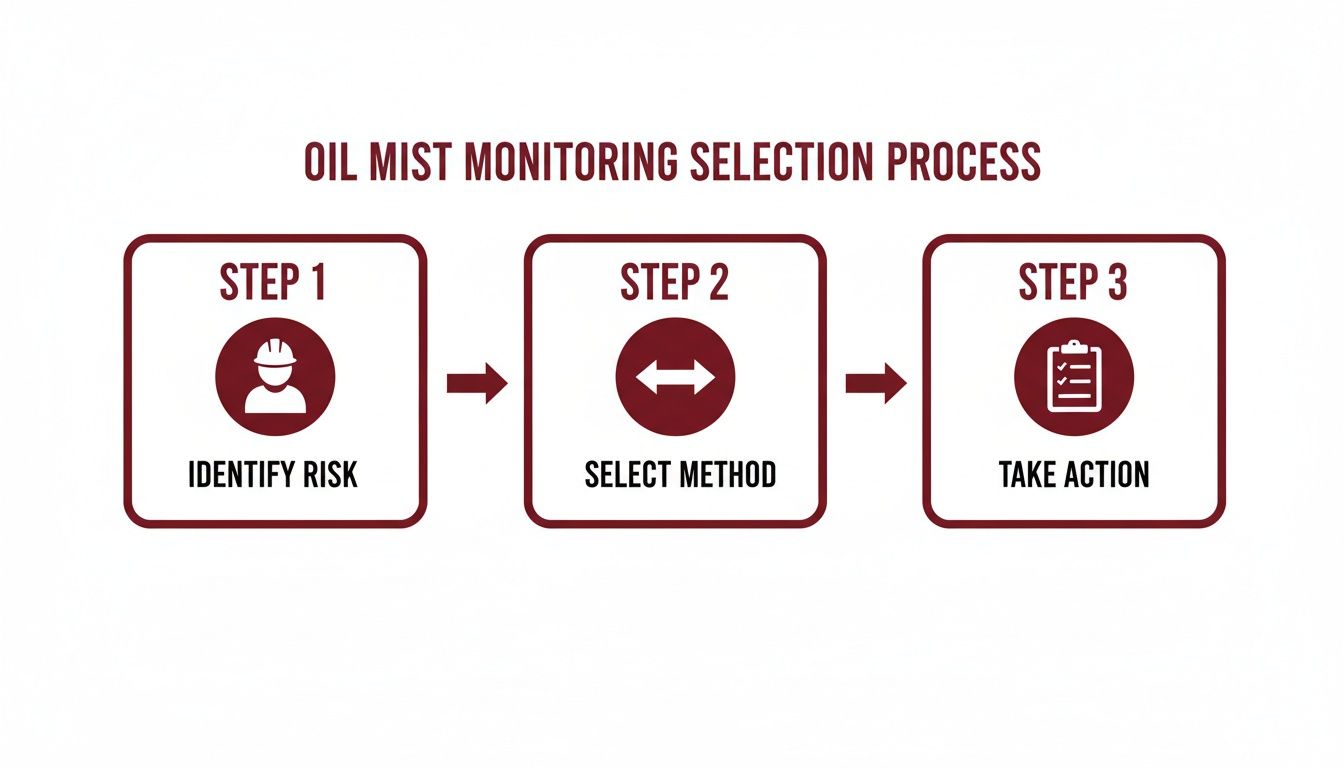
This illustrates that monitoring is a continuous cycle of assessment and action, not a one-off event. By identifying your risks first, you can select the appropriate method to gather data that points directly to intelligent safety improvements.
Pinpointing Your Risks and Defining Objectives
Before calibrating any equipment, the first step is to identify the people and tasks most likely to be exposed. This involves creating a clear picture of your operations to understand exactly where, when, and how oil mist is generated.
Consider the specific roles and activities at your site:
- CNC machine operators work directly with metalworking fluids throughout their shifts and are on the front line of exposure.
- Maintenance crews who open hydraulic systems can be exposed to pressurised fluid atomising into a fine mist.
- Workers near grinding or milling operations are often in the vicinity where high-speed processes aerosolise coolants.
Once you have identified who and what to monitor, you must set clear objectives. Your goal will shape your entire approach. Are you establishing a baseline in a new facility? Do you need to prove compliance with legal exposure limits? Or are you verifying the effectiveness of a new ventilation system? Each objective requires a different strategy.
Developing a Smart Sampling Strategy
With clear objectives established, it is time to design a sampling strategy that will deliver reliable data. This is not about random spot-checks but a calculated plan that considers the frequency, duration, and number of samples required to obtain a truly representative picture of exposure levels.
Key questions to address include how often monitoring should occur—annually for a stable process, or more frequently if operations change—and how many samples are needed to be statistically confident in the results. This is particularly crucial for Australia's manufacturing and metalworking sectors, where oil mist from machining is a persistent hazard. The national standard is capped at 5 mg/m³ TWA, as defined by Safe Work Australia. It is highly recommended to review their complete list of airborne contaminants and their standards to understand the full scope of requirements.
A robust sampling strategy should always aim to capture the "worst-case" scenario. If you monitor during peak production or on tasks known to generate high levels of mist, you can be confident your controls are holding up even on the busiest days.
The Indispensable Role of an Occupational Hygienist
While understanding these steps is beneficial, designing and executing a scientifically valid oil mist monitoring program is a specialist skill. This is where a qualified occupational hygienist becomes an essential partner.
An occupational hygienist brings a deep level of expertise, performing critical functions such as:
- Conducting a thorough risk assessment to accurately identify groups of workers with similar exposure profiles (SEGs).
- Selecting the appropriate monitoring methodology and equipment tailored to your specific circumstances.
- Interpreting complex laboratory results and translating them into a clear, actionable report.
- Recommending effective and practical control measures based on objective data.
Engaging a professional ensures your program goes beyond ticking a legal box. It provides genuine insights that help you manage risk effectively, protecting your most valuable asset—your people.
Turning Monitoring Data Into Actionable Safety Controls
Receiving your oil mist monitoring results is not the end of the process—it is the beginning. This data is a diagnostic report for your worksite, identifying where your safety measures are effective and, more importantly, where they require immediate attention. The real work begins now: translating those numbers into concrete actions that protect your employees and maintain compliance.
The first step is always interpretation. If your data shows exposure levels are well below the Australian standard of 5 mg/m³, it validates that your current controls are working. However, if the numbers are approaching or exceeding that limit, it is a clear warning that demands decisive action.

This is where the hierarchy of controls becomes an invaluable tool. It is a practical, proven framework for managing workplace hazards. The hierarchy prioritises the most effective and reliable safety solutions first, encouraging a proactive approach rather than merely addressing the symptoms of a problem.
Applying the Hierarchy of Controls to Oil Mist
The hierarchy provides a clear roadmap, starting with the most powerful interventions and progressing to the least. The goal should always be to implement the highest-level control that is reasonably practicable for your specific environment.
1. Elimination and Substitution (Most Effective)
This level focuses on removing the hazard at its source. While completely eliminating a core process is often not feasible, substituting materials is frequently a viable option.
- For example: Can you replace a traditional, high-mist mineral oil with a modern synthetic cutting fluid designed for low-mist performance? A simple change in consumables can significantly reduce airborne contaminants before they are generated.
2. Engineering Controls
These are physical modifications to the workplace that create a barrier between workers and the hazard. They are highly reliable because they function passively, without depending on human behaviour.
- For example: Installing a Local Exhaust Ventilation (LEV) system directly on a CNC machine. A well-designed LEV hood acts like a vacuum, capturing oil mist at the point of generation and removing it from the air before it enters a worker’s breathing zone. Fully enclosing the machining process is another excellent engineering control.
The most dependable safety solutions are those built into the environment itself. Engineering controls like ventilation and machine enclosures work continuously to reduce risk, forming the backbone of any effective oil mist management strategy.
3. Administrative Controls
These involve changing work practices and procedures to minimise contact with the hazard.
- For example: Implementing job rotation ensures no single employee spends their entire shift in a high-exposure area. By limiting the time each person spends on a high-mist task, you can help keep their daily time-weighted average (TWA) safely below the legal limit. Comprehensive training on best practices to minimise mist generation is another critical administrative control.
The Final Line of Defence
4. Personal Protective Equipment (PPE) (Least Effective)
When all other controls cannot reduce exposure to a safe level, PPE is used. It is always the last resort because it only protects the individual wearing it, and its effectiveness is entirely dependent on correct and consistent use.
- For example: This involves providing workers with properly fitted respirators equipped with the correct cartridges for oil mist (such as P-series filters). Simply handing out respirators is insufficient; a comprehensive respiratory protection program—including fit-testing, training, and maintenance schedules—is essential.
Ultimately, transforming your oil mist monitoring data into meaningful change requires a methodical approach. Prioritise engineering solutions, support them with smart work procedures, and use PPE only as the final safety net. This structured strategy ensures your investment in monitoring leads directly to a safer, healthier, and more compliant workplace.
Where Does Oil Mist Pop Up? A Look Across Different Industries
The challenge of oil mist varies significantly across different industries. The specific risks and the most effective solutions are directly linked to the processes and environments of each sector. A control measure that works on a manufacturing floor may be entirely unsuitable for a mine site. Understanding these unique contexts is the first step toward developing a truly effective safety strategy.
A one-size-fits-all approach to oil mist monitoring is ineffective because it fails to account for the different types of oils, machinery, and working conditions. Examining real-world examples highlights why a customised monitoring and control plan is not just a "nice-to-have" but an absolute necessity for protecting workers.
The Gritty Reality of Australian Mining
Australian mine sites, particularly underground operations, present some of the most challenging environments for managing airborne contaminants. This setting creates a perfect storm for oil mist exposure.
- Trapped Air: In tunnels and shafts, natural ventilation is often minimal. This allows mists from the hydraulic fluids of heavy machinery to accumulate to dangerous concentrations quickly.
- High-Pressure Leaks: Powerful mining equipment relies on high-pressure hydraulic systems. A tiny pinhole leak in a hose can atomise fluid into a fine, breathable mist that lingers in the air.
- A Nasty Mix: Oil mist rarely exists in isolation. It often combines with other hazards like diesel particulate matter, creating a complex mixture of airborne contaminants that requires sophisticated monitoring to differentiate and control.
The mining sector in Australia is heavily regulated, with strict rules for oil mist. These regulations often require compliance with specific Australian standards, making professional guidance essential. You can gain more insights into dust monitoring obligations and how they apply to worksites.
Nuances in Manufacturing and Metalworking
In manufacturing, especially in workshops focused on precision machining, the primary culprit is typically the coolant itself. Metalworking fluids (MWFs)—whether synthetic, semi-synthetic, or straight oil—are the main source of oil mist.
High-speed CNC machines, grinders, and lathes agitate these fluids, aerosolising them into a mist that can spread throughout the facility. The problem is cumulative; with dozens of machines operating simultaneously, even small emissions from each one can add up to a significant exposure risk for all employees on the workshop floor.
For manufacturing, the game is all about source capture. A good monitoring program will pinpoint which machines are the worst offenders. This allows you to install targeted local exhaust ventilation (LEV) systems right where they're needed, which is a far smarter and more effective approach than trying to air out the entire building.
The Surprising Risks in Food Production
The food industry may not be the first sector that comes to mind for oil mist, but the risk is very real, particularly in large-scale food processing plants. Here, the source is not machinery fluid but the cooking oils used in massive industrial fryers and ovens.
Heating vegetable or animal oils for extended periods creates aerosols that can irritate the respiratory system. Furthermore, these mists settle on floors and equipment, creating dangerously slippery surfaces and a significant slip-and-fall hazard. A dedicated oil mist monitoring program in this context is crucial for verifying that kitchen exhaust hoods are functioning correctly and maintaining a safe and clean production environment.
Answering Your Questions About Oil Mist Monitoring
When it comes to the practicalities of oil mist monitoring, many questions arise. To help you navigate this process with confidence, here are clear, straightforward answers to the queries we frequently hear from managers and safety professionals across Australia.
How Often Should We Be Monitoring for Oil Mist?
There is no single, one-size-fits-all schedule; the appropriate frequency depends on your specific operations. For a stable process with effective controls, an annual assessment is often a good starting point.
However, monitoring should be conducted more frequently under certain circumstances:
- Introduction of a new process: Any new equipment or task that could generate oil mist requires a fresh assessment to establish a baseline exposure level.
- Updates to control measures: After installing new ventilation or switching to a different fluid, you must monitor to verify that the change is effective.
- Worker health reports: If employees report symptoms such as respiratory irritation or skin issues, immediate monitoring is essential to investigate the cause.
Can I Just Use a Real-Time Monitor for My Compliance Reports?
This is a common question, but the short answer is no. While real-time monitors are excellent tools for day-to-day management and troubleshooting—providing an instant snapshot of air quality—they are not typically accepted for official compliance reporting in Australia.
For the formal reports required by regulators, you need the accuracy and legal validity of personal gravimetric sampling, which involves accredited laboratory analysis. Real-time instruments should be viewed as a powerful supporting tool for proactive safety management, not as a substitute for the legally required method.
What’s Our First Move if Results Are Over the Exposure Limit?
If your monitoring results exceed the 5 mg/m³ workplace exposure standard, you must act immediately. Your first responsibility is to inform the affected workers and implement interim controls. This may involve issuing appropriate respiratory protection (PPE) until a permanent solution is in place.
Following this, you must investigate the root cause. This involves a thorough review of the process, an assessment of your engineering controls (like ventilation), and the development of a corrective action plan based on the hierarchy of controls to bring exposure levels safely back below the limit.
Do Water-Based Cutting Fluids Even Create a Hazardous Mist?
Yes, they absolutely can. This is a common misconception. Many assume that only neat oils pose a risk. However, water-based, or "soluble," metalworking fluids are complex mixtures of oil, emulsifiers, biocides, and other chemical additives.
When this mixture is aerosolised, the resulting mist can still cause serious respiratory and skin conditions. For this reason, oil mist monitoring is just as critical for workshops using water-based fluids as it is for those using straight mineral oils.
Protecting your team from airborne hazards isn't just a box to tick—it's a fundamental responsibility. The experts at Anitech Ltd Pty have the hands-on experience and scientific know-how to build a monitoring program that meets your legal obligations and genuinely protects your people. Contact us today to make sure your workplace is both safe and compliant.


