
When we discuss indoor air monitoring, we're essentially talking about a health check-up for the air inside your workplace. It's the systematic process of checking and analysing the air to identify floating pollutants and measure their concentration. This practice is especially vital in industrial and commercial settings where various processes can release potentially harmful substances. For anyone managing a facility, understanding the principles of indoor air monitoring is the first step toward a safer environment and ensuring regulatory compliance.
Think of it like a smoke detector, but for a wide range of threats you often can't see, smell, or taste.
Understanding the Value of Indoor Air Monitoring
You can stare at the air in your workshop or factory all day, but you won't see the microscopic particles or invisible gases that could be present. Yet, what you can’t see can affect everything from your team's health to your operational uptime. Proactive indoor air monitoring isn't just another box to tick; it's a fundamental part of running a safe, productive, and resilient operation. It transforms the invisible into clear, actionable data, giving you a real-time picture of your facility’s respiratory health.
If you want to control your indoor air quality (IAQ), you first have to measure it. Without hard data, any attempt to improve the air is just a shot in the dark. By establishing a baseline measurement and keeping an eye on pollutant levels, you can start making smart, informed decisions that protect both your people and your business.
Why Monitoring Your Air Quality Is Essential
The case for rigorous indoor air monitoring becomes crystal clear when you look at the numbers. We know Australians spend up to 90% of their time indoors, but there are massive gaps in our understanding of the air we're breathing. In a startling revelation, Australia's first national indoor air quality report found that less than 0.03% of the country's buildings have been properly studied for common pollutants like volatile organic compounds (VOCs) and fine particulate matter (PM).
You can dive deeper into these findings by reading more about the national indoor air quality report. This gap isn't just a statistic; it's a massive blind spot for workplace health and safety.
Taking a systematic approach to your air quality pays dividends that go far beyond just meeting regulations. It's a strategic investment in your most important asset: your team.
- Protecting Employee Health: Keeping tabs on airborne contaminants helps prevent exposure that leads to everything from short-term headaches and irritation to serious, long-term illnesses. A healthier workforce means less absenteeism.
- Enhancing Productivity and Morale: It’s been proven that clean air improves cognitive function and overall well-being. When your team feels safe and knows you're looking out for them, they're more focused, engaged, and productive.
- Reducing Operational Downtime: Catching air quality issues early can stop contaminants from damaging sensitive equipment or disrupting production processes, saving you from expensive and unplanned shutdowns.
- Strengthening Company Reputation: Showing a real commitment to a safe working environment boosts your reputation. It makes you an employer of choice and helps you attract and keep the best people.
By actively monitoring your indoor air, you shift from a reactive, problem-fixing mindset to a proactive, risk-prevention strategy. This builds operational resilience and fosters a culture of safety that permeates every level of the organisation.
Identifying the Invisible Threats in Your Facility
So, how do you actually put indoor air monitoring into practice? It all starts with knowing what you’re looking for. The air inside an industrial facility can be a complex cocktail of contaminants, many of which are completely invisible and odourless. These airborne threats are often direct byproducts of the materials you use and the processes you run every single day.
Getting a handle on these specific pollutants is the very first step toward managing them. Once we start categorising these invisible hazards, abstract chemical names turn into tangible operational risks—things you can actually measure and control. This is the foundation of any successful air quality strategy.
Unmasking Common Airborne Contaminants
Industrial workplaces generate a unique profile of airborne pollutants that you just don't find in a typical office or home. We can generally break them down into three main categories, each with its own sources and health implications. Pinpointing where these threats come from is essential for any targeted monitoring.
The real key is to connect the dots between your daily operations—like welding, painting, or machining—and the specific contaminants they release into the air your team is breathing.
Particulate Matter (PM)
Think of Particulate Matter, or PM, as microscopic dust, soot, and liquid droplets just hanging in the air. We categorise these particles by size, because how big they are determines how deeply they can get into your respiratory system.
- PM10: These are the coarser particles, measuring up to 10 micrometres in diameter. They’re kicked up from activities like grinding, crushing, or even just heavy vehicle traffic on unsealed surfaces. They usually get trapped in the nose and throat, causing irritation.
- PM2.5: These are the really fine particles, 2.5 micrometres or smaller. They often come from combustion—think diesel engines, welding fumes, or smelting. Because they're so tiny, they can travel deep into the lungs and even enter the bloodstream, which is where the more serious health risks come in.
Volatile Organic Compounds (VOCs)
Volatile Organic Compounds (VOCs) are gases that are released from certain solids or liquids. You might know this as the "new car smell" or the scent of fresh paint, but in an industrial setting, the sources are far more numerous and potentially much more hazardous.
VOCs are a broad class of chemicals that easily evaporate at room temperature. In a workshop or factory, they can be released from solvents, adhesives, cleaning agents, paints, resins, and petroleum products, creating a persistent source of indoor air pollution.
Common examples include benzene, formaldehyde, and toluene. These can cause anything from headaches and dizziness to serious, long-term organ damage. Identifying the specific VOCs in your facility is a critical part of a thorough risk assessment. You can dive deeper into the specifics of indoor air quality VOC testing to really get your head around the process.
Specific Gases and Chemical Vapours
Beyond the broad categories of PM and VOCs, many industrial processes release specific, high-risk gases that need their own dedicated monitoring. Unlike some VOCs which can have diffuse sources, these gases often come from very clear and identifiable activities.
For instance, a forklift running in a poorly ventilated warehouse can quickly lead to a build-up of carbon monoxide (CO), a toxic gas that displaces oxygen in the blood. Welding can generate nitrogen dioxide (NO2) and ozone, both of which are powerful respiratory irritants.
Chemical plants and manufacturing facilities might also be dealing with vapours from ammonia, chlorine, or various acids used on the production line. Each of these represents an acute risk that demands precise and reliable indoor air monitoring to keep workers safe and prevent an immediate health crisis.
Connecting Air Quality to Health and Compliance
Those contaminants we just talked about aren't just invisible particles and gases floating around. They have very real, tangible consequences for your people and your business's bottom line. Think of indoor air monitoring as the critical link between spotting an unseen threat and truly understanding its impact on the ground.
Making that connection is what shifts a workplace from a reactive "firefighting" mode to a genuinely proactive safety culture. It reframes air quality management from a box-ticking exercise into a smart investment in your team's health, your operational stability, and your overall risk management strategy.
The Human Cost of Poor Air Quality
The health impacts of breathing contaminated air can hit you fast and hard, or they can creep up silently over years of exposure. It’s absolutely vital to understand both sides of this coin to properly protect your team.
Acute health effects are the immediate, short-term reactions that show up soon after someone is exposed to a high concentration of a pollutant. They’re the body’s alarm bells ringing.
- Sudden dizziness or headaches from solvent fumes.
- A wave of nausea caused by a build-up of carbon monoxide.
- That stinging irritation in the eyes, nose, and throat from chemical vapours.
- A sudden asthma attack or bronchitis flare-up triggered by high levels of dust or particulates.
These symptoms don't just hurt; they kill productivity and can cause serious safety incidents if a worker's focus or coordination is thrown off.
On the other hand, you have chronic health effects. These are the long-term consequences of repeated exposure, often at levels that don’t seem dangerous day-to-day. These are the insidious risks that build up over a career.
Chronic exposure to workplace air pollutants can lead to severe, life-altering conditions, including permanent respiratory diseases like emphysema, cardiovascular problems, central nervous system damage, and even certain types of cancer. This underscores the importance of consistent, long-term indoor air monitoring.
Navigating Australian Workplace Regulations
Beyond the very real health risks, keeping the air clean in your workplace is a fundamental legal duty for every Australian business. This isn't just about dodging fines; it’s about fulfilling your duty of care to provide a safe environment for your people. And the regulatory landscape is always tightening, with a clear trend towards stricter standards.
While Australia has come a long way with monitoring outdoor air, the air inside our buildings remains a major blind spot. Because of this, scientists and advocacy groups are pushing hard for enforceable indoor air quality standards in workplaces to protect millions of Australians. You can read more about the push for improved indoor air standards.
For you as a business owner or manager, this all boils down to a few key responsibilities:
- General Duty of Care: Under Work Health and Safety (WHS) laws, you have a primary responsibility to ensure the health and safety of your workers, so far as is reasonably practicable. This absolutely includes managing the risks from airborne contaminants.
- Safe Work Australia Guidelines: Safe Work Australia sets specific Workplace Exposure Standards (WES) for hundreds of airborne chemicals. You need the data to prove your workers’ exposure stays below these legal limits.
- Specific Hazard Management: For some really nasty substances like asbestos, the rules are already incredibly strict. Failing to follow the letter of the law, including things like specialised asbestos air monitoring, can bring about crippling penalties.
Proper indoor air monitoring gives you the hard, legally defensible data you need to prove you’re doing the right thing. It shows you’re on top of your risks and shields your business from the massive legal and financial fallout of a workplace health incident. It turns compliance from a headache into a genuine strategic advantage.
Building Your Air Monitoring Game Plan
Now that we've covered the common threats and your legal duties, it's time to get tactical. You can't just scatter a few sensors around and hope for the best. An effective indoor air monitoring program is a targeted strategy, built from the ground up to reflect your facility’s unique operations, risks, and goals.
Putting together a solid plan is what separates guesswork from a powerful safety tool. It ensures you’re collecting the right data, in the right places, at the right times. Ultimately, a well-designed program doesn't just tick a compliance box; it gives you the actionable insights you need to genuinely protect your team.
Define Your Primary Mission
Before you even think about equipment, you have to answer one critical question: What are we trying to achieve? The answer to this question will drive every decision that follows, from the instruments you choose to the specific spots you test. A vague goal will only ever give you vague data.
Broadly speaking, your mission will probably fall into one of three buckets:
- Establishing a Baseline: This is your starting point. You’re essentially taking a snapshot of the air quality across your facility during a normal workday. The goal is to understand what's "typical" and flag any initial areas of concern.
- Investigating a Specific Source: Maybe you've had a spike in employee health complaints, or a new chemical has been introduced. In this scenario, your mission is to play detective—to hunt down a suspected contamination source and measure what it’s putting out.
- Validating Control Measures: Let's say you’ve just installed a new ventilation system or tweaked a manufacturing process to be safer. Your objective here is to gather hard data that proves the changes have actually worked to reduce contaminant levels.
Personal Monitoring vs. Area Monitoring
With a clear mission in hand, you need to decide how you're going to monitor. The two main approaches are personal monitoring and area monitoring, and they answer very different questions about what's happening in your workplace.
The core difference lies in what you are measuring. Personal monitoring assesses the air an individual worker breathes, while area monitoring evaluates the general air quality in a specific room or zone.
Choosing the right approach—or, more often, a combination of both—is fundamental to your indoor air monitoring strategy. If your primary driver is regulatory compliance for worker exposure limits, personal monitoring is almost always the required method. On the other hand, area monitoring is fantastic for checking if your engineering controls, like a ventilation system, are doing their job effectively.
Selecting Your Sampling Locations
The next piece of the puzzle is deciding where and when to collect your samples. Simply picking random spots is a waste of time and money; you'll likely miss the very problems you're trying to find. Your sampling locations should be chosen strategically, based on a deep understanding of how your workplace functions.
Key considerations for selecting monitoring locations include:
- High-Risk Zones: Pinpoint the spots where hazardous materials are handled most often. Think about processes like welding, grinding, or painting with solvents.
- Worker Proximity: Where do your people spend most of their time? Focus on workstations right next to known emission sources.
- Ventilation Patterns: Contaminants love to hang out in dead spots. Look for areas with poor airflow or places far from fresh air intakes. Understanding effective ventilation strategies can be a game-changer here, helping you prevent issues before they even start.
- Complaint Areas: If a specific department has been reporting headaches or irritated throats, that's a massive red flag. Those locations should shoot to the top of your priority list.
By carefully planning your mission, choosing the right type of monitoring, and selecting smart sampling locations, you build a game plan that delivers data you can actually use. This structured approach is what makes your investment in indoor air monitoring pay off, keeping your workforce safe and your business compliant.
Choosing the Right Tools for the Job
Once you have a clear plan of attack, it’s time to pick the right tools. The world of indoor air monitoring technology can feel a bit overwhelming, but it really boils down to one simple idea: use the right tool for the job at hand. A mechanic wouldn’t use a single wrench for every bolt, and your air quality toolkit will change depending on your specific mission.
This section will walk you through the gear used in professional air quality assessments. Getting a handle on the core differences between these tools will help you make smarter decisions, whether you're buying your own equipment or looking over a proposal from a specialist.
Direct-Read Instruments for Instant Insights
Think of it this way: if you needed to know the temperature in a room, you'd grab a thermometer for an instant reading, not send an air sample off to a lab. Direct-read instruments operate on that exact same principle for air quality, giving you real-time or near-real-time data right on the spot.
These devices are incredibly handy for spotting immediate hazards, checking for leaks, or just getting a quick snapshot of the conditions in a particular area. A classic example is a personal carbon monoxide detector—it doesn't mess around, it just gives you an immediate alarm if levels get dangerous.
Sampling Pumps for Definitive Answers
While direct-read instruments are fantastic for those quick checks, sometimes you need a much deeper and more precise analysis. This is where sampling pumps and accredited lab analysis enter the picture. The process involves using a carefully calibrated pump to pull a specific volume of air through a collection medium—like a specialised filter or sorbent tube—over a set period.
It’s a bit like getting a blood test done. The sample is collected carefully on-site and then shipped off to a lab for a highly detailed and accurate breakdown of everything in it. For compliance purposes, this is the gold standard. It can pinpoint specific chemicals at incredibly low concentrations and provide legally defensible data to measure against the official Workplace Exposure Standards.
The infographic below shows the simple, logical flow of creating a monitoring plan, which you absolutely need to do before you even think about equipment.
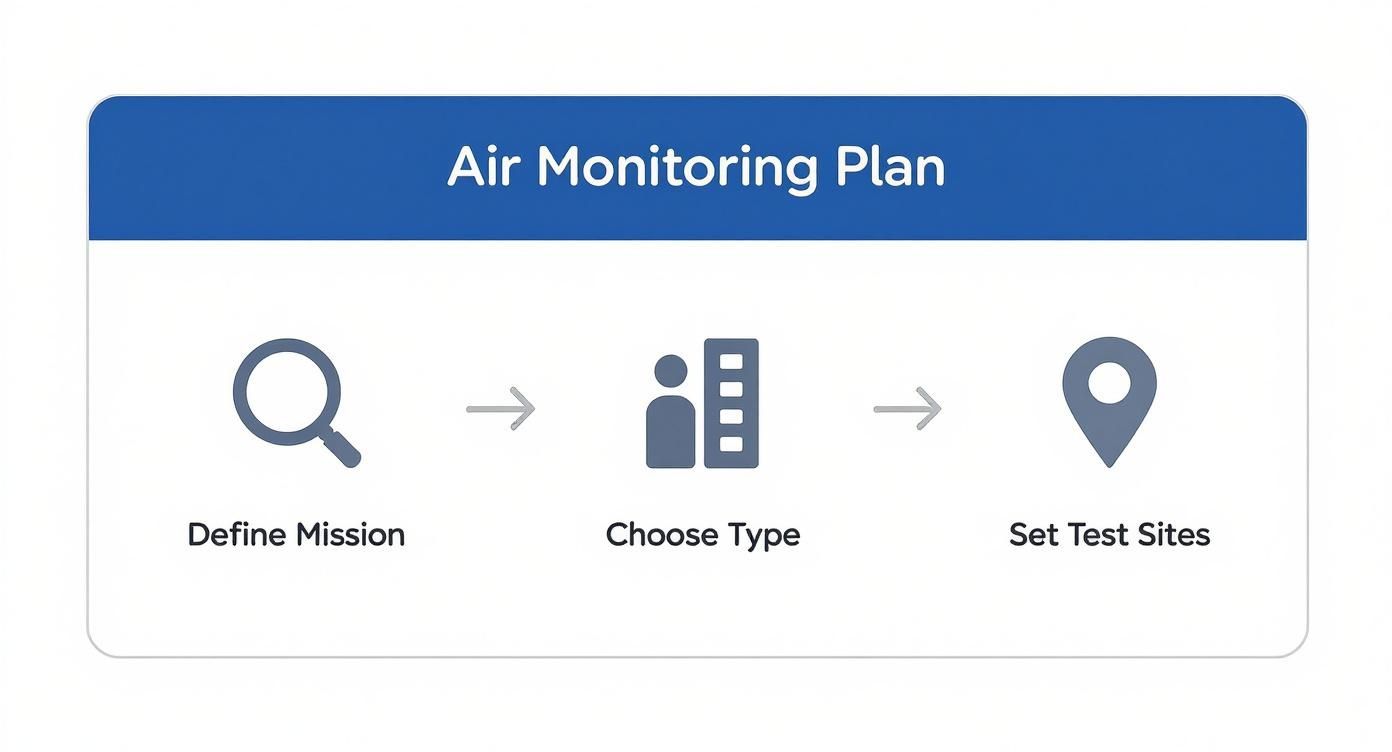
As you can see, defining your mission, choosing your monitoring type, and setting your test sites are the building blocks. Get these right, and the choice of technology becomes much clearer.
A Look at Different Monitoring Technologies
To help you understand the options, here’s a quick comparison of the common instruments you’ll encounter. Each has its own strengths and is suited for different tasks.
Comparison of Indoor Air Monitoring Technologies
| Technology Type | Best For | Pros | Cons |
|---|---|---|---|
| Direct-Read Meters | Quick spot-checks, identifying immediate hazards, leak detection, and real-time area monitoring for common gases (e.g., CO, O₂). | Instantaneous results, easy to use, portable, great for identifying problem areas quickly. | Can be less specific (cross-interference from other chemicals), may not detect very low concentrations, generally not used for official compliance reporting. |
| Active Sampling Pumps | Personal exposure monitoring, compliance assessments against Workplace Exposure Standards, and detailed analysis of specific chemicals. | Highly accurate and specific, provides legally defensible data, measures time-weighted averages (TWA) accurately. | Results are not immediate (requires lab analysis), more complex to set up, can be intrusive for the worker wearing the device. |
| Passive Samplers | Long-term (days or weeks) area monitoring, establishing baseline contaminant levels, and screening large areas cost-effectively. | Inexpensive, non-intrusive, easy to deploy (no pump needed), good for tracking trends over time. | Less precise than active sampling, results are an average over a long period, not suitable for short-term exposure assessments. |
| Continuous (IoT) Sensors | 24/7 monitoring of general air quality parameters (e.g., PM2.5, VOCs, CO₂), verifying ventilation performance, and providing real-time alerts. | Provides a continuous stream of data, great for trend analysis, enables proactive air quality management and instant notifications. | May not be as accurate or specific as lab-based methods; primarily a management tool, not a replacement for compliance sampling. |
The right choice always circles back to your original goal—whether that's a quick safety check, a thorough compliance audit, or a long-term management strategy.
The Rise of Continuous Monitoring
A major shift we're seeing in indoor air monitoring is the adoption of Internet of Things (IoT) sensors. These connected devices can give you a continuous, 24/7 data stream on pollutants like particulate matter, VOCs, and carbon dioxide, feeding that information straight to a central dashboard on your computer or phone.
This is a game-changer. It moves a facility from relying on periodic spot-checks to having a constant, living overview of its air quality. It means getting instant alerts when conditions change and being able to spot trends over weeks or months, giving you a much richer, more complete picture of your workplace environment. While they don't replace formal compliance sampling, these sensors are an incredibly powerful tool for proactive day-to-day management and for proving that your control measures, like ventilation systems, are actually working.
Turning Your Data Into Action
Collecting data through indoor air monitoring is only half the battle. Let's be honest, raw numbers don't protect anyone. The real work begins when you interpret that data and turn it into a concrete plan to make your workplace safer. This is where you transform figures on a screen into tangible, protective measures for your team.
Think of it like a doctor's visit. The data from your monitoring equipment is the lab result; now it's time to diagnose the problem and write a clear prescription for your facility's air.
Benchmarking Against Exposure Standards
First things first, you need to know what 'good' looks like. The initial step is comparing your results against official standards. In Australia, our primary benchmark is the Workplace Exposure Standards (WES), published by Safe Work Australia. These aren't just guidelines; they are legally recognised limits that define the maximum concentration of a substance a worker can be exposed to without expecting ill health effects.
By putting your monitoring data side-by-side with these official limits, you get an immediate snapshot of your compliance. Any measurement that even approaches, let alone exceeds, the WES is a massive red flag. It’s a clear signal that you need to act—and act now—to reduce exposure and protect your people.
Introducing the Hierarchy of Controls
Once you’ve identified a risk, the next question is always, "So, what do we do about it?" The most effective and accepted framework for this is the Hierarchy of Controls. This isn't just jargon; it's a step-by-step, prioritised approach to eliminating or minimising risks, ranking solutions from most effective to least.
The core principle is simple: always start at the top and work your way down. You should exhaust every option at the higher, more effective levels before you even consider lower-level measures like just handing out masks.
The Hierarchy of Controls gives you a structured, logical roadmap for managing risk. It forces you to think beyond the easy fixes and consider permanent, more effective solutions, rather than just defaulting to PPE, which relies entirely on perfect human behaviour.
Here’s how it works in the real world when tackling poor air quality:
-
Elimination: Can you get rid of the hazard completely? This is the gold standard. A great example is switching to a different, non-toxic chemical, which completely removes the source of harmful vapours from your process. Problem solved.
-
Substitution: If you can't eliminate it, can you swap it for something safer? This might mean using a water-based paint instead of a solvent-based one, or switching from a fine powder to pellets to drastically reduce dust.
-
Engineering Controls: This is about making physical changes to the workplace to separate people from the hazard. Installing a local exhaust ventilation (LEV) system right at a welding station to suck up fumes at the source is a classic, highly effective engineering control.
-
Administrative Controls: Here, you change the way people work. This could involve rotating staff through a high-exposure area to limit any single person's time there, enforcing strict housekeeping procedures to keep dust down, or providing in-depth training on handling hazardous materials.
-
Personal Protective Equipment (PPE): This is your last line of defence, not your first. Providing respirators or safety glasses protects the individual worker, but it does absolutely nothing to remove the actual hazard from the air. It’s crucial, but it should only ever supplement higher-level controls.
Applying this framework helps you build a robust, multi-layered defence against airborne contaminants. Once you've gathered and analyzed your air quality data, implementing solutions such as professional duct cleaning can be an effective way to improve your home's air quality with professional duct cleaning, which is another practical action step. For more comprehensive industrial solutions, you can explore various professional methods for improving indoor air quality. This ensures your indoor air monitoring program leads to real, lasting improvements in workplace safety.
Common Questions About Indoor Air Monitoring
Even with a solid plan in place, it's natural to have questions when you're setting up an indoor air monitoring program. Let's tackle some of the most common queries we hear from facility managers to give you the clarity and confidence you need to keep your workplace safe.
How Often Should We Test Our Facility's Air Quality?
This is a great question, but there's no single magic number that works for everyone. The right frequency really hinges on your specific risks and the nature of your operations.
A comprehensive baseline assessment is the perfect place to start—it gives you a clear picture of what your air quality looks like right now. After that, your schedule should be driven by risk. For high-risk areas, like a chemical mixing station or a workshop with dust-generating processes, you might need continuous electronic monitoring or very frequent sampling. In contrast, lower-risk zones like office spaces might only need an annual check-up, or re-testing after a big change like a renovation or new machinery installation.
The best strategy is a dynamic one. The smartest move is to work with an occupational hygienist to build a customised testing plan that's perfectly matched to your site's hazards and compliance obligations.
Are Consumer-Grade Air Monitors Good Enough for Our Workplace?
While those off-the-shelf air quality gadgets are great for raising awareness at home, they simply aren't up to the task for industrial or commercial workplaces. They generally lack the accuracy, the ability to detect specific contaminants, and the rigorous calibration that's essential for workplace safety and compliance.
In an industrial setting, you absolutely need professional-grade, calibrated instruments. This is the only way to ensure your data is reliable enough to base critical health and safety decisions on. To meet regulatory standards and make choices that will hold up under scrutiny, using proper occupational hygiene equipment is non-negotiable.
What Is the Difference Between Air Monitoring and Air Sampling?
It's easy to get these two mixed up. The best way to think about it is that air monitoring is like getting a real-time snapshot of the air. This usually involves an electronic, direct-read device—think of a CO alarm or a dust meter—that gives you immediate feedback. It's fantastic for spotting sudden spikes in a pollutant or confirming that a known hazard is being kept under control.
Air sampling, on the other hand, is more like a detailed diagnostic test. Here, we actively collect a physical sample of air over a set period, using a calibrated pump and a special filter or tube. That sample is then sent off to an accredited laboratory for a highly precise analysis of specific contaminants. Sampling gives you the most accurate and detailed data possible, which is crucial for compliance reporting and deep-dive investigations.
Getting on top of indoor air monitoring is one of the most important things you can do to ensure a safe and compliant workplace. If you need expert guidance to build your strategy, make sense of your data, or choose the right equipment, our team is here to help. Get in touch today to partner with Australia’s leading occupational hygiene specialists.


