
When someone mentions a whole body vibration machine, you probably picture a vibrating platform at the gym. But in the world of construction, mining, and transport, the most common—and hazardous—whole body vibration machines are the heavy vehicles and mobile plant your team operates every day. These are not fitness tools; they are the "hidden" sources of a serious, and often overlooked, occupational health hazard.
This guide provides in-depth information on the risks of occupational WBV, helping you understand, assess, and control this workplace hazard effectively.
Unmasking the Real Whole Body Vibration Machine in the Workplace
In an industrial context, a whole body vibration machine is any vehicle or mobile plant that transmits mechanical vibrations to an operator's body, typically through the seat or floor. This is not the controlled, gentle oscillation of a fitness plate but the harsh, unpredictable jolting from operating heavy equipment on a worksite.
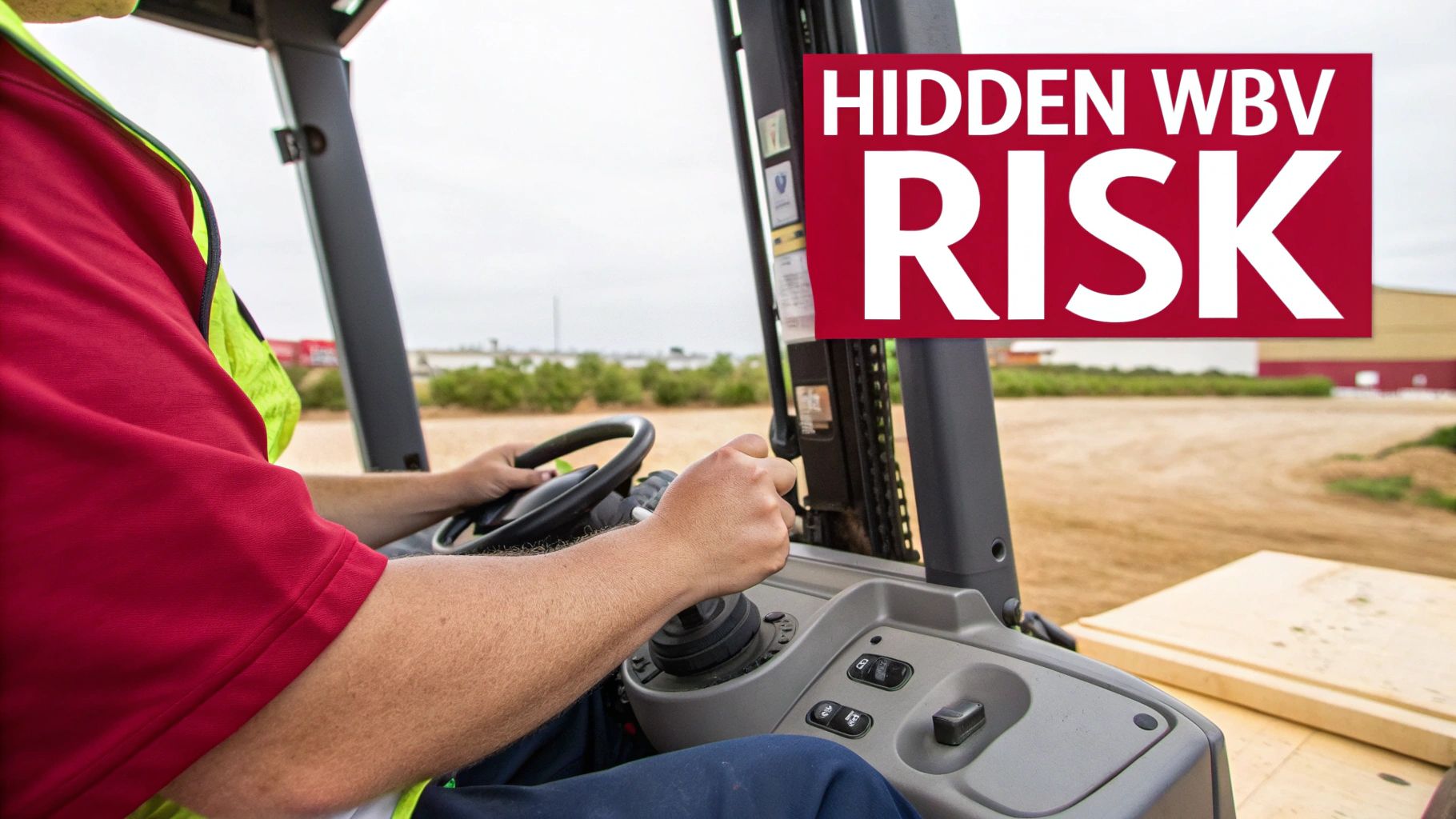
This type of exposure is known as occupational Whole Body Vibration (WBV), a significant workplace hazard. Consider the constant shaking and jarring experienced by drivers of:
- Forklifts and Loaders: Moving across uneven warehouse floors or construction sites sends a continuous stream of vibration through the operator.
- Haul Trucks and Dumpers: Navigating rough terrain in quarries and mines generates incredibly intense shocks and jolts.
- Earthmoving Equipment: The powerful, low-frequency vibrations from dozers, graders, and excavators are transmitted directly to the person at the controls.
- Agricultural Tractors: Spending long hours driving over unpaved fields results in sustained, damaging exposure.
From Fitness Platform to Workplace Hazard
It is critical to distinguish between these two different sources of vibration. A purpose-built fitness machine delivers controlled, predictable oscillations for brief periods to stimulate muscles.
An industrial vehicle, conversely, is an unintentional whole body vibration machine. It delivers harmful, erratic forces for extended periods, day after day.
This distinction is a fundamental health and safety issue. The vibrations from industrial machinery are a direct pathway to chronic health problems, particularly musculoskeletal disorders. The constant compression and jarring of the spine can lead to debilitating conditions like chronic lower back pain, degenerative disc disease, and nerve damage.
The Scale of the Problem in Australia
This hazard is more widespread than many realize. Across Australian workplaces, a staggering 24% of workers report exposure to vibration.
Furthermore, 38% of that group face whole body vibration specifically from operating heavy machinery. What is truly alarming is that only 27% of these exposed workers have ever received training on the risks, and 23% report no control measures in their workplace. You can access more details directly from the official Safe Work Australia report.
To clarify the distinction, here is a straightforward comparison.
Vibration Sources at a Glance
| Attribute | Fitness Vibration Machine | Occupational Whole Body Vibration |
|---|---|---|
| Purpose | Therapeutic muscle stimulation, fitness | Unintentional byproduct of vehicle operation |
| Duration | Short, controlled sessions (10-20 mins) | Prolonged, daily exposure (often 8+ hours) |
| Vibration Type | Consistent, predictable frequency and amplitude | Erratic, unpredictable jolts and shocks |
| Health Outcome | Potential for improved muscle tone and circulation | High risk of musculoskeletal injury and chronic pain |
Understanding that your vehicle fleet are whole body vibration machines is the first crucial step toward managing this risk. It shifts the focus from a fitness novelty to a critical workplace health and safety factor requiring proper assessment, robust controls, and ongoing management.
How Occupational Vibration Impacts Your Team's Health
When your team operates a haul truck, forklift, or earthmover, it may seem like a standard day's work. In reality, their bodies are enduring constant, low-frequency vibration. This is more than mere discomfort; it's a serious health hazard.
The human spine is a finely engineered column of vertebrae cushioned by fluid-filled discs acting as shock absorbers. Imagine shaking this structure for eight hours a day, five days a week. Each jolt, large or small, compresses these discs and strains the supporting muscles and ligaments. Over time, this cumulative stress doesn't just cause soreness—it physically degrades the spinal structure.
The damage from occupational WBV is insidious, building up slowly and often going unnoticed until the pain becomes chronic and, in some cases, debilitating.
The Breakdown of the Musculoskeletal System
The primary target for Whole Body Vibration is the musculoskeletal system, with the lower back bearing the brunt of the impact. The constant compressing and shearing forces slowly wear away at the spinal discs, a condition known as spinal disc degeneration.
This degeneration is a key contributor to chronic lower back pain among equipment operators. Think of the difference between a new, springy shock absorber and one that has been flattened and worn out after thousands of kilometers on rough roads.
When the spine's natural cushioning fails, the entire body suffers. Chronic lower back pain, sciatica, and herniated discs become likely outcomes for workers with years of unmanaged WBV exposure.
This relentless mechanical stress also affects other areas. Operators often report nagging pain and stiffness in their neck, shoulders, and hips as their bodies constantly try to stabilize against the motion, leading to muscle fatigue, tension, and chronic pain that impacts their quality of life.
From Discomfort to Disorder: Real-World Examples
To understand how this plays out, consider these common scenarios:
- The Haul Truck Driver: An operator on uneven mine haul roads experiences intense, whole-body jolts for a full 12-hour shift. After years of this, they can develop severe lumbar spine disorders and pinched nerves, making simple movements agonizing.
- The Forklift Operator: A warehouse worker driving over concrete expansion joints and dock levelers is exposed to high-frequency, jarring vibrations. This can lead to persistent lower back pain and sciatica, often resulting in extended medical leave.
These are not just theoretical examples; they are the reality for many workers. Prolonged WBV has a strong link to chronic back pain and musculoskeletal disorders (MSDs), which accounted for 87% of workers' compensation claims in 2018-2019. While younger workers under 35 often report higher exposure, claims for these injuries peak among those aged 35-54, demonstrating the long-term, cumulative nature of the damage. You can dive deeper into the data on why vibration is a serious health issue in our detailed article.
The connection is clear: unmanaged vibration exposure leads to serious, debilitating injuries. This causes immense suffering for your team and also results in lost productivity, higher workers' compensation claims, and difficulty retaining skilled operators. Tackling vibration is a critical strategy for protecting your people and ensuring business continuity. Learn more from the findings on WBV and workers' compensation from Safe Work Australia.
Measuring Vibration and Meeting Australian Safety Standards
Recognizing your industrial equipment as a powerful whole-body vibration machine is the first step. The next is determining the actual level of vibration your team is exposed to. This is not just good practice; it is a legal requirement under Australia's Work Health and Safety (WHS) regulations.
Relying on guesswork is a significant risk. Without solid data, you are operating blindly, and your operators could be exposed to damaging vibration levels. Professional measurement provides the hard evidence needed to make informed decisions, comply with the law, and protect your employees' health.
Defining the Thresholds: Exposure Action Value and Exposure Limit Value
Australian safety standards for whole-body vibration are based on two key values set by Safe Work Australia, which can be thought of as a traffic light system for risk management.
- Exposure Action Value (EAV): The EAV is set at 0.5 m/s² A(8). This is your "amber light." Reaching this level indicates a potential hazard exists, and you are legally required to assess the risk and implement control measures.
- Exposure Limit Value (ELV): The ELV is 1.15 m/s² A(8). This is your "red light" and the absolute legal maximum. Exceeding this value is a breach of WHS law, and you must take immediate action to reduce exposure below this limit.
It's crucial to understand these values are calculated over a standard eight-hour workday. Even short periods of high vibration can push an operator over the daily limit. For instance, an operator on rough terrain might exceed the ELV in just a few hours.
How Experts Measure Vibration Accurately
Occupational hygienists use specialized equipment to capture the true vibration exposure an operator experiences. The primary tool for assessing risk from a whole-body vibration machine is a seat-pad accelerometer.
This is a small, disc-shaped sensor placed on the operator's seat. It meticulously measures vibration across three axes (up-and-down, side-to-side, and front-to-back) during normal work activities.
- Objective Data: It records the vibration transmitted to the person's body, accounting for factors like vehicle speed, ground conditions, and specific tasks.
- Real-World Conditions: Measurements are taken during normal operations to provide a realistic picture of daily exposure, not an idealized scenario.
- Compliance Reporting: The data is analyzed and compared against the EAV and ELV, giving a clear, definitive assessment of workplace compliance with Australian standards.
Understanding safety protocols is vital. Formal training, such as a Workplace Health Safety (WHS) certification, can provide the in-depth knowledge needed to manage workplace hazards effectively. This professional approach replaces assumptions with facts, giving you the clarity to protect your workers and demonstrate due diligence.
For a deeper dive, learn more about the specifics of Australian workplace safety standards. Ultimately, professional assessment is the only reliable way to ensure your vibration management plan is built on accurate, actionable data.
Conducting a Practical WBV Risk Assessment
Once you have identified potential sources of whole-body vibration, it's time to conduct a proper risk assessment. This is a practical, hands-on process to identify where vibration originates, who is exposed, and what actions are needed to keep your team safe.
The goal is to build a clear, honest picture of your workplace's vibration profile to manage it effectively.
This flowchart illustrates the straightforward, three-step approach for measuring and assessing vibration.
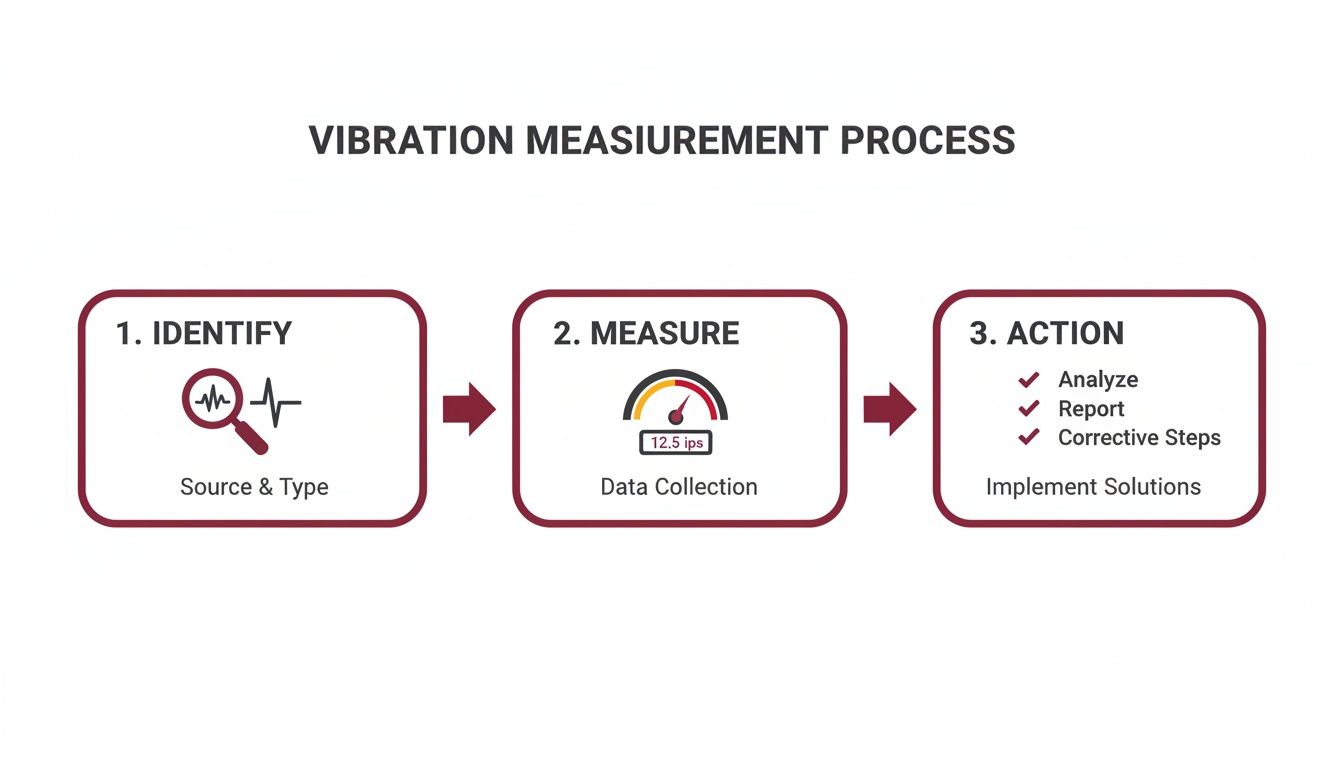
The process boils down to three core stages: identifying hazards, measuring exposure levels, and taking informed action based on real data.
Identifying Vibration Sources and At-Risk Workers
First, create an inventory of all equipment that could be a source of hazardous whole-body vibration. This involves reviewing your machinery roster and work schedules.
List all mobile plant and vehicles that operators sit in or stand on for significant periods.
- Manufacturing and Warehousing: Examine forklifts, reach trucks, and tuggers, especially those operating on older concrete floors with cracks and expansion joints.
- Mining and Construction: Haul trucks, dozers, graders, and loaders are primary sources due to powerful engines and rough terrain.
- Transport and Logistics: Long-haul trucks, courier vans, and buses can expose drivers to continuous, low-frequency vibration for extended periods.
Once you have your list of machines, identify who operates them. Note their typical shift lengths and time spent on each piece of equipment to build a profile of those most at risk.
Evaluating Exposure Factors
The next step is to evaluate other factors that influence vibration levels. The condition of the machine and the environment are often as important as the machine itself.
A new haul truck on a poorly maintained road can produce more dangerous vibration than an older, well-maintained truck on a smooth surface. The true risk is determined by the combination of machine, terrain, and task.
Consider these key variables for each machine and operator:
- Vehicle Condition: Is the suspension maintained? Are tires correctly inflated? Is the air-suspension seat functional and adjusted properly?
- Operating Surfaces: Are haul roads and yard surfaces smooth and graded, or are they filled with potholes and bumps?
- Task and Speed: Do tasks require high speeds or aggressive driving? Are operators trained to drive smoothly to minimize shocks?
- Operator Posture: Are operators taught to adjust their seats and maintain good posture? Leaning forward or sitting rigidly can increase vibration transmitted to the spine.
You can begin with a simple checklist to conduct an informal review of your operations.
Sample WBV Risk Assessment Checklist
| Assessment Area | Check Point | Status (OK/Review) | Notes |
|---|---|---|---|
| Equipment | Are suspension systems regularly maintained? | e.g., Forklift #4 suspension last checked [Date] | |
| Are tyres correctly inflated per manufacturer spec? | |||
| Is the operator's seat an air-suspension model? | |||
| Is the operator's seat in good working condition? | e.g., Airbag leaks, adjustments broken | ||
| Environment | Are work surfaces (roads, floors) smooth? | Note specific areas with potholes, cracks | |
| Do operators frequently drive over curbs or bumps? | |||
| Tasks | Do tasks require high speeds or sharp turns? | e.g., Loading cycles in the east yard | |
| Are operators trained in smooth driving techniques? | |||
| Operator | Is operator posture generally good (not rigid/leaning)? | Observe operators during typical tasks | |
| Do operators report feeling jolts or shocks? |
This checklist is a great starting point. However, if your initial review identifies multiple risk factors, it is a clear sign that you need expert assistance. For a definitive, data-driven assessment of your risk levels and compliance, a formal whole body vibration assessment is essential. This provides the precise measurements needed to protect your workforce and meet your WHS obligations.
Implementing Effective Vibration Control Measures
After your risk assessment has identified the hazards, it is time to implement effective vibration control measures. The goal is to methodically reduce or eliminate exposure to Whole Body Vibration (WBV), making the workplace genuinely safer.
The most effective approach is the Hierarchy of Controls, a safety framework that prioritizes the most robust solutions first.
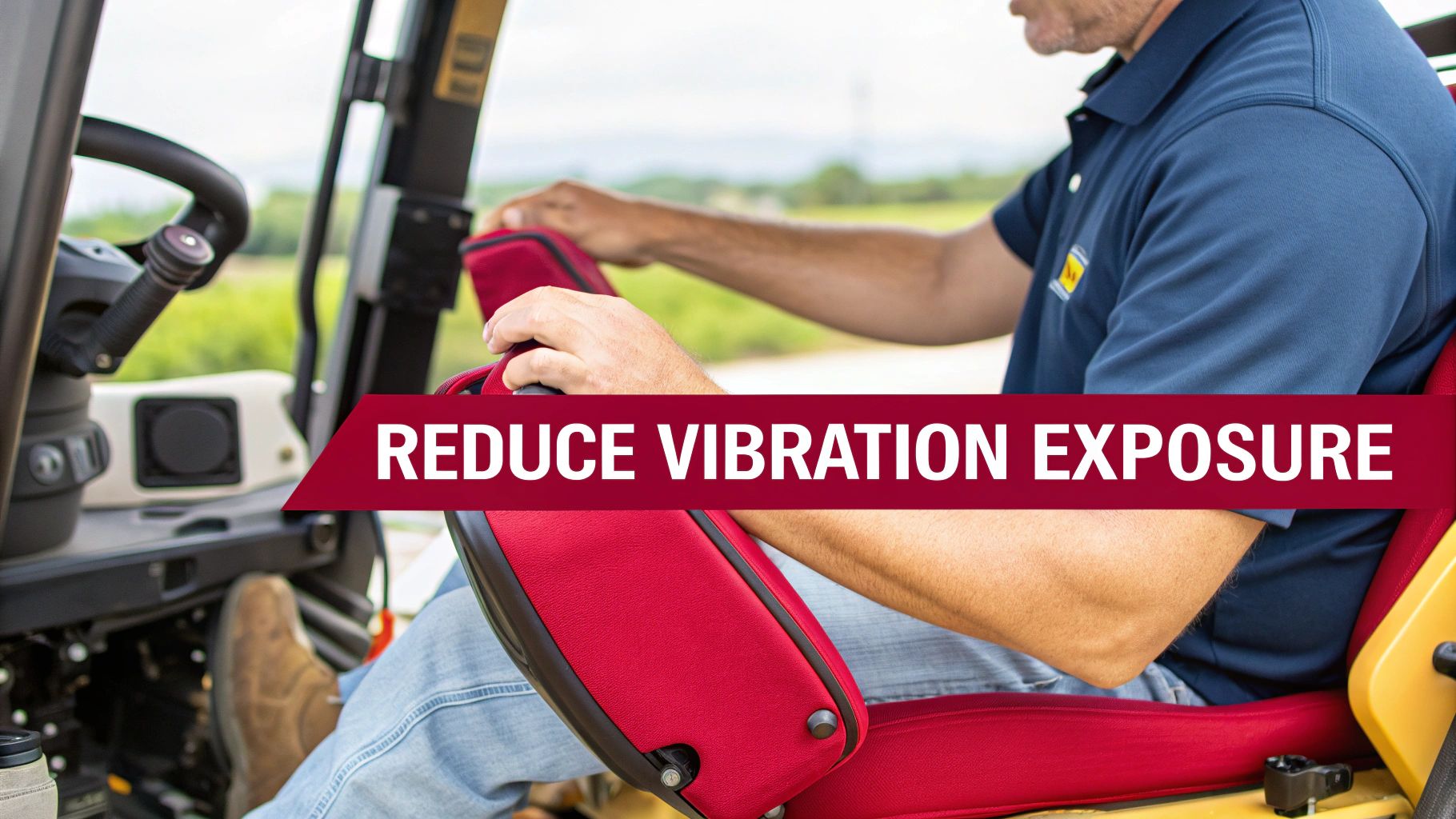
This structured approach ensures you focus on long-term fixes rather than temporary solutions, building a multi-layered defense against the risks posed by any whole-body vibration machine on site.
The Hierarchy of Controls for WBV
The hierarchy provides a clear roadmap for managing hazards.
- Elimination: The most effective control is to remove the vibration source entirely. This might involve redesigning a process so that a vibrating piece of equipment is no longer required.
- Substitution: If elimination is not feasible, replace a high-vibration machine with one that has lower vibration levels, such as upgrading an old forklift to a modern model with a superior suspension system.
- Engineering Controls: These are physical modifications to equipment or the work environment to isolate people from the hazard. Installing a high-quality, vibration-dampening seat in a haul truck is a prime example.
- Administrative Controls: These controls change how people work. Examples include rotating staff through different jobs to limit exposure time or enforcing speed limits on rough haul roads.
- Personal Protective Equipment (PPE): This should always be the last resort. Items like anti-vibration gloves offer minimal protection against WBV and are not a substitute for addressing the problem at its source.
Practical Examples of Control Measures
The most significant improvements come from applying this theory to real-world situations. For most industries, a combination of substitution, engineering, and administrative controls is most effective.
For example, if a mining company finds their haul trucks produce WBV levels above the Exposure Action Value (EAV), a smart, multi-pronged approach would be most effective.
- Engineering Control: Retrofit all trucks with modern, fully-adjustable air-suspension seats to directly reduce the vibration transmitted to the driver.
- Administrative Control: Implement a policy to grade haul roads more frequently and enforce a lower speed limit on the roughest sections.
- Job Rotation: Rotate drivers to ensure no single operator spends their entire 12-hour shift in the highest-vibration vehicles.
This layered strategy is far more powerful than a single fix. It addresses the equipment, environment, and work practices, creating a robust safety net.
Implementing these measures is a core component of any effective safety program and aligns with effective safety management principles that focus on proactively reducing risk.
Simple Changes That Make a Big Difference
Sometimes, the most impactful changes are also the simplest and most cost-effective. Significant vibration reduction can be achieved through regular maintenance and minor operational adjustments.
Consider these low-cost, high-impact actions:
- Maintain Yard and Road Surfaces: Regularly filling potholes and grading unpaved roads is one of the most effective ways to reduce shocks and jolts.
- Ensure Correct Tyre Pressure: Operating vehicles with incorrect tyre pressure significantly increases vibration. Adhering to manufacturer specifications is a vital maintenance check.
- Service Vehicle Suspension: Worn-out suspension components fail to absorb vibration effectively. Regular suspension checks should be part of your preventive maintenance schedule.
By systematically applying the hierarchy of controls and focusing on both major upgrades and routine upkeep, you can build a practical and highly effective plan to manage the risks from any whole-body vibration machine in your workplace.
Why Ongoing Maintenance and Training Are Critical
Addressing Whole Body Vibration (WBV) is an ongoing commitment, not a one-time task. Even the best vibration-dampening systems are ineffective if they are not maintained or used correctly.
Without consistent maintenance and skilled operators, safety equipment can fail, leaving your team exposed to the very risks you sought to prevent. This can create a dangerous false sense of security, where the presence of equipment is mistaken for actual safety.
The Critical Role of Proactive Equipment Maintenance
Poorly maintained equipment is a common cause of excessive vibration. A new haul truck with a faulty suspension or incorrect tyre pressure can generate more vibration than an older, well-maintained vehicle.
Maintenance must be proactive, not reactive. Waiting for an operator to report a problem means they have likely already been exposed to harmful vibration levels. A planned, preventative schedule is the only effective solution.
Essential Maintenance Checks:
- Suspension Systems: These are your first line of defense. Worn components must be replaced on schedule.
- Tyres: Tyre condition and pressure significantly affect vibration. They must be inflated to the manufacturer’s exact specifications.
- Seating: A high-tech, air-suspension seat is useless if it is not functional. Inspections should check for air leaks, faulty shock absorbers, and broken adjustment levers.
A well-maintained vehicle is a safer vehicle. View your maintenance schedule as a direct investment in the long-term health and wellbeing of your team.
Empowering Operators Through Comprehensive Training
The person in the driver's seat is the single most important factor in reducing WBV exposure. A skilled operator can significantly minimize their own risk, but this requires proper training and reinforcement.
Effective training transforms employees into active partners in their own safety, fostering a culture of shared responsibility.
Key Training Modules Should Cover:
- Correct Seat Adjustment: Operators must know how to set the seat for their specific weight and height to maximize its dampening effect.
- Maintaining Proper Posture: Training should cover how to maintain a neutral, relaxed posture to avoid bypassing the seat's protective features.
- Driving Technique: Teaching operators to choose appropriate speeds for the terrain and anticipate ground conditions can dramatically reduce shocks and jolts.
- Reporting Defects: Cultivate a "no-blame" culture where operators feel comfortable immediately reporting faulty equipment without fear of reprisal.
Ultimately, a robust defense against occupational WBV depends on two pillars: well-maintained equipment and well-trained people. These are the foundational elements for any organization serious about protecting its workforce from this preventable hazard.
Got Questions About Whole Body Vibration? Let's Clear Things Up.
As a safety consultant, I frequently receive questions from managers trying to understand Whole Body Vibration (WBV). Let's break down some of the most common queries.
Hand-Arm vs. Whole Body Vibration: What's the Difference?
The distinction lies in the path the vibration takes.
When a worker uses a jackhammer or a grinder, the intense shaking travels into their hands and arms. This is Hand-Arm Vibration (HAV).
Whole Body Vibration, in contrast, is transmitted from the ground up. For a forklift driver or haul truck operator, the vibration travels through the vehicle's seat or floor, affecting their entire body. This poses a greater risk to the spine and internal organs.
How Often Should We Be Doing WBV Risk Assessments?
While Safe Work Australia does not set a rigid schedule, best practice is to assess the risk whenever there is a significant change.
Triggers for a new assessment include:
- Introducing new equipment, such as a new model of excavator or truck.
- Changes in the work environment, like a deteriorating haul road.
- If your team reports vibration-related issues, such as persistent back pain or fatigue.
- As part of a regular safety review cycle, such as annually, to ensure nothing has been overlooked.
Which Industries Are Most at Risk in Australia?
While WBV can occur in any industry, some sectors are at the forefront due to the nature of their work.
In Australia, high-risk industries include:
- Mining and Quarrying: The use of massive haul trucks, excavators, and loaders puts operators at high risk.
- Construction: Operators of earthmoving machinery, compactors, and dump trucks face daily exposure.
- Transport and Logistics: Long-haul truck drivers experience chronic WBV exposure.
- Agriculture: Tractor operators often spend long hours on uneven terrain, which takes a serious toll over time.
What Are My Legal Duties as an Employer?
Under Australia's WHS laws, you have a primary duty of care. This is a legal responsibility to protect your workers from harm, which includes the risks from WBV.
This means you must actively identify WBV hazards, assess the level of risk, and implement control measures to eliminate or minimize exposure. In practical terms, this involves providing well-maintained and suitable equipment, ensuring the work environment is as smooth as possible, and providing your team with proper training.
Ready to ensure your workplace meets Australian safety standards and protects your team from the hidden risks of whole body vibration? Contact Anitech Ltd Pty today for a comprehensive assessment and expert guidance. Visit us online to learn more and schedule a consultation.


