
A robust noise policy for industry is your company's essential framework for protecting your team from hearing damage and ensuring full legal compliance. It’s more than a compliance document; it’s a practical, actionable plan that translates complex regulations into everyday procedures, making the industrial workplace safer for everyone involved. Crafting an effective occupational noise management strategy begins with understanding your legal duties and the significant risks of hazardous noise exposure.

Why a Comprehensive Industrial Noise Policy is Non-Negotiable
In Australia, ignoring hazardous workplace noise is not an option—it constitutes a serious breach of your duty of care. A solid noise policy is more than just paper; it’s a critical component of your risk management strategy, your operational integrity, and your commitment to your workforce's well-being.
Without a clearly defined policy, you risk more than just substantial fines. You're gambling with the long-term health of your employees, which can lead to noise-induced hearing loss (NIHL), and jeopardizing the reputation of your business. Many industrial settings, from whirring factory floors to heavy-duty mining operations, regularly generate noise levels that can cause irreversible hearing damage. This reality places a significant legal and ethical responsibility on employers to implement effective noise control measures.
Understanding Your Core Legal Duties
Under Australian Work Health and Safety (WHS) laws, every employer has a primary duty of care. This means you must do everything reasonably practicable to ensure the health and safety of your workers, which absolutely includes protecting them from excessive noise and implementing a hearing conservation program.
This is an active obligation. It requires you to proactively identify noise hazards, conduct a thorough risk assessment, and implement effective controls. Failure to do so can lead to severe consequences:
- Hefty Financial Penalties: Breaching WHS laws can result in six-figure fines for the company and individual directors.
- Workers' Compensation Claims: Noise-induced hearing loss is a recognized occupational injury, leading to higher insurance premiums and costly claims.
- Operational Shutdowns: Regulators can issue notices that halt your operations until the noise hazard is rectified, costing you valuable time and money.
- Reputational Damage: A reputation as an unsafe workplace makes it difficult to attract and retain skilled employees.
The Key Exposure Standards You Must Know
To maintain compliance, you must understand the specific exposure limits. Safe Work Australia sets the national standard for workplace noise exposure, and there are two critical values you must manage.
The first is the exposure standard: workers cannot be exposed to an average of 85 decibels (dB) or more over an 8-hour period. This is the cornerstone of noise management in high-risk sectors like manufacturing, construction, and mining. You can find more details on these workplace noise standards to understand how they apply to your specific operations.
The second is the peak noise limit. No worker should ever be exposed to a peak noise level of 140 dB(C). This standard is designed to protect against sudden, intense sounds—such as an impact from a tool or a pressure release—that can cause immediate, permanent hearing damage.
To simplify, here are the key exposure limits at a glance.
Australian Workplace Noise Exposure Standards at a Glance
This table summarizes the key noise exposure limits that form the basis of your legal obligations under Safe Work Australia guidelines.
| Metric | Exposure Limit | Key Requirement |
|---|---|---|
| 8-Hour Average Exposure | 85 dB(A) | The average noise level a worker can be exposed to over an 8-hour shift. |
| Peak Noise Exposure | 140 dB(C) | The absolute maximum noise level a worker can be exposed to at any single moment. |
Understanding and acting upon these two figures is the foundation of any effective noise policy for industry.
A well-crafted noise policy isn't just about avoiding penalties. It's about building a sustainable safety culture where hearing conservation is valued as much as productivity. It demonstrates a commitment to your team that goes beyond legal minimums.
Beyond the Workplace: Your Community Impact
Your responsibility for noise control extends beyond your property line. The noise from your operations can easily affect nearby homes and businesses, leading to complaints and unwanted attention from your local council or the Environmental Protection Authority (EPA).
A truly comprehensive noise policy must account for this environmental impact. This involves familiarizing yourself with local and state regulations, which often have different acceptable noise levels for daytime, evening, and night-time hours. Being a good corporate neighbour involves proactive measures like strategic site layouts, scheduling noisy work for appropriate times, and investing in acoustic barriers. This is essential for maintaining positive community relations and avoiding legal complications.
Conducting a Noise Risk Assessment That Actually Works
A noise risk assessment is the bedrock of any effective noise policy. Forget seeing it as a simple box-ticking exercise; a proper assessment gives you the hard data you need to make smart, targeted decisions about controlling noise. It's about moving from guesswork to facts, pinpointing exactly where your noise problems lie and who is most at risk.
The whole point is to build a detailed acoustic map of your workplace. This means methodically tracking down every significant noise source, from the relentless hum of a conveyor belt to the sharp, sudden crack of a pneumatic tool. Without this crucial first step, any controls you put in place are based on assumptions—a perfect recipe for wasted money and ongoing risk to your team's hearing.
Identifying Every Significant Noise Source
First things first, you need to identify all the culprits. The best way to do this is to walk the floor with the sole purpose of listening. Don't just zero in on the big, obvious machinery. It's often the intermittent or secondary sources that get overlooked, yet they can seriously add to an employee's total daily dose of noise.
To make sure you don't miss anything, try organising your survey by category:
- Fixed Plant: Think about all the stationary equipment like compressors, generators, stamping presses, and those big ventilation systems.
- Mobile Equipment: This covers anything that moves, like forklifts, pallet jacks, and other vehicles operating on-site.
- Power Tools: Document every grinder, drill, saw, and air tool. Make a note of where and how often they're used.
- Work Processes: Sometimes the noise isn't from a machine but the job itself—think of the clatter of metal-on-metal impacts in a fabrication shop or bottles rattling down a high-speed production line.
Doing this initial sweep helps you create a rough map of potential "hot spots" where you'll need to conduct more detailed measurements.
Choosing the Right Tools for the Job
Once you’ve identified the sources, you need to measure them accurately. Your two main tools for this are the sound level meter and the personal sound exposure meter, often called a dosimeter. Knowing which one to use, and when, is vital for getting data you can actually use.
A Sound Level Meter (SLM) is a handheld device that gives you an instant reading of the sound pressure level in a specific spot. It's your go-to tool for:
- Measuring the noise coming from a single piece of equipment.
- Pinpointing noise hot spots on the factory floor.
- Checking if that new acoustic barrier you installed is actually working.
On the other hand, a Personal Sound Exposure Meter (Dosimeter) is a small device an employee wears, usually for their entire shift. It tracks their personal noise exposure as they move around and perform different tasks. A dosimeter is essential when:
- A worker is highly mobile, like a maintenance fitter or a forklift operator.
- Noise levels vary wildly throughout the day.
- You need to calculate a worker's time-weighted average exposure over an 8-hour shift (LAeq,8h) to see if it's over the 85 dB(A) exposure standard.
Pro Tip: Using both tools gives you the full story. The SLM tells you how loud a machine is, while the dosimeter tells you how that noise actually impacts a specific worker over their full shift.
Mapping Exposure and Making Sense of the Data
With your measurements in hand, the next job is to figure out what it all means. The goal is to understand the real-world exposure levels for your employees across different roles and shifts.
Take a busy fabrication workshop, for example. A welder might be hit with intense, short bursts of noise from grinding, while a press operator is subjected to a steady, high-level drone all day long. Both are at risk, but you'd need very different control strategies for each.
A professional noise assessment should give you more than just a list of decibel readings. It should deliver actionable insights, mapping out noise contours and detailing individual exposure profiles. This analysis is the essential groundwork for choosing and implementing effective controls, ensuring your resources are aimed at the biggest risks and making your workplace genuinely safer.
Putting the Hierarchy of Controls into Practice
When it comes to managing industrial noise, simply handing out earplugs is a band-aid solution. It’s a reactive approach that doesn't get to the heart of the problem. A genuinely effective noise policy for industry is proactive, built on a well-established safety principle: the hierarchy of controls.
This framework forces you to think from the top down, prioritising the most reliable and permanent solutions first. Instead of just masking the sound, you're tackling the noise at its source.
Relying on Personal Protective Equipment (PPE) alone puts the entire responsibility for safety on the worker, which is always the weakest link in any safety system. A layered defence, starting with eliminating the hazard altogether, will always deliver better and more sustainable results for your entire operation.
Essentially, you want to move from permanent, engineered solutions down to procedural or administrative ones. This simple process map breaks it down.

As you can see, controlling the noise is the final, crucial step that only comes after you've thoroughly understood the hazards through proper identification and measurement.
Elimination and Substitution: The Gold Standard
The most powerful way to deal with a noise hazard is to eliminate it completely. While this isn't always practical, it must be the first question you ask. Can a particularly noisy process be outsourced or discontinued? Is there a fundamentally different, quieter way to achieve the same manufacturing outcome?
If elimination is off the table, substitution is your next best bet. This involves swapping out loud, outdated equipment for a quieter, more modern alternative. Yes, it's a capital investment, but the payoff in long-term health and safety is massive.
- Real-World Example: A metal fabrication shop replaced its jarring pneumatic impact wrenches with modern, high-torque hydraulic models. The upfront cost was a consideration, but the immediate and permanent drop in peak noise exposure was undeniable.
- Another Scenario: Imagine a bottling plant where bottles clatter down metal conveyor guide rails. Swapping those for durable, low-friction polymer guides can dramatically slash the constant rattling noise across the entire production floor.
Engineering Controls: Building a Physical Barrier
When you can't eliminate or substitute the noise source, your next move is to physically block its path to your workers. These are engineering controls—physical modifications to the workplace that either dampen the noise at the source or isolate it.
The real beauty of engineering controls is that they don't depend on what an employee does or doesn't do. They work passively in the background. Think of it as soundproofing your factory.
The goal of engineering controls is to create a quieter workplace by design. This could mean building a dedicated, sound-dampened room for a noisy compressor or erecting acoustic barriers around a stamping press to shield nearby workstations.
When you're looking at these solutions, think about bringing in materials specifically designed for the job. High-performance acoustic ceiling tiles and soundproofing solutions can be incredibly effective at absorbing sound and cutting down reverberation in those big, open factory spaces.
Practical Application of Noise Control Hierarchy
To bring this all together, let's look at how these control levels compare in a real-world setting. The best approach often involves a mix of solutions, but understanding their relative impact and cost is key to making smart decisions.
| Control Level | Industrial Example | Relative Effectiveness | Cost Consideration |
|---|---|---|---|
| Elimination | Replacing a riveting process with welding. | Very High (Permanent solution) | High (Process redesign) |
| Substitution | Swapping a noisy diesel generator for a quieter electric model. | High | High (Capital expense) |
| Engineering | Enclosing a grinding machine in an acoustic housing. | High (Reduces noise by 15-30 dB) | Medium to High |
| Administrative | Rotating workers out of a high-noise area every two hours. | Low to Medium | Low (Operational planning) |
| PPE | Mandating the use of Class 5 earplugs. | Low (Relies on user fit/compliance) | Very Low (Consumable cost) |
This table clearly shows that while PPE is the cheapest option, it's also the least effective at truly protecting your workforce. Investing higher up the hierarchy provides a much more reliable and permanent reduction in risk.
Administrative Controls: Changing How We Work
If engineering fixes can't get you all the way to a safe noise level, you'll need to turn to administrative controls. These are all about changing work practices and procedures to limit how long your team is exposed to loud noise.
These are less reliable than engineered solutions because they depend entirely on people following the rules, but they're still a vital piece of a comprehensive safety strategy.
Common administrative tactics include:
- Job Rotation: Actively moving workers between loud and quiet tasks throughout a shift to keep their total daily noise "dose" below the legal limit.
- Scheduling: Planning the noisiest operations, like running a tumbler, for a back shift when fewer people are on site.
- Quiet Zones: Creating designated break rooms or offices that are acoustically treated, giving employees a genuine space to recover away from the noise floor.
The scale of this problem shouldn't be underestimated. Each year, around 5,000 Australian workers are compensated for industrial hearing loss. That staggering figure is a stark reminder of why we need to move beyond simply handing out earplugs and implement robust, multi-layered control strategies.
Building Your Hearing Protection and Training Program
After you’ve done everything you can with engineering and administrative controls, there will often still be high-noise areas that pose a risk. This is where your focus has to pivot to the people on the floor. Personal Protective Equipment (PPE) becomes your last line of defence, but a good hearing conservation plan is much more than just sticking a box of earplugs on a shelf.
It’s about building a solid program around two things: the right gear and education that actually makes sense to your team.
A successful hearing protection program lives or dies on a simple reality: if the gear is uncomfortable, it won't be worn correctly—if it's worn at all. This is where so many noise policies fall flat. Picking PPE based purely on its Noise Reduction Rating (NRR) or Single Number Rating (SNR) just isn't enough. You have to think about the people who will be wearing it, day in and day out.
Selecting the Right Hearing Protection
The real goal here is to provide protection that people will actually keep in for their entire shift. That means offering a bit of variety and thinking about the specific job they're doing. A one-size-fits-all approach is almost guaranteed to fail because every person is different, and every task has its own challenges.
Here are the key things I always consider when kitting out a team:
- Comfort and Fit: Everyone's ear canals are shaped differently. It’s crucial to have a selection of options available, like different-sized foam earplugs (tapered vs. bell-shaped) or reusable flanged plugs.
- Compatibility with Other PPE: Does a worker need to wear a hard hat or safety glasses? Big, bulky earmuffs might break the seal on their glasses or be impossible to wear with certain hard hats. In those situations, low-profile earplugs are a much smarter choice.
- The Work Environment: Think about the conditions. In a hot, steamy engine room, earmuffs get sweaty and uncomfortable fast. On the flip side, if someone needs to pop their hearing protection in and out to talk to a supervisor, banded earplugs or earmuffs are far more practical than disposable plugs they have to keep re-rolling.
- Communication Needs: It’s a classic mistake, but over-protecting can be just as dangerous as under-protecting. If a worker can't hear a reversing alarm or a shouted warning, you’ve created a new hazard. This is where you might need to look at level-dependent or communication-enabled hearing protectors.
A crucial part of any modern noise policy is making sure the PPE genuinely works for the individual wearing it. The only way to know for sure is to test it. You can see how this is done by exploring the process of hearing protection fit testing, which verifies the real-world noise reduction each employee is getting.
Creating a Training Program That Sticks
Good training is what connects the dots between having PPE and using it properly. A boring, once-a-year PowerPoint isn't going to cut it. To build a real safety culture, your training needs to be practical, ongoing, and explain the "why" behind the rules so you get genuine buy-in.
A solid program should be built on a few key pillars.
The Real-World Impact of Hearing Loss
First, get away from just talking about abstract decibel numbers. Share relatable stories about what noise-induced hearing loss (NIHL) actually means for a person's life. Explain how it doesn't just affect hearing, but also their ability to chat with their family, enjoy music, or even hear their grandkids. That personal connection makes the risk feel much more immediate and real.
Hands-On Fitting and Maintenance
You have to show people, not just tell them. A huge reason PPE fails is that earplugs are put in incorrectly. The classic “roll, pull, and hold” technique for foam plugs needs to be physically demonstrated, and then you need to watch every employee practice it themselves.
From there, cover the day-to-day practicalities:
- Inspection: Show workers what to look for—cracks, tears, or hardening on their reusable plugs and earmuff cushions.
- Cleaning: Explain how to properly clean reusable gear to prevent ear infections and keep it working effectively.
- Replacement: Make it crystal clear when and how they can get fresh PPE.
Building robust safety procedures is fundamental to any industrial workplace, and that includes critical programs like Lock Out/Tag Out safety training. Just as LOTO protects workers from machinery hazards, proper hearing protection training shields them from the invisible threat of noise. A well-trained team is a safer and more productive one, showing a commitment to health and safety that covers all aspects of the job. This kind of integrated approach is what builds a powerful and lasting safety culture.
Managing Your Noise Impact Beyond the Factory Gate
A solid industrial noise policy doesn't stop at your property line. The noise from your operation can have a real impact on nearby residents and businesses, making environmental noise management a massive part of being a good corporate citizen. Get this wrong, and you could be dealing with community complaints, council interventions, and even unwanted attention from the Environmental Protection Authority (EPA).
But managing your acoustic footprint is about more than just dodging trouble; it's about building genuine, positive relationships with your neighbours. This means getting to grips with local and state-level regulations, which often have different acceptable noise levels for daytime, evening, and night-time. A bit of thoughtful planning can turn a potential source of conflict into a clear sign of your company's commitment to the community.
Navigating Environmental Noise Regulations
State-based bodies like the NSW EPA have clear frameworks for industrial noise. For instance, the Noise Policy for Industry (2017) in New South Wales was a significant update, replacing the old 2000 version. It brought in changes based on newer health research, setting the minimum daytime noise level at 40 decibels and adding sleep disturbance criteria that align with World Health Organization (WHO) guidelines. It's well worth getting familiar with the full details to know exactly what’s required of you.
But these policies aren't just about a simple decibel number. They also dig into the character of the noise, because some sounds are far more annoying than others, even if they aren't technically as loud.
- Tonal Noise: Think of the constant, distinct hum from a motor or a fan. It can be incredibly irritating.
- Impulsive Noise: Sudden, sharp sounds like stamping or hammering can be really startling for residents.
- Low-Frequency Noise: That deep, vibrating rumble can travel long distances and even penetrate buildings, causing major disturbances.
Your policy needs to address these specific types of sounds to be truly effective.
Practical Strategies for Community Noise Control
When it comes to controlling external noise, you're essentially applying the same hierarchy of controls you use inside, just with a focus on your site's perimeter. Sometimes, simple, strategic decisions can make all the difference.
For example, think about where you place noisy equipment. Can you orient loading bays or large extraction fans away from residential boundaries? Could you use quieter buildings, like office blocks or warehouses, as a natural acoustic shield? This kind of smart site layout can cut down the noise reaching your neighbours without costing a fortune.
A bit of proactive communication can be just as effective as a physical barrier. Simply letting your neighbours know about planned noisy work, like major construction or after-hours maintenance, can prevent a flood of complaints. A quick letter drop or a note on a community noticeboard goes a long way.
Scheduling and Physical Barriers
Smart scheduling is another powerful tool. If you can, plan your loudest operations for the middle of the day. Ambient community noise is already higher then, and more people are likely to be out of the house. On the flip side, try to avoid firing up loud machinery first thing in the morning or late at night.
When scheduling and clever site planning aren't quite enough, you’ll need to look at physical engineering controls.
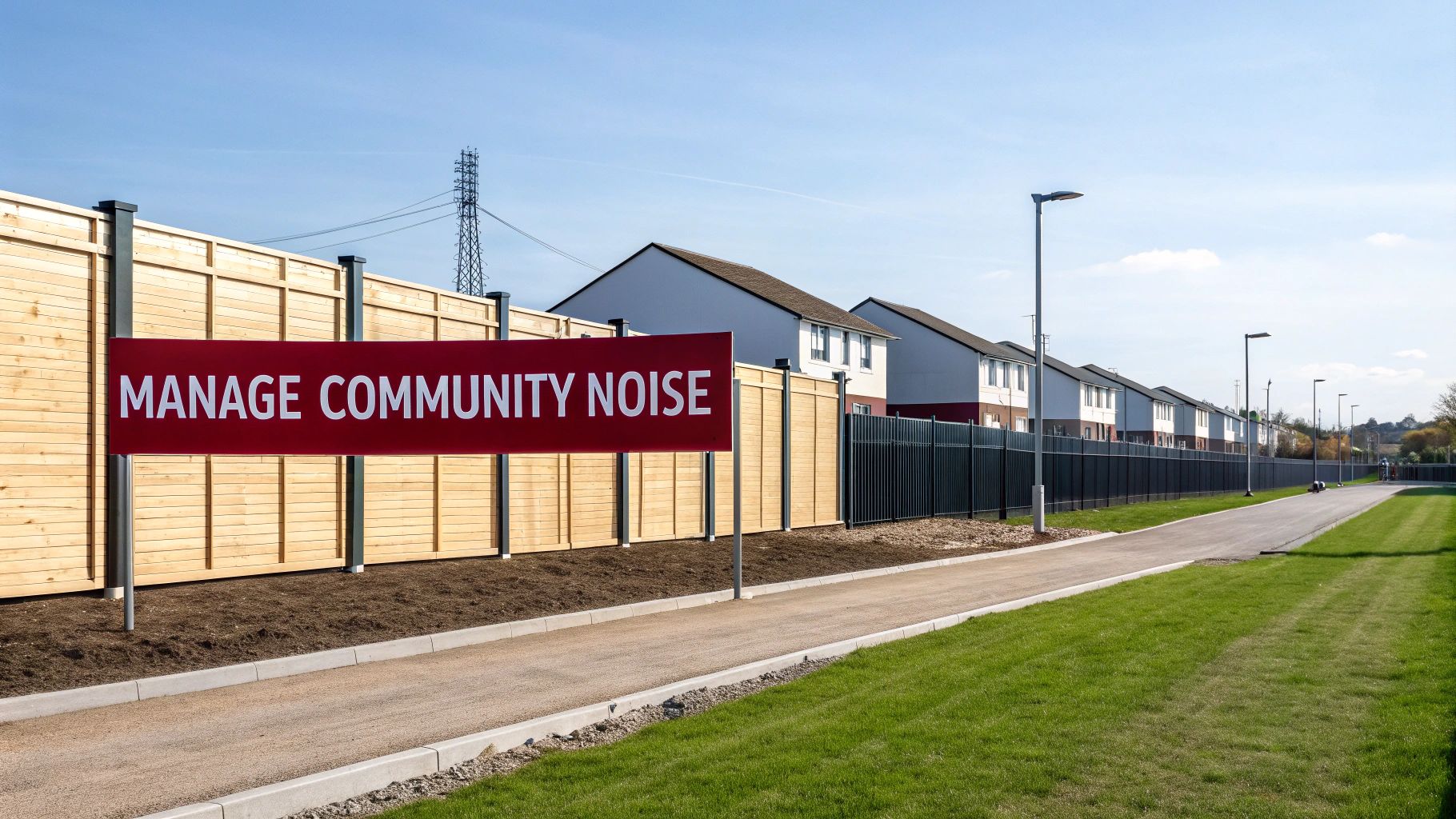
- Acoustic Fencing: Purpose-built sound walls can create a highly effective barrier.
- Building Enclosures: Sometimes the best solution is to build an enclosure directly around a piece of outdoor equipment, like a compressor or generator.
- Landscaping: While it won’t solve everything, strategic planting with dense trees and earth berms (mounds of earth) can help absorb and deflect sound.
A properly documented noise management plan is the best way to pull all of this together. It gives you a structured way to identify, assess, and control these external noise sources. By combining these practical strategies, your operation can coexist peacefully with the surrounding community, protecting both your reputation and your social licence to operate.
Answering Your Questions About Industrial Noise Policies
Even the most thorough plan hits the real world and raises questions. Here, we'll tackle some of the most common queries from managers and business owners when they start putting their noise policy for industry into practice. Getting these details right is what makes a policy work on the factory floor, not just on paper.
How Often Should We Be Reviewing Our Noise Policy?
Your noise policy should be a living document, not a "set and forget" file in a cabinet. It requires regular check-ups to remain effective and compliant.
As a rule of thumb, a formal review should happen at least every two years.
However, you can’t just wait for that two-year mark. Certain events should trigger an immediate review. You'll want to pull out the policy and reassess things whenever:
- New machinery arrives: A new press or generator can completely change your workplace's acoustic profile.
- The layout changes: Moving workstations or altering production lines can create new noise paths and hotspots.
- Regulations are updated: Guidance from bodies like Safe Work Australia evolves, and your policy needs to keep pace.
- Monitoring flags an issue: If your latest noise survey shows rising levels or a control measure isn't working as it should, it's time to act.
- An incident occurs: A worker reporting hearing damage or a near miss is a serious red flag that your current system has a gap.
Keeping your policy current ensures it stays relevant, compliant, and actually protects your team.
What’s the Real Difference Between Engineering and Administrative Controls?
This is a great question because getting this right is the key to effectively using the hierarchy of controls. The fundamental difference is how they tackle the noise problem.
Engineering controls are physical, built-in solutions. They are the gold standard because they remove or reduce the hazard at its source, and they don’t rely on someone remembering to do something. They're permanent and reliable fixes.
Think of building an acoustic enclosure around a loud compressor or lining a room with sound-absorbing panels. You've physically changed the environment to make it quieter.
Administrative controls, on the other hand, change the way people work. They are procedural solutions designed to limit a person's time in a noisy area.
A classic example is job rotation. You might move a worker out of a high-noise area after two hours and swap them with someone from a quieter task. This reduces that individual's daily noise dose, but it hasn’t done a thing to make the area itself any quieter.
They’re a useful tool, but they should always be seen as a secondary measure because they rely entirely on human behaviour.
Are We Legally Required to Provide a Few Different Types of Hearing Protection?
This is where the letter of the law meets practical reality. While Australian WHS regulations state you must provide suitable and effective hearing protection, the secret to a successful program is offering choice.
The law is focused on the outcome—making sure people are protected. But you'll find it's almost impossible to achieve that outcome with a "one-size-fits-all" approach. People have different ear canal shapes and sizes. What’s comfortable for one person can be genuinely painful for another.
It is highly recommended to provide at least two or three well-chosen options. For instance, have a couple of different styles of earplugs (like tapered foam and reusable flanged ones) alongside a quality set of earmuffs. This small step massively increases the chances that your team will actually wear their gear, and wear it correctly.
If PPE is uncomfortable, it gets worn on the neck, stuffed in a pocket, or not sealed properly in the ear. When that happens, it’s completely useless. So, while offering a variety isn’t always explicitly mandated, it’s an essential best practice for making sure your policy actually works.
At Anitech Ltd Pty, we provide expert occupational hygiene services to help Australian industries develop and implement effective noise management strategies. Our team offers comprehensive noise assessments and practical guidance to ensure your workplace is safe, compliant, and productive. To build a robust health and safety framework for your business, visit us at https://occhygiene.com.au.


