
Hearing protection fit testing is all about measuring how much noise reduction a worker actually gets from their earplugs or earmuffs. It takes us beyond the theoretical rating printed on the box and gives us a real-world, personalised number for that specific person. This is how you know for sure that each worker has the right protection, fitted correctly, to prevent lifelong hearing damage.
Why Fit Testing Is a Game Changer for Workplace Safety
Let’s be honest for a moment. That SLC₈₀ or NRR rating printed on a box of earplugs? It’s a laboratory number, not a guarantee for your worksite. It represents the absolute best-case scenario, achieved under perfect, controlled conditions. Your workshop, factory floor, or construction site is anything but a perfect lab.
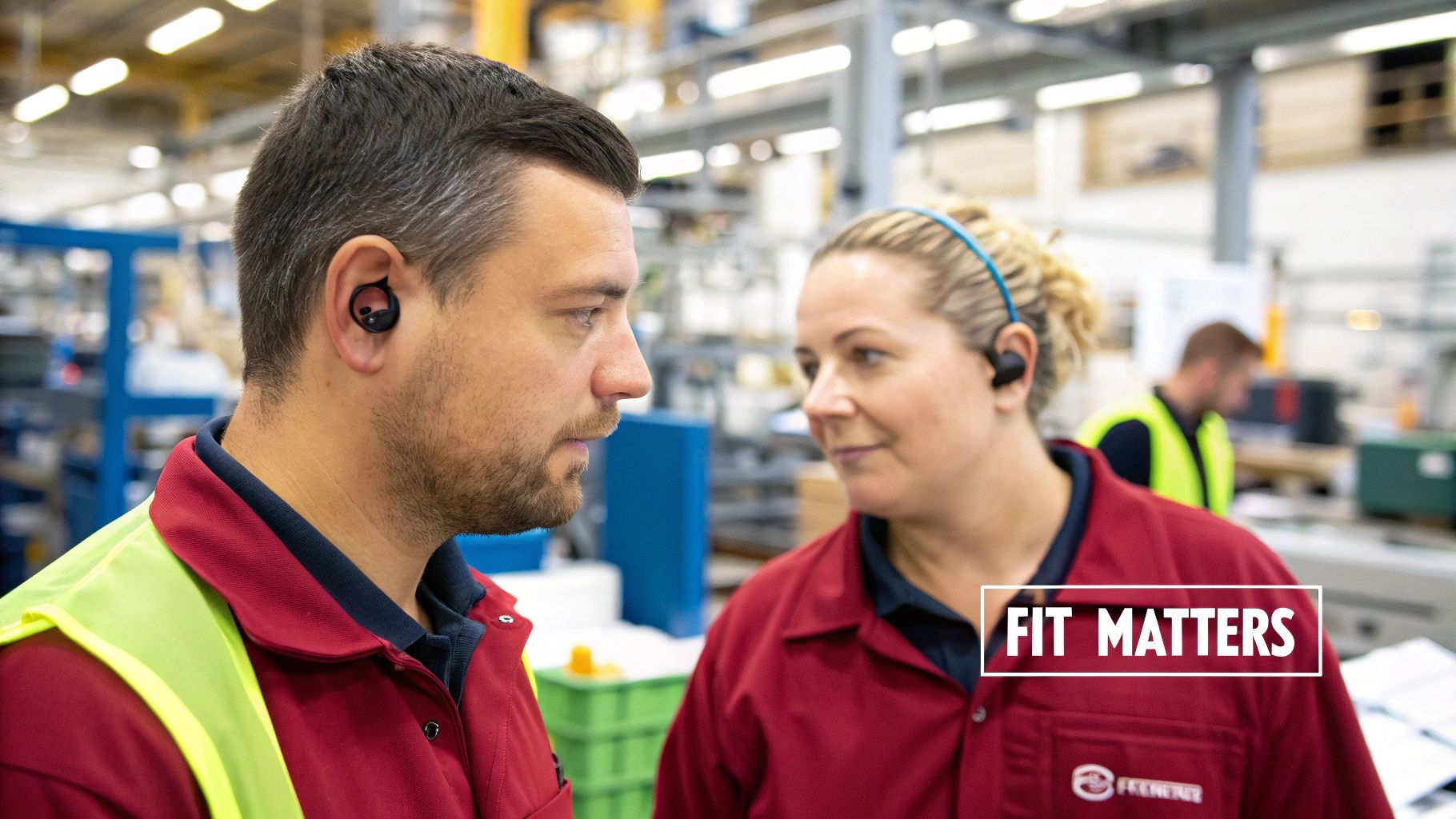
Think about two workers, side-by-side in a noisy plant, using the exact same high-quality earplugs. One of them gets a perfect seal and the full protective benefit. The other, simply because of the unique shape of their ear canal, has a poor fit. They think they're protected, but a tiny, unnoticeable gap is letting damaging noise leak through all day long.
From Lab Ratings to Personal Protection
This scenario plays out every single day, and it highlights the dangerous gap between theoretical protection and what’s actually happening on the ground. This is precisely where the Personal Attenuation Rating (PAR) comes in. The PAR isn’t a generic number off a packet; it’s a true, individual measurement we get through hearing protection fit testing.
By measuring the exact noise reduction for each employee with their specific hearing protector, you can:
- Pinpoint Protection Gaps: Instantly see who isn't getting enough protection, even if they believe they are.
- Check Your Training: It’s the ultimate proof that your training on how to properly insert earplugs is actually working.
- Find the Right Fit: You can figure out the best type, brand, or size of hearing protection for each person’s unique anatomy.
The Real-World Impact of a Bad Fit
I’ve seen firsthand how much ear canal shapes and sizes vary, and this is where the problem lies. A surprising number of workers are unknowingly at risk. For instance, if someone's ear canals are larger than their earplugs, there's a constant leak path for noise.
The data backs this up. A recent Australian study found that about 30% of experienced hearing protection users weren't adequately protected because of a poor fit. Another 17% needed to be retrained on the spot to get a proper seal.
A "fail" during a fit test isn't the employee's fault. It’s a sign that the equipment isn't right for them. Think of it as a critical learning opportunity that prevents irreversible hearing damage down the track.
Ultimately, this isn't just about ticking a compliance box. It’s about building a genuine culture of hearing conservation. Before you even think about implementing a program, your first step should always be a professional noise assessment to understand the specific risks in your environment. By bringing in fit testing, you stop relying on assumptions and start using hard data to protect your team from Noise-Induced Hearing Loss (NIHL), which is good for them and protects your business from future liability.
Laying the Groundwork for a Successful Fit Testing Program
Getting your hearing protection fit testing program right starts long before the first employee ever sits down for a test. A bit of thoughtful planning upfront sets the stage for accurate results, gets your team on board, and actually makes a real difference to workplace safety. This isn't just about ticking a box; it's about building a solid foundation.
If you rush the setup, you'll likely end up with unreliable data and a workforce that sees testing as just another chore. Let's get it right from the start.
Choosing Your Fit Testing Technology
Your first big decision is picking the right quantitative fit-testing system for your site. In Australia, it generally comes down to two main technologies, and each has its own way of working. Understanding the pros and cons is crucial for finding the best match for your workplace and budget.
Both systems give you what you're after: a hard number, the Personal Attenuation Rating (PAR), which tells you exactly how much protection an individual is getting from their earplugs or earmuffs.
- F-MIRE (Field Microphone in Real Ear): This method uses a tiny, specialised microphone that sits inside the ear canal right next to the earplug. It measures the sound levels on both sides of the protector to calculate the difference. It's known for being pretty quick and straightforward.
- REAT (Real-Ear Attenuation at Threshold): This approach feels more like a traditional hearing test. An employee sits in a quiet room and signals when they hear a series of tones, first without their hearing protection and then with it properly fitted. Their PAR is the difference between those two hearing thresholds.
So, which one is right for you? It really depends on your operational needs.
Choosing Your Fit Testing Method
Here's a side-by-side look at the two primary quantitative fit-testing technologies to help you decide which is best for your program.
| Feature | F-MIRE (Field Microphone in Real Ear) | REAT (Real-Ear Attenuation at Threshold) |
|---|---|---|
| Test Duration | Quick. You can often get it done in under 5 minutes per person. | Takes longer, usually around 10-15 minutes for each employee. |
| Environment | More forgiving of background noise. A quiet office near the floor works. | Needs an extremely quiet, almost soundproof room for accurate results. |
| User Interaction | It's a passive test. The employee just wears the gear and waits. | This is an active test. It relies on the employee's full attention and response. |
| Best For | High-volume environments where getting through numbers efficiently is key. | Situations where you need a highly controlled and precise measurement above all. |
Ultimately, the best system is the one that fits your workflow. If you have hundreds of employees to test, the speed of F-MIRE is a huge advantage. If you're focused on a smaller group in a more controlled setting, the precision of REAT might be more appealing.
Preparing the Perfect Testing Environment
Once you've got your system, the next step is setting up the physical space. The right environment is more than just a spare room; it's a controlled space that helps people focus and guarantees reliable data. Your job is to stamp out any variables that could mess with the results.
A poorly chosen space can make your results worthless before you even start. Trying to run a REAT test in a room with a buzzing air conditioner or chatter from the hallway is a recipe for inaccurate PAR scores.
Remember, the goal of hearing protection fit testing is to create a controlled, repeatable measurement. Your testing space should be quiet, private, and free from the distractions and ambient noise of the main work area.
Here’s what you need to create a great testing space:
- A dedicated, quiet room well away from loud machinery and busy corridors.
- Comfortable chairs for both the employee being tested and the person running the test.
- A clean, organised table or desk for the equipment and a good selection of hearing protectors.
- Good lighting so you can clearly see how an employee is inserting their earplugs.
Sorting Out Logistics and Getting Your Team on Board
With the gear and the room sorted, it’s time to think about the people. Smart scheduling and clear communication are what will make or break your program. This is how you minimise disruption and help your team see the real value in what you’re doing, turning a mandate into a genuine team effort.
Make it clear that this process is about finding the most comfortable and effective protection for them personally. When fit testing is presented as part of a bigger commitment to their health, like a comprehensive noise management plan, people see that you're serious about their long-term well-being.
To get everyone on side, try to schedule tests to stagger downtime across different crews and shifts. Most importantly, talk to them early and often. Run a toolbox talk or a brief meeting before you launch to explain what fit testing is, why you're doing it, and what they can expect on the day. That kind of transparency is the secret to getting the buy-in you need for a program that actually sticks.
How to Run an Effective Fit Test
Alright, this is where your planning and prep work really come to life. Conducting the fit test itself is pretty straightforward, but how you run it makes all the difference. Think of it less as a clinical procedure and more as a collaborative, one-on-one coaching session.
Your goal isn't just to get a number. It's to give your people the skills and confidence to protect their hearing for the rest of their careers. A well-run test builds trust and shows everyone you're serious about your hearing conservation program.
Before we dive in, this infographic gives a great high-level view of the whole process, from planning to testing.
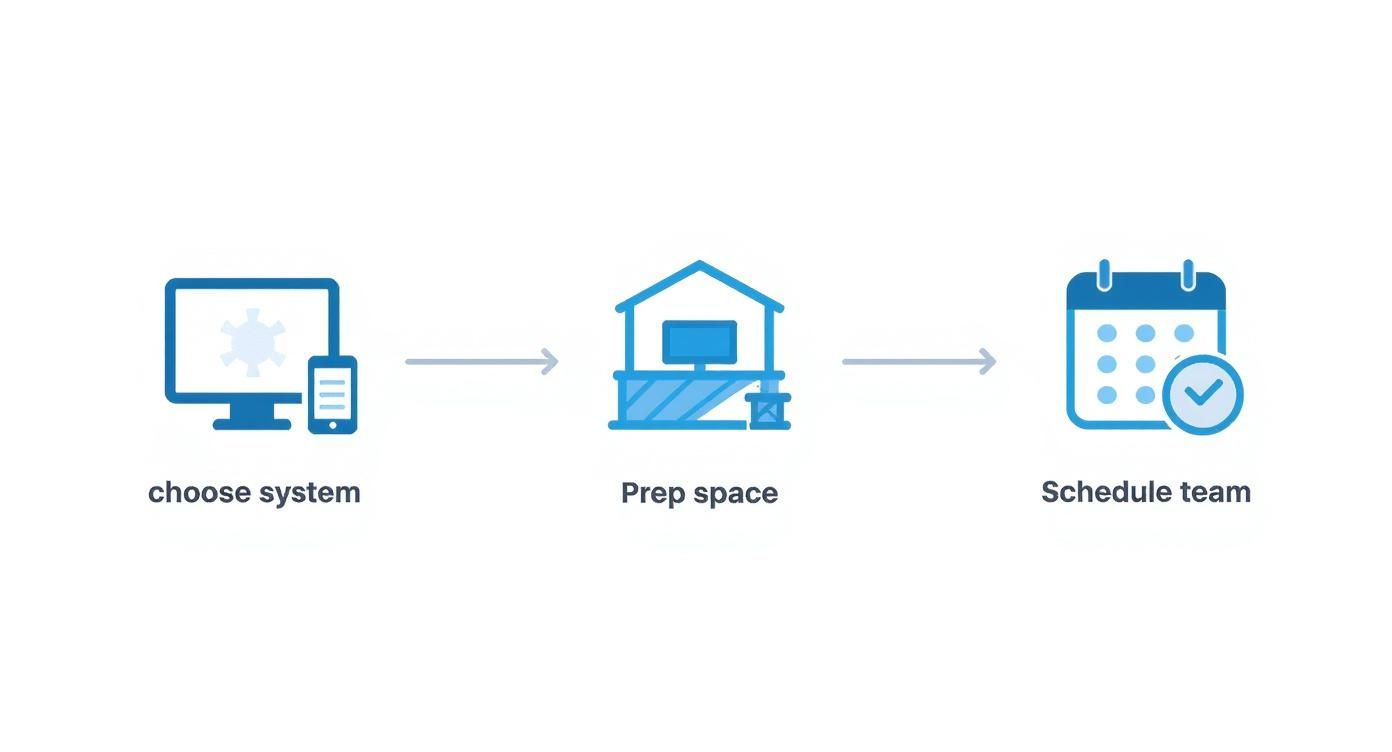
As you can see, getting the right system, setting up the space, and scheduling your team are the building blocks for every successful test you'll perform.
Start With Pure Observation
The test really begins the moment an employee walks in. First things first, make them feel comfortable. Explain what's about to happen in simple terms—that you're working together to find the best and most comfortable hearing protection for them.
Now for the most critical step: ask them to fit their hearing protectors exactly as they would out on the floor. This is key: observe without correcting. Just watch. Are they rolling the foam plug down properly? Do they pull their ear back to straighten the canal?
This first, uncoached attempt gives you a raw baseline. The Personal Attenuation Rating (PAR) you get from this test reveals the level of protection they were actually getting in the workplace. That number is your starting point for everything that comes next.
How to Interpret the Results: A ‘Fail’ is a Finding
After the test, you’ll have a PAR score. You compare this score to the noise levels in their work area to see if the protection is cutting it. The result is a simple ‘pass’ or ‘fail’.
It's crucial to change how you and your team think about a 'fail'. It's not a personal failure. It’s a vital discovery that tells you one of two things: either their fitting technique needs a tune-up, or the protector itself is a bad match for their ear.
A 'fail' isn't a negative outcome; it's a positive opportunity. It's the exact moment you get to prevent a future hearing injury by finding a protection gap no one knew was there.
This is the real power of fit testing. It shines a light on these invisible risks and gives you a clear, immediate way to fix them.
The Coach and Re-Test Loop
If an employee doesn't get a passing score, you immediately shift into coaching mode. This is where you create lasting change with a simple, powerful feedback loop. Don't just tell them—show them.
- Demonstrate: Physically show them the proper insertion technique. For a foam earplug, that means rolling it into a tight, crease-free cylinder.
- Explain: As you demonstrate, explain the ‘why’ behind each step. For instance, explain that pulling the outer ear up and back with the opposite hand straightens the ear canal, allowing for a much deeper and more effective seal.
- Practice: Now, let the employee try it themselves. Give them constructive feedback as they go. This hands-on practice is where the new habit sticks.
- Re-test: Once they’ve got the hang of the new technique, run the fit test again. Almost every time, you’ll see a massive jump in their PAR score.
This loop transforms a simple compliance check into a personalised training session, which is far more impactful than any generic safety meeting because it addresses that person's specific challenges right then and there.
Knowing When It's Time to Switch Protectors
But what happens if you've coached them on technique and they still can't get a pass? This is a huge clue. The problem isn't the person; it's the gear.
No amount of training will make an earplug that's too big or too small for someone's ear canal form a proper seal. It’s just not going to happen.
At this point, stop re-testing the same device and start looking at other options. This is why you need a good variety of hearing protectors on hand—different sizes, shapes, materials, and styles.
Work with the employee to try something else. Maybe a smaller foam plug is what they need, or the cone shape of another brand will fit their ear better. Test each new option until you find one that not only gives them a solid 'pass' but also feels comfortable. This ensures every worker walks away with a passing score and the right tool for their job.
Using Fit Test Data to Strengthen Your Safety Program
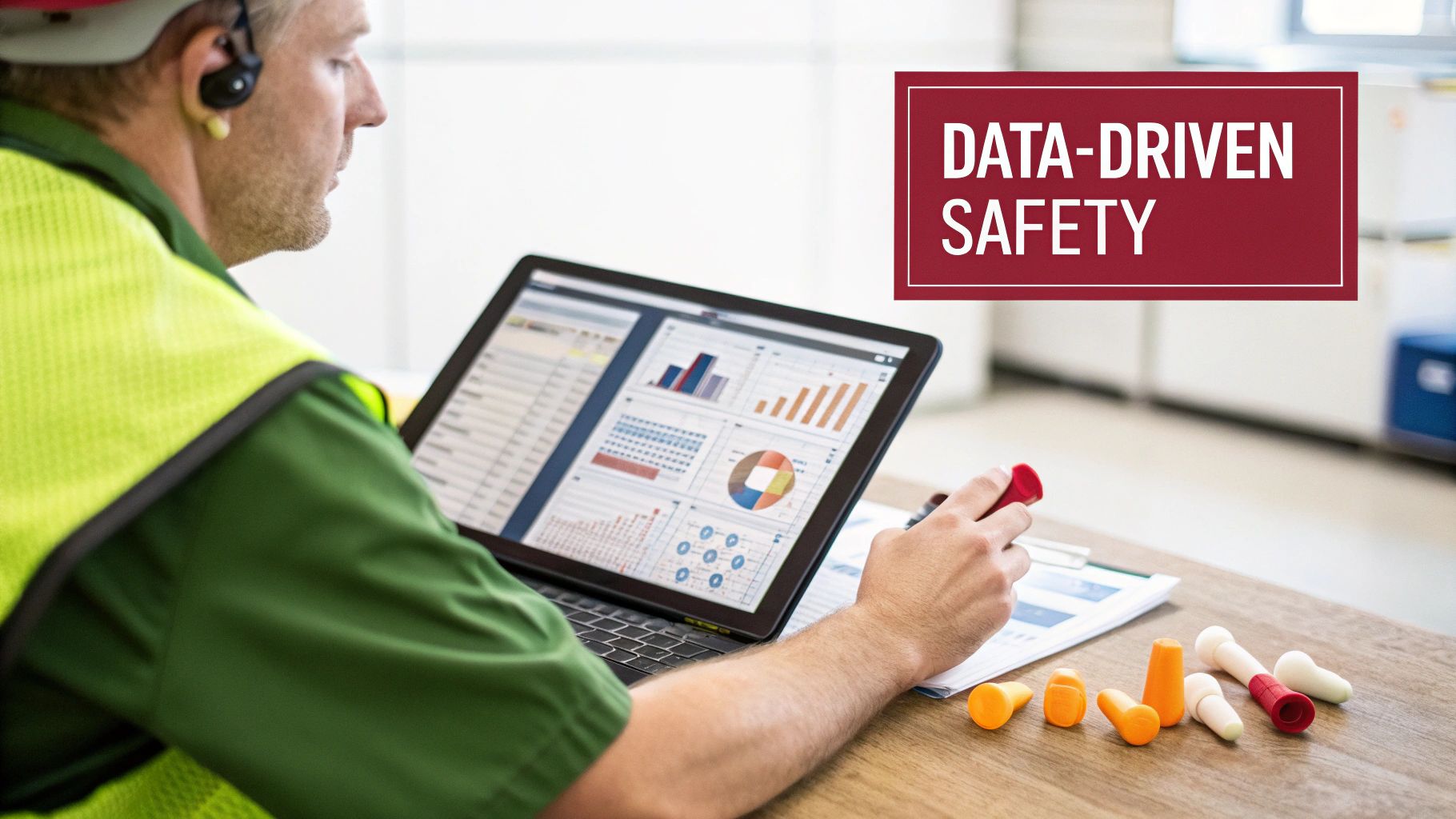
Running individual fit tests is a massive step in the right direction, but the real magic happens when you start looking at the results collectively. The data you gather is more than just a pass/fail score for each worker; it's a goldmine of strategic insight. When you start analysing this information as a whole, you can turn your Hearing Conservation Program (HCP) from a static, check-the-box exercise into a dynamic system that actually gets better over time.
It’s all about shifting from a reactive mindset (like panicking after a failed audiogram) to a proactive one. By zooming out and looking at the bigger picture, you can start spotting trends, validating your training efforts, and making smarter, evidence-backed decisions that genuinely protect your entire workforce.
Spotting Trends and Making Smarter Choices
Your aggregate fit-test data tells a story if you know how to read it. For instance, you might notice one specific brand or model of earplug has a consistently high failure rate across different crews. That’s a huge red flag. It’s not about blaming the workers; it’s a clear signal that the product itself probably isn’t a good match for the general ear canal shape of your team.
This data empowers you to make purchasing decisions based on hard evidence. Instead of just re-ordering what you’ve always used or trusting a sales pitch, you can confidently phase out underperforming products and invest in protectors with a proven track record among your own people.
It’s not always about the gear, either. What if an entire department shows lower-than-average PAR scores? That could point to a gap in their training. Perhaps that team needs a refresher session on proper insertion techniques. This lets you target your training resources precisely where they’ll have the most impact, saving time and getting better results.
Validating Your Training and Proving Effectiveness
How do you really know if your safety training is sinking in? Fit test data is the proof. When you see consistently high pass rates and strong PAR scores, you have concrete evidence that your team not only knows how to fit their protection but is actually doing it correctly. This is incredibly valuable for showing the effectiveness of your HCP to management and safety auditors.
The impact isn't just theoretical. A key Australian study on industrial hearing protection fit-testing found that worksites with this practice had statistically lower rates of significant hearing threshold shifts—a direct indicator of noise-induced hearing loss. Four industrial plants that brought in fit-testing saw a real drop in these incidents, proving it’s a worthwhile investment in worker health.
Think of your fit-test data as a report card for your Hearing Conservation Program. High scores mean your strategies are working. Low scores show you exactly where you need to focus your efforts to improve.
This kind of data-driven validation turns workplace safety from a hopeful goal into a measurable outcome.
Building Robust and Defensible Documentation
Under Australian WHS regulations, solid documentation is completely non-negotiable. Every fit test you conduct creates a permanent record that’s crucial for compliance and for demonstrating your due diligence. This record needs to be more than just a name and a number; it needs to tell the whole story of that worker’s fitting session.
Your records for each employee should capture:
- Employee Details: Full name, ID number, and their department or team.
- Test Information: The date of the test and the make/model of the fit-testing equipment used.
- Hearing Protector Details: The exact brand, model, and size of every protector they were tested on.
- The PAR Score: The objective Personal Attenuation Rating they achieved for each successful test.
- Training Notes: A quick note on any coaching you provided and a confirmation that the employee demonstrated the correct technique themselves.
This level of detail builds a rock-solid, defensible history of your program's effectiveness. If an audit or a compensation claim ever comes up, you'll have a clear, time-stamped log showing the specific, measurable steps you took to protect each worker. It’s also a key component of a comprehensive approach to workplace safety, which should always start with a professional industrial noise survey to identify your high-risk areas.
Meeting Compliance and Australian Best Practices
While hearing protection fit testing isn't a legislated must-do in Australia just yet, it's quickly becoming the benchmark for any serious workplace safety program. Think of it as best practice. The whole approach lines up perfectly with the guiding principles from Safe Work Australia and the spirit of the AS/NZS standards. It’s about moving beyond just ticking a box and fostering a genuine safety culture.
By bringing in a proper fit-testing program, you’re making a clear statement that you're serious about protecting your team from hazardous noise. It fundamentally shifts the focus from simply handing out hearing protection to actually verifying it works for each person. This is what a proactive approach to your primary duty of care really looks like.
Aligning With WHS Principles
At its core, Australian WHS law is all about finding risks and putting effective controls in place. The old way of doing things—just looking at an SLC₈₀ rating on a packet of earplugs—leaves a massive gap between the protection you think your workers have and what they're actually getting.
Fit testing closes that gap. It gives you objective, measurable data.
When you do this, you’re taking a "reasonably practicable" step to ensure your control measure (the hearing protection) is actually doing its job. It’s a far more robust and defensible position than the old 'hand out and hope' method.
I always tell clients to see fit testing not as another compliance headache, but as a strategic tool. It turns your Hearing Conservation Program from a document gathering dust on a shelf into a living, evidence-backed system that genuinely prevents hearing loss.
The Power of Defensible Records
Looking beyond prevention, the detailed records you get from a fit-testing program are worth their weight in gold. If you're ever faced with a safety audit or, worse, a workers' compensation claim for noise-induced hearing loss, this documentation is your proof of diligence.
These aren't just attendance sheets. These records show that you didn't just provide hearing protection, but that you also:
- Verified it was effective for that specific employee.
- Provided one-on-one training on how to fit it correctly.
- Offered different models if the first one wasn't a good match.
This level of detail is a game-changer. It shifts the conversation from, "Did you give them PPE?" to "Here is the objective data proving the PPE was effective for this person on this date."
The Growing Importance of Fit Testing in Australia
Right across the country, regulatory bodies and standards organisations are pushing fit testing as a critical part of modern noise management. Safe Work Australia and the teams behind the AS/NZS standards know that quantitative systems offer an accuracy that traditional ratings can't touch. They account for the two biggest variables in the real world: the user's skill and their unique ear canal shape.
A recent review even pointed to Australia as one of the countries that recommend fit testing in hearing conservation, showing its growing recognition as a key tool in tackling occupational noise exposure.
This proactive approach mirrors a commitment to safety seen in other high-risk areas. For example, adhering to the Australian Standards for electrical work (AS/NZS 3000) is non-negotiable for electrical safety. The principle is identical: standards and best practices are there to create a safer environment. Adopting fit testing shows your organisation operates at this higher standard, moving well beyond the bare minimum to protect the long-term health of your people.
Your Top Questions About Hearing Protection Fit Testing, Answered
Rolling out a fit testing program is a big step, and even the best-laid plans come with questions. It’s only natural for both you and your team to have a few things you're not sure about. Getting these sorted out early with clear, simple answers is the best way to build confidence and get everyone on board.
Think of this as your go-to cheat sheet for the tricky questions that always seem to come up.
How Often Should We Be Fit Testing Everyone?
This is probably the number one question I get asked, and getting the timing right is key to a program that actually works. The best practice is to start with an initial fit test for every new employee who's going to be working in a noisy area. You want to get that baseline sorted from day one.
After that, you should be looking to re-test everyone every one to two years. People's ear canals can change slightly over time, their fitting technique can get a bit sloppy, or you might bring in a new type of hearing protector. This regular check-in catches those little changes before they become big problems.
There's one big exception: if a worker's routine audiogram flags a significant threshold shift (STS), you need to act immediately. That’s a massive red flag that their hearing protection isn't doing its job. An urgent fit test is needed right then and there to figure out why and fix it.
What's the Real-World Difference Between Qualitative and Quantitative Tests?
It’s easy to get these terms mixed up, but the difference is huge. It really boils down to getting a subjective guess versus an objective fact.
-
Qualitative Testing: This is a simple, subjective pass/fail check. The person puts in their earplugs, someone makes a sound, and the person just says if they can hear it or not. It's quick, but it’s not accurate and relies completely on what the person thinks they hear.
-
Quantitative Testing: This is the data-driven method we’ve been focusing on. It uses proper equipment to give you a hard number—the Personal Attenuation Rating (PAR). This is the gold standard because it takes all the guesswork out of the equation and tells you exactly how many decibels of noise are being blocked for that specific person.
If you want a Hearing Conservation Program that will stand up to scrutiny, quantitative testing is the only real option. It gives you the concrete, real-world data you need to properly train your team and choose the right gear.
A qualitative test is like asking, "Do you reckon you're protected?" A quantitative test gives you the answer: "Here is the exact level of protection you are getting." That certainty is the whole point.
What Happens if Someone Fails a Fit Test?
How you frame this is so important for getting your team to trust the process. A 'fail' isn't a black mark against them. It’s the opposite—it's a learning moment where you’ve just caught a problem before it could cause permanent hearing damage.
When someone doesn't pass, the response is all about support and coaching. The person running the test should immediately work with them one-on-one, showing them the right way to insert their hearing protection, like using the 'pull-back' method to open up the ear canal for a much better seal.
The employee then has another go themselves before being re-tested. If they still can't get a pass, it's not their fault; it just means that particular earplug is the wrong shape or size for their ear. The next step is simply to try a different style or brand until you find one that gives them a comfortable, effective seal—and a passing score to prove it.
Does This Mean We Can Stop Doing Audiometric Testing?
No, absolutely not. This is a common point of confusion, but these two tests are completely different and you need both for a complete Hearing Conservation Program. They work together, but they do very different jobs.
- Fit Testing is Proactive: It's all about preventing hearing loss by making sure the protection is working properly right now. It looks forward.
- Audiometric Testing is for Monitoring: It’s designed to detect hearing loss that might have already happened. It looks backward.
Think of it this way: fit testing is your front-line defence to stop the damage from happening in the first place. The audiogram is your long-term check-up to make sure that defence is actually holding up over the years.
At Anitech, we know that building a truly effective Hearing Conservation Program is essential for protecting your crew. Our expert occupational hygienists provide on-site hearing protection fit testing and support to ensure your workplace isn't just compliant, but genuinely safe. Partner with us to protect your team's hearing for the long haul.


