
You've probably heard of workplace safety officers, but what about an occupational hygienist? Think of them as the 'health detectives' of the workplace. Their entire focus is on protecting people from the often-invisible hazards that can lead to illness, injury, and long-term health issues.
They are highly trained scientists dedicated to creating and maintaining a safe, healthy work environment.
The Unseen Guardians of Workplace Health

When we talk about workplace safety, things like hard hats, high-vis vests, and safety harnesses usually come to mind. These are all crucial, of course, but they protect against the dangers you can see. What about the ones you can't?
This is precisely where the occupational hygienist comes in. They are the frontline defence against the unseen threats that can seriously impact a worker's wellbeing over time. Their work is deeply rooted in science, applying rigorous methods to shield people from harm before it happens.
Who Are They, Really?
Imagine a detective arriving at a scene, not to solve a crime, but to solve a potential health puzzle. That's an occupational hygienist. They hunt for clues—subtle signs of potential harm—and use specialised scientific tools to gather hard evidence. This data allows them to understand the risks and develop practical strategies to keep people safe.
Their 'patch' could be a noisy factory floor, a dusty construction site, a mine, or even a seemingly safe office building. The culprits they’re tracking are often invisible to the naked eye.
These hazards typically fall into four main categories:
- Chemical Hazards: This includes everything from dangerous fumes and solvent vapours to microscopic dust particles like crystalline silica or asbestos fibres.
- Physical Hazards: Think excessive noise that can cause permanent hearing loss, extreme heat or cold, and sources of radiation.
- Biological Hazards: These are things like mould, bacteria, or viruses that can flourish in specific work environments, like hospitals or poorly ventilated buildings.
- Ergonomic Hazards: This covers risks from poorly designed workstations, repetitive tasks, or manual handling that can lead to debilitating musculoskeletal injuries.
By scientifically assessing these risks, an occupational hygienist provides the crucial link between the work environment and the long-term health of the workforce. They don't just react to problems; they proactively anticipate them to prevent illness before it occurs.
Ultimately, their mission is simple but profound: to make sure every employee can go home at the end of the day just as healthy as when they arrived. They are the unseen guardians, quietly working behind the scenes to protect the workforce from the hidden dangers of their jobs.
The Four Pillars of Occupational Hygiene
So, what does an occupational hygienist actually do? Their work isn't just a random safety check; it's a systematic process grounded in a robust, four-pillar framework. This methodical approach ensures every potential hazard is properly addressed, from start to finish.
We often use the acronym AREC to remember these four pillars: Anticipation, Recognition, Evaluation, and Control.
Think of it as a roadmap. It guides the hygienist from spotting a potential risk on the horizon all the way through to implementing a lasting solution. Each step builds on the one before, making sure every decision is backed by solid scientific evidence, not just guesswork.
The infographic below helps visualise this foundational process, showing the AREC framework as four sturdy industrial pillars that literally uphold workplace health and safety.

As you can see, each pillar represents a distinct stage, but they're all part of a continuous cycle of managing and improving health in the workplace.
Pillar 1: Anticipation
This is the proactive, forward-looking part of the job. Before a business brings in a new chemical, installs a new piece of equipment, or changes a work process, an occupational hygienist anticipates the health hazards that could pop up. It’s all about asking, "What if?" before it becomes a case of "What now?".
For example, imagine a manufacturing plant is about to introduce a new industrial solvent. The hygienist would get in early, researching its properties, understanding the potential health effects, and figuring out how it might interact with the specific work environment. This foresight is what allows safety to be designed in from day one, not bolted on as an afterthought.
Pillar 2: Recognition
While anticipation is about the future, recognition deals with the here and now. This pillar is all about identifying hazards that already exist in a workplace. This is the real detective work.
A hygienist will walk through the site, carefully observing how people work, and talking to employees to understand their experiences. They might spot a fine cloud of dust hanging in the air near a cutting station, hear the tell-tale whine of a noisy, poorly-maintained machine, or learn from workers that they get headaches after using a certain cleaning agent. It's about finding the real-world health risks that are present today.
Pillar 3: Evaluation
Once a hazard has been recognised, it needs to be measured. Evaluation is the scientific core of the process, where the hygienist quantifies the risk. This isn't about gut feelings; it's about collecting hard data.
This objective measurement is what separates professional occupational hygiene from a basic safety check. It provides the concrete evidence needed to determine if a hazard exceeds legal exposure limits and poses a genuine threat to a worker's health.
Using specialised monitoring equipment, they can get very specific. For instance, they might:
- Measure the exact decibel levels a machine operator is exposed to over an entire shift.
- Take air samples from right inside a worker’s breathing zone to find the precise concentration of a chemical fume.
- Assess the vibration levels coming from a power tool to calculate the risk of developing hand-arm vibration syndrome.
This data paints a clear, undeniable picture of how severe the exposure really is.
Pillar 4: Control
The final pillar, Control, is where theory turns into action. Using the data from the evaluation, the hygienist develops and helps implement strategies to either eliminate the hazard or reduce the risk to an acceptable level.
They don't just jump to handing out masks or earplugs. Instead, they follow a tried-and-tested framework known as the hierarchy of controls, which prioritises the most effective and permanent solutions first.
It’s a top-down approach. The first priority is always to eliminate the hazard completely. If that’s not feasible, the next best thing is to substitute it with a safer alternative. Failing that, they look to engineering controls (like installing a ventilation system), then administrative controls (like rotating jobs), and only then, as the last line of defence, do they rely on personal protective equipment (PPE). This structured thinking ensures the solution is as robust and protective as possible for the long haul.
The Scientific Toolkit of a Health Detective
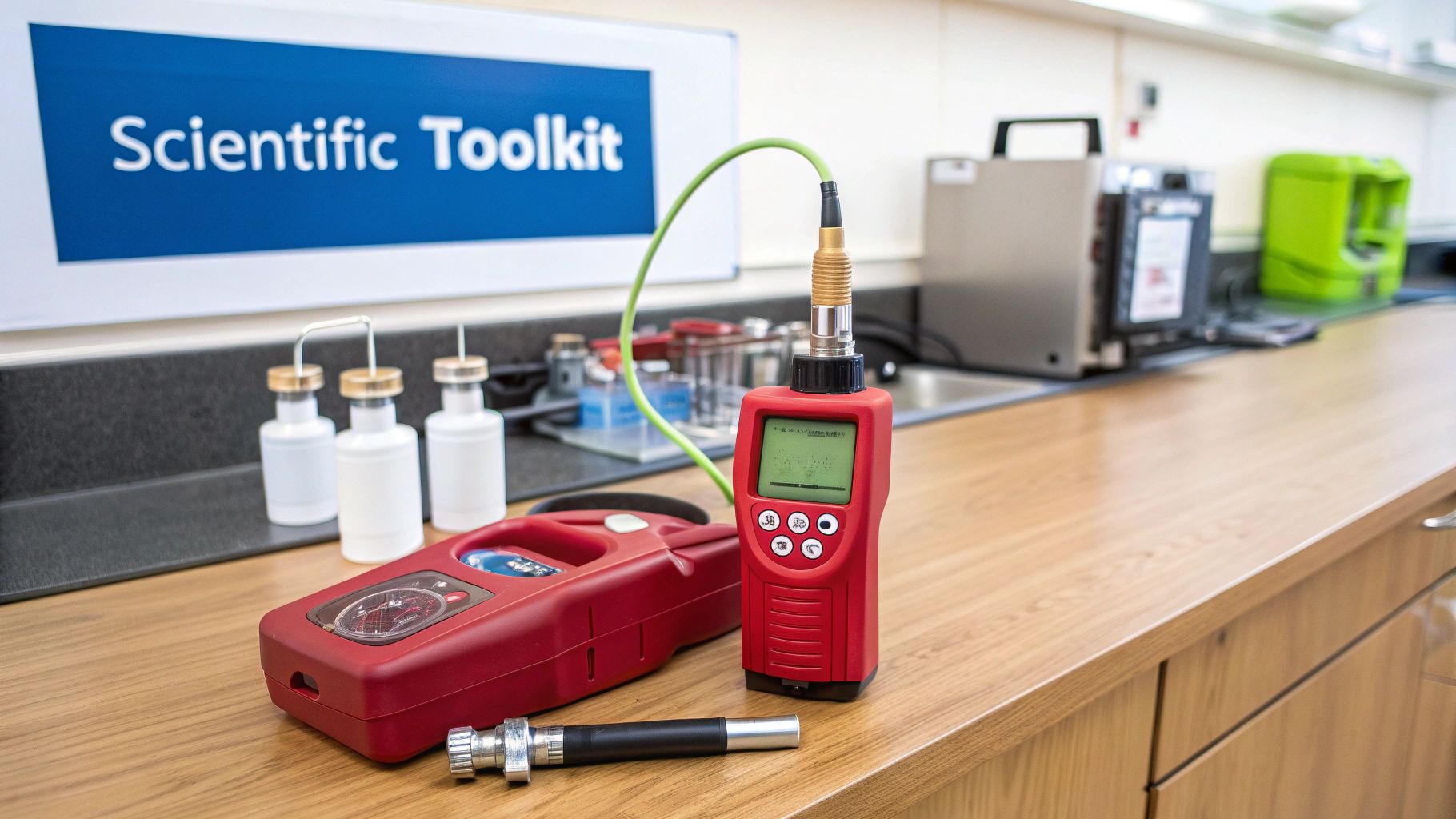
When an occupational hygienist walks onto a site, they aren’t just relying on their eyes and ears. They come armed with a specialised scientific toolkit designed to see, hear, and measure the invisible. Guesswork has no place in protecting people's health.
These instruments give us the power to get objective, quantifiable data about the very real threats that workers might be facing every day. After all, you can't see toxic vapours, and your ears can’t tell you the precise decibel level that’s damaging your hearing. This scientific approach is what elevates a simple safety check into a proper health risk assessment.
Making the Invisible, Visible
A hygienist’s toolkit is as diverse as the hazards they hunt. Each piece of equipment is chosen for a specific job, allowing them to gather the hard evidence needed to build a clear picture of what’s really going on. This data becomes the bedrock of any effective safety strategy.
Here are a few of the essential tools you'll often see in action:
- Sound Level Meters: These devices give us precise noise readings across a workplace. We use this data to create noise maps, pinpointing high-risk zones where hearing protection is non-negotiable.
- Dosimeters: Think of this as a personal noise diary. It’s a small device worn by an employee throughout their shift, measuring their total, cumulative noise exposure to create a highly accurate, individual risk profile.
- Personal Air Sampling Pumps: This is the modern-day canary in a coal mine. A small, quiet pump is worn by a worker, drawing a measured amount of air through a filter or tube. This captures any dust, fibres, or chemical vapours for later lab analysis.
- Direct-Reading Instruments: For instant feedback, we use these handheld devices. They give us real-time data on specific hazards, like the concentration of a particular gas or whether oxygen levels in a confined space are safe.
By using this specialised equipment, the hygienist gathers irrefutable evidence. This data isn't just for a report; it's the critical information needed to justify changes, select the right controls, and ultimately protect people's long-term health from serious occupational diseases.
From Data to Decisive Action
Collecting numbers is just the starting point. The real expertise comes in interpreting what those measurements actually mean for worker health. A crucial part of this is knowing how often to check. For example, understanding the best practices for determining air quality testing frequency is fundamental to keeping on top of any hazards.
When the data points to a problem, like dangerous levels of airborne silica dust, it drives the next steps. It tells us exactly what level of respiratory protection is needed and forms the scientific basis for a full safety plan. In fact, this data is the foundation for creating a compliant and effective plan, which we cover in our guide on implementing a respiratory protection program. This science-led approach ensures that the solutions we put in place are perfectly matched to the problem, giving workers the best possible defence.
How Occupational Hygienists Impact Australian Industries
An occupational hygienist’s work isn't limited to a single factory floor or office building. Their expertise is crucial right across the spectrum of Australian industries. From the red dust of a remote mine site to the sterile environment of a pharmaceutical lab, these professionals are on the ground applying scientific principles to shield workers from harm.
You’ll find them at the front line in the toughest environments, particularly in mining and construction. Here, they lead the charge against devastating respiratory diseases by rigorously monitoring airborne nasties like coal dust and asbestos fibres. A huge part of this work involves managing the risks of respirable crystalline silica (RCS), the primary cause of silicosis. We take a deeper look into this hazard in our detailed article on respirable crystalline silica.
Protecting Workers in Diverse Sectors
The manufacturing sector throws up a completely different set of challenges. In these workplaces, hygienists might be dealing with complex chemical exposures from solvents, paints, or industrial by-products. They also tackle physical hazards like the deafening noise from heavy machinery, designing strategies to prevent permanent hearing loss. Their guidance is essential for helping businesses navigate the often complex WHS regulations in Australia to keep their teams safe.
Even a seemingly clean environment like a hospital relies on their skills. An occupational hygienist in healthcare works to control airborne biological agents, ensures chemical sterilising agents are handled safely, and helps manage ergonomic risks for nurses and other staff.
The common thread, no matter the industry, is a proactive and scientific approach. A hygienist's goal is to anticipate and prevent harm before it ever happens, protecting not just individual workers but the long-term health of the entire business.
A Critical Role in Public Health
The need for this expertise is thrown into sharp relief by national statistics. Safe Work Australia reports that around 2,000 deaths each year are linked to occupational diseases. That figure is shockingly high, far outnumbering the roughly 250 deaths caused by workplace injuries.
Diseases like silicosis, asbestosis, and other dust-related lung conditions are precisely what occupational hygiene initiatives are designed to stop. By getting into the workplace, monitoring exposure levels, and implementing practical controls like better ventilation or safer work procedures, hygienists directly prevent these tragic outcomes. You can learn more about these efforts from the Australian Institute of Occupational Hygienists. Their work is fundamental to creating safer, healthier workplaces for everyone.
What Does It Take to Become a Certified Occupational Hygienist in Australia?
Becoming a trusted expert in workplace health isn't something that happens overnight. It's a demanding career path that calls for a solid scientific mind and a real commitment to keeping people safe from the hidden dangers of their jobs. It’s a journey that blends rigorous academic training with years of hands-on experience.
Most people start with a university degree in a relevant field like science, engineering, or health sciences. This gives you the fundamental building blocks—the chemistry, physics, and biology—that everything else is built upon.
The Journey to Professional Certification
But a bachelor’s degree is just the starting line. To really specialise, the next step is usually a postgraduate qualification in occupational hygiene or a closely related area. This is where you dive deep into the core skills of the trade: how to spot a hazard, measure the risk, and design effective ways to control it.
The real gold standard in Australia, however, is certification. This is what separates the experts from the crowd.
The most recognised credential is the Certified Occupational Hygienist (COH). This designation is awarded by the Australian Institute of Occupational Hygienists (AIOH) and it’s a big deal. Earning your COH status tells everyone that you've met the highest standards for experience, ethics, and specialised knowledge.
Put simply, it's a clear signal to employers and workers alike that you are a highly competent professional dedicated to protecting their health and wellbeing.
The Skills That Really Matter
Of course, it’s not all about qualifications. A great occupational hygienist needs a unique mix of hard and soft skills. You have to be an analytical thinker, someone who can look at complex data and see the story it’s telling about workplace exposure. Strong problem-solving skills are non-negotiable; you're the one who has to come up with practical, real-world solutions that actually work.
Just as critical, though, are top-notch communication skills. It’s one thing to understand the science, but you also have to explain complex health risks in plain English to everyone from the workers on the factory floor to the executives in the boardroom. Being able to translate technical findings into clear, actionable advice is what truly makes a hygienist effective.
In Australia, the profession is championed by the Australian Institute of Occupational Hygienists (AIOH). Established back in 1980, it has grown to over 1,000 members and acts as the peak body for advancing the field and shaping safety policy. You can learn more about the role of the AIOH in Australia.
The Strategic Value and Career Outlook
It's easy to look at occupational hygiene as just another box to tick for compliance, a necessary cost of doing business. But that perspective misses the bigger picture entirely. Really, it's one of the smartest investments a company can make in its most critical asset: its people.
A well-run hygiene program isn't just about avoiding fines; its benefits ripple through the entire organisation. When your team feels genuinely safe and knows you’re looking out for their long-term health, you see a natural boost in morale and productivity. It's common sense. This proactive stance also cuts down on absenteeism and reduces the financial hit from workers’ compensation claims, directly protecting the bottom line.
A Rewarding and In-Demand Career
If you're considering a career in this field, the outlook in Australia is incredibly positive. With regulators paying closer attention and companies genuinely focusing on social responsibility, the need for qualified professionals is growing fast. It’s a fantastic path for anyone with a scientific mind who wants their work to have a real, tangible impact on people's lives.
The pay reflects just how vital this role has become. For example, the average salary for an occupational hygienist in Australia sits around AU$81,314 per year. Newcomers can expect to start near AU$65,000, while seasoned experts can command salaries up to AU$123,000 annually. You can explore more detailed salary data for an occupational hygienist in Australia.
This strong earning potential isn't just a number; it’s a clear signal of the high value industries place on this expertise. It shows that businesses truly understand the link between a healthy workforce and a sustainable, successful operation.
At the end of the day, a career as an occupational hygienist offers a rare mix of scientific challenge, direct human impact, and professional stability. For any business, bringing an occupational hygienist on board is a fundamental step toward creating a workplace that is not only compliant but also resilient, productive, and genuinely committed to the wellbeing of every single employee.
Common Questions About Occupational Hygiene
The world of workplace health and safety can seem a bit murky, and it’s easy to get lost in the different titles and roles. But getting a clear picture of who does what is the first step in making smart decisions to protect your team.
So, let's clear up a couple of the most common questions we hear.
Hygienist vs. WHS Officer: What Is the Difference?
This is a big one, and it's a source of frequent confusion, but the distinction is actually quite simple.
Think of a Workplace Health and Safety (WHS) officer as a general practitioner. They’re fantastic generalists, managing the day-to-day health of your workplace. They handle everything from fire drills and first aid kits to general safety compliance and incident reports. Their role is absolutely vital for keeping things running safely.
An occupational hygienist, on the other hand, is the specialist you bring in when the problem is invisible, complex, or potentially deadly. They are the scientists of the safety world. Their expertise is in deep, methodical analysis—precisely measuring noise levels, quantifying exposure to airborne chemicals, and assessing the kind of long-term health risks that you can’t see or easily measure.
While a WHS officer ensures broad compliance, a hygienist dives deep to investigate and solve complex health hazards at their source.
When Should a Business Hire a Hygienist?
Knowing when to call in an expert is crucial. You should think about engaging an occupational hygienist when you’re facing situations that go beyond the scope of general safety management.
A few common triggers include:
- Introducing New Substances: Bringing a new chemical or material onto the site? A hygienist can assess its potential health risks before it becomes a problem, helping you put the right controls in place from day one.
- Dealing with Complex Hazards: Are you dealing with stubborn issues like excessive noise, dust, or ongoing worker complaints about strange odours or poor air quality? A hygienist has the tools and knowledge to find the root cause.
- Preventing Long-Term Disease: This is where hygienists truly shine. Their work is fundamental to preventing devastating occupational diseases like silicosis, occupational cancers, or hearing loss by scientifically controlling exposures over the long haul.
In essence, you hire a hygienist when you need to move beyond just managing safety and start scientifically controlling complex health risks. Their focus on preventing those slow-burning, often irreversible illnesses provides a layer of protection that a general safety program simply can't.
Our certified occupational hygienists bring the scientific expertise your business needs to get on top of complex health hazards and create a truly safe environment for your team. We offer expert consultation across Australia to help you anticipate, evaluate, and control workplace risks properly. Protect your most valuable asset—your people—by partnering with the leaders in occupational hygiene.
Explore our comprehensive services at https://occhygiene.com.au.


