
Inhalable dust monitoring is all about measuring the airborne particles you can breathe in through your nose or mouth. These particles often get trapped in the upper parts of your respiratory system, and that's where the trouble starts. For anyone working in construction, mining, or manufacturing, this is a serious workplace hazard that can lead to health problems like bronchitis and asthma.
Unmasking the Invisible Threat in Your Workplace
When you walk onto a busy worksite, your attention is naturally drawn to the obvious dangers—heavy machinery in motion, the deafening noise, the things you can see and touch. But one of the most persistent threats is often overlooked because it's literally part of the air you're breathing: inhalable dust. For safety managers and business owners across Australia, getting a handle on this invisible risk is the first real step towards building a truly safe workplace.
While a lot of the talk around dust rightly focuses on the tiny, microscopic particles that cause deep-seated lung diseases, the larger particles we classify as "inhalable" bring their own set of significant, and often more immediate, health risks. These are the particles that get snagged in the upper respiratory tract—the nose, throat, and bronchial tubes.
A Simple Analogy: Throwing Balls at a Net
To really grasp the difference between dust particle sizes and how they affect the body, let's think about someone throwing different sized balls at a net.
- Beach Balls (Nuisance Dust): These are like the very large dust particles. They're too big to even get inhaled, so while they might be an annoyance, they bounce right off your body’s first line of defence.
- Tennis Balls (Inhalable Dust): These are smaller and can easily get caught in the net. This is a perfect analogy for inhalable dust—particles up to 100 micrometres in size that are breathed in and become trapped in your upper airways.
- Marbles (Respirable Dust): These are small, dense, and fast. They slip right through the holes in the net and travel a lot further. This is like respirable dust, which gets past the upper defences and lodges deep inside the delicate tissues of the lungs.
While the "marbles" are notorious for causing devastating, long-term diseases, the "tennis balls" create immediate and recurring problems right away. They are the main culprits behind the irritation and inflammation that plague the airways.
Inhalable dust doesn't just pass through; it lodges in the upper respiratory system, triggering inflammatory responses that can lead to chronic conditions and significantly impact a worker's quality of life and ability to perform their job safely.
From Irritation to Chronic Illness
When inhalable dust builds up in the respiratory system, it can set off a chain reaction of health issues. We're talking about more than just a cough or a sore throat; repeated exposure has serious consequences. For workers in high-risk fields like construction, mining, and manufacturing, this constant irritation can slowly but surely develop into much more severe conditions.
This consistent assault on the body's natural filters can lead to:
- Chronic Bronchitis: A persistent inflammation of the bronchial tubes, which results in a nagging cough and constant mucus production.
- Occupational Asthma: An allergic reaction to specific dust particles found in the workplace, causing the airways to constrict, leading to wheezing and shortness of breath.
- Severe Irritation: Damage to the lining of the nose and throat, which makes workers more susceptible to infections and other respiratory illnesses.
This is precisely why a proactive inhalable dust monitoring program is so critical. It’s not just about ticking a compliance box. It’s a fundamental part of workplace safety, giving you the hard data needed to protect your team from a hazard they might not even see coming.
Understanding these dangers really brings home the need for proactive measures. Beyond monitoring and controls, a key piece of the puzzle is investing in comprehensive Health & Safety training to give workers the knowledge to protect themselves. By actively measuring and controlling these airborne hazards, businesses can prevent illnesses, improve productivity, and foster a culture where every single person goes home safe at the end of the day.
Understanding Australian Dust Exposure Regulations
For any business in Australia, particularly in industries like mining, construction, or manufacturing, getting a handle on workplace safety laws can feel overwhelming. When it comes to inhalable dust, the regulations aren't just suggestions; they're a critical part of your legal responsibility to keep your team safe. The entire framework is designed to protect workers, and it falls squarely on the shoulders of the Person Conducting a Business or Undertaking (PCBU) to manage these risks.
At its core, this is all about the Work Health and Safety (WHS) legislation. The law isn't just about cleaning up after an incident; it demands a proactive approach. You have to actively look for, assess, and control hazards like dust before they cause harm. Inhalable dust monitoring is one of the most powerful tools in your arsenal to meet this duty, giving you the hard data to prove your safety measures are actually working.
The National Standard for Inhalable Dust
The main number you need to know is set by Safe Work Australia’s Workplace Exposure Standards (WES) for airborne contaminants. This is the national benchmark.
For general inhalable dust that isn't classified as a more specific substance, the standard is 10 mg/m³.
This figure isn’t an instantaneous limit. It's a Time-Weighted Average (TWA) calculated over a typical eight-hour workday and a 40-hour week. Think of it as a daily "exposure budget." A worker might have moments of high dust exposure during a specific task, followed by long periods with very little. The TWA averages out these peaks and valleys to give a realistic picture of their overall exposure throughout a full shift.
Sticking to the Workplace Exposure Standard isn't just good practice—it's the law. If your monitoring shows you're exceeding this limit, it's a clear signal that your current controls are failing and workers are at risk. This requires immediate action to fix the problem.
State-Specific Rules and Enforcement
While the WES provides a national baseline, it's vital to remember that WHS laws are actually enforced at the state and territory level. This means your local regulator can, and often does, set more stringent rules, especially for high-risk sectors.
Queensland is a perfect example. The state has some of the toughest regulations in the country for its mining and quarrying industry. Under Queensland law, mines are required to report any dust exposure breaches directly to Resources Safety & Health Queensland (RSHQ). This creates a serious layer of accountability, ensuring that high-exposure events are dealt with on-site and also tracked by the regulator to spot wider industry trends.
To give you a clearer picture, here’s a quick overview of how the regulations are structured across Australia.
Key Australian Inhalable Dust Regulations at a Glance
This table summarises the core legislative components, exposure limits, and responsible bodies for inhalable dust management in Australia.
| Regulatory Aspect | Governing Body | Key Requirement or Standard | Industry Application |
|---|---|---|---|
| National Standard Setting | Safe Work Australia | Establishes the Workplace Exposure Standards (WES), e.g., 10 mg/m³ for inhalable dust. | All industries where airborne contaminants exist. |
| Legislation & Enforcement | State/Territory WHS Regulators (e.g., SafeWork NSW, WorkSafe VIC) | Enforce WHS/OHS Acts and Regulations, conduct inspections, issue penalties. | All businesses operating within that jurisdiction. |
| High-Risk Industry Oversight | Specific Regulators (e.g., RSHQ in QLD) | Mandate specific reporting, health monitoring, and dust control plans for their sectors. | Primarily mining, quarrying, and resources. |
| PCBU Duty of Care | The Business/Employer | Primary duty to ensure health and safety by eliminating or minimising risks so far as is reasonably practicable. | Universal legal obligation for all PCBUs. |
As you can see, while the national body sets the standard, the real day-to-day enforcement and any industry-specific rules come from your local state or territory regulator.
The Importance of Due Diligence
Ultimately, inhalable dust monitoring plays two crucial roles. First and foremost, it protects your workers by showing you exactly where, when, and how much they are being exposed. But just as importantly, it helps you demonstrate due diligence. By consistently gathering and acting on monitoring data, a PCBU can provide clear, documented evidence that they are taking every reasonably practicable step to manage workplace hazards. This is your best line of defence during a regulatory audit or, in a worst-case scenario, after an incident.
This entire regulatory framework is built on scientific evidence. The 10 mg/m³ standard was a major step forward, but research shows that compliance alone isn't a silver bullet. A massive study of 12,797 Australian mine workers between 2001 and 2012 found that even when exposures were below the legal limit, health risks remained. For every 1 mg/m³ increase in inhalable dust, the odds of a worker reporting phlegm went up by 3.3%. It's a stark reminder that the legal limit is the minimum standard, not the ultimate goal.
Beyond the specifics of dust rules, having a solid grasp of broader safety principles is always a good idea. For more on this, you might find a general health and safety blog useful. When you stop seeing monitoring as a chore and start seeing it as an essential business intelligence tool, you can shift from a reactive, compliance-focused mindset to a truly proactive culture of safety.
Getting a Real-World Picture: How We Sample for Dust
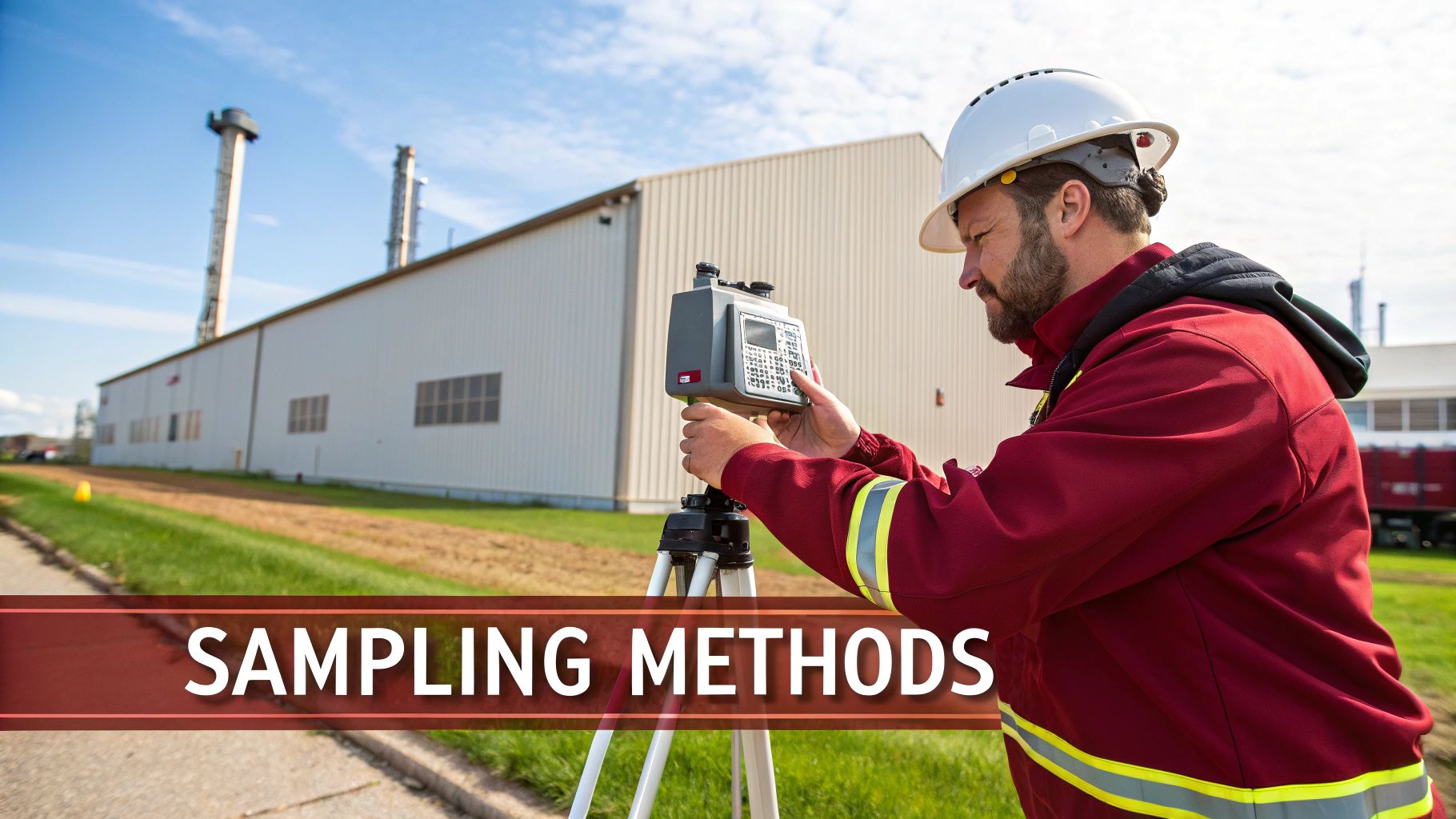
The biggest challenge in monitoring inhalable dust is trying to measure a hazard you often can’t even see. It’s not about guesswork; it's a science that demands a clear strategy and the right tools for the job. To get a true picture of workplace conditions, we need to be smart about where, when, and how we collect our data.
To do this, occupational hygienists lean on two main sampling strategies. Each one helps answer a different—but equally critical—question about the air your team is breathing. These aren't competing methods; a really solid monitoring program will actually use both to build a complete and accurate risk profile.
Personal Monitoring: What is an Individual Worker Breathing?
If you want to know exactly what a specific worker is breathing in throughout their day, nothing beats personal exposure monitoring. It’s considered the gold standard for a reason. This technique involves fitting a worker with a small, lightweight air sampling pump connected to a special filter cassette.
This device, often an IOM (Institute of Occupational Medicine) sampler, is clipped right onto their clothing, placing it within their "breathing zone"—the immediate area around their nose and mouth. For an entire shift, the pump pulls air through the filter at a very precise, calibrated flow rate, capturing the dust particles just as that worker would inhale them.
The real advantage here is precision. The monitor moves with the worker, from the workshop floor to the breakroom, capturing the highs and lows of their exposure as they handle different tasks. This gives us the most accurate data possible to compare against the legal eight-hour Time-Weighted Average (TWA) exposure standard.
Static Monitoring: What’s in the Air in a Specific Area?
While personal monitoring focuses on the individual, static monitoring tells us about the environment itself. Sometimes called area or background monitoring, this method is simple: we place a sampling device in a fixed spot and let it run.
This approach is perfect for answering questions like:
- Is that new dust extraction system actually working at this grinding station?
- How much dust is escaping from that enclosed conveyor belt over there?
- What are the general dust levels in the main part of the workshop?
Static monitors are invaluable for checking if your engineering controls, like water suppression or local exhaust ventilation, are doing their job. They act like sentinels, giving you a baseline for a specific area and helping you pinpoint sneaky dust sources you might otherwise miss.
A common mistake is using static monitoring alone to assess a worker's exposure. A fixed monitor can't follow someone who moves around, so it will almost certainly miss their highest-risk tasks and give you a dangerously misleading—and usually much lower—exposure reading.
Building a Smart Sampling Plan
A proper inhalable dust monitoring program is much more than just having the equipment; it’s about having a strategic plan. The whole point is to collect samples that are truly representative of the risks your people face day in and day out.
A smart first step is to group workers into Similar Exposure Groups (SEGs). An SEG is simply a group of workers who do similar jobs and are therefore likely to have similar dust exposures. For example, all welders in a fabrication shop might be one SEG, while the forklift drivers in the warehouse would be another.
By sampling a representative number of people from each SEG, you can efficiently get a handle on risk across the whole site without having to monitor every single person. This targeted approach makes sure your time and money are spent where it matters most. For particularly nasty hazards like crystalline silica, this detailed approach is absolutely essential. You can learn more about this specific process in our guide on air monitoring for silica dust.
Finally, your sampling plan can't be static. It needs to account for different work cycles, like a high-production run versus a quiet maintenance day. You have to take samples during typical working conditions to make sure the data reflects reality. By combining personal and static methods within a well-thought-out plan, you can turn that raw data into a powerful tool for protecting your team.
Turning Raw Data Into Actionable Insights
Collecting dust samples is just the start. The real value lies in taking those raw numbers and turning them into a practical plan for a safer workplace. A lab report packed with technical jargon can seem a bit daunting, but breaking it down is simpler than you might think. It’s how we bridge the gap between measurement and meaningful action.
When a sample filter cassette gets to the lab, it goes through a process called gravimetric analysis. It's a fancy term for a very precise weighing process. The lab weighs the filter before and after sampling, and that tiny difference in weight is the exact amount of dust collected from the air your team was breathing.
From Milligrams to Meaning
The lab takes this dust mass and combines it with the total volume of air your sampling pump pulled through the filter during the shift. This gives us a concentration, usually written as milligrams per cubic metre (mg/m³).
From there, this figure is converted into an 8-hour Time-Weighted Average (TWA). This calculation essentially smooths out the highs and lows of dust exposure over a standard work shift, giving you a single, representative number to work with.
This TWA is the critical piece of the puzzle. You compare it directly against Australia’s Workplace Exposure Standard (WES) of 10 mg/m³ for general inhalable dust. If your result is below this limit, you’re compliant. If it’s above, you need to act immediately.
The infographic below shows the basic decision-making process once you have your results in hand.
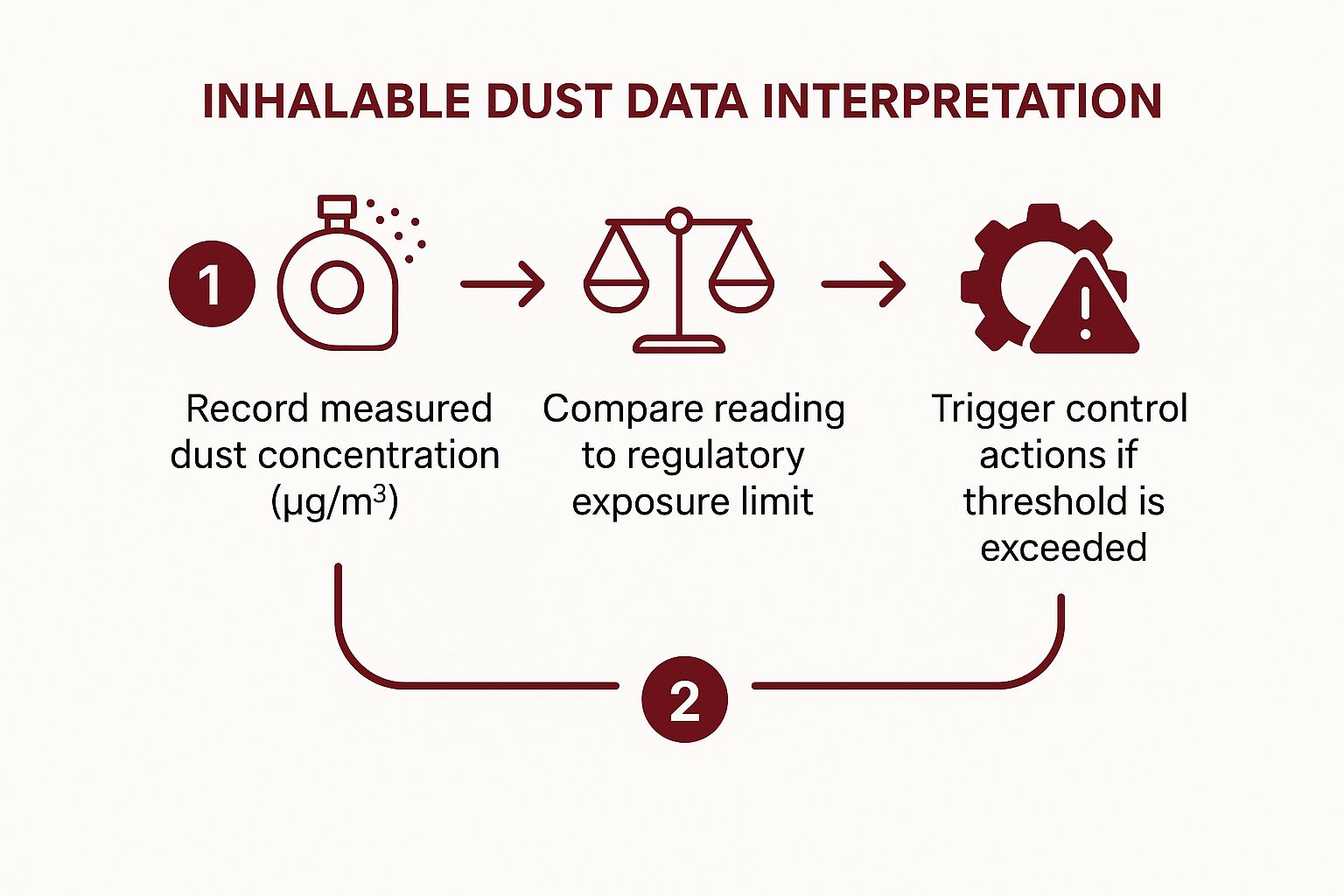
This simple flow demonstrates how a single data point can trigger a vital safety response, which is the heart of a reactive safety strategy.
Looking Beyond Mere Compliance
But let's be honest, a world-class safety culture doesn't just aim to scrape by under the legal limit. The goal isn't just compliance; it's proactive risk management. Simply staying below 10 mg/m³ doesn't mean the risk is zero. The data from your monitoring program is a goldmine of information that can help you get ahead of problems before they start.
Think of it this way: a single high reading is a loud alarm bell, but a series of readings trending upwards—even if they're all technically "compliant"—is the smoke detector beeping. It's an early warning that a control measure might be failing or that a particular work process is getting riskier.
Data isn’t just for ticking a box on a report. It’s a roadmap that shows you exactly where your risks are hiding. Using this data to spot trends and identify high-exposure tasks is what separates a basic compliance program from a world-class safety system.
Take Queensland's mineral mines and quarries, for example. There's a legal requirement to report all respiratory health monitoring data to the state regulator, Resources Safety & Health Queensland, when exposure limits are breached. This aggregated data helps refine safety strategies across the entire industry. Between the 2017/18 and 2018/19 periods, the percentage of samples exceeding respirable dust limits improved from 0.7% to 0.5%—a small but significant shift showing how focused efforts drive real change. You can find more on these reporting requirements on the Queensland government's business portal.
A Practical Example in Manufacturing
Imagine a factory where workers are handling powdered additives. Monitoring data consistently shows that while the overall TWA for the shift is 7 mg/m³ (safely under the limit), there are massive exposure spikes during one specific task: manually slitting and tipping bags of powder.
A manager with a compliance-only mindset might see the 7 mg/m³ result, tick the box, and file the report. A proactive safety professional, on the other hand, digs into the data. They see the spikes and immediately pinpoint the bag-tipping task as a critical control point.
This insight leads to a tangible change, like installing an enclosed tipping station with local exhaust ventilation. This isn't just about inhalable dust, either. Many airborne contaminants, like those from diesel engines, require this same kind of detailed approach. For a closer look, check out our guide on diesel particulate matter monitoring.
By interpreting the data, not just reading it, the factory transforms a routine compliance task into a genuine safety improvement. They slash those peak exposures and make the workplace fundamentally safer for everyone involved.
Implementing Dust Controls That Actually Work
So, your inhalable dust monitoring data has flagged a problem. The numbers are in and the risks are clear—what’s the next move? This is where the real work begins, bridging that crucial gap between measurement and meaningful action.
Knowing there’s too much dust in the air is one thing. Actually implementing control measures that genuinely reduce exposure and make the workplace safer is another entirely.
The most effective way to tackle any workplace hazard is to follow the Hierarchy of Controls. This isn't just a suggestion; it's a proven framework that prioritises the most robust and reliable solutions first. It forces us to move beyond simply handing out masks and instead focus on fixing the problem at its source.
Prioritising Engineering Solutions
Right at the top of the hierarchy, you’ll find engineering controls. These are physical changes to the workplace, equipment, or process that eliminate or drastically reduce the hazard. They are, by far, the most powerful tools in your arsenal because they’re designed to remove human error from the equation. They just work, continuously protecting everyone in the area without needing someone to remember to flick a switch.
Even with advances in dust monitoring, technology alone isn't a silver bullet. Trials in Australian underground coal mining, for instance, revealed that standard controls often remove less than 30% of the inhalable dust being generated. That’s not great.
However, by adopting best-practice engineering controls, that removal rate can jump to over 50%, directly slashing worker exposure.
Here are a few powerful examples of engineering controls in action:
- Local Exhaust Ventilation (LEV): Think of an on-tool dust extractor for tasks like cutting or grinding concrete. It’s like a high-powered vacuum that captures dust right at the point of creation, stopping it from ever becoming airborne.
- Water Suppression Systems: At a rock crushing plant, strategically placed misters and sprays can wet down material before, during, and after processing. This simple "wetting" technique weighs down dust particles, keeping them out of the air.
- Full Enclosure: For processes that generate extreme amounts of dust, like mixing powdered chemicals, containing the whole operation within a sealed booth is the ultimate solution. It physically isolates the hazard from the workers.
The Role of Administrative Controls
When engineering solutions can't eliminate the risk on their own, we then look to administrative controls. These are all about changing the way people work to limit their exposure.
These controls require active management and careful scheduling, but they can be highly effective when implemented properly.
Administrative controls are about smarter work practices. They don’t remove the dust itself, but they intelligently manage how, when, and where workers interact with it, significantly reducing their overall exposure.
Practical administrative controls include:
- Job Rotation: Limiting the time a worker spends on a high-dust task by rotating them through different roles during a shift.
- Scheduling: Performing the dustiest work when fewer people are on-site, like at the end of a shift or on a weekend.
- Restricted Access: Creating clearly marked exclusion zones around high-dust areas and ensuring only essential, properly protected personnel can enter.
PPE: The Final Line of Defence
Finally, at the very bottom of the hierarchy, we have Personal Protective Equipment (PPE). While respirators are absolutely essential in many situations, they should never be the first or only solution.
Their effectiveness hinges entirely on correct selection, a perfect fit, and consistent use by the worker. There's a lot that can go wrong.
PPE is the last line of defence for a reason—it only protects the individual wearing it, and only if everything is done perfectly. It doesn't actually solve the underlying problem. A complete approach means setting up a structured framework to manage this final control measure properly. For anyone looking to make sure their PPE strategy is solid, our detailed guide on implementing a Respiratory Protection Program (RPP) provides a comprehensive roadmap.
By using your inhalable dust monitoring data to guide the implementation of strong engineering and administrative controls first, you create a powerful feedback loop. You measure, you control, and then you verify, ensuring the changes you make have a real, measurable impact on creating a safer and healthier workplace.
Got Questions About Inhalable Dust Monitoring? We’ve Got Answers.
As we’ve walked through the world of inhalable dust—from the health risks to the nitty-gritty of sampling and control—it’s only natural to have some practical questions pop up. Business owners, safety managers, and team leaders often run into the same hurdles when trying to put these principles into action.
This section is all about tackling those common questions with clear, straightforward answers. Think of it as your go-to guide for navigating your responsibilities with confidence.
What Is the Difference Between Inhalable and Respirable Dust?
This is easily the most common point of confusion, and getting it right is fundamental to managing the risk properly.
Picture a cloud of dust kicked up on a worksite. Inhalable dust is essentially the whole cloud—all the particles big enough to be breathed in through your nose or mouth, which can be up to 100 micrometres in size. These larger particles usually get stuck in your upper airways (nose, throat, and larger bronchial tubes) and can lead to problems like irritation, asthma, or bronchitis.
Now, zoom in on that same cloud. Respirable dust is the much finer, invisible fraction. These are the tiny particles, less than 10 micrometres across, that are so small they slip past your body’s natural filters and travel deep into the delicate gas-exchange parts of your lungs. This is the stuff that causes serious, irreversible lung diseases like silicosis.
So, while both are hazardous, they attack different parts of your respiratory system and are measured against completely different exposure standards.
How Often Should We Be Conducting Dust Monitoring?
There’s no single, one-size-fits-all answer here. The right monitoring frequency comes down to your workplace’s specific risk assessment.
Under Australian Work Health and Safety (WHS) laws, you’re required to monitor whenever it's needed to be sure that workers aren’t being exposed to levels above the Workplace Exposure Standard (WES). A solid, best-practice approach usually looks something like this:
- Baseline Monitoring: The first step is to conduct initial monitoring to get a clear, factual picture of your current exposure levels across different job roles and tasks.
- Ongoing Checks: If your baseline results are consistently low (say, under 50% of the WES) and your work processes haven’t changed, you might be able to monitor less frequently, perhaps annually or every couple of years.
- Trigger-Based Monitoring: You must conduct fresh monitoring whenever something significant changes. This could be introducing new equipment, switching raw materials, altering a process, or simply if you have any reason to suspect exposures have gone up.
Your monitoring schedule should be a living document, not a "set and forget" task. It needs to flex and adapt as your workplace changes to give you a true picture of the risks your team is facing.
What Do We Do If Monitoring Shows We’ve Exceeded the Limit?
Finding out you’ve exceeded a legal exposure limit is a big deal. It’s a red flag that your current control measures simply aren’t cutting it, and it demands immediate action.
If a monitoring result comes back over the WES, you need a clear plan of attack:
- Notify and Investigate: First, you have to let the affected workers know about the result and the potential risks. Then, launch a proper investigation to figure out what went wrong. Was it an equipment failure? A breakdown in procedure? An unusual, non-routine task?
- Implement Better Controls: The next priority is to get effective controls in place to bring those exposure levels down. That might mean fixing a faulty ventilation system, improving a water suppression spray, or rethinking and changing a work practice entirely.
- Verify It’s Working: Once you’ve made changes, you must conduct follow-up monitoring. This is the crucial step that proves your fix is actually working and exposures are back to a safe level.
- Report if Required: Depending on your state or territory’s rules, especially in high-risk industries like mining, you may be legally required to report the exceedance to the relevant WHS regulator.
Is Real-Time Monitoring a Substitute for Traditional Sampling?
This is a fantastic question, especially as technology gets better and better. The short answer is no, real-time monitors aren’t a substitute for traditional sampling, but they are an incredibly powerful partner.
Traditional sampling, where a sample is collected on a filter over a full shift and sent to a lab for analysis, is still the legally recognised "gold standard" in Australia. It’s the definitive way to prove compliance with the official 8-hour Time-Weighted Average (TWA) exposure standard.
But real-time monitors give you invaluable, instant feedback. They are brilliant tools for:
- Quickly finding high-risk tasks or "hotspots" in the workplace.
- Giving workers immediate feedback during training on how their actions impact dust levels.
- Checking right away if a new control measure is actually making a difference.
The very best inhalable dust monitoring programs use a combined approach. They use real-time monitors for day-to-day operational control and spotting problems, while relying on traditional sampling for official compliance checks and long-term health surveillance. This gives you the best of both worlds: the immediate insights to act fast and the robust, legally defensible data to prove your workplace is safe.
Managing workplace hazards is a critical responsibility. Expert occupational hygienists provide comprehensive support to help you develop, implement, and verify a dust monitoring program that not only ensures compliance but truly protects the health of your team. Find out how our nationwide services can help create a safer environment for your business.


