
When dealing with the risks of asbestos, an occupational hygienist serves as the scientific guardian for your workplace. These are highly trained professionals who anticipate, identify, evaluate, and control asbestos hazards, ensuring buildings are safe from this invisible yet persistent danger. Their expertise is crucial for protecting health and ensuring legal compliance.
The Unseen Guardian of Your Workplace
Think of them as a highly specialised health detective for your building. Their entire professional focus is dedicated to hunting for hidden health threats long before they can cause irreversible harm. This is the core role of an occupational hygienist when asbestos is involved—a unique blend of scientific investigation and practical risk management, all focused on preventing exposure to deadly asbestos fibres.
If you manage, own, or are planning to renovate any building in Australia constructed before the nationwide ban in 2003, their expertise is absolutely essential. Asbestos-containing materials (ACMs) could still be lurking in ceilings, walls, flooring, insulation, and numerous other components, posing a significant health liability. Simply hoping for the best is not a viable strategy; proactive identification and meticulous management are required by law.
Your Independent Expert Advisor
An occupational hygienist acts as your independent, third-party expert. This is a critical distinction that ensures objectivity and prioritises safety above all else. Unlike a removal contractor whose primary job is to physically take the material away, the hygienist's loyalty is purely to scientific accuracy and your safety.
This deliberate separation of duties is crucial because it eliminates any potential conflict of interest. They are there to provide unbiased verification and scientific validation at every stage of an asbestos project.
Their key responsibilities typically include:
- Initial Identification: Carrying out comprehensive site inspections and taking carefully controlled samples for analysis at a NATA-accredited laboratory.
- Risk Assessment: Methodically evaluating the condition of any ACMs to determine the immediate and potential risk of fibre release into the air.
- Control Planning: Developing detailed, site-specific strategies to either safely manage the asbestos in-situ or create a comprehensive and safe removal plan.
- Oversight and Clearance: Conducting air monitoring during removal work to ensure containment is effective and issuing the final clearance certificate that declares an area safe for reoccupation.
By engaging an occupational hygienist for asbestos-related issues, you are making a direct investment in certainty and safety. Their scientific validation provides documented proof that a workplace is safe, protecting both the health of everyone inside and the legal standing of the business.
Ultimately, the meticulous work of a hygienist is about preventing devastating long-term diseases like mesothelioma, asbestosis, and lung cancer. They are the most important link in the safety chain, ensuring every step is handled correctly and that invisible dangers are brought into the light and managed with scientific precision.
To get a better sense of their wider role, you can learn more about what an occupational hygienist does across various other industries.
Australia's Deep-Rooted Asbestos Legacy
To fully appreciate why an occupational hygienist is so crucial in the Australian context, one must understand just how deeply asbestos is woven into the fabric of the nation's built environment. This is not a matter of ancient history; it is a persistent problem hiding in plain sight. For much of the 20th century, Australia was one of the highest per-capita users of asbestos in the world.
Consider the implications of that for a moment. This material was ubiquitous. It was integrated into fibro sheeting, roof tiles, insulation, vinyl flooring, pipes, and thousands of other common building materials. Our homes, schools, hospitals, and workplaces were constructed with it, embedding a dangerous legacy that still lingers today.
The Three Waves of Asbestos Disease
The tragic fallout from this widespread use did not manifest all at once. Health experts often describe it in terms of "three waves" of asbestos-related disease, with each wave affecting a different group of people. This pattern illustrates how the risk has shifted over time from a concentrated factory-floor problem to a widespread public health crisis affecting the entire community.
- The First Wave: These were the workers at the source—the miners, millers, and manufacturers who handled raw asbestos on a daily basis. Their exposure was direct, prolonged, and intense.
- The Second Wave: This wave primarily affected the tradespeople. Plumbers, electricians, carpenters, and builders who spent their careers cutting, drilling, installing, and disturbing asbestos-containing products.
- The Third Wave: This is the wave we are currently experiencing, and it is arguably the most insidious. It is composed of everyday Australians—DIY renovators, maintenance workers, and homeowners who accidentally disturb asbestos in their own homes, releasing deadly fibres without even realising the danger.
This third wave serves as a stark reminder that asbestos is no longer just a historical workplace issue. It is a hidden threat within our communities, making the expertise of an occupational hygienist absolutely essential to protect families and workers from accidental and catastrophic exposure.
The statistics paint a grim picture of this legacy. Australia has one of the highest rates of asbestos-related diseases (ARDs) in the world, a direct and tragic consequence of our past usage. It was projected that by 2020, Australia would have seen around 18,000 cases of mesothelioma—an aggressive and fatal cancer—along with another 30,000 to 40,000 cases of other diseases like asbestosis and lung cancer. You can discover more insights about Australia's asbestos context and its international standing.
This long shadow from our industrial past is precisely why the scientific rigour of an occupational hygienist is so critically important. They are not merely ticking boxes for compliance; they are on the front line, managing an inherited national risk to protect our health for generations to come.
How Hygienists Conduct an Asbestos Risk Assessment
When an occupational hygienist steps onto a site, they are not just looking around—they are initiating a methodical and scientific investigation to map out any and all asbestos-related risks. This process is far from guesswork. It’s a systematic approach that moves from a broad overview to highly specific, actionable data. The ultimate goal is not just to find out if asbestos is present, but to understand the actual, real-world danger it poses in its current state.
The investigation always begins with a detailed site review. Your hygienist will delve into building blueprints, check maintenance logs, and sift through historical records to pinpoint when and where asbestos-containing materials (ACMs) were most likely installed. This desk-based review is followed by a thorough visual inspection, where the professional walks the entire property, scanning for tell-tale signs of potential ACMs in common culprits like insulation, old flooring, roofing, and pipe lagging.
Evaluating Material Condition
Once potential ACMs are located, the focus immediately shifts to their current physical condition. This stage is crucial because the danger from asbestos is entirely dependent on its potential to release fibres into the air we breathe. An occupational hygienist asbestos expert will classify materials into two main categories:
- Friable: These are materials that can be crumbled, pulverised, or reduced to powder by simple hand pressure when dry. Examples include old, deteriorating pipe insulation or certain types of ceiling tiles. Friable materials are considered high-risk because their fibres can become airborne with even the slightest disturbance.
- Non-Friable (or Bonded): In this case, the asbestos fibres are mixed with a bonding agent like cement or resin, making the material solid and stable. A classic example is fibro sheeting. These materials are generally considered low-risk unless they are damaged, cut, drilled, sanded, or otherwise disturbed.
Correctly making this distinction is fundamental, as it dictates the entire management strategy. A damaged, friable material represents an urgent problem that requires immediate attention, while an intact, non-friable material might simply need a plan to be safely managed in place.
This infographic breaks down the core stages of an asbestos risk assessment, from the initial review right through to the final exposure evaluation.
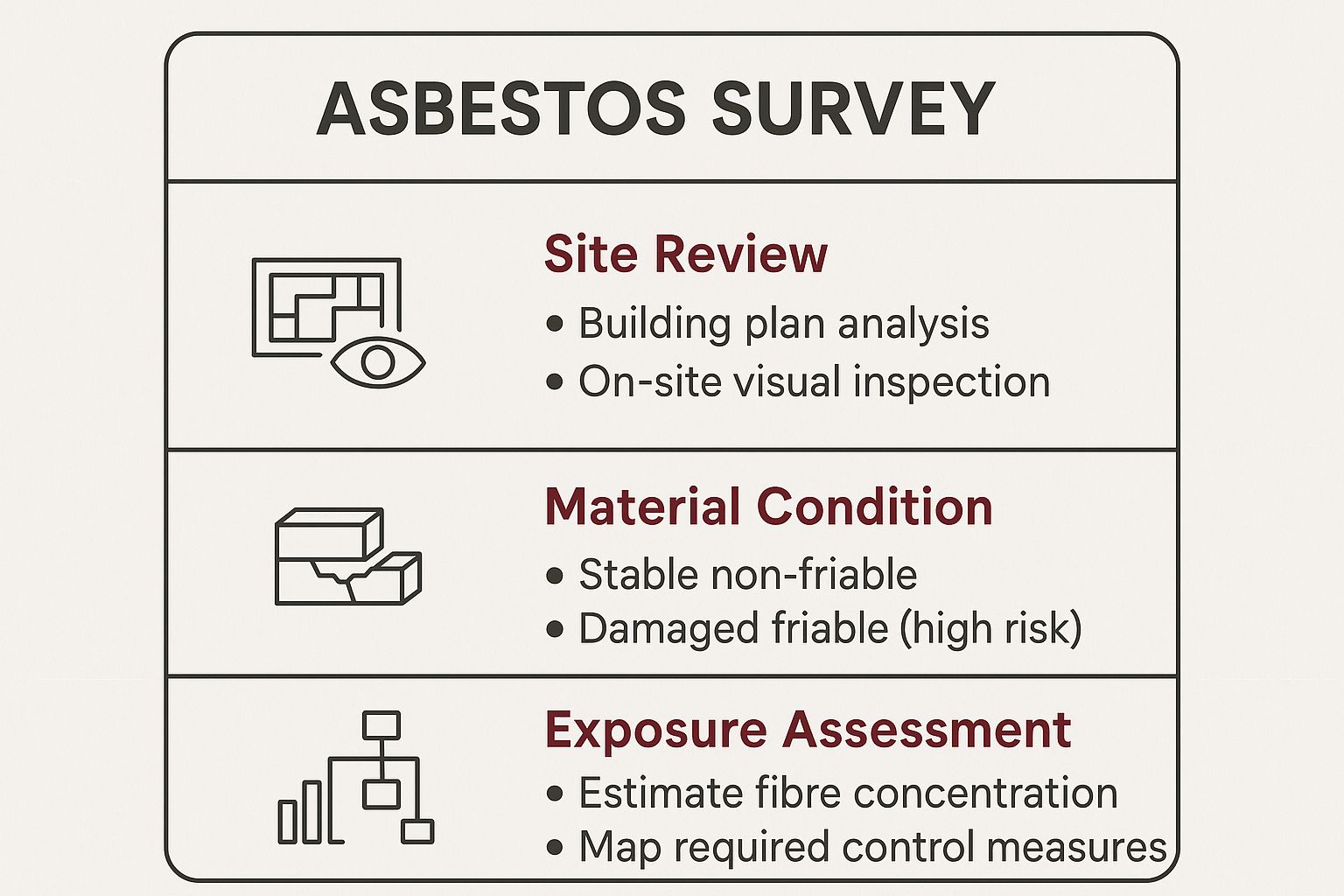
As you can see, the process flows logically from identifying potential hazards to actually quantifying the specific risk they pose, which forms the bedrock of any effective safety and management plan.
Quantifying Exposure Risk
The final, and perhaps most critical, phase of the assessment is the exposure assessment. This is where the potential danger is quantified with scientific data. Hygienists in Australia use sophisticated tools and validated models to estimate potential exposure levels. In fact, a study that validated one of these semi-quantitative tools found a direct correlation between cumulative exposure and mesothelioma, with the highest exposure group facing a staggering hazard ratio of 5.37 compared to the lowest.
This scientific approach is what transforms a general concern into a specific, measurable risk. A hygienist doesn’t just say, "Yes, there's asbestos here." They determine the potential fibre concentration in the air and map out the exact control measures needed—such as sealed enclosures, negative air pressure units, or specific types of respiratory protection—to keep every single person on site safe from harm.
Understanding how hygienists carry out these assessments is especially important for complex projects, such as those requiring specialised demolition excavation expertise. Their methodical and data-driven evaluation ensures that even the most challenging jobs are planned with safety as the absolute top priority, protecting both workers and the public.
The Science of Asbestos Sampling and Analysis
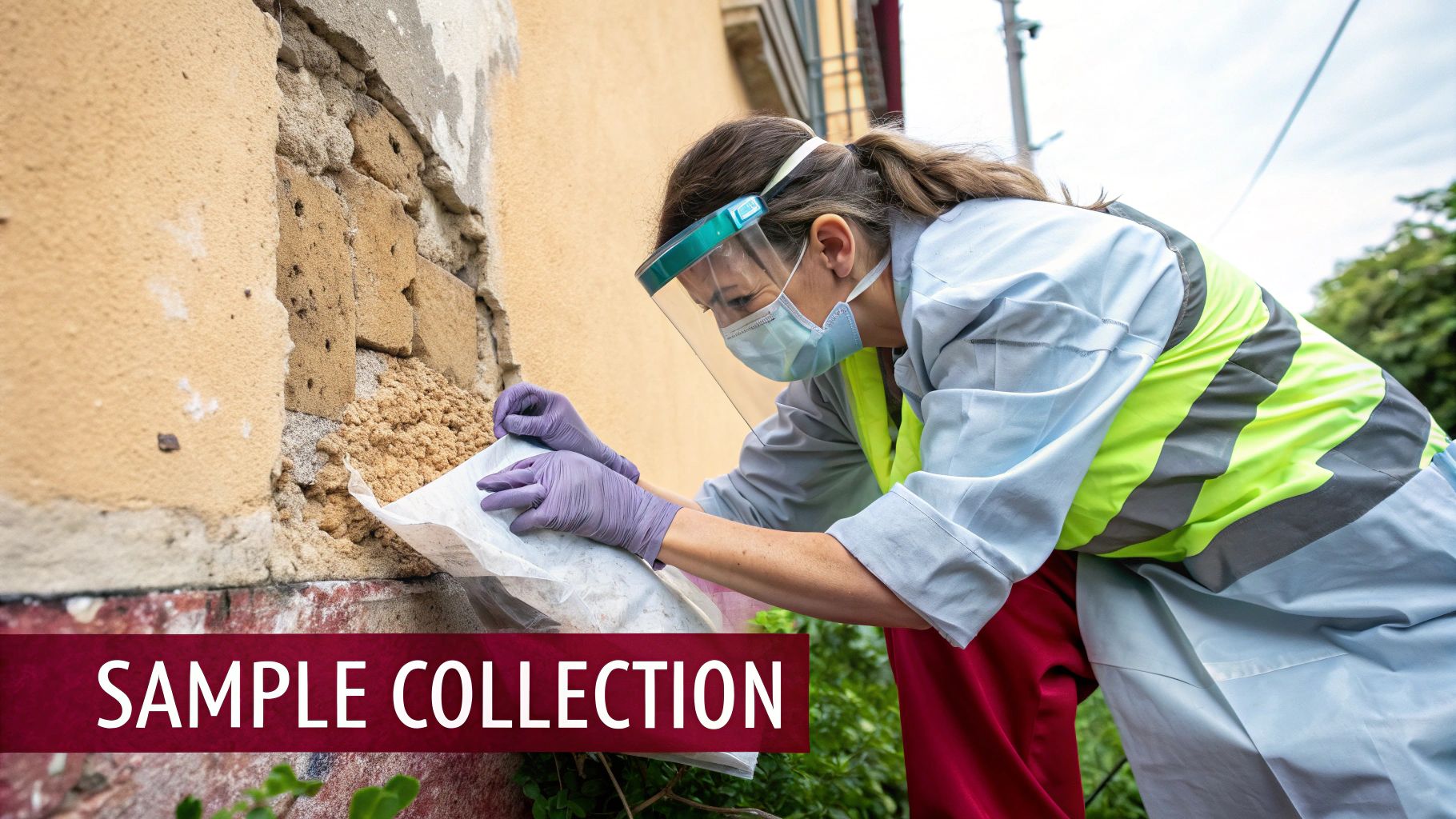
Once a visual inspection flags a potential asbestos-containing material, the occupational hygienist transitions from observation to hard science. This is the point where we move beyond what can be seen with the naked eye and delve into the microscopic data that truly matters—confirming if asbestos is present and, more critically, measuring the actual risk of airborne exposure.
There is absolutely no room for guesswork in this process. Every recommendation, safety measure, and clearance certificate is built upon a solid foundation of methodical sampling and precise laboratory analysis.
This scientific process can be broken down into two key methods. First, there is bulk sampling, which answers the fundamental question: "Does this material contain asbestos?" Then comes air monitoring, which addresses the immediate concern: "Are there dangerous asbestos fibres in the air right now?"
Bulk Sampling for Definitive Identification
When a hygienist suspects a building material contains asbestos, they will take a small, carefully controlled sample. This is not a simple case of snapping off a corner; it is a meticulous procedure designed to minimise any disturbance and prevent the accidental release of fibres into the ambient air.
That small piece of material is then double-bagged, sealed, labelled, and sent to a specialised laboratory. There, it is analysed under a microscope to provide a definitive answer. This step yields the black-and-white evidence needed for your asbestos register, identifying the specific type of asbestos (such as chrysotile, amosite, or crocidolite) and shaping the entire management plan from that point forward.
To get a better sense of the technical work involved in the lab, you can learn more about how asbestos is identified using methods like polarised light microscopy.
Air Monitoring to Measure Airborne Risk
Bulk sampling tells you where a potential hazard is located, but air monitoring tells you if it has become an active threat. It is the only way to accurately measure the concentration of invisible asbestos fibres floating in the air that people might breathe.
An occupational hygienist sets up a specialised pump that pulls a specific, calibrated volume of air through a filter cassette for a set period of time. That filter captures any airborne particles, including any asbestos fibres that may be present.
Once the sampling is complete, the filter cassette is carefully sealed and sent to the laboratory. Technicians then count the fibres under a phase-contrast microscope and calculate the concentration, which is usually expressed as fibres per millilitre of air (f/mL).
There are several distinct types of air monitoring, and each plays a specific and critical role at different stages of an asbestos removal project.
This table breaks down the different types of air monitoring an occupational hygienist will conduct.
| Monitoring Type | Purpose | When It's Performed |
|---|---|---|
| Background Monitoring | To establish a baseline fibre level before any asbestos removal work begins. | Before work commences, to understand the pre-existing conditions of the area. |
| Control Monitoring | To verify that the control measures (like negative air pressure units and enclosures) are effectively containing fibres within the work zone. | During the removal process, typically just outside the sealed work area. |
| Exposure Monitoring | To measure the personal exposure of a worker who is actively removing the asbestos. | During the removal, with the monitor placed within the worker's personal breathing zone. |
| Clearance Monitoring | To confirm that the area is safe for reoccupation after all removal work has been finished. | After the removal is complete and the area has been thoroughly cleaned, but before the enclosure is dismantled. |
Each type of monitoring provides a critical piece of the safety puzzle, from establishing a baseline to providing the final all-clear.
Key Takeaway: Using a National Association of Testing Authorities (NATA) accredited laboratory is not just good practice—it is a legal requirement in Australia for asbestos analysis. This accreditation is your guarantee that the laboratory adheres to stringent scientific protocols, delivering results that are accurate, reliable, and legally defensible.
The hygienist’s job does not stop when the lab report comes in. They must interpret these complex results, benchmark them against Australia's strict legal exposure standards, and ultimately provide the authoritative clearance certificate. This final sign-off is the official confirmation that the asbestos hazard has been successfully managed and the area is safe to re-enter without respiratory protection.
Navigating the Maze of Asbestos Regulations
An occupational hygienist’s responsibilities extend far beyond science and lab results; a significant part of their role is navigating the complex legal landscape of asbestos management. In Australia, the laws governing asbestos are incredibly strict and multifaceted. Think of the hygienist as your expert guide through this intricate maze of safety codes, state-specific work health and safety (WHS) laws, and the national standards established by Safe Work Australia.
Their role goes well beyond simply offering advice. They are there to build a legally sound framework that protects a business from substantial fines, operational shutdowns, and potential legal action. They are, in essence, the architects of your compliance strategy, ensuring every action taken is properly documented, scientifically justified, and able to withstand legal scrutiny.
The Must-Have Asbestos Documents
If you are a person conducting a business or undertaking (PCBU) responsible for a commercial property built before 2004, there are two documents that are not just a good idea—they are a legal requirement. An occupational hygienist asbestos specialist is the key professional you need to create and maintain them effectively.
- The Asbestos Register: This is a dynamic, living document. It pinpoints all known or presumed asbestos-containing materials (ACMs) on your site, detailing their exact location, type, and current condition.
- The Asbestos Management Plan (AMP): This is your strategic playbook. It lays out precisely how you will manage the identified ACMs to prevent anyone from being exposed. This includes everything from routine monitoring procedures and safe work protocols to emergency response plans.
The hygienist’s job is to ensure these documents are more than just paperwork. They must be practical, accurate, and regularly updated—which requires a full review at least once every five years, or more frequently if the asbestos has been disturbed or work is planned in the area.
A robust Asbestos Management Plan is far more than a box-ticking exercise. It is your most powerful risk management tool. It provides documented evidence that you have exercised due diligence and shifts your organisation from a reactive, crisis-driven mode to one of proactive, documented control. This is what protects an organisation from severe legal and financial fallout.
Keeping You Compliant, Every Step of the Way
From the moment they first set foot on your site for an assessment to the day they issue the final clearance certificate, the occupational hygienist’s core mission is to ensure every single action complies with Australian law. This detail-oriented oversight is what makes them an indispensable partner in risk management, not just another consultant.
While asbestos regulations are highly specific, they also fit into the context of broader Indoor Environmental Quality (IEQ) standards that a hygienist helps to maintain. They meticulously document the entire process: the sampling methods used, the findings of the risk assessment, every air monitoring result, and the final clearance data. This complete paper trail creates a defensible, auditable record, providing hard evidence that the PCBU has fulfilled their legal duty of care to keep everyone safe.
Why Asbestos Exposure Is a Lifelong Risk
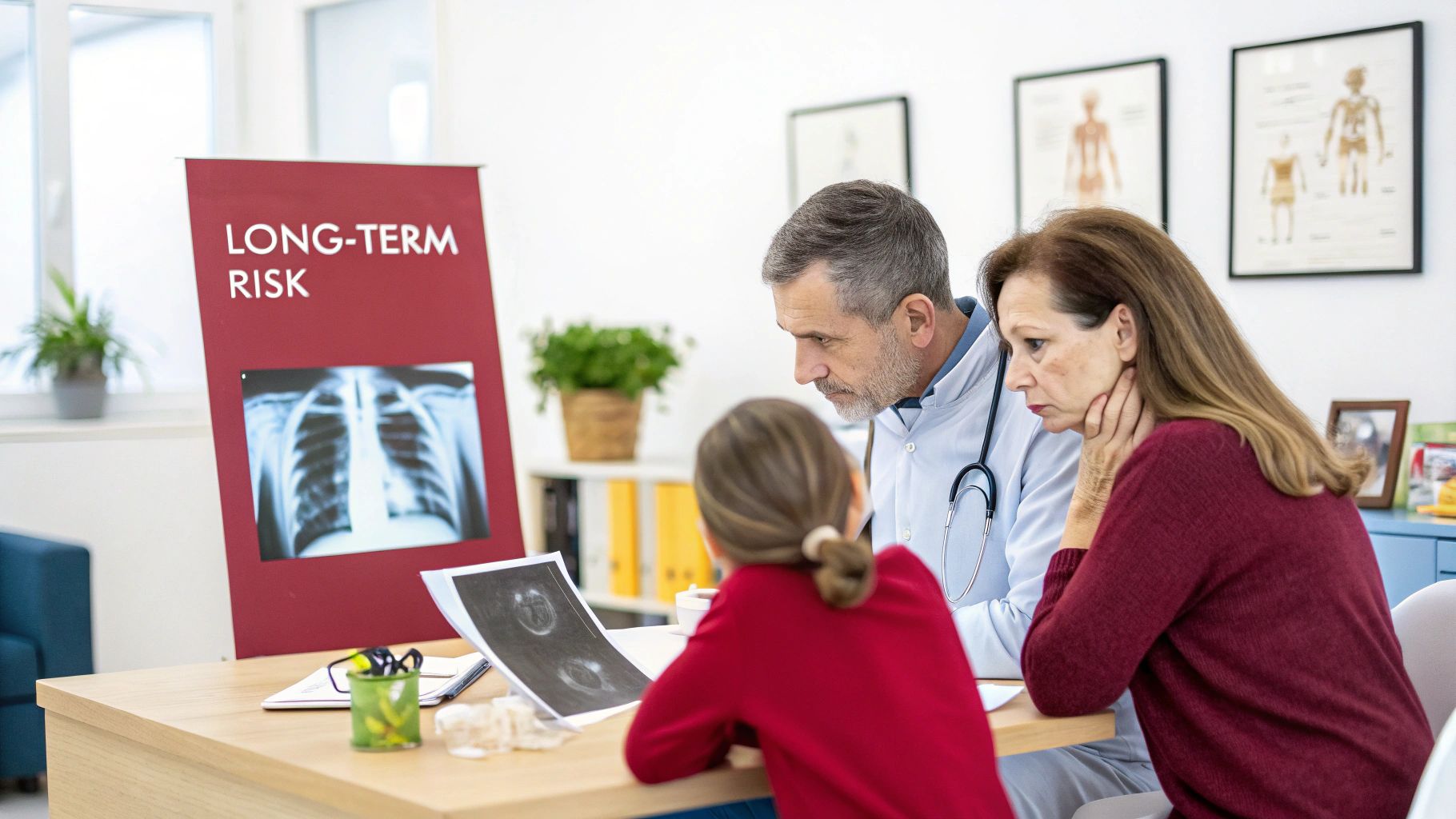
To truly grasp why an occupational hygienist’s role is so critical, one must understand the profound human cost of getting asbestos management wrong. This is not simply about managing a building material; it is about preventing personal tragedies that can unfold over a lifetime. The danger from asbestos is not a short-term scare—it's a lifelong shadow.
The most frightening aspect of asbestos-related diseases is their long latency period. An individual could breathe in airborne fibres during a seemingly minor renovation today and not show a single symptom for 20, 30, or even 50 years. This cruel delay means a devastating health crisis can surface decades after the moment of exposure has been completely forgotten.
The Devastating Health Outcomes
When those microscopic, needle-like asbestos fibres are inhaled, they can become permanently lodged deep in the lungs and the lining of the chest. The body's natural defence mechanisms cannot break them down or remove them, leading to persistent inflammation and scarring that can, over decades, trigger fatal diseases.
Two of the most notorious conditions caused by asbestos are:
- Asbestosis: A chronic, fibrotic lung disease where scar tissue builds up, making it progressively harder to breathe. It is a painful, debilitating, and irreversible condition.
- Mesothelioma: An aggressive and incurable cancer that develops in the lining of the lungs, abdomen, or heart. It is almost exclusively caused by asbestos exposure and has a very poor prognosis.
One can draw a direct line from the scientific work an occupational hygienist performs to the prevention of these terrible health outcomes. Every air monitoring test, every risk assessment, and every clearance certificate is a direct intervention designed to stop these diseases from ever taking root.
The true scale of this public health issue in Australia is often underestimated. Asbestos-related diseases cause approximately 4,000 deaths each year, yet many Australians mistakenly believe the annual toll is below 50. With the average survival for mesothelioma patients being just 11 months after diagnosis, these are exceptionally lethal diseases. To see the full picture, you can explore the scientific facts about asbestos in Australia.
This long-term, hidden threat is precisely why there are no safe shortcuts when it comes to asbestos. The careful, science-backed, and methodical approach of an occupational hygienist is our only reliable defence. Their work ensuring proper controls are in place, like the correct personal protective equipment, is non-negotiable. For anyone working in high-risk environments, implementing a respiratory protection program is a crucial part of that defence, protecting health for decades to come.
Common Questions About Asbestos Hygienists
Discovering that you might have an asbestos problem can be a daunting experience. It's completely normal to feel uncertain about who to call and what the process entails. Understanding the key roles and procedures is the first step toward making a calm, safe, and informed decision. Let's walk through some of the most common questions people have when it comes to hiring an occupational hygienist for an asbestos issue.
Think of these professionals as your independent scientific advisors. Understanding what they do is crucial for making sure your property is managed correctly and safely, right from the very beginning.
When Do I Need to Hire an Occupational Hygienist?
The short answer is: before you undertake any activity that might disturb materials you suspect could contain asbestos. If you're planning a renovation, demolition, or even just significant maintenance work in a building constructed before 2004, it is time to call in a hygienist.
In several situations, it is not just a good idea—it is a legal requirement. You will need a hygienist for:
- Commercial Properties: They are essential for creating and maintaining the legally mandated asbestos register and management plan.
- During Asbestos Removal: They provide independent air monitoring to verify that the removalist's safety controls are effectively preventing fibre release.
- Post-Removal: They must conduct the final visual inspection and take air samples for a clearance certificate, which is the official document confirming the area is safe for reoccupation.
What Is the Difference Between a Hygienist and a Removalist?
This is an excellent question, and the distinction is fundamentally important for safety and compliance. The easiest way to conceptualise it is that the hygienist is the independent referee, and the removalist is the specialised player. Their roles are deliberately kept separate to avoid any conflicts of interest and to guarantee the highest safety standards are met.
The occupational hygienist is the unbiased scientist. They assess the risk, design the safety plan, and independently verify that the removal has been completed safely and effectively. The licensed asbestos removalist is the hands-on expert who physically removes the hazardous material, strictly following the plan set out by the hygienist and WHS regulations.
In essence, the hygienist provides that critical third-party oversight, ensuring the removalist’s work meets all Australian safety regulations and protects everyone from exposure.
What Should I Expect During a Site Assessment?
When a hygienist arrives at your property, they will conduct a thorough visual inspection. They will often use building plans as a guide, checking all the common locations where asbestos-containing materials were typically installed over the decades. They are trained to identify materials that look suspicious based on age, appearance, and application.
Next, they will carefully evaluate the condition of these materials. Are they stable and sealed (bonded), or are they damaged and crumbly (friable)? This assessment is key to understanding the immediate risk of fibres becoming airborne. If necessary, they will take a few small, carefully sealed samples and send them to a NATA-accredited laboratory for definitive analysis. All of this information is then compiled into a detailed report that clearly outlines the risks and provides straightforward recommendations for either managing the material in place or having it professionally removed.
Can I Just Use a DIY Asbestos Testing Kit?
While it may be tempting to use a DIY kit to save time or money, it is a classic case of a little knowledge being a dangerous thing. A DIY kit might be able to tell you if a piece of material contains asbestos, but it stops there. That single piece of information is not nearly enough to keep you safe or compliant.
A hygienist’s role goes far beyond a simple "yes" or "no" answer. They assess the risk of exposure by evaluating the material's condition and friability, they can check for dangerous airborne fibres, and they create a comprehensive management plan that meets all legal requirements. Engaging a professional ensures the entire situation is handled correctly from start to finish, protecting you from serious health risks and significant legal liabilities down the track.
At Anitech Ltd Pty, our team of expert occupational hygienists provides the independent, scientific oversight you need to manage asbestos safely and confidently. We ensure every step, from assessment to clearance, is handled with meticulous care. Protect your people and your business by partnering with trusted experts.
Contact us for a consultation at https://occhygiene.com.au.


