
Monitoring diesel particulate matter is all about measuring the tiny, invisible soot particles that come out of diesel engines. We do this to check air quality and, most importantly, protect people's health. It requires specialised gear to catch these pollutants, which are known to cause cancer, and make sure exposure levels at work and in the environment stay below the legal limits. Think of it as a critical safety check to spot risks and put the right controls in place.
What Is Diesel Particulate Matter and Why Is It So Dangerous?
Picture the fine dust that hangs in the air after you've been cutting wood in a shed. It's light enough to float, tiny enough to breathe in, and it gets everywhere. Diesel Particulate Matter (DPM) is a lot like that, only much, much worse. It’s a nasty mix of microscopic solid bits and liquid droplets spat out when diesel fuel doesn't burn completely.
These particles are incredibly small—often less than one micrometre across. Because they're so tiny, they act more like a gas than a solid, just hanging in the air for ages. This means they can drift a long way from the engine that produced them and are easily breathed deep into the most delicate parts of our lungs, where they can do some serious damage.
The Invisible Health Threat
The real danger with DPM comes down to its size and what it's made of. Bigger dust particles might get caught in your nose or throat, but DPM is so fine it can slip right past your body’s natural filters. Once these particles get into your lungs, they can set off inflammation and damage the cells.
The International Agency for Research on Cancer (IARC) classifies diesel engine exhaust as a Group 1 carcinogen. That puts it in the same risk category as asbestos and tobacco smoke, meaning there’s solid proof it causes cancer in humans.
The health problems from DPM exposure can show up right away or build up over years. In the short term, you might notice things like:
- Irritated eyes, nose, and throat
- Headaches and feeling sick
- Asthma or allergies getting worse
But it's the long-term, chronic health issues from repeated exposure that are the biggest worry. This is why proper diesel particulate matter monitoring isn't just about ticking a box for compliance; it's a non-negotiable part of keeping people safe at work.
From Mines to Urban Centres
The risk is especially high in industries like mining, construction, and transport, where heavy diesel equipment is often running in confined areas with poor airflow. A study on miners in Western Australia really brought this home, showing that workers were frequently exposed to DPM levels at or even above the safety limits. The research confirmed a clear link between high DPM levels and more respiratory problems, highlighting an urgent need for better controls in Australian workplaces.
Of course, DPM is just one piece of the puzzle. A safe worksite depends on good overall indoor air quality, which means managing all sorts of airborne nasties. But when you understand what DPM actually is, the 'why' behind monitoring it becomes crystal clear. It stops being some abstract pollutant and becomes a very real threat that we have to measure and manage to keep people healthy.
Understanding Australian DPM Exposure Regulations
When it comes to diesel particulate matter, you need to know the rules. Navigating the legal side of things in Australia isn't just about ticking boxes; it's about understanding the science-backed limits designed to protect your team from serious, long-term health problems. If you run diesel equipment, compliance is a fundamental part of keeping your workplace safe.
At the heart of it all is the Workplace Exposure Limit (WEL). This is the legally defined maximum concentration of a substance like DPM that someone can be exposed to over a set time without it likely causing them harm. It’s the benchmark that your entire diesel particulate matter monitoring program is measured against.
The 8-Hour TWA: Your Daily Exposure Budget
The most common measurement you'll work with is the 8-hour time-weighted average (TWA). The best way to think of it is as a daily "dose" limit for each worker.
Someone's exposure might spike when they're right next to a running engine and then drop to almost nothing when they move away. The TWA evens all this out, calculating their average exposure over a full eight-hour shift. It gives you a far more realistic picture of the actual risk than a single, one-off reading ever could. That's why it's the gold standard in occupational hygiene. To see how these limits fit into the bigger picture, it's worth reviewing other key Australian workplace safety standards.
Where We Are Now and Where We're Headed
Over the years, Australian DPM regulations have been getting progressively tighter, and for good reason. A key example is the NSW Work Health and Safety (Mines and Petroleum Sites) Regulation, which sets the 8-hour TWA limit for DPM at 0.1 mg/m³, measured as sub-micron elemental carbon. This standard was driven by the critical 2012 decision to reclassify diesel exhaust as a Group 1 carcinogen, confirming its direct link to lung cancer. You can find more details on DPM regulations in Australian mining on coalservices.com.au.
But things aren't standing still. The regulatory landscape is on the cusp of a major change, led by Safe Work Australia, the country's national policy setter.
This isn't just guidance; these standards are legally enforceable and form the bedrock of managing risks from airborne hazards like DPM.
Looking ahead, this focus on worker health is about to get much sharper.
Safe Work Australia is set to dramatically reduce the Workplace Exposure Limit for DPM. From 1 December 2026, the new WEL will be slashed to 0.01 mg/m³.
This is a tenfold reduction, and it signals a massive shift in what will be expected from businesses. Industries like mining, construction, and tunnelling will need to seriously step up their game with better controls and more rigorous monitoring to meet this new, much lower limit. Getting ready for this change now isn't just a good idea—it's essential for protecting your people and your operations down the track.
How DPM Sampling and Analysis Actually Works
Measuring something invisible like diesel particulate matter might seem a bit like black magic, but it’s actually a precise scientific process. The goal is simple: turn an unseen airborne threat into solid, usable data. It all boils down to capturing a good sample of the air and having it properly analysed.
The whole process starts with one fundamental question: what air are we actually trying to measure? Answering that leads us to two distinct approaches for monitoring DPM, each playing a vital role in painting a complete picture of workplace safety.
Personal vs Static Area Sampling
The most important measurement is almost always personal sampling. This method zeroes in on exactly what an individual worker is breathing throughout their shift. We do this by attaching a small, lightweight pump to the worker's belt, which is connected by a tube to a sampling filter clipped to their collar—right in their personal "breathing zone".
This setup acts like a tiny, continuous vacuum cleaner. It draws air through the filter at a steady rate while the worker goes about their day. The filter collects a sample that truly reflects their personal exposure to DPM, factoring in high-risk tasks and time spent in different parts of the site.
On the other hand, static area sampling measures the general air quality in a specific location. For this, the pump and filter are set up in a fixed spot, maybe near a high-traffic entryway or right next to an extraction fan. It’s perfect for checking if ventilation systems are doing their job or identifying general "hotspots" where DPM levels are highest.
Both methods give us valuable information, but personal sampling is the gold standard for assessing direct health risks and proving compliance with personal exposure limits.
To help clarify when to use each approach, this table breaks down their core differences.
Comparing Personal and Static DPM Sampling
This table compares the two primary approaches to DPM air sampling, highlighting their purpose, common applications, and key advantages for a comprehensive monitoring strategy.
| Sampling Method | Primary Purpose | Best Application | Key Advantage |
|---|---|---|---|
| Personal Sampling | Measures a worker's direct exposure in their breathing zone. | Assessing individual health risk and compliance with personal exposure standards. | Provides the most accurate data on what an individual worker is actually inhaling. |
| Static Sampling | Measures the ambient DPM concentration in a fixed location. | Evaluating the effectiveness of controls (like ventilation) or identifying source areas. | Helps pinpoint problem areas and assess the overall effectiveness of engineering controls. |
By combining both personal and static samples, you can build a robust understanding of both individual exposure and the overall effectiveness of your control measures.
The NIOSH 5040 Method Explained
So, once a sample has been collected, what's next? For DPM, the accepted industry standard for analysis is the NIOSH 5040 method. This isn't just one test; it’s a sophisticated laboratory process that breaks down the captured particles to measure their most important components.
Think of the gunk collected on the filter as a "fingerprint" of the diesel exhaust. The NIOSH 5040 method analyses this fingerprint for two key things:
- Elemental Carbon (EC): This is the pure, black soot at the very core of DPM. It's formed during the high-temperature combustion of diesel and is seen as the most reliable marker for DPM.
- Organic Carbon (OC): This is the stuff that comes from unburnt fuel, lubricating oil, and other organic compounds that have stuck to the elemental carbon core.
For regulatory purposes, the focus is almost always on the Elemental Carbon (EC) result. Why? Because it specifically isolates the harmful combustion byproduct from diesel engines, giving a clear, unambiguous measurement. The process is quite similar to other types of occupational hygiene monitoring, like the lab techniques used for air monitoring for silica dust, where a specific hazardous material has to be accurately isolated and measured.
From Collection to Concrete Data
The journey from a noisy worksite to a final, clear report follows a very controlled path. This simple flow diagram shows the three main stages involved in monitoring for diesel particulate matter.
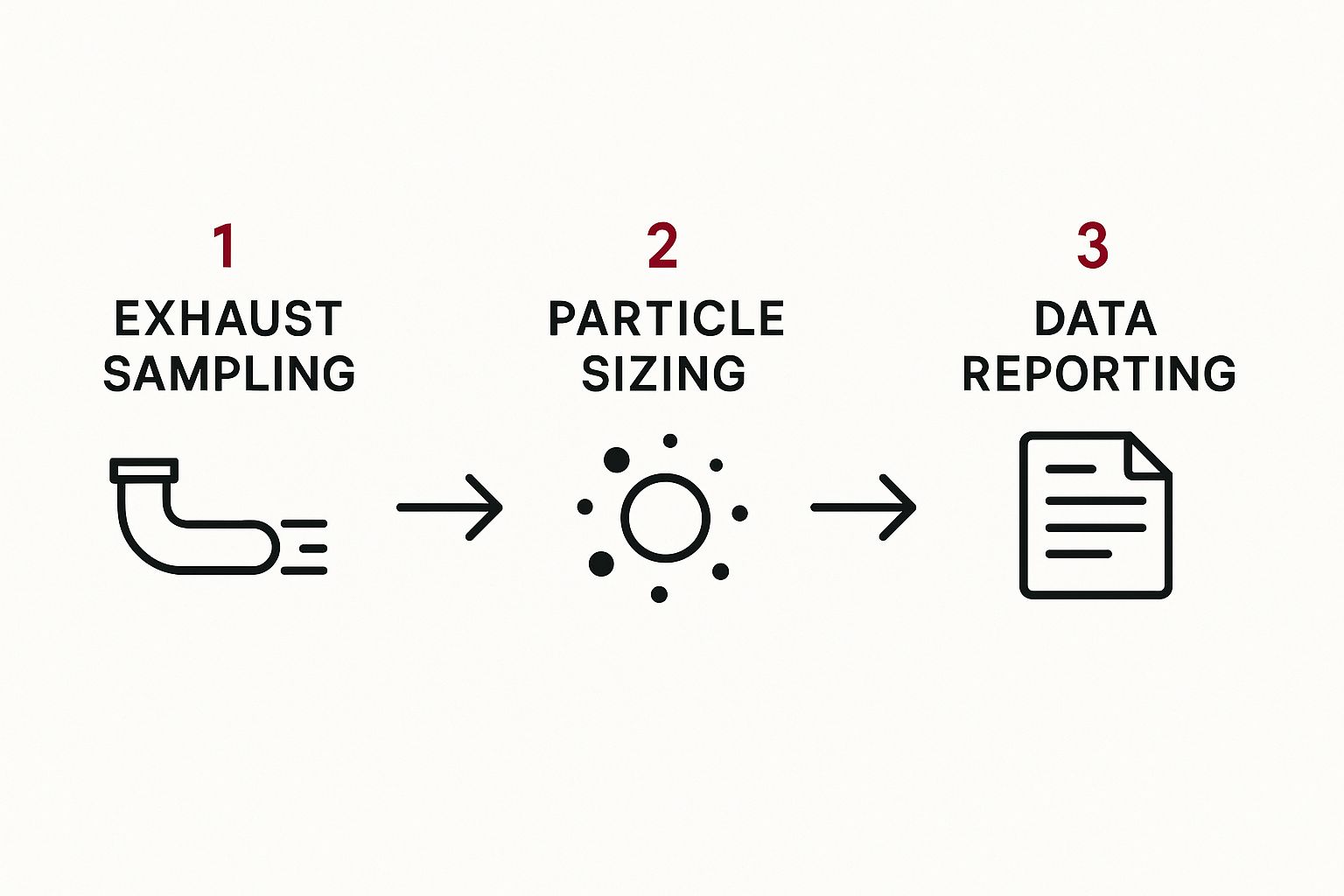
As the graphic shows, it's a systematic process of collecting, measuring, and translating invisible particles into the hard data you need for compliance and safety.
Once the on-site sampling is done, the filter cassette is carefully sealed, labelled, and shipped off to an accredited laboratory. There, technicians use a specialised instrument for a process called thermal-optical analysis.
In this process, the filter is heated in controlled stages. This step-by-step heating burns off the organic carbon first, then the elemental carbon, with a laser system precisely measuring the amount of each as it's released.
The lab then issues a detailed report, giving you a final concentration of elemental carbon in milligrams per cubic metre of air (mg/m³). This number is the concrete data you can hold in your hand—the metric you compare directly against legal workplace exposure standards. It’s how we make an invisible hazard perfectly clear and manageable.
Choosing the Right DPM Monitoring Equipment
Picking the right tools is the foundation of any solid diesel particulate matter monitoring program. Without the correct equipment, you’re flying blind, trying to measure an invisible risk that puts your team in danger. The goal isn’t to find one “best” device; it’s about assembling a smart toolkit that mixes and matches different technologies to fit your site’s specific needs, budget, and compliance rules.

The world of DPM monitoring equipment really breaks down into two main categories. Each one serves a different, yet equally vital, purpose in keeping your workplace safe. Getting a handle on the strengths and weaknesses of each will help you make a much more informed decision.
Traditional Lab-Based Sampling
Think of lab-based sampling as the gold standard—the definitive, “compliance grade” measurement. This is the method that regulators trust, and it’s built around the NIOSH 5040 method we touched on earlier. It involves a person wearing a small sampling pump that draws air through a filter cassette over their entire work shift.
The accuracy you get from this approach is second to none. The sample is sent off to an accredited lab where a detailed thermal-optical analysis precisely measures the elemental carbon. This gives you a legally defensible result that you can directly compare against official Workplace Exposure Standards.
The big trade-off, however, is time. You won't see your results for days, sometimes longer. This means you can’t react to a high exposure event as it’s happening. It’s a retrospective tool—perfect for proving compliance, but not so great for immediate, on-the-spot interventions.
Real-Time Monitoring Instruments
This is where real-time monitors come in. These instruments are your on-the-ground early warning system. These portable, handheld devices give you instant feedback on DPM concentrations, letting you identify problem areas, high-risk tasks, and hotspots right then and there. They're invaluable for seeing how day-to-day operations truly impact air quality.
Real-time monitors don't replace lab-based compliance sampling. Instead, they are a powerful partner to it, giving you the immediate data you need to make proactive safety decisions and check if your control measures are actually working.
These instruments use clever technologies to estimate DPM levels in the moment. Two of the most common types are:
- Light-Scattering Photometers: These devices shine a laser through an air sample and measure how much the particles scatter the light. The more light that gets scattered, the higher the concentration of particulates.
- Aethalometers: This technology works by continuously pulling air through a filter tape and measuring how much light the collected black carbon (soot) absorbs.
The power of this is undeniable. Imagine seeing exposure levels spike on a screen the second a diesel loader enters a poorly ventilated area. It turns an invisible hazard into a visible, immediate problem you can deal with straight away.
This proactive approach has been a cornerstone of Australian workplace safety for decades. Extensive monitoring, particularly in Australian underground mines since the early 1990s, has built up a huge bank of data. For example, between 2005 and 2017, over 7,200 DPM samples were taken in New South Wales mines alone. Over in Western Australia, a similar system recorded 8,666 personal monitoring results by 2015. This data has been critical, showing that while high exposures were common, consistent monitoring and regulation have driven real improvements. You can explore more on the history and impact of this data on Australian DPM exposure standards at resources.nsw.gov.au.
Building Your Ideal Monitoring Toolkit
Ultimately, the most effective strategy is one that uses both. You use lab-based sampling for the authoritative, legally-sound data needed for regulatory compliance, while leaning on real-time monitors for the agility to manage risks day in, day out.
This simple comparison should help guide your thinking:
| Feature | Lab-Based Sampling (NIOSH 5040) | Real-Time Monitoring |
|---|---|---|
| Primary Use | Compliance verification, risk assessment | Identifying trends, checking controls |
| Accuracy | High (The Gold Standard) | Lower (Provides estimates) |
| Data Speed | Delayed (Days) | Instantaneous |
| Cost | Lower initial equipment cost | Higher initial equipment cost |
| Portability | High (small pump and cassette) | Varies (handheld to larger units) |
| Maintenance | Requires off-site lab analysis | Needs regular calibration on-site |
By using real-time instruments to hunt for potential hotspots and then validating those findings with precise lab-based sampling, you create a robust, two-tiered diesel particulate matter monitoring system. This integrated approach ensures you aren’t just ticking compliance boxes—you're actively protecting your people in the most effective way possible.
Turning Monitoring Data into Workplace Action
Collecting data through your diesel particulate matter monitoring program is a fantastic start, but the numbers themselves don't make anyone safer. The real value is unlocked when you translate that raw data into concrete, protective actions. This is the point where you shift from simply measuring a problem to actively solving it, creating a genuinely healthier workplace for your team.
It all begins with making sense of the results. Whether you’re looking at a formal lab report or a real-time readout from a monitor, you need to understand what those figures actually mean on the ground.
Interpreting Your Monitoring Results
When that lab report lands on your desk, the number you’re looking for is the 8-hour time-weighted average (TWA) for elemental carbon (EC). A result like 0.1 mg/m³ TWA tells you the average DPM concentration a worker was exposed to over their entire shift. This is the figure you’ll compare directly against the legal Workplace Exposure Limit (WEL).
If your results are sitting comfortably below the WEL, that's great news—it’s a good sign your current controls are doing their job. But if a result pops up showing an exceedance, that’s a clear signal that you need to act, both immediately and for the long term.
An exceedance isn't just a number on a page; it's a direct indication that a worker has been exposed to a hazardous level of a known carcinogen. Your response must be prompt, structured, and focused on reducing that exposure as quickly as possible.
When an exceedance happens, you need a plan. Your absolute first priority is to protect your people from further harm. That might mean moving them to an area with cleaner air right away, or even stopping the specific task that caused the high reading until better controls can be put in place.
The Hierarchy of Controls for DPM
Once the immediate risk is managed, it’s time to think long-term. The most effective way to structure your response is by using the hierarchy of controls. Think of it as a step-by-step game plan for tackling workplace hazards, starting with the most effective and reliable solutions first.
This framework is brilliant because it pushes you away from simply handing out more masks and towards finding more robust, permanent fixes. It's a proven method for creating safety improvements that last.
Applying Controls to Reduce DPM Exposure
So, how does this hierarchy apply directly to managing diesel particulate matter? Let's break it down.
-
Elimination: Can you get rid of the hazard completely? This is always the best-case scenario. For DPM, this could mean swapping out diesel-powered equipment for electric alternatives, which removes the source of the emissions entirely.
-
Substitution: If you can't eliminate the diesel engine, can you swap something out to make it cleaner? This often looks like switching to a higher grade of low-sulphur diesel fuel or using biodiesel blends, both of which can significantly slash particulate emissions.
-
Engineering Controls: These are physical changes you make to the workplace to separate people from the hazard. When it comes to DPM, this is where you often get the biggest wins. Implementing effective engineering controls is a vital part of turning monitoring data into workplace action, for instance, by understanding and ensuring proper exhaust management through improvements like the importance of anti-downdraft cowls on flues for marine diesel stoves.
Other powerful engineering controls include:
- Installing direct-capture exhaust extraction systems in maintenance bays.
- Upgrading a site's general ventilation system to increase the number of air changes per hour.
- Fitting diesel particulate filters (DPFs) to the exhaust systems of older machinery.
-
Administrative Controls: These are all about changing the way people work. They aren't quite as failsafe as engineering solutions, but they're still a crucial piece of the puzzle. Examples include enforcing strict "no-idling" zones, rotating workers through high-exposure tasks to limit their TWA, and sticking to a rigorous vehicle maintenance schedule to keep engines running as cleanly as possible.
-
Personal Protective Equipment (PPE): This is your last line of defence. Providing workers with properly fitted respirators (like P2 or P3 masks) is essential when other controls just can't get DPM levels below the WEL. But remember, PPE should never be your only solution. Its effectiveness hinges entirely on people using it correctly, every single time.
By systematically working your way down this hierarchy, your diesel particulate matter monitoring results become a powerful diagnostic tool. They don't just tell you there's a problem—they point you toward the most effective solutions, helping you build a workplace that isn't just compliant, but genuinely safe.
Frequently Asked Questions About DPM Monitoring
When you get down to the nuts and bolts of diesel particulate matter monitoring, plenty of practical questions pop up. Getting the details right—from the terminology on lab reports to how often you should be testing—is the key to a safety strategy that actually works. Let’s tackle some of the most common questions we hear from the field.
My goal here is to get past the high-level theory and dig into the practical sticking points that often cause confusion. By clearing these up, you can make sure your monitoring program isn't just a box-ticking exercise, but a genuine safeguard for your team.

What Is the Difference Between EC and TC in DPM Analysis?
This is easily one of the most common technical questions we get. You’ll see Elemental Carbon (EC) and Total Carbon (TC) on your lab reports, and while they sound alike, they measure very different things. Knowing the difference is crucial.
Let’s use an analogy. Picture a tiny particle of diesel soot as a burnt piece of popcorn.
The hard, black, completely burnt part is the Elemental Carbon. It's the pure carbon core—the actual soot—formed during the intense heat of diesel combustion. This is what occupational hygienists and regulators focus on because it’s the most direct and reliable marker for DPM.
Total Carbon, on the other hand, is the entire particle. It’s the burnt EC core plus any sticky, oily residue clinging to it. This oily film is called Organic Carbon (OC), and it comes from unburnt fuel or lubricating oil. So, the formula is simple: TC = EC + OC.
While TC measures all carbon-based gunk, EC is the metric that matters most for compliance. It isolates the harmful diesel soot, giving you a much cleaner, more accurate measure of the specific hazard you’re trying to control.
How Often Should We Conduct DPM Monitoring?
There’s no magic number here. The right frequency for your diesel particulate matter monitoring comes down to one thing: risk. Your schedule should be built directly on the findings of a thorough risk assessment of your site and operations.
The principle is straightforward: the higher the risk, the more often you monitor. A formal risk assessment gives you a defensible and logical schedule tailored to your workplace.
For high-risk environments like underground mines, tunnelling projects, or enclosed vehicle workshops, you might need to monitor quarterly, or perhaps even more frequently. For example, if a mine brings in a new fleet of diesel loaders, you’d want to ramp up monitoring to see what impact that has on air quality.
On the flip side, a lower-risk site—say, an open-air construction project with plenty of natural airflow—might only need annual monitoring. The key is to always reassess your schedule whenever something significant changes, whether it’s new equipment, different work processes, or updated ventilation systems.
Can Real-Time Monitors Replace Lab-Based Sampling?
This is a really important one to get right. While real-time monitors are fantastic tools, they absolutely cannot replace formal, lab-based sampling for compliance purposes here in Australia. They serve two very different, but complementary, roles.
Think of real-time instruments as your day-to-day scout. They’re brilliant for:
- Finding Hotspots: Instantly seeing which tasks or areas are producing the most DPM.
- Checking Controls: Getting immediate feedback on whether that new extraction fan is actually working.
- Boosting Awareness: Showing workers a real number that makes an invisible hazard visible.
But here’s the catch: these devices only give an estimate of the particulate concentration. To prove you’re meeting the legal Workplace Exposure Standards, you need the precision and legal defensibility of the industry-standard NIOSH 5040 method. That lab analysis is the regulatory gold standard.
The best approach is to use both. Use real-time monitors for daily management and quick checks, and use formal lab sampling for your scheduled compliance verification.
What Are the First Steps to Set Up a DPM Monitoring Program?
Getting a diesel particulate matter monitoring program off the ground can feel like a huge task, but it’s much more manageable if you break it down into logical steps. A structured approach ensures you’re not missing anything critical.
Here’s a clear path to follow for setting up an effective and compliant program.
-
Conduct a Risk Assessment: This is your foundation. You need to map out where diesel equipment operates, figure out which workers get the highest exposure, and identify the riskiest tasks. This assessment will inform every other decision you make.
-
Develop a Sampling Strategy: Based on what you found in your risk assessment, write down a formal plan. This document should detail who to monitor (e.g., specific roles like loader operators), where to take samples (both on-person and in fixed locations), and when and for how long the monitoring will last.
-
Partner with a Professional: Get an accredited occupational hygiene consultant or laboratory on board. They have the right gear (pumps, filter cassettes), know the correct methods, and can handle the lab analysis. Their expertise is invaluable for making sure the data you collect is reliable.
-
Create an Action Plan: Before the results even come in, you should know what you'll do with them. Set up clear procedures for interpreting the data, communicating the findings to your team, and what control measures you’ll implement if any levels are over the limit.
Following these steps will help you build a robust program that goes beyond just collecting numbers and actively makes your workplace safer.


