
A noise survey is a methodical way of measuring, mapping, and analysing the sound levels across your workplace. Think of it as a detailed health check for your site's acoustic environment, designed to pinpoint risks before they can cause permanent hearing damage to your team.
What a Noise Survey Reveals About Your Workplace
Trying to manage workplace safety without hard data is like trying to navigate in the dark. You might think things are okay, but you're really just guessing. A noise survey replaces that guesswork with precise, actionable information about the sound in your workplace. It’s not just a box-ticking exercise for compliance; it's a fundamental safety strategy.
A professional survey gives you a clear, detailed picture of how sound actually behaves throughout your facility. It identifies exactly where the noisy spots are, when they are at their worst, and who is most at risk. This is critical for preventing noise-induced hearing loss, one of the most common—and entirely preventable—injuries in Australian workplaces.
Beyond Compliance to Proactive Safety
The real value of a noise survey is how it turns abstract safety regulations into a concrete action plan. It doesn't just tell you there's a problem; it shows you the specific nature and scale of it. This means you can implement targeted solutions instead of resorting to expensive, blanket changes that might not even be necessary.
This kind of detailed insight is essential for meeting your duty of care obligations under Australia's strict occupational health and safety (OHS) laws. Identifying and controlling noise hazards is a key part of any effective safety framework, similar to the principles found in Mastering Risk Management in Construction Projects. The findings from a survey empower you to make informed decisions that protect your people and shield your business from serious legal and financial blowback.
Uncovering Hidden Risks and Opportunities
A thorough noise survey often brings surprising operational details to light. For example, a machine that sounds relatively quiet to the ear might be emitting harmful high-frequency noise that adds significantly to a worker's daily exposure. It’s one of the many unseen hazards that cause occupational hearing loss.
The goal is to create a 'noise map' of your workplace. This visual guide clearly marks out high-risk "red zones" that need immediate attention, "amber zones" that require monitoring, and safe "green zones." It makes your safety planning precise and cost-effective.
With this understanding, you can implement the right controls where they'll make a real difference:
- Engineering Controls: Things like modifying machinery, building sound-proof enclosures, or installing acoustic barriers to stop noise at its source.
- Administrative Controls: Changing work rosters or rotating staff to reduce the time any one person spends in a noisy area.
- Personal Protective Equipment (PPE): Making sure the right hearing protection is provided and used correctly, but only as a last line of defence.
Ultimately, a noise survey is a smart investment in a safer, more productive, and more resilient business.
Getting to Grips with Australian Workplace Noise Rules
Trying to navigate Australia's workplace noise regulations can feel a bit overwhelming at first. But when you boil it down, the main idea is straightforward: you have to protect your people from harm. The legal side of things, mostly driven by the model Work Health and Safety (WHS) Regulations, gives employers a clear duty to manage the risks that come with loud workplaces. This isn't just about ticking a box for compliance; it's about stopping permanent hearing loss before it starts.
The regulations lay out some very specific limits for noise exposure that every business must follow. These numbers weren't just picked out of a hat—they’re based on solid science about the levels at which noise becomes a serious health hazard. The only real way to know if you're meeting these standards and doing your due diligence is by getting a professional noise survey done.
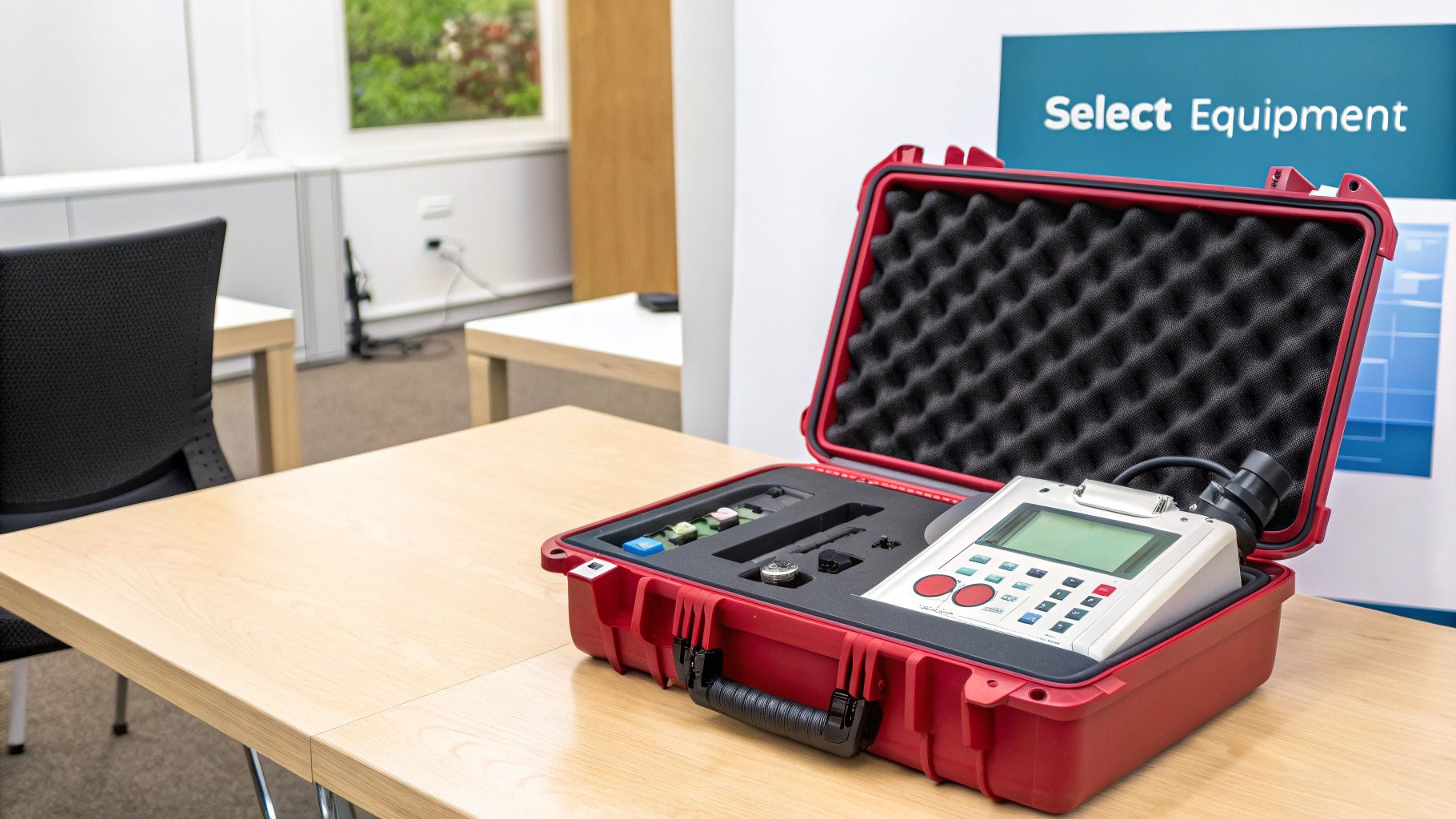
The Two Critical Noise Limits You Need to Know
To manage noise properly, you first have to understand the two main exposure standards set by the WHS Regulations. Think of these as the fundamental benchmarks for any good noise management plan.
- An 8-hour average of 85 dB(A): This is the maximum average sound level a worker can be exposed to over a standard eight-hour day. You can think of it as their daily "noise budget." If they're consistently going over this limit, their risk of long-term hearing damage skyrockets.
- A peak level of 140 dB(C): This is the absolute maximum noise level that should never, ever be crossed—not even for a split second. This rule is there to protect against sudden, sharp sounds like nail guns, metal stamping, or other impact noises that can cause instant, severe damage to the ear.
If you even suspect that your workplace might be getting close to these limits, the law says you have to take action. The very first step? Commissioning a professional noise survey to get the hard data.
Your Legal Duty to Keep Your Team Safe
The responsibility to manage noise isn't a standalone task; it’s a core part of your overall commitment to health and safety. You can't just ignore a potential noise problem and hope for the best. Doing so can lead to hefty fines, an increase in workers' compensation claims, and a real drop in productivity. This "duty of care" is a central pillar of all Australian workplace safety standards.
The reality is, the consequences of not acting are serious. Government figures from New South Wales estimate that around 2,500 people suffer from noise-related hearing damage each year. On a national scale, about 5,000 employees are compensated annually for work-induced deafness. These aren't just statistics; they represent a significant public health issue and a major economic cost.
At its heart, the law expects you to be proactive. An employer can't simply claim they didn't know there was a problem. If there's any chance that noise levels could be hazardous, you have a clear duty to investigate and put effective controls in place.
Getting a formal noise survey is the most robust and reliable way to meet this legal duty. It gives you the objective evidence you need not only to stay compliant but, more importantly, to build a genuinely safer and healthier workplace for everyone on your team.
A Look Inside a Professional Noise Survey
A professional noise survey is much more than just taking a few readings with a sound meter. It's a meticulous process, a deep dive into the acoustic environment of your workplace. Think of it as a health check-up, but for noise. Each step logically builds on the last, moving from understanding your operations to delivering a clear, actionable plan to protect your team.
Getting a handle on this process helps you see its true value. It stops being a simple compliance checkbox and becomes a powerful tool for improving safety and managing risk. Let's break down exactly what happens during a typical noise survey.
Stage 1: The Initial Consultation and Planning
Everything starts with a conversation. Long before any equipment shows up, our experts sit down with your team to get a feel for your workplace. This isn't about applying a generic template; it's about understanding the unique rhythm of your operations.
We’ll look at site plans, chat about work schedules, and pinpoint the machinery or processes that create the most noise. We need to know if things are different on a Monday morning versus a Friday afternoon. This groundwork is absolutely critical for crafting a measurement strategy that captures a true picture of your daily noise levels.
Stage 2: On-Site Data Collection
This is the part everyone imagines: a trained technician on-site with highly specialised, calibrated equipment. Using professional Sound Level Meters and personal Noise Dosimeters, their job is to systematically measure sound levels across every relevant area and for every job role we identified in the planning phase.
The technician might take static measurements to map out noise zones, but they'll also likely fit some employees with small, wearable dosimeters. These devices are brilliant because they track an individual's total noise exposure throughout their entire shift, which is vital for workers who move between different areas. It’s all done with the least possible disruption to your workflow.
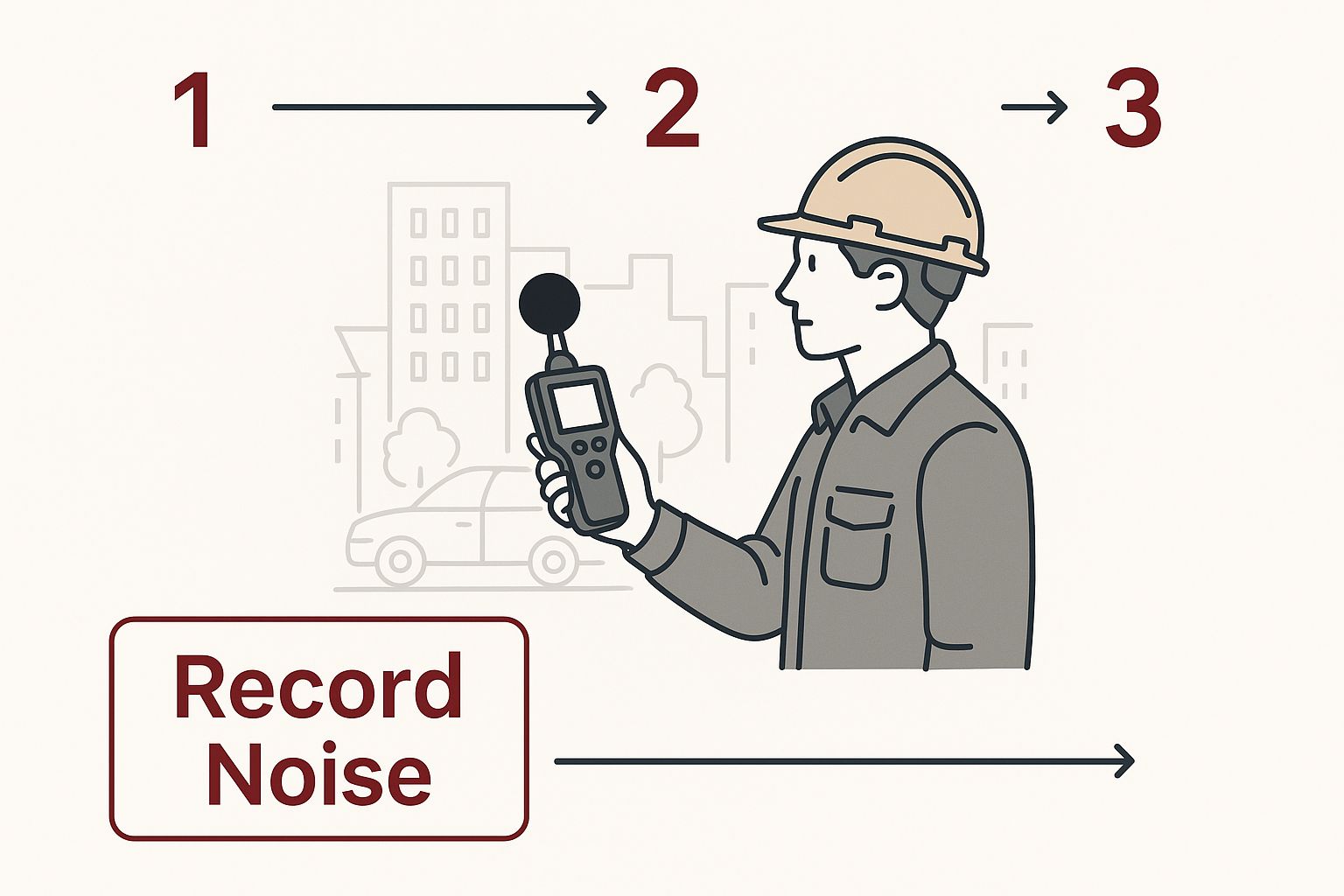
This is what it looks like in action—a professional using the right gear to capture precise, real-world data right at the source.
Stage 3: Data Analysis and Noise Mapping
Once we have the raw numbers, the real work begins back at the office. This is where our acoustic consultants turn data into intelligence. They meticulously analyse the measurements, cross-referencing everything against the legal exposure limits set out in Australian WHS regulations.
One of the most valuable things to come out of this stage is often a noise map.
A noise map is essentially a colour-coded floor plan of your facility. It gives you an instant visual of your noise hotspots. Red zones might scream "immediate danger," showing areas that exceed legal limits, while yellow and green areas show moderate and safe levels.
This simple visual tool is incredibly effective. It lets managers see at a glance where the biggest risks are, making it much easier to prioritise what needs fixing first and to explain the situation to the team.
Stage 4: Reporting and Recommendations
The final piece of the puzzle is the comprehensive report. This isn't just a spreadsheet of decibel readings. It’s a complete story of the investigation, written in plain English that’s easy to understand.
A good report from a noise survey will always include:
- An Executive Summary: A quick, top-level look at the most important findings and recommendations.
- Detailed Results: All the data, including LAeq,8h and LCPeak values for specific jobs and locations.
- The Noise Map: Your visual guide to the noise levels across the site.
- Actionable Recommendations: A clear, prioritised list of control measures. This could range from engineering fixes like machine enclosures, to administrative changes like rotating staff, and advice on the right kind of PPE.
This report becomes your roadmap to a safer, compliant workplace. The insights and practical advice from experienced occupational hygiene consultants are what transform raw data into a real, long-term safety strategy.
Key Stages of a Professional Noise Survey
To put it all together, the entire process follows a clear and logical progression. Each stage is designed to ensure the final results are not only accurate but genuinely useful for protecting your people and your business.
| Stage | Key Activities | Purpose |
|---|---|---|
| 1. Planning | Initial meeting, site walkthrough, review of work schedules and processes. | To understand the specific workplace environment and design a tailored measurement strategy. |
| 2. Data Collection | On-site measurements using Sound Level Meters and personal Noise Dosimeters. | To gather accurate, representative data on noise levels and personal employee exposure. |
| 3. Analysis | Crunching the numbers, comparing data against legal limits, creating noise maps. | To interpret the raw data, identify high-risk areas, and visualise the findings. |
| 4. Reporting | Compiling a detailed report with findings, analysis, and practical recommendations. | To provide a clear, actionable roadmap for noise control, risk management, and compliance. |
By following these structured steps, you can be confident that you're getting a complete and reliable picture of your workplace's acoustic health.
Decoding Your Noise Survey Report
Getting your hands on a professional noise survey report is a big step. But the real work? That starts when you figure out what all that data actually means for your business. Think of this report not as a dry collection of numbers, but as your strategic roadmap to a safer, more compliant, and more productive workplace. Knowing how to read it is what lets you make smart, targeted decisions that really count.
At its heart, the report takes complex acoustic data and turns it into a clear story about the sound in your workplace. It gets you past vague feelings of "it's a bit loud over there" and gives you objective, legally defensible facts. Let’s break down what you'll find inside and how it points you toward a solid action plan.

Key Metrics You Need to Understand
Your report will be full of technical terms, and they can look a bit intimidating at first. Don't worry. Each one just tells a specific part of your workplace's noise story. The two most important ones to get your head around are LAeq and LCPeak.
-
LAeq (Equivalent Continuous Sound Level): This is basically the average noise exposure over a set time, usually an eight-hour workday (LAeq,8h). It smooths out all the ups and downs—the constant drone of a machine, the sharp sounds of a tool, the quiet lulls—into a single, easy-to-understand number. This is the main figure we use to check against the 85 dB(A) eight-hour exposure standard here in Australia.
-
LCPeak (Peak Sound Pressure Level): This one is different. It captures the absolute highest sound level that occurs, even if it’s just for an instant. It’s all about catching those sudden, dangerously loud impulse noises, like the slam of a metal press or the blast from a pneumatic nail gun. This number is measured against the 140 dB(C) peak exposure limit, which must never be exceeded. Not even for a millisecond.
Here’s a good way to think about it: LAeq is like your average speed over a long road trip. LCPeak is the single fastest moment you hit on the speedometer. Both are vital for understanding the overall journey and spotting the high-risk moments.
From Data to Decisions: A Practical Scenario
Let's put this into practice. Imagine the report is for a busy manufacturing floor. The results show a press operator is exposed to an LAeq,8h of 89 dB(A)—clearly over the legal limit. Meanwhile, a forklift driver working in the warehouse next door has an exposure of 81 dB(A). They're under the limit, but still in a zone that needs careful management.
This is where the report’s recommendations are worth their weight in gold. For the press operator, who is in a "red zone," you need to act immediately. The report will likely point you towards:
- Engineering Controls: These are the best-case solutions because they fix the problem at the source. A classic example is building an acoustic enclosure around that noisy press.
- Administrative Controls: If you can't install an engineering fix straight away, you can change how people work. Rotating the operator to a quieter job for part of their shift can bring their daily average exposure down.
- Personal Protective Equipment (PPE): As the last line of defence, mandating properly rated hearing protection is essential.
For the forklift driver in the "amber zone," the approach is more about proactive monitoring. This might involve scheduling regular hearing checks and providing ongoing training about noise risks.
Identifying Hotspots with Noise Maps
One of the most useful tools in a noise survey report is a noise map. It’s a colour-coded floor plan of your site that shows you exactly where the acoustic trouble spots are. When you see a big red patch glowing around a particular grinding machine, it instantly tells you where to focus your attention. It makes it so much easier to explain the risks to your team and decide where to spend your noise-control budget first.
Understanding this stuff in a broader context really drives home why these workplace limits are so crucial. A major Australian study, for instance, found that up to 20% of homes in urban areas are exposed to traffic noise over 63 dB—a level known to cause real annoyance and disrupt sleep. You can read more about these health impacts in the official enHealth guidance on environmental noise. If that level of noise can affect people's health at home, it really highlights the serious risk from the much higher, sustained noise levels found in some workplaces.
At the end of the day, your noise survey report is your guide to managing risk. By understanding these key parts, you can confidently turn the findings into a real-world plan that protects your people, keeps you compliant, and makes your business stronger.
The Tools of the Trade for Accurate Measurement
You can't get reliable data for a noise survey with a smartphone app. It’s a job for highly specialised, precision-engineered equipment that is tested and calibrated like clockwork. Each tool has a specific role, and when used together, they create a complete and legally defensible picture of your workplace's sound environment.
Think of these instruments like a doctor's diagnostic kit. You wouldn't want your GP guessing about your health, and you shouldn't be guessing about workplace noise. Using the right gear ensures every measurement is accurate, repeatable, and ready to inform critical safety decisions.
The Sound Level Meter: The Snapshot Tool
The most fundamental piece of equipment we use is the Sound Level Meter (SLM). The best way to think of an SLM is like a high-performance camera. Just as a camera captures a precise visual snapshot of a moment in time, an SLM captures a detailed snapshot of the sound pressure level at a specific location, right at that instant.
Our technicians use SLMs to take static measurements around a workplace. This is perfect for assessing the noise coming from a particular machine or getting a handle on the ambient sound level in a specific area. It gives you that crucial, in-the-moment reading needed to start building out your noise map.
The Noise Dosimeter: The Personal Story
An SLM is great for fixed locations, but it can’t tell you what a worker who moves around all day is actually exposed to. That’s where the Noise Dosimeter comes in. A dosimeter is a small, lightweight device worn by an employee—usually on their shoulder, close to the ear—for their entire shift.
Think of a dosimeter as a personal fitness tracker, but for sound. Instead of counting steps, it continuously monitors and logs all the sound the worker is exposed to, calculating their total "noise dose" over several hours.
This is absolutely essential for roles where noise exposure changes a lot, such as:
- A forklift driver moving between a quiet warehouse and a loud loading bay.
- A maintenance technician working on different machines across the facility.
- A supervisor who walks the entire factory floor throughout the day.
The data we get from a dosimeter provides an accurate LAeq,8h—the eight-hour average exposure. This is the single most important metric for assessing long-term hearing risk and proving compliance with Australian regulations.
The Acoustic Calibrator: The Guarantee of Accuracy
An SLM or dosimeter is only as good as its last calibration. This is where the Acoustic Calibrator plays a vital, non-negotiable role. It’s a small, handheld device that produces an incredibly precise and stable tone at a known decibel level, typically 94 dB or 114 dB.
Before and after every set of measurements, our technicians fit the calibrator over the microphone of the meter or dosimeter. This simple check confirms the instrument is reading correctly. If it’s off, even slightly, it gets adjusted right there on the spot. This rigorous process ensures every piece of data collected during your noise survey is accurate, reliable, and can stand up to scrutiny from regulators. Without it, the entire survey's findings would be questionable.
Beyond the Factory Floor: Noise and Your Neighbours
While we often think of noise surveys as something for the workplace, the story doesn't end at the property line. The same sounds that can harm an employee's hearing can quickly become a major headache for the surrounding community, blurring the lines between workplace safety and being a good corporate citizen.
It’s about understanding your acoustic footprint. Think about the sounds your business generates that travel beyond your walls—the rumble of late-night deliveries, the persistent hum from an air conditioning unit, or the clatter of a construction project. Managing this isn't just about being nice; it's a savvy move to avoid complaints, council fines, and a hit to your reputation.
The Same Tools for a Different Problem
The good news is that the expertise and equipment used for an occupational noise survey are exactly what's needed to tackle community noise. An acoustic consultant can measure the sound spilling over your boundary just as they would measure hazardous levels inside a factory. This allows you to get ahead of potential issues before they turn into angry phone calls and official complaints.
This proactive stance is more important than ever. As cities grow, industrial zones and residential areas are becoming closer neighbours. What was once an isolated factory might now share a fence with a new housing estate, making noise management a vital part of keeping the peace.
What Annoys the Neighbours?
Community noise complaints can come from a surprisingly wide range of sources, not just the obvious industrial clatter. Day-to-day operations and one-off projects can both disrupt the peace and quiet people expect at home.
Some of the most common culprits include:
- Construction and Demolition: The sharp, unpredictable sounds of jackhammers, saws, and heavy machinery.
- Logistics and Transport: The constant drone of trucks, the high-pitched beep of reversing alarms, and the clanging from loading bays.
- Fixed Plant and Machinery: The endless hum from external equipment like HVAC systems, generators, or cooling towers.
- Entertainment Venues: Amplified music and crowd noise from pubs, clubs, and outdoor concerts that bleed into nearby homes.
Often, it's not just about how loud a noise is, but what it sounds like and when it happens. A rhythmic, thumping bass line at 11 PM can be far more intrusive than a louder, steadier noise during business hours. This is where an environmental noise assessment becomes invaluable—it helps put a number on these otherwise subjective feelings of annoyance.
Don't underestimate how seriously communities take noise. In Western Australia, for instance, historical data showed noise complaints were incredibly high, hitting around 5,900 per million people. Interestingly, the biggest single source of domestic complaints was barking dogs, with 6,727 separate reports. You can dive deeper into these trends by reading the findings from the Australian Acoustical Society conference.
These figures show just how sensitive people are to unwanted sound. For any business, it’s a clear signal that managing your noise output is a crucial part of creating a better environment for everyone—both for your team inside and the community just outside your gate.
Got Questions About Noise Surveys? We've Got Answers.
Diving into occupational noise management for the first time can feel a bit overwhelming. There's a lot to consider, from regulations to practicalities. To clear things up, we’ve put together straightforward answers to the questions we hear most often from business owners and managers about getting a professional noise survey.
How Often Should We Be Doing A Noise Survey?
There’s no single, rigid deadline that applies to every business, but a solid rule of thumb is to have a comprehensive survey done at least every five years. That’s your baseline.
However, you'll need to act much sooner if things change on the ground. A new noise survey is a must whenever there’s a significant shift in your workplace environment. Think of it as a reset button. This includes things like:
- Installing new machinery: Even one new piece of equipment can completely change the soundscape of a workshop.
- Changing your factory layout: Shifting workstations or reconfiguring production lines can create unexpected noise hot spots.
- Modifying work processes: If a job becomes faster, happens more often, or involves different tools, the noise levels can easily creep up.
- Employee concerns: This is a big one. If your team starts raising issues about noise, it’s a clear sign that you need to investigate properly with a formal survey.
Formal Survey Vs. A Quick Spot Check: What's The Difference?
It’s really important to know when a quick check is enough and when you need to call in the professionals for a full survey. Getting this right is key to making sound safety decisions.
A simple spot check, usually done with a handheld sound level meter, is a bit like taking someone's temperature. It gives you a snapshot—a single reading, in a single place, at a single moment in time. It's handy for a quick "is this area loud?" assessment, but it just doesn't have the detail you need for proper risk assessment or to meet your legal obligations.
A formal noise survey, on the other hand, is like a complete medical check-up. It’s a systematic, in-depth investigation. We measure noise levels over full shifts, across all relevant parts of your site, and for people doing different jobs. This process gives us the detailed data—specifically the LAeq,8h and LCPeak values—that Australian WHS regulations require for a legally sound noise management plan.
A spot check can flag a potential problem, but only a formal survey can truly define its scale, pinpoint exactly who is at risk, and show you the right way to fix it. It delivers the solid evidence you need to protect your people and your business.
What If The Survey Shows We're Non-Compliant?
Getting a noise survey report is the first step; acting on it is the crucial next one. If the report highlights areas where you aren't compliant and you don't implement the recommended controls, you are knowingly putting your employees in harm's way.
The consequences for inaction can be serious and come from several directions:
- Improvement Notices and Fines: Workplace safety regulators can issue legally binding notices forcing you to address the hazard, often with hefty fines attached.
- Increased Workers' Compensation Claims: If you fail to act on expert advice, it becomes much easier for an employee to prove their hearing loss is work-related, leading to expensive and damaging claims.
- Legal Liability: In the most serious cases, directors and managers can be held personally liable and face prosecution for failing in their duty of care.
- Reputational Damage: Word gets around. Being seen as an unsafe place to work makes it incredibly difficult to attract and keep good people.
Think of your noise survey as your roadmap to a safer workplace. Following its recommendations is the clearest path to managing your risks and meeting your legal and ethical duties as an employer.
Protecting your team from permanent, noise-induced hearing loss isn't just a regulatory hoop to jump through—it's a fundamental part of running a responsible and successful business. If you have more questions or you're ready to book a comprehensive noise survey, our expert team is here to guide you. Contact us today to make sure your workplace is safe, compliant, and productive. Learn more by visiting us at https://occhygiene.com.au.


