
In Australia, the line in the sand for silica dust is drawn very clearly. The workplace exposure standard for respirable crystalline silica is a non-negotiable legal limit of 0.05 milligrams per cubic metre (mg/m³), averaged over an eight-hour shift. This number isn’t arbitrary; it’s the bedrock of our national strategy to protect workers from the invisible dust that causes incurable diseases like silicosis. This comprehensive guide will walk you through what this standard means, the severe health risks involved, and the practical steps every business must take to ensure compliance and, most importantly, worker safety. Understanding and implementing these measures is not just a legal requirement but a moral one.
Understanding The Foundation Of Silica Safety

Note: Wearing a surgical mask in silica environments gives a false sense of safety; only respirators provide protection.
When you cut, grind, or drill common materials like stone, concrete, sand, or brick, you’re not just making a mess. You’re releasing microscopic particles called respirable crystalline silica (RCS) into the air. These particles are the real danger, a hidden threat that can have devastating long-term consequences.
Because they are so incredibly small, often invisible to the naked eye, they easily bypass the body’s natural filters in the nose and throat. They travel deep into the delicate tissues of the lungs, and once they’re there, they don’t come out. Instead, they cause permanent scarring and inflammation, leading to debilitating health problems that can take years, or even decades, to manifest. It’s a silent, insidious hazard with life-altering consequences, making proactive control measures absolutely essential.
To get a handle on this hidden threat, Australian regulators have established a firm, science-backed number. This workplace exposure standard (WES) represents the maximum concentration of silica dust a worker can be legally exposed to over a working day without facing an unreasonable risk to their health.
The Numbers Behind The Standard
The standard is precisely 0.05 mg/m³, calculated as an 8-hour time-weighted average (TWA). This means that over a typical workday, the average concentration of respirable crystalline silica in a worker’s breathing zone must not exceed this level. It’s a standard that aligns with international health guidelines and is specifically designed to protect workers across a typical five-day workweek over their entire working life.
Think of it as a strict “safety budget” for your lungs. Some tasks might create a higher-than-average spike in dust for a short period, but this must be meticulously balanced by periods of very low or zero exposure to ensure the eight-hour average remains safely below the 0.05 mg/m³ threshold.
To put that number in perspective, it’s an incredibly small amount, a concentration of dust that is often completely invisible to the naked eye. This is precisely why you cannot and must not rely on simply “seeing” the dust to determine if a work area is dangerous. The absence of visible dust clouds is not an indication of safety.
The real purpose of the WES isn’t just about controlling dust; it’s about preventing incurable diseases. It is the legal and ethical benchmark that every single control measure, from advanced water suppression systems to local exhaust ventilation and proper respiratory protection, must aim to beat.
Workplaces across a vast array of sectors need to be acutely aware of these risks. The danger isn’t confined to just one or two industries; it’s widespread wherever silica-containing materials are cut, crushed, drilled, or otherwise disturbed.
Key Industries and Tasks Generating Silica Dust
This table outlines some of the most common industries and specific job tasks where workers are at high risk of exposure to respirable crystalline silica. Acknowledging these risks is the first step toward effective management.
| Industry | Common Silica-Generating Tasks | Primary Materials |
|---|---|---|
| Construction | Cutting, drilling, grinding concrete; demolition; jackhammering; sandblasting. | Concrete, brick, stone, mortar, tiles. |
| Stonemasonry | Cutting, polishing, and finishing engineered and natural stone benchtops. | Engineered stone, granite, marble, sandstone. |
| Mining & Quarrying | Crushing, screening, and drilling rock; tunnelling; mineral extraction. | Rock, sand, ore bodies. |
| Manufacturing | Abrasive blasting; foundry work (casting); glass and ceramics production. | Sand (for moulds), raw silica, clay. |
Understanding precisely where the dust comes from is the foundational first step in controlling it effectively and ensuring your operations remain compliant with the stringent workplace exposure standard.
Why This Standard Is So Important
Having a firm, measurable exposure limit gives every business in a high-risk industry a clear, unambiguous goal. It removes the guesswork from safety and establishes a uniform, high level of protection for every worker, regardless of the job site or the specific task. This standard is a critical component of the broader framework of Australian workplace safety regulations.
Staying compliant with the WES is non-negotiable for several crucial reasons:
- It’s the Law: This is a legal requirement enforced by state and territory regulators. Breaching the standard can lead to substantial fines, project shutdowns, and even prosecution of business owners and managers.
- It Prevents Disease: It is our most effective regulatory weapon in the ongoing fight against silicosis, lung cancer, and other debilitating silica-related illnesses. Adherence saves lives.
- It Builds Trust: A genuine, demonstrable commitment to meeting and exceeding the standard shows your team that their health and safety is your absolute top priority, fostering a positive and proactive safety culture.
At the end of the day, the workplace exposure standard for respirable crystalline silica is far more than just a number. It’s the most important line of defence we have in protecting Australian workers from a completely preventable, and often fatal, occupational disease.
The Hidden Health Risks of Silica Dust
The workplace exposure standard for respirable crystalline silica isn’t just a number on a page; it’s a critical line of defence against severe, life-altering diseases. To truly grasp the danger, you have to look past the immediate work environment and understand the long-term, irreversible damage these tiny particles can inflict on the human body.

Think of it like breathing in microscopic shards of glass. That’s essentially what happens when respirable crystalline silica gets into your lungs. The particles are so fine that the body’s natural defences, like the mucous membranes in the nose and throat, can’t catch them, allowing them to travel deep into the most delicate parts of the lung tissue.
Once these particles are embedded in the lung’s air sacs (the alveoli), they set off a constant and aggressive inflammatory response. The body’s immune system goes on the attack, trying to break down these foreign invaders, but it can’t. The silica is indestructible. This endless, futile battle leads to the formation of hard, fibrous scar tissue, known as fibrosis. This scarring stiffens the lungs and slowly, progressively destroys their ability to do their job: transferring oxygen into the bloodstream.
The Devastating Impact on Health
This internal damage manifests as several serious and often fatal diseases. The causal link between silica dust exposure and these conditions is scientifically undeniable, making prevention the only viable strategy to keep workers safe.
- Silicosis: This is the classic disease linked directly to silica inhalation. It’s an incurable and progressive lung disease where scar tissue (fibrosis) builds up, drastically reducing the lungs’ capacity to take in oxygen. This leads to severe shortness of breath, a persistent cough, and extreme fatigue.
- Lung Cancer: Respirable crystalline silica is classified as a Group 1 carcinogen by the International Agency for Research on Cancer (IARC). In plain English, that means it’s a known and proven cause of cancer in humans. Long-term exposure significantly raises a worker’s risk of developing lung cancer.
- Chronic Obstructive Pulmonary Disease (COPD): This is an umbrella term for a group of lung diseases, including chronic bronchitis and emphysema, that block airflow and make it difficult to breathe. Silica exposure is a known trigger and can significantly worsen pre-existing COPD.
- Kidney Disease: The damage isn’t confined to the lungs. A growing body of scientific evidence has also connected silica exposure to a higher risk of developing serious kidney diseases, including end-stage renal failure.
This wide range of devastating health problems is why it’s so important to understand every aspect of respirable crystalline silica and to implement rock-solid, verifiable controls in the workplace.
The Different Faces of Silicosis
Silicosis isn’t one single disease; it can manifest in different forms depending on the intensity and duration of exposure. Knowing these variations helps paint a clearer picture of the risk and the urgency for control.
Silicosis is a particularly cruel disease because its symptoms often take years, or even decades, to appear after the initial exposure. This long latency period creates a dangerous false sense of security, where workers may feel perfectly fine today while irreversible and progressive damage is silently accumulating in their lungs.
The three main forms of silicosis are:
- Chronic Silicosis: This is the most common form, typically appearing 10 to 30 years after long-term exposure to lower levels of silica dust. It starts subtly with symptoms like a persistent cough or shortness of breath during exercise and gets progressively worse over time.
- Accelerated Silicosis: As the name suggests, this version develops much faster—typically within 5 to 10 years of exposure—after a worker is exposed to higher concentrations of silica. The symptoms are more severe and progress more rapidly. This form has been a major concern in the engineered stone fabrication industry.
- Acute Silicosis: This is a rare but devastating form of the disease that can strike in just a few weeks or months after massive, short-term exposure to extreme levels of silica. The lungs fill with fluid, causing severe shortness of breath and low blood oxygen levels, a condition that is often fatal.
Why Proactive Prevention Is The Only Solution
That long delay between exposure and the onset of symptoms is what makes silica dust so insidious and dangerous. A worker could be exposed to hazardous levels for years without feeling a thing, only to be diagnosed with a debilitating, terminal lung disease a decade or more later, when it’s far too late for any effective treatment.
This is precisely why strict adherence to the workplace exposure standard for respirable crystalline silica is completely non-negotiable. The entire strategy isn’t about managing symptoms once they arrive; it’s about preventing the exposure that causes the disease in the first place. Every control measure—from water suppression and ventilation to proper PPE and health surveillance—is a vital part of ensuring workers can go home healthy, not just at the end of the day, but for the rest of their lives.
Putting a Lid on Silica Dust: A Practical Guide to Controls
Knowing that silica dust is dangerous is the first step, but putting effective controls in place is where the real work begins. A solid safety plan isn’t about hoping for the best; it’s a structured, methodical approach known as the hierarchy of controls. This framework is your roadmap, guiding you to tackle the dust at its source rather than just managing the fallout.
Think of it as a pyramid. The most effective and reliable solutions are at the top, and as you move down, the methods become less reliable and more dependent on human behaviour. Sticking to this hierarchy isn’t just best practice—it’s essential for meeting the workplace exposure standard for respirable crystalline silica and genuinely protecting your team.
Start at the Top: Elimination and Substitution
The single best way to manage any hazard is to get rid of it entirely. While you can’t always avoid silica-containing materials, you should always ask the question: “Do we have to use this?” Could a different, safer material do the job just as well?
For instance, you might use silica-free abrasives for blasting or opt for composite products instead of cutting concrete. Thinking about this from the very start of a project is key. For example, when building brick houses, which involves a lot of cutting, having a comprehensive dust management plan from day one is non-negotiable.
If you can’t eliminate the hazard, the next best thing is to substitute it. This means swapping out a material high in silica for one with a lower, safer concentration. A classic example is choosing a natural stone or laminate benchtop instead of an engineered stone product that can contain over 90% silica. These decisions at the design and procurement stage can have a massive impact on worker health.
Engineering Controls: The Heavy Lifters of Dust Management
This is where you make physical changes to the work environment or equipment to stop dust from ever becoming airborne. Engineering controls are the workhorses of silica safety because they’re built into the process and don’t depend on someone remembering to do the right thing every single time. They provide consistent and reliable protection.
Two main strategies dominate here:
- Water Suppression (Wet Methods): It’s a simple concept that works brilliantly. Applying water at the point of cutting, grinding, or drilling dampens the dust, making the particles heavy so they fall to the ground instead of floating in the air where they can be inhaled. This means using saws with integrated water feeds and drills with a continuous water attachment.
- Local Exhaust Ventilation (LEV): This is all about capturing dust at the source before it can escape into the wider work environment. Think of it like a high-powered, industrial-grade vacuum cleaner for your tools. On-tool dust extraction, where a HEPA-filtered vacuum is connected directly to a power tool’s shroud, is a perfect example of LEV in action.
These controls shouldn’t be an afterthought; they should be an integral part of the job itself. A concrete cutter should never be using a dry saw when a wet one is available. A stonemason should be working on a downdraft table that pulls dust down and away from their face.
This infographic from key regulatory agencies gives a great visual of the exposure limits these controls help you stay under.
As you can see, the legal limit, or Permissible Exposure Limit (PEL), is 50 µg/m³ (which is equivalent to 0.05 mg/m³). But the ‘Action Level’—the point where employers must start implementing controls—is even stricter at 25 µg/m³ (0.025 mg/m³).
Administrative Controls: Changing How the Work Gets Done
Once your engineering controls are locked in, you can layer on administrative controls to reduce exposure even further. These are all about your processes and policies—how, when, and where people work. They’re less foolproof than engineering solutions because they rely heavily on human behaviour and consistent enforcement.
Common administrative controls include:
- Creating Exclusion Zones: Cordoning off high-dust areas with clear signage to keep unprotected workers from entering.
- Smart Scheduling: Planning the dustiest jobs for times when fewer people are around, such as at the end of the day, during off-shifts, or on a weekend.
- Job Rotation: Limiting the duration one person spends on a high-exposure task by rotating them to other, lower-risk duties throughout the shift.
- Smarter Housekeeping: Banning dry sweeping and the use of compressed air for cleaning, which just kicks settled dust back into the air. Instead, mandate wet-sweeping methods or the use of vacuums with HEPA filters for cleanup.
The real aim of administrative controls is to cut down on incidental exposure. It’s about making sure only the necessary, protected workers are near the hazard, and for the shortest time possible, minimising the risk for the entire workforce.
To make this clearer, here’s a breakdown of how the hierarchy applies specifically to silica dust.
Applying the Hierarchy of Controls to Silica Dust
| Control Level | Action | Practical Examples |
|---|---|---|
| Elimination | Remove the hazard completely. | Use silica-free abrasive blasting materials. Choose composite materials instead of concrete. |
| Substitution | Replace the hazardous material. | Select natural stone or laminate benchtops over high-silica engineered stone. |
| Engineering | Isolate people from the hazard. | Use tools with integrated water delivery. Attach HEPA-filtered dust extractors to power tools. |
| Administrative | Change the way people work. | Restrict access to high-dust areas. Schedule dusty work for off-peak hours. Rotate workers. |
| PPE | Protect the worker with equipment. | Provide correctly fitted P2 respirators. Conduct annual fit-testing and provide training. |
This table shows how each layer adds a new level of protection, with Personal Protective Equipment always being the final backstop when other controls are insufficient.
Personal Protective Equipment (PPE): Your Last Line of Defence
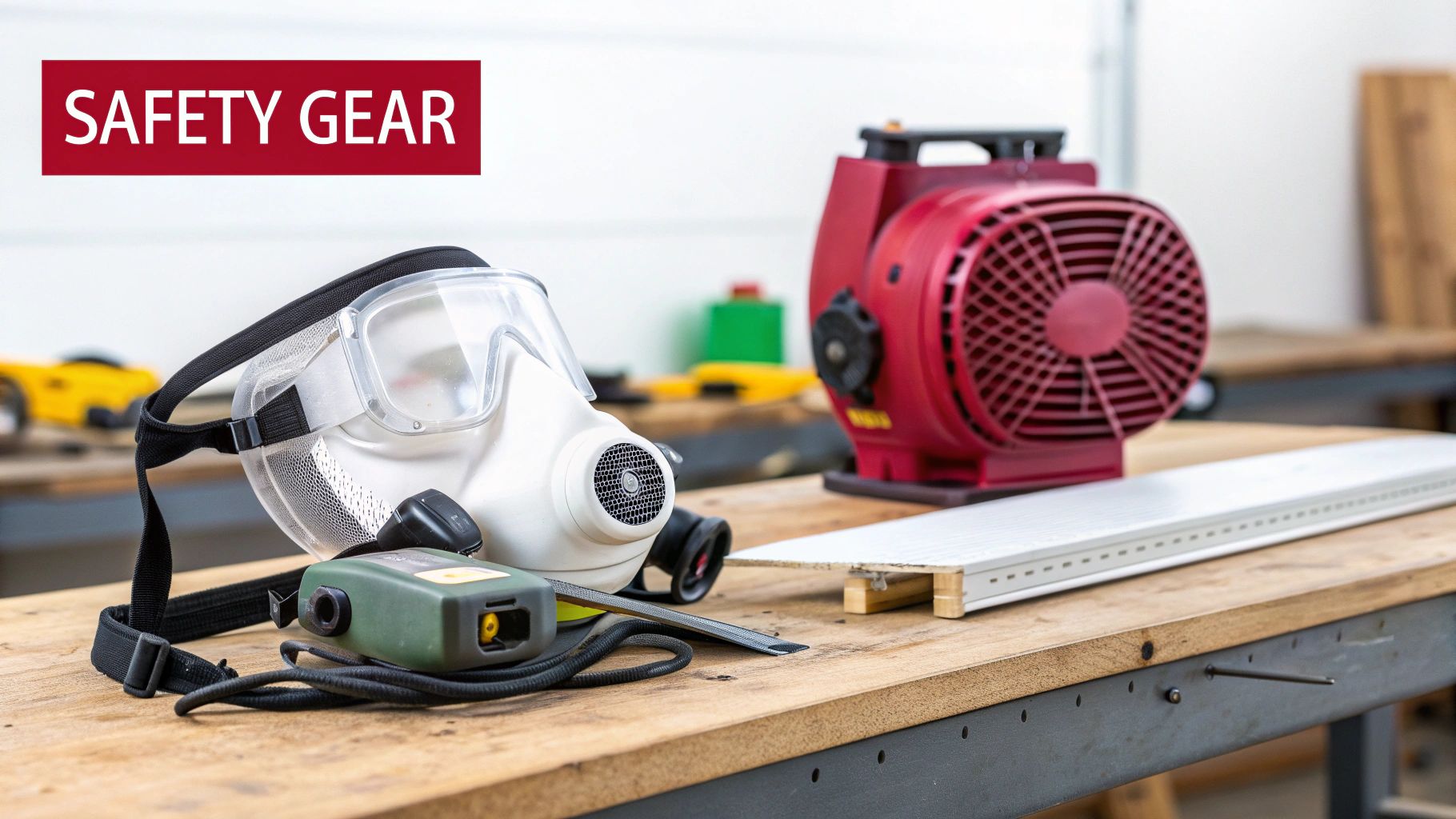
Finally, we get to PPE, specifically respirators. It is absolutely crucial to understand that PPE is the last and least effective control measure in the hierarchy. It should never be your first or only line of defence. You only turn to PPE when all other higher-level controls cannot get exposure below the legal limit, or as a supplementary layer of safety.
Relying solely on a mask is a massive gamble because its effectiveness is incredibly fragile. It hinges on the right mask being chosen for the task, being worn perfectly with a complete seal, and being maintained meticulously.
For PPE to have any chance of working, these three things are absolutely critical and non-negotiable:
- Correct Selection: At a minimum, workers need a P2-rated disposable respirator or a reusable half-face or full-face respirator with P2 particulate filters. The specific type required depends on the concentration of dust in the air.
- Proper Fit-Testing: A mask is utterly useless if it doesn’t create a perfect, airtight seal on the wearer’s face. Every worker who needs to wear a tight-fitting respirator must undergo an annual “quantitative fit test” to ensure there are no leaks. Something as simple as a day’s stubble can break the seal and render a mask worthless.
- Maintenance and Training: Your team needs to be thoroughly trained on how to inspect, clean, and store their respirators. Disposable masks are single-use—they must be thrown out when the shift is over, if they become damaged, or if they become hard to breathe through.
By diligently working your way down the hierarchy of controls, you build a robust, multi-layered defence system that keeps your workers safe and ensures silica levels stay well below the workplace exposure standard for respirable crystalline silica.
Meeting Your Air Monitoring and Health Surveillance Duties
Putting engineering and administrative controls in place is a massive step forward, but it’s only half the battle. To really be sure you’re complying with the workplace exposure standard for respirable crystalline silica, you need to prove those controls are actually working effectively in your specific environment. This is where your legal duties for air monitoring and health surveillance kick in—think of them as the verification and protection phases of your comprehensive safety plan.
Here’s a simple way to look at it: your dust controls are like putting a speed limiter on a car. Air monitoring is the speedometer that provides the data to show you’re staying under the legal limit, and health surveillance is the regular mechanic’s check-up to make sure no hidden damage is happening to the engine (the worker’s lungs) over time. You absolutely need both to run a safe and compliant operation.
Verifying Safety Through Air Monitoring
Air monitoring isn’t about guesswork or estimation. It’s a scientific process for measuring the exact amount of respirable crystalline silica in a worker’s personal breathing zone. The goal here is simple and singular: collect hard, objective data to prove that your control measures are successfully keeping exposure levels below that all-important legal limit of 0.05 mg/m³.
To do this, a qualified occupational hygienist will usually place a small air sampling device on a worker to collect air samples throughout a typical shift. This isn’t just for show or to satisfy a regulator; the data collected is incredibly valuable for your business.
- Compliance: It provides you with the documented, legally defensible proof that regulators require to demonstrate you are meeting your obligations.
- Effectiveness: It tells you what’s working and, just as importantly, what isn’t. High readings can pinpoint a failing control system or an unsafe work practice that needs immediate correction.
- Risk Identification: You can pinpoint specific tasks, tools, or work areas that are generating far more dust than you realised, allowing you to take targeted, effective action to mitigate the risk.
By regularly measuring exposure, you shift from hoping your workplace is safe to knowing it is. That distinction is the bedrock of a robust and trustworthy safety management system. To get into the nuts and bolts of the process, have a look at our detailed guide on air monitoring for silica dust.
Air monitoring transforms safety from an abstract policy into a concrete, measurable outcome. It’s the only way to be certain that the invisible threat of silica dust is being kept at bay and that your workers are genuinely protected day in and day out.
The Critical Role of Health Surveillance
While air monitoring looks at the environment, health surveillance is focused entirely on the worker. It’s a mandatory program of medical checks for any worker who is at significant risk of silica dust exposure. This is much more than a box-ticking exercise; it’s a proactive health strategy designed to catch the very first signs of silica-related disease when there’s still a chance to intervene and prevent further harm.
The sad reality of rising cases of accelerated silicosis, particularly in the engineered stone industry, has spurred Australian states and territories to tighten up regulations significantly. For example, back in 2017, Queensland’s Department of Natural Resources, Mines and Energy rolled out strict health monitoring guidelines for mine and quarry workers. These mandated baseline and regular medical exams, including everything from respiratory history and spirometry (lung function tests) to specialised chest X-rays designed to detect dust diseases.
What to Expect From Medical Examinations
A registered medical practitioner, usually one with specific experience in occupational health and dust diseases, must oversee the health surveillance program. The whole process is structured to create a comprehensive health baseline for each worker before they are exposed and then to track any changes meticulously over time.
A comprehensive program will always include:
- Baseline Medical: This happens before a worker even starts in a high-risk role. It establishes their starting point for lung health and fitness for the role.
- Periodic Medicals: These are performed at regular intervals—often yearly or every two years, depending on the level of risk—to keep a vigilant eye out for any developing issues.
- Exit Medical: A final check-up that documents a worker’s health status when they leave the high-risk role or the company, providing a complete health record.
Each examination involves specific tests to assess lung function and spot the earliest possible signs of disease. Workers can expect a review of their work and medical history, a physical check-up, and some specialised testing. This typically means spirometry (a breathing test measuring lung capacity) and a special chest X-ray that uses the International Labour Organisation (ILO) classification system to look for subtle, dust-related changes in the lungs. These ongoing checks are the most important safety net you can provide for the long-term health and well-being of your team.
How Australia Woke Up to the Silicosis Crisis
The tough new workplace exposure standard for respirable crystalline silica wasn’t created in a vacuum. It was born from a national health emergency, sparked by a tragic and alarming surge in silicosis cases, particularly among young workers in the engineered stone fabrication industry. This crisis was a harsh, unavoidable spotlight on the real-world cost of inadequate protection, forcing a top-down, nationwide response from governments, regulators, and industry bodies.
This wasn’t just a single new rule. It was a massive, coordinated effort pulling together government agencies, medical experts, and industry leaders to address a catastrophic failure in workplace safety. The first step was to grasp the true scale of the problem and then build a unified, much stronger regulatory framework to shield Australian workers from a disease that is entirely preventable.
The People and Reports That Drove the Change
Two key players were at the forefront of this push for radical change: Safe Work Australia, the national policy body, and the National Dust Disease Taskforce, a group of experts convened by the federal government. Their job was to dig into the shocking rise in silicosis diagnoses and come back with real, actionable, and urgent solutions.
What they found was a sobering wake-up call for the entire country. Their reports exposed deep-seated failures in workplace safety practices, a lack of awareness, and a desperate need for modernised regulations that could actually stand up to the risks posed by modern materials like engineered stone. This evidence-based work became the undeniable backbone for overhauling Work Health and Safety (WHS) laws across Australia, moving beyond outdated standards to tackle these dangers head-on.
The national response was driven by a clear and sobering realisation: the existing rules and practices were failing to protect a new generation of workers from an age-old disease. This catalysed a fundamental shift from a culture of passive compliance to one of proactive, nationwide prevention.
This has created a much more serious and vigilant culture of enforcement. Regulators across all states and territories now have a clear mission: to make sure businesses aren’t just aware of the risks but are actively and effectively controlling them on a daily basis.
The Big Regulatory Shake-Up
The taskforce’s findings led to several landmark changes designed to protect workers immediately and set a new, higher safety benchmark for the future. These were not minor adjustments; they were decisive, life-saving actions aimed squarely at the most hazardous work practices.
The 2021 Final Report from the National Dust Disease Taskforce was a critical document, calling for urgent and sweeping action. It recommended dropping the workplace exposure standard to 0.05 mg/m³ (as an 8-hour time-weighted average) and, crucially, banning the uncontrolled dry cutting of engineered stone—a practice that was quickly outlawed in many states and is now subject to a national ban from July 2024. You can read the full, detailed findings in the National Dust Disease Taskforce Final Report.
The most significant changes included:
- Banning Uncontrolled Dry Cutting: This was a no-brainer. Recognised as one of the single most dangerous work activities, the dry cutting, grinding, and polishing of engineered stone was swiftly prohibited.
- Harmonising the Laws: A huge effort was made to get all states and territories on the same page with their WHS laws and exposure standards. The goal was to ensure every Australian worker has the same high level of protection, no matter where their job is located.
- Tougher Enforcement: Regulators were given more power and resources to walk onto sites, conduct inspections, hand out serious on-the-spot fines, and even shut down operations that weren’t meeting the new, stricter standards.
Why This Backstory Matters for Your Business
Knowing the ‘why’ behind these rules gives you crucial context for your own safety plan. It explains exactly why the workplace exposure standard for respirable crystalline silica is so strict and why regulators are taking compliance and enforcement so seriously.
Your work to control silica dust is more than just a box-ticking exercise to avoid a fine. It’s a direct contribution to a national mission to wipe out preventable occupational lung diseases like silicosis for good. Every time you enforce wet-cutting, hook up on-tool dust extraction, or take the time to check a worker’s respirator fit, you are playing your part in this critical effort. Seeing the bigger picture makes it clear just how important every single safety measure you put in place really is.
We’re All in This Together: Building a Proactive Silica Safety Culture
Let’s be clear: having all the right rules, fancy equipment, and air monitoring plans is crucial. But on their own, they’re just items on a checklist. The real shield against silica dust is a workplace culture where every single person on site—from the newest apprentice to the CEO—is switched on, looking out for each other, and feels confident enough to speak up. This is the human element of meeting the workplace exposure standard for respirable crystalline silica, and frankly, it’s the part that makes all the difference.
A truly safe site is one where doing things the right way is just… how things are done. It’s about moving beyond a grudging, “box-ticking” approach to safety and creating a genuine sense of shared responsibility for everyone’s long-term health. This kind of culture doesn’t just happen; it’s built intentionally, brick by brick, on a solid foundation of effective training, open communication, and unwavering trust.
Training That Actually Sticks
Let’s face it, nobody gets inspired by a death-by-PowerPoint session and a sign-off sheet. For training to mean anything, your crew needs to understand why they’re being asked to do something, not just what they have to do. Once someone truly grasps the irreversible, life-destroying reality of silicosis, they stop seeing a dust mask as a hassle and start seeing it as a vital piece of personal protection.
Any training worth its salt has to cover:
- The Real-World Dangers: No sugar-coating. Use real-life case studies and visuals to show what silicosis and other silica-related diseases actually do to a person’s lungs and life.
- Using the Gear Correctly: This has to be hands-on. Demonstrate how to properly operate water-fed saws, hook up a dust extractor, and check if it’s working at full capacity.
- PPE Isn’t a Silver Bullet: Teach everyone how to choose, fit-test, use, and look after their respirators. But hammer home the point that PPE is the last line of defence, not the first, and is useless without a proper seal.
When you do this, you’re not just training workers to follow rules; you’re empowering them with the knowledge to actively protect themselves and their colleagues.
Communication is More Than Memos
Keeping safety top of mind isn’t about a one-off meeting or a poster in the breakroom. It’s about weaving it into the daily rhythm of the worksite. It’s about making sure the right information gets to the right people, right when they need it, in a way they can understand and act on.
A strong safety culture is one where flagging a risk is seen as helping the team, not causing trouble. It’s about creating an environment where anyone, from the new apprentice to the site foreman, feels safe enough and empowered enough to hit the brakes on a task if something looks wrong or unsafe.
Here’s what that looks like in practice:
- Daily Toolbox Talks: Quick, sharp catch-ups before the day kicks off. Discuss the jobs for the day, point out the specific silica risks involved, and confirm which controls will be used for each task.
- Signs That Make Sense: Clear, simple warnings and instructions posted in high-risk zones act as a constant visual reminder about what gear and precautions are needed to enter.
- An Open Door for Feedback: Have a straightforward, no-blame way for workers to report hazards or near misses. This isn’t about pointing fingers; it’s about finding and fixing systemic problems before they hurt someone.
It Takes a Team: Reinforcing Shared Responsibility
At the end of the day, silica safety is a partnership. Yes, the employer has the primary legal duty to provide a safe workplace, but that’s only half the equation. Workers have a critical part to play by following the procedures, using the provided equipment properly, and keeping an eye out for their mates. This teamwork is what drives a truly proactive and effective safety culture.
Management’s job is to lead by example, provide the right tools, the right training, and enough time to get the job done safely without cutting corners. In return, workers need to commit to using that equipment correctly, participating in health monitoring, and speaking up when they see a problem. When everyone understands and owns their role in the system, the whole system works, and we get closer to the most important goal of all: making sure everyone goes home healthy, every single day.
Got Questions About Silica Dust Exposure? We’ve Got Answers.
When it comes to the workplace exposure standard for respirable crystalline silica, it’s natural to have a few questions. The rules can seem complex, but getting a handle on them is the best way to keep your team safe and stay on the right side of the law. Let’s break down some of the most common queries we hear from businesses just like yours.
What’s the Magic Number for Silica Exposure in Australia?
The official limit you absolutely must stay under is 0.05 milligrams of respirable crystalline silica per cubic metre of air (0.05 mg/m³).
But this isn’t just a snapshot measurement. It’s what’s known as an 8-hour time-weighted average (TWA). In simple terms, this means a worker’s average exposure over a standard eight-hour shift can’t exceed that 0.05 mg/m³ level. It’s designed to protect workers from the cumulative effects of exposure over a full working life.
Do I Really Need to Organise Health Checks for My Workers?
Put simply, yes. If your workers are carrying out tasks that put them at significant risk of silica exposure, health surveillance is mandatory. A common trigger for this requirement is if a worker needs to wear a respirator to protect them from silica dust for 30 or more days a year.
This is a critical legal requirement designed to spot the very first signs of silica-related lung diseases. A registered doctor with experience in occupational medicine must oversee the program, which involves medical checks before they start, at regular intervals during their employment, and when they finish up, all to keep a close and continuous eye on their lung health.
Think of health monitoring as the ultimate safety net for your people. While air monitoring tells you what’s in the environment, health monitoring tells you how your workers are actually faring. It’s about catching any issues early when intervention and removal from exposure can make the biggest difference to their long-term health outcomes.
Isn’t All Silica Just Sand? What’s the Big Deal?
Not exactly. The real danger lies in what we call respirable crystalline silica (RCS). This is crystalline silica that’s been smashed into microscopic, airborne dust—we’re talking particles at least 100 times smaller than a grain of beach sand—by high-energy work like cutting, drilling, grinding, or blasting.
Those larger particles you can see, like sand, are generally too big to get deep into your lungs, so they don’t pose the same fibrotic risk. It’s the invisible RCS dust floating in the air that can be inhaled right into the deepest parts of the lungs (the alveoli), where it causes permanent scarring and serious diseases like silicosis.
Can I Just Rely on My Dust Controls to Meet the Standard?
In many situations, absolutely. Your first line of defence should always be robust engineering controls, like using water to suppress dust (wet methods) or installing a properly designed local exhaust ventilation (LEV) system. These are designed to capture or contain the dust right where it’s made, making them far more effective and reliable than just handing out masks.
The only way to know for sure if your controls are working effectively, though, is through professional air monitoring. If the results show that your engineering solutions alone cannot keep exposure consistently below the 0.05 mg/m³ limit, then you are legally required to implement other measures, such as administrative controls like rotating jobs and, as a last resort, providing the right, fit-tested respiratory protection.
