
When tools and machinery are constantly shaking, that energy doesn't just disappear—it travels directly into the body, causing slow, cumulative, and often irreversible damage to nerves, blood vessels, and joints. This isn't just about a bit of tingling at the end of the day; it's a serious occupational hazard that can lead to debilitating, lifelong health conditions. Understanding why is vibration a serious health issue is the first step for any employer in safeguarding their team from these pervasive occupational diseases.
The Hidden Hazard Shaking Up Australian Workplaces
For anyone working in construction, manufacturing, or mining, a constant hum, buzz, or jolt is often just background noise—a normal part of the job. But hidden within that daily vibration is a significant risk that many people underestimate. The real answer to why is vibration a serious health issue is that this relentless exposure methodically wears down the human body, leading to permanent, painful harm.
This invisible threat comes in two main forms, both of which are major concerns for workplace health and safety (WHS):
- Hand-Arm Vibration (HAV): This is the vibration you feel when using handheld power tools. Think of angle grinders, jackhammers, chainsaws, or even impact wrenches. The energy travels from the tool straight into your hands and arms, causing havoc on delicate nerves and blood vessels.
- Whole-Body Vibration (WBV): This form of vibration is transmitted through the seat or the floor when you're driving heavy machinery. If you operate a forklift, truck, excavator, or any other large vehicle, your entire body—especially your spine—is absorbing those shocks.
A Widespread and Underestimated Risk
Simply ignoring this hazard can have devastating consequences. We're talking about conditions like severe nerve damage, debilitating musculoskeletal disorders, and chronic pain that can end careers. These aren't just abstract possibilities; they are a daily reality for too many Australian workers.
A study from the Australian Workplace Exposure Survey (AWES) gave us a startling look at the numbers. It estimated that 3.8% of the Australian workforce were exposed to Hand-Arm Vibration levels above the recommended action value on their most recent shift. The problem was even more common in trades, construction, and remote occupations. This data, which you can read more about in the full report on workplace vibration exposure in Australia, highlights a clear and present danger in many industries.
To give you a clearer picture, here's a simple breakdown of the risks associated with each type of vibration exposure.
Workplace Vibration Risks at a Glance
| Type of Vibration | Common Health Risks |
|---|---|
| Hand-Arm Vibration (HAV) | Permanent nerve damage ("white finger"), carpal tunnel syndrome, reduced grip strength, musculoskeletal issues in the hands and arms. |
| Whole-Body Vibration (WBV) | Chronic lower back pain, spinal disc degeneration, digestive problems, damage to internal organs, impaired balance. |
As you can see, the outcomes are far from minor, affecting everything from a worker's ability to hold a tool to their long-term spinal health.
For any business, getting a handle on this risk is about much more than just ticking a compliance box. It's about protecting your most valuable asset: your people. Proactively identifying and controlling vibration hazards is fundamental to ensuring the long-term health of your team and the sustainability of your operations.
Understanding these basics is the critical first step. Now, let's look closer at how this exposure actually causes lasting physiological damage.
How Vibration Causes Lasting Damage to the Body
To really understand why vibration is such a serious health issue, you have to look past the surface and see what’s happening inside the body. It’s not about a sudden injury; it's about a relentless, invisible force that gradually wears down critical biological systems. The damage often builds silently for years, only showing itself when it’s become irreversible.
Think of the delicate network of blood vessels in your hand as a tiny garden hose. When you’re using a power tool, the high-frequency shaking from Hand-Arm Vibration (HAV) is like someone constantly kinking that hose. This repeated stress constricts blood flow, effectively starving the nerves and tissues of the oxygen and nutrients they desperately need to function and repair themselves.
This isn’t just a passing discomfort. Over time, that lack of oxygen causes permanent damage to the walls of the blood vessels and nerves, laying the groundwork for a lifelong injury.
The Cascade of Damage from Hand-Arm Vibration
The first signs of HAV might seem easy to ignore—a bit of tingling in the fingertips or numbness after a long shift. But these are crucial warning signs of a dangerous chain reaction taking place. If that exposure continues, the damage escalates into a collection of debilitating conditions known as Hand-Arm Vibration Syndrome (HAVS).
The damage doesn't happen all at once. It unfolds in predictable stages:
- Vascular Damage: The most recognised symptom is Vibration White Finger (VWF). This is where the fingers turn ghost-white and go numb in the cold because the damaged blood vessels spasm and cut off blood supply.
- Neurological Damage: The nerves in the hands and fingers sustain damage, leading to a permanent loss of feeling and dexterity. Everyday tasks like doing up buttons, picking up a coin, or even holding a pen become incredibly difficult.
- Musculoskeletal Damage: The bones, joints, and muscles in the hands and arms are also affected. This can lead to a weakened grip, carpal tunnel syndrome, and painful inflammation like tendonitis.
This well-documented decline shows just how quickly a seemingly manageable workplace hazard can turn into a permanent disability. For a closer look at the mechanisms, you can learn more about what causes Hand-Arm Vibration.
The Grinding Effect of Whole-Body Vibration
Now, let’s switch gears to Whole-Body Vibration (WBV). Imagine the human spine as a finely tuned suspension system, built to absorb shocks and protect the vital central nervous system. When a worker is sitting in the cab of heavy machinery, their entire body—and especially their spine—is subjected to constant, low-frequency jolts and jarring.
This relentless shaking overloads the body's natural shock absorbers. The intervertebral discs, those soft cushions between each vertebra, are continuously compressed and worn down. It’s a lot like the tyres on a truck that’s driven exclusively on rough, unpaved roads. At the same time, the supporting muscles in the back and abdomen are forced to stay tense just to keep the body stable, leading to chronic fatigue and strain.
It’s not one single event that causes the harm. It’s a slow, grinding, cumulative trauma that systematically breaks down the musculoskeletal structure over months and years, leaving behind chronic pain and permanent spinal disorders.
The long-term consequences of WBV are career-ending and life-altering:
- Chronic Lower Back Pain: This is by far the most common outcome, often becoming a constant and disabling condition that affects every part of a person's life.
- Spinal Degeneration: WBV significantly speeds up the wear and tear on spinal discs, which can lead to agonising conditions like sciatica or herniated (slipped) discs.
- Other Health Issues: The damage isn’t just limited to the back. Research has also connected long-term WBV to digestive problems, balance issues, and even strain on the cardiovascular system.
The health outcomes from vibration exposure in Australian workplaces are well-documented, placing a huge burden on workers and businesses alike. Long-term HAV is directly linked to HAVS, a cluster of disorders that can become permanent if not caught early. Statistics show that while about 24% of workers report some level of vibration exposure, compensation claims are heavily concentrated among older workers. This reflects the long delay before the disease becomes truly disabling, meaning many people only show impairment after decades of exposure—often when it’s too late to reverse the damage.
Understanding Your Legal Duties and Exposure Limits
Knowing that vibration is a serious health issue is one thing; understanding your legal obligations as an employer is something else entirely. In Australia, Work Health and Safety (WHS) regulations are not just a set of guidelines. They’re legal requirements put in place to protect your people from hazards like excessive vibration.
Failing to comply doesn't just risk significant penalties. More importantly, it means you're failing to protect your team from very real, preventable harm.
To get a proper handle on this risk, you first need to know how it’s measured. The key metric used across Australia is the daily exposure A(8) value. This isn't just a quick snapshot of vibration from a tool. It's a standardised value that calculates a worker's total exposure over a typical eight-hour workday.
This A(8) value averages out the intense periods—like a jackhammer tearing up concrete—with the quiet moments, giving you a clear, actionable picture of the overall daily "dose" of vibration. It's this number that helps you answer crucial questions, like how long someone can safely use a specific piece of equipment before they hit a dangerous threshold.
The Two Critical Thresholds You Must Know
Under Australian WHS laws, there are two key thresholds for both Hand-Arm Vibration (HAV) and Whole-Body Vibration (WBV). These aren't just arbitrary numbers; they are scientifically determined levels that spell out your legal responsibilities.
- Exposure Action Value (EAV): Think of this as the first warning bell. If a worker's daily exposure reaches this level, you are legally required to take action to bring that exposure down. You can't just ignore it—hitting the EAV triggers your duty to implement control measures.
- Exposure Limit Value (ELV): This is the hard line. It's the absolute, non-negotiable legal limit. A worker's daily exposure must never, ever exceed this value. This is the final safeguard protecting workers from an unacceptably high risk of developing severe health problems.
Understanding the difference is vital. The EAV is your signal to act proactively, while the ELV is the legal maximum you must never cross. Professional measurement is the only reliable way to know where your operations stand in relation to these critical values.
Australian Workplace Vibration Exposure Standards
So, what are the actual numbers you need to work with? Australian WHS regulations set clear, harmonised benchmarks for employers. The table below breaks down the values you are legally required to follow.
| Vibration Type | Exposure Action Value (EAV) | Exposure Limit Value (ELV) |
|---|---|---|
| Hand-Arm Vibration (HAV) | 2.5 m/s² A(8) | 5.0 m/s² A(8) |
| Whole-Body Vibration (WBV) | 0.4 m/s² A(8) | 0.85 m/s² A(8) |
These figures are the bedrock of legal compliance and effective risk management. They aren't just for show; they're the practical numbers you use to keep your people safe.
Let’s put this into a real-world scenario. Imagine a construction worker using a heavy concrete breaker. A professional vibration assessment might find the tool produces enough vibration to hit the Exposure Action Value (EAV) of 2.5 m/s² in just 30 minutes of trigger time. That finding immediately tells you, the employer, that you need to step in and implement controls.
The assessment would also determine the trigger time it takes to hit the strict Exposure Limit Value (ELV) of 5.0 m/s². Let's say that happens after two hours of continuous use. Now you have a hard legal limit: no single worker can operate that tool for more than two hours in one day. From here, you can build practical controls like job rotation to ensure everyone stays below that line.
This whole process shows why a professional assessment isn't just a "nice-to-have"—it's an essential first step. Without accurate measurements, you're essentially flying blind, unable to meet your legal duties or protect your workers from the long-term damage that makes vibration so dangerous.
For a deeper dive into the specific requirements, our guide on the standard for Hand-Arm Vibration in Australia offers further insights.
Implementing Practical Vibration Control Measures
Knowing that vibration is a serious workplace hazard is one thing; doing something about it is what really protects your people. There’s no single magic bullet for managing vibration. Instead, the most effective approach is a layered strategy built on the hierarchy of controls—a proven framework that prioritises the most impactful solutions first.
It’s about moving from theory to practice. By combining smart engineering fixes, well-thought-out administrative procedures, and the appropriate use of personal protective equipment, you can create a robust defence against the harmful effects of both hand-arm and whole-body vibration.
Engineering Controls: The First Line of Defence
The best way to deal with any hazard is to engineer it out of the picture. When it comes to vibration, that means getting to the source: the tools, machinery, and vehicles your team uses every single day. The goal is simple—either get rid of the vibration or isolate your workers from it.
Here are a few powerful examples:
- Buy low-vibration equipment. When it's time to purchase new tools or machinery, make vibration emission data a non-negotiable part of your buying criteria. Modern equipment is often designed with built-in damping systems that can drastically cut the vibration passed on to the operator.
- Install anti-vibration mounts. For big, stationary machines that can shake an entire workshop, specialised mounting pads can absorb that energy before it travels through the floor and affects everyone nearby.
- Upgrade vehicle suspension. For anyone operating heavy vehicles, the seat is where the impact happens. Investing in modern, air-suspended seats or improving the vehicle’s overall suspension system can make a world of difference in reducing the jolts that lead to chronic back pain. You can learn more about how to manage these risks in our deep-dive on whole-body vibration.
The diagram below shows how workplace vibration is split into Hand-Arm Vibration (HAV) and Whole-Body Vibration (WBV)—the two distinct types that these controls are designed to address.
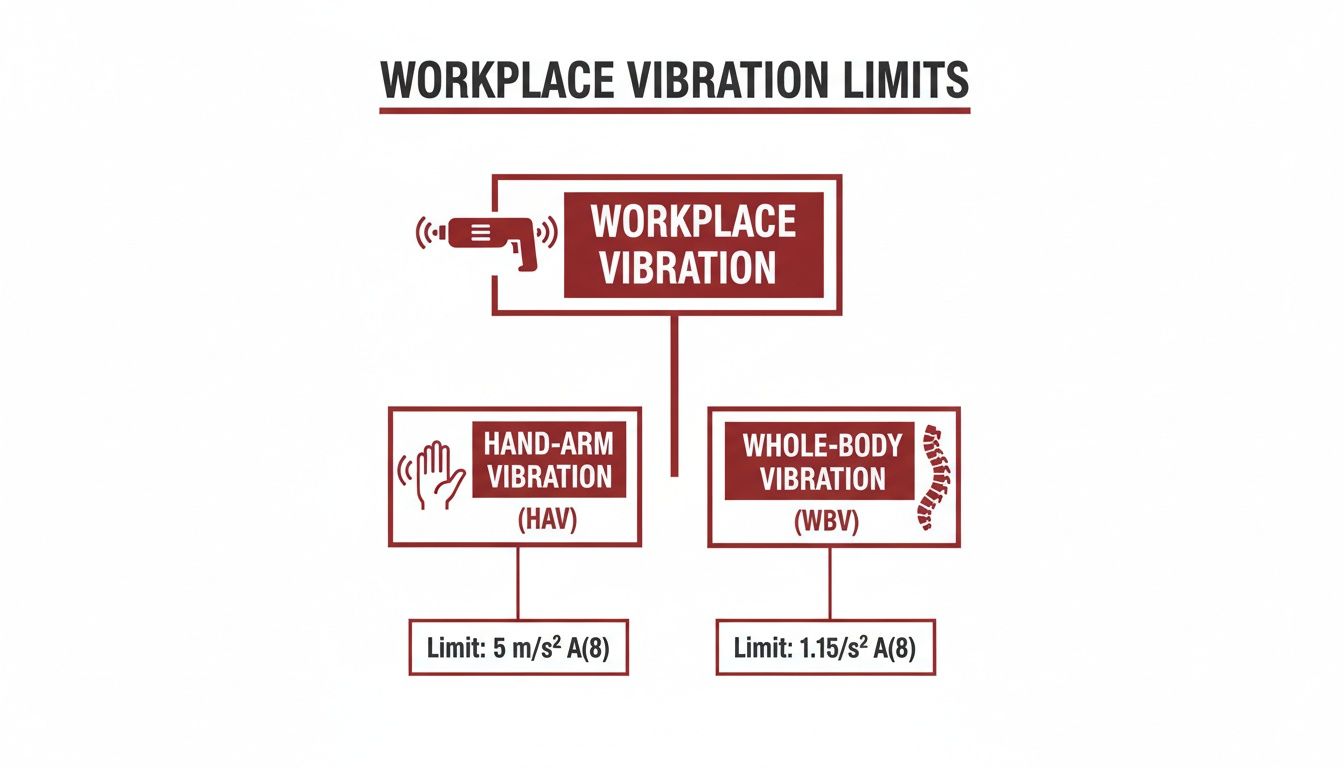
This distinction is crucial because it highlights why you need targeted engineering solutions for each type of exposure.
Administrative Controls: Changing How the Work Gets Done
Once you’ve exhausted your engineering options, the next layer of protection involves changing your work practices and policies. This is all about limiting how long a worker is exposed and making sure equipment is being used safely and correctly.
To make sure these changes stick, it’s vital to develop clear Standard Operating Procedures (SOPs). Well-written SOPs ensure that everyone on the team follows safety protocols the same way, every time.
Key administrative controls include:
- Job rotation schedules. This is one of the simplest and most effective strategies. By rotating workers through different jobs, you can carefully manage their daily "trigger time" on high-vibration tools, ensuring no one goes over the safe exposure limit.
- Proactive maintenance programs. A poorly maintained tool will almost always vibrate more than a well-kept one. A regular maintenance schedule to replace worn parts, balance components, and sharpen blades can have a huge impact on reducing unnecessary vibration.
- Comprehensive training. Your workers need to know the risks. They need to be trained on how to spot the early signs of vibration-related injury and taught the right techniques for operating equipment to keep their exposure to a minimum.
Personal Protective Equipment: The Last Resort
Finally, we have Personal Protective Equipment (PPE). It’s crucial to remember that PPE is always the last line of defence, not the first. While anti-vibration gloves might seem like an easy fix, their effectiveness is often overstated, and they should never be your primary control measure.
Here’s why you need to understand their limitations:
- They don't replace better tools. A low-vibration tool is always safer than a high-vibration tool, even if the operator is wearing special gloves.
- Their effectiveness is limited. Gloves tend to be better at dampening high-frequency vibrations but offer very little protection against the more damaging low-frequency vibrations.
- They can create a false sense of security. A worker might be tempted to use a tool for much longer than is safe, thinking the gloves are providing total protection when they aren’t.
Anti-vibration gloves can play a supplementary role, but only after all other engineering and administrative controls have been put in place. The strongest defence is always a multi-layered one.
Where the Shakes Happen: A Look at Industry-Specific Vibration Risks
You can’t really grasp why vibration is such a serious health and safety issue until you see how it plays out in different workplaces. The vibration hazard on a construction site is a world away from the one on a manufacturing floor or an offshore oil rig. The tools, the machinery, and the day-to-day tasks all create specific challenges that demand a tailored solution, not some generic, one-size-fits-all checklist.
Getting a handle on these distinct risks is the first real step towards controlling them. For every industry, the sources of hand-arm vibration (HAV) and whole-body vibration (WBV) create a unique risk profile, and you need specialist knowledge to manage it properly.
Manufacturing: The Danger is in the Repetition
In the manufacturing world, the real enemy is often repetition. Picture a worker on an assembly line using the same handheld power tool—a pneumatic wrench, a grinder, or a sander—for hours on end, day after day. A single use might seem harmless, but it's the cumulative exposure over a full shift, week after week, that leads to serious, life-altering health problems.
- The Challenge: High-volume production lines practically demand the prolonged use of high-vibration tools. On top of that, heavy automated machinery can send significant vibration right through the factory floor, causing WBV for operators who are on their feet all day.
- The Risk: This kind of constant, repetitive exposure to hand-arm vibration is a direct pathway to Hand-Arm Vibration Syndrome (HAVS). We’re talking permanent nerve damage and a loss of dexterity that can be utterly devastating for a skilled worker.
- The Solution: The trick is to break the cycle of continuous exposure. You can do this by investing in modern, low-vibration ergonomic tools and, just as importantly, bringing in job rotation schedules that limit how long any single worker spends on a high-vibration task. For floor vibration, something as simple as installing anti-vibration matting at workstations can make a huge difference to WBV exposure.
Construction and Mining: The Heavy-Duty Hazards
When it comes to vibration exposure, construction and mining are arguably in a league of their own. This work is all about raw power—think jackhammers shattering concrete, rock drills boring through stone, and massive earthmoving vehicles bouncing over rough terrain. The vibration here isn’t subtle; it’s intense and punishing.
The sheer force needed for these jobs means that both HAV from tools and WBV from vehicles are often at extreme levels. A worker could pick up a rock drill and blow past their daily exposure limit in just a matter of minutes.
In places defined by intense power and rugged conditions, controlling vibration isn't just about comfort—it’s a critical safety measure to prevent rapid, severe, and career-ending injuries.
Oil and Gas: Risks Onshore and Offshore
The oil and gas industry is a complex beast, with a whole mix of vibration hazards spread across its operations. Maintenance crews, whether on an offshore platform or an onshore refinery, rely on powerful handheld tools like impact wrenches, needle guns, and grinders for their daily work. They’re often using them in cramped or awkward positions, which ramps up the risk for severe HAV.
And that’s not all. Workers on drilling platforms are exposed to constant, low-frequency WBV from the enormous motors and generators powering the entire operation. That vibration travels right through the steel structure of the rig, affecting everyone on board.
- The Challenge: The 24/7 nature of the work, combined with the need for heavy-duty maintenance tools, creates a high-risk environment for both HAV and WBV.
- The Risk: Workers here face a double threat: the immediate, intense HAV from their tools and the pervasive, long-term WBV coming from the platform itself.
- The Solution: A solid plan starts with a strict "buy quiet, buy smooth" procurement policy for any new handheld tools. To tackle the WBV problem, engineering controls like installing vibration damping mounts on major equipment can help isolate the source. In a high-stakes environment like this, regular health surveillance is absolutely critical to catch the early signs of injury before it’s too late.
Aerospace: Specialised Tools and Precision Tasks
In the aerospace sector, the challenge is different yet again. The power levels might not match a mine site, but the work demands incredible precision. This means workers often use specialised, high-frequency tools like orbital sanders, riveters, and polishers to fabricate and finish components to perfection.
The high-frequency vibration from these tools can be particularly damaging to the fine nerve endings and blood vessels in the hands. Over time, it can make tasks that require extreme dexterity difficult, if not impossible. The pressure to achieve a flawless finish can also lead to workers using these tools for far too long.
A practical control strategy here requires a deep dive into each specific task. It means carefully selecting tools with the lowest possible vibration that can still do the job right. It also involves designing workstations with jigs and supports that can bear the tool's weight, taking the strain off the operator. This kind of industry-specific thinking is crucial for protecting the highly skilled workforce that the aerospace sector relies on.
Let's Tackle Vibration Risk, Together
We've covered a lot of ground, and the answer to the question why is vibration a serious health issue? should now be crystal clear. This isn't some minor inconvenience; it's a stealthy hazard that can cause irreversible harm, leaving businesses facing serious legal, financial, and human costs when it's not managed properly. When your team's health and careers are on the line, simply hoping for the best isn't a strategy.
That’s where we come in. We are here to help you move from simply knowing about the risk to taking decisive, effective action. Think of us as your specialist partner, equipped with the expertise and tools to protect your people and your business from the hidden toll of vibration. Our whole approach is grounded in solid science and practical, real-world solutions that actually work.
A Practical Plan for Workplace Safety
We offer a complete range of services built to find, measure, and control vibration exposure right across your operations. Our process is designed to ensure you’re not just ticking a box, but genuinely exceeding your WHS obligations.
Here’s how we can help:
- Expert Risk Assessments: We start by getting our boots on the ground, conducting detailed evaluations to pinpoint exactly where your vibration hazards are, who is at risk, and what kind of exposure they’re facing.
- Precise On-Site Measurement: Using highly accurate, modern equipment, we measure both Hand-Arm and Whole-Body Vibration levels on-site. We then stack these numbers up against Australia's legal exposure limits to give you a black-and-white picture of where you stand.
- Tailored Control Plans: One-size-fits-all solutions just don't cut it. We’ll collaborate with you to build a practical, multi-layered control plan that makes sense for your specific industry, tools, and workflows.
- Health Surveillance Guidance: Setting up a health monitoring program is a crucial part of the puzzle. We provide the expert guidance you need to establish an effective surveillance system that can catch the early warning signs of injury before the damage becomes permanent.
Engaging a specialist is more than just a compliance measure—it's a proactive investment in the long-term health of your people and the overall resilience of your company. We deliver the clarity and confidence you need to get a handle on this serious risk.
At the end of the day, protecting your team from vibration is about more than just rules and regulations. It’s about building a genuine safety culture where every single worker is valued and protected. By tackling vibration head-on, you’re not only preventing debilitating injuries but also shielding your business from the hefty costs of compensation claims, lost productivity, and fines.
Don't wait until a serious health incident forces you to act. Contact us today for a consultation, and let our team of occupational hygiene experts help you build a safer, healthier workplace.
Got Questions About Workplace Vibration? We've Got Answers.
To wrap things up, let's tackle some of the most common questions we hear from managers and workers on the ground. Getting clear, straightforward answers is the first step toward making smart decisions and building a genuinely safer workplace.
What Are the First Signs of a Vibration Injury?
Catching the early warning signs is absolutely crucial for preventing long-term, irreversible damage. With Hand-Arm Vibration (HAV), the first symptoms are often subtle and easily brushed off as just part of the job.
Keep an eye out for these red flags:
- An occasional tingling or pins-and-needles feeling in the fingers, especially right after putting down a power tool.
- A slight loss of feeling or finding it a bit clumsy to do fiddly tasks like buttoning up a shirt.
- Fingers going white (a process called blanching) and feeling numb, which often happens in cold or damp conditions. This is a tell-tale sign of Vibration White Finger.
When it comes to Whole-Body Vibration (WBV), the initial clues are usually a nagging lower back pain or a general sense of stiffness and exhaustion after a long shift driving heavy machinery or standing on a vibrating platform.
Are Anti-Vibration Gloves Enough to Protect My Team?
In a word: no. Anti-vibration gloves are not a silver bullet, and they should never be your primary strategy for controlling vibration risk. There's a reason they're considered the last line of defence.
While some gloves might dampen certain high-frequency vibrations slightly, their performance is wildly inconsistent and depends heavily on the specific tool and how it's being used. The real danger is that relying only on gloves can create a false sense of security, which might lead workers to use high-vibration equipment for far longer than is safe.
A truly effective safety plan always starts with better solutions. Prioritise engineering controls (like investing in modern, low-vibration tools) and administrative controls (like rotating jobs to limit exposure). Gloves should only ever be a supporting player in a much broader strategy.
How Often Should We Be Doing Vibration Risk Assessments?
A vibration risk assessment isn't a "one and done" task you can just tick off a list. Think of it as a living process that's central to keeping your workplace safe. You’ll need a thorough initial assessment to get a baseline understanding of exposure levels and pinpoint which jobs or tools pose the biggest threat.
But it doesn't stop there. This assessment needs to be reviewed and updated regularly. You should schedule a new assessment whenever:
- New machinery or tools are brought onto the site.
- The way a job is done changes in a meaningful way.
- A worker reports symptoms that could be linked to a vibration injury.
Treating risk assessment as a continuous cycle is the only way to ensure your safety measures stay relevant and your team remains protected as your business evolves.
Ready to move from questions to action? Our team delivers expert on-site assessments and practical control strategies to protect your workforce and keep you compliant. Contact us today to discuss your workplace safety needs.


