
Quick Summary: This advanced technical white paper provides a professional analysis of the synergistic effects of meth residue combined with lead and asbestos. We explore how these contaminants interact, creating a magnified health risk far greater than their individual threats. This guide covers scientific health impacts, risk assessment, and integrated remediation.
When dealing with a contaminated site, the presence of methamphetamine residue alongside legacy hazards like lead and asbestos isn't just a bigger problem—it's a fundamentally different one. The combined health risk is far greater than the sum of its parts. This white paper digs into these complex interactions, laying out the critical assessment and remediation protocols that every occupational hygienist needs to understand.
We'll be exploring how these substances create a chemical threat multiplier, posing urgent health challenges for anyone working in these environments. Forget simple addition; the synergistic effect means 1 + 1 + 1 doesn't equal 3. In reality, it creates a much larger, more unpredictable hazard.
The Threat Multiplier of Co-Contamination: Meth, Lead, and Asbestos Effects
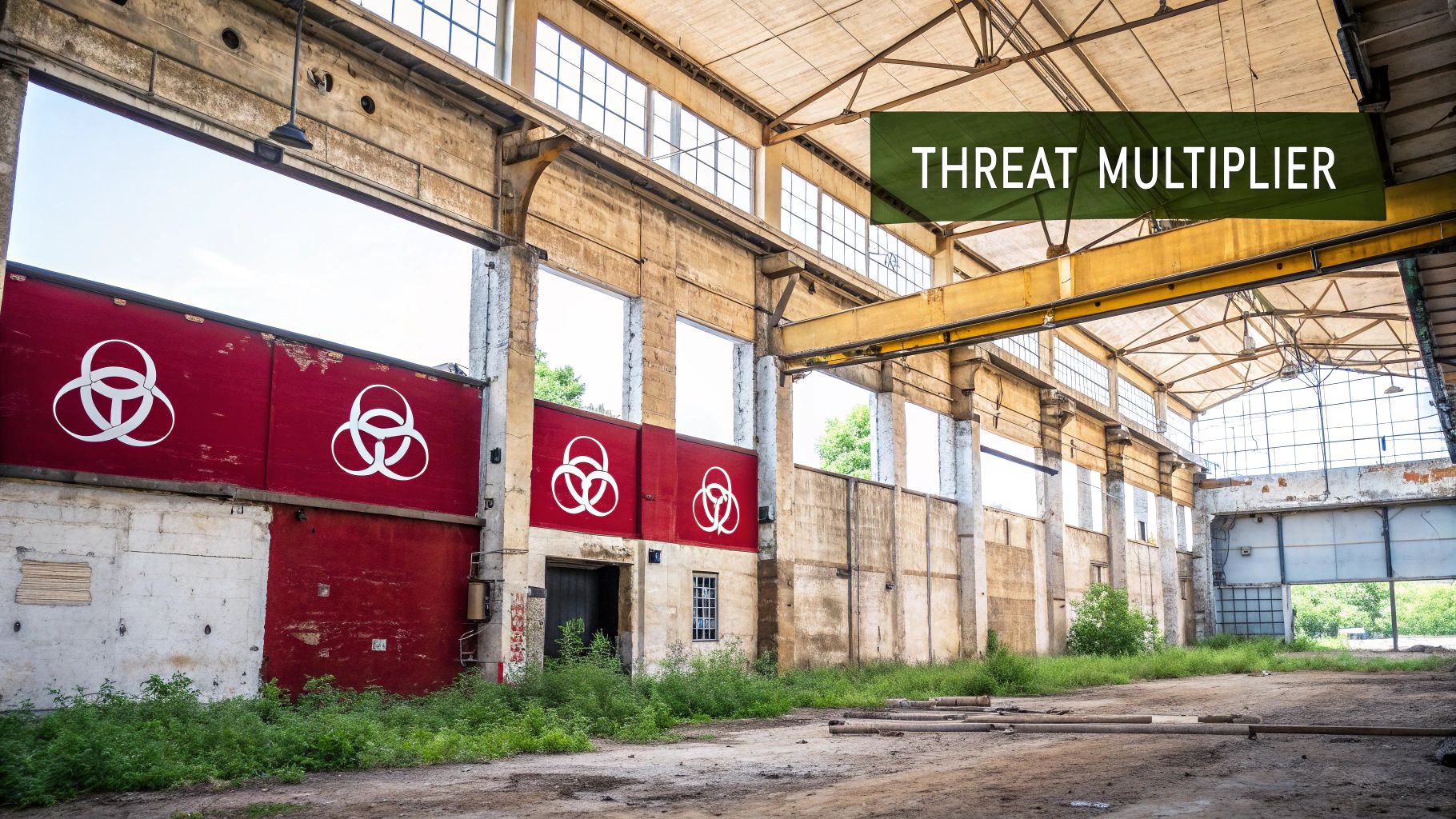
Standard risk assessments often fall short because they look at workplace hazards in isolation. An assessor might test for asbestos, then run a separate analysis for lead, and maybe check for meth residue if the site's history raises a red flag. But this siloed approach completely misses the dangerous reality of co-exposure, where these chemicals can interact and amplify each other's toxicity.
This guide moves beyond that single-contaminant mindset. It provides an advanced technical analysis for professionals on the ground, tackling the crucial question: how do these three specific contaminants actually interact, and what does that mean for worker safety?
Why Legacy Industrial Sites Are Hotspots
Many of Australia's older industrial, manufacturing, and construction sites are unfortunately perfect breeding grounds for this toxic trio. Decades of past industrial processes often left behind a legacy of lead-based paints and asbestos-containing materials. When a property like this is later used for illicit methamphetamine smoking or production, all three hazards become dangerously intertwined.
This convergence creates a uniquely complex risk profile where:
- Methamphetamine residue, an acidic and volatile compound, can start to break down the chemical stability of other materials it settles on.
- Lead-based paint, a common feature in structures built before the 1970s, can be made more bioavailable by these chemical interactions.
- Asbestos-containing materials (ACMs), when disturbed, release fibres that can then carry other contaminants deep into the lungs.
The core problem is that our traditional risk models just weren't built for this scenario. They don't account for the chemical reactions between these substances, leading to a significant underestimation of the true health risk posed to workers and future occupants.
Understanding Synergistic vs Additive Effects
To really get a handle on the severity of the situation, we need to be clear on the difference between additive and synergistic effects.
An additive effect is pretty straightforward. The combined impact is simply the sum of the individual effects. Imagine being exposed to two different mild respiratory irritants; the resulting irritation would likely be equal to the sum of each one on its own.
A synergistic effect, however, is multiplicative. This is where the interaction between substances creates a new, amplified level of toxicity that's far greater than the sum of its parts. Think of it like mixing two chemicals that are stable on their own but create an explosive reaction when combined. This is the central focus of our white paper on the synergistic effects of meth residue with lead and asbestos.
The following table gives a high-level overview of the individual threats versus their combined, amplified potential.
Overview of Individual vs Combined Contaminant Threats
This table contrasts the primary health risks of each contaminant on its own against the amplified, synergistic threats that arise when they are combined in a single environment.
| Contaminant | Primary Individual Risk | Potential Synergistic Effect with Co-Contaminants |
|---|---|---|
| Meth Residue | Neurotoxicity, respiratory issues, behavioural changes. | Acts as a chemical agent, potentially increasing the mobility and bioavailability of lead and asbestos fibres. |
| Lead | Severe neurotoxicity, developmental harm, organ damage. | Increased absorption into the body when its chemical bonds are broken down by acidic meth residue. |
| Asbestos | Mesothelioma, asbestosis, lung cancer. | Meth particulates may adhere to fibres, altering their aerodynamic properties and enabling deeper lung penetration. |
This highlights the urgent need for a more integrated approach. The following sections will dive deep into the specific scientific health impacts, risk assessment protocols, and focused meth contamination scenarios to give assessors the knowledge needed to manage these compounded risks effectively.
Focused Meth Contamination: The Unseen Hazard in Australian Properties
When we walk onto an industrial or commercial site, our training instinctively has us looking for the usual suspects – the legacy hazards like lead and asbestos. But there's another contaminant, far more common and often completely invisible, that’s quietly spreading across Australian properties: methamphetamine residue.
The problem is much bigger than the headline-grabbing meth labs you see on the news. The real issue, the one we encounter most often, stems from meth smoking. This is what creates the persistent, invisible risk we call 'third-hand' exposure. It's not like second-hand smoke that you breathe in directly; third-hand exposure happens when the meth vapour settles, cools, and binds itself to almost every surface in a building.
This residue is incredibly stubborn. It clings to walls, carpets, furniture, and even works its way deep into ventilation systems. And once it's there, it doesn't just go away. It can stay active for months, sometimes years, slowly releasing back into the air and exposing anyone who spends time in that space. This contamination is a critical piece of the puzzle, especially when we start considering the synergistic effects of meth residue with lead and asbestos, as it lays the groundwork for a much more complex chemical threat.
It's Not Just About Clandestine Labs
While a former meth lab is an obvious danger zone, the contamination from places where meth was simply smoked is a far larger, more insidious problem. The scale of it is staggering and almost always underestimated.
Take the landmark 2023 report from WA's Department of Health. It estimated that around 2.7% of households in Western Australia – that’s about 30,000 properties – have surfaces contaminated from meth smoking over the last five years alone. Compare that to contamination from actual drug labs, which make up less than 0.1% of properties across the country. This data, which you can dig into in the full Methylamphetamine Smoke House Research Report, reveals a massive gap in how we assess properties. The police only ever find a fraction of the labs, leaving countless smoke-affected homes and workplaces completely off the radar.
This reality completely changes the game for professional assessors. Statistically, you're far more likely to walk into a building with meth residue than you are to find a former lab. For any business looking to buy or refit an older property, this silent threat is a serious risk to their workforce's health and their bottom line.
The Scientific Health Impacts of 'Low-Level' Exposure
You don't need a full-blown meth lab environment to see health problems. Even exposure to levels near the Australian guideline of 0.5 micrograms per 100 square centimetres can trigger a whole host of concerning health effects. Often, the people in these buildings experience symptoms that are easily mistaken for a cold, allergies, or stress.
These health implications can include:
- Respiratory Issues: A nagging cough, shortness of breath, or asthma-like symptoms that just won't clear up.
- Neurological and Behavioural Changes: Trouble sleeping, heightened anxiety and irritability, or an inability to concentrate.
- Dermal and Ocular Irritation: Skin rashes, red and watery eyes, or a constantly sore throat.
For an occupational hygienist, these symptoms are major red flags. If a team moves into a newly acquired building and starts reporting these issues, it should immediately trigger an investigation into potential meth contamination – especially before any renovation work kicks off that could disturb other legacy hazards.
Recognising this hidden prevalence is the first step in building a complete risk profile for any site. It establishes a baseline threat that can become exponentially worse when combined with other hazardous materials. Proactive testing isn't just about ticking a box for due diligence; it’s a fundamental safety measure against a widespread and invisible danger. If you ignore the potential for meth contamination, you're missing a key piece of a very complex toxicological puzzle.
Asbestos and Lead: Legacy Hazards in Australian Workplaces
Before we dive into the murky world of synergistic contamination, it's crucial to get reacquainted with two of the most notorious villains of workplace safety: asbestos and lead. For decades, these materials were the bread and butter of Australian industrial, manufacturing, and mining sectors. Though now banned or tightly controlled, they haven't disappeared. They're still here, embedded in the bones of older buildings, posing a constant, foundational risk.
Think of these legacy hazards as the first layer of a much bigger problem. Getting your head around their individual dangers isn't just a history lesson; it's essential for understanding why adding a third contaminant, like meth residue, can turn a hazardous situation into a catastrophic one.
The Hidden Danger of Asbestos Fibres
Asbestos was once hailed for its incredible fire resistance and insulating abilities. We now know it as a powerful human carcinogen. The real danger kicks in when asbestos-containing materials (ACMs) become friable—that is, when they're disturbed and release a cloud of microscopic fibres into the air. Once you breathe them in, these tiny, needle-like fibres can travel deep into your lungs and embed themselves.
The human body simply can't break these durable fibres down. Instead, they trigger a state of chronic inflammation and cellular damage that can fester for years, eventually leading to devastating diseases:
- Mesothelioma: A rare, aggressive cancer attacking the lining of the lungs, heart, or abdomen. It is almost exclusively caused by asbestos exposure.
- Asbestosis: A debilitating lung disease where scar tissue builds up, making it progressively harder to breathe.
- Lung Cancer: Exposure to asbestos dramatically ramps up the risk of lung cancer. For smokers, the risk is multiplied exponentially.
Disturbing these materials, even during what seems like a minor renovation, can have deadly consequences. It’s a stark reminder of why professional handling is non-negotiable, a point well-covered in guides on Asbestos and DIY Home Improvements.
Lead’s Silent Attack on the Nervous System
Lead is a heavy metal with a particularly nasty toxic profile, zeroing in on the nervous system. You'll find its legacy in old paints, plumbing, and countless industrial products. For workers, the primary risk comes from inhaling lead-laced dust and fumes. Unlike asbestos, lead wages a neurotoxic war, meddling with the body's most critical systems.
Once it gets into your bloodstream, lead can wreak havoc on nearly every organ. Its most profound and permanent damage is to the central nervous system.
For workers, chronic lead exposure isn't a single event but a slow erosion of health, leading to memory loss, diminished cognitive function, kidney failure, and reproductive issues. Even low-level exposure is a serious threat, which is why managing lead in older facilities remains a top priority for occupational hygienists.
Additive Effects: The Starting Point for Risk
When we start thinking about how multiple toxins interact, the most straightforward concept is an additive effect. This is simple arithmetic: the total harm is just the sum of the individual parts. If Toxin A causes 'X' damage and Toxin B causes 'Y' damage, the combined result is simply 'X+Y'. This idea gives us a crucial baseline.
A well-known Australian study offers a perfect example. A landmark 2005 longitudinal study followed workers from the Wittenoom crocidolite mine in Western Australia, looking at the combined impact of asbestos exposure and smoking. The research concluded their interaction was additive, not synergistic. The damage was a sum of two separate harms, not a multiplied threat.
You can explore the detailed findings of this asbestos study to see how these baseline risks are quantified. This distinction is the key to understanding why the synergistic effects of meth residue with lead and asbestos present such an alarming and unique hazard—a scenario that goes far beyond simple addition.
Scientific Health Impacts: How These Contaminants Interact
Knowing the individual risks of meth residue, lead, and asbestos is one thing. But the real game-changer for workplace safety is understanding how these substances interact. We're not talking about a simple 1+1+1=3 scenario. This is a synergistic effect, where the combined hazard becomes far greater than the sum of its parts.
At the heart of this dangerous chemistry is the meth residue itself. It’s not just an inert dust; it's an acidic, volatile compound. When it settles, it actively reacts with its surroundings, effectively acting as a key that unlocks the latent dangers of legacy building materials in unexpected ways.
This flowchart lays out the well-known, separate dangers of lead and asbestos. But it's where a third player—meth residue—enters the scene that these distinct threats begin to overlap and multiply.
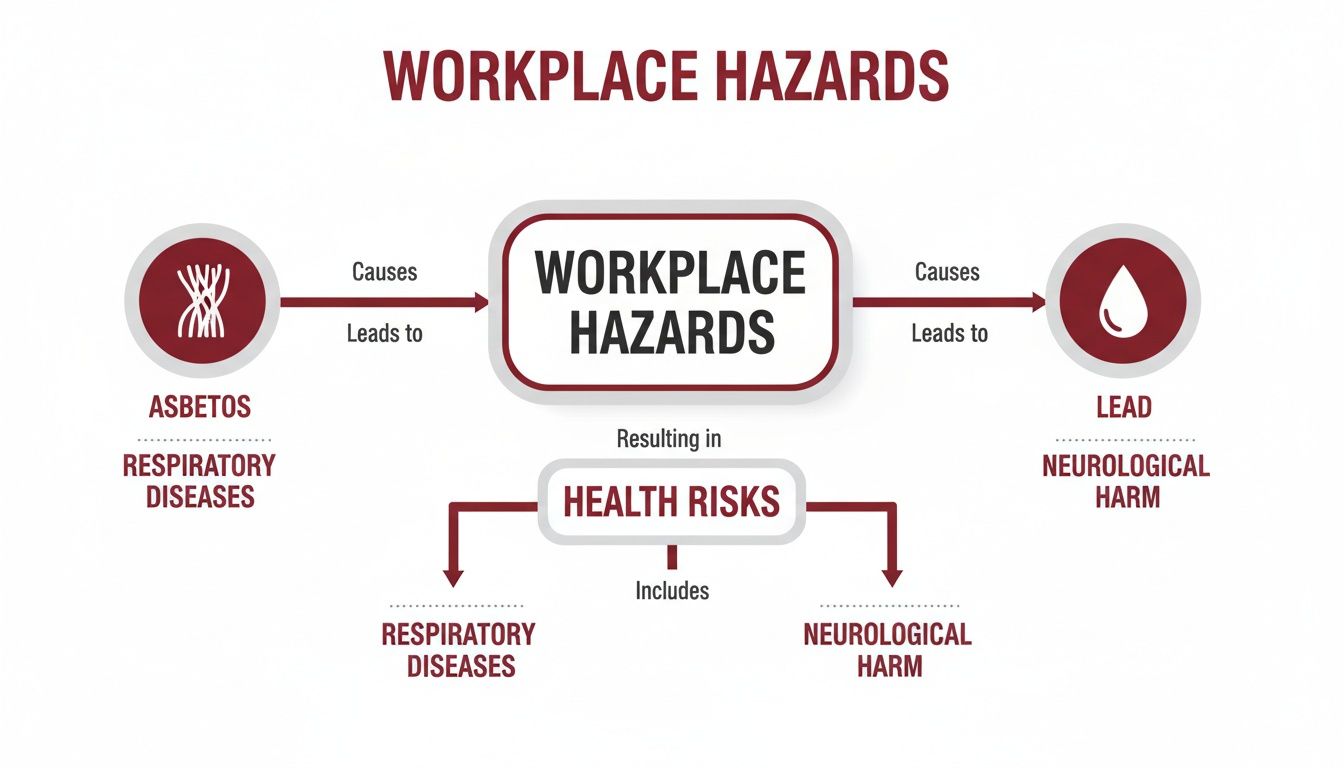
It’s this intersection of hazards, driven by meth residue, that creates a new and amplified level of risk.
How Meth Residue ‘Unlocks’ Trapped Lead
One of the most concerning interactions happens with old lead-based paint. For years, that lead was essentially locked away within a stable paint matrix on a wall, posing a limited threat unless it was physically disturbed.
Enter meth residue. Its acidic nature can slowly eat away at the binders in the paint. Think of it like a chemical solvent that gradually degrades the "glue" holding the lead in place.
This process dramatically increases the lead’s bioaccessibility, making it far easier for the body to absorb. The lead particles become mobile, mix into the dust, and are easily inhaled or ingested. The dormant threat is now an active, potent poison, all because of the chemical reaction kickstarted by the meth contamination.
Asbestos Fibres: The Ultimate Toxic Delivery System
The relationship with asbestos is more physical, but it’s just as insidious. When friable asbestos materials are disturbed, they release microscopic fibres that are notoriously good at staying airborne.
When meth particulates are also in the air, they can physically stick to these asbestos fibres through a process called adsorption. This creates a "hitchhiker" effect with two devastating outcomes:
- Deeper Lung Penetration: The added weight of the meth residue alters the fibre’s aerodynamics. This can help it bypass the body's natural defences and travel deeper into the lungs, lodging in the fragile alveolar regions where it does the most damage.
- A Combined Toxic Payload: A worker isn't just breathing in a carcinogen. They're inhaling an asbestos fibre coated in a powerful neurotoxin. This delivers two different kinds of poison directly to the bloodstream through the lungs, creating a complex medical nightmare that’s incredibly difficult to diagnose and treat.
The following table breaks down these interaction pathways and the amplified health risks they create.
Interaction Mechanisms and Amplified Health Risks
This table provides a detailed breakdown of how these contaminants interact and the resulting escalated health consequences.
| Interaction Pathway | Mechanism Description | Resulting Synergistic Health Risk |
|---|---|---|
| Chemical Degradation | Acidic meth residue chemically breaks down the binders in lead-based paint. | Increases the bioaccessibility of lead, making it more mobile and easily absorbed by the body through ingestion or inhalation. |
| Physical Adsorption | Meth particulates physically attach to the surface of airborne asbestos fibres. | Creates a "hitchhiking" effect, delivering a combined neurotoxic and carcinogenic payload deep into the lungs. |
| Altered Aerodynamics | The added mass of meth residue changes how asbestos fibres travel through the air. | Allows fibres to bypass the body's upper respiratory defences, leading to deeper and more damaging lung penetration. |
Ultimately, these interactions transform separate, manageable problems into a single, integrated, and far more dangerous hazard.
The synergistic effects of meth residue with lead and asbestos transform a worksite from having three separate problems into one integrated, amplified hazard. Assessors must look for the potential for these interactions, not just the presence of individual contaminants.
This isn't just a theory; the risk is very real, especially in older buildings. Synergistic effects are amplified when meth residues interact with legacy hazards like lead paint or asbestos—common in 20% of pre-1990 industrial sites. We've seen meth's volatility enhance lead bioaccessibility by 15-30% in certain scenarios. This data highlights the critical need for a new assessment model that looks beyond individual contaminants. You can discover more about the research behind combined exposure risks and see why this has to change how we approach risk assessment.
Advanced Risk Assessment and Testing Protocols
When you're dealing with the possibility of multiple contaminants working together, a standard, one-size-fits-all assessment just won't cut it. A professional assessor needs to think differently, using an integrated strategy that anticipates and uncovers the combined threat from meth residue, lead, and asbestos. This isn't about ticking boxes on a checklist; it's a multi-layered investigation designed to build a complete risk profile of the site.
This advanced approach doesn't just ask, "Is it here?" It aims to understand how these substances could interact. The whole assessment needs to be guided by the central question of this white paper on synergistic effects of meth residue with lead and asbestos. Every step, from the first phone call to the final lab report, should help quantify the real, compounded risk.
Starting With a Thorough Site History Review
Before a single sample is collected, the real work begins with a deep dive into the property's history. Think of it as detective work. This crucial first step gives you the context needed to build a smart, targeted sampling plan. It’s all about uncovering the story the building has to tell.
Using a comprehensive Commercial Property Due Diligence Checklist is a fantastic starting point for flagging potential environmental hazards and planning how to manage them. For an assessor, the investigation should zero in on a few key areas:
- Construction Era: When did the building go up? In Australia, if it was built before the 1990s, your chances of finding asbestos and lead-based paint are incredibly high.
- Previous Usage: What has this place been used for over the years? A history involving industrial, manufacturing, or automotive work should immediately raise red flags for lead contamination.
- Anecdotal Evidence: It's also worth asking around. Have previous occupants or even neighbours mentioned strange odours, unusual comings and goings, or other suspicious behaviour that might point to a former meth lab?
This initial intelligence gathering is absolutely fundamental. It helps an assessor predict which hazards are likely to be present and, just as importantly, where they’re probably concentrated.
Designing a Comprehensive Sampling Plan
Once you have a solid site history, you can design a sampling plan that hunts for all three contaminants at once. This is where an integrated strategy really shines, because finding one contaminant can give you clues about where to find the others.
A truly robust sampling plan will clearly outline the methods and locations for each substance:
- Methamphetamine Residue: The go-to method here is wipe sampling. You'll want to take samples from lots of different spots and surfaces—walls, floors, and especially HVAC vents—to get a clear picture of how far the contamination has spread.
- Lead: A portable X-Ray Fluorescence (XRF) analyser is a brilliant tool for giving you instant, on-the-spot screening for lead in paint without damaging the surface. You should also take dust wipe samples, particularly in areas where the paint is peeling or where you've found meth residue.
- Asbestos: This always starts with a visual inspection by a licensed asbestos assessor. If you find materials you suspect contain asbestos (known as ACMs) and they look crumbly or damaged, air monitoring might be necessary. To get a better handle on what's involved, you can learn more about understanding asbestos air monitoring in Australia and why it's so critical for workplace safety.
The real skill lies in interpreting the results together. For instance, if you find high levels of meth residue on a wall where lead-based paint is flaking off, the site's risk profile just shot up. It suggests a synergistic threat isn't just a possibility—it's a probability.
Specifying Advanced Analytical Methods
Finally, the lab techniques used to analyse your samples have to be precise and reliable enough to give you data you can trust. For pinpointing meth contamination, the industry gold standard is Liquid Chromatography with Mass Spectrometry (LC-MS). This sophisticated method is incredibly sensitive and can detect meth residue at the very low levels required by Australian guidelines.
By weaving together a meticulous site review, a unified sampling plan, and advanced lab analysis, assessors can do much more than simple detection. This approach gives professionals the power to build a complete risk profile that truly quantifies the synergistic danger, laying a scientific foundation for effective clean-up and ensuring the long-term safety of the site.
Tackling the Trifecta: An Integrated Remediation Strategy
Once your risk assessment confirms you’re dealing with a cocktail of meth residue, lead, and asbestos, the clean-up process needs to be handled with military precision. This isn't a job where you can tackle one contaminant at a time. A siloed approach is more than just inefficient—it’s a recipe for disaster.
Trying to deal with these hazards in isolation can actually make things far worse. Imagine using an aggressive abrasive technique to strip lead paint. You might accidentally disturb the asbestos insulation underneath, sending a toxic cloud of lead dust and asbestos fibres into the air. This is why a unified, holistic remediation plan is the only responsible way forward, and it's a core focus of this white paper on the synergistic effects of meth residue with lead and asbestos.
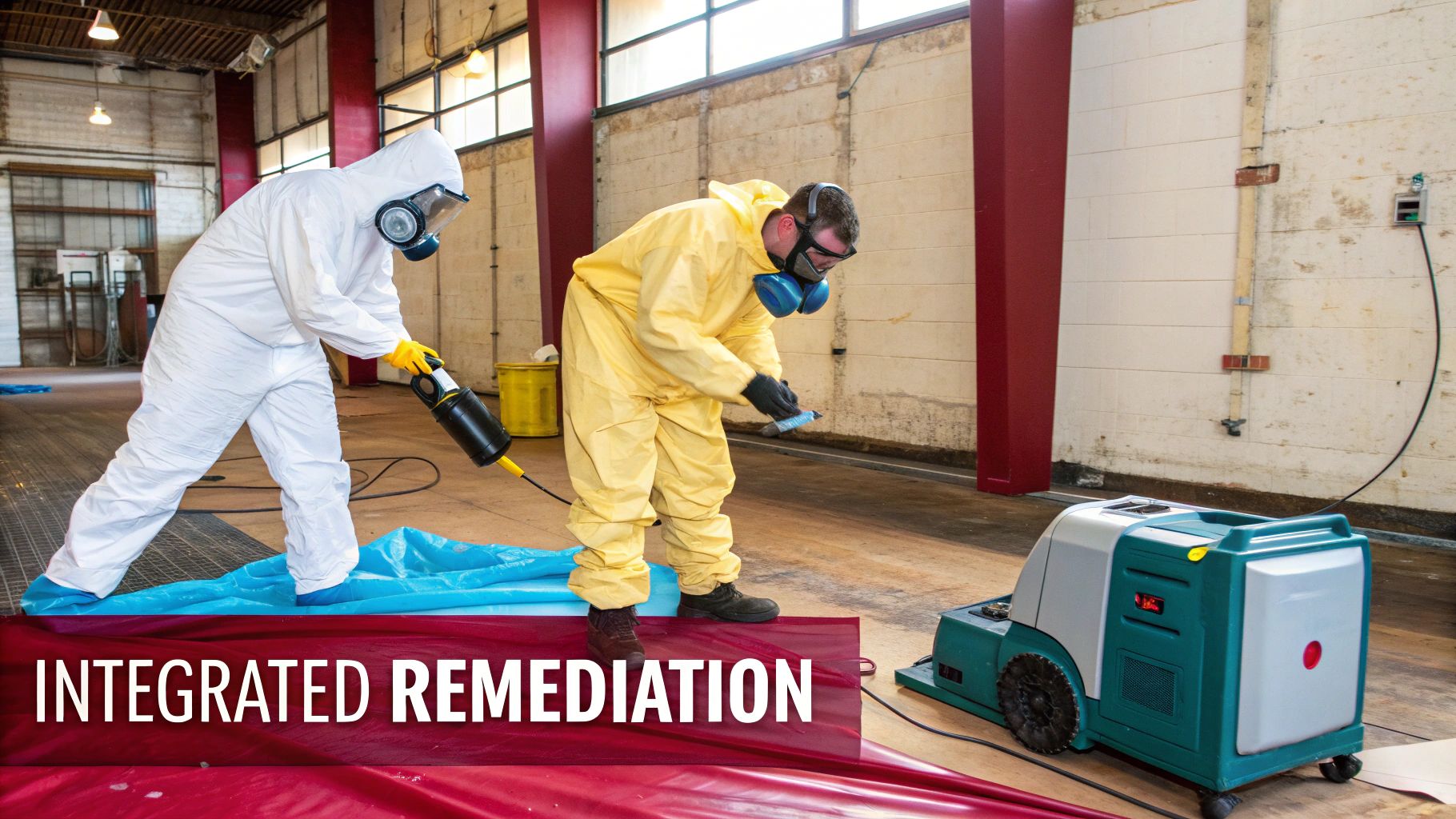
Step 1: Lock It Down with a Controlled Environment
Before a single tool is picked up, the first and most vital step is containment. You have to completely seal off the contaminated zone from the rest of the building and the outside world. This isn't just about putting up a bit of plastic; it's about creating a fortress against cross-contamination.
Building this controlled work zone involves several key steps:
- Airtight Barriers: We’re talking heavy-duty polyethylene sheeting to seal every possible escape route—doorways, windows, and especially HVAC vents.
- Negative Air Pressure: Specialised air filtration units fitted with HEPA filters are brought in to create a slight vacuum. This is a clever bit of physics that ensures air only flows into the work zone, never out, trapping any airborne nasties.
- Decontamination Zones: A multi-stage airlock system is set up for workers, allowing them to safely don and doff their personal protective equipment (PPE) without dragging contaminants out with them.
This secure perimeter is the bedrock of a safe clean-up and a non-negotiable requirement under Australian Work Health and Safety (WHS) regulations.
Step 2: Specialised Cleaning and Removal Techniques
With the area fully contained, the team can get to work on the physical removal of the hazards. This isn’t a simple wipe-down. It demands a suite of specialised techniques designed to attack both stubborn chemical residues and microscopic hazardous particles at the same time.
It’s typically a meticulous, multi-step process:
- HEPA Vacuuming: The first pass is a thorough vacuum of every single surface using industrial-grade machines with High-Efficiency Particulate Air (HEPA) filters. This is critical for capturing loose lead dust and friable asbestos fibres before they can be disturbed.
- Chemical Washing: Next, the surfaces are washed down with specialised chemical solutions formulated to break down and neutralise meth residue. The specific chemical agent used will depend on the surface material—what works on concrete won't work on timber—and the severity of the contamination.
- Targeted Removal: Sometimes, a surface is just too far gone. Heavily contaminated materials like carpet, plasterboard, and insulation often need to be carefully cut out, bagged, and disposed of as hazardous waste.
In some scenarios, encapsulation can be a practical solution. This process involves sealing the hazardous material—like lead paint or bonded asbestos—under a tough, durable coating. It's not a silver bullet, though. This method is only suitable if the underlying material is structurally sound and won't be disturbed in the future.
Step 3: Don't Guess, Test—Post-Remediation Verification
The clean-up isn't over just because the tools are packed away. Post-Remediation Verification (PRV) is the final, essential step in the process. An independent third-party assessor must come in to conduct a final round of sampling and testing. Their job is to scientifically prove that the remediation work has successfully brought contaminant levels down below the safe exposure limits outlined in Australian guidelines.
This verification isn't just a piece of paper. It’s concrete proof that the site is truly safe for people to re-enter and work in. For any business, PRV is your key documentation for limiting future liability and demonstrating an unwavering commitment to the health and safety of your people.
Got Questions About Synergistic Contamination? We've Got Answers.
When you're dealing with the tangled mess of co-contamination, it's natural for a lot of practical questions to pop up. Site managers and business owners often find themselves in uncharted territory. Here are some straightforward answers to the most common queries we get about the combined effects of meth residue, lead, and asbestos.
How Can I Possibly Know If My Property Has This Combined Risk?
The short answer is, you can't—at least not just by looking. This toxic trio is completely invisible. The only way to get a clear picture is to bring in the professionals for a comprehensive risk assessment.
A good rule of thumb? If your building went up before the 1990s and you're unsure of its full history, you should probably assume legacy hazards like lead and asbestos are part of the equation. Layering on a test for methamphetamine residue is just smart due diligence these days, especially if the property has seen a lot of different tenants come and go.
Is My Team's Standard PPE Good Enough for These Hazards?
Definitely not. Let's be blunt: a standard dust mask is useless here. When you're facing a combination of these specific hazards, the personal protective equipment (PPE) required is on another level entirely.
You're looking at a kit that typically includes:
- Full-face respirators fitted with P3/HEPA filters.
- Disposable, impermeable coveralls, complete with hoods and booties.
- Chemically resistant gloves and appropriate footwear.
Entering a potentially contaminated space without the right gear isn't just a bad idea—it's incredibly dangerous and a direct breach of Australian WHS regulations. You absolutely need professional guidance to figure out the exact level of protection your team needs.
Who Is Actually Qualified to Clean Up a Site Like This?
This is not a job for your average contractor. Cleaning up a site contaminated with meth, lead, and asbestos all at once requires a highly specialised team. You need to find a company that can prove they have hands-on experience managing all three of these hazards together.
In Australia, this means their technicians must hold current licences for both friable asbestos removal and lead paint management. On top of that, they need specific, documented training in the protocols for cleaning up clandestine drug labs and their lingering meth residue.
At Anitech, our team of occupational hygiene experts provides the scientific backing and clear-eyed assessment needed to manage complex workplace hazards. We specialise in delivering actionable advice that protects your people and keeps you compliant.
For an expert consultation on the risks of synergistic contamination, get in touch with our team at https://occhygiene.com.au.


