
The primary hazard associated with Hand-Arm Vibration Syndrome (HAVS) is the prolonged and repeated exposure to vibration transmitted from handheld power tools and machinery. This physical energy travels directly from the tool into a worker's hands and arms, causing progressive, cumulative, and often permanent damage to the delicate network of nerves, blood vessels, and joints. Understanding this direct link between the vibration hazard and its physiological effects is the most critical step toward preventing this debilitating occupational illness.
This guide will provide in-depth, valuable information that answers user queries about the specific hazard causing HAVS, how it damages the body, which industries are most at risk, and the practical steps needed for effective control and prevention in the workplace.
The Cumulative Damage of Vibration: How the Hazard Works
When a worker uses a jackhammer, grinder, or chainsaw, they are absorbing physical energy that, over months and years, disrupts the body's natural functions. This relentless shaking is the core hazard that leads directly to Hand-Arm Vibration Syndrome. The injury is not caused by a single event but by the cumulative toll of using these tools day after day. The damage builds up quietly, often going unnoticed until the symptoms become severe and irreversible. The true danger lies in the consistency and intensity of that vibration exposure.
From Power Tool to Human Tissue
The moment a tool is switched on, mechanical vibrations travel from the handle into the operator's hands and arms. This energy ripples through skin, muscle, and bone, hitting three critical systems particularly hard: vascular, neurological, and musculoskeletal. This cascading effect—a physical agent (vibration) causing a chain reaction of biological harm—is precisely why HAVS is such a complex and serious condition.
To provide a clearer picture, let’s break down the impact on the body. The table below outlines how the primary hazard of vibration translates into specific health effects across different systems.
Key Hazards and Effects of Hand-Arm Vibration
| Affected System | Primary Hazard Effect | Resulting Condition or Symptom |
|---|---|---|
| Vascular System | Vibration causes small muscles in blood vessel walls to contract, restricting blood flow. | Vibration White Finger (VWF), where fingers turn white and painful in the cold. |
| Nervous System | Delicate nerve endings in the hands and fingers are damaged by the constant shaking. | Tingling, numbness, loss of touch sensation, and reduced dexterity. |
| Musculoskeletal System | Continuous strain is placed on joints, bones, and muscles in the hands and arms. | Weakened grip strength, muscle wasting, carpal tunnel syndrome, and arthritis. |
The true danger of hand-arm vibration is how stealthy it is. The harm isn't immediate like a cut or a burn. It's a gradual erosion of a person's health that can lead to permanent disability if the hazard isn't controlled.
Why The Damage Is Often Permanent
One of the most sobering facts about HAVS is that the damage is frequently irreversible. Once the nerves and blood vessels have been significantly compromised, there’s no quick fix or simple cure to restore them. This reality makes prevention more than just a best practice—it's an absolute necessity in any workplace where vibrating tools are standard equipment. For employers and safety managers, grasping that prolonged vibration exposure is a direct line to permanent injury is the foundation of a safe work environment. This isn't about managing temporary discomfort; it's about safeguarding a worker's long-term health, wellbeing, and ability to do their job.
How Vibration Damages Your Body
To understand what makes Hand-Arm Vibration Syndrome (HAVS) so dangerous, we need to look past the vibrating tool itself and see what’s happening inside the body. The constant shaking is a destructive force that wages a war on three fronts: your blood vessels, your nerves, and your muscles and bones. This combined assault is what makes HAVS so debilitating. It's important to remember that this damage doesn't happen overnight. It’s a slow burn. Each shift spent using a vibrating tool adds another small, almost unnoticeable layer of harm, which over time builds into a serious, often irreversible health condition.
The Vascular Attack: Vibration White Finger
The most well-known sign of HAVS is the damage it does to the vascular system, a condition famously called Vibration White Finger (VWF). Think of the blood vessels in your fingers as tiny, flexible hoses carrying warm, oxygen-rich blood. The persistent vibration from a tool acts like someone repeatedly squeezing those hoses shut, causing the small muscles in the vessel walls to spasm and tighten. Over time, this constant constriction damages the vessels, leaving them hypersensitive to triggers like cold weather. When exposed to the cold, the blood flow to the fingers can slow or stop altogether.
This leads to the classic symptoms of VWF:
- Blanching: One or more fingers turn a ghostly white and feel completely numb or "dead."
- Pain and Numbness: Without blood flow, the affected area becomes numb and can be quite painful.
- Throbbing Return: As the hands warm up and blood flow returns, the fingers often turn bright red and begin to throb painfully.
This cycle is a clear signal that the circulatory system in the hands has been significantly, and often permanently, damaged.
The infographic below shows this simple but destructive pathway, tracing the hazard from the tool right through to the tissue.
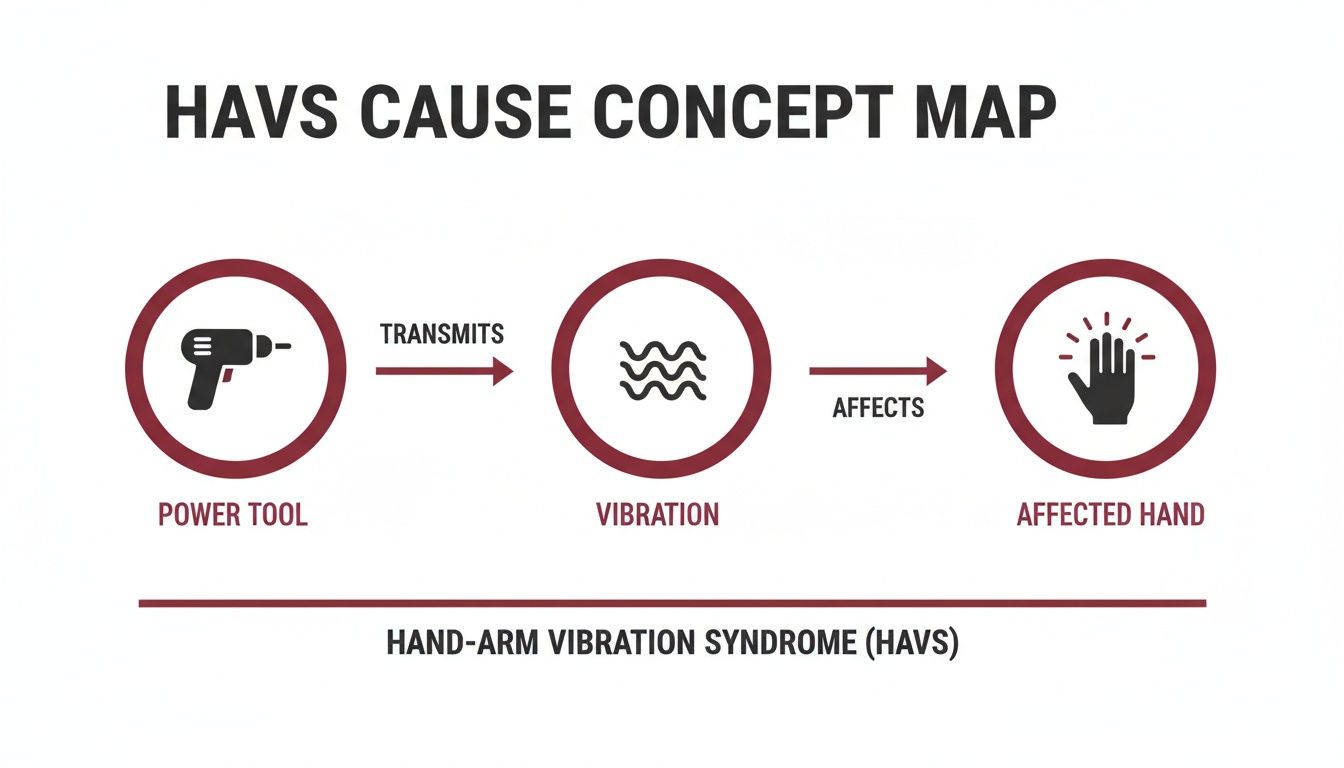
This visual gets to the heart of HAVS, showing how the energy from a power tool becomes the very hazard that injures the worker's hand.
Neurological Damage and Sensory Loss
It's not just blood flow that's at risk; the relentless vibration also attacks the nervous system. The hands and fingers are packed with delicate nerve endings designed to feel texture, temperature, and pressure. Subjecting them to constant shaking is like fraying a fine electrical wire through continuous motion. This nerve damage shows up as tingling, numbness, and a gradual loss of feeling. Workers might suddenly struggle with tasks that need a delicate touch, like fastening a small bolt, picking up a coin, or even doing up their shirt buttons.
Hand-arm vibration syndrome encompasses multiple serious health consequences that extend beyond simple discomfort, making it a public health concern in Australian workplaces. HAVS manifests with three distinct categories of symptoms: vascular symptoms including occupational Raynaud's disease, neurological complications such as carpal tunnel syndrome, and musculoskeletal damage including impaired grip strength, osteoarthritis, and bone necrosis. Learn more about these occupational health findings in Australia and their impact on Australian workers.
Musculoskeletal Harm and Weakness
Finally, the vibration hazard takes a heavy toll on the musculoskeletal system. The continuous force travelling up into the hands, wrists, and arms puts an enormous strain on muscles, tendons, bones, and joints.
Common musculoskeletal effects include:
- Weakened Grip Strength: As muscles and nerves are damaged, it becomes harder to hold tools securely.
- Carpal Tunnel Syndrome: Vibration is a well-known risk factor for this painful condition, where the median nerve in the wrist gets compressed.
- Bone Cysts and Arthritis: Over the long term, small cavities (cysts) can form in the bones of the wrist and fingers, and the constant stress can lead to the early onset of osteoarthritis.
This triple threat of damage—vascular, neurological, and musculoskeletal—is precisely why controlling vibration in the workplace isn’t just a good idea; it’s an absolute necessity.
Identifying High-Risk Industries And Jobs
Pinpointing which industries and job roles carry the highest risk is a critical first step for any business serious about preventing Hand-Arm Vibration Syndrome (HAVS). The hazard is most concentrated in sectors where high-vibration tools are essential for getting the job done. These are tough, physically demanding environments where powered tools are a tradie’s most important piece of kit. From breaking up concrete on a construction site to felling trees in a forest, the constant transfer of vibration from the machine to the person is where the real damage begins.
Core Industries At Risk
While any job that involves power tools can pose a threat, some Australian industries consistently expose their workers to higher levels of vibration. A landmark National Hazard Exposure Worker Surveillance (NHEWS) survey found that roughly 24 percent of Australian workers face this hazard. The survey identified the Agriculture, forestry and fishing, Transport and storage, and Construction industries as having the highest probability of worker exposure. You can get a deeper insight by exploring the survey's findings on occupational risk patterns in Australia.
Here are the key industries to watch:
- Construction and Civil Works: This sector is arguably the most affected, with routine use of jackhammers, concrete breakers, compactors, and powerful drills.
- Mining and Quarrying: Workers frequently handle heavy-duty rock drills, scaling hammers, and other intense vibrating equipment.
- Forestry and Arboriculture: The daily grind involves chainsaws, brush cutters, and stump grinders, all of which place them at significant risk.
- Manufacturing and Fabrication: Grinders, sanders, and impact wrenches are staple tools in metalwork, vehicle assembly, and general manufacturing.
- Groundskeeping and Landscaping: Tools like mowers, strimmers, and hedge trimmers contribute to a worker's cumulative vibration exposure.
- Utilities and Maintenance: People maintaining our roads, railways, and utilities rely on tools like pavement breakers and impact wrenches.
The Tools And The Trades
Behind every high-risk industry are the specific tools and the skilled workers who use them day in, day out. The level of risk isn't just about the tool itself, but about the intensity of its vibration and, critically, the duration of its use. A worker using a grinder for several hours a day is in a much higher risk category than someone who only picks it up for a few minutes.
Understanding the link between a specific job, the tools required, and the potential for prolonged vibration exposure is fundamental to effective risk management. It transforms the abstract threat of HAVS into a tangible, measurable workplace hazard.
To make this connection clearer, let's look at some common job roles and the tools they can't do their work without.
Linking Job Roles to High-Vibration Tools
| Job Role | Common High-Vibration Tools Used |
|---|---|
| Construction Labourer | Jackhammers, concrete vibrators, power drills, plate compactors. |
| Mechanic / Fitter | Impact wrenches, air chisels, grinders, sanders. |
| Forestry Worker / Arborist | Chainsaws, brush cutters, pole saws. |
| Welder / Fabricator | Angle grinders, needle scalers, chipping hammers. |
| Groundskeeper | Lawn mowers (walk-behind), hedge trimmers, leaf blowers. |
| Stonemason | Pneumatic hammers, grinders, polishers. |
By drawing these direct lines, a business can move from general awareness to targeted action. It’s this focused approach that is essential for stopping the debilitating effects of HAVS before they can take hold.
A Practical Guide To Controlling Vibration Risk
Knowing that prolonged vibration is the hazard behind hand-arm vibration syndrome is one thing; controlling that risk is the real challenge. There’s a proven framework for tackling any workplace hazard, known as the hierarchy of controls. It’s a smart, structured approach that prioritises the most effective solutions first. Proper risk management means systematically digging in to eliminate or minimise the hazard at its source. For HAVS, that means taking a hard look at the task, the tool, and the amount of time a worker is exposed.

Start At The Top With Elimination And Substitution
The most powerful way to deal with a hazard is to get rid of it completely. This top-tier control measure is called elimination. Is there a way to do the job without using a high-vibration tool at all? If you can't eliminate the task, the next best thing is substitution. This is all about swapping out a hazardous process or tool for a safer one. Could that old, rattling grinder be replaced with a modern, low-vibration model designed to protect the user?
Implement Engineering Controls
When elimination and substitution aren't possible, the next step is to introduce engineering controls. These are physical changes to the equipment or workspace that reduce the hazard without relying on a worker to change their behaviour.
Here are a few practical examples:
- Use Tools with Built-in Damping: Many modern power tools now come with anti-vibration features that soak up harmful energy.
- Install Remote Controls: For some fixed machinery, remote operation may be possible, completely cutting out vibration exposure.
- Keep Tools in Top Shape: A poorly maintained tool will vibrate more. Regular servicing ensures equipment runs smoothly and keeps excess vibration to a minimum.
A proper hand-arm vibration assessment is invaluable here, as it can pinpoint which engineering solutions will be most effective.
The following table breaks down the hierarchy of controls, providing a clear roadmap for managing vibration risks.
Hierarchy Of Controls For Managing Vibration Risk
| Control Level | Description | Practical Example |
|---|---|---|
| Elimination | Physically remove the hazard from the workplace. | Designing a process to use pre-fabricated parts instead of cutting or grinding materials on-site. |
| Substitution | Replace the hazardous tool or process with a safer one. | Swapping an old, high-vibration pneumatic chisel for a modern, low-vibration electric model. |
| Engineering | Isolate people from the hazard by modifying equipment or the environment. | Purchasing power tools with built-in anti-vibration handles or damping systems. |
| Administrative | Change the way people work to limit their exposure time. | Implementing job rotation so no single worker uses a jackhammer for more than 1 hour per shift. |
| PPE | Provide personal protective equipment as a last line of defence. | Issuing certified anti-vibration gloves for workers to wear during tasks with residual vibration risk. |
Use Smart Administrative Controls
Next up are administrative controls, which are all about changing work practices to limit exposure. While not as foolproof as engineering solutions, they are a critical piece of any complete safety plan.
Key strategies include:
- Job Rotation: Limit the time any one person spends on a high-vibration tool.
- Scheduled Breaks: Enforce mandatory breaks away from vibrating equipment to interrupt constant exposure.
- Clear Exposure Limits: Know the vibration levels of your tools and set clear daily limits for their use.
Putting these controls in place is a key part of building comprehensive workplace safety programs that genuinely protect your people.
The Final Line of Defence: Personal Protective Equipment
At the bottom of the hierarchy is Personal Protective Equipment (PPE). For vibration, this usually means anti-vibration gloves. These gloves can help with some high-frequency vibrations but often do little to protect against the powerful, low-frequency vibrations from heavy-duty tools. PPE should never be your only line of defence. It’s a last resort to be used after you’ve implemented elimination, substitution, engineering, and administrative controls.
Getting to Grips with Australian Workplace Safety Standards
When it comes to workplace hazards like HAVS, you have to know the rules set out by Safe Work Australia, which represent your legal duty of care. Understanding these standards is the first step. The real challenge is turning those technical regulations into practical, everyday actions that genuinely protect your team from a risk that quietly builds up over years, often going unnoticed until the damage is done.
The Two Big Numbers You Need to Know
The Australian standards boil down to two crucial thresholds: the exposure action value (EAV) and the exposure limit value (ELV). Think of them like a traffic light for vibration risk.
- Exposure Action Value (EAV): 2.5 m/s² A(8). This is your amber light. Once a worker's daily exposure hits this level, you must take action to reduce exposure.
- Exposure Limit Value (ELV): 5 m/s² A(8). This is the hard red light. A worker's daily exposure must never go over this limit. It’s a non-negotiable line.
These values are the legal bedrock of your vibration management plan. For a deeper dive, check out our guide on what the standard for hand-arm vibration in Australia is.
Why Health Surveillance is Non-Negotiable
Just measuring vibration levels isn't enough. An effective HAVS prevention plan hinges on a solid health surveillance program. This is about being proactive—spotting the earliest signs of trouble long before they become permanent injuries.
A proper health surveillance program should include:
- Baseline health checks before a worker starts a job involving vibration exposure.
- Regular, annual check-ups for every at-risk worker.
- A confidential way for workers to report symptoms.
- Prompt follow-up examinations if someone reports symptoms or is diagnosed with HAVS.
Proactive health monitoring is your best defence. It’s what connects the dots between knowing there's a risk and stopping someone from suffering irreversible harm. It turns whispers of symptoms into a clear signal for action.
The Hidden Problem of Underreporting
For a long time, HAVS has been a ghost in the system here in Australia. In 2000, for example, WorkCover New South Wales had only three officially reported cases. When compared to international data, it's clear this is just the tip of the iceberg. The full story behind these numbers can be found in these occupational health findings in Australia. This massive gap shows why you can't just wait for people to report symptoms. It’s easy for a worker to brush off tingling fingers as just being tired, unaware that it’s the first red flag of a serious condition. A structured health surveillance program is the only reliable way to uncover these hidden cases and step in before it's too late.
Common Questions About Hand-Arm Vibration Syndrome
Getting clear answers is the first step to building a safe workplace. Let's tackle some of the most common questions to clear up any confusion about which hazard is associated with hand-arm vibration syndrome and what to do about it. The main culprit is prolonged exposure to vibration from power tools, but the finer points of prevention and management are where people often need more clarity.
What Are the Very First Warning Signs of HAVS?
The earliest signs of HAVS are sneaky and easy to brush off. Catching these initial clues is critical before permanent damage sets in. The first red flags are almost always sensory.
A worker might start to notice:
- Occasional tingling or numbness in their fingertips, especially after using a vibrating tool.
- A slight loss of touch sensitivity, making fiddly tasks more difficult.
- Fingers turning white (blanching) in the cold or wet, which might only last for a few minutes at first.
These aren't minor annoyances; they're your body's alarm system. To get a closer look, you can learn more about the three early signs of HAVS and see why spotting them early makes all the difference.
Can the Damage from HAVS Be Reversed?
This is a big one, and the answer is unfortunately a hard no. In most cases, the damage from Hand-Arm Vibration Syndrome is permanent and irreversible. Once the delicate network of nerves, blood vessels, and joints is significantly damaged, there’s no medical fix to turn back the clock. This is why prevention isn't just the best approach—it’s the only approach. Once HAVS is advanced, treatment shifts to simply managing the symptoms, which can mean living with chronic pain and loss of dexterity.
What Are My Employer's Legal Duties?
Here in Australia, Work Health and Safety (WHS) legislation gives employers a non-negotiable duty of care to protect their people from workplace hazards, including vibration.
This duty of care means taking several key actions:
- Conducting a proper risk assessment to identify who is exposed to hand-arm vibration.
- Putting control measures in place using the hierarchy of controls to eliminate or reduce the risk.
- Providing information and training so workers understand the risks of HAVS.
- Setting up a health surveillance program for at-risk workers to catch any early signs of the condition.
Failing to manage this risk can lead to serious legal and financial consequences, on top of the life-changing impact on an employee's health.
"Understanding your legal responsibilities is the foundation of a safe work environment. It's about moving from awareness to action and ensuring that every reasonable step is taken to prevent this debilitating, yet entirely preventable, condition."
For those interested in exploring a broader range of general health-related information beyond occupational hazards, you may find resources among various health and wellness topics that cover a wide spectrum of wellbeing subjects.
Are Anti-Vibration Gloves an Effective Solution?
Anti-vibration gloves are one of the most misunderstood pieces of kit out there. Their effectiveness is very limited. While they might offer some benefit against high-frequency buzz from tools like grinders, they are largely ineffective against the powerful, low-frequency vibrations from heavy-duty gear like jackhammers. It’s vital to remember that gloves are PPE—the last line of defence. They should only ever be used to supplement more effective controls, like swapping out old tools for low-vibration models and implementing administrative changes like job rotation.


