
At its core, VOC testing is the science of measuring invisible chemicals in the air we breathe. These chemicals, known as Volatile Organic Compounds, easily evaporate into a gas at room temperature. Think of it as a detailed health check for your building or workplace, uncovering hidden nasties that could be impacting people's well-being and long-term health. The process provides critical data that allows homeowners, facility managers, and industrial safety officers to identify potential airborne threats and take decisive action to mitigate them, ensuring a safer environment for everyone inside.
Understanding the Importance of VOC Testing
You know that “new” smell? The one from fresh paint, a new car, or a recently laid carpet? That distinctive odour is often the result of VOCs being released into the air in a process called off-gassing. While some of these smells are just a temporary nuisance, many VOCs can quietly degrade the quality of our indoor air, creating real risks to our health and even our ability to concentrate. Indoor environments can often trap these compounds, leading to concentrations that are significantly higher than those found outdoors.
VOC testing takes the guesswork out of the equation. It's a precise process that identifies exactly which chemicals are present and in what quantities. This is incredibly important because hundreds of common items in our homes and workplaces are sources of VOCs, including:
- Building materials like paints, glues, and varnishes.
- Furnishings such as carpets, vinyl flooring, and MDF products.
- Everyday cleaning supplies, disinfectants, and air fresheners.
- Office equipment like printers and photocopiers.
- Industrial solvents and chemicals used in manufacturing.
Without actually measuring them, you're flying blind. It's impossible to know if the levels of these compounds are high enough to cause harm or if your mitigation strategies are effective. Professional testing provides the scientific evidence needed to make informed decisions about air quality management.
To get you started, here’s a quick rundown of the essential concepts you'll come across when dealing with VOCs.
Key VOC Concepts at a Glance
| Concept | Brief Explanation |
|---|---|
| Volatile | Refers to how easily a substance evaporates or turns into a gas at normal room temperature. |
| Organic Compound | A chemical containing carbon atoms, commonly found in both natural and man-made products. |
| Off-Gassing | The process where VOCs are released from a material into the surrounding air. This is what causes that "new product" smell. |
| Concentration | The amount of a VOC present in a specific volume of air, usually measured in parts per million (ppm) or billion (ppb). |
| Exposure Limits | Legally mandated or recommended maximum concentrations of a substance a person can be exposed to over a period. |
This table gives you a foundational understanding, but the real-world implications are where it truly matters.
Why You Cannot Ignore VOCs
The number one reason for VOC testing is simple: protecting people's health. High levels of certain VOCs can trigger a whole host of immediate symptoms, from headaches and dizziness to irritation of the eyes, nose, and throat. These short-term effects can reduce productivity, increase absenteeism, and generally lower the quality of life for those exposed.
It’s the long-term effects that are even more concerning. Chronic exposure has been linked to serious damage to the liver, kidneys, and central nervous system. Worse still, some common VOCs like formaldehyde and benzene are known carcinogens.
By identifying the specific compounds and their concentrations, you can take targeted action to mitigate risks and create a safer, healthier space for employees, customers, or family members.
A Foundation for Better Air Quality
So, what is VOC testing in the grand scheme of things? It's the first and most critical step towards properly managing indoor air quality. The data you get from testing provides a clear, objective baseline, helping you understand the true scope of any contamination problem.
This information is the key to implementing solutions that actually work, whether that means upgrading your ventilation, choosing low-VOC products for a renovation, or bringing in air purification systems.
VOC testing is a crucial step in understanding and improving your building's environment. For a more comprehensive look, it helps to explore the broader aspects of indoor air quality to see how different factors work together. Furthermore, understanding the results from professional air quality tests is essential for ensuring a safe and compliant workplace, protecting everyone who breathes the air inside.
The Hidden Health Risks of VOC Exposure
You’ve probably heard the term "Volatile Organic Compounds," and it might sound a bit like science jargon. But the risks these invisible chemicals pose are very real and can hit close to home. Exposure can lead to a whole range of health issues, from immediate discomfort to serious long-term problems. It’s not just about a weird smell in the air; it's about what that smell means for your health.
Many of us have actually felt the short-term effects of high VOC levels without connecting the dots. Think about that nagging headache after a day of painting, the dizzy feeling from that "new car smell," or the scratchy throat you get around strong cleaning products. Those are all common reactions. Your body is basically sending up a flare, warning you that the air quality isn't great.
Immediate and Short-Term Symptoms
When VOC concentrations spike, your body can react almost instantly. These immediate effects are often the first clue that your indoor environment is unhealthy and might need a closer look from a professional.
Common short-term symptoms include:
- Headaches and Dizziness: Feeling lightheaded or getting a persistent headache that seems to appear only in certain rooms or buildings.
- Respiratory Irritation: A stuffy nose, sore throat, coughing, or finding your asthma symptoms are suddenly worse.
- Eye and Skin Irritation: Dealing with itchy, watery eyes or even breaking out in an unexplained skin rash.
- Nausea: A general feeling of sickness that seems to fade away once you step outside for some fresh air.
These aren't just minor annoyances; they're direct signals of poor air quality. To get a better handle on how these compounds are pinpointed, exploring the specifics of combined mould and VOC testing can offer valuable insights into making your indoor space safer.
Long-Term Health Consequences
The real danger with VOCs often comes from being exposed to them day in and day out. Over months or years, these chemicals can contribute to much more serious health conditions—some of which might not show up for a very long time. This is precisely why it’s so important to be proactive with monitoring.
Chronic exposure to certain VOCs, such as formaldehyde and benzene, has been linked to severe health outcomes, including damage to the liver, kidneys, and central nervous system. Some are even classified as known human carcinogens.
This established link makes finding and reducing VOC sources a critical step for protecting public health. For instance, chemicals slowly released from building materials, new furniture, and industrial solvents can build up in poorly ventilated spaces, creating a chronic health hazard for anyone living or working there.
But the impact doesn't stop with our health. VOCs are also a major contributor to environmental pollution. When they escape outdoors, they react with other pollutants in sunlight to form ground-level ozone, which is the main ingredient in smog. This creates wider air quality problems that affect entire communities and ecosystems.
So, by getting a handle on the VOCs inside our homes and workplaces, we're also taking a small but important step towards protecting the environment we all share. This double impact makes a compelling case for why VOC testing is such a vital tool for any responsible home or business owner.
Getting to Grips with Australian VOC Regulations
Navigating the rules around Volatile Organic Compounds isn't just a box-ticking exercise for compliance; it’s about looking after people's health and safety. Australia's regulations on VOC emissions have become much clearer over the years, setting firm standards for manufacturers and businesses. These rules have a direct impact on the everyday products we bring into our homes and workplaces.
The government is particularly focused on things that are known to contribute to indoor air pollution. We're talking about common items like paints, building materials, and even the disinfectants we use to clean our benchtops. By putting strict caps on how much VOC content is allowed, these regulations are designed to cut down on the harmful chemicals released into the air we breathe every day, making our indoor spaces healthier right across the country.
The Heart of Australian VOC Standards
In Australia, VOC testing isn't just a good idea—it's a legal requirement woven into our national standards. The main goal is to get a handle on the chemical makeup of products before they ever get into our hands, which helps nip potential health risks in the bud. It's a proactive way to make sure the materials used to build and renovate our spaces contribute to a safer environment for everyone.
Recent changes to the rules really drive this point home. Volatile Organic Compounds (VOCs) testing in Australia has come a long way, with specific standards now in place to measure and limit emissions, especially from building materials. For instance, the Australian government brought in new VOC limits for coatings starting 1 January 2024, and these will expand to include disinfectants by 1 January 2025. This shift shows just how seriously we're taking the health risks of indoor VOCs, bringing Australia's standards more in line with what's happening globally. You can understand Volatile Organic Compounds better and see how these rules are changing product formulas.
Who Needs to Pay Attention?
While everyone has a role to play, the responsibility for compliance falls squarely on the shoulders of manufacturers, importers, and suppliers. If your business is involved with any of the following, these regulations are non-negotiable.
- Paints and Coatings: Architectural and decorative paints are under the microscope, with strict limits on VOCs measured in grams per litre (g/L).
- Building Materials: Think adhesives, sealants, flooring, and composite wood. All these products have to meet emission standards before they can be used in a building project.
- Cleaning and Disinfectant Products: As the rules tighten, these household staples are also being checked for their VOC content.
Sticking to these standards is about more than just avoiding fines. It's a core part of being a responsible business and showing that you're committed to keeping your customers safe and looking after the environment.
Meeting national VOC standards doesn't just keep you on the right side of the law. It builds real trust with customers, who are more savvy than ever about the health impact of the products they buy.
The Role of Testing and Certification
So, how does a business actually prove its products are up to scratch? It all comes down to thorough, standardised VOC testing. Australian regulations usually point to internationally recognised testing methods to keep everything consistent and accurate. This means sending product samples off to an accredited lab where they’re put through their paces in a controlled setting.
The results of these tests decide whether a product can be legally sold in Australia. You’ll often see compliant products with special labels or certifications that let you know they are low-VOC, helping you make a smarter choice. For businesses, this testing is a critical part of product development and quality control. It's how they ensure what they're selling is safe, compliant, and ready for the Australian market.
How Professionals Perform VOC Testing
So, what actually happens during a professional VOC test? It’s a precise, multi-stage process that starts with careful sample collection on-site and finishes with sophisticated analysis back in the lab. This is far more than just a quick check; think of it as a scientific investigation designed to reveal the exact chemical makeup of your indoor air.
The first step is always collecting a sample, but how that’s done depends entirely on the goal of the test. Professionals don't just wave a device around. They use specialised equipment to capture a truly representative snapshot of the environment. It’s a bit like a geologist taking an ice core sample to study ancient climates—the sample has to be pristine to tell the right story.
The Art of Air Sampling
The most common method involves capturing the air itself, and there are a couple of key ways to do this.
One popular technique uses sorbent tubes. These are small glass tubes filled with a special material that acts like a chemical sponge, soaking up VOCs from the air. A calibrated pump draws a very specific volume of air through the tube, trapping the VOCs on the sorbent material for analysis later on.
Another approach uses Summa canisters. These are stainless steel containers that have been specially cleaned and put under a vacuum. When the valve is opened on-site, the canister slowly sucks in the surrounding air over a set period, which could be anything from a few minutes to a full 24 hours. This method is brilliant for getting an average concentration over time, giving a much clearer picture of the building's typical air quality.
Analysing Materials in a Controlled Setting
Sometimes, the mission isn't just to test the air but to find the source of the VOCs. This is where environmental chamber testing comes into play. A sample of a specific material—say, a piece of new carpet, a section of plasterboard, or a freshly manufactured desk—is placed inside a sealed, climate-controlled chamber.
Inside, the temperature and humidity are carefully managed to mimic a real-world indoor space. Over a set period, specialists measure the VOCs that are released, or "off-gassed," from the material. This method is critical for manufacturers who need to prove their products meet low-VOC standards, and for building investigators trying to pinpoint the root of a specific air quality problem.
This infographic shows some of the common product categories in Australia where these testing protocols are strictly enforced.
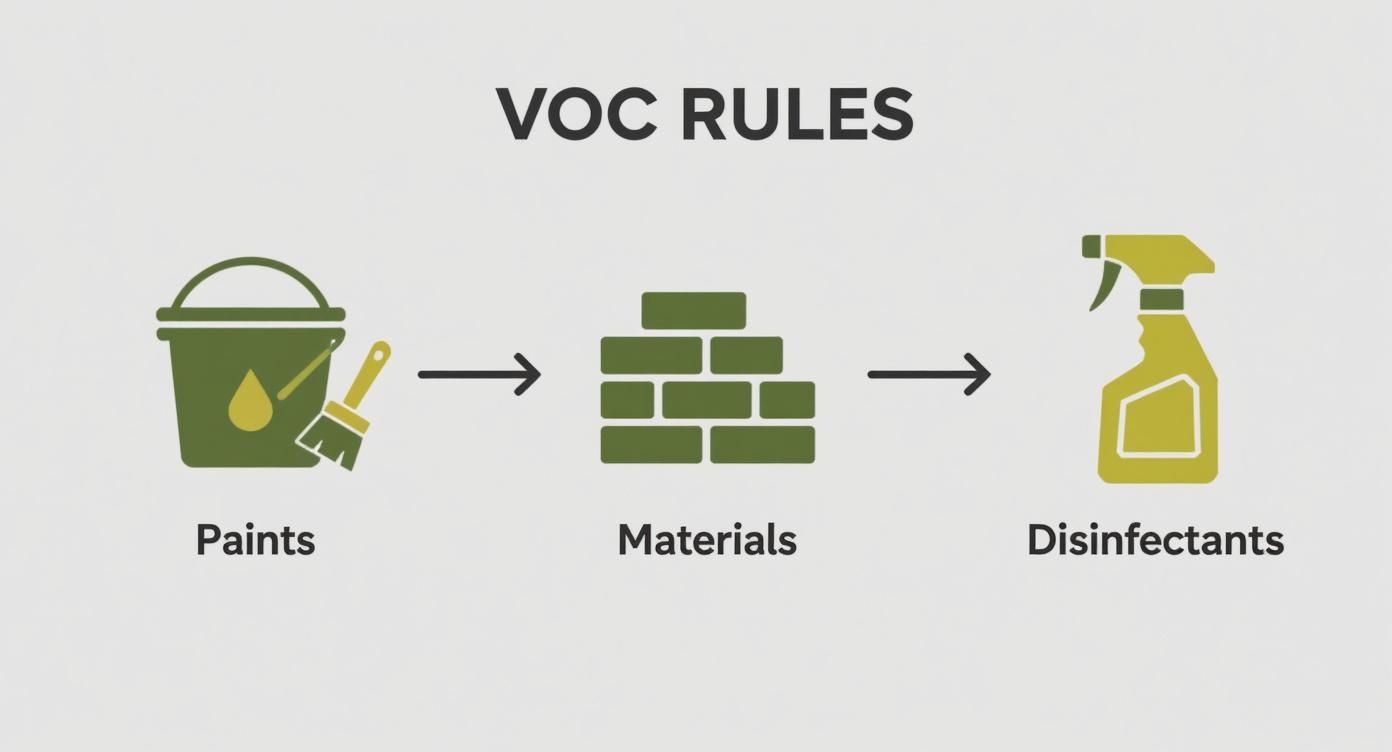
As you can see, the regulations systematically cover key sources of indoor air pollution, from the paint on our walls to the very materials used in construction.
Inside the Laboratory: The Final Step
Once a sample has been collected, it’s carefully sealed and sent to an accredited laboratory for the final, most crucial step. Here, scientists use incredibly advanced technology to identify and measure every single compound that was captured.
The gold standard for this analysis is a technique called Gas Chromatography-Mass Spectrometry (GC-MS). It's a powerful two-part process. First, it separates the complex mixture of VOCs into individual components. Then, it identifies each one by its unique chemical fingerprint.
This detailed breakdown provides a comprehensive report that lists every VOC detected and its precise concentration. It’s how invisible airborne chemicals are turned into clear, actionable data.
To truly understand the entire process, engaging a professional VOC testing company is the best way to get accurate and meaningful results for your home or workplace. They ensure every step, from sampling to final analysis, is handled with the scientific rigour it deserves.
Making Sense of Your VOC Test Results

Getting your VOC testing report back can be a bit confronting. You're often looking at a dense document packed with chemical names, acronyms, and a whole lot of numbers. The trick is knowing how to translate that data into a clear action plan for your indoor environment.
First things first, let's get a handle on the units. VOC concentrations are usually measured in micrograms per cubic metre (µg/m³), parts per million (ppm), or parts per billion (ppb). Think of these as a recipe: they tell you how much of a specific chemical is mixed into a set volume of air.
Reading Between the Lines: The TVOC Figure
One of the first things you'll probably spot is the Total Volatile Organic Compounds (TVOC) value. This is the big-picture number—it’s the combined total of every single VOC picked up by the test. It's a handy snapshot of your overall air quality, but it's really just the cover of the book, not the full story.
A high TVOC level definitely flags that something is up, but it doesn't tell you what the problem is. For example, two rooms could have the exact same TVOC reading. One might have a cocktail of relatively benign compounds, while the other is dealing with a dangerous concentration of just one or two high-risk chemicals.
Think of the TVOC score as a preliminary screening. The real, actionable insights come from digging deeper into the individual chemical concentrations to find the specific culprits that need your attention.
Identifying High-Risk Chemicals
This is where you need to put your detective hat on. Your report should break down that TVOC figure into a list of specific compounds. This is the most critical part of the analysis. Health organisations and regulatory bodies have set clear exposure limits for certain high-risk VOCs known to cause serious health problems.
Keep an eye out for these common offenders on your report:
- Formaldehyde: A known carcinogen, often off-gassing from building materials, new furniture, and glues.
- Benzene: Another carcinogen, frequently linked to petrol fumes, paints, and cigarette smoke.
- Toluene and Xylene: Solvents used in paints and adhesives that can impact the central nervous system.
- Tetrachloroethylene: A chemical commonly used in dry cleaning that carries long-term health risks.
If any of these—or other known hazardous VOCs—show up at high levels, they should be your number one priority. Their presence signals a tangible risk that needs to be sorted out, whether that means removing the source, sealing a surface, or boosting ventilation.
Pinpointing where these chemicals are coming from can be tricky. Scientific monitoring in New South Wales has shown just how complex it is to trace VOC emissions. A study in areas like Camden and Singleton detected various compounds, with tetrachloroethylene levels hitting up to 58.3 parts per billion in some spots, pointing to localised industrial pollution. These findings highlight how much things like weather and proximity to sources can influence what we find inside our buildings. You can discover more insights about these VOC emission studies to see the bigger picture of regional air quality.
By carefully working through the specific chemicals on your report, you can move beyond the general TVOC number and build a targeted plan to genuinely improve your indoor air quality and safeguard the health of everyone inside.
When and Where Should You Test for VOCs?
Putting the science of VOC testing into practice is where its real value shines. Knowing exactly when and where to test can turn vague health concerns into concrete actions that protect people. Whether it's a family home or a busy factory floor, testing gives you the hard data needed to create a safer, healthier space.
For those at home, certain life events should be a clear signal to think about VOC testing. It’s best to treat it like any other essential home maintenance check, right up there with testing your smoke alarms or getting the air conditioner serviced.
In and Around Your Home
Being proactive with testing at home is one of the best things you can do for your family’s health, particularly for kids, the elderly, or anyone with asthma or other respiratory issues.
Here are a few classic scenarios when a homeowner should get a test done:
- After a Renovation: That new paint smell? The scent from new carpets or kitchen cabinets? That's VOCs off-gassing into your air. Testing after a reno is the only way to be sure those levels have dropped back to a safe point.
- Moving into a New Place: A new home has an unknown history, whether it’s brand new or just new to you. A quick VOC test can give you peace of mind and uncover any hidden air quality problems before you’ve even unpacked the boxes.
- Mystery Health Issues: If someone in the family is suddenly dealing with ongoing headaches, allergies, or a nagging cough with no obvious cause, the air inside your home could be the culprit. VOC testing can help you pinpoint or rule out chemical irritants.
Critical Uses in Workplaces and Industry
When we move into the commercial world, VOC testing is no longer just a personal choice—it’s a cornerstone of occupational health and safety. It's how businesses meet legal standards, protect their staff, and show they’re serious about corporate responsibility.
For any business, VOC testing isn’t just about ticking a compliance box. It’s a direct investment in the health and productivity of your team. A healthy workplace is a productive one, and clean air is a non-negotiable part of that.
In these settings, testing is crucial for a few key reasons. First and foremost, it ensures compliance with workplace exposure limits, making sure employees aren't breathing in harmful levels of chemicals day in and day out. For companies chasing sustainability goals, getting a green building certification like Green Star often requires rigorous VOC testing to prove low-emission materials were used.
It also keeps suppliers honest. If a company has spent good money on 'low-VOC' paints or furniture, testing is the only way to confirm those products are actually delivering on their promise. This is especially important in industrial environments where chemical use is a daily reality.
For example, VOC emissions from Australian power generation facilities can change dramatically depending on their operations. Data from the 2024 fiscal year showed one power station's VOC emissions jumped by 125% simply due to running for more hours and a change in fuel by-products. This is a stark reminder of how industrial activity directly shapes air quality, and it really drives home why regular testing in these environments isn't just good practice—it's essential for protecting both public and environmental health.
Got Questions About VOC Testing? We've Got Answers
Let's clear the air on some of the most common questions people have about Volatile Organic Compounds and what's involved in testing for them. Getting straightforward answers is the first step toward making smart decisions for a healthier indoor space.
How Often Should I Be Testing My Home for VOCs?
It’s a good idea to test after any big change that could mess with your air quality. Think renovations, a major furniture haul, or even just a fresh coat of paint.
You should also seriously consider a test if you're moving into a new place, or if someone in your family suddenly develops ongoing, unexplained symptoms like headaches, respiratory trouble, or allergy flare-ups. For ongoing peace of mind, especially in homes with vulnerable individuals, testing every one to two years can provide a valuable health baseline.
Will a Normal Air Purifier Get Rid of VOCs?
Not necessarily. Most standard air purifiers are great at what they do, but what they do is capture particles. Their HEPA filters are built to trap things like dust, pollen, and pet dander, but they can't stop gaseous chemicals.
To really tackle VOCs, you need an air purifier that has a hefty activated carbon filter. This is the key ingredient, as the carbon's structure is perfect for adsorbing and locking away those harmful gases, cleaning the air you breathe.
Is VOC Testing Expensive, and Who Should Handle It?
The cost can swing a fair bit, depending on how deep you want to go and the methods used. You'll find DIY kits on the market, but for results you can actually trust, it's always best to bring in an accredited environmental testing professional.
An expert not only has the right gear but also the know-how to collect samples properly and interpret the complex lab analysis. That level of precision is absolutely vital when you're making decisions about health and potential fixes based on the data.
For professional, science-backed occupational hygiene solutions that protect your team and ensure you're compliant, trust Anitech Ltd Pty. Discover how our nationwide expertise can elevate your workplace health and safety standards by visiting us at https://occhygiene.com.au.


