
Ever felt that deep, constant rumble during a long haul on a rough road, or the persistent shake from heavy machinery? That's the essence of whole-body vibration. It’s not just a minor annoyance from the driver's seat; it's a significant occupational hazard where mechanical energy from vehicles or machinery travels right through your body, potentially causing serious health issues over time. Understanding what whole-body vibration is represents the first critical step toward creating a safer work environment.
Unpacking Whole-Body Vibration

When we talk about whole-body vibration (WBV), we're referring to the vibrations that pass through a worker's entire body from a surface they're standing or sitting on. This is a daily reality in many Australian industries, from mining and construction to transport and logistics.
Picture an excavator operator on a busy construction site or a forklift driver navigating a warehouse floor. They're not just operating machinery; they're absorbing constant jolts and shakes from engine vibration, ground surfaces, and the tasks they perform.
This isn't just about comfort. Over time, that relentless shaking can lead to serious health problems, impacting everything from a worker's concentration to their long-term physical well-being. That’s why getting a handle on WBV is such a critical piece of the workplace health and safety puzzle.
To put the fundamental concepts into perspective, here's a quick summary.
Key Aspects of Whole-Body Vibration at a Glance
| Concept | Brief Explanation |
|---|---|
| Definition | Mechanical vibrations transmitted through the entire body, typically via a seat or the feet. |
| Source | Commonly from vehicles (trucks, forklifts), heavy machinery (excavators, loaders), and industrial platforms. |
| Exposure Route | Energy travels from the vibrating surface into the worker's body, impacting the musculoskeletal and nervous systems. |
| Key Risk Factor | Both the intensity (magnitude) and the duration of exposure contribute to the overall health risk. |
Understanding these basics is the first step toward effectively managing the hazard in your workplace.
The Scale of Exposure in Australia
Just how common is this problem? You might be surprised.
According to research from Safe Work Australia, about 24% of Australian workers reported being exposed to some form of workplace vibration. Drilling down into that figure, 38% of them were exposed specifically to WBV, and another 17% dealt with both whole-body and hand-arm vibration. These numbers show just how many people are affected. You can learn more about the effects of workplace vibration and read the full National Hazard Exposure Worker Surveillance survey for a deeper dive.
It's crucial to remember that WBV isn't just about intense, bone-rattling jolts. A relatively mild vibration, experienced for an eight-hour shift day after day, can be more damaging in the long run.
Why It Matters for Your Workplace
Putting a name to WBV is the first step toward creating a safer work environment. It’s an invisible stressor with very real consequences if you ignore it. The primary worry is the cumulative damage it can do to the human body, especially the spine and internal organs.
This guide will walk you through exactly what you need to know about this occupational hazard. We'll cover:
- Common Sources: We’ll pinpoint the vehicles and machinery that pose the biggest risks.
- Health Risks: You'll get a clear picture of the short-term and long-term physical impacts.
- Measurement and Standards: We'll explain how to assess exposure levels according to Australian guidelines.
- Control Strategies: You’ll learn practical, actionable steps to reduce vibration in your operations.
By properly understanding what whole-body vibration is, you can move from simply acknowledging a risk to actively managing it. This knowledge empowers you to protect your team, ensure you’re compliant, and ultimately build a healthier, more productive workforce.
Identifying Common Sources and High-Risk Industries
It's one thing to know that whole-body vibration is a real workplace hazard, but the crucial next step is to pinpoint exactly where it's coming from. WBV isn’t some abstract concept; it’s generated by the very machinery and vehicles that form the backbone of many key Australian industries. Being able to spot these sources is the foundation of any solid risk management plan.
The workplaces where people are most at risk are often dynamic and complex. The intensity of the vibration isn't just about the machine itself—it's influenced by everything from the task being performed to the very ground the equipment is operating on. Let's break down where you're most likely to find it.
High-Risk Mobile Equipment
If there's one major contributor to WBV exposure, it's mobile equipment. These are the workhorses of mining, construction, and agriculture, but the physical toll they take on operators can be immense. The combination of powerful engines, constant movement, and rough terrain is a perfect recipe for harmful vibration.
You'll see this across many Australian worksites:
- Earthmoving Machinery: This is a huge category, covering everything from bulldozers and excavators to scrapers and graders. The sheer force these machines exert, often on ungraded construction sites or in mine pits, sends significant shocks and vibrations straight to the operator's cab.
- Haul Trucks and Dump Trucks: A common sight in mining and large-scale construction, these giants carry massive loads over often temporary and unpaved haul roads. This leads to constant, jarring movements that are notoriously hard on the body.
- Forklifts and Loaders: They might be smaller, but don't underestimate the risk. Essential in warehouses and manufacturing plants, forklifts often run on concrete floors with cracks, expansion joints, and other imperfections, creating sharp, high-frequency jolts.
Stationary Plant and Machinery
While vehicles are an obvious culprit, WBV isn't just a problem for drivers. Large, powerful stationary machines can transmit intense vibrations through the floor to operators who have to stand or sit nearby for their entire shift. It's an easy source to overlook because you don't see the machine bouncing around.
Keep an eye out for these sources:
- Large-Scale Generators: In power plants or sites with substantial backup power, the hum of massive generators can be felt right through the building's structure.
- Industrial Crushers and Screens: Anyone who has worked in a quarry or processing plant knows the feeling. This equipment violently shakes and sorts material, and all that energy has to go somewhere—usually into the surrounding platforms and control rooms where people work.
The key takeaway here is that risk isn't just about driving. If an employee's workstation physically shakes or rumbles because of nearby machinery, you need to be looking at a WBV assessment.
Transport and Logistics Vehicles
The transport sector is another industry right on the front line. Drivers spend countless hours exposed to WBV, and while it might seem less intense than a haul truck on a mine site, the long-term, cumulative effect can be just as damaging.
Common vehicles of concern in this industry include:
- Long-Haul Trucks: Spending eight, ten, or even more hours a day on the road exposes drivers to continuous vibration from the engine, drivetrain, and the road surface itself.
- Buses and Coaches: Much like truck drivers, bus operators are in their seats for long shifts. The constant stop-start nature of city driving can add to the overall vibrational load they experience.
- Delivery Vans and Light Commercial Vehicles: Zipping around town in a van might seem low-risk, but navigating varied road surfaces—including potholes and poorly patched streets—can expose delivery drivers to significant shocks.
Amplifying Factors You Cannot Ignore
The machine itself is only one piece of the puzzle. A number of factors in the work environment and the way a job is done can dramatically crank up an operator's exposure, turning a moderate risk into a serious health hazard.
- Vehicle Condition: An older machine with worn-out suspension or shot engine mounts will transfer far more vibration. A deteriorating seat is a massive red flag, as it’s the last line of defence between the machine's vibration and the operator's body.
- Ground Surface: This is a big one. Driving over rough, unpaved, or poorly maintained surfaces is a primary cause of high WBV levels. The difference between a smooth, graded haul road and a potholed track is night and day for an operator.
- Operator Technique: How you drive matters. Speeding, aggressive cornering, and sudden braking all create more intense jolts and vibrations.
- Tyre Pressure: It sounds simple, but incorrectly inflated tyres don’t absorb shock effectively. That means more vibration gets passed straight through the vehicle's frame and up to the driver.
Recognising these sources and the factors that make them worse is fundamental. It empowers you to look at your operations and ask not just what is causing the vibration, but why it might be more severe than it needs to be. For businesses that rely on specialised equipment, understanding the specifics of a whole-body vibration machine can offer even deeper insights into managing these risks.
How Vibration Exposure Is Measured and Assessed
You can't manage what you don't measure. When it comes to whole-body vibration, this old saying is especially true. So, how do we take an invisible, rumbling hazard and turn it into something we can actually quantify and control? It's a process that translates the physical forces acting on an operator's body into hard data, giving you a clear picture of the risk and what you need to do about it.
At its heart, assessing WBV is about capturing the intensity, direction, and duration of the jolts and shakes an employee feels throughout their day. For a deeper look into the physics behind this, you can explore what is force measurement.
To get this data, specialists use some clever bits of kit. The go-to tool is a tri-axial accelerometer. Think of it as a highly sensitive sensor that measures vibration in three directions at once: up-and-down (the z-axis), side-to-side (y-axis), and front-to-back (x-axis). This device is usually tucked into a seat pad placed right where the operator sits, ensuring it captures the vibrations precisely as they travel into their body.

Key Metrics in a WBV Assessment
Once the accelerometer has done its job, the raw data needs to be interpreted. This is where a few key metrics come into play—they are the language of vibration safety.
- Acceleration (m/s²): This is the big one. It measures the intensity of the vibration, telling us how quickly a surface is speeding up and slowing down. The higher the acceleration, the greater the force on the body.
- Frequency (Hz): This tells us how often the vibration occurs each second. The body reacts differently to various frequencies, and for WBV, the low-frequency vibrations (typically below 20 Hz) are the most damaging.
- Duration: It’s simple but crucial: how long is someone exposed? A lower-intensity vibration can become a significant risk if it continues for hours on end.
These pieces of the puzzle are then put together to get the single most important number in any WBV assessment.
The ultimate goal is to calculate the daily vibration exposure value, or A(8). This single figure represents a worker's total exposure, averaged over a standard eight-hour workday, which allows for a direct comparison against legal safety limits.
Understanding Australian Exposure Standards
Here in Australia, the rulebook for this process is AS ISO 2631-1. This standard doesn't just offer suggestions; it lays out the exact methodology for measurement and defines the critical exposure thresholds that every workplace must follow.
A professional whole-body vibration assessment is built around comparing your A(8) value to the benchmarks in this standard. It's a structured way to determine when the risk becomes unacceptable and action is mandatory. In demanding industries like mining, for example, long-term WBV exposure has been linked not just to back pain, but to a host of other health problems, including cardiovascular and digestive issues.
The standard gives us two vital numbers to work with:
-
Exposure Action Value (EAV): 0.5 m/s² A(8)
- Think of this as the first warning bell. Once exposure hits this level, the risk is considered significant enough that you are legally required to act.
- This means you must start implementing controls to reduce exposure and provide health monitoring and training for affected staff.
-
Exposure Limit Value (ELV): 1.15 m/s² A(8)
- This is the hard limit. The red line. An employee's daily exposure must never, under any circumstances, exceed this value.
- If you find that the ELV has been breached, work must stop immediately. The cause of the high exposure needs to be found and fixed before anyone can safely resume that task.
By measuring the vibration and calculating that all-important A(8) value, you get a clear, legally defensible way to check your workplace conditions against these national standards. It’s how you connect the technical data directly to your duty of care.
The Serious Health Effects of Long-Term WBV Exposure
A bit of shaking on the job might seem like just part of the day, but it’s the long haul you need to worry about. Think of whole-body vibration (WBV) not as a single event, but as a slow, steady erosion of the body. Those constant jolts and shudders are physical forces that grind away at the body’s structures, day after day, year after year.
Ignoring WBV isn’t just an oversight; it’s a direct route to chronic, often irreversible, health problems that can end careers. It usually starts small—a few aches and pains you brush off as normal fatigue. But under the surface, a much more serious process is underway, setting the stage for significant, long-term harm.
This is why we have to stop thinking of vibration as a comfort issue. It’s a critical workplace health hazard that demands serious, proactive management.
The Debilitating Impact on the Musculoskeletal System
The most common and well-documented damage from long-term WBV is to the spine. Our spines are incredible pieces of natural engineering, but they simply weren't built to absorb constant, low-frequency vibrations for eight hours a day.
This continuous mechanical stress can lead to a host of severe musculoskeletal disorders:
- Chronic Lower Back Pain: This is the number one complaint for a reason. Vibration speeds up the wear and tear on the lumbar spine and its supporting muscles, leading to persistent, often debilitating pain.
- Degenerative Disc Disease: WBV can starve the intervertebral discs of nutrients. This causes them to dry out, shrink, and lose their ability to cushion impacts, which can lead to herniated discs and sciatica.
- Spinal Column Disorders: Over time, the constant stress contributes to conditions like spinal osteoarthritis, where the cartilage wears away and bone starts grinding on bone.
These conditions aren’t just painful. They’re life-altering, severely limiting what a worker can do both on and off the job. To get a deeper understanding of the mechanics, our article on why is vibration a serious health issue breaks down the physiological impacts.
Picture this: every time an operator hits a pothole or a rough patch of ground, that shockwave doesn't just vanish. It travels straight up their spine, compressing discs and straining ligaments. Multiply that by thousands of impacts a week, and you can see how all that micro-trauma eventually adds up to a major injury.
Systemic Health Risks Beyond the Spine
But the damage doesn't stop at the back and joints. Those vibrations ripple through the entire body, affecting internal organs and systems in ways that are easy to miss until real symptoms start to show.
Prolonged exposure has been linked to several other major health problems:
- Digestive System Issues: It's common for workers with high WBV exposure to report stomach pain, indigestion, and even a higher risk of ulcers. The constant agitation simply disrupts normal digestive function.
- Cardiovascular Strain: Some research points to a link between long-term WBV exposure and an increased risk of heart problems. The body’s stress response to constant vibration may affect heart rate and blood pressure over time.
- Potential Reproductive Harm: There is also evidence suggesting that WBV could pose risks to the reproductive systems of both male and female workers, adding another critical reason to get it under control.
The Real-World Cost in Australian Workplaces
These health effects aren't just theoretical; they have a real, measurable cost for Australian industries. Injured workers mean lost productivity, higher insurance premiums, and above all, human suffering.
Workers' compensation data tells a pretty clear story. Between 2001 and 2015, vibration-related injuries led to over 5,200 workers' compensation claims in Australia. The cost of these claims? A staggering AUD $134 million. The mining industry was a major contributor, which is no surprise given workers operate heavy machinery for long shifts on rough terrain.
This statistic hammers home a crucial point: managing WBV is about far more than just ticking a compliance box. It’s a fundamental investment in the long-term health and wellbeing of your most important asset—your people. Protecting them from these serious risks is the key to building a safer, more sustainable, and more productive workforce.
Practical Strategies to Control and Mitigate Vibration
Knowing there’s a problem is one thing; fixing it is another entirely. When it comes to managing whole-body vibration (WBV) in the workplace, the best approach is a structured one. We use what’s known as the hierarchy of controls, a reliable framework that prioritises the most effective solutions—like getting rid of the hazard altogether—over those that simply rely on people changing their behaviour.
This is all about preventing the very real health effects of WBV, which range from short-term aches to serious long-term damage and significant financial fallout.
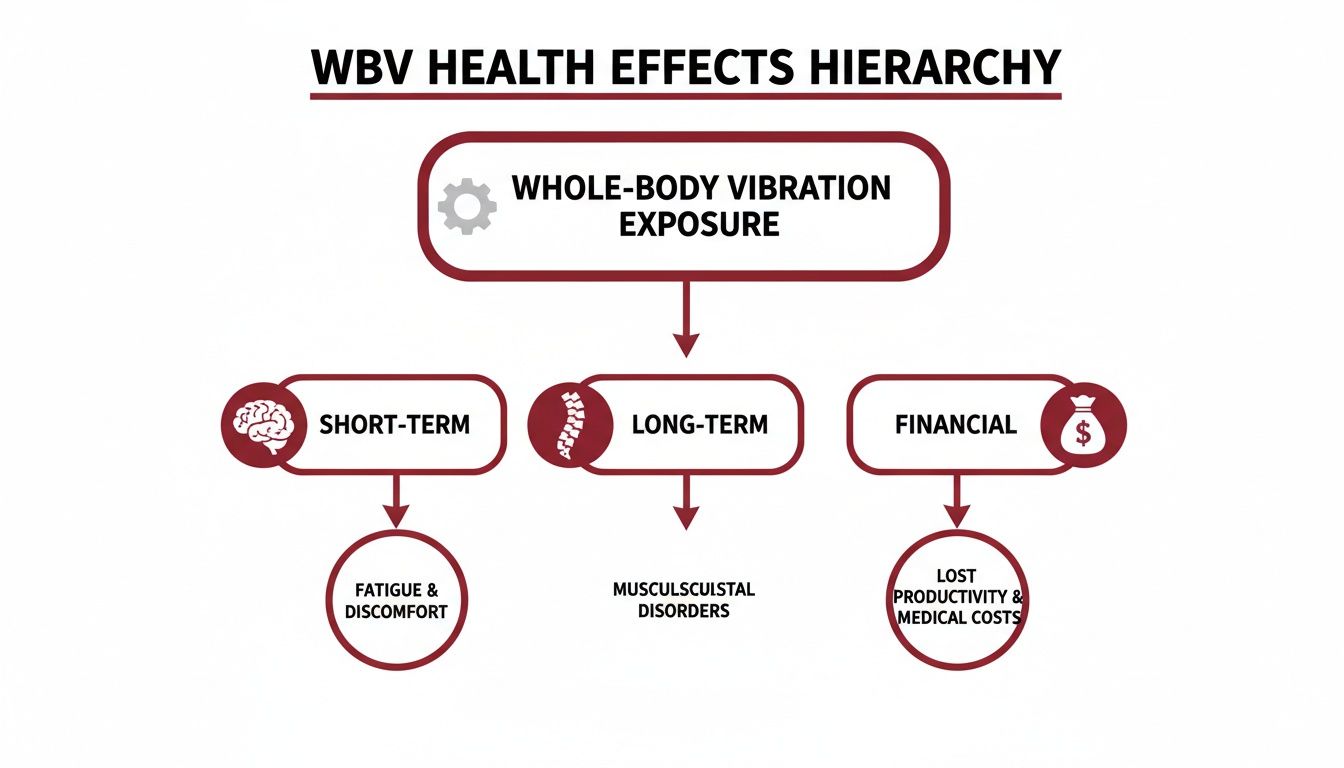
As you can see, the consequences build over time. What starts as fatigue can escalate into debilitating spinal injuries, leading to major costs for both the worker and the business.
To tackle WBV effectively, we start at the top of the hierarchy and work our way down. This means focusing first on engineering solutions, then on administrative changes, and finally, as a last resort, on personal protective equipment.
The table below outlines this approach, moving from the most effective controls to the least.
Hierarchy of Controls for Managing WBV
| Control Level | Example Strategies |
|---|---|
| Elimination | Automate tasks to remove the need for a human operator in a vibrating environment. |
| Substitution | Replace a high-vibration piece of equipment (e.g., an old tractor) with a newer, low-vibration model. |
| Engineering | Install vibration-dampening seats, improve vehicle suspension, or maintain smooth road surfaces. |
| Administrative | Implement job rotation, enforce site speed limits, and schedule mandatory breaks away from the source. |
| PPE | Provide training on posture and safe operation (though no specific PPE is certified to reduce WBV). |
Let's break down what these controls look like in the real world.
Engineering Controls: The First Line of Defence
By far, the most effective strategies are those that physically change the equipment or the work environment to cut down vibration at its source. These are engineering controls, and they’re so powerful because they make the workplace safer by design, rather than asking an employee to remember a new rule.
Here are a few practical examples:
- Choose Low-Vibration Equipment: When you’re buying new vehicles or machinery, make WBV emission data a non-negotiable part of your purchasing criteria. Modern equipment is often designed with far better suspension and engine mounts that stop vibration from ever reaching the operator.
- Install Vibration-Dampening Seats: Got older vehicles? Retrofitting them with high-quality, air-suspended seats can make a night-and-day difference. Just make sure the seats are properly adjusted for the operator’s weight and height, or you won't get the full benefit.
- Maintain Your Surfaces: This one is huge and often completely overlooked. Regularly grading haul roads, filling in potholes, and repairing cracked concrete floors directly reduces the jolts and shocks that cause dangerous WBV exposure.
A proactive forklift replacement policy is a perfect real-world example. Imagine a busy warehouse deciding to phase out its older, rough-riding units. By bringing in new models with superior suspension, the company permanently reduces the hazard for every single operator from that day forward. That’s an engineering control in action.
Administrative Controls: Changing How the Work Gets Done
What happens when engineering controls can’t quite get the exposure levels low enough? That's where administrative controls come in. These strategies are all about changing work practices and company policies to limit how long any single person is exposed to the hazard.
These are essential for managing any leftover risk:
- Job Rotation: Instead of one person spending a full eight-hour shift on a high-vibration machine, rotate them through different tasks. This shares the load and keeps any individual's daily exposure value, or A(8), well below the limit.
- Enforce Speed Limits: Driving too fast over uneven ground is a guaranteed way to create high levels of WBV. Setting and, more importantly, enforcing site-specific speed limits for loaders and haul trucks is a simple but incredibly effective administrative fix.
- Schedule Proper Breaks: Build in mandatory breaks away from the vibrating source. This isn't just for a cuppa; it gives the body crucial time to recover and stops the cumulative effect of constant vibration.
- Provide Clear Training: Make sure your team understands what whole-body vibration is, the health risks it carries, and how their own actions—like driving technique—can massively impact their exposure.
It's genuinely shocking how often these basic measures are missed. Some research shows that a disturbing 23% of exposed workers had no control measures at all, and only 27% received any training on managing WBV risks. You can read more about these findings on Australian workplace safety to see just how big the gap is.
The Role of Personal Protective Equipment (PPE)
Finally, we get to Personal Protective Equipment (PPE). Let’s be perfectly clear on this: PPE is the least effective control for WBV. Currently, there is no certified PPE, like gloves or boot inserts, that has been proven to meaningfully reduce the transmission of whole-body vibration.
You'll see products marketed as "anti-vibration" gloves or padded seat covers, but they generally target much higher frequencies than those that cause WBV and offer minimal, if any, real protection. Relying on them creates a false sense of security. The focus must always, always be on the higher-level engineering and administrative controls if you want to truly protect your team.
How We Can Help You Manage WBV Risks
Getting a handle on whole-body vibration can feel overwhelming, especially when you're trying to balance safety regulations with the daily demands of your operation. That’s where we come in. At Anitech, we bring the specialised expertise and scientific precision you need to turn WBV risk management from a complex obligation into a real, lasting strength for your business.
We don't just show up and take readings. Our process is designed to be supportive and practical for Australian workplaces. It all starts with a conversation to get a clear picture of your operations and challenges. From there, our occupational hygiene experts conduct a thorough on-site assessment, using properly calibrated equipment to measure exactly what your team is being exposed to.
From Complex Data to Clear Actions
The raw data is just the beginning. We analyse our findings and benchmark them against key Australian standards, like AS ISO 2631-1, so you know precisely where you stand. But we won’t leave you with a dense report full of confusing numbers. Our job is to translate that complex data into a straightforward, practical risk management plan with clear, prioritised actions you can take right away.
This targeted approach often uncovers risks in places you wouldn't expect. For example, in a project with a major Australian mining company, it was found that over one-third of vertical vibration readings on critical machinery were well into the health caution zone defined by ISO 2631-1. This insight led to specific, effective changes that significantly lowered the risk of injury for their operators. You can read more about these vibration management findings to see how it worked.
Our team has deep experience across the sectors where WBV is a major issue, including:
- Mining and resources
- Construction and transport
- Manufacturing and logistics
- Agriculture and forestry
Working with us is about more than just ticking a compliance box. It’s an investment in a proactive strategy to build a genuinely safer, healthier, and more productive workplace for every single person on your team.
We're here to help you build a robust safety culture—one that's grounded in good science and practical, real-world solutions.
Frequently Asked Questions About Whole-Body Vibration
When you’re trying to get a handle on workplace health and safety, a lot of questions can pop up. Let's tackle some of the most common ones we hear about whole-body vibration, with straight-to-the-point answers to help you manage this hazard properly.
Is All Workplace Vibration Harmful?
Not necessarily. The real issue isn't vibration itself, but the type, intensity, and duration of the exposure. What we’re really concerned about with WBV are the low-frequency vibrations you get from heavy machinery and off-road vehicles. A brief, one-off exposure to mild vibration probably won't do any damage.
The risk really starts to climb with long-term, intense exposure. Think of it this way: harm from WBV is cumulative. It builds up day after day, over months and years. That’s why safety standards zero in on the A(8) daily exposure value—it gives you an average dose over a full eight-hour workday.
Can Better Driving Reduce WBV Exposure?
Absolutely. How an operator handles their vehicle or machine makes a massive difference to the vibration levels they feel. In fact, promoting smooth, controlled operation is one of the most effective and immediate changes you can make.
A few simple adjustments can have a huge impact:
- Slow Down: This is the big one. Dropping your speed, especially on rough or uneven ground, is the single best way to cut down on sharp jolts and shocks.
- Avoid Obstacles: Actively steering around potholes, bumps, and other debris prevents a lot of unnecessary impacts that travel right up the spine.
- Smooth Acceleration and Braking: Getting on and off the power or brakes gradually eliminates the jerky motions that cause high vibration peaks.
Teaching operators why their driving habits matter for their long-term health is a cornerstone of any good WBV management plan.
Are Anti-Vibration Seat Cushions Effective?
It's a common question, and the answer is usually no. While there are plenty of products out there marketed as "anti-vibration," most do very little to dampen the specific low frequencies that cause WBV-related health problems. A properly installed and well-maintained air-suspension or mechanical suspension seat is a far more effective engineering solution. These seats are purpose-built to isolate the operator from the machine's vibration.
A simple cushion might make the seat feel a bit more comfortable, but it should never be mistaken for a proper safety control. Always prioritise solutions that are scientifically proven to reduce the measured vibration levels.
How Often Should We Conduct WBV Assessments?
You should carry out a whole-body vibration assessment whenever there's a reason to believe your workers might be at risk.
This typically means:
- When you bring in new machinery or vehicles.
- If you make significant changes to how work is done—like altering haul road surfaces or extending shift times.
- Whenever workers start reporting symptoms that could be linked to WBV, such as chronic back pain or unusual fatigue.
- As part of a scheduled review, often every few years, just to make sure your current controls are still doing their job effectively.
Getting a grip on whole-body vibration is a vital part of keeping your workplace safe and your team healthy. If you need an expert eye to help you assess your risks and put practical, effective controls in place, we are here to help. We offer comprehensive occupational hygiene services across Australia, taking a scientific approach to ensure you're not just ticking a compliance box but genuinely protecting your people. Visit our website to learn more at https://occhygiene.com.au.


