
Understanding what is the standard for hand-arm vibration in Australia can initially seem complex. Unlike some countries, Australia does not have a single, prescriptive Australian Standard with rigid legal limits for Hand-Arm Vibration (HAV). Instead, the nation's Work Health and Safety (WHS) laws are built on a powerful principle: the primary duty of care. This requires employers (or PCBUs) to proactively identify, assess, and manage the risks associated with vibrating tools in the workplace to prevent long-term harm.
So, how do Australian businesses benchmark safety and compliance? To apply a concrete value to this risk, industries across the country almost universally adopt the well-established guidance from the European Union. This framework provides two indispensable benchmarks that form the core of effective HAV management: the Exposure Action Value (EAV) and the Exposure Limit Value (ELV). These values are the key to fulfilling your duty of care and protecting your workforce from debilitating conditions like Hand-Arm Vibration Syndrome (HAVS).
Australia’s Approach to Hand-Arm Vibration Standards

While Australian WHS laws don't stipulate exact numerical limits, Safe Work Australia provides clear, authoritative guidance based on international best practices. The entire system revolves around managing a worker's total daily exposure to vibration, which is standardised to an eight-hour reference period. This critical metric is represented by a single figure known as the A(8) value.
You can think of the A(8) value as a worker's "daily vibration dose." Every time an employee uses a vibrating tool—whether it's a jackhammer, grinder, or sander—they receive a dose of vibration. The intensity of the tool's vibration and the duration of use (known as "trigger time") both contribute to the size of that daily dose. The primary goal of any HAV management plan is to ensure this daily dose remains within safe, acceptable limits to prevent irreversible health damage.
The Two Critical Values You Must Know
The entire framework for managing HAV risk is structured around two key trigger points. These are not arbitrary numbers; they are clear, legally significant signals that mandate specific actions from an employer to remain compliant.
-
Exposure Action Value (EAV): 2.5 m/s² A(8). Consider this the first warning bell. When a worker's daily exposure reaches this level, it signifies that the risk is significant enough to require intervention. You are now legally obligated to take specific actions, such as implementing control measures and starting health surveillance, to reduce their exposure.
-
Exposure Limit Value (ELV): 5.0 m/s² A(8). This is the absolute legal limit—a non-negotiable hard stop. A worker's exposure must never be permitted to reach or exceed this level on any given day. Exceeding the ELV indicates an unacceptable risk of serious, permanent health damage and represents a failure in risk controls.
These values are the bedrock of effective HAV management in Australia. They are referenced in Safe Work Australia's Guide to Measuring and Assessing Hand-Arm Vibration, which aligns with the internationally recognised EU Physical Agents (Vibration) Directive 2002/44/EC.
Let's break down exactly what these values mean for you as an employer.
Australian Guidance on Hand-Arm Vibration Exposure Limits
The table below summarises the key exposure values and the actions you're legally and morally expected to take when they are reached. It serves as a practical roadmap for keeping your team safe from vibration-related injury.
| Exposure Level | Value (m/s² A(8)) | Required Employer Action |
|---|---|---|
| Exposure Action Value (EAV) | 2.5 m/s² | This is a trigger for action. You must conduct a formal risk assessment and introduce technical and organisational control measures to reduce exposure. Health surveillance for affected workers is also required. |
| Exposure Limit Value (ELV) | 5.0 m/s² | This is the maximum permissible daily exposure. Exposure must not exceed this limit under any circumstances. If it is exceeded, you must immediately take steps to reduce exposure below the limit and implement preventative measures to ensure it does not happen again. |
Following this framework isn't just about ticking compliance boxes; it's about proactively protecting your people from life-altering injuries.
By understanding and applying these exposure values, businesses can proactively protect their teams from the irreversible damage caused by Hand-Arm Vibration Syndrome (HAVS), also known as 'vibration white finger'.
This risk-based approach is a core component of broader Australian workplace safety standards. It's about moving beyond simply looking at numbers—it requires identifying real-world hazards, implementing intelligent and practical controls, and safeguarding the long-term health and well-being of your employees.
Understanding the Exposure Action and Limit Values
To effectively manage hand-arm vibration, it's essential to deeply understand the two most important numbers in the Australian guidance: 2.5 m/s² and 5.0 m/s². These aren’t just abstract figures; they are the cornerstone of a practical safety framework. Think of them as a traffic light system for vibration exposure, designed to help you recognise when the risk level shifts from acceptable to dangerous.
The first threshold is the Exposure Action Value (EAV), set at 2.5 m/s² A(8). Picture this as the amber light at an intersection. It’s not an order to stop all work immediately, but it is an unambiguous signal that you have reached a point where you must take decisive action to control the risk.
Hitting the EAV is your official cue to initiate a formal control program. It's the trigger point for commencing health surveillance to detect any early signs of injury and ensuring your team is properly trained on the dangers of HAV and the control measures in place.
The "Amber Light": Exposure Action Value (EAV)
When a worker's daily exposure reaches 2.5 m/s², your safety plan must spring into action. The entire goal from this point forward is to implement controls that reduce their exposure, aiming to keep them consistently below this value.
Once the EAV is reached, you are legally required to:
- Implement technical or organisational controls. This could involve sourcing low-vibration tools, modifying work patterns to include non-vibrating tasks, or automating processes where feasible.
- Provide health surveillance. This means arranging regular medical check-ups for exposed workers to detect the early symptoms of Hand-Arm Vibration Syndrome (HAVS) before they become severe.
- Inform and train your workers. Ensure everyone operating vibrating tools understands the health risks, knows the control measures, and feels empowered to report any symptoms without fear of reprisal.
The "Red Light": Exposure Limit Value (ELV)
The Exposure Limit Value (ELV) of 5.0 m/s² A(8) is the hard stop. This is your red light. It represents the absolute maximum daily exposure permitted, and it is non-negotiable. No worker should ever exceed this limit, under any circumstances.
Why is it so strict? Because at this level of exposure, the risk of an individual developing a serious, permanent health condition like HAVS becomes unacceptably high.
The ELV is not a target to aim for. It’s a legal and moral line in the sand that must never be crossed. If a worker hits this limit, you need to stop the work, investigate why the controls failed, and ensure it never happens again.
Grasping the difference between the EAV and ELV is fundamental to keeping your workers safe. For example, a worker using a heavy-duty grinder might reach the EAV in just over an hour, which signals the need for controls like job rotation. However, they could hit the non-negotiable ELV in under four hours, meaning they must stop using that tool for the rest of the day.
This is why accurately tracking "trigger time"—how long a worker is actually using a vibrating tool—is so incredibly important. It’s the only way to be certain they’re staying within these safe and legal limits.
How to Measure and Assess Vibration Exposure
You can't manage what you don't measure. When it comes to hand-arm vibration, that principle is paramount. To genuinely protect your team, you must move beyond guesswork and obtain real, objective data on what your workers are actually being exposed to throughout their day. This entire process is guided by standards like AS ISO 5349.
It’s about more than just knowing a tool's manufacturer-stated vibration rating. The real key is understanding the relationship between that vibration level and a worker's "trigger time"—the actual duration they spend operating the tool. It’s surprising for some, but using a high-vibration tool for just one hour can easily expose a worker to the same risk as using a low-vibration tool for a full eight-hour shift. This is precisely why we calculate the daily exposure, known as the A(8) value, to get an accurate picture of the risk.
The Tools and the Process
So, how do we get that data? A professional vibration assessment involves specialised equipment like vibration meters and accelerometers. These sensitive devices are attached directly to the tool's handle, precisely where the vibration enters the worker's hands. Correct placement is absolutely crucial for obtaining accurate and reliable readings.
Now, you might be tempted to just use the vibration data that manufacturers provide. While that’s a useful starting point for initial risk screening, those numbers are almost always measured in perfect, sterile lab conditions. Out on a real worksite, the situation is far more dynamic. Factors like the age of the tool, its maintenance condition, the material being worked on (think dense concrete vs. soft pine), and even the user’s technique can dramatically increase the real-world vibration levels. This is why on-site measurements are often the only way to truly understand the risk.
The flowchart below shows how these measurements translate into clear actions.
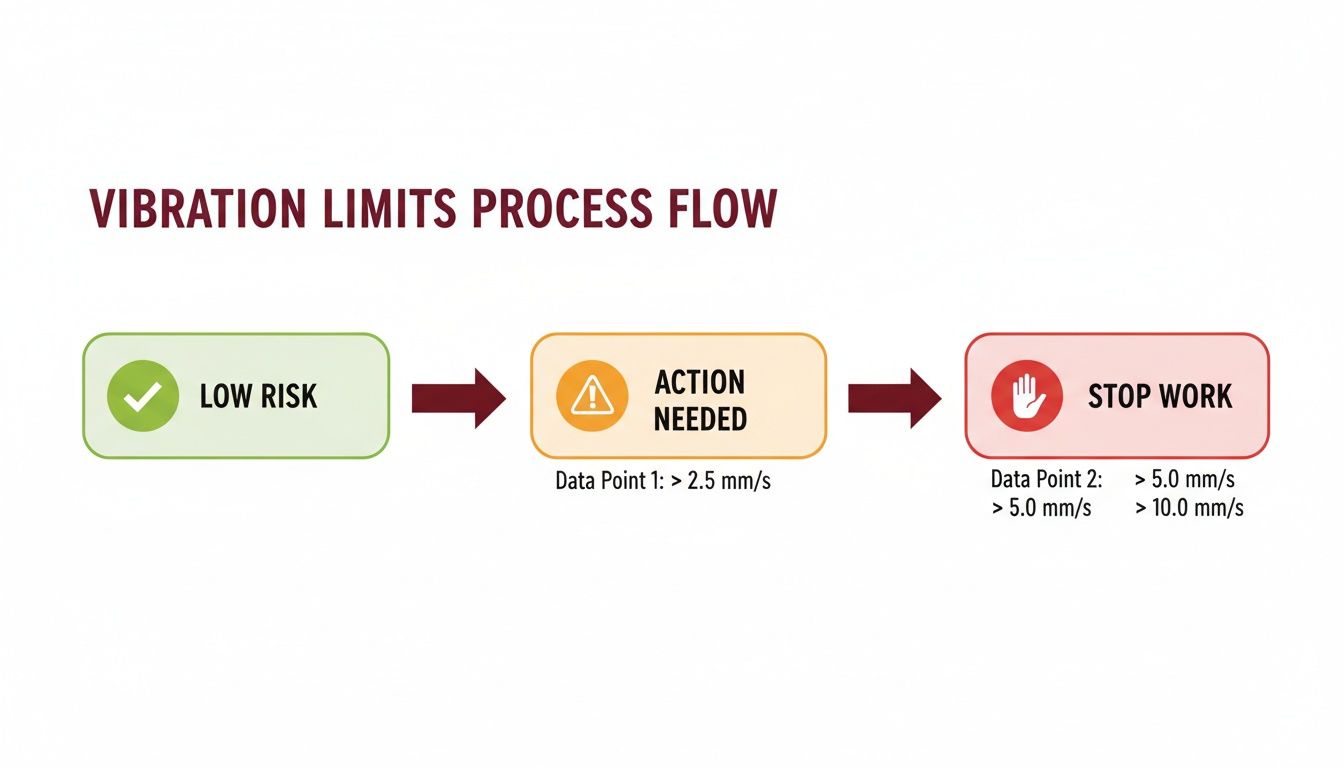
As you can see, it maps out a clear path from a low-risk green zone, to an amber zone that signals the need for action, and finally to a red zone where work must stop until effective controls are implemented.
In Australia, the measurement and evaluation of hand-arm vibration must follow the methods outlined in AS ISO 5349.1-2013, which details how to calculate that daily A(8) exposure. Safe Work Australia simplifies this with a colour-coded system:
- Red Zone (above 5 m/s²): This is the Exposure Limit Value (ELV). Exposure must not exceed this level, and immediate, strict controls are required.
- Amber Zone (2.5-5 m/s²): This is the Exposure Action Value (EAV). Once you hit this range, you must take proactive steps to reduce exposure.
- Green Zone (below 2.5 m/s²): While this is considered lower risk, it's not no risk. HAVS can still develop from long-term, cumulative exposure even at these levels, so ongoing vigilance is necessary.
For a complete and compliant assessment that you can have confidence in, bringing in an occupational hygiene expert is often the smartest move. If you need professional guidance, you can learn more about our comprehensive hand-arm vibration assessment services.
What Are Your Legal Duties as an Employer?
Knowing the exposure values is one thing, but actually meeting your legal obligations under Australian Work Health and Safety (WHS) laws is what keeps your team safe and your business compliant. As an employer or a Person Conducting a Business or Undertaking (PCBU), you have a primary duty of care to protect your workers from harm, so far as is reasonably practicable.
While there isn't a specific, legally mandated national exposure standard for hand-arm vibration in Australia, vibration is officially recognised as a workplace hazard. This means you have a legal duty to manage the risks it creates, just like any other hazard. Ignoring this responsibility is a direct breach of your WHS duties.
The Four-Step Risk Management Process
WHS law is very clear: you must follow a systematic process to manage risks. This isn't just a best-practice guideline; it’s a legal requirement to proactively protect your people.
Here’s how it breaks down into four essential steps:
-
Identify the Hazard: First, you need to find where the vibration is coming from. Pinpoint which tools, equipment, or tasks are the culprits. This involves getting out on the floor, observing work being done, talking to your operators, and reviewing the manufacturer’s specifications for the tools they use.
-
Assess the Risks: Once you've identified the sources, you need to evaluate the severity of the risk. Who is being exposed? For how long each day (their "trigger time")? Crucially, you need to determine if their daily exposure is likely to approach, meet, or exceed the EAV of 2.5 m/s².
-
Control the Risks: If your assessment identifies a risk, you are legally required to do something about it. Your duty is to implement effective control measures to eliminate or minimise that risk, so far as is reasonably practicable. This must be done by following the well-established hierarchy of controls.
-
Review Your Controls: Implementing a solution is not the end of the process. You must regularly review your control measures to ensure they remain effective and have not inadvertently created new hazards.
A critical point to remember: under WHS law, consulting your workers isn’t optional—it's mandatory. You must talk with your workers and any health and safety representatives (HSRs) at every stage of this risk management process. They are the ones using the tools every day and often have the most valuable practical insights into the hazards and what might actually work to fix them.
Finally, if your risk assessment shows that workers are regularly exposed to vibration above the EAV, you have an obligation to provide health surveillance. This medical monitoring is vital for catching the early signs of Hand-Arm Vibration Syndrome (HAVS) and serves as a final check to confirm your control measures are truly protecting your team.
Practical Controls to Reduce HAV Risk
Knowing the theory and the numbers is important, but genuinely protecting your team means putting practical, effective controls in place on the ground. When managing hand-arm vibration (HAV) risk, the hierarchy of controls provides a proven framework. It compels us to prioritize the most reliable solutions first—starting with eliminating the hazard entirely—rather than relying on less effective measures like gloves as a last resort.
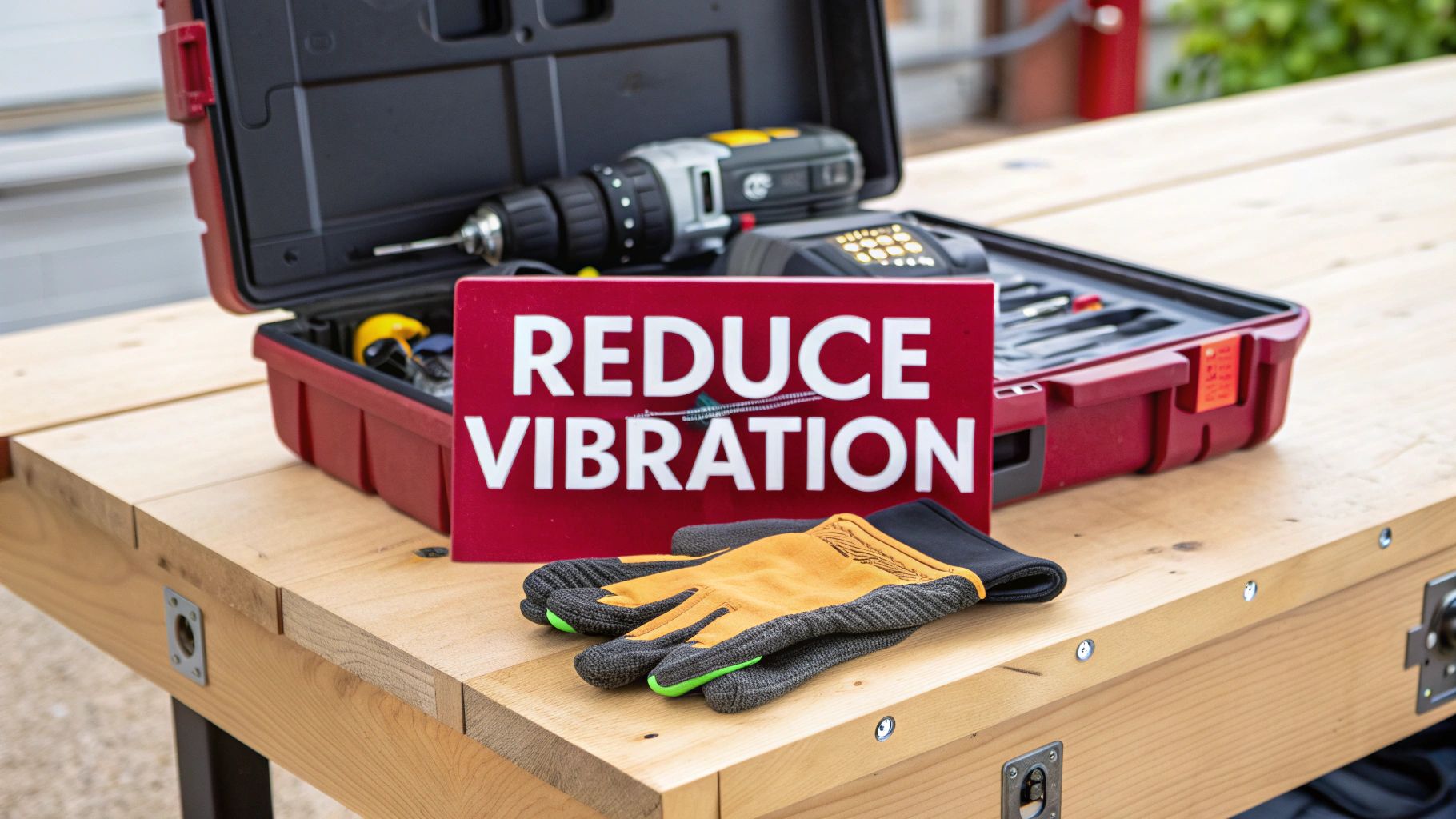
The most effective way to control a risk is to get rid of it completely. This means stepping back and asking if there's a different way to get the job done without using high-vibration tools at all. This could involve using block splitters instead of demolition saws, or exploring automation for repetitive, high-exposure tasks.
Elimination and Substitution Controls
The most powerful controls are those that remove the source of the vibration. Before anyone picks up a tool, the first question should always be: can we eliminate this task or substitute the equipment?
- Elimination: Can the task be automated? Using a remote-controlled demolition robot instead of a handheld jackhammer, for instance, completely removes the operator from harm's way.
- Substitution: Is there a tool available with a lower vibration rating for the job? Simply choosing modern, well-designed equipment with built-in anti-vibration features is one of the easiest and most effective changes you can make.
Engineering and Administrative Controls
When you can't eliminate the hazard, the next best approaches are to either engineer it out or change how the work is organised.
Engineering controls are all about modifying the equipment or process. A prime example is using a jackhammer trolley, which isolates the operator from the tool’s intense vibration. This is a key strategy for tackling some of the most common issues of what causes hand-arm vibration on a construction site.
Administrative controls, on the other hand, focus on work practices. Australia's guidance for managing HAV risks puts a strong emphasis on these sensible solutions. This includes strategies like limiting an individual's "trigger time" on a tool, implementing a "buy-low-vibration" purchasing policy, and rotating jobs. For example, if a tool vibrates at 10 m/s², a worker can only use it for a maximum of two hours to stay under the exposure limit. You can explore these controls further in the OHS Reps guide on vibration standards.
A well-designed job rotation schedule ensures no single worker bears the full burden of a high-vibration task. By spreading the exposure across the team, you can keep everyone’s individual daily vibration dose well below the action value.
Personal Protective Equipment (PPE)
Finally, we come to Personal Protective Equipment (PPE). Anti-vibration gloves are often seen as a quick fix, but it's crucial to understand their limitations. They should never be your first or only line of defence.
Research indicates that these gloves typically reduce vibration by only 5-20%, and this effect is mostly for mid-to-high frequencies. What’s worse, they can sometimes amplify the more damaging low-frequency vibrations, potentially making the risk greater. Their main benefit is keeping hands warm and dry, which improves blood circulation and provides some comfort. Think of them as a supporting player, not the main solution.
A Closer Look at High-Risk Industries
Hand-arm vibration is not a one-size-fits-all problem. The risks a construction worker faces from a jackhammer are vastly different from those a forestry worker encounters with a chainsaw. To manage this hazard effectively, we need to zoom in on the specific challenges within Australia's highest-risk sectors—construction, mining, and manufacturing—and identify solutions that work in the real world.
Each industry has its own common sources of high-vibration tools. By identifying these specific sources, we can begin to implement targeted controls that make a genuine difference to worker health and safety.
Construction and Demolition
The construction industry is notorious for high-vibration work. Tools like jackhammers, concrete breakers, and plate compactors are fundamental to many projects, but they also expose workers to some of the most intense vibration levels. This is precisely why the standard for hand-arm vibration in Australia is so critical—it pushes the industry towards smarter, safer methods of working.
One of the most effective developments has been the adoption of engineering controls, with a perfect example being the Makinex Jackhammer Trolley. Rather than merely accepting the risk, this type of innovation tackles it directly. Independent testing has demonstrated just how effective such devices can be at reducing the vibration that reaches an operator's hands.
A 2017 study revealed that moving a jackhammer from handheld operation to a trolley mount slashed the average vibration from around 9.7 m/s² down to 7.3 m/s². That's not just a number; it's a significant extension of safe working time, allowing workers to complete the job without putting their long-term health on the line.
Equipment like this physically isolates the user from the worst of the vibration, directly controlling the hazard at its source.
Mining and Quarrying
In the mining sector, workers constantly handle powerful tools like rock drills, scaling hammers, and heavy-duty bolters. The hard materials and often confined spaces can exacerbate an already serious vibration problem. For any site committed to meeting Australian safety guidance, managing this exposure must be a top priority.
Solutions in this industry often involve a smart combination of substitution and improved work practices:
- Swapping old for new: Modern pneumatic and hydraulic tools are frequently designed with sophisticated internal damping systems. Making the switch can have an immediate and significant impact.
- Smart job rotation: It sounds simple, but ensuring no single worker is assigned to a high-vibration tool for their entire shift is a powerful administrative control that reduces cumulative exposure.
- Prioritising maintenance: A well-maintained tool is a less vibratory tool. Regular servicing is not just about performance; it's a critical safety measure.
Forestry and Landscaping
For workers in forestry and landscaping, the daily toolkit often includes chainsaws, brush cutters, and hedge trimmers. While the vibration might not feel as violent as a concrete breaker, the danger lies in prolonged, cumulative use over many hours. It is surprisingly easy to exceed the daily exposure action value during a full day's work.
This is where investing in modern, low-vibration chainsaws and tools with superior ergonomic designs becomes essential. These features are not just nice-to-haves; they are crucial for protecting workers from long-term nerve, vascular, and musculoskeletal damage.
Answering Your Key Questions on Hand-Arm Vibration
Let's conclude by addressing some of the most common and practical questions we receive about hand-arm vibration. Consider this your quick-reference guide for navigating HAV risks with confidence.
What Is Hand-Arm Vibration Syndrome (HAVS)?
Hand-Arm Vibration Syndrome (HAVS), sometimes known as 'vibration white finger,' is a serious and, importantly, permanent condition caused by prolonged exposure to vibrating tools. It progressively damages the nerves, blood vessels, and joints in the hands and arms, leading to a range of debilitating symptoms.
Symptoms often begin as tingling or numbness but can develop into a crippling loss of grip strength and dexterity. Sufferers may experience painful episodes where their fingers turn white and lose all sensation, particularly when exposed to cold. As there is no cure for HAVS, prevention is the only effective strategy.
Are Employers Required to Provide Health Monitoring?
Yes, absolutely. Once your risk assessment confirms that your team is being exposed to vibration above the Exposure Action Value of 2.5 m/s² A(8), Australian WHS regulations require you to act. You have a clear legal duty to implement a health monitoring program for those affected workers.
This is not just a paperwork exercise. It must be supervised by a qualified medical practitioner and is designed to detect the very early signs of injury before they become irreversible. It serves as your critical final check to ensure that all your implemented control measures are working effectively to protect your people.
Health monitoring isn't optional—it's a mandatory part of your duty of care once that action level is crossed. It’s the safety net that prevents irreversible harm.
Can I Rely on Manufacturer Vibration Data?
Manufacturer-supplied data is a reasonable starting point for an initial risk assessment, but it's crucial to understand its limitations. The vibration values printed on the box or in the manual are typically measured under perfect, controlled laboratory conditions. That is a world away from the realities of an active worksite.
In the field, factors such as the age and condition of the tool, the type of material being worked on, and even the way an operator grips the equipment can cause vibration levels to spike dramatically. For any meaningful risk assessment, especially when your team uses high-risk tools for extended periods, there is no substitute for obtaining on-site measurements. It’s the only way to know what’s really happening on the ground.
At Anitech Ltd Pty, we provide expert occupational hygiene services to help you accurately assess and control hand-arm vibration risks. Our specialists ensure your workplace is safe, compliant, and protected. Contact us today to safeguard your team’s long-term health.


