
VOC testing is how we measure the levels of airborne chemicals, known as Volatile Organic Compounds (VOCs), in a specific area. These are the invisible gases that come off everyday items like paints, cleaning products, and even office furniture. It’s a critical step in making sure the air inside a workplace is safe to breathe and meets Australian health and safety standards.
Getting to Grips with VOCs and Why Testing is Non-Negotiable
You know that "new car smell," the sharp scent of fresh paint, or the strong aroma of a cleaning agent? What you're smelling are Volatile Organic Compounds, or VOCs. These are chemicals that easily evaporate into a gas at room temperature. Think of them as tiny particles escaping from solids and liquids, floating around and mixing with the air we breathe. While many are harmless, some can cause serious health problems, especially when you're exposed to them day in, day out in an enclosed space like an office or workshop.
This is exactly why VOC testing is so important. It’s the scientific process of capturing air samples from an environment to figure out which VOCs are present and, crucially, in what concentrations. Without this kind of analysis, you could have staff breathing in harmful substances every single day without anyone even realising it.
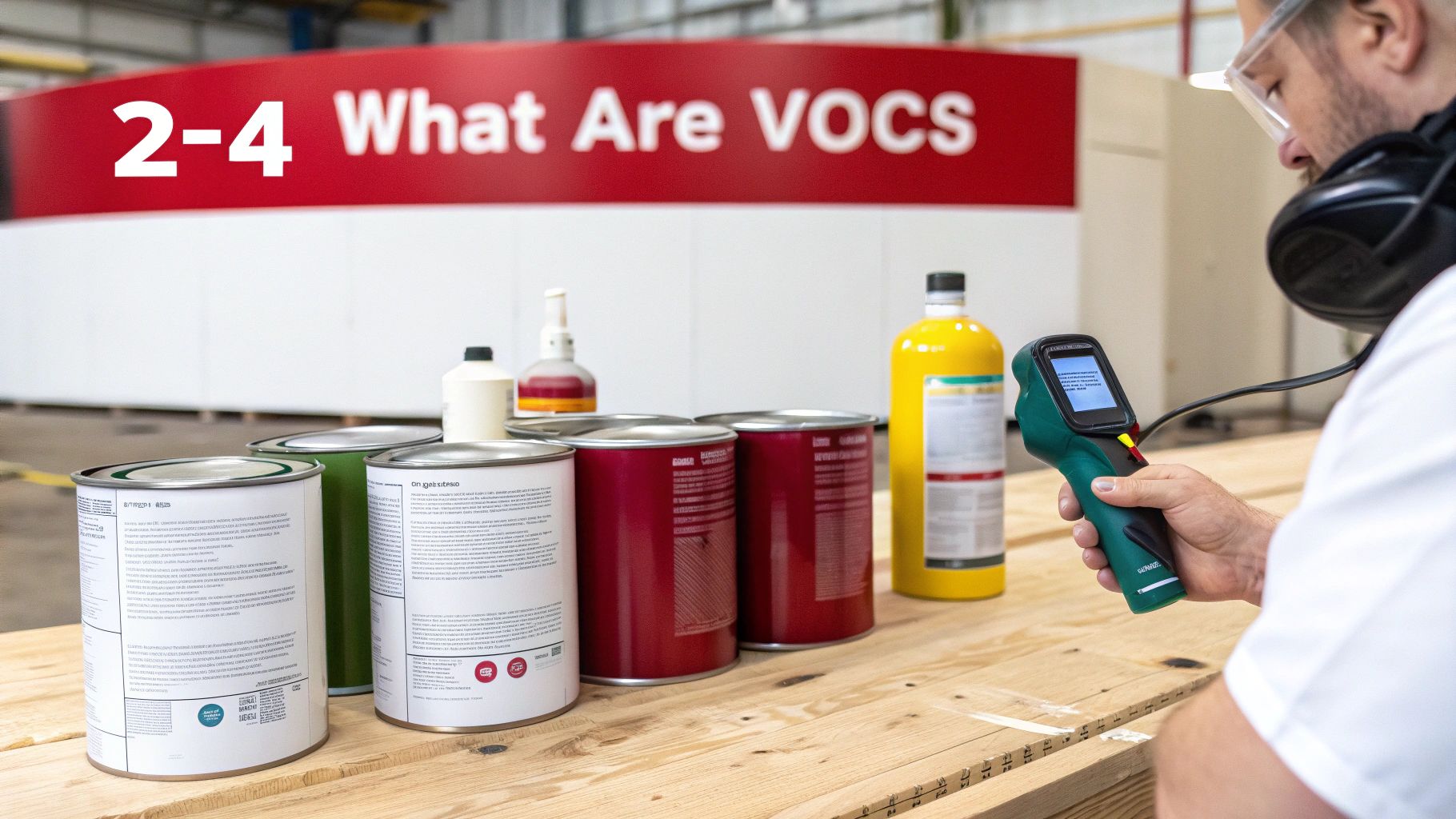
Why Your Nose Isn't a Reliable Detector
It’s a common mistake to think that if you can't smell anything, the air must be clean. The reality is that many of the most dangerous VOCs have no odour at all. On the flip side, some really pungent smells come from chemicals that are relatively benign. Trusting your sense of smell is just not a reliable or safe way to judge air quality.
On top of that, everyone reacts differently. An odour one person barely registers could give someone else headaches, dizziness, or irritate their lungs. Professional testing takes all the guesswork out of the equation.
VOC testing gives you objective, scientific data about what’s really in the air. It shifts safety from a subjective guess to a measurable certainty, which is the cornerstone of any good workplace health and safety plan.
The Bedrock of a Safe Workplace
Understanding and managing what’s floating in your workplace air is a fundamental part of providing a safe environment. This proactive mindset is a key part of the wider field of occupational hygiene, which is all about spotting, assessing, and controlling workplace hazards before they can harm people's health.
The sheer number of products containing VOCs is staggering, and many are essential for running a business. We even find volatile organic compounds in everyday products like perfume laundry detergents, so it's no surprise they are prevalent in commercial settings.
In a workplace, the sources are often more concentrated and diverse:
- Manufacturing: Think solvents, glues, and coatings used on production lines.
- Construction: Paints, sealants, glues, and materials like MDF are major sources.
- Offices: Everyday items like cleaning supplies, printer toners, and even new carpets or furniture off-gas VOCs.
By using systematic testing to pinpoint these potential hazards, a business can make informed decisions to protect its most important asset: its people. This isn't just about preventing short-term issues like headaches; it's about protecting against the serious long-term health risks that come with chronic chemical exposure.
The Real Risks of Ignoring VOCs in Your Workplace
Turning a blind eye to Volatile Organic Compounds in your workplace isn't just a minor oversight; it's a serious gamble with the health of your people and the stability of your business. The fallout from unchecked VOCs can impact everything from staff wellbeing and productivity right through to your legal compliance and public image. A proactive VOC testing program is the only way to get a handle on these invisible threats.

The first warning signs are often the immediate health effects of high VOC concentrations. These acute symptoms can pop up suddenly and are easily mistaken for everyday complaints like a cold or simple fatigue.
But make no mistake, these are direct physiological responses to chemical exposure. They are your body's alarm system, signalling that something in the air is causing harm.
Immediate and Long-Term Health Dangers
When VOC levels spike, your employees can experience a whole raft of short-term symptoms that get in the way of them working safely and effectively. It’s so important to see these signs not as one-off complaints, but as potential clues to a much bigger air quality problem.
Common acute effects of VOC exposure include:
- Respiratory Irritation: A nagging cough, sore throat, or shortness of breath can be a direct result of irritant compounds inflaming the airways.
- Headaches and Dizziness: Many solvents and chemicals mess with the central nervous system, bringing on headaches, light-headedness, and even nausea.
- Eye and Skin Irritation: Direct exposure to VOCs can cause stinging eyes, blurry vision, and painful skin rashes.
As worrying as these immediate effects are, the truly insidious danger of ignoring VOCs is the chronic, long-term health damage from repeated exposure. These conditions are far more severe and, tragically, often irreversible.
Over time, persistent exposure to certain VOCs, such as benzene and formaldehyde, is linked to severe health outcomes, including damage to the liver, kidneys, and central nervous system, and an increased risk of certain cancers. This transforms a workplace hazard into a lifelong health burden.
The Legal Imperative of WHS Compliance
Beyond the clear moral duty to protect your people, there’s a strict legal one. In Australia, Work Health and Safety (WHS) laws aren't just suggestions; they are legally binding regulations that compel employers to provide a safe working environment. That absolutely includes making sure the air is free from harmful levels of chemical substances.
Regular VOC testing is a cornerstone of meeting this duty of care. It gives you the hard data needed to prove you are actively monitoring and controlling workplace hazards, just as the law demands.
Failing to comply can lead to serious consequences, including massive fines and, in the worst cases, prosecution. This legal risk alone should put a structured testing program at the top of your priority list. It’s also about investing in a skilled and safe team, which aligns with national goals for a productive workforce. For instance, the primary driver for 72.8% of students finishing vocational education in 2024 was directly employment-related, highlighting the importance of a safe and secure career path. You can discover more insights about the Australian VET system on the Productivity Commission's website.
Protecting Your Business and Reputation
A genuine commitment to health and safety pays dividends that go far beyond just ticking a legal box. A workplace with a reputation for being safe and healthy will always have an edge in attracting and keeping top talent. This proactive stance also polishes your company’s image as a responsible corporate citizen.
What’s more, a solid VOC testing and control program delivers tangible business improvements:
- Reduced Absenteeism: By heading off both short-term sickness and chronic illness, you can see a real drop in sick days.
- Increased Productivity: It’s simple. Healthy, safe workers are more focused, more engaged, and get more done.
- Lower Legal and Insurance Costs: Getting on the front foot with risk management dramatically cuts your chances of facing expensive workers' compensation claims and legal battles.
At the end of the day, investing in regular VOC testing is an investment in the long-term health of your people and the sustainable success of your business. It's a non-negotiable for any modern, responsible organisation.
Getting to Grips with Australian Workplace Exposure Standards
Just knowing VOCs are in the air isn't enough; you need to know if the levels are dangerous. That’s where the official benchmarks come in. In Australia, our go-to guide is the Workplace Exposure Standards (WES), published and updated by Safe Work Australia. These standards aren't just recommendations—they're the legal limits for airborne chemicals and draw a clear line in the sand between a safe and an unsafe workplace.
Think of the WES like a speed limit. It’s not just a random number; it's backed by scientific evidence and designed to protect the health of an average worker over their entire career. Staying within these limits isn't optional—it's a core requirement under Australian Work Health and Safety (WHS) law. And the only way to prove you’re on the right side of that line is with a professional VOC testing program.
Key Exposure Limits Explained
When you get a VOC testing report back, you’ll see a few key terms. They might look technical at first, but the ideas behind them are pretty simple. The two most critical numbers you’ll be looking at are the TWA and the STEL.
-
Time-Weighted Average (TWA): This is the maximum average concentration of a chemical a worker can be exposed to over a standard eight-hour workday, five days a week, without any known ill effects. You can think of it as a worker's 'daily dose limit'. It accounts for the fact that exposure levels will naturally rise and fall during a shift, but ensures the overall average stays safely below the threshold.
-
Short-Term Exposure Limit (STEL): This is a much tighter limit, measured over just 15 minutes. The STEL is designed to protect workers from the immediate, acute effects of a chemical. It’s like a 'sprint limit' – preventing those short, sharp spikes in concentration that could cause dizziness, irritation, or seriously impair someone's ability to work safely, even if the eight-hour average is fine.
It’s absolutely critical to remember that TWA and STEL aren't interchangeable. You could be perfectly compliant with the eight-hour TWA, but a sudden, intense spike could blast past the STEL, putting your workers in immediate danger.
Common VOCs and Their Australian Workplace Exposure Standards
Not all VOCs are created equal. Some are far more hazardous than others, which is why each chemical gets its own specific TWA and STEL. A highly toxic substance will have a very low exposure limit, while a less harmful one will have a higher one. This ensures the safety measures you put in place are directly proportional to the risk.
To bring this to life, here are some common VOCs you might find in an Australian workplace, along with their official limits set by Safe Work Australia. This table shows how the standards give safety managers clear, measurable targets to aim for.
| VOC Name | Common Sources | TWA (ppm) | STEL (ppm) |
|---|---|---|---|
| Acetone | Solvents, paint removers, cleaners | 500 | 1000 |
| Benzene | Crude oil, petrol, plastics, resins | 1 | 2.5 |
| Formaldehyde | Resins, adhesives, pressed wood products | 1 | 2 |
| Toluene | Paints, lacquers, glues, printing | 50 | 150 |
| Xylene | Solvents, paints, printing inks | 80 | 150 |
As you can see, a known carcinogen like Benzene has an incredibly low TWA of just 1 ppm, reflecting its severe health risk. Acetone, which is far less toxic, has a much higher allowance. This data-driven framework is the backbone of good risk management. A proper VOC testing strategy is all about measuring your workplace air against these exact figures, turning complex chemical safety into a clear, manageable process.
How Professional VOC Sampling and Analysis Works
Figuring out that you need to measure VOCs is one thing; understanding how the pros actually do it is another. Professional VOC testing isn't as simple as waving a detector around in the air. It’s a precise, multi-stage process designed to give you accurate, defensible data that will stand up to scrutiny from regulators.
The whole process really breaks down into two main phases: collecting the sample on-site and analysing it back in the laboratory. Think of it like a detective at a crime scene. First, they have to carefully bag the evidence (the air sample), and only then can they take it back to the lab for detailed forensic analysis to identify the culprits (the specific VOCs).
On-Site Evidence Collection: Sampling Methods
The method a hygienist chooses to collect an air sample is never one-size-fits-all. It depends entirely on the situation—what chemicals are suspected, their likely concentrations, and even the work patterns of your team. The two main approaches are active and passive sampling.
Active Sampling: The Targeted Approach
Active sampling is like using a tiny, highly specialised vacuum cleaner. The hygienist uses a small, battery-operated pump calibrated to pull a very precise volume of air through a sorbent tube over a specific time. This tube is packed with a material like activated charcoal, which acts like a chemical magnet, trapping VOC molecules as the air flows past.
This method is the go-to choice for:
- Short-Term Snapshots: Perfect for capturing data for Short-Term Exposure Limit (STEL) assessments, which typically look at exposure over a 15-minute window.
- Targeted Investigations: When you have a strong suspicion about a specific chemical and need to know its exact concentration, active sampling delivers fast, precise results.
- Detecting Trace Amounts: By pulling a large, known volume of air through the tube, this method can accurately detect even very low levels of contaminants.
Passive Sampling: The Silent Witness
Passive sampling, on the other hand, works more like a sponge. It involves a small badge or monitor, often worn on a worker's collar, that contains a sorbent material. There's no pump involved here. Instead, it relies on the natural movement of air—a process called diffusion—for VOCs to land on and be absorbed by the sorbent material. This is usually done over a much longer period, like a full eight-hour shift.
Passive sampling is an excellent way to measure a worker's average exposure over their entire workday, making it perfectly suited for comparison against Time-Weighted Average (TWA) exposure limits. It’s less intrusive for the worker and gives a brilliant overall picture of a typical day's exposure.
Inside the Lab: The Analysis Phase
Once the sample—whether it's a sorbent tube or a passive badge—is collected, it's carefully sealed and sent off to an accredited laboratory. This is where the real magic happens. The most common and powerful technique used to analyse VOCs is called Gas Chromatography-Mass Spectrometry (GC-MS).
If that sounds complicated, just think of GC-MS as a highly advanced sorting and identification system.
-
Gas Chromatography (GC): First, the trapped chemicals are released from the sorbent material, usually with heat or a solvent. This vapour is then injected into a long, thin, coiled tube (the chromatograph). As the mixture travels through the tube, different chemicals move at different speeds, which effectively separates the complex mix into its individual components.
-
Mass Spectrometry (MS): As each separated chemical exits the GC tube, it flies straight into the mass spectrometer. Here, it gets zapped with electrons, which shatters the molecule into charged fragments. The machine then measures the mass of these fragments, creating a unique chemical "fingerprint" for that specific substance.
The lab's software compares these unique fingerprints against a massive database of known chemicals. This allows them to identify each VOC with incredible precision and calculate its exact concentration in the original air sample. This detailed process is what makes professional VOC testing so reliable and accurate.
By combining meticulous on-site sampling with powerful laboratory analysis, occupational hygienists can paint a clear, accurate picture of the airborne chemical risks in your workplace. If you suspect your workplace needs this level of detailed analysis, your best bet is to partner with a professional VOC testing company to ensure the job is done right.
Turning Your Test Results into Actionable Safety Plans
Getting that detailed lab report back from your VOC testing is a significant step, but it’s really just the starting line. The true value comes from turning that data into a practical, robust safety plan that actually protects your people. It’s about transforming abstract numbers on a page into concrete actions that make a tangible difference.
First things first: you need to benchmark your findings against the legal standards. This means comparing every single result directly against the Australian Workplace Exposure Standards (WES). You’ll be looking at the Time-Weighted Average (TWA) for each chemical to gauge exposure over a full shift, and the Short-Term Exposure Limit (STEL) for any tasks that involve brief, high concentrations. This simple comparison immediately tells you where you stand—are you well within safe limits, or are you creeping up to (or even past) a legal threshold?
This infographic offers a straightforward way to think about selecting the right sampling method based on what you expect to find.

As you can see, high-concentration environments usually need active sampling for precise, immediate measurements. On the other hand, lower, ambient levels can often be monitored just as effectively with passive sampling over a longer period.
Responding to Your Results
How you respond depends entirely on what the numbers say. If all your measured VOC levels are comfortably below the WES, your main job is maintenance. Document the results, make sure your current safety controls (like ventilation and work procedures) are working as they should, and schedule your next round of testing.
But if any result gets close to or exceeds an exposure standard, it’s time for immediate and decisive action. This is where a methodical approach known as the hierarchy of controls becomes your most important tool. It’s a framework that forces you to prioritise the most effective and permanent solutions first.
The hierarchy of controls isn’t a pick-and-choose menu. It’s a top-down model that legally requires you to start with the most effective control measure you can before moving down to less effective, but still necessary, safeguards.
This structured response is a fundamental part of any thorough chemical risk assessment, ensuring your actions are logical, compliant, and genuinely protective.
Applying the Hierarchy of Controls
When your VOC testing flags a problem, you need to work your way down the hierarchy to find the right fix for your workplace. The goal is always to control the hazard at its source whenever possible.
-
Elimination: Can you get rid of the hazardous substance completely? This is the gold standard. Changing a process so the chemical is no longer needed removes the risk entirely. It’s the ultimate solution.
-
Substitution: If you can't eliminate the chemical, can you swap it for something safer? Switching from a high-VOC, solvent-based paint to a water-based one is a classic example. This can dramatically reduce emissions without changing the outcome of the work.
-
Engineering Controls: When you’re stuck with the chemical, you have to physically separate people from the hazard. This means installing or upgrading equipment. For VOCs, common engineering controls include local exhaust ventilation (LEV) systems that capture fumes right where they’re produced or enclosing a process to stop vapours from escaping into the wider work area.
-
Administrative Controls: These are all about changing the way people work. Think about rotating staff through high-exposure tasks to limit any one person's TWA, creating restricted 'no-go' zones, or beefing up training on safe chemical handling. This is also where skilled training becomes vital. It’s no surprise the Australian Technical and Vocational Education and Training market, projected to hit USD 19.4 million in 2024, is on track to more than double by 2030, reflecting a huge national focus on upskilling.
-
Personal Protective Equipment (PPE): This is your last line of defence, never your first. If a risk still exists after you’ve tried everything else, you must provide appropriate PPE, like respirators fitted with the correct chemical cartridges. Remember, PPE only protects the person wearing it; it does nothing to reduce the actual hazard in the environment. That’s why it’s always the last resort.
By systematically working through these controls, you build an action plan that doesn’t just tick a compliance box—it shows a genuine, demonstrable commitment to keeping your workers healthy and safe.
A Few Common Questions About VOC Testing
Even after getting your head around the science and the regulations, a few practical questions always pop up when it's time to actually get a VOC testing program running. Let's walk through some of the most common queries we hear from managers, safety officers, and business owners.
Think of this as the practical, real-world side of managing airborne chemical safety. We'll cover everything from how often you should be testing to what to do when the results land on your desk.
How Often Should We Be Doing VOC Tests?
There’s no magic number here. The right frequency for VOC testing really comes down to your specific workplace, the chemicals you’re handling, and the risks involved. A cookie-cutter calendar just doesn't work.
The best approach always starts with initial baseline testing. This gives you a snapshot of the air quality as it stands today, creating a benchmark you can measure everything against later. It’s how you find your potential hotspots and figure out what "normal" actually looks like for your site.
Once that baseline is locked in, your schedule should be driven by events. In other words, you need to re-test any time something significant changes that could mess with the concentration of VOCs in the air.
You should definitely schedule follow-up tests if you:
- Bring in new chemicals: A new solvent, adhesive, or cleaning agent has an unknown impact until you measure it.
- Change your process: Altering a manufacturing line, speeding up production, or even just moving equipment around can completely change how and where vapours are released.
- Tweak your ventilation: Any upgrades, adjustments, or even a breakdown in your ventilation system means you need to re-test to make sure it's still doing its job properly.
And, of course, if a worker reports symptoms that could be linked to chemical exposure—like ongoing headaches, dizziness, or a nagging cough—immediate VOC testing is a non-negotiable part of your investigation. For high-risk areas where you’re using hazardous VOCs all the time, setting up a regular schedule, maybe annually, is a smart way to ensure your safety controls are holding up.
What's the Difference Between Personal and Area Sampling?
This is a great question, because personal and area sampling answer two very different things. The real difference is who or what you're measuring the exposure for.
Personal sampling is the gold standard for figuring out what an individual worker is actually breathing in. It's done by clipping a small, lightweight sampling device right in their "breathing zone"—the air immediately around their nose and mouth. This little device travels with them all day, collecting a sample of air as they do their job, move around the site, and go about their shift.
When it comes to checking exposure against a worker's legal Time-Weighted Average (TWA) limit, personal sampling gives you the most accurate and legally defensible data. It measures their personal "dose," which is exactly what Workplace Exposure Standards are all about.
Area sampling, on the other hand, is static. The sampler is placed in a fixed spot, maybe in the middle of a room or right next to a piece of equipment. It measures the general concentration of a VOC in that specific spot over time.
This method is incredibly useful for other tasks, like:
- Pinpointing emission sources: Setting up a few samplers can help you track down exactly which machine or process is pumping out the most fumes.
- Checking if ventilation is working: You can see if your local exhaust vent is actually capturing contaminants before they escape into the wider workspace.
- Gauging background levels: It gives you a good sense of the ambient air quality in a particular space.
But here’s the key takeaway: area sampling doesn't tell you what a specific person is breathing. Depending on how close they work to the source and how much they move around, a worker’s real exposure could be much higher (or lower) than the area sample suggests. For compliance and true risk assessment, personal sampling is always the way to go.
What Do We Do If Our VOC Test Results Are Over the Limit?
Getting a report showing you’ve exceeded a legal Workplace Exposure Standard (WES) is serious, and it requires you to act immediately and methodically. Your first and only priority is the health of your people.
The very first thing you do is communicate. You have to let the affected workers know about the results, which chemical is involved, and what the potential health risks are. This isn’t just good manners; it’s a legal requirement.
Next, you need to roll out a control plan based on the hierarchy of controls. This isn't just a suggestion—it's the legally required framework for managing workplace hazards in Australia.
Your action plan must follow this order:
- Elimination or Substitution: Can you get rid of the hazardous chemical entirely? If not, can you swap it for a safer, low-VOC alternative? This is always the best option.
- Engineering Controls: If you can't eliminate or substitute, you bring in physical controls. This usually means installing or improving ventilation, like adding a local exhaust system to capture fumes at the source or enclosing the process.
- Administrative Controls: These are changes to how people work. You might rotate staff through a high-exposure area to limit their time there, or create exclusion zones.
- Personal Protective Equipment (PPE): Things like respirators with the right chemical cartridges are the last line of defence. PPE is a temporary fix to protect workers while you’re putting in place better, more permanent controls.
Once your new controls are in, you're not done. You are required to conduct follow-up VOC testing to prove that your changes worked and that exposure levels are now safely under the legal limit. This crucial final step closes the loop and gives you documented proof that you’ve managed the risk.
Can We Just Use a DIY VOC Testing Kit?
You’ve probably seen DIY VOC testing kits for sale online, and while they might be interesting for checking the air in your home, they are completely unsuitable for workplace compliance in Australia. They simply don't have the accuracy or reliability needed for occupational hygiene.
Workplace Health and Safety (WHS) regulations are crystal clear: air monitoring for compliance must be done by a competent person. That means a qualified occupational hygienist who knows how to design a sampling strategy, uses professionally calibrated gear, and sends samples to a NATA-accredited lab for proper analysis.
DIY kits just don't make the grade for several reasons:
- They’re not specific: Most consumer kits give you one reading for "Total VOCs" (TVOCs). The problem is, they can’t tell you which chemicals are present. A high reading could be from something harmless, while a dangerously high level of a toxic chemical like benzene could be hidden in a low overall reading.
- Their accuracy is questionable: These devices aren't held to the same strict calibration standards as professional equipment. The results aren't reliable and wouldn't stand up in a legal setting.
- You get data, not answers: A professional hygienist provides an expert interpretation of the lab report, comparing the numbers to legal standards and explaining what they mean for your workplace. A number from a DIY kit without that expert context is pretty much useless for making real safety decisions.
When it comes to meeting your legal obligations and genuinely protecting your workers, you must bring in a professional occupational hygiene service. Using a DIY kit for compliance creates a false sense of security and leaves your business completely exposed.
At Anitech, we provide expert occupational hygiene services across Australia, helping businesses ensure their workplaces are safe, healthy, and fully compliant with all regulations. Our team of specialists offers professional VOC testing and clear, actionable advice to protect your most valuable asset—your people. To learn how we can support your workplace safety goals, visit us at our official website.


