
VOC testing services are designed to pinpoint and measure the invisible chemicals floating around in our indoor air. These are known as Volatile Organic Compounds (VOCs), and they’re released by everyday items like paint, new furniture, and even cleaning products. Getting the air tested is a crucial step in making sure your home or workplace is safe and meets health standards.
What Are VOCs and Why Is Testing So Important?
You know that distinct smell you get from a freshly painted room, a new car, or brand-new furniture? That scent is often the result of Volatile Organic Compounds—or VOCs for short—being released into the air. Think of them as invisible chemical hitchhikers, escaping from everyday items and dispersing into the spaces where we live and work.
At a basic level, VOCs are carbon-based chemicals that turn into a gas very easily at room temperature. Because they’re found in so many products, they're a major cause of indoor air pollution. In fact, concentrations of many VOCs can be up to ten times higher indoors than outdoors.
The Hidden Sources Right Under Our Noses
The real challenge with VOCs is just how common they are. They're given off by thousands of products we use daily, often without us even thinking about it. Knowing where they come from is the first step to understanding why a professional assessment is a smart move.
Common culprits for indoor VOC emissions include:
- Building Materials and Furnishings: Paints, varnishes, glues, carpets, vinyl flooring, and manufactured wood products like MDF are all big offenders.
- Household Products: Cleaning supplies, disinfectants, air fresheners, and cosmetics can release a whole cocktail of different VOCs.
- Office Equipment: Things like printers, copiers, and even correction fluids can emit chemicals when they're running.
- Hobbies and Crafts: Glues, permanent markers, and other supplies used for hobbies can also be significant sources.
Paint is a perfect example. That strong smell is a clear sign of VOCs being released, and it’s a common trigger for indoor air quality concerns. If you're looking for quick fixes, there are some helpful tips for managing common paint odors that can offer temporary relief. But for a real solution, you need to know exactly what you're dealing with.
The Urgent Need for Professional VOC Testing Services
While dealing with obvious smells is a good start, the most dangerous thing about VOCs is that many of them are completely odourless. This is where professional VOC testing services become absolutely essential. You can't manage a risk you can't measure. Without solid data, trying to create a healthy indoor environment is just pure guesswork.
The real goal of VOC testing is to stop guessing and start acting. It gives you the clear, scientific data you need to identify specific chemical pollutants and their concentrations, paving the way for targeted fixes that actually improve your air quality.
Testing isn’t just about finding problems; it’s about protecting people's health. Short-term exposure to high levels of some VOCs can cause immediate issues like headaches, dizziness, and eye, nose, and throat irritation. The long-term effects are far more worrying, though, with potential links to chronic respiratory diseases and other serious health conditions. Professional testing gives you the insight needed to properly tackle these risks. For a closer look at what’s involved, you can learn more about comprehensive indoor air quality and VOC testing services that help create safer spaces for everyone.
Navigating VOC Health Risks and Regulations
It’s one thing to know VOCs are around, but it’s another to truly grasp the risks they pose to our health and to business operations. These invisible chemicals aren't just a minor annoyance; they're a serious health hazard and a major focus for regulators. Ignoring them means turning a blind eye to a direct threat to employee wellbeing and failing to meet your legal duties.
The link between VOCs and health problems is crystal clear. When we breathe them in, these chemicals can set off a whole range of reactions. How they affect someone depends on the specific VOC, how concentrated it is, and how long they've been exposed. This is precisely why proactive VOC testing services are so essential for any responsible organisation.
The Immediate and Long-Term Health Consequences
Even short-term exposure to high levels of VOCs can cause symptoms you'll notice right away. People often brush these off as everyday complaints, but they’re actually early warnings of poor indoor air quality.
Common short-term effects include:
- Irritation of the eyes, nose, and throat
- Headaches and feeling dizzy
- Nausea and vomiting
- Making asthma symptoms worse
While these might seem temporary, being exposed again and again over time can lead to far more serious health problems. The long-term risks are where the real danger is. Chronic exposure has been linked to severe damage to the liver, kidneys, and central nervous system. Some VOCs, like formaldehyde and benzene, are even known to cause cancer in humans.
For a business, this isn't just about health; it's a major liability. A workplace with bad air can tank productivity, drive up sick days, and even lead to legal action from employees. Protecting your team's health is directly tied to protecting your business.
For homeowners wanting to cut down on indoor air pollutants, looking into top non-toxic paint brands is a great first step. Making a simple choice like this can significantly reduce a major source of harmful emissions right from the start.
Staying Compliant with Australian Regulations
Beyond the health side of things, Australian businesses have to navigate a complex web of regulations. Bodies like Safe Work Australia set clear workplace exposure standards for airborne contaminants to keep workers safe. These aren't just guidelines—they are legally binding limits.
Failing to comply can lead to serious consequences, including hefty fines and even being forced to shut down. The only reliable way for a business to know for sure that it's meeting these legal requirements is through professional VOC testing services. This testing provides the hard evidence you need to prove you’ve done your due diligence and are committed to a safe workplace.
Key regulations businesses need to be aware of include:
- Workplace Exposure Standards (WES): These set the maximum concentration of a specific chemical a worker can be exposed to over a certain time without harm.
- Hazardous Chemicals Regulations: Businesses are required to identify risks from hazardous chemicals (which includes many VOCs), put control measures in place, and train their staff properly.
- Duty of Care: At its core, every employer has a legal duty to provide a safe work environment, and that absolutely includes clean, safe air.
Ultimately, managing these risks isn't just about dodging penalties. It's about building a safe, healthy, and productive environment for everyone. By investing in professional VOC testing, businesses can stop guessing and start acting, protecting their people and their reputation with confidence. It’s a non-negotiable tool for any forward-thinking organisation.
Understanding Professional VOC Testing Methods
So, how do experts actually pinpoint and measure these invisible chemicals floating around? To really grasp the value of professional VOC testing services, you need to peek behind the curtain at the science they use. This isn't about guesswork; it's a precise, scientific investigation to uncover exactly what’s in your environment.
Think of it like this: you have a massive bin of mixed recycling. Just weighing the bin tells you something is in there, but it doesn't tell you what it is or how much plastic, glass, or paper you have. Advanced lab techniques are the sophisticated sorting machine that separates every single item, identifies it, and gives you a perfect count. That's exactly what high-tech methods do for the air you breathe.
The Core of Professional VOC Analysis
At the heart of most professional VOC testing is a powerhouse technique called Gas Chromatography-Mass Spectrometry (GC/MS). The name sounds like a mouthful, but the idea is actually quite simple.
The "Gas Chromatography" part does the sorting. It takes the complex mixture of VOCs in an air sample and separates them into individual chemicals, just like our recycling machine separates plastic from glass.
Then, "Mass Spectrometry" kicks in. This part acts like a high-tech scanner, identifying each separated chemical by its unique molecular fingerprint. This dual process doesn't just tell you that VOCs are present; it names names—like formaldehyde or benzene—and measures their exact concentration. This incredible level of detail is what sets a professional assessment miles apart from a basic off-the-shelf air quality monitor.
The power of professional VOC testing lies in its specificity. It moves beyond a simple "good" or "bad" air quality reading to provide a detailed chemical breakdown, which is essential for identifying health risks and ensuring regulatory compliance.
Active vs. Passive Sampling: What's the Difference?
When a technician arrives on-site, they won't just wave a wand around. They’ll choose a specific method to collect air samples, and the two main approaches are active and passive sampling. Each has its place, and understanding them helps clarify what to expect during an assessment.
Before we dive into the methods, it's important to see the bigger picture. Unchecked VOCs can create a domino effect of problems, as the infographic below shows.
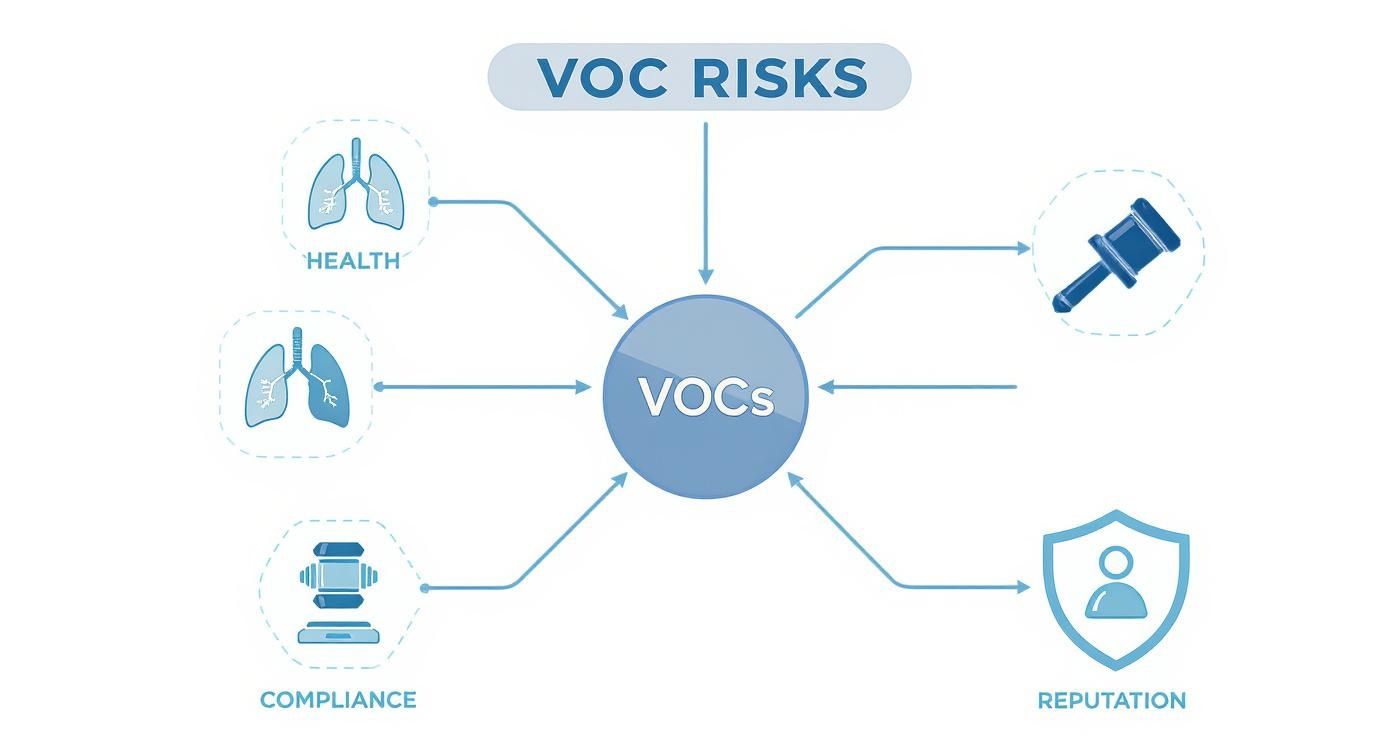
This visual really drives home how a single issue—unmanaged VOCs—can spiral into health, compliance, and reputational nightmares, making proper testing a critical risk management tool.
Methods for Capturing Air Samples
The way a sample is collected is just as important as how it's analysed. Here’s a look at the most common methods and when they’re used.
Comparison of Common VOC Testing Methods
To help clarify which approach might be right for you, this table breaks down the three primary testing methods, outlining their best use cases, key advantages, and potential limitations.
| Testing Method | Primary Use Case | Advantages | Limitations |
|---|---|---|---|
| Active Air Sampling | Workplace compliance checks and short-term environmental monitoring. | Highly accurate and precise; provides a "snapshot" of a specific time and place. | Can be intrusive (pump noise); reflects only the period of sampling. |
| Passive Sampling | Measuring long-term personal exposure (e.g., an 8-hour work shift). | Unobtrusive and easy to deploy; excellent for TWA (Time-Weighted Average) exposure. | Less precise for short-term spikes; relies on natural air movement. |
| Chamber Testing | Certifying product emissions for manufacturers (e.g., furniture, flooring). | Provides highly controlled, repeatable data on a specific product's off-gassing. | Doesn't measure a real-world environment; can be costly and time-consuming. |
Each method provides a different piece of the puzzle, and a skilled testing provider will know exactly which one to use to get you the answers you need.
A Closer Look at Each Method
1. Active Air Sampling
This is the go-to method for most workplace or environmental assessments. It involves using a calibrated pump to actively pull a known volume of air through a collection tube filled with a special material (a sorbent). Think of it like using a vacuum cleaner with a very specific filter to capture invisible dust. Because it measures a precise quantity of air over a set time, it gives an incredibly accurate snapshot of airborne concentrations at that moment. This makes it perfect for checking against official workplace exposure standards.
2. Passive Sampling
Passive samplers, often small badges, work quite differently. They don't use a pump. Instead, they rely on the natural movement and diffusion of air to collect contaminants over a longer period, usually from eight hours to several days. You'll often see these clipped to an employee's collar to measure their personal exposure over a full shift. While not as precise for capturing sudden spikes, they are brilliant for understanding a person’s average exposure over time and are far less intrusive.
3. Chamber Testing for Product Emissions
Sometimes, the goal isn't to test the air in a room, but to find out what a specific product is putting into the air. This is where chamber testing shines. A product—say, a new office chair or a roll of carpet—is placed inside a sealed, climate-controlled stainless-steel chamber. Clean air is circulated through it, and samples are taken over time to measure the rate at which the product emits VOCs. This is the gold standard for manufacturers needing to certify their products as low-VOC or to meet green building standards like Green Star.
Ultimately, the right method depends entirely on your goal. A factory needing to prove it complies with Safe Work Australia exposure limits will almost certainly need active sampling. A furniture maker wanting to sell to architects will need chamber testing to back up its "low-emission" claims. A truly reliable VOC testing service will listen to your concerns and recommend the method that delivers accurate, relevant, and actionable data.
How Different Industries Rely on VOC Testing
The science is fascinating, but where the rubber really meets the road is in how VOC testing services solve real-world problems. This isn't just about abstract chemistry; it’s a practical tool that businesses use every day to keep people safe, maintain quality control, and stay ahead of the curve.
From the dust of a construction site to the sterile corridors of a hospital, the applications are as diverse as the industries themselves. Testing takes the invisible threat of chemical exposure and makes it visible, giving you the hard data needed to turn vague concerns into targeted, effective solutions.
Construction and Green Building Certification
For anyone in the building game, creating healthy indoor spaces has shifted from a nice-to-have to a non-negotiable. We're building more energy-efficient, tightly sealed buildings than ever before, which is great for power bills but can be a disaster for air quality. Without proper management, these airtight envelopes can trap VOCs off-gassing from new paints, adhesives, flooring, and cabinetry.
This is exactly where VOC testing services come in. Testing is absolutely essential for:
- Nailing Green Building Standards: Certifications like Green Star in Australia have incredibly strict benchmarks for indoor air quality. Post-construction VOC testing is often a mandatory hurdle to prove a building meets these low-emission targets, which adds massive value and market appeal to the property.
- Protecting Occupant Health: A builder's reputation is built on the quality of their work. Testing provides the peace of mind that a new home or office is safe from day one, helping to sidestep complaints and potential liability linked to "sick building syndrome."
- Verifying Low-VOC Materials: It’s one thing to specify low-VOC paints and carpets in your plans; it's another to confirm they perform as advertised on-site. Testing holds suppliers accountable and ensures the final product is as healthy as you designed it to be.
Manufacturing and Worker Safety
Step onto any factory floor, and you'll find potential VOC sources everywhere. Solvents, cleaning agents, coatings, and various raw materials can release significant levels of chemicals into the air. For manufacturers, whether they're making furniture or electronics, managing these emissions is a critical balancing act between product quality and worker safety.
Imagine an office manager getting a sudden spike in staff complaints about headaches and eye irritation. A VOC testing service can quickly pinpoint the culprit—perhaps a new shipment of office chairs or recently laid carpet—allowing them to take swift action, like boosting ventilation or removing the source. It solves the immediate health problem and sends a clear message that they value their team's wellbeing.
For manufacturers, VOC testing is a fundamental part of risk management. It’s not just about ticking a box for Safe Work Australia; it’s about creating a safe, productive environment where your team isn’t exposed to hidden chemical dangers.
Product certification is another huge application. A furniture designer wanting to market their new product line as ‘eco-friendly’ can use chamber testing to get concrete data proving it has low emissions. This kind of verification is a powerful marketing tool, resonating with health-conscious consumers and commercial buyers who put a premium on sustainability.
Healthcare and Sensitive Environments
In places like hospitals, clinics, and aged care facilities, the standards for indoor air quality are at their absolute highest. Patients are often dealing with compromised immune systems, which makes them far more susceptible to the harmful effects of airborne chemicals.
Professional VOC testing services are non-negotiable in these settings. They are used to:
- Identify and eliminate VOC sources from powerful cleaning products, disinfectants, and even medical equipment.
- Ensure that renovation or building works don't contaminate patient care areas with harmful new materials.
- Maintain a sterile and safe atmosphere, which is a cornerstone of patient recovery and positive health outcomes.
Sometimes, indoor air quality issues are complex, involving more than just VOCs. To get a better sense of how professionals untangle these situations, you can find more information on integrated mould and VOC testing methodologies.
Commercial and Office Spaces
The modern office is packed with potential VOC sources. Printers and their toner, cleaning chemicals, new carpet tiles, and even the humble permanent marker all contribute to the chemical cocktail in the air. Poor air quality has been directly linked to a drop in cognitive function and productivity—what many now refer to as "sick building syndrome."
Forward-thinking businesses are now using VOC testing to create workspaces optimised for both health and high performance. It's a proactive move that does more than just boost morale; it can reduce absenteeism and foster a genuine culture of wellness. In the end, regular air quality testing is a smart investment in a company's most important asset: its people.
Making Sense of Your VOC Testing Report
Getting a technical document packed with chemical names, acronyms, and figures can be a bit daunting. But your VOC testing report isn't just a jumble of data; it's a practical tool to help you create a safer, healthier indoor space. The real skill is learning how to turn those numbers into meaningful insights.
Let's walk through what you’ll find in a typical report from professional voc testing services. We'll cut through the jargon so you can move from complex data to clear, confident decisions for your workplace.
Decoding Key Terms and Metrics
At first glance, your report might seem like another language. Once you get a handle on a few key terms, everything starts to click into place.
- Analyte or Compound: This is just the technical term for the specific VOC that was found. Think Benzene, Formaldehyde, or Toluene.
- Concentration Level: This is the heart of the report. It tells you exactly how much of a particular VOC is in the air, usually measured in micrograms per cubic metre (µg/m³).
- Detection Limit (DL): This is the lowest amount of a substance the lab equipment can accurately pick up. If a VOC is listed as "below detection limit," it was either absent or the amount was so minuscule it couldn't be properly measured.
A good way to think about the concentration level is like the volume on a stereo. A low number is like quiet background music—you know it’s there, but it’s not a problem. A high number is like music blaring at full volume—it’s impossible to ignore and could be doing some damage.
Comparing Results to Safety Benchmarks
Knowing a VOC's concentration is one thing, but you need context to understand if it’s actually a problem. This is where your report gets truly useful, by comparing your results against established safety benchmarks.
The most critical comparison is against the Workplace Exposure Standards (WES) published by Safe Work Australia. These are the legally recognised limits for airborne chemicals, defining what’s considered safe for a worker over the course of their day.
The entire point of a VOC testing report is to answer one vital question: Is the air in this space safe according to official health and safety standards? By lining up your results against these benchmarks, you get a clear answer.
You’ll typically see these comparisons laid out in a simple table, making it easy to spot which compounds, if any, are pushing past the safe limits.
Turning Data into Actionable Steps
A quality voc testing service won’t just drop a list of problems in your lap and walk away. The final part of a good report is all about solutions.
This section usually includes:
- Source Identification: Based on the cocktail of VOCs found, the report might pinpoint likely culprits, like new furniture, cleaning agents, or a specific industrial process.
- Prioritised Recommendations: You’ll get a clear, actionable list of steps to tackle the issues, often ranked by urgency.
- Control Measures: These are the practical solutions. Suggestions could range from increasing ventilation or installing air purifiers to swapping a high-VOC product for a safer alternative or tweaking work procedures.
For instance, if high levels of formaldehyde are detected in a new office fit-out, a common recommendation is to perform a "building flush-out"—running the HVAC system on high for 72 hours before anyone moves in. Or, if xylene is found near a printing press, the focus might be on improving the local exhaust ventilation.
Ultimately, the report transforms from a technical document into your strategic roadmap for a safer, healthier, and more compliant workplace.
How to Choose the Right VOC Testing Provider
Picking a partner for VOC testing services is a decision that has to go deeper than a simple price comparison. The reliability of your results, and just as importantly, the quality of the advice you get, hinges entirely on the provider’s expertise. Get this choice right, and you’re investing in solid data, actionable insights, and genuine peace of mind.
The truth is, not all testing providers are created equal. The differences in qualifications, equipment, and processes can dramatically alter the outcome. Handing over your workplace safety to an unaccredited or inexperienced company can lead to shoddy results, poor advice, and a dangerous false sense of security.
Look for NATA Accreditation First
Before you even think about anything else, your first check should be for NATA (National Association of Testing Authorities) accreditation. In Australia, this is the absolute gold standard for proving a laboratory is competent and reliable. It’s an independent stamp of approval confirming their methods, gear, and team meet stringent national and international standards.
Working with a NATA-accredited provider means you can be certain that:
- The Results Are Defensible: Their findings are scientifically valid and will hold up under scrutiny from regulators like Safe Work Australia.
- The Methods Are Sound: They use documented, validated procedures for both sampling and analysis, which is key for accuracy and consistency.
- The Equipment Is Calibrated: All their instruments are properly maintained and calibrated, a non-negotiable step for getting precise measurements.
Think of it like this: you wouldn't go to a doctor who didn't have a medical degree. NATA accreditation is the testing world's equivalent—it signals a real, proven commitment to quality and precision.
Key Questions to Ask Potential Providers
Once you've confirmed their credentials, it's time to dig a little deeper. A truly professional and experienced provider will be happy to answer your questions clearly and confidently. Have this checklist ready before you pick up the phone.
- What experience do you have in our industry? Someone who knows their way around a manufacturing plant will be far more effective than a company that’s only ever tested office buildings. Don't be afraid to ask for examples of similar jobs they’ve completed.
- Which testing methods do you recommend for our situation, and why? They should be able to explain whether active sampling, passive badges, or another technique is the best fit for your goals and justify that choice in plain English.
- How do you guarantee sample integrity from collection to analysis? Ask them to walk you through their chain of custody protocols. This is the documented paper trail that proves your samples weren't contaminated or mishandled on their journey from your site to the lab.
- What will the final report look like? A useful report is more than just a list of numbers. It needs to put those figures into context by comparing them to Australian safety benchmarks, pinpointing likely sources, and giving you clear, practical recommendations for what to do next.
The goal is to find a partner, not just a data collector. The right provider will help you understand the 'what', the 'so what', and the 'now what' of your VOC results, empowering you to take effective action.
Beyond the Report: What to Expect
The job isn't done when the report lands in your inbox. A top-tier VOC testing service will offer support after the fact, helping you make sense of the results and build a solid action plan. They should be available to answer any follow-up questions and provide guidance on putting control measures in place.
Choosing the right partner is a critical part of managing your workplace's health and safety. By making NATA accreditation a priority and asking these key questions, you can confidently find a provider who delivers not just data, but a clear path forward to a safer environment. If you're ready to find that trusted expert, exploring the credentials of a dedicated VOC testing company is the perfect place to start.
Your VOC Testing Questions Answered
Diving into the world of chemical testing can feel a bit overwhelming, and it's natural to have questions. To make things clearer, we’ve answered some of the queries we hear most often about professional VOC testing services, pulling from our years of experience in the field.
How Often Should I Organise VOC Testing?
There's no single "one-size-fits-all" answer to this, as the right timing really hinges on what's happening in your space. A good rule of thumb is to test after any major changes. Think renovations, a fresh coat of paint, or bringing in new furniture, flooring, or even a large piece of office equipment.
Also, listen to the people in the building. If you start hearing reports of unexplained headaches, dizziness, or irritated airways, that's a massive red flag telling you it's time for an air quality check. For many businesses, especially in manufacturing or industrial environments, proactive testing is simply part of their regular health, safety, and compliance schedule.
Are DIY Home VOC Test Kits Reliable?
Look, a DIY kit can seem like a convenient and cheap first step. It might tell you that some VOCs are present, but that’s about where its usefulness ends. It’s a bit like using a basic stud finder – it tells you something is behind the wall, but it can't tell you if it's a pipe, a wire, or a wooden stud.
Professional VOC testing services are on a completely different level. We use precisely calibrated equipment and send samples to NATA-accredited laboratories. This allows us to identify the exact chemicals in your air and measure their precise concentrations – crucial details needed for any meaningful health risk assessment or to prove you're meeting regulatory standards.
What Are the Most Common Sources of High VOCs?
It’s often the things that make a space look and feel brand new that are the biggest offenders. Fresh paint is a classic example, along with new carpets and furniture built from manufactured wood like MDF or particleboard. These materials are well-known for "off-gassing" high levels of VOCs, especially when they're new.
Other significant sources we regularly find include:
- Adhesives, glues, and sealants from construction or repairs.
- Heavy-duty cleaning products and disinfectants.
- Office machinery, particularly printers and photocopiers.
- Everyday consumer goods like air fresheners and aerosol sprays.
What Happens if High VOC Levels Are Found?
Finding high VOC levels isn't the end of the story. A good testing provider will never just hand you a confusing sheet of numbers and walk away. Their report should clearly explain the findings and provide practical recommendations based on the specific chemicals detected and your unique environment.
The solutions are often straightforward. Common strategies include improving ventilation to flush out the contaminated air, tracking down and removing the source material if possible, or using air purifiers with activated carbon filters, which are great at trapping VOCs. A true expert will guide you toward the most effective and efficient solution based on the science.
Making sure your workplace is free from harmful airborne contaminants is one of your most important responsibilities. The expert team provides comprehensive, NATA-accredited VOC testing services across Australia to help you protect your people and meet your compliance obligations with complete confidence. Learn more about our occupational hygiene solutions and secure your environment today.


