
When you hear about VOC testing in Melbourne, you're essentially talking about getting a professional analysis of your indoor air quality. It’s a process designed to pinpoint and measure the levels of invisible chemical gases, known as Volatile Organic Compounds (VOCs), that are often given off by everyday items in our homes and workplaces. Think of it as the first, most crucial step towards ensuring the air you breathe is genuinely healthy.
What Are VOCs and Why Should We Test for Them?
You know that "new car smell" or the distinct odour of a freshly painted room? That's the smell of VOCs. These carbon-based chemicals have a knack for turning into gas at room temperature, a process called "off-gassing," and they quickly mix into the air we breathe.
While the name sounds a bit like something from a science lab, their origins are surprisingly familiar. Countless products and materials in our homes and offices are constantly releasing these compounds. The problem is that modern buildings are sealed up tight for energy efficiency, which is great for power bills but not so great for air circulation. It means these VOCs get trapped inside, often reaching concentrations far higher than you'd ever find outdoors.
Where Are These VOCs Hiding?
These invisible pollutants can come from a huge range of sources, both man-made and natural. Getting a handle on where they come from is the key to understanding potential air quality issues in your Melbourne property.
Some of the most common culprits include:
- Building & Renovation Materials: Think paints, varnishes, glues, caulking, and especially composite wood products like MDF and particleboard.
- Furniture & Furnishings: That new carpet, vinyl flooring, or mattress can off-gas VOCs for weeks or even months.
- Household & Personal Products: Aerosol sprays, air fresheners, strong cleaning agents, cosmetics, and even your dry-cleaned clothes can be sources.
- Office Gear: Printers, photocopiers, and permanent markers are all common emitters in a work environment.
It’s this slow, constant exposure that really matters. It's not one big event but the cumulative effect of spending hours every day in an environment filled with these low-level chemicals.
A professional VOC test is like a health check-up for your home or office. It takes the guesswork out of the equation and gives you hard data on exactly which chemicals are in your air and at what concentrations, so you can actually do something about it.
At the end of the day, you can't fix a problem you don't know you have. A proper assessment gives you a clear, scientific baseline of your indoor air quality. This data is what empowers you to make smart, targeted decisions to protect the health of your family or your team, making sure the air inside is as clean and safe as it can be.
The Hidden Health Risks of Poor Indoor Air Quality
It’s easy to think of our homes as safe havens, but the air inside can sometimes be more polluted than the air outside. While the sources of VOCs are often everyday household items, their impact on our health is anything but ordinary. These invisible chemicals are directly linked to a whole host of health issues, affecting everything from our immediate comfort to our long-term wellbeing.
The first signs of high VOC concentrations can be sneaky, often masquerading as common ailments we might otherwise ignore. Think of those persistent headaches, sudden dizzy spells, or that scratchy feeling in your eyes, nose, and throat. For anyone with asthma or allergies, a room full of VOCs can mean more frequent and severe flare-ups.
From Annoyance to Serious Concern
These short-term symptoms are your body's early warning system. When you're breathing in this contaminated air day after day, the health risks start to stack up. Some VOCs are particularly nasty—take formaldehyde from flat-pack furniture or benzene from paints, for example. Both are known carcinogens.
Over time, this constant exposure puts a real strain on your body's filtration systems. The liver and kidneys can become damaged from working overtime to clear out the toxins. There's also a growing body of evidence linking long-term VOC exposure to problems with the central nervous system. It really drives home why being proactive about your indoor air is so important.
High concentrations of certain VOCs aren't just irritants; they are recognised health hazards. The cumulative effect of breathing contaminated air can contribute to severe, long-term health conditions that develop silently over many years.
Making the Connection in Your Melbourne Home
It helps to connect the dots between the products in your home and their potential health effects. That new cabinet you just installed? The pressed wood could be off-gassing formaldehyde, a chemical notorious for causing respiratory issues and linked to cancer. Even the solvents in many common cleaning products can release compounds that impact cognitive function.
This is exactly where professional VOC testing in Melbourne proves its worth. It’s not just about finding out if you have VOCs; it’s about identifying the specific types and their concentrations. Armed with that knowledge, you can pinpoint the source and take targeted action. For a deeper look at how different products contribute to indoor pollution, you can explore detailed information on VOC product emission testing.
Of course, identifying the problem is only half the battle. To genuinely improve your home's air quality, you need to reduce the buildup of these pollutants. Solutions like an effective passive ventilation design for Melbourne homes can make a massive difference. By tackling both the sources and the airflow, you create a genuinely healthier space for you and your family.
How Professional VOC Testing in Melbourne Works
Wondering what actually happens when you book a professional VOC testing service in Melbourne? It’s not as mysterious as it sounds. The process is a clear, step-by-step investigation designed by environmental experts to give you a precise snapshot of your indoor air, taking you from an initial chat all the way to a practical, easy-to-understand report.
It all starts with a simple phone call. When you first reach out to a specialist, they’ll want to get a feel for your situation. They'll likely ask about your home or office, if you've done any recent renovations, bought new furniture, or if anyone is experiencing unusual health symptoms. This initial chat is crucial—it helps them pinpoint potential VOC sources and tailor their on-site strategy.
The On-Site Sampling Process
When the environmental technician arrives, they’ll be carrying some serious gear. This isn't your average off-the-shelf air monitor. They use highly specialised equipment, including calibrated pumps connected to sorbent tubes, which are specifically designed to trap and hold a huge range of airborne chemical compounds over a set period. Think of it like a highly sophisticated chemical sponge.
The technician will then place these samplers in strategic locations. These "hotspots" are usually the most logical culprits: a freshly painted nursery, a living room with a new carpet, an office filled with new desks, or simply the bedrooms where you spend a third of your day. The idea is to build a complete picture of the air you’re breathing, not just take a random sample from one spot.
From Your Home to the Laboratory
After the sampling is complete, the tubes are meticulously sealed, labelled, and sent straight to a NATA (National Association of Testing Authorities) accredited laboratory. This isn't just a box-ticking exercise; NATA accreditation is your guarantee that the analysis meets Australia's most rigorous scientific standards, ensuring your results are both accurate and reliable.
At the lab, scientists get to work using powerful techniques like Gas Chromatography/Mass Spectrometry (GC/MS). This technology is incredible—it separates the air sample into its individual chemical parts, identifying each specific VOC and measuring its precise concentration in the air. It’s sensitive enough to detect hundreds of different compounds, even at very low levels. If you're curious about the science, you can dive deeper into the various VOC testing methods and see how it all works.
To get a better idea of where these chemicals come from, here’s a look at some common sources in a typical Melbourne home.
Common VOC Hotspots in a Typical Melbourne Home
Everyday items in our homes and offices are often the biggest contributors to indoor air pollution. The table below breaks down some of the most common sources and the primary VOCs they release.
| Source | Primary VOCs Emitted | Common Location |
|---|---|---|
| Paint & Varnishes | Toluene, Xylene, Benzene, Formaldehyde | Walls, Furniture, Decks |
| New Furniture & Carpet | Formaldehyde, Styrene, Acetaldehyde | Living Rooms, Bedrooms |
| Cleaning Products | Limonene, Ethanol, Terpenes | Kitchens, Bathrooms |
| Aerosol Sprays | Propane, Butane, Acetone | Bathrooms, Storage Closets |
| Printers & Office Supplies | Styrene, Ozone, Volatile Acetates | Home Offices, Workplaces |
| Dry-Cleaned Clothing | Perchloroethylene (PERC) | Wardrobes, Bedrooms |
Recognising these hotspots helps you understand why professional testing is so valuable—it quantifies the invisible risks lurking in seemingly harmless products.
This infographic helps visualise the journey from a simple household item releasing VOCs to the potential health effects they can cause.
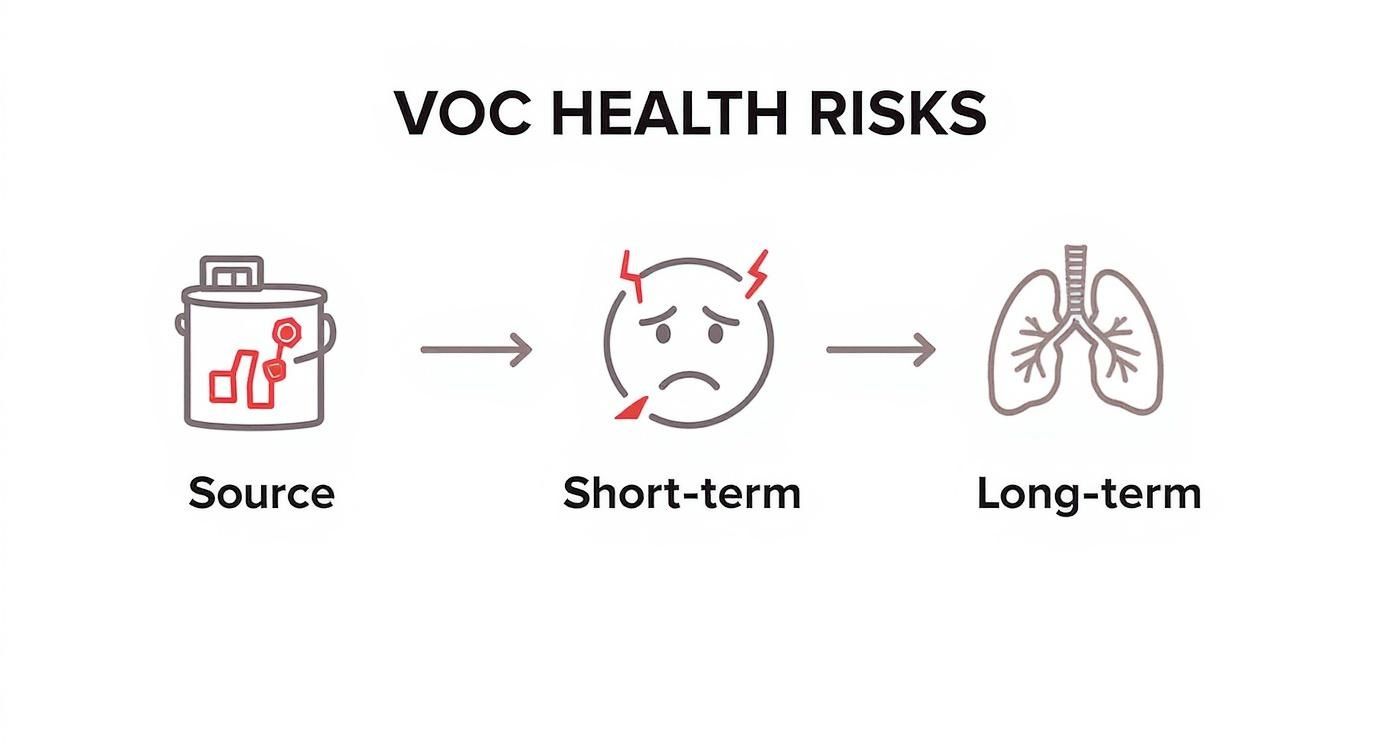
As you can see, what starts with a new coat of paint or a cleaning spray can lead to everything from headaches and dizziness to more serious, long-term health issues if the exposure is high or prolonged.
Finally, all this scientific data is translated into a comprehensive report. But it’s not just a page of confusing numbers and chemical names. A good report interprets the findings for you, comparing your VOC levels against established Australian and international health and safety guidelines. It’s your personalised roadmap, giving you the clear, scientific evidence you need to make smart decisions and improve the air you breathe every day.
How to Choose the Best VOC Testing Service in Melbourne
Finding the right team for VOC testing in Melbourne isn’t just about ticking a box. It’s a crucial step in protecting the health of everyone in your building, and the quality of the service you choose directly affects the accuracy of your results. Think of a good provider as your scientific partner, dedicated to giving you data you can actually trust and act on.
So, where do you start? The absolute first thing to look for is NATA accreditation.
NATA, which stands for the National Association of Testing Authorities, is Australia’s gold standard for laboratory accreditation. When a company uses a NATA-accredited lab, you have a solid guarantee that their analysis meets the highest scientific benchmarks for precision and reliability. Don't even consider a service that can't provide this—it’s non-negotiable.
Beyond the lab, the people doing the fieldwork are just as important. You want a service that sends out qualified environmental technicians or occupational hygienists. These are the experts trained to spot potential VOC hotspots, handle specialised sampling equipment correctly, and make sure the samples are pristine before they even get to the lab.
Key Credentials to Check
Before you sign on the dotted line, it's smart to do a little homework on their qualifications and processes. This is what really separates the true professionals from the pack.
- Laboratory Accreditation: Insist on seeing proof that they use a NATA-accredited laboratory for all sample analysis. This makes your results scientifically sound and legally defensible.
- Technician Qualifications: Don't be shy about asking about the experience of the technicians visiting your site. A background in environmental science or occupational hygiene is a massive plus.
- Testing Methodology: A reputable company will be totally open about their methods. They should be able to clearly explain the equipment they use and, more importantly, why it’s the right choice for your specific situation.
Once you have a shortlist of providers, it’s time to dig a bit deeper. Their answers to a few specific questions will tell you everything you need to know about their professionalism and the real value they bring to the table.
Your Checklist for Selecting a VOC Testing Provider
Getting a price is easy, but what you really need is a detailed, transparent report that helps you solve a problem. Before you make a decision, have a chat with any potential provider and run through these points. A quick look at what professional VOC testing services include can also give you a great baseline for what to expect.
Here’s a handy checklist to guide that conversation.
| Checklist for Selecting Your VOC Testing Provider |
| :— | :— | :— |
| Evaluation Criterion | What to Look For | Why It's Critical |
| Detailed Reporting | Ask for a sample report. It should identify specific VOCs, list their concentrations, and compare them against established safety guidelines. | A simple "pass" or "fail" is useless. You need the specifics to pinpoint the source and figure out a real solution. |
| Turnaround Time | Get a clear and realistic timeline for when you’ll receive the final report after the on-site sampling is done. | When health symptoms are a concern, you need to act fast. Quick, reliable results let you get started sooner. |
| Remediation Advice | The provider should offer unbiased, practical advice on lowering VOC levels. Their job is to explain solutions, not just sell you more products. | The ultimate goal is to fix the problem. The best companies empower you with actionable steps, not just send you a bill. |
| Customer Support | Pay attention to how they answer your questions. Are they happy to explain technical concepts in a way you can understand? | Good communication is key. It ensures you fully grasp your results and feel confident about what to do next. |
Choosing the right VOC testing service is an investment in your health and peace of mind. The best providers in Melbourne don’t just deliver data; they offer the expertise and guidance needed to help you create a genuinely safer indoor environment.
How to Read Your VOC Test Results and Take Action
So, your VOC test report has arrived. At first glance, it might look a bit intimidating, full of scientific terms and numbers measured in micrograms per cubic metre (µg/m³). Don't worry, it's more straightforward than it appears.
The trick is to zero in on two key pieces of information: which specific chemicals were found, and at what concentration.

A quality report won't just throw data at you. It will clearly list each VOC detected—like formaldehyde or benzene—and show its measured level. Crucially, it will then compare that number against established Australian indoor air quality guidelines. This comparison is everything; it tells you whether a chemical's presence is within a safe range or if it's a red flag.
Interpreting the Concentration Levels
To make sense of the numbers, it can be helpful to think of them like a traffic light system: green, yellow, and red. This simple analogy helps you quickly gauge the urgency of the situation.
- Low (Green): These are levels comfortably below the guideline values. Your air quality is in a good place, so your focus should be on keeping it that way.
- Moderate (Yellow): Here, the concentrations are getting close to or have just tipped over the guidelines. This is a clear signal to start taking proactive steps to find the source and improve ventilation.
- High (Red): These levels are significantly above the safety benchmarks. This is a serious issue that demands immediate action, often with professional guidance.
A good VOC report is more than just data—it's a roadmap. Understanding where your results fall helps you choose the right response to protect your home's air quality.
Practical Steps to Improve Your Air Quality
Once you know where you stand, you can move from diagnosis to action. The right steps will depend entirely on what your VOC testing in Melbourne has uncovered.
For Low to Moderate VOC Levels:
- Boost Ventilation: This is your first and best line of defence. Simply opening windows and doors for 15-30 minutes a day can do wonders, flushing out polluted indoor air and replacing it with fresh air.
- Hunt Down the Source: Play detective. If formaldehyde levels are up, did you recently buy new pressed-wood furniture? If so, moving it to a well-ventilated garage to "off-gas" for a while can make a huge difference.
- Shop for Low-VOC Products: As you paint, renovate, or even buy cleaning supplies, make a conscious effort to choose products labelled "low-VOC" or "zero-VOC." It's a simple way to stop new pollutants from entering your home.
When to Call in the Experts:
If your report flags high levels of a VOC, or if a particularly nasty chemical is present even at moderate levels, it's time to bring in a professional. An occupational hygienist can pinpoint the exact source—which could be anything from a hidden building material issue to a faulty product—and create a targeted plan to fix it.
This ensures you're not just masking the problem, but solving it for good.
Your VOC Testing Questions Answered
Got a few lingering questions about VOC testing? You're not alone. Let's tackle some of the most common queries we hear from homeowners and businesses across Melbourne, covering everything from costs to getting your property ready for the test.
How Much Does VOC Testing Cost in Melbourne?
The price for professional VOC testing in Melbourne isn't one-size-fits-all; it really depends on the size of your property and how deep you need the analysis to go. For a typical home, you can expect the cost to start from a few hundred dollars.
Your best bet is to reach out to a few different NATA-accredited companies. Getting a couple of quotes allows you to compare not just the price, but what's included in their service, ensuring you get the right fit for your needs and budget.
How Long Does the On-Site Test Actually Take?
The on-site part of the process—where a technician physically collects the air samples—is surprisingly quick. It usually wraps up in just one to three hours.
The real work happens back at the lab. That detailed analysis can take several business days to complete. Your testing provider will give you a clear timeline for when you can expect your full report.
It's worth remembering that the time spent in the lab is crucial. This is where the science happens, ensuring the results are accurate and giving you reliable data you can trust for your Melbourne property.
What Do I Need to Do to Prepare My Home for a VOC Test?
Your testing service will give you a specific checklist, but the main goal is to create what's known as a 'closed-building' environment. This typically means you'll need to keep all windows and doors shut for up to 24 hours before the test.
You’ll also probably be asked to hold off on using things like aerosol sprays, potent cleaning products, or doing any painting right before the test. This simple prep work is key to getting a true picture of your home’s everyday air quality without any external factors skewing the results.
How Often Should I Test My Property?
There are a few key times when testing is a smart move. Think about organising a test after a major renovation, when you bring in a lot of new furniture, or if someone in the family starts experiencing new allergies or breathing issues without an obvious cause.
For general upkeep and peace of mind, having a test done every few years is a great way to keep an eye on your indoor air and ensure it stays healthy.
For expert analysis and industry-leading occupational hygiene solutions, trust Anitech Ltd Pty. Ensure your environment is safe and compliant by visiting us at https://occhygiene.com.au.


