
Choosing the right partner from the many VOC testing companies out there is one of the most important decisions you'll make for your business. This isn't just about ticking a box for regulatory compliance; it's about protecting people and managing the invisible risks in your workplace. Get it right, and you’re golden. Get it wrong, and the consequences can be serious.
Why Accurate VOC Measurement is Non-Negotiable
Volatile Organic Compounds, or VOCs, are gases that sneak out from all sorts of common materials in commercial and industrial settings. We're talking about everything from the adhesives and paints in a new office fit-out to the cleaning solvents your team uses every day, or even the chemicals central to a manufacturing process. You can't see them, but their impact is very real.
We've seen recent studies showing that after major events like bushfires, dangerous VOCs like benzene can hang around in buildings for weeks, creating ongoing health risks. It’s a stark reminder that simply opening a window often isn't enough to clear the air.
What to Expect from a Quality Provider
When you're looking at VOC testing companies, you need someone who gives you more than just a spreadsheet of numbers. You're paying for clarity and a clear path forward. A professional service should always cover a few key bases:
- Initial Site Walk-Throughs: A proper first look to get a feel for the environment, identify potential VOC hotspots, and figure out what testing actually needs to be done.
- Targeted Sampling & Analysis: This is the core work, using specialised gear to collect air, soil, or water samples. They then take these back to the lab for detailed analysis.
- Ongoing Monitoring Plans: For many businesses, VOC testing isn’t a one-off. A good provider can set up a regular testing schedule to keep you compliant with Safe Work Australia exposure standards over the long haul.
- Clear Reports & Practical Advice: The final report should make sense. It needs to explain the findings, show how they stack up against legal limits, and give you practical steps to fix any issues.
The Impact in the Real World
Let's say you're a furniture maker and you market your products as "low-VOC." An independent test from a reputable company is your proof. It builds trust with your customers and gives you a genuine advantage over competitors. On the flip side, a botched test could lead to a product recall, fines, and a brand reputation that’s hard to rebuild.
The accuracy of a VOC test is everything. An incorrect result doesn't just mislead; it can jeopardise health, compromise your legal standing, and trigger expensive clean-up efforts later. It’s the bedrock of your safety decisions.
Think about a construction firm about to hand over a new commercial building. They absolutely must have verification that the indoor air quality is safe for the people who will work there. Partnering with a skilled testing company provides that crucial sign-off, protecting them from future liability claims and ensuring a healthy environment from day one.
Finding the right firm takes a bit of homework. While this guide on the 6 steps to finding a genuine service provider is for a different industry, the principles are exactly the same. The partner you choose will determine the quality of your data, and that data is the cornerstone of a safe, compliant, and responsible operation.
Laying the Groundwork: Define Your Project Needs First
Before you even start looking for a VOC testing company, the most important work needs to happen right where you are. We’ve seen it time and time again: companies rush this stage and end up with mismatched services, confusing quotes, and results that don’t actually answer their questions. Taking the time to build a detailed project brief is the single best thing you can do to find the right partner for the job.
Think of it this way—you wouldn't hire a builder without a detailed set of blueprints. Your project brief serves the exact same purpose; it's the blueprint that will guide the entire testing process.
Pinpoint the Specific VOCs You're Worried About
The universe of Volatile Organic Compounds is massive. No lab can test for every single one simultaneously, so your first task is to narrow things down. Different industries and situations have completely different VOC profiles.
For example, a construction company managing a new office fit-out will be laser-focused on things like formaldehyde coming from engineered wood, glues, and paints. Their goal is to make sure the indoor air is safe for the people who will eventually work there.
On the other hand, a petrochemical plant has a totally different set of concerns. Their environmental licence likely requires them to monitor for specific compounds like benzene and xylene at their fenceline to prove they aren't affecting the local community.
A classic mistake is asking for a "general VOC screen." It might sound like a good starting point, but it's often too vague for real compliance or problem-solving. Knowing your target compounds from the get-go leads to much more accurate testing and far more useful data.
Figure Out the Scope and Timing of Your Testing
Once you know what you’re looking for, you need to define the when and how often. Are you dealing with a one-time problem, or is this part of an ongoing compliance schedule? The answer completely changes the kind of service you’ll need.
Think about which of these scenarios fits your situation:
- A one-off assessment: This is pretty common after a specific event, like cleaning up a chemical spill or wanting to give the all-clear for a renovated area before people move back in. You’re just looking for a single, definitive snapshot in time.
- Baseline testing: This is absolutely vital before introducing a new industrial process or before a new facility goes live. It establishes what "normal" looks like, giving you a benchmark to measure any future changes against.
- Ongoing monitoring: Many businesses with an EPA licence have to conduct regular testing—maybe quarterly or even monthly—to show they’re staying within legal limits. This isn’t a one-off job; it requires a solid, long-term partnership.
If your project involves potential workplace exposure and employee health, it's always best to bring in an expert to help map things out. You can learn more about how a consulting occupational hygienist can define the scope for this kind of critical monitoring.
Putting It All Together: A Real-World Example
Let's walk through a practical scenario. Imagine you're an Australian furniture manufacturer. You've just launched a new line of "eco-friendly" office desks and you're marketing them as having low-VOC materials. To back up that claim, you need independent proof.
Here’s what your project brief would need to spell out:
- The Goal: To get independent verification that the new desk product line meets the low-VOC emissions criteria for a Green Star rating.
- Target Compounds: The main one is formaldehyde, but the brief should also ask for a broader Total VOCs (TVOCs) analysis, just as the standard requires.
- Testing Method: This is crucial. The testing can't just be a simple air sample from the factory floor. It must be done using a static emissions chamber, following the specific ISO standard that Green Star references.
- What You Need Back: A NATA-accredited lab report that clearly states the emission rates in µg/m²/hr, plus a clear statement confirming whether the product complies with the relevant Green Star limits.
By creating a brief this detailed, you can send it out to several VOC testing companies and get quotes that are actually comparable. It cuts out the guesswork and ensures everyone is quoting on the exact same work. This is how you make a true apples-to-apples comparison of their expertise and pricing.
Gauging a Lab's Technical Capabilities
Okay, so you’ve got your project brief sorted. Now for the tricky part: figuring out if a lab actually has the right gear and expertise to do the job properly. Not all labs are created equal, and it’s easy to get bogged down in technical jargon. Let's cut through the noise and focus on what really matters for getting data that's accurate, legally sound, and actually useful.
This infographic breaks down those initial project definition steps – a crucial foundation before you can even start talking tech with potential labs.
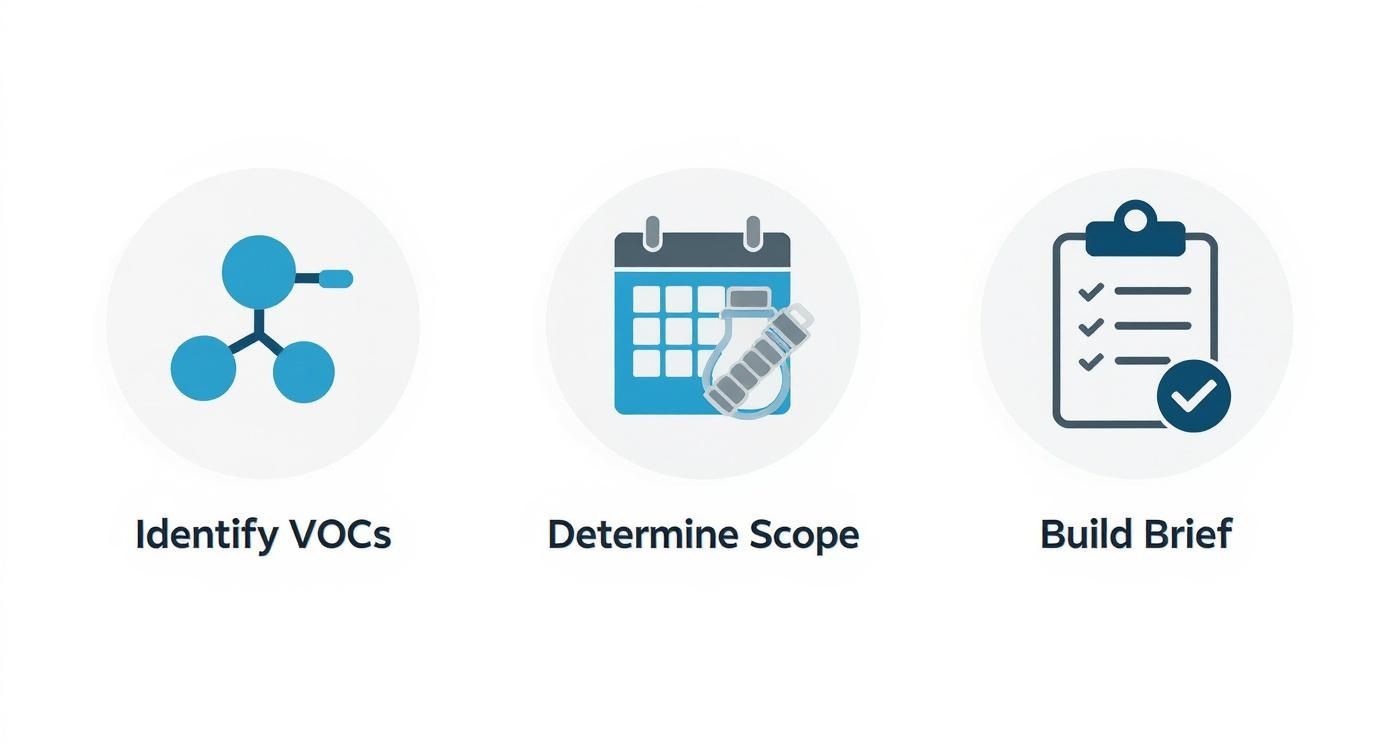
With a clear idea of your target VOCs, scope, and project goals, you can start asking the right, sharp questions to see if a lab is a good technical fit.
What's Happening Inside the Lab?
When you need to identify and measure a whole range of individual VOCs, the industry gold standard is Gas Chromatography-Mass Spectrometry (GC-MS). It’s a powerful two-step process.
First, the Gas Chromatograph (GC) takes a complex mix of chemicals and separates them, a bit like runners spreading out over the course of a race. Then, the Mass Spectrometer (MS) acts like a super-precise finish-line camera, identifying each "runner" by its unique chemical signature.
This level of detail is non-negotiable when you need to know exactly which VOCs are present and at what concentration. A basic screening might just tell you the Total VOC (TVOC) level is high, but GC-MS can pinpoint the culprit – say, benzene, which has a much stricter safety limit than other, less harmful compounds. It's the difference between knowing there's a problem and knowing precisely what the problem is.
Comparison of Common VOC Testing Technologies
While GC-MS is the heavyweight champion for detailed analysis, labs use various technologies depending on the job. Understanding the basics will help you have a more informed conversation with potential providers. Here’s a quick rundown of some common methods.
| Technology | Best For | Key Advantage | Consideration |
|---|---|---|---|
| Gas Chromatography-Mass Spectrometry (GC-MS) | Identifying and quantifying a wide range of specific VOCs. | Highly specific and sensitive. The "gold standard" for detailed analysis. | Slower turnaround time and higher cost than simple screening methods. |
| Photo-Ionization Detector (PID) | Real-time screening and leak detection for a broad range of VOCs. | Instantaneous readings, portable, and excellent for initial site surveys. | Non-specific; it measures total VOCs but can't identify individual compounds. |
| Flame Ionization Detector (FID) | Measuring total hydrocarbons, especially in industrial settings. | Very sensitive to hydrocarbons and provides reliable total concentration data. | Doesn't identify specific compounds and has a poor response to some chemicals. |
| Fourier-Transform Infrared Spectroscopy (FTIR) | Continuous monitoring of known gases in a controlled environment. | Can measure multiple compounds simultaneously in real-time. | Less sensitive for some compounds and requires a clear "line of sight" for open-path monitoring. |
Choosing the right tool for the job is paramount. For a quick site check, a PID is great, but for regulatory compliance or product certification, you'll almost certainly need the precision of GC-MS.
Why Their Detection Limits Are a Big Deal
Here’s a question you absolutely must ask any potential lab: "What is your Limit of Detection (LOD) for my target compounds?" The LOD is the smallest amount of a chemical their equipment can reliably spot. If a lab's LOD is higher than the regulatory limit for a VOC in Australia, their test is practically useless for compliance.
It's like trying to measure a single grain of sugar on a set of bathroom scales. The scales simply can't register something that small. A lab with the wrong LOD is in the same boat—they might not see a problem that could still put you in breach of safety standards.
A reputable lab will be completely transparent about their LODs. You need to make sure their capabilities line up with the standards set by bodies like Safe Work Australia or your state’s EPA.
Getting the Right Sample in the First Place
How a sample is collected is just as vital as how it's analysed. The two main approaches you’ll come across are active and passive sampling.
- Active Sampling: This involves a pump pulling a specific volume of air through a collection tube. It’s highly precise and gives you a clear snapshot of the air quality at a particular moment, making it perfect for checking against workplace exposure standards.
- Passive Sampling: This method uses a simple badge or tube that absorbs chemicals from the air over a longer period, like an 8-hour shift or even several days. It’s a great, low-fuss way to measure a person's average long-term exposure.
The right choice hinges entirely on your goal. If you're certifying a product's safety, for example, you'll need the tightly controlled conditions found in a specialised VOC chamber testing service to get precise, repeatable results.
The demand for this kind of technology is growing fast. In Australia, the VOC detector market was valued at around USD 184.7 million in 2025 and is tipped to reach USD 298.0 million by 2035. This boom is driven by tougher pollution laws and a bigger focus on workplace health, pushing innovation in the field. By getting a handle on these technical details, you'll be in a much stronger position to judge whether a lab has the scientific rigour your project demands.
The Importance of NATA Accreditation
When you're searching for a company to handle your VOC testing, one credential stands out above all others in Australia: NATA accreditation. Think of it less as a "nice-to-have" and more as the absolute baseline for quality. If you want data that's accurate, reliable, and will hold up under scrutiny, partnering with a NATA-accredited lab is non-negotiable.
So, what does that accreditation actually mean? NATA, the National Association of Testing Authorities, is essentially the gold-standard auditor for laboratories. For a lab to earn this credential, they undergo a rigorous, top-to-bottom assessment of their entire operation. We're talking everything from equipment calibration and staff training to their data handling and quality control protocols. It’s the ultimate proof they have their act together.
This isn't just about ticking a box for technical competence. When you're dealing with regulators like Safe Work Australia or the EPA, a NATA-endorsed report carries serious weight. It’s an independent, third-party stamp of approval that can be a lifesaver during compliance audits or, worse, legal disputes.
How to Check a Lab's NATA Accreditation
Never just take a company's word that they're accredited. Always verify it for yourself. Thankfully, NATA makes this incredibly simple. A quick check on their official website is all it takes to get the proof you need before you sign anything.
Here's how to do it:
- Head to the NATA website: Look for the "Find an Accredited Facility" search tool.
- Search for the company: You can pop in their name or accreditation number.
- Check their status: The results will confirm if their accreditation is current.
- Drill down into their Scope of Accreditation: This is the most crucial part of the process.
Why the 'Scope of Accreditation' Is So Important
Finding the lab on the NATA register is a great start, but it's only half the story. You absolutely must click through and review their "Scope of Accreditation." This document details the specific tests the laboratory is actually accredited to perform.
A lab can hold NATA accreditation but not be accredited for the specific test you need. It’s like hiring a registered builder to rewire your house—they’re qualified in their field, but not for the job at hand.
For example, a lab might be fully accredited for analysing heavy metals in water but have no accreditation whatsoever for testing formaldehyde in indoor air. If they run a test that falls outside their approved scope, the report they give you can't carry the official NATA endorsement. This renders the results scientifically and legally weak.
Before you commit, always cross-reference the exact test methods you need (like a particular ISO or USEPA method) with the lab's official scope listed on the NATA website. This simple step ensures the data you pay for is worth the paper it’s printed on.
What About ISO/IEC 17025?
You'll often see labs mention ISO/IEC 17025 in their credentials. This is the global benchmark for the technical competence of testing and calibration laboratories.
The good news is that NATA's accreditation framework is built directly on the principles of this international standard. So, if a lab is NATA-accredited, it means they are already operating in compliance with ISO/IEC 17025. It’s your assurance that their quality management systems are on par with the best in the world.
Australia's environmental testing market is booming. One recent report projects it will jump from $141.7 million in 2023 to $294.5 million by 2031. This surge is driven by tighter regulations and growing public awareness, especially in the industrial sector, which makes up 36.9% of the market. With more players entering the field, taking the time to verify credentials like NATA accreditation is the best way to separate the genuine experts from the crowd. For a deeper dive, you can read the full research on Australia's environmental testing market.
Diving into Report Quality and Ongoing Support
The fieldwork and lab analysis are only half the battle. Honestly, the real value of a top-tier VOC testing company shows up after the samples are taken—it’s all about the quality of their reports and the support you get afterwards. A spreadsheet full of raw data is next to useless without interpretation, context, and a clear plan of attack.

This final stage is where you find your answers and see the return on your investment. A good provider knows their job isn't just to hand over numbers; it's to deliver clarity. That means translating complex scientific findings into something that you, your management, and even regulatory bodies can actually understand and act on.
What Makes a Report Truly Useful?
Before you even think about committing to a provider, always ask for a sample report. I can't stress this enough—it's a non-negotiable part of vetting. When you get your hands on it, you're not just looking for slick graphics; you're assessing whether it's genuinely helpful.
A high-quality report should always have these key things:
- A Solid Executive Summary: Right at the beginning, there should be a plain-English overview of the critical findings. You shouldn't need to dig through pages of data to grasp the main points.
- Clear Regulatory Benchmarks: The results need to be shown right next to the relevant Australian exposure standards. Think Safe Work Australia limits or state-specific EPA guidelines, like the NEPM standards.
- Context is Everything: The report must explain what the results actually mean for your site or product. It should factor in the operational context—things like work processes or ventilation—that could be influencing the numbers.
- Actionable Recommendations: This is where the best firms separate themselves from the pack. They don't just point out a problem; they offer sensible, prioritised steps you can take to fix it.
Your goal is to find a partner who gives you a roadmap, not just a map. The report should be your guide for what to do next, whether that’s tweaking a ventilation system, swapping out a chemical, or rolling out new staff training.
Don't Underestimate Post-Project Support
The relationship shouldn't just stop the second that final report lands in your inbox. It’s completely normal to have follow-up questions, and being able to get answers from an expert is a massive sign of a company that cares about its clients.
Before signing anything, ask what their post-project support involves. Can you actually speak to the occupational hygienist or chemist who worked on your project? That direct line is incredibly valuable for clearing up any confusion about the data or discussing how to implement their recommendations in the real world. A company that makes its experts accessible is one that stands behind its work.
Finding the Sweet Spot Between Speed and Accuracy
Finally, get the conversation about turnaround times on the table early. Speed is often a factor, especially when you’re up against project deadlines, but it should never, ever compromise accuracy. A reputable VOC testing company will be upfront about their lab's capacity and give you a realistic timeline.
The global VOC testing market was valued at $191.24 million in 2023 and is projected to hit $316.22 million by 2031, partly driven by tech that improves efficiency. While new gear like portable GC-MS systems can speed things up on-site, quality lab work still follows a meticulous process. You can discover more insights about these market trends and see how they're changing the game.
Ask potential partners how they manage to deliver quick results while maintaining the strict quality control that NATA accreditation requires. This ensures the data you get is not only fast but also completely reliable and defensible.
Your VOC Testing Questions Answered
When you're diving into the world of VOC testing companies, a lot of practical questions are bound to pop up. Getting straight answers is the only way to budget properly, stick to your project timeline, and make sure the whole process is as painless as possible. Let’s tackle some of the most common queries we get from clients.
So, How Much Does VOC Testing Actually Cost in Australia?
The price tag for VOC testing can swing wildly because it’s all tied to the scope of your project. For instance, a simple indoor air quality screen in a small office might only set you back a few hundred dollars. This gives you a quick, basic snapshot of what’s going on.
On the other end of the spectrum, a full-blown industrial compliance program could easily run into the thousands. That bigger number reflects a much more involved process—maybe you need to test for a long list of specific VOCs, take samples from multiple locations, and get detailed, NATA-accredited lab analysis. My best advice? Always hand over a detailed project brief and ask for an itemised quote. It’s the best way to avoid nasty surprises later on.
What’s a Realistic Turnaround Time for Results?
We all know project deadlines are a reality. For standard lab analysis, you can typically expect your results back within 5 to 10 business days from when the samples hit the lab.
Most good companies get that some situations are time-sensitive. That's why they'll often offer an express service for an extra fee, which can slash the wait time down to just 1 to 3 days. This can be a real lifesaver for things like post-incident assessments or when you’re up against a tight compliance deadline. Just be sure to lock in the expected timeline before you start.
A quick tip from experience: while getting results fast is great, it should never compromise accuracy. The integrity of your data is everything, so double-check that the company isn't cutting corners on their quality control just to speed things up.
Do I Need to Be On-Site While They Collect the Samples?
This really comes down to the site itself. If it’s a straightforward office air quality test, your presence isn't mission-critical. A trained technician can usually manage the collection just fine without any hand-holding.
But for industrial sites, manufacturing plants, or other complex commercial environments, my answer is a firm yes. Having someone from your team on-site is incredibly helpful. You can point the technician to the exact sampling spots, clarify any questions about operational processes, and make sure the whole strategy aligns with what you’re trying to achieve. That kind of context is gold when it comes time to interpret the results.
What’s the Difference Between VOC Screening and Detailed Lab Analysis?
Getting your head around this is key to picking the right service. They have very different jobs, but they often work together.
-
VOC Screening: Think of this as a quick health check. A technician comes on-site with a handheld device, often a Photo-Ionization Detector (PID), to get real-time readings. It gives you an immediate measurement of the Total VOC (TVOC) concentration in the air. It’s a fast and cost-effective way to see if there’s a potential problem worth investigating further.
-
Detailed Lab Analysis: This is where the real detective work happens. An air sample is collected in a special tube or canister and sent off to a laboratory. There, scientists use high-tech methods like Gas Chromatography-Mass Spectrometry (GC-MS) to pinpoint and precisely measure individual VOC compounds.
Here’s an easy way to think about it: screening tells you if there’s smoke, but the detailed analysis identifies exactly what's burning. Screening flags a potential red flag, while the full lab analysis provides the hard data you need for compliance reports, risk assessments, and figuring out a real solution.
Our goal is to give you clear, actionable insights—not just a page of numbers. Our NATA-accredited services deliver the reliable information you need for a safe and compliant workplace. If you have more questions or want to chat about a project, get in touch with our expert team today.


