
VOC testing in Australia is all about identifying and measuring the concentration of airborne chemicals known as Volatile Organic Compounds (VOCs) inside a building. It's a critical step for protecting the health and safety of anyone using the space, because long-term exposure to common VOCs like formaldehyde and benzene can cause some serious health problems.
What Are VOCs and Why Is Testing So Important?
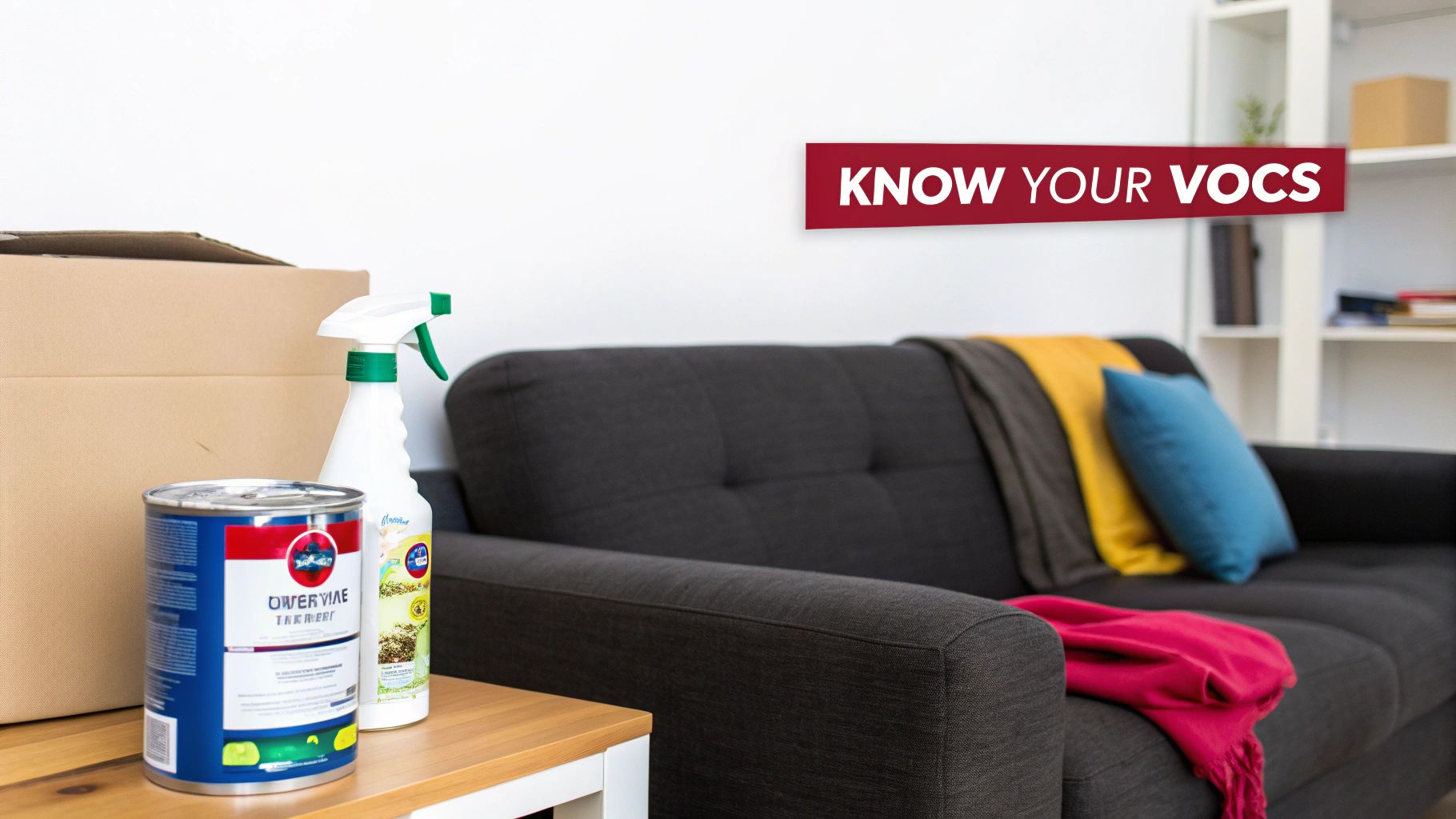
You know that distinct "new" smell from a freshly painted room, a new car, or even that flat-pack furniture you just put together? That scent is actually a cocktail of Volatile Organic Compounds, or VOCs, being released into the air. These invisible chemicals are everywhere, and getting to know them is the first step toward creating a healthier indoor environment.
VOCs are a broad family of carbon-based chemicals that turn into gas at room temperature. Think of it like a puddle of water evaporating into steam, except in this case, it’s microscopic chemical particles escaping from a solid product and mixing with the air you breathe. This process is often called "off-gassing," and it’s happening constantly in our homes and offices.
Common Sources of VOCs in Australian Buildings
You really don't have to look far to find VOCs. They are lurking in countless everyday items all across Australia, and knowing where they come from is the key to managing your indoor air quality.
Some of the biggest culprits include:
- Building and Renovation Materials: Paints, varnishes, glues, and sealants are major sources. Engineered wood products like particleboard and MDF—the stuff used in most modern cabinetry and furniture—often contain formaldehyde, a particularly nasty VOC.
- Furniture and Furnishings: That new carpet, vinyl flooring, mattress, or upholstered sofa can off-gas a mix of chemicals for weeks, sometimes even months, after you bring them home.
- Cleaning and Personal Care Products: Aerosol sprays, air fresheners, disinfectants, and even some cosmetics and perfumes release VOCs directly into the air every time you use them.
- Office Equipment: Things you wouldn't even think of, like printers, copiers, and permanent markers, can emit VOCs, adding to the chemical load in the workplace.
The Health Imperative Behind VOC Testing
At the end of the day, we conduct professional voc emissions testing to protect people's health. While many VOCs are fine in tiny amounts, high concentrations or long-term exposure can lead to a whole host of health issues.
The effects can pop up right away or develop over time. Short-term symptoms are often brushed off as minor annoyances, but they're really your body's early warning signs that the air you're breathing isn't clean.
These health effects are usually split into two categories:
Short-Term Effects:
- Headaches and dizziness
- Nausea or feeling sick
- Irritation in your eyes, nose, and throat
- Making asthma symptoms worse
Long-Term Effects:
- Chronic respiratory conditions
- Damage to the liver, kidneys, and central nervous system
- An increased risk of developing certain cancers
Given that most of us spend up to 90% of our lives indoors, the quality of that air has a massive impact on our wellbeing. By testing for VOCs, you can get a clear picture of what chemicals are present and at what levels. This information empowers you to take action—whether that's improving ventilation, removing the source, or choosing safer products—to create a truly healthy space for your family or employees.
Navigating Australian VOC Regulations and Standards
Trying to get your head around the rules for Volatile Organic Compounds in Australia can feel a bit like decoding a complex manual. But at their core, these regulations are all about one thing: protecting people. Whether you're on a job site, in a brand-new office, or just at home, these standards provide a framework for creating safer indoor spaces right across the country.
Australia doesn’t have one single, giant law for VOCs. Instead, what we have is a patchwork of workplace safety rules, national building codes, and voluntary green certification programs. Together, these different pieces all push in the same direction—towards lower VOC emissions and the need for accurate VOC testing in Australia.
Protecting Workers with Exposure Standards
The first line of defence against VOCs is in the workplace. This is where people can be exposed to chemicals day in, day out. Safe Work Australia, our national body for work health and safety (WHS), sets the Workplace Exposure Standards (WELs) for hundreds of chemicals found in the air, including a long list of common VOCs.
These standards aren't just friendly suggestions. They are legally binding limits on the concentration of a chemical that a worker can be exposed to over an eight-hour shift without it likely causing them harm. Think of it like a speed limit for the air we breathe at work. Staying under that limit is absolutely vital for protecting the long-term health of anyone working with solvents, paints, glues, and other chemical-based products.
Take formaldehyde, for instance. Its WEL is incredibly low because of the serious health risks it poses. Businesses have to use VOC testing to prove they're keeping levels below that threshold, demonstrating that their safety measures are actually working.
When a business fails to monitor and control the air its people are breathing, it’s not just risking a fine. It’s gambling with the health of its team. These standards are the absolute foundation of a safe, responsible workplace.
Building Healthier Spaces with Green Star Ratings
Outside of the workplace, one of the biggest drivers for managing VOCs comes from the building and construction industry. The Green Building Council of Australia (GBCA) runs the Green Star rating system, a voluntary program that has really become the gold standard for creating healthy, efficient, and sustainable buildings.
A huge part of earning a Green Star rating is all about using materials with low VOC content. This affects just about everything you’d find inside a new build.
The system gives points for choosing products that meet really strict VOC limits, such as:
- Paints and Coatings: Using low-VOC or zero-VOC paints is now pretty much standard practice on Green Star projects.
- Adhesives and Sealants: The glues holding down floors or sealing gaps have to be low-emitting.
- Carpets and Flooring: Materials are often tested and certified to ensure they don't release harmful chemicals into the air.
- Engineered Wood Products: Things like furniture and kitchen cabinets made from MDF or particleboard must meet low formaldehyde emission standards.
Getting a high Green Star rating is more than just a badge of honour; it directly results in better indoor air quality for the people who will live or work in the building, and it can even boost the property's value. This has created a really powerful incentive for manufacturers to create and certify low-VOC products, making them easier for everyone to get their hands on.
This focus on safer materials is more critical than ever, especially with so many new skilled workers entering the trades. With apprenticeship completions hitting a decade high—over 51,000 finished their training in the year to March 2025—we need to ensure the materials they handle are safe. This boom is bringing nearly 100,000 skilled workers into the industry, which really underscores why these strong safety standards are so important. You can find more details on Australia's growing trade sector in this report on Australia's future workforce.
Ultimately, whether they’re following mandatory safety laws or aiming for a voluntary green rating, businesses and builders are showing they care about people's health. And accurate VOC testing is the tool that proves it—verifying compliance, confirming materials are safe, and giving everyone peace of mind that the air inside is clean.
How Professionals Actually Test for VOCs
Ever wondered how experts manage to measure chemicals you can't even see? It’s not magic, just good science. Conducting professional VOC testing in Australia is all about a systematic process of capturing air samples to get a clear, accurate picture of what’s floating around in your indoor environment.
The whole process kicks off with a crucial first step: sampling. This is where a technician collects a representative slice of the air from your space. This sample is then whisked away to a specialised lab for a deep dive into its chemical makeup. There are two main ways they do this, each suited for different situations.
The Two Main Ways to Collect Air Samples
You can think of the sampling methods like fishing. You could cast a net and pull it in quickly for an immediate snapshot of what’s there (active sampling), or you could leave a baited line in the water for a day to see what you catch over time (passive sampling). Both work, but they tell you different things about the air you're breathing.
Here's a quick comparison of the two main approaches.
Common VOC Sampling Methods Compared
| Method | Description | Best For | Key Advantage |
|---|---|---|---|
| Active Sampling | Uses a calibrated pump to pull a specific volume of air through a collection tube (sorbent tube). | Getting a precise, "in-the-moment" snapshot of air quality, like checking for compliance with workplace exposure limits. | Fast, highly accurate, and great for pinpointing peak concentrations. |
| Passive Sampling | A small badge or canister is left in a room for an extended period (e.g., 24+ hours) to absorb chemicals from the air via natural diffusion. | Assessing average, long-term exposure in homes or offices to understand typical air quality over time. | Simple, non-intrusive, and provides a more realistic picture of day-to-day exposure. |
Let's break these down a bit further.
Active Sampling: The "Snapshot" Method
Active sampling is the go-to choice for a fast, precise measurement. A technician uses a calibrated pump to draw a known volume of air through a special sorbent tube over a set time.
Think of it like a tiny, high-tech vacuum. The pump is the motor, and the sorbent tube is a filter designed to trap VOC molecules. Because we know exactly how much air passed through (e.g., 10 litres) and for how long (e.g., 30 minutes), the lab can calculate a very specific concentration of VOCs present at that exact time. It’s perfect for checking immediate workplace exposure against Safe Work Australia limits or hunting down the source of a sudden, strong odour.
Passive Sampling: The "Slow and Steady" Method
Passive sampling works more like a sponge. A small badge containing a sorbent material is simply left in a room, often for 24 hours or more.
Instead of actively pulling air in, this method relies on the natural movement of molecules—a process called diffusion. Over time, VOCs in the air land on the sorbent and get trapped. This approach doesn't give you a peak concentration at a single point in time, but rather an average concentration over the entire sampling period. This makes it ideal for understanding the typical air quality people are exposed to in a home or office day in and day out.
From Your Site to the Science Lab
Once the samples are collected, they are carefully sealed and sent off to a NATA-accredited laboratory. This is where the real detective work happens, using incredibly sensitive equipment to identify and count every chemical captured.
The gold standard for this analysis is a technology called Gas Chromatography-Mass Spectrometry (GC/MS).
If that sounds complex, just think of it as a chemical fingerprinting machine. The 'Gas Chromatography' part is like a long, winding racetrack that separates all the different VOCs based on their unique properties. Then, the 'Mass Spectrometry' part acts like a high-speed camera at the finish line, zapping each chemical to positively identify it and measure its exact quantity. This detailed breakdown is essential for creating a clear and useful report.
For certain projects, testing needs to happen in an even more controlled environment. You can find out more about how that works in our guide to VOC chamber testing.
The infographic below shows how these processes fit within key Australian standards for keeping our buildings and workplaces safe.

As you can see, whether it’s for workplace safety or meeting green building certifications, a structured testing and analysis process is the foundation of good indoor air quality management.
Making Sense of Your VOC Test Results
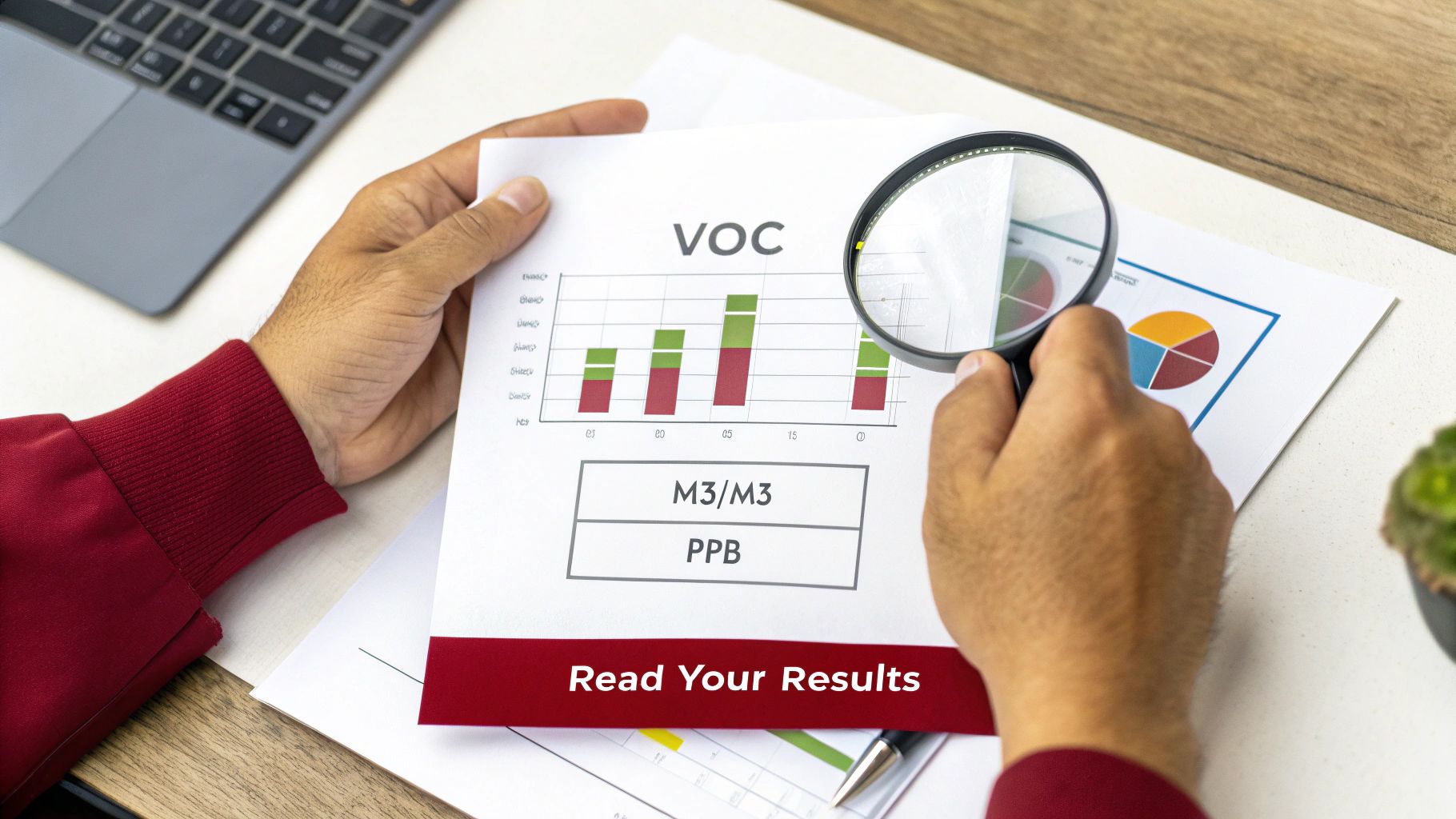
So, you’ve done your VOC testing in Australia, and now you’re holding a lab report. It’s likely a dense document, packed with chemical names, acronyms, and numbers that can look pretty intimidating at first glance. Don’t worry. This report is your roadmap to understanding the air quality in your space, and learning to read it is easier than it seems.
The idea isn’t to turn you into a chemist overnight. It’s about giving you the confidence to look at that data and know exactly what it means for the health and safety of your environment. Let's break down what you’re looking at and pinpoint what really matters.
Decoding the Numbers and Units
The first thing you’ll see is a list of all the VOCs the lab found, with a concentration value next to each one. These concentrations are typically shown in one of two ways: either as micrograms per cubic metre (µg/m³) or parts per billion (ppb).
Think of µg/m³ as a measure of mass within a volume. It basically answers the question, "If we took a one-metre cube of air from this room, how many millionths of a gram of this chemical would we find inside?" It's a very precise unit that's commonly used in Australian health and safety standards.
On the other hand, ppb is a ratio. It tells you, "For every billion molecules in this air sample, how many of them are molecules of this particular chemical?" It’s a bit like finding a few red grains of sand on an entire beach. Both units tell the same story, but you need to know which one your report is using to compare your results against the right safety limits.
Comparing Your Results to Australian Benchmarks
A number on its own is just a number. It only becomes useful when you compare it to a benchmark. For VOC testing in Australia, we have a few key guidelines that tell us whether a particular level is considered safe.
The main reference points you’ll want to know about are:
- Safe Work Australia’s Workplace Exposure Standards (WELs): These are the legal limits for workplaces. If you’ve tested a commercial or industrial site, checking your results against these standards is non-negotiable for compliance and keeping your team safe.
- NHMRC Indoor Air Quality Guidelines: The National Health and Medical Research Council (NHMRC) sets out guidelines for homes and other non-industrial spaces to protect public health from common pollutants like formaldehyde.
- Green Star VOC Limits: If you're working on a project aiming for a Green Star rating from the Green Building Council of Australia, your results will need to meet their strict limits for building materials and finishes.
A good report will often list the relevant guideline right next to your result, making it simple to spot if a VOC is over the recommended limit.
A VOC test result that’s "above the limit" isn't a reason to panic. Think of it as a clear signal to start investigating. It's your cue to find the source of the emission and take action, whether that's improving ventilation or removing the problem material.
Pinpointing Problematic Compounds
Not all VOCs are created equal. Your report might list dozens of different compounds, but some are far more concerning than others due to their known health effects. Any decent occupational hygienist will highlight these for you in their summary.
A few of the usual suspects to keep an eye out for include:
- Formaldehyde: A common culprit found in MDF, particleboard, glues, and some types of insulation. It's a well-known irritant and is also classified as a carcinogen.
- Benzene: Often linked to petroleum products, vehicle exhaust, and cigarette smoke. It’s a serious one, with long-term exposure tied to major health issues.
- Toluene: You’ll find this in many paints, lacquers, and adhesives. It’s known to affect the central nervous system.
If these compounds—or others—are flagged at high levels, it gives you a massive clue about where the problem might be coming from. High formaldehyde in a new office fit-out? The culprit is probably the new desks or cabinetry. This is how your detailed VOC testing report transforms from a confusing list of chemicals into a practical action plan for creating a healthier indoor space.
How to Choose the Right VOC Testing Service
Picking the right company for your VOC testing in Australia is probably the most important decision you'll make in this whole process. The accuracy of the results and the quality of the advice you get hinge entirely on the expertise of the people you hire. It's about looking past a simple price tag and really digging into a company's qualifications, methods, and credentials.
You're not just buying a lab report; you're looking for clear, actionable insights to protect the health of your family or your employees. Let’s break down what really matters.
The Absolute Must-Have: NATA Accreditation
If there’s one thing you take away from this guide, make it this: the laboratory that analyses your samples must be NATA-accredited.
NATA stands for the National Association of Testing Authorities, Australia. They’re the official body that ensures labs are technically competent and meet incredibly high-quality standards. Think of it as the ultimate seal of approval for any scientific testing in the country.
A NATA-accredited lab means their equipment is properly calibrated, their methods are scientifically validated, and their results can stand up in a court of law. This isn't just a "nice-to-have" badge; it's the gold standard that separates a professional, reliable service from one that could give you worthless data.
Always ask a provider for proof of NATA accreditation for the specific VOC analysis methods they’ll be using. If they can’t provide it, walk away.
Key Questions to Ask Any Potential Provider
Once you've confirmed the lab is NATA-accredited, it's time to vet the people who will actually be taking the samples and writing the report. A truly professional team will be happy to answer your questions and will have clear, confident responses.
Here are a few essential questions to get the conversation started:
- What sampling methods do you use? Ask them whether they use active or passive sampling and, more importantly, why they’re recommending a particular method for your home or workplace. Their reasoning will tell you a lot about their experience.
- Which specific VOCs will you be testing for? A generic "VOC test" isn't good enough. You need to see a list of the target chemicals. Make sure it includes the common troublemakers like formaldehyde, benzene, and toluene.
- What are your team's qualifications? The people physically collecting the air samples should be trained occupational hygienists or environmental scientists. Their skill is just as critical as the lab's equipment.
- What will the final report look like? Ask to see a sample report. It should be easy to read, clearly explain what the numbers mean, and compare your results against Australian benchmarks, like the exposure limits from Safe Work Australia.
The quality of their answers is a dead giveaway of their professionalism. Taking the time to find the right fit among the various VOC testing companies is what guarantees a reliable outcome.
Your Provider Comparison Checklist
To make things even easier, use this quick checklist when you’re comparing different services.
- NATA-Accredited Laboratory: Is their lab NATA-accredited for the specific VOC tests you need? (Yes/No)
- Qualified Field Staff: Are the people coming to your site experienced and properly qualified? (Yes/No)
- Transparent Methodology: Do they clearly explain how they take samples and how they're analysed? (Yes/No)
- Comprehensive Reporting: Does their report offer clear interpretations and compare results to Australian standards? (Yes/No)
- Good Communication: Are they responsive, professional, and willing to answer all your questions without jargon? (Yes/No)
Finding a provider that ticks every one of these boxes means you’re investing in a service that gives you more than just data—it gives you confidence and peace of mind.
This kind of careful vetting is crucial, not unlike the rigorous standards seen across Australia's vocational education sector. With over 5 million students enrolled in VET programs nationally in 2023, there's a huge emphasis on quality and safety. This skilled workforce, especially the 1.4 million in Certificate III or IV programs, needs safe environments to train and work in, highlighting why professional standards matter everywhere. You can learn more about these trends from Australia's Productivity Commission.
Your Questions About VOC Testing, Answered
Even after getting your head around the science, a few practical questions always pop up when it's time to actually organise VOC testing. It's easy to get bogged down in the details of cost, timing, and what to do with the results. Let's clear up some of the most common queries so you can move forward with confidence.
What’s the ballpark cost for professional VOC testing in Australia?
There's really no single price tag for professional VOC testing; it's tailored to the situation. The final cost hinges on a few key things, so you'll always want to get a customised quote.
The main factors that will influence the price are:
- The size and type of the property: Testing a small one-bedroom apartment is a much simpler affair than assessing a multi-level office building or a sprawling factory floor. More space usually means more sample points are needed to get a true picture.
- How many samples are needed: A consultant might recommend sampling several different rooms or zones to track down a specific source or compare different areas. Each sample adds to the lab analysis costs.
- The depth of the analysis: A basic screening for a handful of the usual suspects will be a lot more budget-friendly than a deep dive that looks for a huge range of specific chemical compounds.
As a rough guide, a straightforward test for a home might start in the low hundreds of dollars. On the other hand, a comprehensive commercial assessment could easily run into the thousands, especially if the investigation is complex.
It's best to think of this as an investment in health, not just a cost. A proper quote should cover everything: the on-site visit by a qualified professional, the high-grade lab analysis, and a detailed report that actually explains what it all means in plain English.
When you're comparing quotes, make sure the provider uses a NATA-accredited laboratory. This is your guarantee that the results are accurate, reliable, and can be defended scientifically. Going for a cheaper option that cuts corners on lab quality often leads to bad data and wasted money.
When is the right time to do a VOC test?
Timing is everything if you want your VOC test results to be meaningful. The best time to test really boils down to what you're trying to achieve.
For new builds or after a major renovation, the sweet spot is right after the last tradie has packed up but before anyone moves in. This gives you a clean baseline, measuring the peak "off-gassing" from all the new paints, glues, floors, and joinery without daily life muddying the waters. It's the perfect way to make sure a space is healthy and safe from day one.
For existing, lived-in homes or operational workplaces, the strategy is completely different. You want to test under normal, everyday conditions to get a real-world snapshot of what people are actually breathing in. If you've just brought in new furniture, laid new carpet, or installed a bunch of new office workstations, it's a good idea to let things settle for a few weeks before testing. This allows the initial high-intensity off-gassing to taper off, giving you a much more realistic picture of the long-term air quality.
We found high VOC levels. What’s the first thing we should do?
Getting a report showing high VOCs can feel a bit scary, but there's no need to panic. Think of the report as your roadmap to a solution. The first steps are usually surprisingly simple and very effective.
Your immediate priority is to boost ventilation. It's the fastest and easiest way to bring down indoor VOC concentrations. Throw open the windows and doors to get a cross-breeze going—fresh air is brilliant at diluting indoor pollutants. Flick on the exhaust fans in kitchens and bathrooms, too; they do a great job of pulling stale air out.
Next, it's time to play detective and find the source. Your report is the best clue you have, as it will list the specific chemicals detected. For example, a spike in formaldehyde almost always points to engineered wood products (like MDF or particleboard), while high toluene levels might suggest a recent paint job. Once you have a likely suspect, you can take direct action.
If you've identified a specific item like a new rug or piece of furniture, try "airing it out." Move it to a well-ventilated area—a garage with the door open is perfect—for a few days. This helps it release its VOCs more quickly before you bring it back inside.
If the problem persists or the source isn't obvious, you may need to take further action. This could involve bringing in air purifiers with activated carbon filters, which are specifically designed to trap VOCs and other gaseous pollutants. In more serious cases, you might have to remove the offending material altogether. An indoor environmental professional can help you figure out the best game plan.
Are those DIY VOC test kits from the hardware store any good?
While those DIY kits might seem like a tempting, low-cost option, they have some serious drawbacks. Most of them only give you a single, vague reading for Total VOCs (TVOCs). They can't tell you which specific chemicals are present.
Without knowing exactly what's in your air, you can't properly assess the health risks or track down the source of the problem. Is it a harmless new-car smell or something more concerning? A DIY kit won't tell you. On top of that, the accuracy of these consumer-grade sensors is often a far cry from the precise, calibrated equipment used in a NATA-accredited lab.
For any serious matter—whether it’s related to health concerns, legal compliance, or a property sale—professional VOC testing in Australia is the only way to go. It gives you the specific, accurate, and actionable data you need to make informed decisions.
How long does off-gassing actually last?
There's no single answer here—the off-gassing timeline varies wildly depending on the material, the temperature, and how much fresh air is moving through the space. Some things, like a freshly painted wall, will release the vast majority of their VOCs within a few days or weeks.
But other materials are in it for the long haul. Things like engineered wood, foam insulation, and certain vinyl flooring can continue to release small amounts of chemicals for months, or even years. The rate will decrease over time, but it doesn't just stop overnight.
A couple of things can speed the process up:
- Higher Temperatures: Heat excites the molecules and makes them release VOCs faster.
- Higher Humidity: For some materials, moisture in the air can also accelerate the release of chemicals.
This is why you sometimes hear about builders "baking out" a new building. They crank up the heat to a high temperature while running powerful fans to ventilate the space. It’s a way to force a large chunk of the off-gassing to happen quickly, before anyone moves in.
We provide expert occupational hygiene services to ensure your environment is safe and compliant. Our team uses scientific methodologies to deliver precise VOC testing and clear, actionable reports. To protect the health of your team and ensure a safe workplace, learn more about our professional occupational hygiene services.


