
VOC product emission testing is the process we use to measure the invisible chemicals—known as Volatile Organic Compounds (VOCs)—that are released from everyday manufactured goods. It’s a crucial step in making sure products like furniture, building materials, and electronics are safe for indoor use, because high levels of VOCs can be harmful to our air quality and, ultimately, our health.
Understanding VOCs and the Need for Emission Testing
You know that distinct ‘new car’ or ‘new furniture’ smell? That scent is often the signature of Volatile Organic Compounds (VOCs) being released into the air. These are simply carbon-based chemicals that turn into a gas at room temperature, a process you might have heard of called "off-gassing."
It might sound technical, but the sources are all around us in our homes, schools, and offices. VOCs are hiding in plain sight—in the adhesives holding your kitchen cabinets together, the foam inside your office chair, and the paint on your walls. Countless products quietly release these compounds, shaping the chemical cocktail of the air we breathe indoors.
This chart gives a great visual breakdown of where most VOCs come from in a typical indoor space.

As you can see, building materials and furnishings are often the biggest culprits. This is exactly why it's so important to test these products before they end up in our spaces.
Why Are These Emissions a Concern?
Here’s a startling fact: the concentration of many VOCs is regularly much higher indoors than outdoors—sometimes up to 10 times higher. This is a real worry, especially when you consider that most Australians spend about 90% of their time inside. If a room or building has poor ventilation, these compounds can build up to levels that start to pose genuine health risks.
Exposure to a high concentration of VOCs can trigger a whole range of health issues. In the short term, you might experience:
- Headaches and dizziness
- Eye, nose, and throat irritation
- Nausea and general fatigue
Over the long haul, ongoing exposure can lead to more severe problems, including potential damage to the liver, kidneys, and central nervous system. This direct link between the products we use and our wellbeing is the driving force behind VOC product emission testing. If you're keen to understand how these compounds are identified and measured in a real-world setting, you can learn more about professional indoor air quality and VOC testing services.
The Role of Product Testing
For manufacturers, VOC product emission testing is far more than just ticking a regulatory box. It’s a fundamental quality control measure that directly protects public health. It gives us a scientific way to measure the invisible threat of off-gassing and ensures that products made for our indoor environments meet stringent safety standards.
By measuring the specific chemicals and the rate at which they’re released, testing helps create safer products. This, in turn, leads to healthier indoor spaces for everyone, from office workers to school children.
This kind of proactive testing allows manufacturers to pinpoint high-emission materials in their supply chain, reformulate their products to be safer, and ultimately show they’re committed to the health of their customers and the environment. It’s about building trust and making sure the places where we live, work, and learn aren’t making us sick.
Decoding VOC Regulations and Standards in Australia
If you're making or bringing products into Australia for indoor use, you absolutely need to get your head around the local regulatory scene. It's a bit different here. Unlike some parts of the world with rigid, government-enforced VOC limits on every consumer item, Australia’s approach is largely shaped by industry initiatives and green building programs. These schemes have become the real market movers, driving the demand for low-emission products.
So, while there isn't a single federal law that dictates VOC levels for, say, a desk or a roll of carpet, the intense focus on health and sustainability in the building industry has created its own set of powerful standards. For manufacturers, this means the game isn't about ticking one government box. It's about making sure your products are good enough to be chosen for major, eco-conscious building projects.
The Power of Green Building Schemes
In Australia, when you talk about low-VOC products, two names immediately come to mind: Green Star and the National Australian Built Environment Rating System (NABERS). These aren't laws; they're voluntary rating tools. But don't let the word "voluntary" fool you—their influence over the commercial building sector is massive. Think of them as the gatekeepers of sustainable construction.
For developers, getting a high rating under one of these schemes is a badge of honour. It tells the world they're serious about environmental responsibility and the health of the people inside their buildings. A huge part of earning points towards these ratings comes from using materials—paints, floors, furniture—that are certified as having low VOC emissions.
- Green Star: Run by the Green Building Council of Australia, this is a comprehensive rating system for the whole lifecycle of a building. It awards specific credits to projects that choose paints, adhesives, flooring, and furniture with proven low VOC content.
- NABERS: This system is more about a building's real-world performance, measuring things like energy and water use. While it doesn’t set VOC limits itself, improving indoor environment quality (IEQ) is a key part of the puzzle, and using low-VOC products is a well-established way to do it.
Bottom line? For a product to even be considered for a Green Star project, it generally needs to go through VOC product emission testing to prove its emissions are below certain thresholds. This single requirement has sparked a competitive marketplace where having a low-VOC certification gives you a serious edge.
What are the Key Standards and Emission Limits?
So, what benchmarks are we actually talking about? Australian standards often lean on or harmonise with well-established international testing methods. The process usually involves placing a product in a controlled chamber to measure its total VOCs (TVOC) and to check for specific nasties like formaldehyde.
The whole idea is pretty straightforward: to get certified and be specified for green building projects, a product has to prove it won’t harm the indoor air quality. This verification is what gives architects and builders the confidence to choose one material over another.
The acceptable limits for VOCs change depending on what the product is. The goalposts for a can of paint are naturally different from those for an engineered timber floor or a piece of carpet. Manufacturers need to send their products to accredited labs that can run the right tests and deliver the data needed to get that all-important certification.
How Did Australia Get Here?
This focus on clean air didn't just appear overnight. It's been a long journey, one that actually started with a focus on outdoor air quality. A pivotal moment was the National In-Service Emissions (NISE) study, a huge vehicle emissions testing program that kicked off in the mid-1990s.
With a budget of $1.75 million, the study tested 640 cars to measure their exhaust and evaporative emissions. This work provided a rock-solid statistical foundation for future clean-air strategies. You can read more about this landmark research and what it found on the Australian Government's infrastructure website.
That early work on cars helped build a much wider understanding of air quality management, which eventually expanded to include the air we breathe inside. The lessons learned from that large-scale outdoor testing have shaped the more detailed, product-focused approach we see in today's building standards.
Ultimately, even without a single, all-encompassing VOC law, the combined influence of powerful green building schemes and a public that increasingly demands healthier indoor spaces has created a very real regulatory environment. For any business in this space, VOC product emission testing is no longer just about compliance—it's a strategic move towards leading the market.
The Core Methods of VOC Product Emission Testing
How do you measure something you can't see? That’s the central challenge of VOC product emission testing, and the answer lies in creating a meticulously controlled environment. The most trusted and widely recognised method uses specially designed emission test chambers, which are essentially high-tech, sealed-off labs built to capture and analyse a product's chemical off-gassing.
Think of an emission test chamber as an ultra-clean room with a single purpose: to find out exactly what a product is releasing into the air. The process is precise. A sample of the product—maybe a piece of new carpet, a freshly painted board, or a brand-new office chair—is placed inside this stainless-steel chamber. Conditions like temperature and humidity are carefully managed to replicate a typical indoor space.
Then, a steady stream of purified, VOC-free air is passed over the product. As the item naturally off-gasses, the invisible VOCs are swept up by this clean air and funnelled into special collection tubes. This captured air sample is what holds all the secrets to the product's emission profile.
The Science of Detection and Analysis
Once the air sample is safely collected, the real detective work kicks in. The mission is to identify every chemical present and measure its exact quantity. For this, we turn to the gold standard in analytical chemistry: a powerful technique called Gas Chromatography-Mass Spectrometry (GC/MS).
It helps to imagine the collected air sample as a massive, jumbled crowd of people. Gas Chromatography (GC) is like a series of gates that separates each person (the chemical compound) based on their unique characteristics, like how fast they move.
As each individual chemical compound exits the GC, it’s immediately sent into the Mass Spectrometer (MS). The MS acts like a sophisticated fingerprinting system, breaking down each compound and identifying it with astonishing accuracy.
This powerful two-step analysis allows scientists to:
- Pinpoint specific VOCs: The system can identify individual culprits like formaldehyde, benzene, and toluene.
- Quantify their concentration: It measures the precise amount of each VOC, usually in micrograms per cubic metre (µg/m³).
- Track the emission rate: This reveals how quickly a product releases chemicals over a set period.
By using such a sophisticated method, VOC product emission testing delivers data that is not just reliable but also genuinely useful. It’s this data that helps manufacturers prove their products meet the strict chemical emission limits required by standards like Green Star.
This infographic shows how a product moves from manufacturing through standards compliance to finally reach the market.
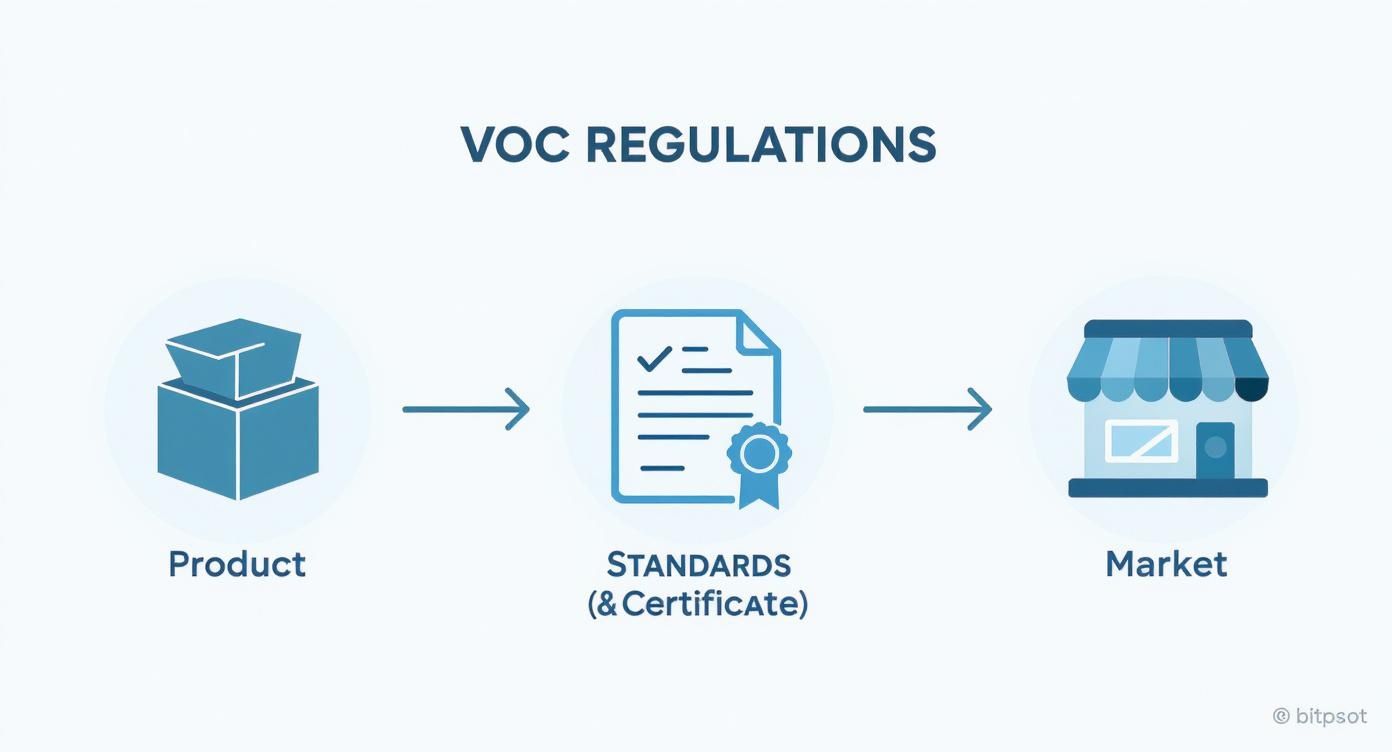
As the graphic shows, meeting these established standards isn't just a box-ticking exercise; it's a critical step for getting products to market, especially in the building and construction industry.
Comparing Different Testing Approaches
While emission chamber testing is the go-to for building materials and furniture, it's not the only tool in the toolbox. The right technique often comes down to the product itself and the specific regulations it needs to satisfy.
The ultimate goal of any testing method is to provide a repeatable, scientific way to evaluate a product's effect on indoor air quality. Whether it’s a huge chamber for a sofa or a tiny vial for a tube of sealant, the core principle of controlled measurement is always the same.
To give you a clearer picture, here’s a quick look at the main methods used for VOC emission testing.
Comparing Common VOC Emission Testing Methods
This table breaks down the most common methods for VOC testing, looking at how they work, what they're used for, and where they really shine.
| Testing Method | Principle of Operation | Best Suited For | Key Advantage |
|---|---|---|---|
| Emission Test Chamber | A product is placed in a sealed chamber with controlled airflow, and emitted VOCs are collected and analysed. | Building materials, furniture, electronics, and large consumer goods. | Provides a highly accurate, real-world simulation of off-gassing over time. |
| Headspace Analysis | A small sample is sealed in a vial and heated; the VOCs released into the air (headspace) above it are then analysed. | Liquids, powders, plastics, and packaging materials. | Fast and effective for screening raw materials and smaller components. |
| Thermal Desorption | VOCs are collected on an adsorbent tube, which is then heated to release the compounds for GC/MS analysis. | Air quality monitoring and measuring very low VOC concentrations. | Extremely sensitive, capable of detecting trace amounts of chemicals. |
Each of these methods has a specific role to play in the wider world of materials analysis.
For businesses aiming for green building certifications, getting a solid grasp of VOC chamber testing is non-negotiable, as it’s the mandated method for most architectural and interior products in Australia. Choosing the right test is the first crucial step toward proving compliance and ensuring your products help create healthier indoor environments for everyone.
How International Standards Shape Australian VOC Testing
While Australia's own green building programs, like Green Star, set a high benchmark for indoor air quality, they don't exist in a bubble. For any Australian manufacturer looking to sell products overseas or supply to multinational projects, just meeting local rules is only the first step.
Think of international certification as a passport for your product. A local tick of approval is great for business here at home, but a globally recognised one opens up borders. It allows your products to compete on the world stage and satisfy the strict procurement policies of global corporations.
The Key Global Standards in Play
When you look beyond our shores, a handful of standards are recognised as the global gold standard for VOC emissions. These are the frameworks that architects, specifiers, and regulators trust worldwide. They create a common language for product performance and safety, making them essential knowledge for anyone in the building materials industry.
Two of the most dominant frameworks you'll come across are:
- ISO 16000 Series: This is a comprehensive family of standards dedicated entirely to indoor air. It lays out very specific methods for how to sample, measure, and test for all sorts of pollutants, including VOCs. In many ways, it's the foundational text that other national standards build upon.
- California Specification 01350 (CDPH Standard Method): Don't let the name fool you; this standard from the California Department of Public Health is one of the most stringent and widely adopted VOC testing methods on the planet. It sets incredibly low emission limits for more than 35 individual VOCs and is a common requirement for products destined for schools and hospitals in the US and beyond.
Choosing to test against these standards sends a powerful message: it shows you’re serious about producing genuinely low-emission products and positions your brand as a leader in health and safety.
Australian Norms vs. Global Protocols
So, how do our local requirements stack up against these international heavyweights? Australian schemes like Green Star typically set clear pass/fail limits for the total amount of VOCs (TVOCs). International standards, however, often get much more specific. California Specification 01350, for instance, doesn't just look at the total; it demands that certain high-risk chemicals are individually measured and kept below minuscule concentration levels.
The real difference is in the detail. Australian standards provide a great overall safety net, but international protocols often mandate a much deeper chemical analysis to catch and control even tiny traces of the most harmful compounds.
This push for more granular testing is a global trend. In Europe, for example, regulations like the Construction Products Regulation (CPR) and REACH put tight controls on specific substances like formaldehyde. If an Australian company wants to sell its products in the EU, testing against these standards isn't a choice—it's a must.
Why International Certification Is a Smart Move
Deciding to pursue international certification through VOC product emission testing isn't just about compliance; it's a strategic business decision. It's an investment that can pay off handsomely, opening doors to new export markets and helping you win contracts with global firms that have one set of rules for all their suppliers. It’s about making your products resilient in a market that increasingly demands transparency and proven health credentials.
Australia has, unfortunately, been slow to adopt best practices in some areas of emissions regulation. A clear example comes from the automotive industry, where research showed that emissions from Australian passenger vehicles were lagging far behind other major markets. In 2021, the average CO2 emissions from new cars here were about 53% higher than in Europe, North America, and Japan. A key reason for this was our reliance on outdated testing protocols. You can read more about how these old methods mask real-world emissions, but the lesson is clear: aligning with modern, rigorous international standards is crucial for credibility and progress.
How to Prepare Products for Successful Emission Testing
Getting that all-important pass on a VOC product emission testing certificate isn’t something that happens by chance. The real work begins long before your product is sealed in a box and shipped off to the lab. Honestly, the preparation process is just as critical as the test itself, and getting it right can save you a world of time, money, and headaches. A failed test means frustrating delays, costly re-testing, and even the risk of losing contracts.
Success really boils down to a series of deliberate steps, starting from the moment you choose your materials right through to how you package the final sample. Think of it like preparing an athlete for the Olympics; you wouldn't just turn up on the day and hope for the best. It takes careful conditioning and preparation to secure a winning result.
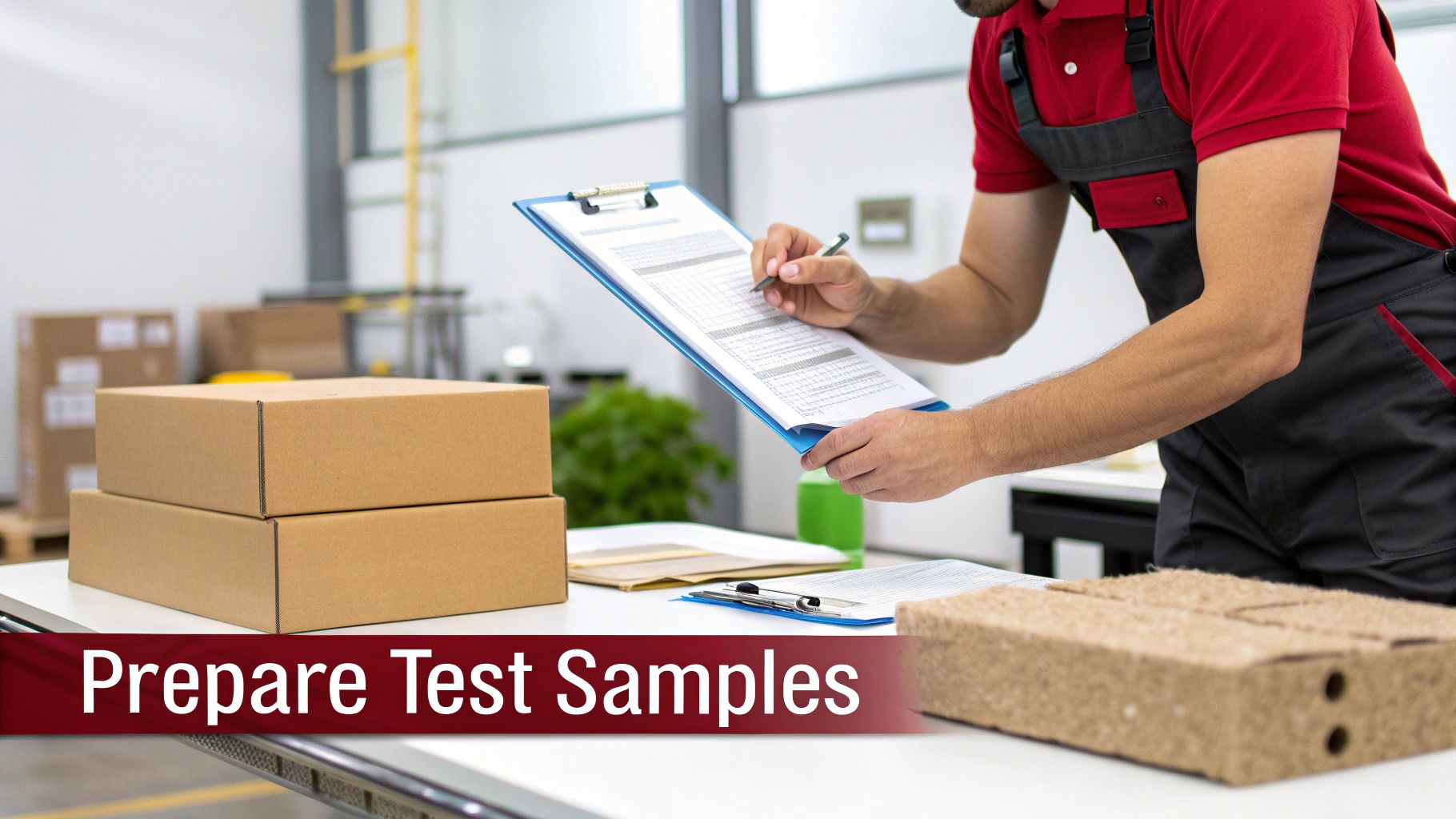
Let's walk through the essential prep checklist. To make it tangible, we'll use the example of a newly manufactured office desk to illustrate each stage. Following these practices will give your product the best possible shot at passing the first time.
Start with Low-VOC Raw Materials
The path to low emissions starts right at the source. It’s a simple truth: you can't build a low-VOC product from high-VOC components. This means you need to be meticulous about every single raw material that goes into your finished item.
For our office desk example, this means looking at:
- Timber Panels: Sourcing particleboard or MDF that's certified as low-formaldehyde or, even better, completely formaldehyde-free.
- Adhesives and Glues: Choosing water-based glues over their solvent-based counterparts, which are well-known for being packed with VOCs.
- Surface Coatings: Selecting paints, laminates, and edge banding materials that are specifically marketed as low-VOC or zero-VOC.
When you build a "clean" product from the ground up, you're already halfway there. It’s far easier to control emissions at the material selection stage than to try and fix the problem later on.
Respect the Curing and Airing-Out Period
One of the most common pitfalls we see is testing a sample that's too "fresh." Newly made products, especially those with paints, coatings, or adhesives, go through a curing process where they off-gas the majority of their VOCs. This emission rate is at its absolute peak in the first few days and weeks.
A product tested too soon will show artificially high emission levels, making a failure almost inevitable. The sample needs to represent the product as a customer would receive it, not how it is straight off the assembly line.
Testing labs have specific guidelines for curing times, which can range from a few days to several weeks, all depending on the materials involved. For our office desk, this means letting the finished product sit in a clean, well-ventilated space for the recommended period before it gets packaged for testing. This crucial step allows the most aggressive off-gassing to occur before the sample ever enters the highly controlled chamber environment.
Avoid Sample Contamination at All Costs
So, you've carefully selected your materials and let the product cure properly. The final hurdle is preventing contamination during handling and transport. The testing equipment is incredibly sensitive and can pick up even minuscule amounts of external VOCs, which will completely throw off your results.
Here are the golden rules for packaging and sending your sample:
- Use Clean Packaging: Never grab a recycled cardboard box that might have absorbed other chemicals. Always use new, clean materials.
- Avoid Plastic Wrapping: Standard plastics like cling film or bubble wrap can actually emit their own VOCs. Use inert materials like aluminium foil or special low-emission bags if the lab recommends them.
- Handle with Care: Make sure anyone handling the sample does so in a clean environment, well away from solvents, perfumes, or cleaning sprays.
For our office desk, a sample piece would be carefully wrapped in laboratory-grade foil and then placed in a new, odour-free box. This ensures that the only VOCs being measured are the ones coming from the desk itself.
Having the right processes in place is key, and working with experienced professionals can make all the difference. For guidance, looking into different VOC testing companies can give you valuable insight into their specific sample requirements. When you take these preparation steps seriously, VOC product emission testing shifts from being a gamble to a predictable and reliable quality assurance process.
The Business Case for Low-VOC Products
For years, many businesses wrote off VOC product emission testing as just another box to tick on a compliance checklist. It was seen as a cost, a regulatory headache you just had to deal with. But that old way of thinking is completely out of step with where the market is today. Now, it's not an expense—it's a smart investment in your brand's reputation and its future.
Let's move past the idea of just being compliant. The real upside here is creating healthier spaces for people to live and work in. Think about it: when your products, whether that’s office furniture, building materials, or even paint, release fewer harmful chemicals, you're directly improving the wellbeing of your customers. That’s a powerful thing.
This isn't just a feel-good story, either. A commitment to health has become a massive point of difference in the market. Today’s consumers and corporate clients are actively looking for brands that are open, honest, and can prove their products are safe. Having a low-VOC certification is a clear, trustworthy signal that you take these values seriously.
Gaining a Competitive Edge
In the cut-throat world of commercial tenders and big projects, environmental and health standards aren't just a "nice-to-have" anymore. They are often deal-breakers. Architects, builders, and the people sourcing materials for schools, hospitals, and major corporate fit-outs are often required to use products that meet tough benchmarks like Green Star or NABERS.
If your products don't have that low-VOC certification, you might not even make it to the shortlist for these valuable contracts. Having those verified test results in hand gives you a genuine competitive advantage, making your products the obvious choice for high-stakes projects where health and sustainability are top priorities.
Embracing these forward-thinking principles isn't just about keeping up with today's rules. It’s about setting your brand up as a leader in a market that increasingly rewards companies who care about health, safety, and the environment. It’s a proactive play for long-term growth.
This is especially true here in Australia, where awareness around emission-related issues is growing fast. To put it in a different context, data from the National Transport Commission shows that our light vehicle fleet has a significantly higher emissions intensity than international averages. The average for registered vehicles sits at 193.7 g/km, partly because we have so many older, high-emission cars still on the road. You can read more about these trends in light vehicle emissions to see how broad the push for emission reduction really is.
The Marketing Power of Low Emissions
The story behind your low-VOC products is an incredible marketing asset. It lets you build a brand narrative around trust, safety, and genuine quality, which really connects with an audience that is more informed and health-conscious than ever before.
Just think about the marketing opportunities:
- A Stronger Brand Image: When you link your brand to health and sustainability, people notice and feel good about choosing you.
- Laser-Focused Marketing: You can directly target architects, designers, and builders who specialise in green building projects.
- Justifies a Premium: A low-VOC certification backs up a premium price. Customers are genuinely willing to pay a bit more for products they know are healthier.
Of course, a big part of this comes down to the materials you choose. Innovations like water-based cabinet paint are a perfect example of a healthier alternative for both home and commercial projects. By making these choices and talking about them, you give customers real, tangible proof of your commitment.
At the end of the day, putting your money into VOC product emission testing is an investment in your brand's resilience, its position as a market leader, and a healthier future for everyone.
Your VOC Testing Questions Answered
When it comes to VOC product emission testing, it’s easy to get bogged down in the details. What does it cost? How long will it take? What do all those product labels even mean? Here are some straightforward answers to the questions we hear most often from manufacturers and builders across Australia.
How Much Does Testing Cost and How Long Does It Take?
There’s no one-size-fits-all answer here, as the cost and timeframe really depend on what you need. The specific test method, the type of product you’re testing, and the certification you're chasing will all influence the final quote. A quick screening test is one thing, but a full chamber test against a tough international standard like California Specification 01350 is a much bigger undertaking.
As a general guide, you could be looking at a process that takes anywhere from a few days to several weeks. The chamber test itself might only run for 24 to 72 hours, but you also have to factor in sample prep, curing time, and the in-depth chemical analysis that happens afterwards. The best bet is always to chat directly with an accredited lab to get a precise quote for your product.
What Happens if a Product Fails a VOC Test?
Failing a test isn't a dead end—think of it as a critical piece of feedback. The lab report is incredibly valuable, as it will tell you exactly which chemicals are over the limit. This gives your product development team a clear, data-driven path forward.
Typically, the process looks like this:
- Find the Culprit: Your team will need to trace the source of the high emissions. Is it a specific adhesive, a coating, or one of the composite panels?
- Reformulate and Refine: This usually means working with your suppliers to find lower-emitting materials or tweaking your own manufacturing process.
- Test It Again: Once you’ve made the changes, you’ll submit a new sample to confirm the product now meets the standard.
How Do I Find an Accredited Lab in Australia?
Getting your testing done by a reputable, accredited lab is non-negotiable. It’s the only way to guarantee your results are accurate and will be recognised by programs like Green Star.
In Australia, the National Association of Testing Authorities (NATA) is the organisation that accredits laboratories. A lab with NATA accreditation has proven it meets stringent technical and quality benchmarks. You can easily search the NATA directory to find a facility that handles VOC product emission testing.
What Is the Difference Between Low-VOC and Zero-VOC?
You’ll see these terms everywhere in marketing, but they aren’t interchangeable.
Low-VOC products have been formulated to contain far fewer Volatile Organic Compounds than their traditional counterparts. They still release some chemicals, but the levels are low enough to be considered safe for indoor air quality.
Zero-VOC products, as the name suggests, contain no intentionally added VOCs. It's almost impossible to create a product that is 100% free of trace volatile compounds, but these formulas have the lowest possible emissions. This makes them the ideal choice for sensitive places like hospitals, childcare centres, and schools.
At Anitech Ltd Pty, we know that getting your head around VOCs and workplace safety is a huge part of running a responsible business. Our occupational hygiene experts are here to give you the practical guidance you need to create healthy, compliant environments. Whether you need help choosing materials or making sense of a complex test report, we’ve got your back.
See how our nationwide services can help you lift your health and safety standards by visiting us at https://occhygiene.com.au.


