
VOC chamber testing is all about placing a product inside a sealed, controlled environment to measure the Volatile Organic Compounds (VOCs) it releases into the air. It's a highly precise method that helps us understand a product's real impact on indoor air quality, making sure it’s safe for our homes, schools, and offices.
Why VOC Chamber Testing Is Essential for Healthy Buildings
You know that 'new car smell' or the sharp scent of fresh paint? Those distinct odours are caused by Volatile Organic Compounds, or VOCs for short. These are chemicals that countless everyday products slowly release—or 'off-gas'—into the air around us. While some VOCs are perfectly harmless, others can seriously degrade indoor air quality and even lead to health issues. That’s why measuring and controlling them has become a huge focus in modern building design.
This is where VOC chamber testing comes into its own. The easiest way to think of it is as a highly controlled laboratory experiment for the air we breathe. A product—whether it’s a new piece of furniture, a roll of carpet, or a can of paint—is placed inside a sealed, sterile environmental chamber. Inside, everything from the temperature and humidity to the air exchange rate is precisely managed to replicate a typical room. This scientific precision is crucial because it guarantees that any chemicals we detect are coming directly from the item being tested, and nowhere else.
Uncovering Invisible Threats
Many of the products we bring into our homes and offices can off-gas VOCs for weeks, months, or even years after they're installed. Without this kind of controlled testing, it's virtually impossible to know what that new desk or flooring material is secretly adding to the air.
The goal of the process is simple: identify and measure the specific chemicals being released. This gives manufacturers, builders, and even homeowners clear, practical data. It helps answer critical questions like:
- What specific chemicals is this product actually emitting?
- How much of each chemical is being released over time?
- Does the product meet Australian health and safety standards?
To get a handle on the terminology, it helps to understand a few key concepts. These terms pop up all the time in test reports and discussions about indoor air quality.
| Term | What It Really Means | Why It's Important |
|---|---|---|
| Emission Rate | How quickly a product releases VOCs into the air. It’s often measured in micrograms per square metre per hour (μg/m²/hr). | This tells you the speed of the off-gassing. A high emission rate means a product is polluting the air faster. |
| Concentration | The amount of a specific VOC found in a given volume of air within the chamber, usually measured in micrograms per cubic metre (μg/m³). | This is the bottom line for air quality—it shows how much of a chemical you might actually be breathing in a room. |
| TVOC (Total Volatile Organic Compounds) | The sum total of all the different VOCs detected in the test. | While it doesn’t identify individual chemicals, TVOC gives a great overall snapshot of a product's total emission load. |
Understanding these terms makes it much easier to interpret test results and see why this process is so fundamental to creating healthier indoor spaces.
The Foundation of Safer Indoor Environments
By understanding these emissions, manufacturers can refine their products to be healthier and have lower VOC levels. At the same time, architects and builders can use this data to make smarter choices, selecting materials that actively contribute to a cleaner indoor environment. Knowing where pollutants come from is the first step; for instance, you can learn more about how different carpet types can impact home air quality.
In essence, VOC chamber testing moves us beyond guesswork. It replaces assumptions with hard data, empowering us to build and furnish spaces that protect the health and wellbeing of occupants.
Ultimately, the insights we get from this meticulous process are fundamental to creating the healthy buildings that Australians expect and deserve. For a closer look at how this applies in real-world situations, our experts provide detailed information on indoor air quality and VOC testing services. This commitment to proper scientific measurement is the most important step we can take toward ensuring the air in our homes and workplaces is as clean and safe as possible.
How the VOC Chamber Testing Process Works Step by Step
To really get your head around VOC chamber testing, you need to picture a process where every single detail is meticulously controlled. It’s all about creating a completely isolated environment for a product, so we can be certain that every chemical we detect is coming directly from that item and nothing else. Think of it as putting a product in its own pristine, sealed-off "mini-room" to see exactly how it off-gasses in the real world.
The whole thing starts with careful preparation, long before the test even begins. We don't just grab an item off the shelf. The product sample has to be selected, handled, and conditioned according to a strict protocol. This stops any outside contamination—from packaging, the oils on someone's hands, you name it—from skewing the results. The sample is then left to acclimatise for a set period, allowing its emissions to stabilise before it goes anywhere near the chamber.
Setting the Stage for Accurate Measurement
Once the sample is ready, it's placed inside a specialised environmental chamber. These are far from being simple stainless steel boxes; they are incredibly sophisticated pieces of equipment.
- Pristine Environment: The chamber's internal surfaces are constructed from inert materials that don't release their own VOCs. This ensures the test isn't tainted from the get-go.
- Controlled Climate: Our technicians set precise levels for temperature, relative humidity, and the air exchange rate. This allows us to mimic specific indoor environments, like a typical Australian office or living room.
- Purified Air: Before it even enters the chamber, the air is scrubbed clean with HEPA filters to remove any existing pollutants, creating a pure baseline for measurement.
This hyper-controlled setting is the absolute foundation of reliable VOC chamber testing. Without it, the data would be unreliable and essentially useless.
The infographic below gives you a great visual of what we're trying to capture and measure—the journey of VOCs from a product into the air we breathe.
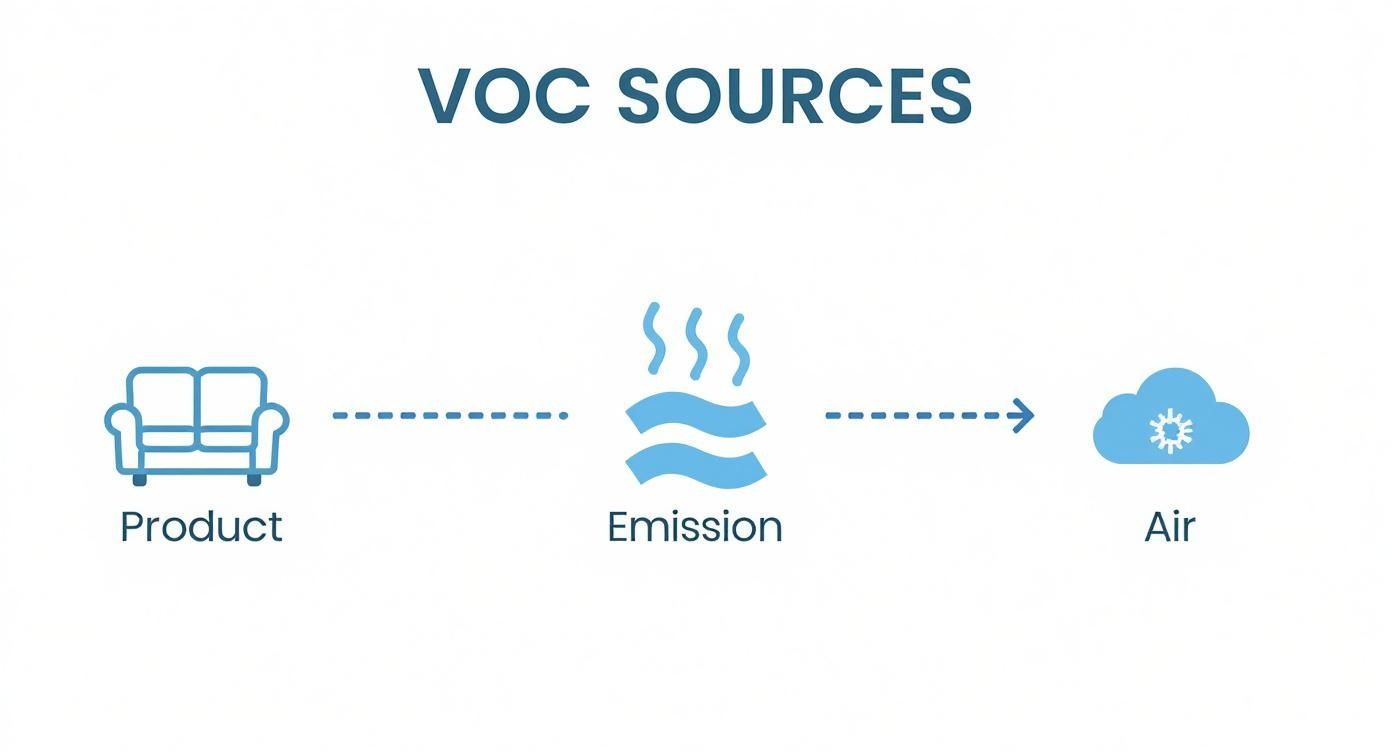
As you can see, an everyday item like a sofa can be a significant source of emissions, impacting the air quality in a room. Chamber testing is how we put a number on that impact.
Capturing and Analysing the Invisible
With the test running, the chamber's systems get to work on the most crucial part: sampling the air. We draw out small, precise volumes of air from the chamber at set intervals, often at 24, 48, and 72 hours.
This air is carefully channelled through sorbent tubes. You can think of these tubes as highly specialised sponges, packed with a material that traps VOC molecules while letting the clean air pass through. It’s a clever way to concentrate those invisible emissions into a physical sample that we can then take away for analysis.
This is the moment where the invisible becomes visible. The sorbent tubes capture a chemical fingerprint of the product's emissions, giving us a clear snapshot of its off-gassing behaviour over time.
The final, and most technical, step is analysing these sorbent tubes in the lab. Here, we bring out the heavy-duty equipment. The tubes are processed using a technique called Gas Chromatography/Mass Spectrometry (GC/MS).
This powerful method separates, identifies, and quantifies every single chemical compound we've captured. It's so sensitive it can distinguish between hundreds of different VOCs, giving us a detailed report of not just what is being emitted, but exactly how much. This is the level of detail needed to assess a product's safety and ensure it meets regulatory standards.
Here in Australia, this methodology isn't new; it has a long and successful history. Chamber testing for VOCs from wood-based panels, for instance, has been standardised since the early 2000s. The process uses chambers of various sizes, with air samples collected on sorbent tubes and analysed via GC/MS. It’s a critical step in predicting how these common building materials will affect the indoor air quality of a typical Australian home. You can dig deeper into this in reports on Australian VOC emission studies.
From painstaking preparation to advanced chemical analysis, every step in the process is designed to deliver accurate, repeatable data that manufacturers and builders can trust to create safer products for all of us.
How Australian Standards and Regulations Govern VOCs
It’s all well and good to measure chemical emissions in a lab, but what really matters is how that science connects to the real-world rules designed to keep us safe. VOC chamber testing is the critical link, ensuring the building materials and products we bring into our homes and offices meet Australia's strict public health standards.
Australia doesn't just invent these rules out of thin air. Our regulatory framework is built on a solid foundation of internationally recognised testing methods. This is incredibly important because it means a test conducted in Sydney will produce results comparable to one in Berlin or Tokyo, creating a consistent, reliable system for manufacturers and consumers alike.
The Bedrock: National and International Standards
At the heart of all this are the standards that define exactly how a VOC chamber test must be run. For a result to be considered valid and trustworthy, the lab has to follow these protocols precisely. It's what ensures fairness, accuracy, and repeatability, no matter where the test is performed.
Two of the most significant international players are:
- ISO (International Organization for Standardization): ISO sets the global benchmark for environmental testing. The ISO 16000 series, for example, is the go-to guide for measuring indoor air pollutants.
- ASTM International (American Society for Testing and Materials): ASTM publishes highly specific technical standards for a vast range of materials, including detailed methods for chamber testing products.
In Australia, we often adopt or adapt these international guidelines to fit our local conditions and regulatory aims. This ensures a high-quality, consistent testing environment across the country that everyone can rely on.
Australian Building Codes and Getting the Green Light
In the construction world, the main player driving VOC compliance is the Australian Building Codes Board (ABCB). While the ABCB doesn't set the exact VOC emission limits itself, it creates the overarching framework that state and territory governments use to manage indoor air quality in new buildings.
This is where VOC chamber testing truly proves its worth. For manufacturers of building materials—think flooring, adhesives, paints, or engineered wood—to show they're compliant, they need to provide data from an accredited lab. This data is the proof that their products won't harm the air quality inside a new home or office.
A product's VOC test certificate isn't just a piece of paper; it's a declaration of safety. It reassures architects, builders, and homeowners that the material meets the health expectations laid out in our national building codes.
The ABCB specifically points to chamber testing as a key tool for ensuring good indoor air quality. In fact, the 2022 ABCB Handbook on Indoor Air Quality explains how these tests are used to check VOC emissions from things like coatings and wood panels, aligning with broader national environmental protection measures. As part of these measures, states are required to monitor air contaminants, including VOCs, at over 50 sites across Australia, safeguarding public health nationwide. You can find out more about the ABCB's approach to indoor air quality on abcb.gov.au.
Why a Standardised Approach Is So Important
Having a unified approach to testing brings huge benefits. For manufacturers, it creates a clear, predictable path to demonstrate that their products are safe and low-emitting. It also levels the playing field, making sure everyone is judged by the same tough criteria. This naturally encourages companies to innovate and develop healthier, more sustainable materials.
For the rest of us—the people living and working in these buildings—it offers invaluable peace of mind. Knowing that the materials used in our indoor spaces have passed rigorous VOC chamber testing according to national and international standards gives us confidence in the quality and safety of our environment. Ultimately, this regulatory oversight is fundamental to creating healthier buildings for all Australians.
Real-World Examples of VOC Testing in Action
While the science behind VOC chamber testing can seem pretty technical, its impact is all around us in the everyday products we use. This isn't just some abstract laboratory process; it's a critical quality control step that has a direct say in how safe our homes, workplaces, and even our cars are. Think of it as the hidden process that helps manufacturers build better, healthier products for all of us.
From the paint on your walls to the flooring under your feet, companies rely on this detailed testing to innovate and improve. Let's take a closer look at how different industries are using VOC chamber testing to protect public health and guarantee their products are up to scratch.
Greener Building Materials and Safer Homes
The building and construction industry is easily one of the biggest champions of VOC testing. It makes sense when you think about it—products like paints, glues, insulation, and engineered wood can be major sources of indoor air pollution if they aren't formulated correctly.
This is where forward-thinking manufacturers use chamber testing as a core part of their research and development, not just as a box-ticking exercise for compliance. By testing different formulas, they can pinpoint exactly which ingredients are causing high emissions and swap them out for safer, low-VOC alternatives. This has paved the way for a new generation of building materials that are far healthier for us to live and work with.
You can see this commitment to improvement in the coatings industry. A report on surface coatings in Australia highlighted just how essential chamber tests are for verifying the VOC content of paints and varnishes. The study found a significant drop in the average VOC levels in architectural coatings, with many now well below the 100 g/L mark. It's a clear example of how testing drives product evolution. For more details, you can explore the full report on how testing has improved surface coatings on nepc.gov.au.
Enhancing Vehicle Interior Air Quality
We've all experienced that "new car smell," and it’s a perfect example of VOCs in action. That distinct odour comes from the off-gassing of plastics, adhesives, textiles, and foams that make up a car's interior. As people have become more aware of indoor air quality, the demand for healthier vehicle cabins has shot up.
Automotive manufacturers now use specialised VOC chambers to test every single component, from the dashboard plastics to the seat upholstery. The main goal is to minimise harmful emissions and create a cleaner breathing space for drivers and passengers, especially on long trips where you're exposed for longer.
By simulating real-world conditions, like a car parked in the hot sun, manufacturers can measure worst-case emissions. This helps them design components that stay stable and low-emitting even when things heat up.
Safe Consumer Goods from Furniture to Toys
The use of VOC chamber testing goes well beyond construction sites and car factories. It's just as crucial for the countless consumer goods we bring into our homes every day.
Take a look at how different product categories benefit:
- Furniture: Materials like pressed-wood, foams, and fabrics used in sofas, desks, and cabinets are tested to make sure they don't release harmful chemicals like formaldehyde into your living room.
- Electronics: Your computer, printer, and TV can all emit VOCs when they heat up. Testing helps manufacturers keep these emissions in check.
- Children’s Toys: When it comes to products for kids, safety is non-negotiable. Chamber testing verifies that the paints, plastics, and other materials used in toys are free from nasty volatile compounds.
This table shows how various sectors apply VOC chamber testing to meet their unique goals.
| Industry | Common Products Tested | Primary Testing Goal |
|---|---|---|
| Building & Construction | Paints, adhesives, flooring, insulation, engineered wood | Certify low-VOC products, meet green building standards, and ensure occupant safety. |
| Automotive | Dashboards, seating, carpets, headliners, trim components | Minimise interior air contaminants, meet global air quality regulations, and reduce "new car smell". |
| Furniture & Furnishings | Desks, chairs, mattresses, upholstery, cabinetry | Reduce formaldehyde and other emissions, ensuring products are safe for residential and office use. |
| Electronics | Computers, printers, televisions, mobile devices | Control emissions during operation (heating), ensuring devices don't degrade indoor air quality. |
| Children's Products | Toys, cribs, art supplies, playground equipment | Guarantee materials are free from harmful volatile compounds, ensuring the highest level of safety for kids. |
Ultimately, this rigorous testing process gives us confidence that the products we rely on daily are safe. It also highlights the link between different indoor contaminants. To learn more, have a look at our guide on distinguishing between mould and VOC testing to see how they fit together to create a complete picture of indoor environmental health. These real-world applications prove that VOC chamber testing is more than a technical requirement—it’s a fundamental tool for protecting our wellbeing.
How to Make Sense of a VOC Test Report
When a VOC test report lands on your desk, it can look pretty intimidating. You're usually faced with pages of technical jargon, complex graphs, and long lists of chemical names. It's easy to feel a bit lost in the data.
But here’s the good news: you don't need a chemistry degree to understand what it all means. Once you grasp a few key ideas, you can cut through the noise and find the clear, actionable insights you need to make smart decisions about your product's safety and compliance.

Emission Rates vs. Concentration Levels
First up, let's tackle the two most important numbers you'll see: emission rates and concentration levels. They might sound like the same thing, but they tell you two very different, and equally important, parts of the story.
-
Emission Rate: Think of this as the speed at which your product is releasing VOCs. It’s measured in micrograms per square metre per hour (µg/m²/hr). A high emission rate means the product is off-gassing quickly, pumping more chemicals into the air in a shorter amount of time.
-
Concentration Level: This is the amount of a specific VOC present in the air within the test chamber at a specific time. It’s usually shown in micrograms per cubic metre (µg/m³). This is the number that really matters for health, as it reflects what someone might actually breathe in.
Getting your head around this difference is crucial. One product could have a huge initial emission rate that trails off to nothing in a day, while another might have a lower, slower rate that lingers for weeks.
Context Is Everything: Benchmarking Against Standards
A list of numbers is just that—a list. The data only becomes meaningful when you compare it to established health guidelines and regulatory limits. A good lab report will do this for you, putting the results into context.
For instance, the report might flag that your product emits formaldehyde at 15 µg/m³. On its own, that number doesn't mean much. But when the report shows this next to a guideline from a body like Australia's National Health and Medical Research Council (NHMRC), you can see instantly whether you're in the clear.
The real value of a VOC test report lies in this comparison. It transforms raw data into a clear verdict on product safety, answering the crucial question: "Is this product safe for indoor use?"
Reading the Emission Decay Curve
One of the most useful visuals in any report is the emission decay curve. This graph plots the product's VOC emissions over time, with measurements often taken at key intervals like 24, 48, and 72 hours, and sometimes stretching out for weeks.
This curve tells a story about your product’s behaviour. Does it off-gas in a big burst right at the start before settling down? Or is it a slow, steady emitter? This kind of insight is gold for manufacturers wanting to refine their materials or for builders trying to plan out ventilation on a new project. Understanding the decay pattern helps you make practical, data-driven decisions.
Key Considerations for Accurate VOC Chamber Testing
Getting reliable, repeatable results from VOC chamber testing isn't about luck. It's the result of following strict, painstaking protocols. The slightest oversight can contaminate a sample or throw off the data, rendering the whole exercise useless. Think of it as a scientific tightrope walk where every single variable has to be kept in perfect balance.
This fanatical attention to detail is what makes the difference between a test you can trust and one you can't. From the second a sample is collected to the final calibration check, every step is a crucial link in the chain of accuracy.
Starting with a Clean Slate
Before any testing can even begin, the chamber has to be an absolutely pristine environment. Any leftover chemicals from a previous test—what we call chamber background contamination—can easily get mixed into the new analysis, leading to false positives and wildly inaccurate emission rates.
To stop this from happening, labs carry out a critical process known as chamber cleanliness validation. This involves heating the empty chamber and flushing it with purified air, all while taking samples of the air inside to make absolutely sure it’s free of any residual VOCs.
It's a bit like deep-cleaning your kitchen before you start baking. You wouldn't want the smell of last night's curry getting into your cake, and it's the same principle here—labs have to make sure no chemical "ghosts" are haunting the chamber.
The Importance of Sample Integrity
The accuracy of any test boils down to the quality of the sample itself. The way a product sample is chosen, handled, and prepared can have a huge impact on the final numbers. Contamination can sneak in from something as simple as the packaging it was shipped in or even the natural oils on a technician's hands.
To keep the sample pure, strict protocols are essential:
- Aseptic Handling: Samples are handled in a controlled space, usually with gloves, to keep any outside contaminants from getting on them.
- Proper Conditioning: The sample is left to sit for a specific period under controlled conditions before testing, which lets its chemical emissions stabilise.
- Controlled Storage: It’s stored in a way that stops it from soaking up VOCs from the air around it before it even gets into the chamber.
Calibrating for Confidence
You can have the most sophisticated analytical equipment in the world, but it's completely worthless if it isn’t calibrated correctly. Instruments like the Gas Chromatography/Mass Spectrometry (GC/MS) system have to be tuned and checked against known chemical standards on a regular basis.
This calibration process is what guarantees that when the machine flags a specific VOC and measures how much of it is there, the reading is spot-on. It’s an absolute must for any accredited lab and the foundation for producing scientifically sound data that can stand up in court. Without it, the figures on a test report are just educated guesses. If you're searching for a provider that puts these strict quality controls first, you can find more information on choosing a professional VOC testing company that meets the highest industry standards.
Mimicking the Real World
Finally, the conditions inside the chamber have to closely match the real-world environment where the product will actually be used. Testing a piece of office carpet at a temperature or humidity level you’d never find in a real office building will give you data that means nothing.
Technicians carefully control these key environmental settings:
- Temperature: Set to reflect typical indoor spaces, usually somewhere between 20°C and 25°C.
- Relative Humidity: Generally kept around 50% RH to simulate a standard indoor climate.
- Air Exchange Rate: This mimics the ventilation of an actual room, ensuring the measured concentration levels are realistic.
By staying focused on these critical points, labs ensure the results of VOC chamber testing aren't just numbers on a page, but a true reflection of a product's real impact on the air we breathe.
Your Top Questions About VOC Chamber Testing, Answered
As more people tune into the importance of healthy indoor air, the science behind it naturally brings up a lot of questions. Let's tackle some of the most common queries about VOC chamber testing to clear things up.
How Long Does a VOC Chamber Test Take?
There's no single answer here, as the test duration really depends on the product itself and the specific standard we're testing against. A fairly standard test run involves taking air samples at set times, often at 24, 48, and 72 hours.
That said, some protocols demand a much longer view. For certain materials that release chemicals slowly over time, a test might need to run for several days or even weeks. This longer timeframe is essential to see how the emissions taper off, giving us a complete picture of the product's long-term impact on air quality.
Can You Test Any Product in a Chamber?
Pretty much! If it's designed to be used indoors, we can assess it. The testing chambers themselves come in all shapes and sizes, from small boxes that sit on a benchtop to massive, walk-in rooms that can fit a whole sofa or large building panels.
This versatility means we can test a huge variety of common items, including:
- Paints, glues, and sealants
- Flooring like carpet, vinyl, and timber
- Engineered wood products (think MDF or particleboard)
- Furniture and mattresses
- Even electronic gadgets
The trick is to get the scale right—we need to match the size of the product sample to the chamber volume to properly mimic how it would behave in a real room.
A common misconception is that testing is only for building materials. In reality, any item that could release chemicals into indoor air—from a child's toy to an office printer—is a valid candidate for chamber testing.
What’s the Difference Between Chamber Testing and Onsite Air Sampling?
This is a really important distinction. Think of onsite air sampling as taking a snapshot of the air quality in an entire room, like your office or living room. It tells you what’s in the air right now but mixes together emissions from every single source—the paint, the carpet, the furniture, even the cleaning products used that morning. This is the kind of general assessment that leads people to ask how often indoor air quality testing should be performed in their spaces.
On the other hand, VOC chamber testing is a controlled laboratory experiment. We place one single product inside a completely clean, sealed environment. This lets us measure only the emissions coming from that specific item, with no outside interference. It's how manufacturers can scientifically prove their product’s low-emission claims and get it certified.
Anitech Ltd Pty provides the expertise needed to navigate the complexities of occupational hygiene and product safety. Their scientific approach ensures your workplace meets the highest health and safety standards. To learn more about their services, visit https://occhygiene.com.au.


