
Quick Summary: Clandestine laboratory activity leaves behind subtle physical indicators. This visual guide details 12 key signs, from chemical odours and electrical modifications to waste disposal patterns. Understanding these is the first step in initiating diagnostic testing and property screening workflows to mitigate risks like focused meth contamination.
In the complex landscape of occupational hygiene and property management, ensuring a safe environment is paramount. Beyond routine inspections, a more nuanced threat can emerge from the presence of a clandestine laboratory. These illicit operations, often associated with focused meth contamination and other hazardous substance production, leave behind a trail of subtle but significant physical evidence. For safety professionals, first responders, and industrial hygienists, recognising these indicators is the first critical step in mitigating severe health risks, environmental damage, and significant legal liabilities.
This visual guide: 12 subtle physical indicators of clandestine laboratory activity is designed to equip you with the knowledge to spot these signs early. We will explore a dozen distinct physical indicators, each supported by imagery, expert analysis, and clear diagnostic testing and property screening workflows. Understanding these subtle cues allows for timely intervention, protecting both people and property from the lasting impact of hazardous chemical activities. For occupational hygiene professionals, understanding what property managers look for when inspecting commercial buildings can be instrumental in identifying anomalies that might otherwise be dismissed as simple maintenance issues. This article provides a specialised framework, moving beyond standard checks to focus on the specific, often hidden, evidence of illicit chemical operations. By mastering these observational skills, you can implement more robust screening and testing protocols to confidently manage and remediate these hidden dangers.
1. Indicator #1: Pungent Chemical Odours and Airborne Particulates
Unusual, strong, or persistent chemical odours are often the first and most telling of the subtle physical indicators of clandestine laboratory activity. While legitimate industrial processes produce distinct smells, these are typically well-managed through engineered ventilation and emission controls. A clandestine operation, however, rarely prioritises such safety measures, leading to uncontrolled vapour release.
These odours, which can range from acrid and sharp to sweet or ammonia-like, often signify the presence of volatile organic compounds (VOCs), solvent vapours, or toxic gases created during illicit chemical synthesis. The presence of fine dusts or a visible haze in the air, especially in areas without obvious dust-generating activities, can also point to uncontrolled airborne particulates from chemical processing or grinding.
Why It's a Critical Indicator
The persistent presence of such odours despite what appear to be standard facility controls is a significant red flag. It suggests that an unauthorised and unregulated chemical process is occurring, bypassing your established occupational hygiene and safety protocols. These emissions pose immediate inhalation risks to all personnel, can be flammable or explosive, and may indicate improper chemical handling and waste disposal, such as dumping materials down drains, causing odours to back up into the facility.
Actionable On-Site Checks & Next Steps
- Conduct Sensory Audits: Perform regular 'odour audits' or sensory walks around the property at different times of the day and night. Document the character, intensity, and location of any unusual smells.
- Establish a Baseline: Formally document the expected odour profiles for all legitimate, authorised operations within your facility. This baseline makes it easier to identify and investigate anomalies.
- Implement a Reporting Protocol: Train all staff, including security and cleaning crews, on how to recognise and immediately report unusual odours through a clear, no-blame channel.
- Deploy Monitoring Technology: In high-risk areas or where concerns have been raised, install environmental monitoring systems like VOC detectors or particulate counters to gather objective data.
Next Steps: If a suspicious odour is confirmed and cannot be linked to a known, safe process, immediately secure the area to prevent entry. Do not attempt to locate the source yourself. Notify management and engage a qualified environmental or occupational hygiene professional for further investigation and potential diagnostic testing.
2. Unusual Electrical Modifications and High Power Consumption Patterns
Clandestine laboratory activity, such as illicit drug manufacturing or unauthorised chemical processing, often demands significant electrical power for heating elements, high-intensity lighting, pumps, and powerful ventilation systems. This excessive power draw frequently surpasses the designed capacity of a building's standard electrical system, leading operators to make crude, dangerous, and highly visible modifications. These can include exposed, heavy-gauge wiring, bypassed meters, or jury-rigged connections tapping directly into main power lines.
These modifications are one of the key subtle physical indicators of clandestine laboratory activity because legitimate industrial tenants will have their electrical needs properly planned, documented, and installed by qualified electricians to meet safety standards. Unauthorised wiring is a direct sign of an operation attempting to conceal its energy footprint or support equipment beyond the site’s official capacity.
Why It's a Critical Indicator
Unauthorised electrical work presents a severe fire and electrocution hazard, not only to the clandestine operators but to everyone in the facility and surrounding properties. Overloaded circuits, improper grounding, and exposed live wires can easily ignite flammable chemical vapours present in the lab environment. Furthermore, abnormal spikes in electricity consumption that cannot be reconciled with legitimate tenant operations strongly suggest an intensive, unapproved process is running, often around the clock.
Actionable On-Site Checks & Next Steps
- Review Energy Bills: Monitor electricity consumption patterns monthly for unexplained spikes or consistently high usage that is incongruous with the declared activities of a tenant.
- Conduct Electrical Audits: Engage a qualified electrician to perform quarterly inspections of all electrical panels, junction boxes, and utility meters. They are trained to spot non-compliant or dangerous modifications.
- Maintain As-Built Drawings: Keep detailed and updated electrical schematics and modification records for the entire property. Any wiring not on the official plans warrants immediate investigation.
- Install Smart Meters: Where feasible, use smart metering technology to gain real-time data on power consumption, allowing for quicker detection of anomalies.
Next Steps: If unsafe or unauthorised wiring is discovered, the immediate priority is safety. Do not touch or attempt to disable the wiring yourself. Secure the area, notify management, and contact both a certified electrician to assess the immediate danger and the appropriate authorities, as this is a significant indicator of illegal operations.
3. Restricted Access Areas and Physical Security Measures
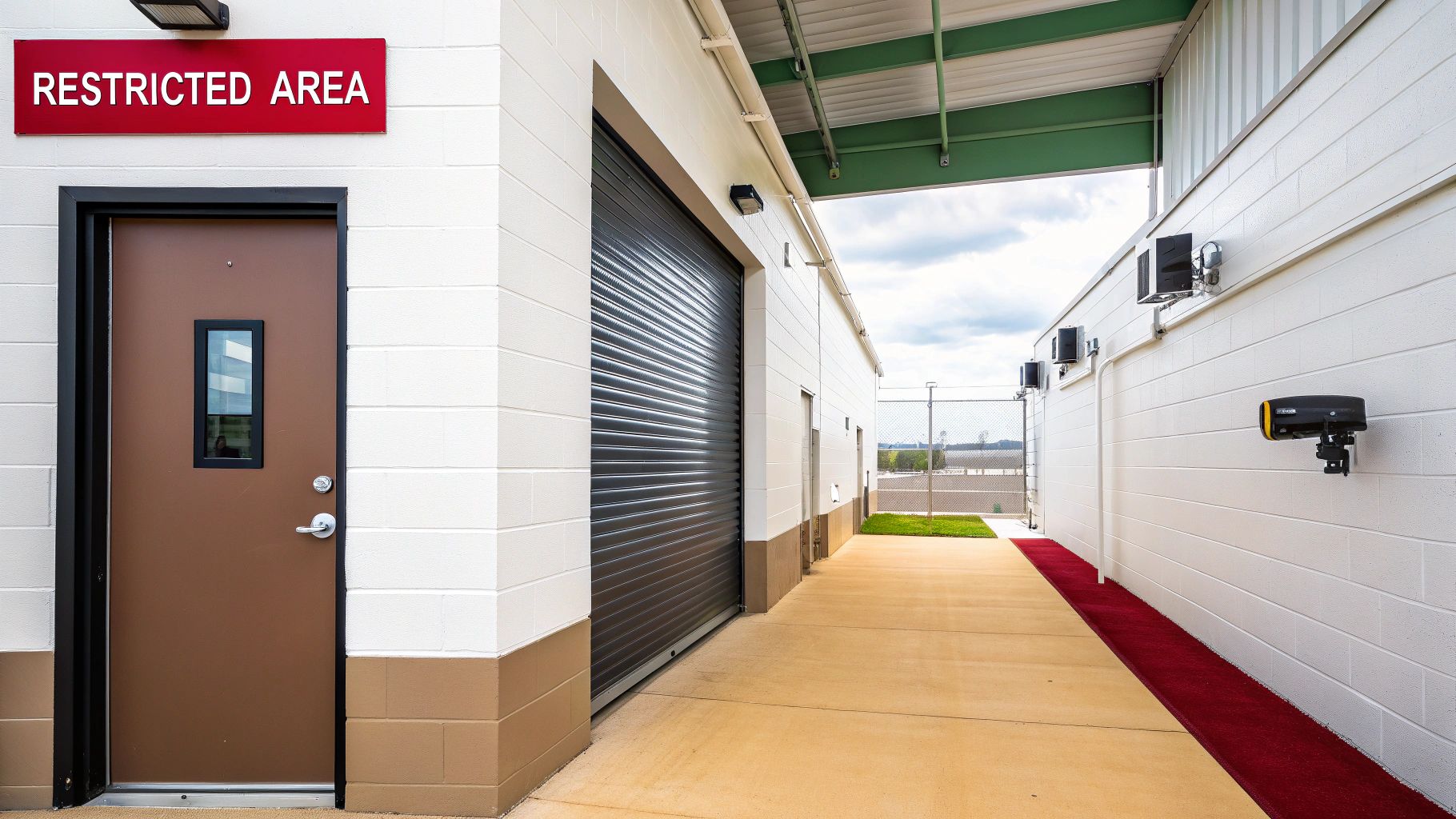
Excessive or disproportionate security measures can be a key physical indicator of clandestine laboratory activity. While legitimate operations maintain security appropriate to their business needs, illicit activities often require extreme measures to prevent discovery. This can manifest as newly reinforced doors, blacked-out or permanently covered windows, or security cameras aimed internally at specific areas rather than at facility perimeters.

The creation of unauthorised restricted access zones, such as sealed-off rooms or cordoned-off sections within a larger warehouse without a documented business justification, is particularly suspicious. These measures go beyond standard asset protection and suggest a deliberate effort to conceal an unsanctioned process from all personnel.
Why It's a Critical Indicator
Security infrastructure that is inconsistent with the declared purpose of a space is a significant red flag. It implies that an activity is occurring which requires a level of secrecy far beyond normal operational requirements. This concealment effort can hide a range of hazards, from the illegal synthesis of controlled substances to the improper storage of dangerous chemicals, all of which bypass your established safety protocols, risk management frameworks, and emergency response plans.
Actionable On-Site Checks & Next Steps
- Conduct Security Audits: Systematically review all physical security measures on-site. Document every locked door, restricted area, and security camera, cross-referencing them with site plans and operational justifications.
- Verify Access Controls: Review electronic access logs for unusual patterns, such as access being limited to a very small number of individuals or occurring only during off-hours for a supposedly standard operational area.
- Establish a Security Baseline: Maintain a formal register of all authorised security measures and restricted zones, including the specific business or regulatory reason for their existence.
- Train Staff on Observation: Empower all employees, particularly maintenance and security staff, to report any new or unusual security modifications that have not been officially communicated.
Next Steps: If you identify security measures that cannot be justified by legitimate business needs, document them with photographs and notes. Report your findings to senior management and your security lead. Do not attempt to bypass these measures or confront individuals. The area should be professionally assessed to understand the nature of the concealed activity.
4. Chemical Storage Irregularities and Incompatible Material Proximity
Proper chemical storage is a cornerstone of workplace safety, governed by strict regulatory guidelines. Deviations from these standards, such as improper container labelling, poor segregation, or the absence of appropriate containment, are significant physical indicators of clandestine laboratory activity. A legitimate operation invests in compliant storage solutions; a clandestine one often prioritises concealment and speed over safety, leading to hazardous and chaotic storage practices.
Observing chemicals in uncertified containers, a lack of Safety Data Sheets (SDS), or most critically, the storage of incompatible materials in close proximity, signals a severe breakdown in safety protocols. For example, acids stored next to bases or oxidisers near flammable liquids create an imminent risk of violent reaction, fire, or toxic gas release. These irregularities suggest either profound negligence or, more likely, an intentional effort to hide unauthorised substances from formal inventory and safety audits.
Why It's a Critical Indicator
Chemical storage irregularities point directly to a disregard for established safety and regulatory frameworks. This is a critical red flag because it indicates an unmanaged and undocumented chemical inventory, which could be used for illicit synthesis. The immediate dangers are substantial, including uncontrolled chemical reactions, explosions, fires, and acute personnel exposure. Furthermore, it implies that the individuals involved are either untrained in chemical handling or are deliberately bypassing safety measures to conceal their activities, making them a threat to the entire facility.
Actionable On-Site Checks & Next Steps
- Conduct Regular Audits: Perform thorough, unannounced chemical storage and inventory audits monthly. Compare physical stock against purchasing records and the official chemical register.
- Implement Segregation Protocols: Ensure your chemical segregation chart is prominently displayed in all storage areas and that all personnel are trained on its use. Verify that incompatible chemical classes are stored with appropriate physical separation.
- Mandate Photo Documentation: Require photographic documentation of all chemical storage areas as part of routine safety inspections. This creates a visual record and encourages compliance.
- Review Container Integrity: Train staff to check for appropriate labelling (GHS-compliant), container integrity, and the use of secondary containment bunding for all liquids.
Next Steps: If you discover significant storage irregularities or undocumented chemicals, immediately restrict access to the area. Do not attempt to move or consolidate any containers. Notify your safety officer or management, and consider engaging an occupational hygienist to assess the unidentified substances and advise on safe handling and disposal procedures.
5. Unusual Waste Disposal Patterns and Environmental Contamination
The management of waste is a highly regulated and documented process in any legitimate industrial operation. Therefore, significant deviations from established protocols, such as irregular waste disposal or observable environmental contamination, are a powerful physical indicator of clandestine laboratory activity. This can manifest as unauthorised dumping, improper liquid discharge, or a sudden, unexplained increase in waste volume.
Operators of illicit labs must dispose of chemical by-products and often do so hastily and improperly to avoid creating a documented trail. This frequently results in direct environmental damage, such as discoloured soil, stressed or dead vegetation near drains or remote areas of the property, unusual staining on pavement, or the presence of chemical containers in non-designated waste streams like general refuse bins.
Why It's a Critical Indicator
A breakdown in documented waste protocols is a serious compliance and safety issue. For a clandestine operation, it's a necessity. The appearance of chemical burns on the ground or sudden plant death suggests the dumping of corrosive or toxic liquid waste. Similarly, finding solvent-soaked materials or empty chemical packaging in standard rubbish bins indicates a deliberate effort to bypass hazardous waste tracking and conceal the nature of the materials being used on-site.
Actionable On-Site Checks & Next Steps
- Conduct Waste Audits: Regularly inspect all waste collection points, including skips, compactors, and hazardous waste drums. Compare the contents and volumes against production records and waste manifests.
- Inspect Property Perimeters: Walk the exterior of your facility, paying close attention to drainage channels, soil beds, and isolated corners for signs of stressed vegetation, soil discolouration, or illegally dumped materials.
- Review Waste Manifests: Maintain and meticulously review detailed waste manifests and documentation from your certified disposal partners. Investigate any anomalies or discrepancies immediately.
- Train Staff on Protocols: Ensure all personnel understand the correct waste segregation and disposal procedures. This makes any deviation from the norm easier for them to spot and report.
Next Steps: If you discover evidence of improper chemical disposal or environmental contamination, secure the affected area to prevent exposure. Document the findings with photographs and detailed notes. Report the situation to management and engage an environmental consultant to assess the contamination and advise on remediation and regulatory reporting obligations.
6. Suspicious Personnel Activity Patterns and Behavioural Indicators
While physical evidence is crucial, observing human behaviour and operational patterns offers another layer of detection. The activities of a clandestine laboratory often necessitate unconventional work schedules, high levels of secrecy, and unusual staff interactions that deviate sharply from standard business practices. These deviations are often subtle but consistent, presenting a significant anomaly when viewed against documented operational norms.
Anomalies may include 24-hour operations without a corresponding business justification, unusually high staff turnover confined to a specific area, or workers who appear unfamiliar with the broader facility. Evasive behaviour, such as a reluctance to discuss work processes or the implementation of unusually strict communication protocols, can also be a key behavioural sign of concealed illicit activities.
Why It's a Critical Indicator
Legitimate industrial operations are built on transparency, documented procedures, and predictable staffing models. The presence of secretive, erratic, or undocumented personnel activities is a major red flag because it directly contradicts these principles of operational integrity and safety. Such patterns suggest an organised effort to conceal an unauthorised process from management and regulatory oversight, potentially exposing the entire facility and its workforce to unknown chemical hazards, security risks, and significant legal and financial liability.
Actionable On-Site Checks & Next Steps
- Audit Work Schedules: Regularly review and cross-reference personnel rosters, access control logs, and production schedules. Investigate any discrepancies, such as staff accessing the site at odd hours or for durations that don't match their stated tasks.
- Observe Team Dynamics: Train supervisors and security personnel to be aware of team dynamics. Note groups that are unusually isolated, secretive, or exhibit a high rate of turnover without a clear explanation.
- Enhance Vetting Procedures: Implement and consistently apply thorough background verification procedures for all employees and contractors, especially those working in sensitive or isolated areas of the facility.
- Promote an Open Culture: Foster a workplace culture where employees feel safe to report concerns about unusual activities or behaviours without fear of reprisal. A clear and confidential reporting channel is essential.
Next Steps: If a pattern of suspicious personnel activity is identified and cannot be reasonably explained through legitimate business needs, document your observations meticulously. Report your findings to senior management and human resources. Consider engaging a professional security consultant to conduct a discreet investigation or risk assessment. Do not confront the individuals directly.
7. Laboratory Equipment and Apparatus Inconsistencies
The presence of specialised laboratory equipment that does not align with your facility’s documented business operations is a strong physical indicator of clandestine activity. This includes items like glass reaction vessels, distillation columns, heating mantles, condensers, or industrial-scale filtration systems appearing in areas without a corresponding, legitimate process justification. A clandestine operator may acquire or assemble this gear to perform unauthorised chemical synthesis on-site.
These inconsistencies can be subtle, such as new glassware appearing in a maintenance workshop or a vacuum pump set up in a storage area. The equipment might be professional-grade or improvised, but its existence without a clear, authorised purpose strongly suggests an illicit manufacturing process is being established or is already underway. This is a critical point in our visual guide to the subtle physical indicators of clandestine laboratory activity.
Why It's a Critical Indicator
Unaccounted-for scientific apparatus is a direct link to unauthorised chemical processing. Unlike raw materials, which can sometimes be explained away, specialised equipment has a singular purpose: chemical reaction, separation, or purification. Its presence bypasses all procurement, safety, and operational controls, introducing risks associated with high temperatures, pressurised systems, and the handling of hazardous reagents without proper engineering safeguards, risk assessments, or trained personnel.
Actionable On-Site Checks & Next Steps
- Maintain an Asset Register: Keep a detailed and up-to-date inventory of all authorised laboratory and processing equipment, including purchase dates, location, and its designated operational purpose.
- Conduct Regular Equipment Audits: Perform quarterly physical audits, cross-referencing the equipment present on-site against your official asset register. Investigate any discrepancies immediately.
- Implement Strict Procurement Controls: Require all equipment purchases to be authorised and justified with a clear operational need and a documented risk assessment before approval.
- Train Staff on Recognition: Educate warehouse, maintenance, and security staff on what common laboratory apparatus looks like and empower them to report any unfamiliar or out-of-place equipment.
Next Steps: If unauthorised equipment is discovered, do not touch or attempt to operate it. Immediately secure the area and prohibit access. Notify senior management and your designated safety officer. Engage a professional risk consultant or law enforcement to assess the situation, as the equipment could be part of an active and potentially hazardous setup.
8. Ventilation System Abnormalities and Environmental Controls
Ventilation systems that are inadequate, bypassed, or unusually extensive for a facility's stated purpose are a significant physical indicator of clandestine laboratory activity. This includes observing multiple exhaust points, amateurish or modified ductwork, or HVAC systems with a capacity disproportionate to the documented processes. Legitimate industrial operations design and maintain ventilation systems proportionate to their activities, complete with proper filtration, monitoring, and engineering records.
Abnormalities suggest a deliberate effort to manage hazardous fumes, vapours, and airborne particulates from an unauthorised process. For example, a warehouse used for simple storage would not typically require extensive, industrial-grade air extraction systems. Similarly, seeing flexible ducting routed crudely through walls or windows points to a makeshift, unregulated setup designed to vent toxic by-products away from the immediate workspace, often directly into the outside environment.
Why It's a Critical Indicator
Engineered ventilation and environmental controls are precisely documented components of a safe industrial facility. Any deviation, modification, or addition that is not officially recorded and justified by a legitimate process change is a major red flag. Such systems may be venting flammable, toxic, or corrosive vapours without any filtration, posing a direct threat to personnel, the surrounding environment, and the structural integrity of the building itself. Bypassed or jury-rigged systems signal a deliberate circumvention of established safety protocols.
Actionable On-Site Checks & Next Steps
- Review HVAC Documentation: Maintain and regularly review as-built drawings and design justifications for all HVAC and ventilation systems on-site. Compare these records against the physical installations.
- Conduct Airflow Audits: Perform quarterly air quality and flow measurements at key intake and exhaust points. Document these readings to establish a baseline and quickly identify anomalies in system performance.
- Cross-Reference with Operations: Correlate ventilation capacity and design with the specific operational processes in each area. Question any system that seems overly complex or powerful for its designated purpose.
- Inspect for Unauthorised Modifications: During routine safety walks, train personnel to look for signs of tampering, such as new ductwork, unusual vents, or disabled sensors on environmental control systems.
Next Steps: If unauthorised or suspicious modifications to ventilation systems are discovered, do not attempt to disable or alter them. Secure the immediate area, prevent access, and notify senior management. Engage a certified HVAC engineer and an occupational hygienist to assess the system's function and determine what substances may be being vented.
9. Inconsistent Record-Keeping and Documentation Gaps
Absent, falsified, or profoundly inconsistent documentation is a significant administrative indicator of clandestine laboratory activity. While clerical errors occur, a pattern of missing production records, significant inventory discrepancies, or undocumented material purchases suggests a deliberate effort to conceal illicit operations. Legitimate, regulated processes rely on meticulous, transparent, and auditable documentation to ensure safety, quality, and compliance.
A clandestine operation running within a legitimate business will inevitably create anomalies in the paper trail. This could manifest as batch records without corresponding product output, chemical inventories that don't align with documented usage, or purchase orders for precursor chemicals that have no logical place in authorised production workflows. These gaps are often where illegal activities are hidden from oversight.
Why It's a Critical Indicator
Robust documentation is the backbone of operational integrity and regulatory compliance. Systemic inconsistencies or gaps are a major red flag because they suggest that an unauthorised process is consuming resources, generating unlogged products, or creating unrecorded waste streams. This compromises your entire safety and quality management system, making it impossible to account for chemical usage, worker exposure, or environmental discharge, and points towards activities someone is actively trying to hide.
Actionable On-Site Checks & Next Steps
- Conduct Spot Audits: Perform unannounced, randomised audits of inventory logs, batch manufacturing records, and waste disposal manifests. Compare them against purchasing records and actual physical stock levels.
- Implement Cross-Verification: Establish a secondary verification process for critical records, requiring sign-off from two separate departments (e.g., production and quality assurance) to confirm accuracy.
- Establish Clear Protocols: Ensure all staff are thoroughly trained on strict documentation requirements. A well-understood and consistently enforced standard makes deviations easier to spot.
- Utilise Integrated Systems: Where possible, use integrated inventory and production management software that automatically flags discrepancies between material inputs and product outputs.
Next Steps: If a significant and unexplainable pattern of documentation gaps is discovered, do not confront the suspected individuals directly. Secure the original documents or digital records and immediately report your findings to senior management or a designated security officer. This provides objective evidence for a formal, high-level investigation.
10. Water Usage Anomalies and Liquid Discharge Irregularities
Anomalies in water consumption and unusual liquid discharges serve as crucial physical indicators of clandestine laboratory activity. Many illicit chemical syntheses require significant amounts of water for cooling, reaction processes, or washing equipment and waste. A clandestine operation, often set up within an existing facility, can cause noticeable spikes in water meter readings that are inconsistent with authorised, legitimate production schedules.
Furthermore, the disposal of liquid chemical waste is a major challenge for illicit operators. This often results in unauthorised discharges into stormwater drains, sanitary sewers, or directly onto the ground. Telltale signs include strangely coloured, foamy, or oily liquid waste, stained soil or concrete near drains, and the presence of makeshift plumbing or temporary sump systems designed to bypass standard effluent monitoring.
Why It's a Critical Indicator
A sudden, unexplained increase in water usage or the appearance of undocumented discharge points suggests a significant, unmonitored process is underway. This unauthorised activity bypasses all your environmental and safety controls. The discharged liquids can be highly corrosive, toxic, or flammable, posing a severe risk to your facility's infrastructure, the local environment, and public water systems. Such irregularities are a direct violation of environmental regulations and can lead to significant legal and financial penalties for the property owner.
Actionable On-Site Checks & Next Steps
- Conduct Water Bill Audits: Regularly compare monthly water bills against historical usage data and production outputs. Investigate any significant and unexplained variances immediately.
- Inspect All Drainage Points: Perform routine visual inspections of all stormwater and sewer drains, looking for signs of unusual discolouration, vegetation die-off, or evidence of recent, unauthorised connections.
- Map Water Infrastructure: Ensure all water lines, meters, and discharge points are accurately mapped and documented. Any unmapped or "rogue" plumbing requires immediate investigation.
- Implement Basic Water Quality Checks: At key discharge points, conduct simple, routine pH testing. A significant deviation from the normal baseline could indicate the dumping of acidic or alkaline chemical waste.
Next Steps: If you identify an unauthorised discharge or a significant, unaccountable spike in water usage, do not attempt to sample the liquid or trace the plumbing yourself. Secure the area to prevent exposure, notify management, and engage a qualified environmental specialist to conduct a formal assessment and sampling.
11. Structural Modifications and Physical Facility Changes
Unauthorised or undocumented physical modifications to a facility are a significant red flag. While legitimate operational pivots require changes, these are typically planned, permitted, and recorded. Clandestine activities, however, often necessitate rapid, off-the-books alterations to accommodate equipment, conceal operations, or re-route utilities like plumbing and electricity.
Observable signs can include newly erected interior walls in a warehouse without a documented purpose, fresh patches in flooring, or unusual utility runs that bypass standard safety shut-offs. Evidence of recent, undocumented construction, such as cut concrete, altered ventilation ducts, or sealed-off rooms, suggests a hidden agenda. These changes are often made quickly and poorly, prioritising function over safety and compliance.
Why It's a Critical Indicator
Unauthorised structural changes create immediate and severe safety hazards. They can compromise the building's structural integrity, fire ratings, and emergency egress routes. Modified electrical systems may overload circuits and lack proper grounding, creating fire and electrocution risks, while jury-rigged plumbing can lead to leaks of hazardous materials and cross-contamination of water supplies. Such changes indicate a deliberate attempt to operate outside of established safety frameworks and management oversight.
Actionable On-Site Checks & Next Steps
- Maintain Up-to-Date Schematics: Ensure you have current and accurate blueprints and floor plans for all facilities. Any deviation discovered during an inspection must be investigated.
- Conduct Regular Facility Audits: Perform quarterly physical walkthroughs specifically looking for changes. Compare the current state against architectural drawings and maintenance logs.
- Document All Authorised Work: Implement a strict change management protocol where all modifications, no matter how minor, require a work order, safety review, and photographic documentation upon completion.
- Train Staff on Observation: Empower maintenance, security, and operations staff to recognise and report any construction or modification they were not officially tasked with.
Next Steps: If you discover unauthorised structural or utility modifications, immediately restrict access to the affected area. Do not attempt to test or interact with altered electrical or plumbing systems. Notify senior management and consult with a qualified structural engineer and certified electrician or plumber to assess the safety and integrity of the changes.
12. Presence of Safety Equipment Violations and Lack of Containment Systems
Legitimate chemical operations are defined by their robust safety protocols and engineered controls. A stark and concerning indicator of clandestine laboratory activity is the noticeable absence, neglect, or deliberate disabling of this critical safety infrastructure. This includes everything from non-functional fire suppression systems and missing spill containment bunds to bypassed ventilation interlocks designed to protect personnel.
Such violations reveal a disregard for established safety standards and regulatory compliance. Where a legitimate enterprise invests in and maintains safety equipment to protect its people, property, and the environment, an illicit operator views these measures as obstacles. They prioritise concealment and production speed over safety, creating an inherently hazardous environment. The lack of proper Personal Protective Equipment (PPE) provisions or enforcement further compounds the risk.
Why It's a Critical Indicator
The state of a facility’s safety systems is a direct reflection of its operational legitimacy. Purposefully disabled fire sprinklers in a chemical storage area, absent secondary containment for large containers of hazardous liquids, or jerry-rigged electrical systems are not signs of simple negligence; they are often deliberate acts to accommodate an unsanctioned process. This creates an immediate and severe risk of catastrophic fire, explosion, or toxic release, endangering everyone on-site and potentially the surrounding community.
Actionable On-Site Checks & Next Steps
- Conduct Safety System Audits: Perform regular, documented functionality checks on all safety equipment, including fire suppression systems, emergency showers, eyewash stations, and ventilation alarms.
- Verify Containment Integrity: Routinely inspect all secondary containment systems for integrity. Ensure they are present where required by regulations and are not being used for unauthorised storage.
- Review Maintenance Records: Cross-reference physical inspections with maintenance logs. Gaps in documentation or a history of neglected repairs for critical systems are significant red flags.
- Monitor PPE Compliance: Observe operational areas to ensure that PPE requirements are being followed. A sudden lack of compliance or missing PPE supplies may indicate an unsanctioned activity where standard gear is deemed inconvenient.
Next Steps: If you discover that safety systems have been intentionally bypassed or are critically non-functional without a valid work order or explanation, this is a serious breach. Immediately secure the affected area, document your findings with photographs, and report the situation to senior management and your organisation's safety officer. This is a critical safety failure that requires an immediate and decisive response.
Visual Comparison: 12 Subtle Indicators of Clandestine Labs
| Indicator | Implementation complexity | Resource requirements | Expected outcomes | Ideal use cases | Key advantages |
|---|---|---|---|---|---|
| Chemical Odor Emissions and Airborne Particulates | Low–Moderate (visual/olfactory checks and monitoring) | Low–Moderate (staff reporting; VOC detectors) | Early detection of emissions; prompts investigation | Chemical-handling areas, warehouses, process rooms | Immediate, low‑tech indicator; early warning |
| Unusual Electrical Modifications and High Power Consumption Patterns | Moderate (metering analysis, inspections) | Moderate (utility data, electrical audits) | Quantifiable evidence of unauthorized power use | High-energy operations, grow/processing sites | Objective utility data; often physical proof |
| Restricted Access Areas and Physical Security Measures | Low (visual inspection, access log review) | Low–Moderate (access systems, log analysis) | Indicates intentional concealment; audit leads | Facilities with sealed rooms or unexplained secure zones | Visually observable; creates audit trail |
| Chemical Storage Irregularities and Incompatible Material Proximity | Low–Moderate (storage inspections, SDS review) | Moderate (inventory audits, SDS access) | Identifies safety violations and contamination risks | Storage rooms, warehouses, laboratories | Regulatory benchmarks make irregularities clear |
| Unusual Waste Disposal Patterns and Environmental Contamination | Moderate (site inspection, environmental testing) | Moderate–High (sampling, lab analysis) | Detects contamination and disposal violations | Industrial sites, disposal areas, mining | Physical environmental evidence; confirmable by testing |
| Suspicious Personnel Activity Patterns and Behavioral Indicators | Moderate–High (HR analysis, observation) | Moderate (records, background checks, access logs) | Reveals operational irregularities and staffing risks | Shift-based operations, covert schedules | Documentable behavioral patterns; HR corroboration |
| Laboratory Equipment and Apparatus Inconsistencies | Moderate (equipment inventory and use review) | Moderate (procurement records, technical expertise) | Reveals unauthorized processing capability | Warehouses, non-lab spaces with lab apparatus | Tangible equipment evidence; procurement trail |
| Ventilation System Abnormalities and Environmental Controls | Moderate–High (HVAC evaluation, flow testing) | High (HVAC specialists, monitoring equipment) | Shows emission-control manipulation; air quality issues | Facilities with unusual exhaust/ductwork | Measurable air‑flow and filtration evidence |
| Inconsistent Record-Keeping and Documentation Gaps | Moderate (data audits, cross-referencing) | Moderate (audit teams, integrated systems) | Exposes concealment through missing or falsified records | Manufacturing, regulated production environments | Financial/regulatory records provide strong evidence |
| Water Usage Anomalies and Liquid Discharge Irregularities | Moderate (utility review, water sampling) | Moderate–High (metering, lab testing) | Detects unauthorized discharges and contamination | Sites with liquid processing or discharge systems | Quantifiable utility data; confirmable by testing |
| Structural Modifications and Physical Facility Changes | Low–Moderate (visual inspection, permit checks) | Low–Moderate (building records, site surveys) | Reveals covert spaces or undocumented infrastructure | Warehouses, rented industrial spaces | Visible and verifiable via permits and photos |
| Presence of Safety Equipment Violations and Lack of Containment Systems | Low–Moderate (safety inspections, log review) | Moderate (function tests, maintenance records) | Identifies immediate safety risks and non‑compliance | Chemical storage/processing areas, labs | Clear regulatory non‑compliance; direct safety implications |
From Identification to Action: Your Next Steps in Ensuring Site Safety
This visual guide to the 12 subtle physical indicators of clandestine laboratory activity has equipped you with the critical knowledge needed to move beyond surface-level inspections. By learning to recognise these nuanced signs, from the faint, sweet smell of chemical odor emissions to the tell-tale gaps in documentation, you are now better prepared to safeguard your workplace and personnel. The journey from suspicion to confirmation is a methodical one, and your ability to spot these indicators is the essential first step.
The true power of this guide lies not just in identification, but in empowering you to take informed, decisive action. Each of the twelve indicators represents a potential piece of a much larger, more hazardous puzzle. A single anomaly, such as an unusually high power bill or an oddly placed ventilation duct, might seem minor in isolation. However, when viewed through the lens of this guide, it becomes a significant data point that warrants further investigation. This systematic approach transforms your routine safety checks from a passive exercise into a proactive risk mitigation strategy.
Synthesising Observations into a Cohesive Risk Profile
The most effective way to utilise the insights from this visual guide is to integrate them into a holistic risk assessment framework. Rather than treating each indicator as a separate issue, consider how they might interrelate. For example:
- Indicator #1 (Chemical Odours) might be directly linked to Indicator #8 (Ventilation Abnormalities), suggesting an attempt to improperly vent hazardous fumes.
- Indicator #2 (High Power Consumption) could correspond with Indicator #7 (Unusual Laboratory Equipment), pointing towards energy-intensive illicit processes.
- Indicator #9 (Documentation Gaps) often accompanies Indicator #5 (Irregular Waste Disposal), as unauthorised activities are rarely documented, and their by-products must be disposed of covertly.
By connecting these dots, you can build a more compelling and accurate risk profile. This comprehensive view is crucial for justifying the need for further action, such as initiating a more detailed diagnostic testing and property screening workflow. It provides the evidence-based foundation required to escalate concerns to management or regulatory bodies, ensuring your observations are taken seriously.
The Critical Role of Professional Verification
While this guide provides the tools for initial identification, it is vital to understand that visual observation is not a substitute for professional scientific analysis. Suspicions of clandestine laboratory activity, especially those involving focused meth contamination, must be confirmed through methodical diagnostic testing conducted by certified occupational hygienists. Attempting to sample or manage a potentially contaminated site without the proper training and personal protective equipment (PPE) can expose you and your team to severe chemical, biological, and physical hazards.
Engaging a professional service ensures that the entire process, from initial site assessment to final clearance, is handled with scientific rigour and legal defensibility. Experts can accurately identify unknown substances, quantify the extent of contamination, and develop a safe, compliant, and effective remediation plan. This professional partnership is your most reliable pathway from identification to action, guaranteeing that the health and safety of your employees and the integrity of your facility are properly protected. Ultimately, mastering the ability to spot these subtle signs is a testament to a robust safety culture, transforming every team member into a vigilant guardian of the workplace.
Are you concerned about potential contamination or need to verify your observations with scientific certainty? The expert team at Anitech specialises in comprehensive diagnostic testing and property screening for clandestine laboratory residues, including focused meth contamination. Partner with us to transition from suspicion to certainty, ensuring your site is safe, compliant, and free from hidden hazards. Contact Anitech today to schedule a confidential consultation.


