
When you hear the word 'radiation,' it's easy to picture something dangerous. But the truth is, all types of radiation are simply energy moving through space. It's a natural and constant part of our world, and understanding the different forms of radiation is the first step to managing it safely in any Australian workplace. This guide explores the electromagnetic spectrum, from ionising to non-ionising radiation, to provide valuable, in-depth information on this complex topic.
Think of it like a massive spectrum of energy, ranging from very low to incredibly high. Where a particular type of radiation sits on this spectrum determines how it behaves and, more importantly, how it interacts with us.
The most critical dividing line on this spectrum separates all radiation into two main families. Getting your head around this distinction is fundamental to workplace safety, whether you're in a factory, a mine, or a lab.
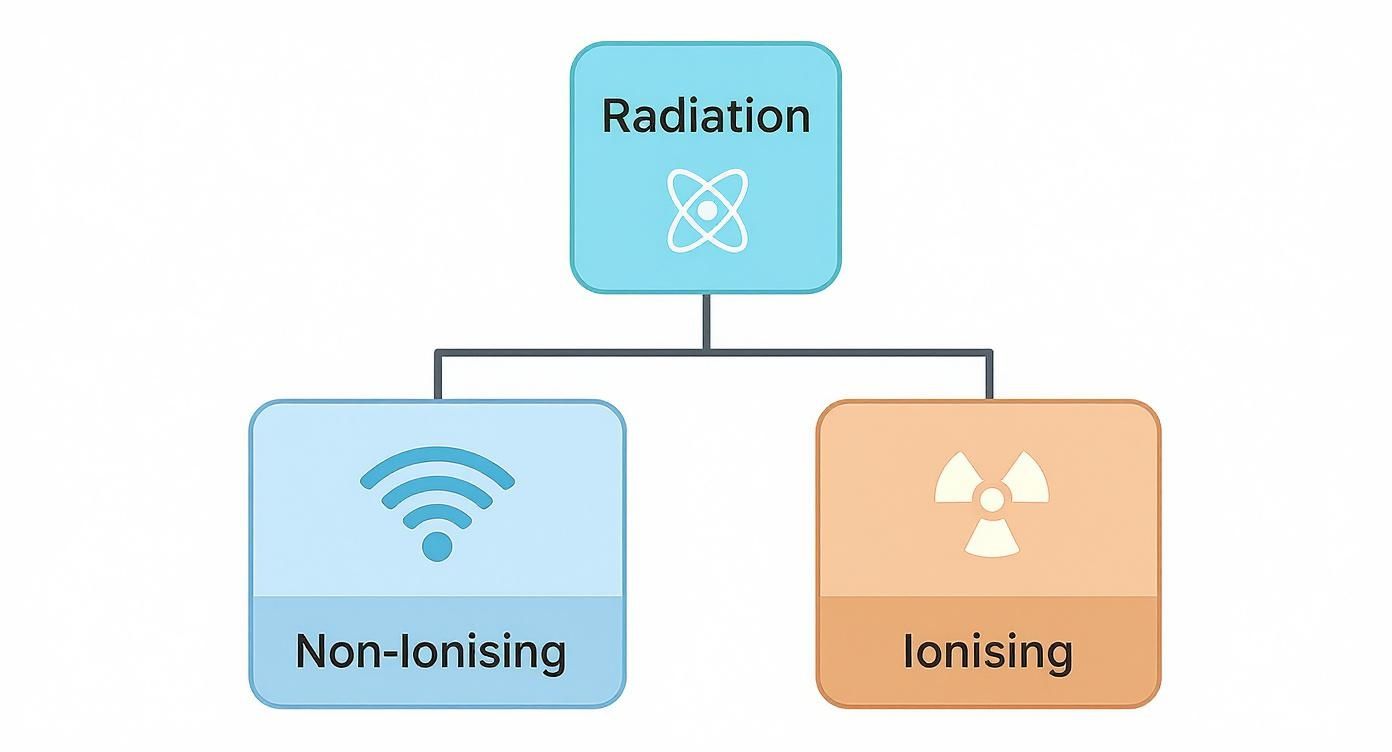
As this image shows, every type of radiation falls into one of two buckets: non-ionising or ionising. Their names might sound technical, but the difference is quite straightforward.
The Two Core Radiation Categories
Let's break down these two categories with a simple analogy. Imagine an atom is a small, stable solar system, with electrons orbiting a central nucleus like planets.
Non-ionising radiation is like a gentle push. It has enough energy to make the 'planets' (electrons) wobble or spin faster, which we might feel as heat. Think of microwaves warming up your food. But it doesn't have the brute force to knock an electron out of its orbit.
Ionising radiation, on the other hand, is like a stray meteor crashing through the system. It packs so much punch that it can violently eject an electron from its orbit, leaving the atom electrically charged and unstable—a process called ionisation. This is the key.
This single difference—the ability to knock an electron out of an atom—is the absolute cornerstone of radiation safety. It's why we treat different radiation sources with vastly different levels of caution.
To make this distinction even clearer, let's look at the core differences side-by-side.
Ionising vs Non-Ionising Radiation at a Glance
This table summarises the essential characteristics that separate these two fundamental types of radiation.
| Characteristic | Ionising Radiation | Non-Ionising Radiation |
|---|---|---|
| Energy Level | High | Low |
| Effect on Atoms | Ejects electrons, creating ions. | Causes electrons to vibrate or move to a higher energy level. Does not eject them. |
| Potential for Harm | Can damage DNA and living tissue. | Primarily causes heating effects. Some types have other specific risks. |
| Common Examples | X-rays, gamma rays, alpha particles, beta particles. | Radio waves, microwaves, infrared, visible light, ultraviolet (UV). |
Understanding this table helps explain why we can safely surround ourselves with Wi-Fi signals (non-ionising) but need strict controls and shielding for industrial equipment that uses radioactive sources (ionising).
From here on, everything we discuss about workplace safety, monitoring, and control measures will build on this crucial foundation.
Exploring High-Energy Ionising Radiation
Now we’re moving to the high-energy end of the spectrum, where we find ionising radiation. This stuff packs a serious punch and demands a great deal of respect and careful management. Unlike its non-ionising cousins, this type of radiation carries enough energy to literally knock electrons out of their atoms.
This process can alter materials and, more critically, damage living cells. It's precisely this power that makes it a major focus for workplace safety in so many Australian industries.
The family of ionising radiation isn't just one thing; it's made up of several distinct forms, each with its own unique personality. Getting to know these different types is the first step in understanding how to protect ourselves from them.
Unpacking the Main Forms of Ionising Radiation
A good way to think about the different forms of ionising radiation is to picture them as different types of projectiles. Each one has a different size, mass, and ability to get through a barrier.
-
Alpha Particles: These are the bowling balls of the radiation world. They’re large, heavy, and carry a lot of force, but only for a very short distance. Because they're so bulky, they're incredibly easy to stop—a single sheet of paper or even the outer layer of your skin is more than enough. The real danger with alpha particles comes from inhaling or ingesting the material emitting them, where they can do a lot of damage to cells up close.
-
Beta Particles: Think of these as more like cricket balls. They're much smaller and lighter than alpha particles, which means they can travel further and penetrate more deeply. Beta particles will zip right through paper but are reliably stopped by a thin sheet of aluminium or even a block of plastic.
-
Gamma Rays and X-rays: These are the tiny, high-speed bullets. They aren't particles at all but high-energy waves (photons), a bit like light but with far more power. They have no mass or charge, allowing them to travel long distances and penetrate deep into materials. To stop them effectively, you need thick, dense barriers like lead or concrete.
This difference in penetrating power is absolutely fundamental to how we design safety protocols and build shielding in workplaces that handle these materials.
Where We Find Ionising Radiation in Australia
Ionising radiation isn't just locked away in nuclear power plants or science labs; it's a natural part of our world and a vital tool across many Australian sectors.
To put it in perspective, the average effective dose for a person in Australia from all background sources is about 1.8 mSv per year. Roughly half of that comes from natural sources around us, and the other half from medical procedures. This shows just how common it is in both our environment and our healthcare system.
Here are a few key examples you'll find at work:
-
Mining and Resources: The Aussie mining industry regularly deals with Naturally Occurring Radioactive Materials (NORM). Elements like uranium and thorium are present in the earth's crust and can get concentrated during mining and processing. This can create a source of alpha, beta, and gamma radiation that needs to be managed carefully.
-
The Medical Field: X-rays are probably the most famous type of ionising radiation, used every day for diagnostic imaging. But even more powerful gamma rays are used in radiation therapy to target and destroy cancer cells, making it a cornerstone of modern oncology.
-
Industrial Applications: Many industries rely on sealed radioactive sources for critical tasks. This includes industrial radiography to check the integrity of welds in pipelines, density gauges in manufacturing to make sure containers are filled correctly, and sterilisation processes in the food and beverage industry.
The Double-Edged Sword: Health Risks and Benefits
The very thing that makes ionising radiation so potent—its ability to disrupt atoms—is what makes it both a risk and a reward.
Uncontrolled or excessive exposure can lead to cellular damage. It can either score a direct hit on critical molecules like DNA or create free radicals—unstable atoms that cause chemical chaos inside our cells. This is the primary health risk we manage.
But it’s this same power that makes it so incredibly useful.
When precisely controlled, ionising radiation becomes an invaluable tool. In medicine, its cell-destroying ability is harnessed to eliminate cancers and save lives. In industry, its penetrating power allows for non-destructive testing that ensures the safety and integrity of our most critical infrastructure.
Of course, with this power comes the need to understand and manage potential side effects, like the adverse effects of radiation therapy. The key to unlocking its benefits while keeping people safe lies in robust safety management. This means strict controls, constant monitoring, and unwavering adherence to regulatory standards across every single sector that uses it.
Understanding Non-Ionising Radiation in Daily Life
Now that we’ve covered the high-energy end of the spectrum, let's look at the forms of energy that are all around us, every single day: non-ionising radiation. Unlike its more powerful counterpart, this type of radiation doesn’t pack enough punch to strip electrons from atoms. Instead, its main effect is to make molecules vibrate, which we usually just feel as heat.
This isn’t some abstract concept from a science lab; it's woven into the fabric of modern life. It's the light that helps us see, the warmth we get from the sun, and the very technology that keeps us connected. Getting a handle on these different types is the first step in separating scientific reality from common myths.
Common Forms of Non-Ionising Radiation
From the microwave in your kitchen to the sunlight pouring through the window, non-ionising radiation is everywhere. Each form has its own unique characteristics and uses, both at home and in tough industrial settings.
Here’s a breakdown of the most common types you'll encounter:
- Ultraviolet (UV) Radiation: We all know this one as the part of sunlight that causes sunburn. UV sits at the most energetic end of the non-ionising spectrum and has enough oomph to trigger chemical reactions, which is why too much of it can damage skin cells.
- Visible Light: This is the only slice of the electromagnetic spectrum our eyes can actually see. It’s obviously essential for sight and carries very few direct health risks, although intense sources like industrial lasers certainly require proper eye protection.
- Infrared (IR) Radiation: We feel this as heat. It’s given off by anything hot, from industrial furnaces and welding arcs right down to a simple campfire. IR is the basis for thermal imaging cameras and is used in many industrial heating processes.
- Microwaves: Famous for reheating last night’s leftovers, microwaves are also crucial for telecommunications and radar systems. They work by making water molecules vibrate rapidly, which generates heat.
- Radiofrequency (RF) Waves: This broad category covers everything from AM/FM radio and TV signals to Wi-Fi and mobile phone communications. These are some of the lowest-energy waves on the entire spectrum.
Health Effects and Workplace Considerations
When it comes to non-ionising radiation, the health effects are directly tied to the energy level. For the lower-energy sources like RF and microwaves, the main scientifically established effect is the heating of body tissues, but only at intensities far, far higher than what we encounter in everyday life. Safety standards, like those set by the Australian Radiation Protection and Nuclear Safety Agency (ARPANSA), are specifically designed to prevent these heating effects.
As we climb the energy ladder, though, the risks change. Intense infrared radiation can cause serious thermal burns to the skin and damage the eyes—a major hazard for anyone working with furnaces or in glass blowing.
The most significant health risk from non-ionising radiation in Australia comes from a natural source: the sun. Understanding this specific risk is a critical public and workplace health issue.
Sitting at the top of the non-ionising spectrum, ultraviolet radiation poses the most common risk. Due to our geography and climate, Australia cops some of the highest levels of UV radiation in the world. Sun protection is an absolute must when the UV Index hits 3 or higher, which happens for much of the year across the country. This natural exposure is a leading cause of skin cancer, and the risk from artificial sources like commercial solariums was deemed so high they were banned in all Australian states as of 2015. You can dig deeper into the numbers by exploring the statistics on UV radiation from the Cancer Council.
Managing Risks in Australian Workplaces
While public chatter often centres on mobile phones and Wi-Fi, the real occupational hazards from non-ionising radiation come from high-intensity industrial sources.
Good workplace management starts with identifying these sources and putting the right controls in place. For instance:
- Welders must use specialised face shields to protect their eyes and skin from the blindingly intense UV and IR radiation thrown off by welding arcs.
- Workers near high-powered communication towers might find access to certain areas is restricted to limit their exposure to strong RF fields.
- Outdoor workers in fields like construction and agriculture need robust sun safety policies. This means protective clothing, broad-brimmed hats, and sunscreen to keep UV exposure in check.
By understanding the specific nature of each type of radiation, workplaces can implement targeted safety measures that protect employees from genuine harm, not just perceived risks.
Where Radiation Shows Up in Australian Workplaces
It’s one thing to understand the science of radiation, but it’s another to see where it actually fits into the day-to-day operations of Australian industries. Radiation isn't just some abstract hazard; it's a powerful and often essential tool. From the dusty outback of a mine site to a sterile pharmaceutical facility, controlled radiation sources are fundamental to how things get done.
Looking at these real-world applications is the best way to grasp why diligent safety management is so critical. In many of these jobs, exposure isn't an accident—it’s an expected and planned part of the work. That's why knowing the sources, their purpose, and the controls in place is the absolute bedrock of occupational health and safety.
Mining and Natural Resources
Australia's mining sector works directly with the earth, which naturally contains radioactive elements like uranium and thorium. During mining and processing, these materials can get concentrated in ore, dust, and even on equipment. We call these Naturally Occurring Radioactive Materials (NORM).
Miners and processing staff can be exposed to low levels of alpha, beta, and gamma radiation as a result. This is a known and manageable risk in the industry. The key is constant monitoring of dust levels, equipment contamination, and waste to ensure exposures stay well below legal limits. Handling NORM safely is a huge responsibility that extends all the way to its disposal, forming a critical part of any comprehensive hazmat and waste management strategy.
Oil and Gas Integrity
When you're dealing with thousands of kilometres of high-pressure pipelines, you can't afford to guess about their integrity. In the oil and gas industry, industrial radiography—using powerful gamma or X-ray sources—is a non-negotiable part of the safety toolkit.
Highly trained technicians use these penetrating rays to essentially take an X-ray of welds and metal structures, looking for tiny cracks or weaknesses you could never spot with the naked eye. This kind of non-destructive testing is what prevents catastrophic failures, making controlled radiation exposure a vital trade-off for ensuring public and environmental safety.
This is a perfect example of a core principle: radiation is a tool. When we manage it correctly, it helps us prevent far greater dangers than it poses itself.
Manufacturing and Quality Control
In a modern factory, it’s all about precision and speed. Many manufacturers in the food and beverage, pharmaceutical, and consumer goods industries use specialised radiation gauges to keep their quality control sharp. These devices typically contain a small, safely sealed radioactive source emitting beta or gamma rays.
The gauge works by measuring how much radiation gets through a product as it passes by on a conveyor belt. Think of a can of soft drink or a pack of tablets. The device can instantly tell if it's filled to the right level or has the correct density. It's an incredibly efficient, non-contact way to check every single item without slowing down the production line.
Aerospace and Advanced Materials
The aerospace industry operates with zero margin for error. Just like in oil and gas, manufacturers use industrial radiography to inspect mission-critical components, from jet engine turbine blades to sections of the fuselage, ensuring there are no hidden internal flaws.
You might also find radiation in the cockpit. Some aircraft instruments, especially older ones, use radioluminescent paint containing tritium (a beta-particle emitter) to make the dials glow. While modern tech is phasing this out, it's still a radiation source that needs to be managed carefully during maintenance and when aircraft are decommissioned.
Healthcare and Pharmaceuticals
We all know about X-rays and cancer therapy, but radiation plays another huge role in healthcare behind the scenes: sterilisation. A massive amount of single-use medical equipment—syringes, surgical gloves, implants—is made sterile using intense gamma radiation.
This process, called irradiation, is fantastic because it kills off any lingering bacteria or viruses without using heat or chemicals that could melt or damage the items. It’s a safe, incredibly effective way to ensure medical gear is sterile and safe for patients.
To pull all this together, let's look at a simple breakdown of where these sources pop up.
Radiation Sources in Key Australian Industries
| Industry Sector | Common Radiation Type(s) | Specific Application or Source |
|---|---|---|
| Mining & Resources | Alpha, Beta, Gamma | Naturally Occurring Radioactive Materials (NORM) in ores, dust, and scale. |
| Oil & Gas | Gamma, X-rays | Industrial radiography for non-destructive testing (NDT) of welds and pipelines. |
| Manufacturing | Beta, Gamma | Sealed-source gauges for level, density, and thickness measurements on production lines. |
| Aerospace | X-rays, Gamma, Beta | NDT of critical components; tritium in radioluminescent aircraft instruments. |
| Food & Beverage | Gamma, X-rays | Irradiation for sterilisation and pest control; X-ray for foreign body detection. |
| Pharmaceuticals | Gamma | Irradiation to sterilise single-use medical devices, packaging, and raw materials. |
This table really highlights how integral radiation is across the board. While the sources and their uses vary, the one constant is the need for expert oversight and stringent safety protocols to protect workers and the public.
How Workplaces Manage Radiation Safely
Knowing the different types of radiation is one thing, but managing it safely in a busy workplace is the real challenge. Since we can't see, smell, or feel most forms of radiation, industries have to rely on a robust, multi-layered safety strategy. This whole approach is built on three incredibly simple yet powerful principles that form the foundation of every radiation safety plan, whether you're in a high-tech aerospace facility or on a remote Australian mine site.
The guiding philosophy behind it all is known as ALARA, which stands for "As Low As Reasonably Achievable." This isn't just a catchy phrase; it's the core principle that drives every safety decision. It means we don't just aim to stay under the legal limits—we actively work to push exposure as low as we practically can.
The Three Golden Rules of Radiation Protection
So, how do we put ALARA into practice? Safety professionals focus on controlling three key factors. Think of them as the main dials you can turn to control a worker's total radiation dose.
-
Time: The less time you spend near a radiation source, the lower your dose. It’s a direct relationship—halve the time, and you halve the exposure. This is why administrative controls, like setting strict time limits for tasks in high-radiation areas, are so common.
-
Distance: This is one of the most powerful tools in our arsenal. The intensity of radiation drops off dramatically as you move away from its source. In fact, doubling your distance can slash your exposure rate by a factor of four. Workplaces use this principle constantly by storing radioactive sources in isolated areas and using remote handling tools to keep workers at a safe distance.
-
Shielding: When you can’t reduce time or increase distance any further, the final line of defence is putting a physical barrier between the worker and the source. The right shielding material depends entirely on the type of radiation you're dealing with. A simple sheet of paper can stop alpha particles and a thin plate of aluminium will block beta particles, but for powerful gamma rays and X-rays, you need to bring in the heavy hitters like lead or thick concrete.
These three principles work in concert to create a safe working environment, effectively turning a potential hazard into a manageable industrial tool.
The Tools of the Trade for Monitoring Radiation
Of course, you can't manage what you can't measure. That’s why workplaces use specialised instruments to make the invisible visible, giving us a clear picture of both individual exposure and the ambient radiation levels in the environment.
The most common tool is the personal dosimeter, which is usually a small badge worn on the chest. This clever device acts like a personal radiation diary for each worker, passively recording their cumulative exposure over a set period, like a month or a quarter. At the end of that period, the badge is sent off to a lab for analysis, creating a formal, legal record of the worker's occupational dose.
Alongside personal monitoring, workplaces use portable survey meters. These handheld devices give real-time readings of radiation levels, allowing safety officers to scan work areas, check equipment for any contamination, and confirm that shielded areas are doing their job properly.
This national-level data collection is vital. It helps us understand exposure trends and proves that our safety measures are working across all industries. This data provides a crucial benchmark for workplace safety performance.
Engineering and Administrative Controls in Action
Beyond personal gear, employers implement much broader controls to minimise risk from the outset.
Engineering controls are physical changes made to the workplace itself. Think of things like installing permanent lead shielding around an X-ray machine or using clever interlock systems that automatically shut down a radiation source if a door is opened.
Administrative controls, on the other hand, are all about procedures. This includes creating controlled zones with restricted access, providing detailed safety training for everyone on site, and developing rigorous operating protocols. These controls are the bedrock of a strong safety culture and are a key component of effective occupational hygiene services.
Australia's national approach to monitoring is incredibly effective. Occupational exposure is tracked via the Australian National Radiation Dose Register (ANRDR), which holds dose records for around 72,000 people across mining, research, and medical fields.
The results speak for themselves. The maximum recorded annual dose for the top 100 Commonwealth licence holders was just 4.35 mSv—well below the strict occupational limit of 20 mSv. To minimise risks in medical applications, tools are crucial for effective radiotherapy dose management, as detailed in this guide to safer radiotherapy practices.
Australia's Radiation Safety and Regulations Framework
To keep people safe across the many industries that use radiation, Australia has a multi-layered regulatory system. It’s designed to be a practical framework that protects workers, the public, and the environment without getting tangled up in legal jargon. The goal is a clear, consistent approach to managing radiation hazards no matter where you are in the country.
At the very top is the Australian Radiation Protection and Nuclear Safety Agency (ARPANSA). Think of ARPANSA as the main authority for the Australian Government on all things radiation and nuclear safety. They set the national standards and policies, while the day-to-day enforcement and licensing are handled by regulators in each state and territory.
Core Pillars of Australian Radiation Regulation
This cooperative approach means we get the best of both worlds: strong national standards with practical, local oversight. The entire system is built on a few core principles that every single business working with ionising radiation has to follow. These aren't just suggestions; they are fundamental to maintaining Australia's strong safety record.
Three requirements form the backbone of this entire framework:
- Strict Occupational Dose Limits: ARPANSA establishes legally binding limits on how much radiation a worker can be exposed to. For a designated radiation worker, this limit is 20 mSv per year, averaged over five years.
- Mandatory Licensing: You can't just go out and buy radioactive materials or radiation-generating equipment. Any business must first get a licence from their state or territory regulator, which involves proving they have the right procedures, equipment, and expertise to handle it all safely.
- Radiation Management Plans (RMPs): This is a huge part of the licensing process. An RMP is a detailed, practical document that maps out exactly how a company will manage its radiation sources, control exposures, train its team, and respond if anything goes wrong.
This robust, government-backed structure ensures that from a remote mine site to a city hospital, the use of radiation is not left to chance. It is a planned, licensed, and heavily regulated activity designed for maximum safety.
These regulations are a critical piece of the puzzle when it comes to the broader landscape of Australian workplace safety standards, ensuring that radiation risks are managed with the same seriousness as any other occupational hazard.
Your Radiation Questions, Answered
To wrap things up, let's tackle a few of the questions that pop up most often. It’s one thing to understand the science, but it’s another to see how it all fits into our everyday lives.
Is the Radiation From My Mobile Phone or Wi-Fi Dangerous?
This is easily the most common question we hear. Your phone and Wi-Fi router give off a type of low-energy, non-ionising radiation called radiofrequency (RF) energy. After years of extensive research, major health authorities like Australia’s own ARPANSA have found no solid evidence that the RF exposure from these devices causes any harm.
The energy levels are incredibly low. The only known effect of this type of radiation at much, much higher power levels is a slight heating effect, which simply isn't a factor at the levels our gadgets use.
What’s the Difference Between Radiation and Radioactivity?
People often use these two words as if they mean the same thing, but they describe two different parts of a process. It’s a subtle but important distinction.
- Radioactivity is a property. It’s the potential of an unstable atom to break down and release energy.
- Radiation is the energy that’s actually released when that atom decays.
Here’s a simple analogy: think of a log for a fire. That log is radioactive—it holds potential energy. The light and heat that come off it when it's burning? That's the radiation.
Are Bananas Really Radioactive?
They are, but only a tiny bit! Bananas are rich in potassium, and a small, naturally occurring fraction of that is an isotope called potassium-40, which is radioactive.
When you eat a banana, you get a minuscule dose of ionising radiation—about 0.1 microsieverts (µSv). To put that into perspective, you'd have to eat around 100,000 bananas to equal the radiation dose from a single chest CT scan. It’s a perfect illustration of how background radiation is just a normal, harmless part of the world around us.
Do I Get Exposed to Radiation When I Fly?
You certainly do. When you're in a plane cruising at high altitude, you're exposed to more cosmic radiation from space. Our atmosphere acts as a protective blanket, and the higher you fly, the thinner that blanket gets.
A typical flight from Sydney to Melbourne, for instance, will add about 5 µSv to your annual dose. That's a tiny amount, roughly the same as eating 50 bananas. While it's a known occupational exposure that needs monitoring for pilots and cabin crew, it’s nothing for the occasional flyer to worry about.
Getting your head around the details of radiation is the first crucial step to creating a safe workplace. For practical, expert guidance on identifying, assessing, and controlling radiation hazards in your specific industry, it pays to trust the specialists. Anitech Ltd Pty offers comprehensive Occupational Hygiene services across Australia, helping businesses like yours meet regulatory standards and keep their teams safe.
Contact us today to learn how we can support your workplace's health and safety goals.


