
Methamphetamine contamination is an invisible but significant hazard, and it’s not just a problem for former drug labs. It is increasingly found in commercial and industrial properties across Australia, creating a hidden danger for employees, tenants, and visitors. This ultimate guide to meth testing and decontamination is designed to give you a clear, comprehensive overview of this complex issue.
Key Facts: Meth Testing in Australia
- Australia’s meth safety threshold is 0.5 micrograms per 100cm² (µg/100cm²) — set by national health guidelines.
- Professional NATA-accredited lab testing costs $250–$450+ depending on property size and sample count.
- A standard residential property requires 8–10 surface swab samples; on-site collection takes 15–30 minutes.
- Lab results from a NATA-accredited laboratory are typically delivered within 24–72 hours of sample collection.
- Meth residue is invisible and odourless — standard building and pest inspections cannot detect it.
- Decontamination of a contaminated property typically costs $5,000–$50,000+ depending on severity.
- Results from a NATA-accredited lab are legally defensible in property disputes, insurance claims and tenancy proceedings.
Think of it like invisible secondhand smoke. Toxic chemical residues from meth use or manufacturing cling stubbornly to walls, carpets, and ventilation systems long after the source is gone. This guide will provide a high-level look at the real-world health risks, your legal duties under Australian law, and the critical steps for effective meth testing and decontamination, equipping you with the foundational knowledge to protect your property and people.
Why Meth Contamination Is a Silent Threat to Your Workplace
When you hear about meth contamination, your mind probably jumps to a makeshift drug lab. But the reality is far more common. In Australia, the leading cause of property contamination isn’t manufacturing—it’s simply from people smoking the drug. This act leaves behind a toxic chemical residue that is odourless, colourless, and incredibly difficult to get rid of.
These microscopic particles settle on just about every surface you can think of: office furniture, carpets, and even deep inside a building’s HVAC system. Without professional testing, this hazard can fly under the radar for years, creating a long-term exposure risk for anyone who sets foot in the building. It’s a silent threat that can seriously undermine workplace safety and create a massive liability for business owners and property managers.

The Hidden Impact on Commercial Properties
While the media often focuses on residential homes, commercial and industrial spaces are just as vulnerable, if not more so. The high turnover of tenants in some commercial properties and the sheer size of industrial sites can make it incredibly difficult to keep an eye on what’s happening.
A previous tenant could have easily contaminated a space without anyone knowing, leaving a dangerous legacy for the next business to inherit. Getting to grips with why to test properties for methamphetamine is the first step toward a proactive safety plan. The fallout from doing nothing isn’t just about health; it hits you legally and financially, too.
An unaddressed contamination issue can lead to Work Health and Safety (WHS) violations, costly legal battles, a drop in property value, and serious damage to your company’s reputation. Proactive management isn’t just best practice—it’s essential risk mitigation.
Your Duty of Care as an Employer
Under Australian law, the responsibility is clear. Employers and property managers have a non-negotiable duty of care to provide a safe environment for everyone. This legal obligation means you must identify and control hazards in the workplace—and that includes chemical hazards like methamphetamine residue. Pleading ignorance simply isn’t a defence.
Failing to act can have severe consequences:
- Serious WHS Penalties: Regulators won’t hesitate to impose hefty fines for non-compliance and for failing to protect employees from known or foreseeable risks.
- Workers’ Compensation Claims: Staff who develop health problems due to exposure can file claims, which can lead to higher insurance premiums and other direct financial hits.
- Business Interruption: Discovering contamination often means you have to shut down operations for thorough testing and remediation, resulting in lost productivity and revenue.
This guide will walk you through everything you need to know to tackle these challenges head-on, protecting your team, your assets, and your business’s future. Let’s dive into the health risks, legal standards, and the practical steps required to manage this invisible threat for good.
What Are the Real Health Risks of Meth Residue?
When we talk about exposure to methamphetamine residue, we’re not talking about direct drug use. We’re talking about the invisible cocktail of toxic chemicals left clinging to surfaces long after the drug is gone. This is often called “third-hand exposure,” and it’s a serious, often overlooked threat to anyone who steps into a contaminated space. These risks aren’t just theoretical; they are real-world liabilities that can hit your employee well-being, productivity, and ultimately, your company’s bottom line.
The tricky part? Meth residue is odourless and colourless. You simply can’t see it or smell it. This means your team could be absorbing these harmful substances without even knowing it—through skin contact with a contaminated desk, by breathing in disturbed dust particles, or from simple hand-to-mouth contact. This quiet, persistent exposure is precisely why professional meth testing and decontamination is so critical for workplace safety.
The First Signs: Immediate Health Symptoms
The initial effects of meth residue exposure are frustratingly vague and often get brushed off as the flu, a cold, or seasonal allergies. This makes it incredibly difficult to connect the dots back to the work environment unless you already suspect there might be a problem.
Here are some of the immediate, or acute, symptoms your staff might report:
- Respiratory Problems: Think persistent coughing, shortness of breath, or a constant sore throat. This is the body’s first line of defence reacting to inhaled chemical particles.
- Headaches and Dizziness: Neurological effects can show up fast, causing nagging headaches, feeling light-headed, or just a general sense of being “off.”
- Skin and Eye Irritation: Direct contact can lead to rashes, itchy skin, or a burning sensation. You might also notice people complaining about red, watery, or irritated eyes.
On their own, these symptoms might just seem like a run of bad luck, leading to more sick days and a dip in productivity. But they could be the first warning signs of a much bigger problem.
The Long Game: Severe Risks and Lasting Damage
Living or working in a contaminated space over weeks, months, or years is where the real danger lies. Even low levels of exposure can lead to severe, chronic health issues as the toxic chemicals accumulate in the body and start causing systemic damage.
Long-term exposure is what turns a minor health complaint into a serious occupational hazard. The cumulative effect of these toxins can cause irreversible damage to vital organs, creating a significant and entirely preventable risk for your workforce.
In Australia, this is a serious occupational health issue. Residue from a hidden meth lab or even from heavy smoking can leave behind contamination levels far exceeding safe limits. It’s a widespread problem, too. Recent data shows that 1.6 million Australians (7.5%) have used some form of methamphetamine, which helps explain why contamination is turning up in all sorts of properties, including industrial and commercial sites. You can get a clearer picture of these trends from the drug consumption data published by the Australian Criminal Intelligence Commission.
Connecting the Dots: From Health Risks to Business Liabilities
The health consequences of meth exposure aren’t just a personal issue for your employees; they translate directly into serious risks for your business. Under Work Health and Safety (WHS) laws, every employer has a duty of care to provide a safe working environment. That includes protecting people from hidden chemical hazards like this.
Ignoring potential contamination can lead to some heavy legal and financial consequences.
- Workers’ Compensation Claims: If an employee’s health suffers due to workplace exposure, they have every right to file for compensation. This can lead to a spike in your insurance premiums on top of the direct costs.
- Legal Penalties and Fines: WHS regulators don’t take this lightly. They can impose substantial fines on businesses that fail to manage known or foreseeable hazards. Pleading ignorance simply isn’t a defence.
- Reputational Damage: Word gets out. An incident involving meth contamination can do serious damage to your company’s reputation, eroding client trust, sinking employee morale, and making it harder to attract good people.
Understanding how these pieces fit together is the first step toward building a solid safety plan. When you can recognise the symptoms and acknowledge the liabilities, you’re in a much better position to take proactive steps to protect both your team and your business.
Getting Your Head Around Australian Standards and Legal Duties
If you’re a business owner or manage property in Australia, getting a handle on your legal responsibilities around methamphetamine contamination isn’t just a box-ticking exercise—it’s central to your duty of care. Pleading ignorance simply won’t cut it when it comes to health and safety. The laws are there to protect people, and getting it wrong can lead to hefty fines, legal trouble, and a black mark against your business’s name.
At the heart of it all are the Work Health and Safety (WHS) laws. These aren’t optional. They clearly state that employers and anyone in control of a property must provide a safe environment, free from hazards. Methamphetamine residue is legally considered a chemical hazard, which means it falls squarely under WHS regulations. In plain English, you have a legal obligation to find, assess, and manage the risks it poses.
Making Sense of the National Guidelines
While there isn’t one single, federally mandated law for meth clean-ups, the industry standard is set by the Australian Clandestine Drug Laboratory Remediation Guidelines. Think of these as the unofficial rulebook. They aren’t legislation themselves, but they are what state authorities, courts, and professionals all refer to as best practice.
These guidelines give us the number that matters most: 0.5 micrograms of methamphetamine per 100 square centimetres (0.5 µg/100cm²). This is the accepted screening level. If lab tests show contamination above this level, you’re legally expected to bring in the professionals for a full decontamination.
It’s a common mistake to think these rules only apply to properties where meth was cooked. The reality is, the guidelines cover any property with meth residue, even if it’s just from smoking. The health risk is still there, and so is your legal duty to deal with it.
State-by-State Differences Are Crucial
Now, here’s where it gets a bit more complex. While that 0.5 µg/100cm² figure is the go-to benchmark, the specific rules and how they’re enforced can change depending on where you are in Australia.
Below is a quick overview of the accepted remediation guideline levels across the country. Health departments in states like Western Australia, Queensland, and New South Wales have put out their own detailed guidance that builds on the national recommendations. This means you absolutely have to know what’s required in your local area.
Australian Meth Contamination Guideline Levels by State
| State/Territory | Guideline Level (μg/100 cm²) | Reference/Governing Body |
|---|---|---|
| National | 0.5 | Australian Clandestine Drug Laboratory Remediation Guidelines |
| WA | 0.5 | Guidelines for the Remediation of Clandestine Drug Laboratories in WA |
| NSW | 0.5 | Clandestine Drug Laboratory Remediation Guidelines (NSW Health) |
| QLD | 0.5 | QLD Health Clandestine Drug Laboratory Remediation Guidelines |
| SA | 0.5 | SA Health Guidelines for the Remediation of Clandestine Drug Laboratories |
| VIC | 0.5 | Clandestine Laboratory Remediation – Information for property owners |
| TAS | 0.5 | Tasmanian Clandestine Drug Laboratory Remediation Guidelines
Our occupational hygienists provide meth testing services across Australia. Location-specific guides and services are available for Melbourne, Victoria, New South Wales, Canberra and the ACT, Tasmania, and South Australia. |
| ACT | 0.5 | ACT Health Clandestine Drug Laboratory Remediation Information |
| NT | 0.5 | Follows National Guidelines |
The key takeaway here is consistency. While local guidance exists, the 0.5 µg/100 cm² standard is the universally accepted level for determining if a property is safe for re-occupancy.
To make sure you’re covered, always:
- Touch base with your local state health department to check for any specific rules or reporting protocols they have.
- Hire an occupational hygienist who really knows the ins and outs of the laws in your state.
- Keep a meticulous paper trail of every test, clean-up report, and clearance certificate. This is your proof of due diligence.
The True Cost of Cutting Corners
Ignoring suspected contamination can become a financial nightmare. For businesses in hands-on industries like manufacturing or construction, this could mean breaching the Work Health and Safety Regulations 2011. These regulations have incredibly strict limits, sometimes as low as 0.05 mg/m³ for airborne particles.
Data from NSW Health shows that without proper, expert-led testing, a staggering 30-50% of former meth cook sites fail their initial clean-up swabs. This forces multiple, expensive remediation cycles that can easily run from $10,000 to $50,000 per site.
Beyond the regulatory fines, you could be looking at workers’ compensation claims, massive legal bills, and serious disruption to your business. Trying to sort out the financial mess and insurance claims can be overwhelming. In these situations, getting professional help like a public adjuster can make all the difference in getting a fair payout for the damage.
Knowing your obligations is the starting point, but having the right professional advice on meth testing, clearance testing, and the 0.5 µg/100 cm² standard is what will actually shield your business from these huge risks.
How Professional Meth Testing Works
When you suspect a property might be contaminated with methamphetamine, you need clear, reliable answers. Guesswork won’t cut it. The professional testing process is designed to give you exactly that—concrete data to understand the risk and map out a plan for making the space safe again. It’s a methodical, forensic-level approach that holds up under scrutiny, protecting everyone involved.
The whole process usually kicks off because of a few red flags. Maybe there are reports of strange chemical smells, unusual staining on the walls and floors, or you’ve been told about suspicious activity at the property. In a workplace, it could be a string of employee health complaints—like persistent headaches, breathing problems, or skin irritation—that points towards an environmental cause.
Initial Screening vs Professional Lab Analysis
It’s easy to see the appeal of a cheap, do-it-yourself (DIY) test kit from the hardware store. While they can give you a quick “yes” or “no,” that’s where their usefulness ends. These kits are notorious for false positives and negatives, can’t tell you how much contamination you’re dealing with, and their results won’t stand up in any legal or official capacity.
For a definitive, actionable result, professional testing with analysis by a NATA-accredited laboratory is the only way to go. This involves bringing in a qualified occupational hygienist who knows exactly where and how to take samples to get a true picture of the situation.
A professional hygienist doesn’t just swab random surfaces. They use their expertise to identify high-contact areas and potential hotspots where residues are most likely to accumulate, ensuring the sampling strategy is both efficient and thorough.
The Professional Sampling Process
A qualified technician follows a very strict protocol. This isn’t just a simple wipe-and-send job; it’s a careful procedure designed to ensure the samples are pristine and the results are bulletproof.
- Strategic Site Assessment: The hygienist starts with a visual walk-through, creating a sampling plan based on the property’s layout and known history. They’ll pinpoint key areas like bedrooms in a house or common areas and ventilation intakes in a commercial building.
- Controlled Sample Collection: Using special meth-testing wipes, the hygienist swabs a precise area—usually 100cm²—marked out with a template. Each sample is handled with extreme care to prevent any cross-contamination.
- Strict Chain of Custody: Every single sample is meticulously labelled, sealed, and documented. This creates an unbroken “chain of custody,” which is a formal record tracking the sample from the moment of collection all the way to the lab. This step is non-negotiable if you need results for legal or insurance purposes.
- NATA-Accredited Laboratory Analysis: The samples are couriered to a NATA-accredited lab. Here, they undergo sophisticated analysis to detect and, crucially, quantify the exact concentration of methamphetamine residue.
The diagram below breaks down the legal duties and procedural flow, showing why sticking to the official guidelines is so important.
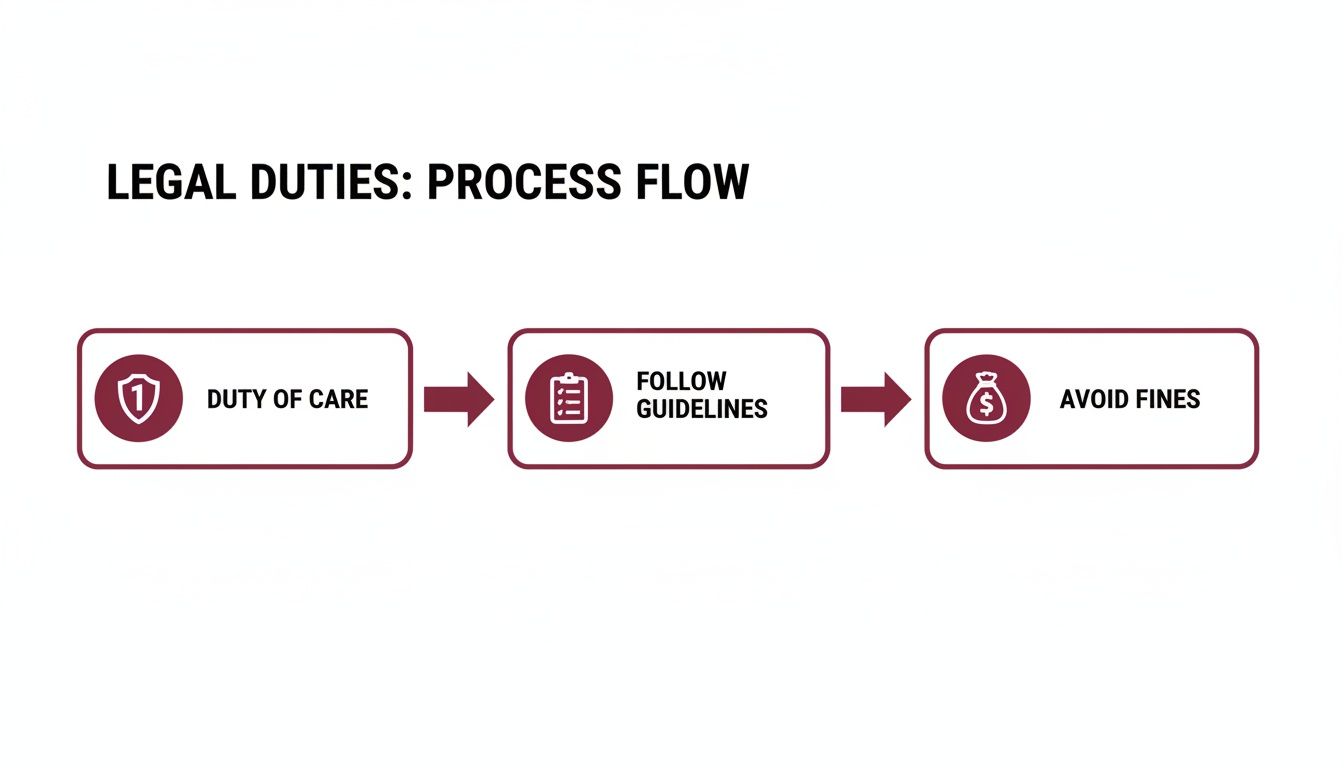
As you can see, fulfilling your duty of care by following these guidelines is the most direct way to steer clear of serious legal and financial trouble.
Interpreting the Laboratory Report
When the analysis is done, you’ll get a detailed report back from the lab. The number you need to focus on is the contamination level, measured in micrograms per 100 square centimetres (µg/100cm²).
This result is compared directly against the Australian National Guideline, which sets the safety threshold at 0.5 µg/100cm². If your report shows a number higher than this, professional decontamination is not just recommended—it’s required.
There’s a good reason Australian standards are so specific. They mandate testing with meth-specific wipes sensitive enough to meet a detection limit of 0.05 µg/100 cm². This is because meth residue can break down into amphetamine, which can be missed by less-sensitive drug screens.
While a simple steam clean might seem like a good idea and can reduce surface meth by about 70%, it’s not nearly enough. To meet safety standards, you need a comprehensive decontamination protocol—using specialised detergents, primers, and follow-up testing—to achieve the >99% removal rate required.
You can learn more about the prevalence of meth use in Australia and its impact on cracksintheice.org.au. Having these hard numbers in hand empowers you to move forward confidently, swapping uncertainty for a clear, data-driven plan to fix the problem.
A Practical Guide to Methamphetamine Decontamination
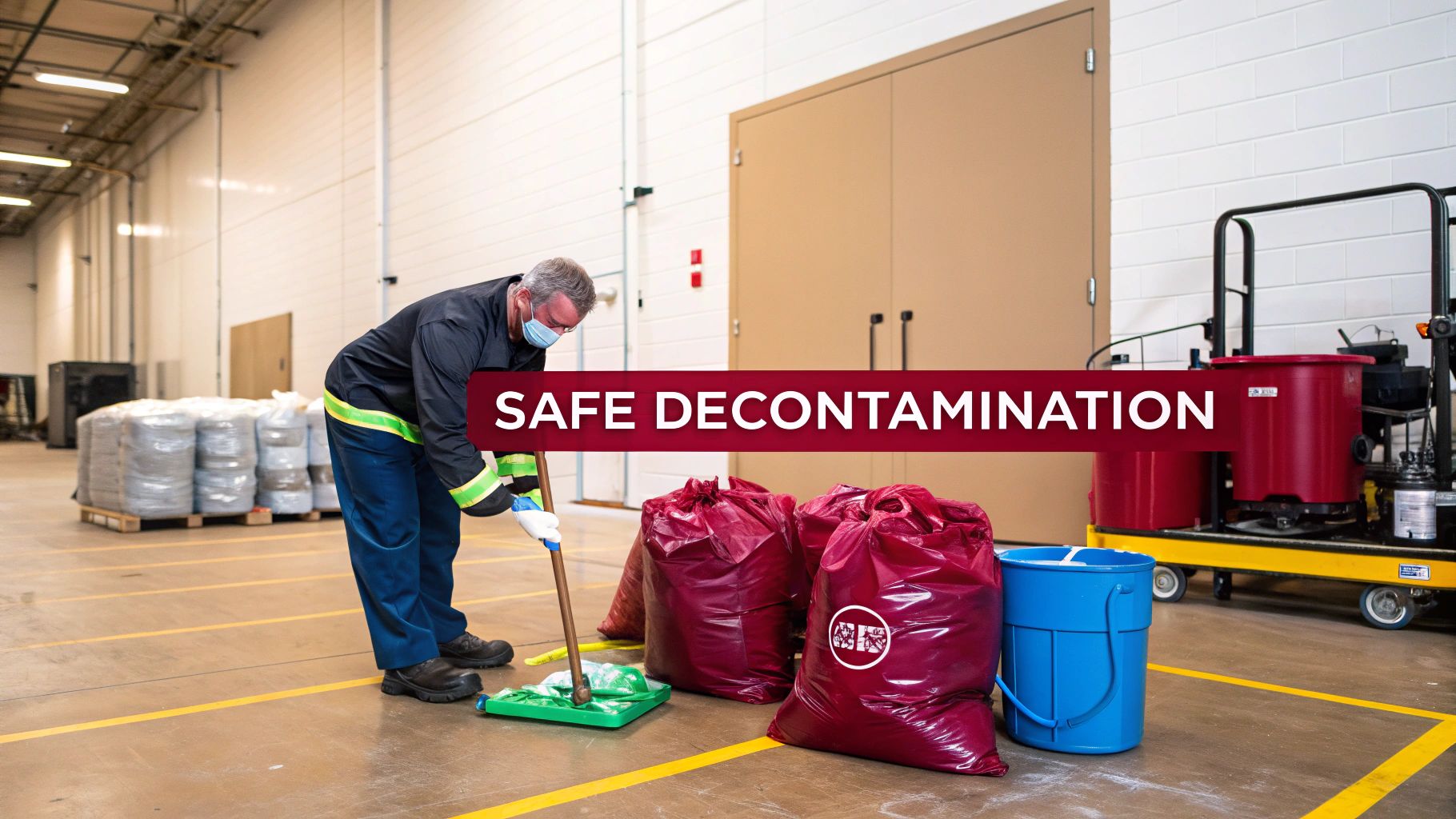
Getting a lab report back that confirms methamphetamine contamination can be a shock, but it’s the first concrete step toward sorting out the problem. What follows is a professional decontamination process—a highly methodical approach designed to systematically strip out the hazard and make the property safe again. This is a world away from a simple deep clean; it’s a scientific process aimed at neutralising an invisible, toxic chemical threat.
This guide will walk you through what to expect during a professional meth testing and decontamination project. Knowing the stages helps you understand what the experts are doing and why, ensuring the job is done thoroughly, safely, and effectively. The ultimate goal isn’t just to clean, but to prove beyond a doubt that the risk has been eliminated.
Stage 1: The Initial Setup and Site Security
The very first thing a professional remediation team does is lock down the site. This isn’t just for show—it’s a critical safety measure to stop anyone from being accidentally exposed to the toxic residues inside.
The crew will isolate the contaminated area, putting up clear warning signs to keep unauthorised people out. Inside, they establish containment zones, often using heavy-duty plastic sheeting and negative air pressure systems. This clever setup ensures that any contaminated dust kicked up during the cleanup can’t spread to clean areas or escape the building.
Before anyone even thinks about starting the physical work, understanding the proper use of Personal Protective Equipment (PPE) is non-negotiable. We’re talking full-body suits, specialised respirators, gloves, and boot covers to keep the team completely protected.
Stage 2: Removal of Contaminated Materials
Unfortunately, not everything can be saved. Porous materials like carpets, curtains, unsealed timber, and couches act like sponges for meth residue, soaking it up so deeply that it’s nearly impossible to clean them out completely.
Working from the Remediation Action Plan (RAP) put together by the occupational hygienist, the team will systematically remove and dispose of these items. This is a tightly controlled part of the job.
- Sorting and Segregation: Materials are first sorted. Anything porous is almost always destined for disposal.
- Hazardous Waste Disposal: Contaminated items are treated as hazardous waste. They have to be double-bagged, sealed, and taken to a licensed facility, all according to strict environmental laws.
- HEPA Vacuuming: Once the soft furnishings are out, every remaining surface gets a meticulous vacuuming with industrial-grade machines fitted with HEPA filters. This is key for capturing microscopic meth particles without just blowing them back into the air.
Stage 3: Specialised Cleaning and Neutralisation
Now for the real heavy lifting. This stage involves a multi-step chemical wash using specialised, industrial-strength cleaning agents formulated specifically to break down and lift methamphetamine residue off surfaces.
Technicians will wash every non-porous surface—walls, ceilings, floors, cabinetry, and light fittings—and they’ll often do it several times over. The cleaning solution is painstakingly applied, agitated, and then removed, taking the dissolved contaminants with it. It’s hard, repetitive work, but it’s absolutely essential.
A common myth is that you can just paint over the problem. This is incredibly dangerous. Meth residue can leach through paint over time, and if anyone ever sands the walls in the future, they could release a concentrated cloud of toxic dust.
For tricky surfaces that can’t be easily washed but might be salvageable, other techniques come into play. One of these is encapsulation, where a specialised sealant is applied to lock in any remaining trace residue. This is a specialised approach best discussed with a qualified remediation professional.
Stage 4: Final Verification and Clearance Testing
The job isn’t done until an independent expert says it’s done. Once the cleaning crew has finished, the final—and most crucial—step is the post-remediation verification, or “clearance testing.”
An independent occupational hygienist returns to the property. It’s vital that they aren’t connected to the cleaning company to avoid any conflict of interest. They will take a fresh set of surface samples from the same spots that originally tested high for contamination.
These new samples are sent back to a NATA-accredited lab for analysis. The property is only given the all-clear if every single sample result comes back below the Australian health guideline of 0.5 µg/100cm². If it passes, you receive a clearance certificate. This document is your official, legally defensible proof that the property is clean and safe to occupy again.
Your Questions About Meth Contamination, Answered
When you’re facing a potential meth contamination issue, your head is probably swimming with questions about costs, what you’re legally required to do, and the practical next steps. It can feel overwhelming. Let’s cut through the noise and get you some straight, clear answers to the most common queries we hear from property and business owners.
Think of this as the practical part of the ultimate guide to meth testing and decontamination—we’re tackling the real-world concerns that matter most when you’re on the front line of this problem.
How Much Does Professional Meth Testing Actually Cost?
This is usually the first question on everyone’s mind, and the honest answer is: it depends. The cost of professional meth testing isn’t a one-size-fits-all figure; it’s shaped by a few key factors that dictate the scale of the job.
The main things that influence the price are:
- The Size and Layout of Your Property: A sprawling commercial building with dozens of rooms and a complex HVAC system is a different beast to a small, open-plan office. More area and complexity mean more sampling is needed to get a true picture.
- The Number of Samples Required: The cost is directly tied to how many samples the hygienist needs to collect. This isn’t an arbitrary number; it’s a calculated decision based on the property’s size and the suspected extent of the contamination.
- The Type of Lab Analysis: There’s a price difference between a basic screening test and full quantitative analysis, which tells you precisely how much contamination is present. If you need results in a hurry, express turnaround times from the lab can also add to the cost.
It’s easy to get fixated on the upfront cost, but it’s far better to view professional testing as an investment. The potential financial and legal fallout from unaddressed contamination—from WHS fines and workers’ comp claims to business shutdown—is astronomically higher than the cost of getting solid, actionable data from a NATA-accredited lab.
Can I Just Clean Up Minor Meth Contamination Myself?
It’s a tempting thought, especially if you think the contamination is only minor. But trying to clean up methamphetamine residue on your own is not just a bad idea—it’s ineffective, incredibly dangerous, and puts you in a legally precarious position.
Meth residue is a stubborn, toxic chemical hazard. Your standard cleaning products from the supermarket won’t touch it. Wiping down surfaces or slapping on a fresh coat of paint does absolutely nothing to neutralise the underlying chemicals. In fact, you can easily make things worse by accidentally spreading the contamination or kicking the toxic particles up into the air, which just increases everyone’s exposure risk.
Trying a DIY cleanup is like attempting to rewire your building’s switchboard with a butter knife. You don’t have the right gear or the know-how, and the risk of causing serious harm is sky-high. Professionals use specialised, industrial-grade chemical solutions and follow strict, documented safety protocols for a very good reason.
On top of all that, a DIY clean gives you zero legal standing. Without a post-remediation clearance certificate issued by an independent hygienist, you have no proof whatsoever that the property is actually safe. This leaves you completely exposed legally and shows a failure to meet your duty of care under Australian WHS laws.
What Are My Legal Obligations if My Property Tests Positive?
The moment you get a positive test result—that is, contamination levels are found to be above the 0.5 µg/100cm² guideline—your legal duty of care under Work Health and Safety regulations officially kicks in. You are now legally required to take decisive action to control the hazard and protect anyone who sets foot on the property.
Here’s what you must do immediately:
- Lock It Down: The contaminated area has to be secured immediately. Post clear warning signs and make sure no one can enter without authorisation. Nobody should be going in there until it’s been professionally remediated and cleared.
- Call in Certified Pros: You have to hire a professional decontamination company that has proven experience with meth remediation. They will work from a formal Remediation Action Plan (RAP) to clean the property methodically.
- Get Independent Clearance Testing: After the decontamination crew has finished, a completely independent occupational hygienist (someone not connected to the cleaning company) must come in to perform verification testing.
- Get the Clearance Certificate: You’ll only receive a clearance certificate once every single post-remediation sample comes back below the 0.5 µg/100cm² limit. This certificate is your official proof that you’ve done your due diligence, fulfilled your legal obligations, and the property is safe to re-occupy.
There are no shortcuts here. Following these steps isn’t optional; it’s the only way to stay compliant with the law, protect people’s health, and shield your business from massive legal and financial headaches down the road.
At Anitech, we provide expert occupational hygiene services to help businesses get on top of complex workplace safety issues. Our team offers nationwide support, making sure your environment is not just compliant, but genuinely safe for everyone. If you suspect contamination or just need some guidance on meth testing and decontamination, contact us today to ensure your workplace meets the highest health and safety standards.
📚 More in This Series: Remediation & Decontamination
- Meth Encapsulation Remediation Method: Complete Guide
- Australia’s Methamphetamine Decontamination Guidelines
- Professional Meth Decontamination: The Definitive Method
- Meth Encapsulation vs Removal: Choosing Your Method
- Best Cleaning Agents for Meth Decontamination | Guide
- When to Retest After Meth Decontamination: Diagnostic FAQ
- 90-Day Meth Decontamination Plan: Multi-Family Case Study
- Meth Decontamination ROI: Cost vs Full Structural Replacement


