
Quick Summary:
Managing meth-contaminated real estate requires a proactive executive framework to mitigate financial, legal, and reputational risks from clandestine labs. This guide outlines a pillar for investors and property managers, focusing on a four-stage process: detection, scientific testing, professional remediation, and independent verification. A cross-functional governance team is crucial for protecting asset value, ensuring legal compliance, and making sound financial decisions regarding asset disposition.
It’s the phone call every asset manager dreads: a high-value property in your portfolio isn’t just sitting vacant, it’s a potential biohazard. Methamphetamine contamination from a clandestine lab leaves behind an invisible chemical cocktail, creating a perfect storm of financial, legal, and reputational risk. This isn’t just about calling in the cleaners; it’s a complex asset management crisis that demands a formal, proactive strategy. The executive framework for managing meth contaminated real estate assets is a critical pillar for asset protection.
The Hidden Threat to Real Estate Portfolios
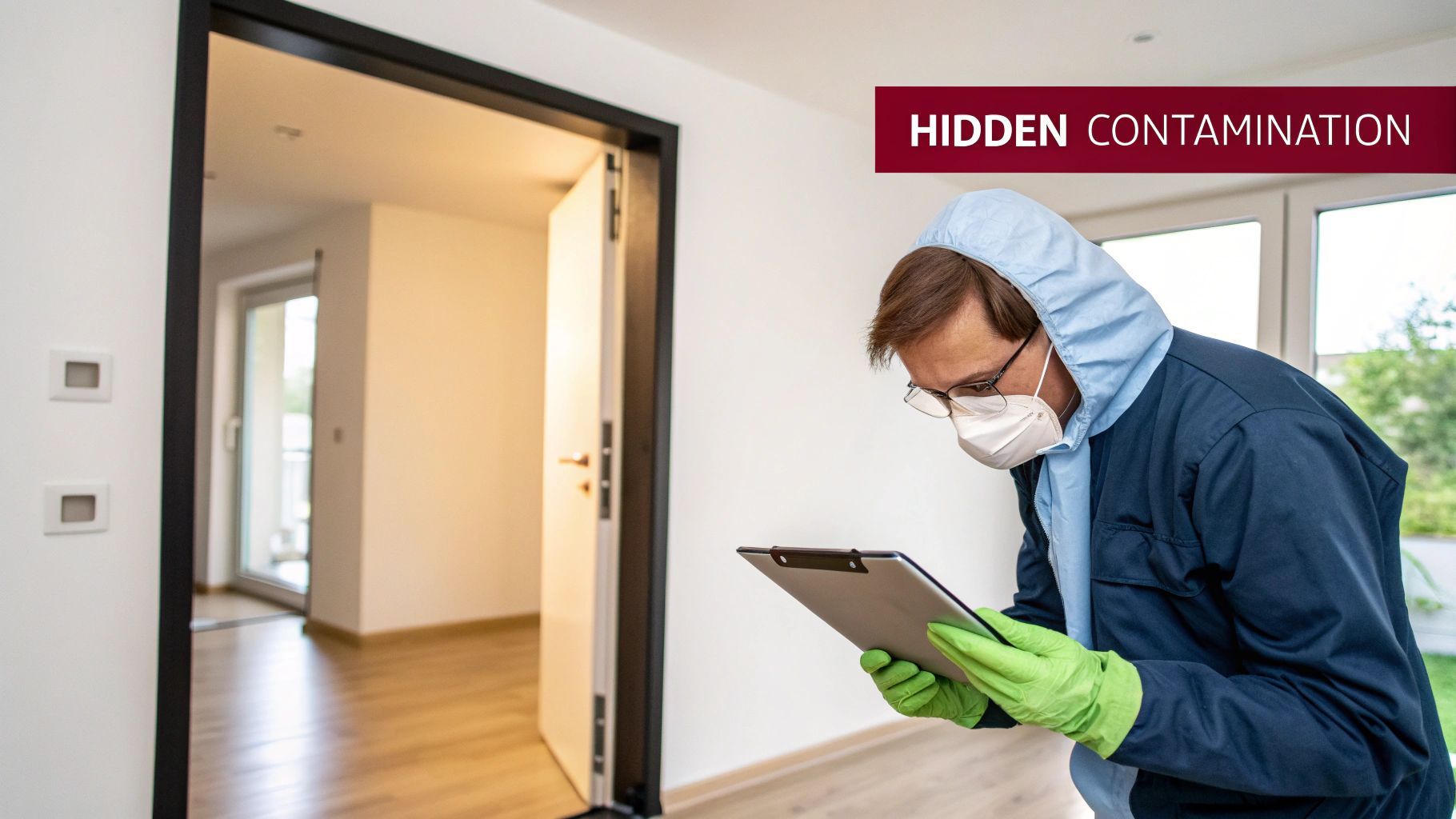
The problem of meth contamination is far more widespread than most executives realise, posing a quiet but significant threat to property portfolios across Australia. Clandestine labs used for meth production aren’t just a law enforcement issue; they leave a toxic legacy long after they’re gone.
Chemical residues saturate everything—walls, floors, carpets, and even the ventilation systems. These hazards are completely invisible, can’t be smelled, and can linger for years, posing serious health risks to anyone who enters the property.
For an asset manager, discovering this kind of contamination triggers an immediate and complex chain of problems. The property’s value can instantly plummet, rental income evaporates, and what was once an asset becomes a major liability. Simply ignoring it is out of the question; the legal and financial fallout from inaction can be devastating.
Understanding the Scale of the Problem
Just how common is this? The numbers might surprise you. In Australia, the issue has become a serious concern for the property industry.
A Queensland Parliament petition brought some alarming data to light, revealing that one specialist testing firm found approximately 16% of properties they inspected—that’s roughly one in every six—were contaminated above the accepted Australian safety guidelines.
This statistic drives home a crucial point for investors and fund managers: the risk isn’t hypothetical, it’s statistically significant. Without a structured plan, your organisation is wide open to unforeseen costs and liabilities that can seriously damage your portfolio’s performance.
This reality demands a fundamental shift in thinking. We need to move away from a reactive, “clean-up” mindset and towards a proactive risk management strategy. The entire point of the executive framework for managing meth-contaminated real estate assets is to be prepared. It ensures that when contamination is found, or even suspected, there’s already a clear, decisive plan ready to go.
Why a Proactive Framework is Essential
Putting a formal framework in place gives your organisation the structure it needs to handle these high-stakes situations with confidence. It’s about taking control of the chaos.
A solid plan helps you:
- Protect Asset Value: By tackling contamination swiftly and professionally, you can stop value depreciation in its tracks and get the property back to a marketable state much faster.
- Ensure Legal Compliance: Following a documented process is your best defence. It demonstrates due diligence and helps you meet all your disclosure obligations, dramatically lowering the risk of future litigation.
- Manage Financial Impact: A planned approach allows for realistic budgeting. You can properly forecast the costs of testing, remediation, and lost income, preventing the kind of spiralling, uncontrolled expenses that can cripple a project.
Before committing to any path forward, conducting a thorough feasibility study is an essential first step. This analysis helps you weigh all your options and their financial implications, forming the data-driven foundation for any strategic decision you make.
Establishing Your Asset Protection Governance Team
When a clandestine lab is discovered in one of your properties, the situation can spiral into chaos almost instantly. Without a clear game plan, organisations often find themselves in a scramble of finger-pointing and paralysis, bleeding time and money as the risks compound. This is why the first and most critical pillar of the executive framework for managing meth contaminated real estate assets is putting a dedicated governance team in place before you need one.
This isn’t a job for a single department. A swift, coordinated response demands a cross-functional team where everyone knows their role. Think of it as your own corporate emergency response unit, pre-briefed and ready to go for this specific type of incident. The aim is to create a clear chain of command that kicks into gear the moment a threat is identified, making sure every decision is deliberate, not desperate.
Instead of a crisis meeting starting with “Who’s handling this?”, your team already has the answer. That proactive structure is what turns a potentially catastrophic financial and legal disaster into a manageable operational challenge. For firms holding large and diverse property portfolios, this isn’t just good practice—it’s essential.
Assembling Your Cross-Functional Response Team
A truly effective governance team needs to pull expertise from every corner of the business. Each member brings a crucial piece of the puzzle, leading to a more balanced and robust response. Your core team should always include people from:
- Legal Counsel: They’re your shield, navigating the tangled web of disclosure laws, tenant rights, and liability exposure. They keep you compliant and out of court.
- Finance Department: These are the people who control the purse strings. They’ll need to approve budgets for testing and remediation, calculate lost rent, and ultimately assess the hit to the asset’s value.
- Operations or Property Management: Your eyes and ears on the ground. They know the building, manage the tenants, and will be the ones coordinating with contractors and remediation crews.
- Health and Safety: They ensure every action, from initial inspection to final clean-up, complies with WHS standards, protecting your staff and contractors from hazardous exposure.
This multi-disciplinary setup stops decisions from being made in a vacuum. The finance team’s budget concerns are weighed against the legal team’s liability warnings, creating a complete strategy that protects the entire organisation.
Defining Roles with a Decision-Making Matrix
Once you have the players, you need a playbook. A decision-making matrix is a surprisingly simple but powerful tool for defining exactly who is responsible for what. It spells out authority and accountability for every stage of the crisis, preventing delays and making sure nothing critical falls through the cracks.
A well-defined governance structure transforms reactive panic into a structured, strategic response. It ensures that every action, from initial testing to final sign-off, is authorised, documented, and aligned with the organisation’s overall asset protection goals.
To make this practical, we can map out these responsibilities in a clear matrix. This ensures there’s no confusion about who signs off on what, especially when costs and risks are escalating.
Executive Roles and Responsibilities Matrix
| Role/Department | Risk Assessment Phase | Testing & Verification Phase | Remediation & Disposal Phase | Financial & Legal Oversight |
|---|---|---|---|---|
| Legal Counsel | Advises on initial disclosure obligations & liability risks. | Reviews testing contracts & ensures compliance with standards. | Drafts contractor agreements & advises on final liability releases. | Manages all legal claims, insurance matters, & regulatory reporting. |
| Finance Dept. | Approves budget for initial risk assessment & preliminary testing. | Authorises budget for comprehensive lab testing & reporting. | Approves final remediation budget & capital expenditure for disposal. | Tracks all costs, calculates financial impact & impairment, manages insurance claims. |
| Operations/PM | Secures the property & manages immediate tenant communications. | Coordinates site access for testing specialists & receives reports. | Manages remediation contractors & oversees on-site project execution. | Provides operational data for financial modelling & legal review. |
| Health & Safety | Establishes site safety protocols & ensures PPE compliance. | Reviews testing methodologies for WHS risks. | Audits remediation work for safety compliance & contractor conduct. | Signs off on final site safety clearance & maintains WHS records. |
This matrix isn’t just a document; it’s your blueprint for action. It clarifies, for instance, that while Operations might request screening tests, it’s the Finance department that has the authority to approve a full-scale remediation budget that could run into the tens of thousands. It also centralises who is responsible for stakeholder communications—tenants, investors, insurers, and regulators—ensuring one consistent, controlled message goes out. This is the bedrock of managing a contaminated asset crisis effectively.
The Four Stages of Contamination Management
Successfully dealing with a meth-contaminated property isn’t about guesswork; it’s about having a methodical, evidence-based process. A key part of the executive framework for managing meth contaminated real estate assets is breaking down the entire response into four distinct, manageable stages. This approach cuts through the technical jargon and confusion, allowing executives to make calm, informed decisions based on data, not fear.
Each stage logically follows the one before it, creating a clear pathway from the first inkling of a problem to getting a legally sound “all clear.” Following this systematic process ensures no critical steps are missed, which is essential for protecting the asset’s value and minimising legal exposure. It turns a potential crisis into a structured, operational task.
This process requires a coordinated response team—blending legal, financial, and operational know-how—to execute each stage effectively.
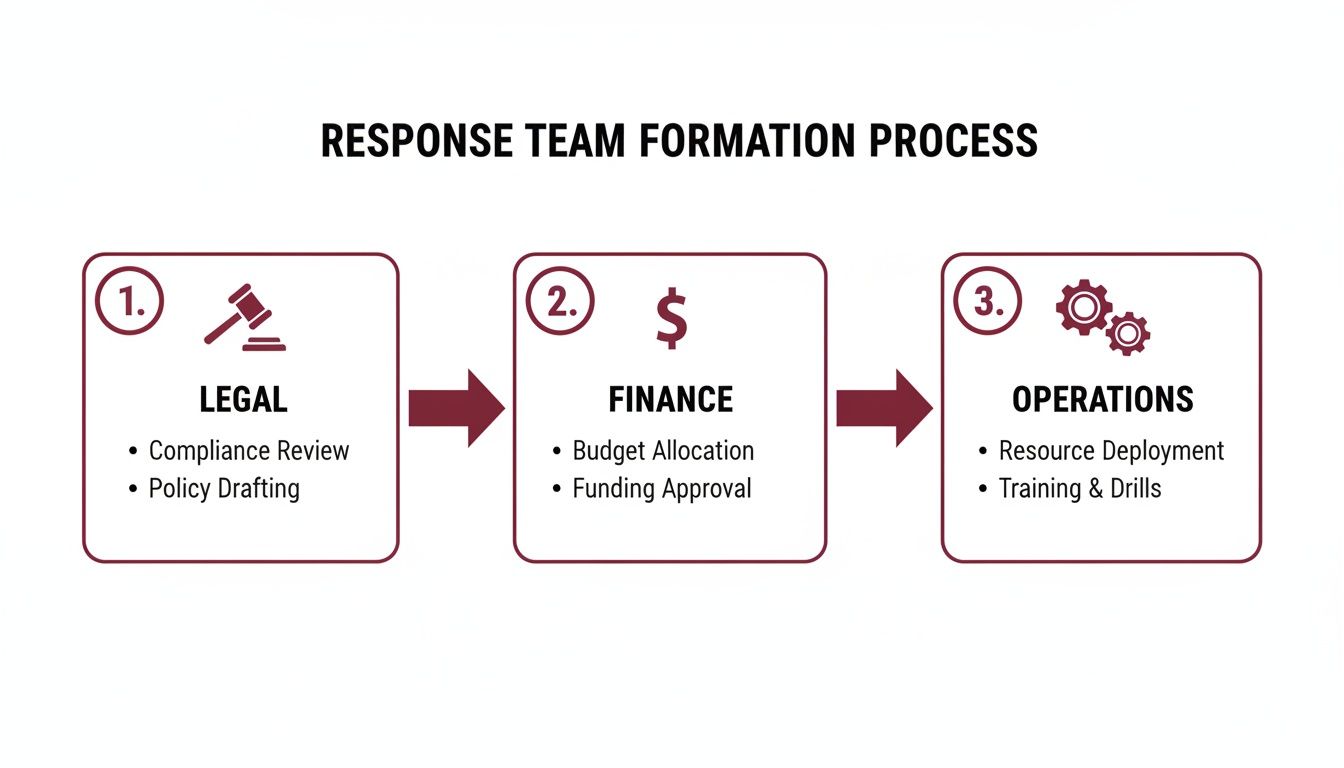
As the visual shows, you need a cross-functional approach where legal gives the green light, finance approves the spend, and operations gets the job done. It’s a team effort from start to finish.
Stage 1: Initial Detection
It all starts with a suspicion. The initial detection stage is all about recognising the red flags that suggest a clandestine lab might have been operating in the property. These signs can be subtle and are easily missed by an untrained eye during routine inspections.
Your property managers and maintenance staff are your first line of defence. They should be trained to spot potential indicators, such as:
- Strange chemical smells, often described as being like ammonia or solvents.
- Yellow or brown stains on walls, ceilings, floors, and even benchtops.
- An unusual amount of rubbish, particularly empty chemical containers, tubing, or packets of cold medicine.
- Odd modifications to ventilation systems or windows that have been blacked out.
Catching these signs early is the first critical step in protecting the asset and preventing anyone else from being exposed.
Stage 2: Scientific Testing
Once you have a reason to be concerned, it’s time to replace assumptions with hard facts. This is where scientific testing comes in, and it’s non-negotiable. This stage usually happens at two levels.
First up is often a presumptive field screening. This is a low-cost, instant test that can give you a quick “yes” or “no” on the presence of methamphetamine residue. While helpful for an initial assessment, these kits aren’t legally defensible and can’t tell you how much contamination there is.
If the field screen comes back positive, or if the initial suspicion is very strong, the framework requires moving to comprehensive laboratory analysis. This is the serious part. A certified hygienist will visit the property and take multiple swab samples from various surfaces. These samples are then sent to an accredited lab to determine the exact concentration of methamphetamine residue.
The Australian Clandestine Drug Laboratory Remediation Guidelines set a clear standard. The health-based investigation level is 0.5 micrograms (µg) per 100 square centimetres (100 cm²). Any reading above this means the property is officially contaminated and requires professional remediation.
This number is the most important piece of data for your governance team. It defines the scale of the problem and dictates exactly what you need to do next.
Stage 3: Remediation Pathways
With lab results confirming contamination above that 0.5µg threshold, the property officially enters the remediation stage. This is where you absolutely must bring in the professionals. Trying to clean it yourself or using an in-house team is not only completely ineffective against invisible chemical residues, but it also creates a massive legal liability.
Professional remediation is a detailed, multi-step process carried out by specialised contractors who follow strict safety protocols. It typically involves:
- Site Containment: Sealing off the affected areas to stop contamination from spreading.
- Removal of Porous Materials: Getting rid of anything that can’t be properly decontaminated, like carpets, curtains, and unsealed timber.
- Chemical Decontamination: Using specialised cleaning agents designed to break down and remove meth residues from every surface.
- Triple Washing: A meticulous process of washing, rinsing, and drying all non-porous surfaces to ensure nothing is left behind.
The complexity of this work highlights why you need specialists. Research has proven the public health risks from third-hand exposure are very real; smoking meth leaves behind a residue that settles on surfaces and gets into dust, which can then cause measurable exposure in anyone who lives there later. You can discover more about the research into methamphetamine residue transfer from leading experts in the field.
Stage 4: Post-Remediation Verification
This is the final, and arguably most important, stage: post-remediation verification. After the professional cleaners have packed up and left, you need an independent environmental hygienist to come back to the property. It’s crucial this is a different company from the one that did the cleaning.
This step provides impartial, third-party validation that the job was done right. The hygienist will take a new set of swab samples from the same areas tested before the clean-up and send them off for lab analysis.
Only when those results come back confirming that all surfaces are now below the 0.5µg/100 cm² guideline is the property officially considered decontaminated. This final clearance report is a vital legal document. It’s your proof that you’ve met your duty of care, protecting your organisation from future claims and finally restoring the asset’s value, making it safe to be lived in or sold.
Navigating Legal and Financial Obligations
Once the physical clean-up of a meth-contaminated property is done, you’re not out of the woods. In fact, you’ve just entered an entirely new landscape, one filled with complex legal duties and serious financial risks. Getting this part right is a critical function of the executive framework for managing meth contaminated real estate assets. One wrong move here can turn a containable operational problem into a full-blown financial and legal disaster.
The moment you discover contamination from a clandestine lab, a whole series of legal requirements kick in. These aren’t just suggestions; they’re legal obligations designed to protect tenants, buyers, and the public. For any asset owner or property manager, knowing these duties inside and out is your best defence against crippling lawsuits and fines.
The Critical Duty of Disclosure
One of the biggest legal hurdles you’ll face is the duty to disclose the contamination. The specific rules change from state to state, but the core principle is the same everywhere in Australia: you cannot hide a significant fact that could affect someone’s health or the property’s value. Trying to keep it quiet is a gamble you can’t afford to take.
For landlords, this means you have to tell prospective tenants about any past or current contamination issues. For sellers, it means making sure potential buyers know the property’s history. Attempting to sweep it under the rug can backfire spectacularly.
Here’s what you risk:
- Voided Contracts: A tenant or buyer who finds out later can often legally walk away from the lease or sale.
- Massive Lawsuits: You could be sued for everything from health problems and relocation expenses to the drop in property value.
- Brand Damage: The fallout from a public lawsuit can tarnish your organisation’s reputation far more than the remediation ever would have cost.
The Financial Fallout of Contamination
The financial pain from a meth-contaminated asset goes way beyond the clean-up invoice. As an executive, you need to brace for a financial hit from multiple angles that can hammer a property’s performance and your portfolio’s bottom line. The costs come fast, and they linger.
As soon as contamination is confirmed, the asset’s value plummets. A property that’s legally unlivable is, for all intents and purposes, worthless until it’s been given the all-clear by a professional. Then comes the long list of direct and indirect costs you’ll need to manage meticulously.
A proactive management framework forces an organisation to confront these costs head-on. The investment in a structured response is minimal compared to the staggering expense of inaction, which can include legal battles, regulatory fines, and permanent asset value destruction.
Quantifying the True Cost of Inaction
To get buy-in for a proactive framework, you need to paint a clear picture of what’s at stake. The total financial damage is almost always much higher than just the remediation bill.
Key Financial Impacts to Consider
| Cost Category | Description |
|---|---|
| Remediation Costs | The direct expense for certified decontamination professionals. This can run from a few thousand dollars to tens of thousands, depending on how bad it is. |
| Lost Rental Income | The property will sit empty and generate zero revenue during testing, clean-up, and verification. This dead period can easily stretch for months. |
| Property Devaluation | Even after it’s cleaned, the property might carry a stigma. This can lower its sale price or make it harder to find tenants. |
| Insurance Difficulties | Don’t assume your insurance will cover this. Many standard policies exclude contamination from illegal activities, leaving you to pay the entire bill. Your premiums could also spike. |
| Legal Fees | The cost of defending yourself in court against tenants or buyers can escalate quickly, often dwarfing the original clean-up cost. |
This financial pressure is made worse by a huge problem of underreporting. A Flinders University study found that less than 10% of suspected meth contaminations in Australian homes are ever actually reported to the authorities. This creates a hidden minefield for investors. Meth residues can linger for up to five years, posing serious third-hand exposure risks and creating latent liabilities that can pop up years down the track. You can read the full study on meth house reporting gaps to grasp the true scale of this issue.
Ultimately, staying on top of these legal and financial duties means having a solid grasp of property law. It’s not just about the specific contamination rules; it’s about the entire legal framework. For instance, property managers should also be familiar with broader obligations like the essential California landlord laws for 2025 that govern all aspects of property ownership and tenancy.
Developing Your Asset Valuation and Disposition Strategy
Once a property is confirmed as contaminated, the first question that hits the boardroom table is a financial one: what is this asset actually worth now? A positive test for meth residue instantly rewrites the asset’s financial story, pushing you out of crisis management and into strategic financial decision-making. This is a critical pivot point in the executive framework for managing meth contaminated real estate assets.
The immediate task is to get a firm handle on the financial damage. This isn’t guesswork; it involves a specific, dual-valuation approach to accurately quantify the loss and inform your next move. It’s all about comparing two distinct scenarios to see the true, dollars-and-cents cost of the contamination.
Conducting ‘As-Is’ vs ‘Remediated’ Valuations
To get the full financial picture, you’ll need to engage a certified property valuer—specifically one with experience in contaminated sites—to prepare two separate valuations.
- The ‘As-Is’ Valuation: This is the property’s current market value, with the contamination baked in. It accounts for the positive test results, the legal obligation to disclose, and the estimated cost to fix the problem. Unsurprisingly, this figure will be significantly lower, reflecting an asset that is currently unlivable and unmarketable.
- The ‘Remediated’ Valuation: This valuation paints a picture of the future. It projects the property’s market value after a professional decontamination and the issuing of a clearance certificate. This is the asset’s potential worth once it’s safe, compliant, and ready to re-enter the market.
The gap between these two numbers is the direct financial impact of the contamination. This isn’t just an accounting exercise. This data is the bedrock for every strategic decision that follows, giving you the hard numbers needed to analyse the return on investment for any path you choose.
Exploring the Three Primary Disposition Pathways
With a clear financial assessment in hand, you can start evaluating the three main pathways for dealing with the asset. The right choice will hinge on the remediation bill, local market conditions, and your organisation’s appetite for risk.
- Remediate and Hold: This strategy is straightforward—you clean the property to meet all legal standards and then bring it back into your portfolio as a rental asset. This is often the best long-term play in a strong rental market, where ongoing income can eventually recoup the upfront clean-up costs.
- Remediate and Sell: Here, the objective is to decontaminate the property and then sell it for its full ‘remediated’ market value. It’s a solid option when the goal is to exit the asset, de-risk the portfolio, and recover capital quickly, especially if the sales market is hot.
- Demolish and Rebuild: In the most severe cases—where contamination is so widespread that the cost of remediation would eclipse the property’s value—the bulldozer might be the only financially sensible option. This pathway completely removes the liability and gives you a clean slate for redevelopment.

A crucial part of any disposition strategy is transparently marketing the property post-remediation. Using the official clearance certificate as a key selling point builds buyer confidence, demonstrates due diligence, and serves as a powerful legal shield against future liability claims.
Making a data-driven choice means laying out the options side-by-side and weighing the pros and cons of each pathway. The following table breaks down the core considerations for each strategy.
Asset Disposition Strategy Comparison
| Strategy | Pros | Cons | Best Suited For |
|---|---|---|---|
| Remediate and Hold | Preserves long-term asset value and restores rental income stream. | Requires significant upfront capital for clean-up; potential for market stigma. | Organisations with a long-term investment horizon in a stable or growing rental market. |
| Remediate and Sell | Allows for quick capital recovery and removes a problematic asset from the portfolio. | Remediation costs eat into profit margins; market timing is critical. | Investors looking to de-risk their portfolio or capitalise on a strong seller’s market. |
| Demolish and Rebuild | Completely eliminates contamination liability and offers potential for higher future value. | Highest initial cost and longest timeline; requires navigating planning and construction. | Cases of severe, widespread contamination where remediation is not economically viable. |
By analysing the projected ROI for each of these scenarios against market trends and your own portfolio goals, you can make the smartest financial decision. It’s how you turn a major liability back into a performing real estate asset.
Turning Your Executive Framework into Action
Alright, let’s get down to brass tacks. We’ve covered a lot of ground, but a framework is just a piece of paper until you put it to work. Moving from high-level strategy to decisive action on the ground is where the real value is found. This is the moment your organisation takes all this theory and turns a potential crisis into a manageable, operational challenge, all guided by the executive framework for managing meth-contaminated real estate assets.
The core message here is simple: get on the front foot. Waiting for a property to test positive before figuring out your plan is a surefire way to bleed money and walk into a legal minefield. By embedding this framework into your standard asset management protocols, you’re not just reacting; you’re creating a systematic, repeatable process. This is how you safeguard your investments, protect the people in your properties, and keep your company’s reputation intact.
The Bedrock Principles of Your Plan
Think of the pillars we’ve discussed not as a checklist, but as interconnected parts of a single, robust system designed for asset protection. Each one supports the others, forming a comprehensive defence against the very real risks of meth contamination.
- Nail Down Your Governance: Before anything else, everyone needs to know who’s calling the shots. A pre-defined, cross-functional team armed with a clear decision-making matrix stops the buck-passing and confusion right from the start. It ensures a swift, coordinated response when the clock is ticking.
- Stick to the Four-Stage Process: There’s no room for guesswork here. You must follow the scientific pathway: Initial Detection, followed by Scientific Testing, Professional Remediation, and finally, Independent Verification. This methodical approach ensures every decision is backed by evidence, defensible, and legally sound.
- Know Your Legal and Financial Duties: Your job doesn’t end with the clean-up crew. You have significant obligations around disclosure, accurate asset valuation, and transparent communication. Managing these proactively is absolutely critical to minimising liability and protecting your bottom line.
- Make Financially Sound Decisions: Your disposition strategy has to be driven by the numbers. Use the ‘as-is’ versus ‘remediated’ valuation model to make a clear-eyed choice. Whether you decide to remediate and hold, sell at a discount, or demolish the asset entirely, that decision must be based on a cold, hard analysis of ROI and current market realities.
Your Immediate Action Checklist
To get the ball rolling today, here’s a no-nonsense checklist for executive oversight. Use these points to frame your initial meetings and start delegating. This is how you prepare your organisation before a crisis lands on your desk.
- Assemble Your Governance Team: Formally appoint the key people from legal, finance, operations, and health and safety. Put their names in the charter.
- Draft the Decision Matrix: Get specific. Who has the authority to approve a $10,000 testing budget? Who signs off on a $50,000 remediation contract? Define it now.
- Schedule Staff Training: Get your property managers educated. They are your first line of defence and need to know the early warning signs of a clandestine lab.
- Vet Your Specialist Contractors: Don’t wait until you need one. Pre-qualify and build relationships with independent hygienists and certified remediation companies now to avoid costly delays later.
- Review Your Insurance Policies: Pull out the fine print. Do you actually have coverage for contamination events? Understand what’s covered and, more importantly, what isn’t.
- Develop Communication Templates: When things go wrong, you won’t have time to wordsmith. Prepare draft communications for tenants, investors, and regulators so you can respond quickly and professionally.
Taking these concrete steps shifts your entire organisation from a reactive, vulnerable position to one of proactive control. You’ll be ready to manage any contamination incident that comes your way, not with panic, but with a plan.
Frequently Asked Questions
When you’re dealing with the possibility of meth contamination in a property, a lot of questions come up fast. It’s a complex issue, so let’s tackle some of the most common ones property owners and managers ask when applying the executive framework for managing meth contaminated real estate assets.
What Are the First Signs of a Clandestine Meth Lab?
The contamination itself is invisible, which is part of the problem. But the manufacturing process? That often leaves behind a trail of physical clues.
Training your property managers and maintenance teams to spot these red flags during inspections is one of your best first lines of defence. Look out for:
- Distinctive Chemical Odours: A sharp, persistent smell like ammonia, solvents, or even cat urine that just doesn’t air out.
- Staining: Odd yellow or reddish-brown stains popping up on walls, ceilings, floors, or concentrated around drains and sinks.
- Excessive or Unusual Rubbish: Piles of empty pseudoephedrine blister packs, chemical containers, glass tubing, or used coffee filters with strange, coloured residues are classic signs.
- Modified Security: Blacked-out windows (using paint, foil, or heavy coverings) and over-the-top security like extra locks or surveillance cameras can be a major warning.
Is Meth Testing Mandatory in Australia?
This is a really common point of confusion, and the answer is nuanced. As it stands, there is no single, national law that makes meth testing mandatory in Australian properties.
But don’t let that fool you. The absence of a national mandate doesn’t mean you’re off the hook. Property owners and managers have a serious legal duty of care under various state-based tenancy and public health acts. Your responsibility is to provide a safe and habitable home.
Ignoring suspected contamination because there’s no specific testing law is a dangerous gamble. It can open you up to significant legal and financial blowback if a tenant’s health is affected.
How Much Does Professional Remediation Cost?
It’s tough to give a single figure because every situation is different, but you should budget for a realistic range. For a typical residential property, professional meth remediation usually falls somewhere between $5,000 and $50,000.
What drives that cost? It really comes down to a few key factors:
- Level of Contamination: The higher the readings are above the 0.5µg/100cm² guideline, the more aggressive the cleaning and chemical treatments need to be.
- Property Size and Layout: It’s simple maths—a larger, multi-level house will cost more to decontaminate than a small unit.
- Materials Requiring Removal: Costs can climb quickly if porous materials like carpet, curtains, and plasterboard are too saturated to be cleaned. When they have to be ripped out and disposed of as hazardous waste, the price tag goes up.
Yes, the upfront cost can feel steep. But think of it as a critical investment. It’s a fraction of the potential long-term costs of legal battles, a permanently devalued asset, and the reputational damage that comes from not taking action.
Navigating occupational hazards is complex. Anitech provides expert Occupational Hygiene services across Australia to ensure your assets and workplaces are safe and compliant. We offer scientific testing and tailored support to protect your investments and people. For professional guidance on managing contaminated sites and other workplace safety challenges, visit https://occhygiene.com.au.


