
Quick Summary: This guide provides a technical breakdown of HEPA filtration and air scrubbing standards, crucial for professional decontamination and remediation. It focuses on equipment, standards like AS/ISO 16890, and practical strategies for creating safe containment zones, particularly for hazards like methamphetamine contamination, ensuring worker and public safety.
When you're dealing with a remediation site, especially one contaminated with hazardous substances like methamphetamine residue, a solid technical grasp of HEPA filtration and air scrubbing standards isn't just a "nice-to-have"—it's an absolute must for safe operation. This goes way beyond simple cleaning. It's about occupational health and safety, plain and simple, and it's what keeps workers safe and stops hazardous materials from escaping the work zone. This technical breakdown delves into the professional decontamination and remediation strategies required for such high-risk environments.
Why Air Purification Is a Non-Negotiable on Remediation Sites
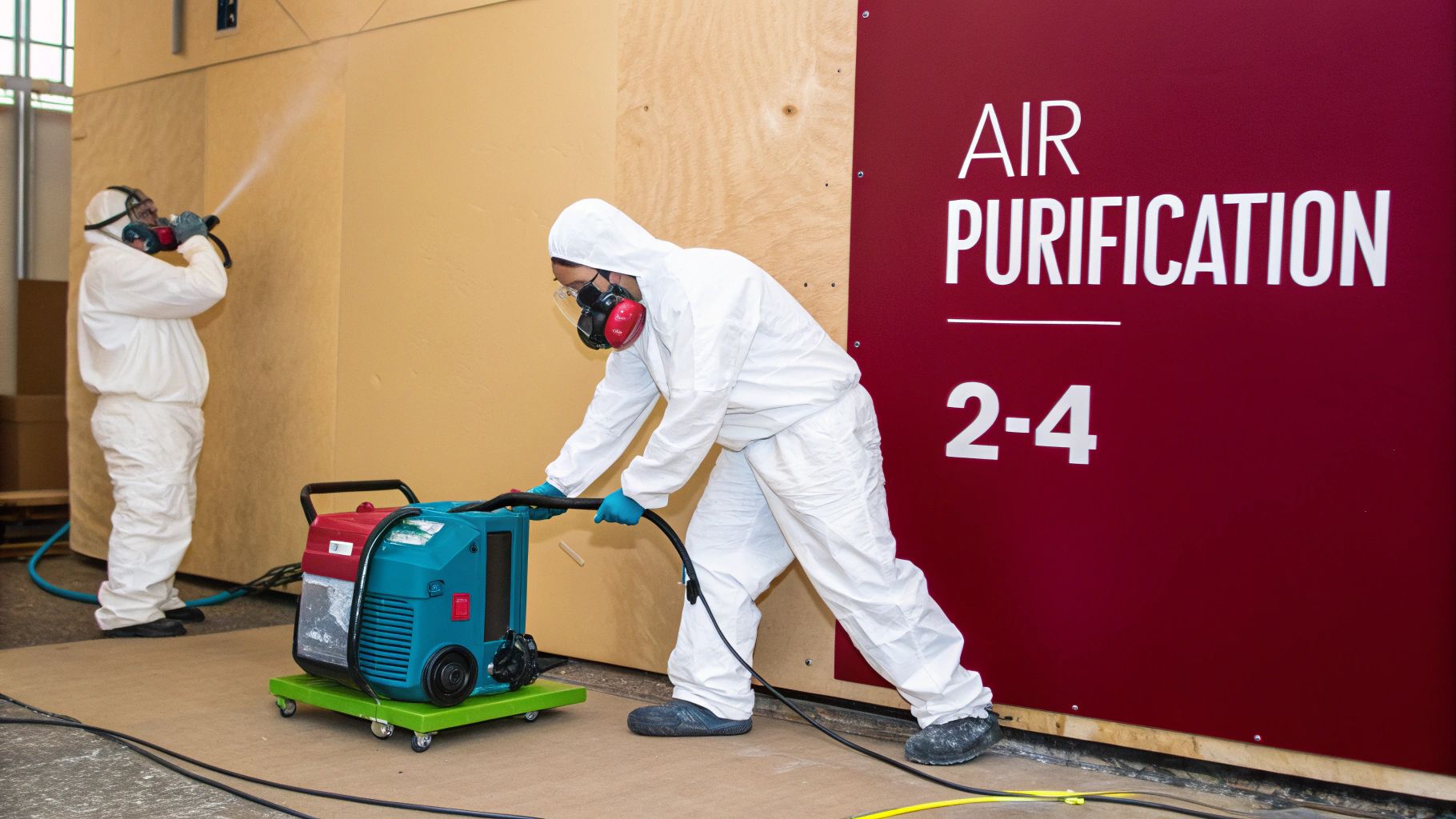
In professional decontamination, the stuff that can do the most harm is often the stuff you can't see. Disturbing materials contaminated with asbestos, lead, or meth residue sends microscopic particles airborne. These contaminants are a serious respiratory threat to work crews and can easily settle elsewhere on the property, creating a cross-contamination nightmare that can derail the entire project.
This is exactly why industrial-grade air purification is a non-negotiable part of the job. It's our primary line of defence in maintaining a safe, tightly controlled worksite.
The Core Equipment Required for Safe Operation
When it comes to controlling airborne nasties, two pieces of equipment do the heavy lifting: air scrubbers and the High-Efficiency Particulate Air (HEPA) filters inside them. Think of the air scrubber as a high-powered fan that sucks in the contaminated air, while the HEPA filter is the critical element that traps the particles.
To break it down, here's a look at the key technologies we rely on in the field.
Core Air Purification Technologies in Remediation
| Technology | Primary Function | Typical Application | Key Standard |
|---|---|---|---|
| HEPA Filtration | Traps 99.97% of particles at 0.3 microns | Capturing asbestos, lead dust, mould spores, meth residue | AS 4260:1997 |
| Air Scrubber | Actively draws and filters air within a space | Maintaining negative pressure, general air cleaning | IEC 60335-2-65 |
| Activated Carbon | Adsorbs odours, gases, and volatile organic compounds (VOCs) | Fire/smoke damage, chemical spills, meth labs | Not standardised, performance varies |
| Negative Air Machine | Creates a pressure differential to contain contaminants | Isolating work zones, preventing cross-contamination | ANSI/AIHA Z9.2-2018 |
These systems work together to ensure that what happens in the containment zone, stays in the containment zone.
Setting Up a Safe Containment Zone
One of the most important jobs for this tech is creating "negative air pressure." It sounds complex, but the concept is straightforward. Technicians seal off the contaminated area and place an air scrubber inside, configured to exhaust the filtered, clean air outside the containment.
This setup ensures that air only flows into the contaminated zone, not out of it. It’s a simple but brilliant bit of physics that prevents hazardous dust and vapours from escaping through a doorway or tiny gaps in the plastic sheeting.
A proper understanding of the work environment is critical, as the approach to air purification is often determined by the classification of hazardous locations. The specific risks on-site—from chemical residues in a clandestine lab to mould spores after a flood—dictate the type and number of air scrubbers needed. Getting this right is fundamental to executing a project safely and successfully.
Decoding HEPA Filtration: The Gold Standard in Air Cleaning
To really get why HEPA filters are the absolute cornerstone of safe remediation, we need to move past the marketing talk and dig into how they actually work. A true HEPA filter isn't just a fancy sieve; it’s a complex maze of incredibly dense glass fibres, engineered with precision to trap particles you can't even see.
This maze doesn't simply block particles that are bigger than the gaps between the fibres. Instead, it uses a clever combination of three different physical principles, all working together to pull contaminants out of the air. This is what makes them so effective.
The Three Pillars of HEPA Capture
The genius of HEPA filtration is how it tackles particle capture from multiple angles, ensuring almost nothing gets through.
Interception: Think of this as the most straightforward method. Larger particles, like dust and mould spores, are carried along by the airflow and get snagged when they brush up against a fibre, just like a fly caught in a spiderweb.
Impaction: Heavier particles have too much momentum to follow the air as it weaves around the fibres. They just keep going in a straight line and slam directly into a fibre, where they stick.
Diffusion: This is the really clever part that deals with the tiniest, most dangerous particles. Ultrafine particles (those under 0.1 microns) don’t travel in straight lines. They bounce around erratically in the air, a movement called Brownian motion. This random, zig-zagging dance makes it almost inevitable that they will collide with and stick to a filter fibre.
It's this three-pronged attack that allows HEPA filters to succeed where others fail, especially when it comes to those particles that are the most difficult to capture.
The Ultimate Test: The 0.3-Micron Particle
You'll constantly hear HEPA filters being rated against their ability to capture particles that are 0.3 microns in size. This isn't just a random number; it represents the Most Penetrating Particle Size (MPPS).
It sounds counterintuitive, but it’s a quirk of physics. Particles larger than 0.3 microns are easily caught by interception and impaction. Meanwhile, those much smaller than 0.1 microns are effectively wrangled by diffusion.
The 0.3-micron particle is stuck in the middle. It's just big enough that diffusion has less of an effect, but it's also small and light enough to often follow the airflow around the fibres. This makes it the hardest particle size for any filter to catch. If a filter can trap 99.97% of these tricky particles, you can be confident it's even better at capturing everything else, both bigger and smaller.
Australian Standards and Performance Ratings
Here in Australia, we don't just take a manufacturer's word for it. Filter performance is governed by strict standards. To be called a HEPA filter under Australian standards like AS 4260:1997 and the international EN 1822, a filter must capture a minimum of 99.97% of those 0.3-micron particles.
This makes them non-negotiable for professional air scrubbing in remediation. And while that standard is incredibly high, some jobs demand even more. An H13 grade filter, for instance, must achieve 99.95% efficiency, while filters used in medical or cleanroom settings can hit 99.99% or higher.
This level of filtration is absolutely critical in hazardous material remediation, such as a meth lab cleanup, where invisible chemical residues can hitch a ride on airborne dust particles.
The Danger of "HEPA-Like" Filters
This is a big one. You have to know the difference between a true, certified HEPA filter and the knock-offs marketed as "HEPA-type" or "HEPA-like." These imitations almost always use lower-quality materials and simply don't have the density or construction needed to perform.
Using one of these substandard filters on a professional decontamination job isn't just cutting corners; it's a massive risk. It might catch some of the visible dust, but it will let the dangerous, sub-micron contaminants from meth residue, asbestos, or lead sail right on through.
This creates a false sense of security and can expose workers and future occupants to serious health risks. When you’re dealing with hazardous materials, only certified HEPA filtration meets the necessary air scrubbing standards in remediation. No exceptions.
From AS 1324 to ISO 16890: A Major Leap Forward in Air Filtration
To really get a grip on air scrubbing, you first need to understand the standards that govern air filters. It's not about memorising numbers; it's about appreciating the journey from outdated methods to a modern, health-focused approach. For years, the remediation industry worked with standards that, frankly, had some serious blind spots.
Making the switch from these older benchmarks isn’t just a box-ticking exercise. It represents a fundamental shift in how we measure a filter's real-world ability to protect people, especially when dealing with invisible threats like meth residue or mould spores.
The Problem with the Old Standard: AS 1324
The old Australian Standard, AS 1324, was the benchmark for a long time, but it had a critical flaw. Its testing method looked at a filter’s ability to capture particles of a single size. Think of it like a security guard trained to only spot people wearing red hats—they’d miss every other potential threat. That’s not how contamination works in the real world, which is a complex cocktail of different particle sizes.
Even more concerning was its failure to account for electrostatic charge. Many synthetic filters come brand new with a static charge that helps them grab particles, a bit like a statically charged balloon sticking to your hair. The problem is, this charge wears off pretty quickly in the field, causing the filter's performance to plummet. This often gave a false and dangerous sense of security on site.
The Smarter Approach: AS/ISO 16890
The introduction of AS/ISO 16890 was a game-changer, bringing Australia in line with a much more realistic and scientifically sound global standard. Instead of a one-trick-pony test, this new system evaluates how well a filter captures a whole range of particle sizes. Crucially, it links this performance directly to the particulate matter (PM) ratings used by health organisations like the WHO.
This new standard gives us a much sharper picture of how a filter will actually behave on a job. The move to AS/ISO 16890 replaced the outdated AS 1324 series, which only checked efficiency at 0.6 µm with a sloppy ±15% error margin and completely ignored the static charge issue.
Now, ISO 16890 tests across the entire 0.3–10 µm spectrum. It then sorts filters into practical categories like ISO ePM1, ePM2.5, and ePM10. This gives us precise data on a filter's power against the ultrafine and PM2.5 particles that pose the biggest health risks in our line of work. If you're interested in the details, you can explore more data on the Australian air filter market and its standards.
What Do the ePM Ratings Actually Mean?
At the heart of ISO 16890 is the ePM (particulate matter efficiency) system. It’s a simple way to classify a filter based on how well it traps particles in the three size ranges that are known to harm human health.
ePM1: This is the most important one for remediation. It targets the nastiest ultrafine particles, from 0.3 to 1 micron. We're talking about combustion particles, viruses, and the tiny chemical residues left behind in a meth lab. These are the particles that can bypass your body's natural defences, go deep into your lungs, and even get into your bloodstream.
ePM2.5: This covers fine particles up to 2.5 microns, like mould spores, bacteria, and nasty dusts like crystalline silica. They are serious respiratory irritants and cause long-term health problems.
ePM10: This category handles coarser (but still inhalable) particles up to 10 microns, like pollen and general construction dust.
With these ratings, a remediation project manager can choose a filter that is specifically proven to capture the main contaminant they're dealing with. It’s about choosing the right tool for the job.
The Bottom Line: The ePM rating directly tells you how well a filter protects against specific health hazards. For any serious remediation work, an ePM1 rated filter is the gold standard, offering the best defence against the smallest and most damaging airborne particles.
The Real-World Difference in Performance
Let's make this tangible. Under the old AS 1324 standard, a typical F5-rated filter might have looked okay on paper. But when put to work against the dangerous sub-micron particles, its performance was often mediocre at best—and it got worse as the filter aged.
Now, compare that to a modern filter rated ISO ePM1 >50%. This certification guarantees that the filter will capture at least 50% of the most harmful ultrafine particles (ePM1), and—this is the key part—it’s tested after its electrostatic charge has been neutralised. This tells you what you can expect from the filter for its entire working life, not just for the first five minutes out of the box.
This isn’t just a slight improvement; it's a quantum leap in protecting worker health. It's the difference between hoping a filter works and knowing it’s proven to handle the invisible dangers on site. For anyone diving into a technical breakdown of air scrubbing standards in remediation, demanding filters rated to AS/ISO 16890 isn't just best practice—it's non-negotiable.
Getting Air Scrubbers on the Ground in Remediation Projects
Knowing the science behind HEPA filters is one thing, but putting that knowledge to work on-site is where the real magic happens. The practical deployment of air scrubbers is what turns a hazardous space into a controlled work zone, ultimately deciding how safe and successful a remediation project will be.
It all starts with the gear. A professional-grade air scrubber isn't just a big fan with a filter slapped on it. It’s a sophisticated, multi-stage system built to tackle a whole spectrum of airborne nasties.
The evolution of filter standards really tells the story. We've moved from older, almost token efforts to modern standards that offer serious respiratory protection.
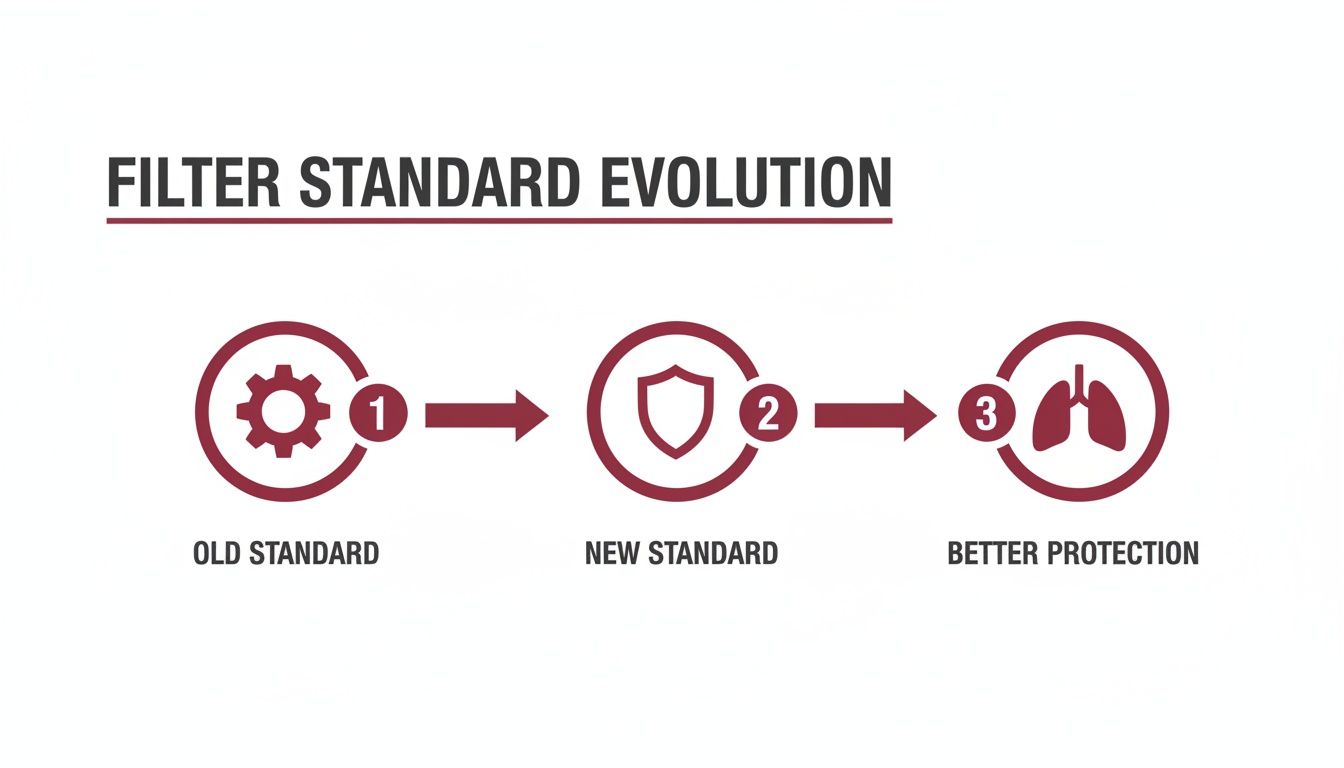
This shift is more than just technical—it's about creating a stronger shield against the invisible dangers we face in remediation, directly safeguarding the health of every person on site.
The Anatomy of a Professional Air Scrubber
If you open up a typical professional unit, you'll find a series of filters lined up, each with a specific job to do. They work in concert to systematically purify the air.
Pre-Filters: Think of these as the bouncers at the front door. They catch the big stuff first—dust, hair, and larger debris—which is vital for protecting the more sensitive and costly filters further down the line.
Activated Carbon Filters: This is where you tackle the invisible threats. Activated carbon is essential for dealing with things like volatile organic compounds (VOCs) and odours, a massive issue in meth contamination cleanup. The carbon's porous structure is perfect for adsorbing chemical molecules right out of the air.
The HEPA Filter: This is the heart of the operation, the final and most critical stage. It’s what captures a staggering 99.97% of microscopic particles down to 0.3 microns. We're talking about meth residue, mould spores, and other hazardous particulates that you simply can't see.
This layered defence means air scrubbers can handle a diverse mix of contaminants. In Australia, industries like mining and construction rely on these systems to bring down harmful PM2.5 particulates. In fact, research shows that HEPA cleaners can slash indoor PM2.5 levels by an average of 38.6%. The effect is even more pronounced when you use multiple units at a medium flow rate. In some controlled tests, particle levels plummeted from 37.5 µg/m³ to almost nothing in minutes. You can dig into the specifics of this HEPA performance study on airborne particles to see just how powerful they are in a containment scenario.
Sizing the Machine for the Job
Putting an air scrubber to work isn't just a matter of plugging it in. You need to do a bit of simple but crucial maths to make sure it's powerful enough for the space. This is where two key metrics come into play: Air Changes per Hour (ACH) and Clean Air Delivery Rate (CADR).
ACH is how many times the machine can filter the entire volume of air in a room within one hour. For remediation work, we're typically aiming for 4 to 6 ACH.
CADR is the scrubber's raw power, measured in cubic metres per hour (m³/h). It tells you exactly how much clean air the unit pumps out.
To pick the right machine, first, you need the volume of your containment area (Length x Width x Height, all in metres). Then, you plug it into this straightforward formula:
Required CADR (m³/h) = Room Volume (m³) x Target ACH
This quick calculation ensures you're not bringing a knife to a gunfight. You'll have a machine with enough grunt to keep the environment safe.
To make this even easier, here’s a quick reference table.
Air Scrubber Sizing Guide for Remediation Zones
This table helps you quickly estimate the required CADR for different-sized containment zones, based on a target of 4 to 6 air changes per hour (ACH), which is the standard for most remediation work.
| Containment Volume (m³) | Target ACH | Required CADR (m³/h) |
|---|---|---|
| 50 m³ (Small Room) | 4 | 200 m³/h |
| 50 m³ (Small Room) | 6 | 300 m³/h |
| 100 m³ (Medium Room) | 4 | 400 m³/h |
| 100 m³ (Medium Room) | 6 | 600 m³/h |
| 250 m³ (Large Area) | 4 | 1000 m³/h |
| 250 m³ (Large Area) | 6 | 1500 m³/h |
Remember, it's always better to oversize slightly than to undersize. Having more capacity than you need gives you a buffer and ensures you can maintain negative pressure effectively.
Creating Negative Air Pressure: The Golden Rule of Containment
By far, the most critical strategy for using an air scrubber is to establish negative air pressure. This technique is the absolute cornerstone of preventing cross-contamination. Get this right, and you're well on your way.
Here’s how it’s done:
- Seal the Containment Area: Every door, window, and vent needs to be sealed tight with heavy-duty plastic sheeting and tape. You'll create a single way in and out, usually with a zipper system or overlapping flaps.
- Position the Scrubber: The air scrubber itself goes inside the contained zone.
- Exhaust Clean Air: Attach flexible ducting to the scrubber’s exhaust port and run it outside the containment to a clean, unoccupied area.
Once you switch the machine on, it starts pulling air from the sealed room. Because it’s removing air faster than it can get back in through tiny gaps, it creates a slight vacuum. This negative pressure is what you want. It means air can only flow into the work zone, effectively trapping any contaminated particles and stopping them from escaping. It's a simple principle with a powerful impact on safety and job success.
Getting it Right: Monitoring, Testing, and Maintenance
Putting a professional-grade air scrubber on a job site is just the beginning. The real proof is in the data—you can't just assume it's working. We need to validate that the containment and filtration setup is actually doing its job, which is non-negotiable for ensuring the area is safe to re-enter.
This is where we move from theory to practice, using specific tools and methods to get a live picture of the air quality and system performance. It's how we meet the strict air scrubbing standards in remediation and deliver a successful, verifiable result.
Keeping a Real-Time Eye on Performance
You can't just "set and forget" a HEPA filtration system. It demands active, ongoing monitoring to ensure everything is running as it should. On-site technicians use specialised gear to get a live feed of what's happening inside the containment, allowing for quick adjustments if something's off.
Two pieces of equipment are absolutely essential for this:
- Particle Counters: These are handheld devices that give you an instant snapshot of airborne particle levels. By taking readings both inside and outside the containment area, we can confirm two critical things: that the air scrubber is pulling contaminants out of the air, and that none of those contaminants are escaping the work zone.
- Manometers: A manometer, or differential pressure gauge, is our go-to for confirming negative pressure. It measures the tiny difference in air pressure between the contained area and the space outside. This gives us a clear, numerical confirmation that air is flowing the right way—into the work zone, not out of it.
Using these tools consistently provides the hard data we need to prove the environment is under control. To get a better handle on the science behind this, it's worth understanding the principles of professional indoor air monitoring.
Making Sure the HEPA Filter is Properly Sealed
A top-of-the-line HEPA filter is completely useless if it isn't sealed perfectly within its housing. Even the smallest gaps or tears can let contaminated air sneak past, defeating the entire purpose of the filtration system. That's why filter integrity testing is a must-do step.
The industry standard here is DOP or PAO smoke testing. It sounds technical, but the concept is simple. A non-toxic, engineered aerosol (like Di-Octyl Phthalate or Poly-Alpha Olefin) is introduced into the air stream before it hits the filter. On the "clean" side, a highly sensitive device called a photometer is used to scan for any particles that get through.
This test is so precise it can detect microscopic leaks in the filter material or, more often, find tiny flaws in the gasket seal around the filter's frame. It’s the definitive method for confirming your HEPA system is 100% sealed and performing at its peak.
Smart Maintenance and Safe Disposal
To keep your air scrubbers running effectively project after project, a solid maintenance routine is crucial. This isn't just about prolonging the life of the machine; it's about safety and performance, involving regular checks and filter changes under strict protocols.
A good maintenance checklist should always include:
- Pre-Filter Checks: Think of these as the first line of defence, catching all the large dust and debris. They need to be checked daily and either cleaned or swapped out to prevent them from getting clogged, which would choke the airflow and put extra strain on the main HEPA filter.
- Carbon Filter Swaps: On jobs dealing with VOCs or odours—like a meth lab clean-up—the activated carbon filter is doing the heavy lifting. These filters have a finite capacity and eventually become saturated. They need to be replaced based on the manufacturer's schedule or as soon as odours start to break through.
- HEPA Filter Change-Outs: Most quality air scrubbers feature a pressure gauge that tells you when the HEPA filter is loaded with contaminants and restricting airflow. Changing it is a delicate operation. The unit must be switched off, and technicians need to be in full personal protective equipment (PPE) to avoid releasing any of the captured nasties.
Once a filter is removed, it's not just regular rubbish. It's now classified as hazardous waste.
Handling Contaminated Filters
The final link in the chain is the safe handling and disposal of used filters. This is a critical compliance step governed by strict hazardous waste regulations here in Australia.
- Bag It: The moment it's removed, the contaminated filter must be sealed in a thick, clearly labelled hazardous waste bag.
- Decontaminate: The outside of the bag should be carefully wiped down before it's taken out of the containment zone.
- Dispose of It: The sealed bag must then be handed over to a licensed hazardous waste management company for proper transport and disposal.
Following these steps to the letter ensures that all the contaminants captured during the project stay contained for good, protecting the public, the environment, and the integrity of the job. It’s the final, crucial step in closing out a remediation project professionally and safely.
Wrapping It Up: It’s More Than Just Clean Air
We’ve walked through the technical side of HEPA filtration and air scrubbing, from the standards that define performance to the on-the-ground practices that make a worksite safe. If there's one thing to take away, it's this: getting this right isn't just about ticking a box for compliance. It's about a genuine commitment to protecting people. Your team, your clients, and the public all depend on it.
Every decision matters. Whether you're choosing the right air scrubber for a tricky meth decontamination job or running final clearance tests to prove a space is safe, the details are what count. Things like maintaining negative pressure, testing your filters, and handling contaminated waste correctly aren't optional extras—they are the very definition of professional remediation.
Don't Just React, Prepare
Think of high-quality air purification as a core investment in your entire health and safety system, not just a tool you pull out when there’s a problem. Take a hard look at your current procedures and stack them up against the standards we've covered. Are there gaps?
Shifting your focus to top-tier air scrubbing and filtration does more than just control hazards. It builds a powerful culture of safety and sends a clear message that you hold yourself to the highest professional standard on every single job.
Ultimately, this commitment ensures that when you walk away from a project, the site isn't just clean to the naked eye. It’s verifiably safe for people to return, protecting their health and cementing your reputation as a true professional.
Got Questions? We Have Answers
When you're dealing with remediation, the details around air quality can get technical fast. Let's tackle some of the most common questions that pop up on-site, breaking them down into clear, practical answers.
What's the Difference Between a HEPA Filter and an Air Scrubber?
It’s a common point of confusion, but the distinction is simple. Think of it like a car engine versus the car itself.
A HEPA filter is the core component. It’s the incredibly dense, pleated media that does the heavy lifting, trapping an astonishing 99.97% of particles as small as 0.3 microns.
An air scrubber (or Negative Air Machine, as they're often called in the industry) is the whole machine. It's the robust, portable unit that houses the HEPA filter, a powerful fan, and usually a series of pre-filters to catch larger debris first. Its job is to draw in huge volumes of contaminated air, scrub it clean, and then exhaust it, often to create negative pressure in a contained space.
How Often Should We Change HEPA Filters on a Remediation Job?
There's no magic number here—it all comes down to the job site. The filter's lifespan is dictated entirely by how much gunk is in the air.
On a project with a lot of airborne dust, like a major drywall strip-out, you might be cleaning the pre-filters every single day, and the main HEPA filter could be choked up within a couple of weeks. But for something like a smoke damage clean-up where the particles are finer, that same HEPA filter could easily last for months.
This is why professional-grade air scrubbers have a differential pressure gauge or a filter load light.
Field Tip: Don't just guess or stick to a rigid schedule. Trust the machine. The pressure gauge is your single best indicator—once it shows the filter is loaded, airflow is restricted, and it's time for a change.
Can I Just Use a Regular Home Air Purifier for Remediation Work?
Absolutely not. It might be tempting, but using a residential unit on a professional remediation site is a massive risk and a false economy.
They simply aren't built for the task and fall short in several critical areas:
- Toughness: A consumer-grade unit won't survive running 24/7 in the harsh, dusty conditions of a work site.
- Power: Its Clean Air Delivery Rate (CADR) is nowhere near powerful enough to achieve the required Air Changes per Hour (ACH) needed to properly clean the air in a containment zone.
- Sealing: They're not designed for a perfect, airtight seal. You can't use them to establish and hold the negative air pressure that's essential for safe containment.
Trying to cut corners with a residential purifier is a recipe for cross-contamination and equipment failure, and it goes against core health and safety principles.
Why is Negative Air Pressure So Important for Meth Lab Clean-ups?
When cleaning a former meth lab, you're dealing with invisible dangers. The chemical residues from the cooking process can become airborne as tiny, toxic particles the moment they're disturbed by cleaning activities.
Without negative pressure, these particles will find any way out of the work area—through gaps under doors, ceiling vents, or even tiny cracks in the walls. They can quickly spread and contaminate the rest of the building.
By setting up a sealed containment and using an air scrubber to pump filtered air outside, you create a pressure difference. This forces all air to flow into the contaminated zone, not out of it. It’s like a one-way door for air, effectively trapping all those hazardous particles inside where the HEPA filter can capture them. It is the single most critical engineering control for preventing the spread of contamination.
At Anitech, we provide expert occupational hygiene services to ensure your workplace meets the highest safety standards. Our scientific approach and deep industry knowledge help protect your team from workplace hazards. Discover how we can support your health and safety management by visiting us at https://occhygiene.com.au.


