
Quick Summary: Recent survey data reveals a significant gap between the prevalence of residential meth contamination and public awareness. An estimated 140,000 Australian homes are affected, yet consumers are largely unaware of the serious health risks from third-hand meth residue. This guide unpacks the scientific health impacts and risk assessment based on this data.
Imagine an invisible hazard lurking in your home. You can't see it, smell it, or touch it, yet it silently coats walls, carpets, and furniture, posing a continuous health threat to your family. This is the reality of third-hand methamphetamine contamination, a widespread problem that flies completely under the radar for most Australians, as highlighted by survey data on consumer knowledge gaps regarding residential meth hazards.
Scientific Health Impacts & Risk Assessment: A Nationwide Blind Spot
The disconnect between the scale of this issue and public awareness is alarming. Recent survey data on consumer knowledge gaps regarding residential meth hazards shows that very few homebuyers or renters even consider this risk. This creates a massive safety blind spot, leaving families vulnerable to dangers they don't know exist.
This hazard isn't just confined to former meth labs—that’s a common misconception. The far greater risk comes from properties where meth has simply been smoked. Startling research from the Western Australian Department of Health estimates that over a five-year period, about 1.5% of all Australian homes, or roughly 140,000 properties, have been affected by meth smoke. You can read the full research about these residential meth hazards to understand the full scope of the problem.
The Analogy of Invisible Smoke
Think of third-hand meth contamination like the lingering residue from cigarette smoke. Long after the smoke has cleared, toxic chemicals remain embedded in every surface, continually exposing anyone in the environment.
Meth residue works the same way but is far more persistent and potent. It doesn't simply fade over time; it stays, creating a long-term exposure risk for future occupants, particularly young children who crawl on floors and touch everything.
This persistent, invisible residue means that even a home that appears clean and well-maintained could harbour dangerous levels of contamination. It's a chemical footprint left behind that standard cleaning methods cannot erase.
Why Standard Inspections Fail
A critical part of this knowledge gap is the false sense of security people get from standard pre-purchase building and pest inspections. These inspections are purely visual and structural; they are not designed to detect chemical contaminants.
An inspector can check for termites and roof integrity but will walk right past toxic meth residue without ever knowing it's there. This leaves the responsibility squarely on the shoulders of homebuyers and renters to seek specialised testing. Without awareness, however, they don't know to ask the right questions or take the necessary precautions, perpetuating a cycle of uninformed risk.
The following table breaks down the core statistics to put this issue into perspective.
Meth Contamination at a Glance: Key Statistics
This table summarises the core findings from recent research, illustrating the widespread nature of residential meth contamination versus public awareness levels.
| Statistic | Finding | Implication For Consumers |
|---|---|---|
| Affected Homes | An estimated 140,000 properties (1.5% of all Australian homes) are contaminated. | The risk is not rare; it affects a significant number of homes across the country, not just "problem" neighbourhoods. |
| Primary Source | Casual meth smoking is a larger source of contamination than meth labs. | A property doesn't need to be a clandestine lab to pose a serious health risk. |
| Vulnerable Group | Young children are at the highest risk due to hand-to-mouth behaviours. | The "invisible" nature of the threat makes it especially dangerous for families with toddlers and babies. |
| Inspection Gaps | 100% of standard building and pest inspections do not test for chemical residue. | Relying on standard inspections provides a false sense of security regarding chemical safety. |
These numbers paint a clear picture: a serious, widespread health risk is going largely unnoticed. Throughout this guide, we will unpack what this risk means for your health and what steps you can take to protect your family.
Focused Meth Contamination Survey Data: Uncovering Public Blind Spots
The most startling thing we found isn't just that people are unaware of meth contamination in homes—it's the sheer scale of the problem. We’ve established just how widespread this issue is, yet proactive public concern is practically non-existent. This dangerous disconnect puts countless unsuspecting families at risk every single day they move into a new rental or purchase a home.
The numbers really tell the story. A nationwide investigation found that a tiny 6% of Environmental Health Officers received just one to five public enquiries about meth contamination that weren't triggered by police. What does that tell us? It means everyday people—homebuyers, renters, and property investors—simply aren't asking the question. You can dive deeper into the full investigation into public meth hazard awareness.
This lack of curiosity is terrifying when you realise an estimated 140,000 homes have been contaminated by meth smoke over a five-year period alone. The public is not just unaware; they're inactive, creating a perfect storm for hidden dangers to fester unnoticed.
The Invisibility Factor
A huge part of the problem is that meth contamination is completely invisible. The residue is colourless, odourless, and it doesn't break down on its own. A house can look immaculate, pass a standard building inspection with flying colours, and still be dangerously toxic.
Think of it like lead dust from old paint. For decades, nobody understood the danger because the dust itself is microscopic and easy to ignore. The hazard could only be found with specialised testing. Third-hand meth residue is today’s equivalent—a stubborn, invisible poison that you can only identify with the right knowledge and equipment.
The core issue here is perception. If a home doesn't look dirty or damaged, people naturally assume it's safe. This assumption is fundamentally flawed when you're dealing with chemical contaminants that leave no visible trace.
Without a visual cue or a strange smell, the risk feels abstract and distant, making it easy to dismiss. This "out of sight, out of mind" mentality is a massive hurdle in getting people to take proactive safety measures.
Misunderstanding Where the Contamination Comes From
Another major blind spot we uncovered is a deep misunderstanding of how a property gets contaminated in the first place. When people hear "meth contamination," their minds jump straight to dramatic images of a criminal meth lab. While these labs cause extreme levels of contamination, they're just the tip of the iceberg.
The far more common—and in many ways, more insidious—source is casual meth use. The smoke from using the drug settles as a fine layer of crystalline residue on every single surface in a home, including:
- Walls and ceilings
- Carpets and flooring
- Furniture and curtains
- Ductwork and ventilation systems
This "third-hand exposure" is much more widespread than contamination from a meth lab. Research shows that while 68.4% of labs are found in or near homes, the number of properties contaminated by meth smoke is exponentially higher. But this crucial distinction is completely lost on most people. They might wrongly assume a property is safe as long as it wasn't a "meth lab," giving them a false sense of security and stopping them from even considering a test.
What Is Third-Hand Exposure and Why Is It a Problem?
The gaps in public awareness our survey uncovered are genuinely concerning because third-hand meth exposure isn't just a theory—it's a real-world chemical hazard with serious health implications.
Unlike dangers you can see, smell, or taste, methamphetamine residue is an invisible chemical film that coats surfaces. It doesn't simply fade away over time. Instead, it clings stubbornly to walls, carpets, furniture, and even gets pulled into ventilation systems, creating a chronically toxic environment long after any drug activity has stopped.
For anyone moving into a previously contaminated property, this invisible residue poses a constant threat. Exposure happens through three main pathways.
How Meth Residue Enters the Body
The toxin finds its way into the body in subtle, everyday ways, turning a home into a source of ongoing contamination. This is especially dangerous for the most vulnerable members of a household, like children and pets.
- Inhalation: When someone vacuums, dusts, or even just walks across a contaminated carpet, microscopic meth particles can be kicked up into the air. Once airborne, they’re easily breathed into the lungs and absorbed directly into the bloodstream.
- Ingestion: This is a huge risk for babies and toddlers. They crawl on floors, touch all sorts of surfaces, and naturally put their hands in their mouths, ingesting the residue directly. It can also contaminate benchtops and transfer to food during meal preparation.
- Dermal Absorption: Your skin is your body's largest organ, and it can absorb meth residue through simple contact. Touching a contaminated wall, sitting on an affected sofa, or handling tainted fabrics can allow the chemical to pass through the skin.
This is where the lack of awareness becomes a public health issue. As the flow chart below shows, the sheer number of contaminated homes, combined with a widespread knowledge gap, means very few people even think to ask if their property is safe.
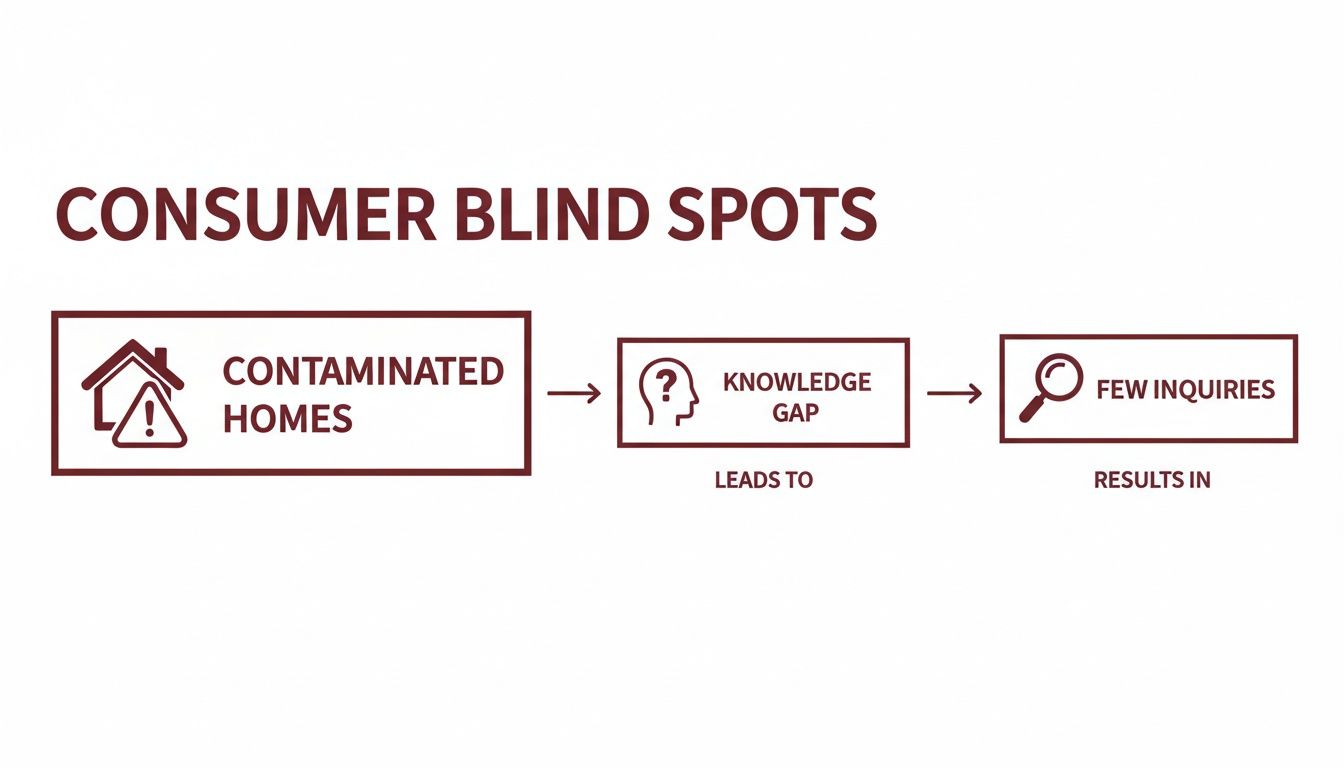
This dangerous cycle means countless contaminated properties likely go unnoticed and unaddressed, simply because people don’t know to look for the problem in the first place.
From Invisible Residue to Real-World Health Crises
The health impact of this constant, low-level exposure is very real and has been well-documented. It's not just an abstract number on a lab report; it translates into genuine, often debilitating, health issues for families who have no idea their home is making them sick.
A powerful Australian study of 25 case studies brings this to life. Researchers documented 63 individuals, including many children, who unknowingly lived in contaminated homes. They suffered from severe health problems even when residue levels were near the national guideline.
Reported symptoms ranged from behavioural issues and sleep disturbances to respiratory problems, relentless skin and eye irritations, and chronic headaches—all triggered by environmental meth levels as low as 0.5 μg/100 cm².
These aren't just minor annoyances. Think of a child who suddenly develops unexplainable behavioural problems, a baby with an angry, persistent rash that no cream can soothe, or an entire family suffering from coughs and breathing issues that doctors can't diagnose.
Because the source of the problem is invisible, these symptoms are often chalked up to allergies, common viruses, or stress. This misdiagnosis allows the toxic exposure to continue, day in and day out.
Below is a summary of the kinds of symptoms that have been officially reported in medical and environmental studies.
Common Health Symptoms Linked to Third-Hand Meth Exposure
This table summarises health effects reported in individuals unknowingly living in meth-contaminated properties, categorised by system.
| Symptom Category | Reported Health Effects | Affected Groups |
|---|---|---|
| Neurological | Headaches, dizziness, confusion, anxiety, irritability, sleep disturbances, behavioural changes (especially in children) | Adults, Children |
| Respiratory | Persistent coughing, shortness of breath, asthma-like symptoms, bronchitis | Adults, Children |
| Dermatological | Skin rashes, chemical burns (in high concentrations), eye irritation, sore or red eyes | Adults, Children, Pets |
| General/Systemic | Nausea, vomiting, abdominal pain, kidney and liver issues, compromised immune function | Adults, Children |
These symptoms highlight just how varied and widespread the impacts of chronic exposure can be, often mimicking other common illnesses.
The real danger lies in the chronicity of the exposure. When you live in a contaminated home, your body never gets a break. It’s a constant toxic load that leads to an accumulation of health problems over time.
Understanding this direct link between an invisible residue and a severe illness is vital. It shifts meth contamination from being a distant crime-related issue to what it really is: an immediate public health crisis affecting everyday Australian families.
To learn more about how these signs can present, check out our guide on identifying third-hand meth exposure symptoms in children and pets. This knowledge is the first step in bridging the awareness gap and empowering yourself to recognise the risks.
Navigating Australia's Messy Regulations and Safety Standards
With such a clear gap between the real dangers of meth contamination and what the public knows, you have to ask: why isn't this problem being handled better? The answer, unfortunately, is a messy and often contradictory web of regulations that leaves everyday people exposed. We don't have a single, consistent national standard, which means families are forced to figure out a patchwork of rules that can change dramatically from one state to the next, or even between local councils.
This inconsistency creates a dangerous false sense of security. A house that gets a "pass" in one state could easily fail safety checks just across the border. It’s a perfect example of how there's no reliable, universal safety net for Australian families. Without clear, enforceable laws at the federal level, the responsibility—and the risk—is pushed onto individuals to figure it all out for themselves.
What Is Australia's "Safe" Level for Meth Contamination?
At the heart of Australia's approach is the national guideline: 0.5 micrograms (μg) per 100 square centimetres (cm²). This number represents the maximum acceptable level of meth residue left on a surface after a property has been professionally cleaned and decontaminated.
It’s a tiny measurement, so let's put it in perspective. A single grain of salt weighs about 50,000 micrograms. The guideline allows for just 0.5 µg—a completely invisible trace—spread over an area the size of a drink coaster (10cm x 10cm). This really drives home just how potent and stubborn meth residue is, and why the clean-up standard has to be so strict.
But here’s the crucial thing to understand: this guideline isn't a magic number that guarantees zero risk. Recent studies have shown that people, especially children, can suffer serious health effects in homes with contamination at or even below this supposedly "safe" threshold.
This means a property can tick the official box for compliance but still be a genuine health hazard for the people living inside. It’s a stark reminder that hitting the guideline is the absolute bare minimum, not the final word on whether a home is truly safe.
A Patchwork of State and Local Rules
The biggest problem is that the national guideline is just that—a guideline. It’s not legally binding everywhere, which has led to huge differences in how it's applied across the country. Some states have written it into their public health laws, but others haven't. This creates a confusing maze for property owners and renters to navigate.
This fractured system causes some serious problems:
- Unequal Protection: A family in one state might have strong legal protections and clear rules for clean-up, while a family in a neighbouring state has virtually none.
- Gaps in Enforcement: Even where rules do exist, local councils often don't have the funding, training, or specific power to enforce them effectively.
- Confusion for Industry Professionals: Without clear, binding regulations, the responsibilities of real estate agents, property managers, and even remediation companies can become murky.
This lack of consistency is a major reason why the consumer knowledge gaps regarding residential meth hazards are so wide. When the authorities can't send a unified message or enforce consistent rules, how can we expect the public to understand the true scale of the risk?
When a formal clean-up is actually triggered, the process involves testing, decontamination by specialised cleaners, and a final round of testing to prove the residue is below the 0.5 μg/100 cm² limit. But trying to manage this process without an expert is incredibly difficult. It means deciphering complex lab reports and, most importantly, understanding that "compliant" doesn't always mean "safe." To truly close the safety gap left by inconsistent standards, you need to go beyond technical compliance and get independent, expert advice.
How a Home Meth Lab Becomes a Workplace Problem
It's easy to think of meth contamination as a problem that stays behind the closed doors of a private home. But the reality is, this hidden danger frequently spills over into the workplace, creating serious, and often completely unexpected, liabilities for Australian businesses.
The risks are especially high for industries that provide worker housing, manage big property portfolios, or operate on remote sites. This is where the gap in public awareness about meth hazards becomes a real failure in corporate risk management. A company's duty of care doesn't just stop at the end of the workday, not when they're responsible for the roof over an employee's head. That legal and moral obligation means making sure those living spaces are safe from every foreseeable hazard—and that includes chemical contamination.
The potential for exposure is far more common than most organisations think. If meth contamination is found in a company-provided home, the employer can be on the hook for everything from employee health problems to lost productivity and all the costs that come with it.
Where the Risk is Highest: Real-World Scenarios
Some industries are naturally more exposed to these crossover risks simply because of how they operate. When they don't take action, the fallout can hit both their people and their bottom line hard.
Just think about these very real situations:
- Mining and Resources: A mining outfit puts its fly-in-fly-out (FIFO) crew up in a set of local rental units. If one of those places was previously used by a meth smoker, the new workers are being unknowingly exposed to toxic residue day in and day out. Before long, people start getting sick, and absenteeism spikes with no obvious explanation.
- Construction: A building firm moves onto a site that's been sitting empty, a magnet for squatters who were using meth inside. When demolition or renovation crews go in, they’re walking into a highly contaminated environment without the right personal protective equipment (PPE). What was a residential issue has just become a direct workplace health and safety incident.
- Property Management: A real estate agency with a large rental portfolio doesn't bother testing for meth between tenants. They move a young family into a contaminated house, and it's only after the family starts experiencing health issues that the cause is discovered. Now, they're facing legal action for negligence from both the tenants and the property owner.
In every one of these examples, the failure to check for meth in a residential property created a massive industrial or corporate liability.
It's Time to Shift from Cleanup to Due Diligence
For any business in these sectors, tackling this problem means changing how you think about it. Meth testing isn't some fringe expense you only consider when you suspect a problem. It needs to be a standard part of your business operations—a crucial piece of corporate due diligence and risk management.
Proactive testing isn't just a safety precaution. It's a core business strategy that protects your people, your assets, and your reputation. One incident can trigger expensive lawsuits, hefty regulatory fines, and destroy the public's trust in your company.
Taking this proactive approach shows a genuine commitment to your team's welfare that goes far beyond just ticking a compliance box. It marks the company as a responsible employer that puts its people's health and safety first. Having a solid policy for contamination testing is one of the most powerful things you can do to shut down legal and financial risks before they ever get a chance to grow.
Why an Occupational Hygienist is Your Best Defence
This is exactly where the skills of an occupational hygienist become essential. These are the professionals who bring the scientific rigour needed to stop guessing and start managing the risk properly. Their entire job is to identify, evaluate, and control workplace hazards, and that expertise is perfectly suited to assessing residential properties under a company's care.
Bringing in an occupational hygienist gives you a few key advantages:
- Accurate Risk Assessment: They can build a testing plan that’s tailored specifically to your properties or worksites, making sure the data you get is reliable.
- Clear, Actionable Advice: They take complex lab reports and translate them into plain English, explaining what the numbers actually mean for your employees' health and your company's liability.
- Certainty of Safety: If a property needs to be decontaminated, a hygienist can perform clearance testing afterwards to verify that it is genuinely safe for people to live in again.
By working with experts from a trusted provider like Anitech, businesses can get on top of these hidden risks with confidence. It's the only way to be sure you're meeting your duty of care and protecting your most important asset: your people.
Your Proactive Guide to Ensuring a Safe Environment
Understanding that meth contamination is a real risk is the first hurdle. But knowing is only half the battle; taking decisive action is what truly keeps you, your family, or your employees safe. Now that you're aware of the common blind spots, you can move from a reactive position to a proactive one. It’s all about knowing what to look for, what questions to ask, and when it's time to call in an expert.
This guide gives you a practical roadmap to confirm a property is safe, whether it’s your potential new home or a business asset you manage.
A Checklist for Homebuyers and Renters
Meth residue is completely invisible. You simply can't rely on a standard visual inspection to spot it. Your due diligence needs to be focused on asking the right questions and demanding proof before you sign on the dotted line.
- Ask the Real Estate Agent Directly: Be blunt. Ask things like, "Has this property ever been tested for methamphetamine contamination?" and "Are you aware of any history of drug activity here?" Get their answers in writing if you can.
- Request Disclosure Documents: Ask for any property history reports that might flag prior issues, such as police call-outs or previous decontamination work.
- Make Testing a Condition of Sale: This is your most powerful tool. Make your offer to buy or rent conditional on a professional meth contamination test. It's a small investment for complete peace of mind.
Taking these steps is the best way to overcome the survey data: consumer knowledge gaps regarding residential meth hazards that leave so many people exposed.
Risk Management for Businesses and Property Managers
For anyone managing properties, protecting your assets and the people inside them demands a formal policy. A straightforward risk management framework isn't just good practice—it's a vital part of your duty of care and protects you from massive liability.
Your policy should lay out a clear, repeatable process for handling properties, especially during tenant changeovers or when preparing a space for employees.
- Screening and History Checks: Build questions about a property’s known history into your standard tenant or acquisition checklists.
- Baseline Testing: Test properties between tenancies as a rule. This establishes a clean baseline and protects you from inheriting a problem.
- Mandatory Clearance: If a property needs decontamination, always get a post-remediation clearance certificate from a qualified professional. No exceptions.
- Employee Education: Make sure your team understands the risks and knows the company’s policy for managing them.
A framework like this turns safety from an afterthought into a non-negotiable part of your operations.
The Essential Role of an Occupational Hygienist
Trying to navigate this complex issue on your own is a recipe for disaster. An occupational hygienist is the only professional truly qualified to give you the certainty you need. Their expertise isn't just helpful; it's indispensable.
An occupational hygienist provides independent, scientific verification. They don't just find problems; they confirm solutions, ensuring that a property is not just legally compliant but genuinely safe for human habitation.
Here’s why they are so critical:
- Accurate Assessment: They use scientifically valid methods to conduct reliable testing, not just DIY kits.
- Interpreting Lab Results: They can translate a complex lab report into a clear, understandable risk assessment.
- Verifying Remediation: They provide the final sign-off, confirming that a clean-up job has actually eliminated the hazard.
Bringing in an expert is the only way to truly close the gap between being aware of the risk and being absolutely certain of your safety. Ultimately, moving from uncertainty to confidence requires you to be proactive and to trust the guidance of a qualified professional.
Common Questions About Meth Contamination
We've seen a lot of confusion from homeowners, renters, and property managers about meth contamination. To help clear things up, let's walk through some of the questions we hear most often.
How Can I Tell If a Property Is Contaminated?
Here’s the hard truth: you can't. Methamphetamine residue is completely invisible and has no smell, so you can't rely on your own senses to detect it.
Sometimes you get lucky and see obvious red flags from a former drug lab, like chemical stains or weird ventilation systems. But the contamination left behind from just smoking meth is far more subtle—it leaves absolutely no visible trace.
The only way to know for certain is to bring in a qualified occupational hygienist. They have the right equipment to take surface samples and send them to a lab for proper analysis.
Is Contamination From Smoking Meth Dangerous?
Absolutely. It's a different kind of risk than a full-blown meth lab, but it's just as serious. Labs create explosive, highly concentrated chemical hazards. Smoking, on the other hand, deposits a fine, potent layer of crystalline residue on every single surface in a home.
This creates what we call "third-hand" exposure, which is a significant long-term health risk, especially for young children. This invisible residue gets stirred up into the air, ingested when someone touches a surface and then their mouth, or absorbed through the skin. Over time, that constant, low-level exposure can lead to chronic illness.
What Does the 0.5 µg/100 cm² Guideline Mean?
This number—0.5 micrograms per 100 square centimetres—is the official Australian guideline. It represents the maximum acceptable level of meth residue on a 10cm by 10cm surface after a property has been professionally cleaned. Think of it as a health-based safety benchmark.
But here’s something crucial to understand: scientific case studies have found people suffering serious health problems in homes with contamination at or even below this level. This really drives home the point that the goal shouldn't be to just scrape by under the guideline. The real aim should always be to get the contamination down to the lowest detectable level possible.
Does a Standard Building Inspection Cover Meth Testing?
No, it doesn't. This is probably one of the biggest and most dangerous misconceptions out there. A standard pre-purchase building and pest inspection is purely visual. The inspector is looking for structural issues, termites, and visible defects—not invisible chemical hazards.
This knowledge gap leaves countless buyers and renters with a completely false sense of security. If you want to know if a property is truly safe from this hidden danger, you must commission a separate meth contamination assessment from a qualified professional.
At Anitech, our expert occupational hygienists provide the scientific certainty you need to protect your family or your business. We offer comprehensive testing and clear, actionable advice to ensure your environment is safe. Contact us today to learn more about our services.


