
Quick Summary: Specialised cleaning agents are essential for high-level methamphetamine neutralisation. Unlike standard cleaners, these professional chemical solutions are scientifically formulated to break down and destroy toxic meth molecules. This guide covers the chemistry of decontamination, how to select the right agent for different surfaces, and the critical importance of professional remediation strategies to ensure workplace safety and meet Australian regulatory standards.
Specialised cleaning agents are much more than just heavy-duty soaps. They are engineered chemical solutions designed to find, break down, and completely eliminate toxic methamphetamine residues—not just smear them around. For ensuring a workplace is truly safe after high-level exposure, these professional-grade formulas are absolutely critical. Standard cleaning products are powerless against the stubborn, invisible contamination left by meth, making professional meth decontamination & remediation strategies the only viable solution.
Why Professional Meth Decontamination is Non-Negotiable
The presence of methamphetamine in Australian workplaces is a growing and often hidden danger. It’s not just about clandestine labs; contamination can easily spread from an employee's clothing or personal items, leaving a trail of hazardous residue on machinery, office furniture, and shared surfaces. This kind of "third-hand" exposure puts the entire workforce at risk from hazardous chemicals.
For industries where safety is everything—think manufacturing, mining, and transport—this is a risk you simply can't afford to ignore. The fallout from undetected meth residue goes far beyond employee health. It can trigger operational shutdowns, create serious legal liabilities, and permanently tarnish a company's reputation. Your regular cleaning crew just isn't equipped to tackle this kind of chemical hazard, necessitating the use of specialised cleaning agents for high-level methamphetamine neutralisation.
The Alarming Scale of Meth in Aussie Workplaces
The data from workplace drug testing across Australia paints a stark picture, with methamphetamine standing out as a major concern. In one recent analysis, amphetamine-type substances (ATS) were found in a staggering 53.2% of all positive tests.
This isn't a problem confined to one sector. High-risk industries are feeling the impact, with significant detection rates in construction (5.4%), transport (5.4%), and even hospitality (9.5%). For a business owner, this means that even a tiny amount of contamination from an employee can leave residues on surfaces that far exceed safe levels. This is where specialised cleaning agents become essential, as they are proven to bring contamination levels below the Australian guideline of 0.5 µg/100 cm². You can dive deeper into the findings of a workplace drug prevalence study to see the full scope of the issue.
Why Your Standard Cleaners Just Won't Cut It
Trying to tackle meth residue with off-the-shelf products like bleach or all-purpose sprays is not only a waste of time—it's dangerous. They fail on every critical level.
Here’s a look at why standard cleaners and specialised agents are worlds apart.
Standard Cleaners vs Specialised Meth Neutralisation Agents
| Feature | Standard Cleaners (e.g., Bleach, Detergents) | Specialised Meth Neutralisation Agents |
|---|---|---|
| Mechanism of Action | Lifts and smears surface-level dirt and grime. | Initiates a chemical reaction that breaks down the methamphetamine molecule into non-toxic by-products. |
| Efficacy on Meth Residue | Ineffective. Does not neutralise the toxic chemical structure. | Highly effective. Proven to reduce contamination below the Australian safety guideline of 0.5 µg/100 cm². |
| Penetration of Surfaces | Cannot penetrate porous materials like wood, concrete, or drywall where meth residue hides. | Formulated with surfactants that allow the agent to seep into porous surfaces and reach embedded contamination. |
| Risk of Cross-Contamination | High risk. Wiping can aerosolise toxic particles, spreading them into the air and HVAC systems. | Low risk. The chemical reaction neutralises the hazard at the source, preventing it from becoming airborne. |
| Safety Outcome | Leaves a false sense of security while the toxic hazard remains active and can even be spread further. | Renders the area genuinely safe by chemically dismantling the harmful compounds. |
As you can see, the difference is night and day. Standard cleaners might make a surface look clean, but the invisible danger remains.
True decontamination isn't about wiping something away; it's about a chemical reaction that completely dismantles the meth molecule. Specialised agents are formulated to do just that, breaking the hazardous compounds down into harmless by-products like water and carbon dioxide. Only then can an environment be considered genuinely safe.
Ultimately, tackling this complex issue requires a scientific approach. It all starts with understanding the unique challenges meth residue presents and accepting that only professional-grade solutions can deliver the safety and compliance your workplace needs.
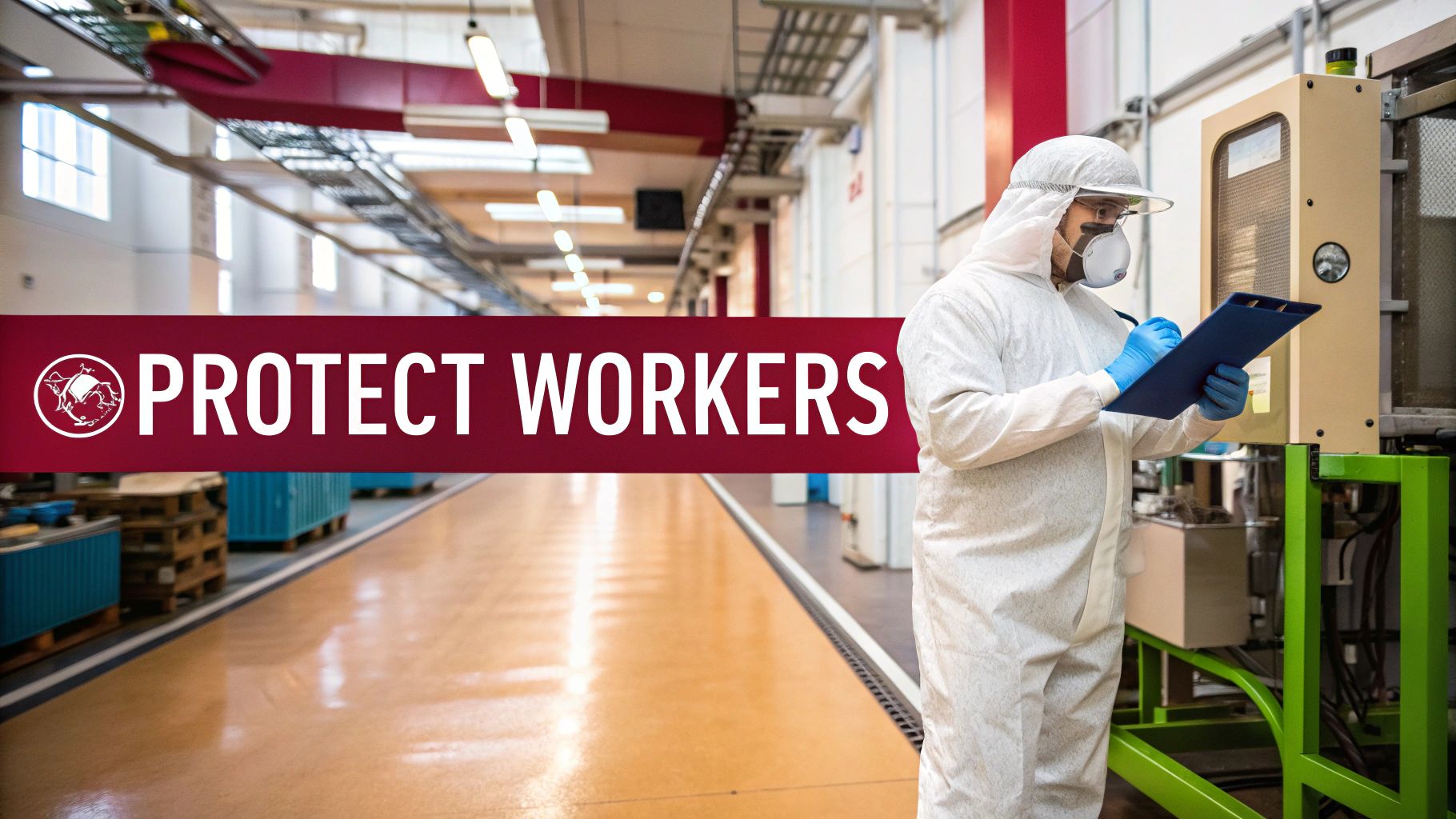
Understanding How Meth Contamination Spreads
To really get why we need specialised cleaning agents for high-level methamphetamine neutralisation, you first have to understand the contamination itself. This isn't like dealing with everyday dirt or grime. Meth residue is a stubborn, pervasive chemical hazard, and it behaves in ways that your standard cleaning playbook simply can’t handle.
Think of it like an invisible, sticky film that latches onto every single surface it comes across. When meth is smoked or manufactured, it doesn't just vanish into thin air. It turns into a vapour, a lot like smoke from a fire, and drifts everywhere.
As that vapour cools down, it deposits a layer of microscopic, oily particles on everything. It doesn't discriminate. This is how you end up with an insidious and widespread contamination zone.
The Science of Airborne Contamination
The particles produced when meth is used are incredibly tiny, so they can hang around in the air for a long, long time. This airborne quality is what makes the contamination so tricky to pin down. It’s not just settling on the floor or one workbench; it's coating entire rooms from top to bottom.
This process means the residue gets into places you’d never even think to clean:
- Porous Surfaces: Materials like concrete, wood, plasterboard, and fabrics are like sponges. They just soak the residue deep into their structure.
- HVAC Systems: Your air conditioning and ventilation systems become superhighways for contamination, sucking in tainted air and circulating it through the whole building.
- Hidden Areas: The residue settles inside machinery, gets behind wall panels, sits on top of ceiling tiles, and even finds its way into electrical conduits. These spots become hidden reservoirs of toxicity.
The real kicker is its persistence. Methamphetamine residue doesn't just break down or evaporate on its own. It chemically bonds to surfaces on a molecular level and can stay there as a toxic threat for years unless it's chemically dismantled.
The Invisible Threat of Third-Hand Exposure
This lingering contamination creates a serious health risk we call third-hand exposure. It happens when people touch contaminated surfaces long after any drug activity has stopped. They can absorb the toxins through their skin or breathe in particles that get kicked back up into the air.
In an industrial or commercial space, this is a direct threat to unsuspecting staff. Everyday workplace activities can easily lead to exposure. A worker might lean against a contaminated wall or handle a piece of equipment, transferring the residue onto their hands and clothes without ever knowing.
The health effects of this long-term, low-level exposure can be serious, leading to issues like:
- Respiratory problems, such as a persistent cough or shortness of breath.
- Skin and eye irritation, including rashes and even chemical burns.
- Neurological symptoms, like headaches, dizziness, and confusion.
Children are particularly vulnerable, which is a massive concern if employees are accidentally taking these residues home on their work gear.
Why Surface Wiping Just Doesn't Cut It
Once you understand how the contamination spreads, it’s easy to see why just wiping a surface is a complete waste of time. Standard cleaning might get rid of the very top layer of grime, but it does absolutely nothing to break the chemical bonds holding the contamination in place. In fact, aggressive scrubbing can make things worse by dislodging toxic particles, flinging them back into the air, and spreading the problem even further.
This is exactly why we need a specific chemical approach. Proper remediation isn't about cleaning in the traditional sense; it’s about neutralisation. It demands specialised agents designed to get deep into porous materials, hunt down the meth molecules, and trigger a chemical reaction that shatters them into harmless, non-toxic substances. Only this kind of scientific intervention can guarantee a worksite is brought back to a verifiably safe state, protecting your people and your business.
The Chemistry of Professional Cleaning: Neutralising Methamphetamine Residue
To get a real grip on what makes specialised cleaning agents for high-level methamphetamine neutralisation work, we need to dive into the chemistry. Your average cleaning product just won't cut it. Why? Because they're designed to wipe away surface-level dirt, but meth residue is a stubborn chemical contaminant that bonds to surfaces. Proper remediation isn't about more elbow grease; it's about kicking off a specific chemical reaction to dismantle the hazardous molecules for good.
Think of it like a lock and key. The methamphetamine molecule is the lock. The specialised agent is the precision-engineered key, shaped to fit inside, break it apart, and render it completely harmless. This is the science that professional remediation teams rely on to guarantee a property is truly safe, not just looking clean.

Unlocking Contaminants with Alkaline Solutions
One of the first tools out of the bag for professional meth decontamination is a powerful alkaline-based solution. These agents are masters at breaking the physical bond between the sticky, oily meth residue and the surface it’s clinging to. It’s a bit like trying to wash greasy hands with plain water—you don’t get very far.
Alkaline agents act like a heavy-duty soap in this scenario. They’re packed with surfactants, special compounds that get between the oily residue and the surface. This action allows the cleaning agent to lift the contamination away and hold it in suspension, so it can be physically removed without just smearing it around.
But simply lifting the residue isn’t the whole story. The best alkaline formulas also start breaking down the meth molecule's structure, setting the stage for its complete destruction. This is a crucial first step, particularly on non-porous surfaces like stainless steel or sealed benchtops.
Chemically Shattering Molecules with Oxidising Agents
For a much deeper and permanent clean—especially in porous materials like plasterboard, timber, and concrete—professionals bring in the heavy hitters: powerful oxidising agents. This isn't just about lifting anymore; it's about chemically shattering the methamphetamine molecule itself. This is where true high-level methamphetamine neutralisation happens.
Oxidising agents are highly reactive chemicals that kick off a process called oxidation-reduction (or redox). In simple terms, the agent aggressively “steals” electrons from the meth molecule. This theft destabilises the molecule's entire chemical structure, causing it to literally fall apart.
This chemical reaction is irreversible. The methamphetamine molecule is permanently converted into harmless, non-toxic byproducts—usually just carbon dioxide, water, and simple salts. This isn’t cleaning; it’s a permanent chemical transformation.
This process ensures there's zero chance of the hazardous residue re-emerging or remaining active deep within a material. It’s the only method that can meet Australia’s stringent regulatory standards and allow a facility to be declared safe for re-entry, free from any lingering health risks.
The Importance of Dwell Time and Reaction
One of the most critical parts of any professional remediation strategy is dwell time. This is simply the amount of time a specialised agent needs to sit on a surface to let the chemical reaction run its course. It’s definitely not an instant process.
Rushing this step and wiping the agent off too soon is like putting a key in a lock but not turning it all the way. The chemical neutralisation will be incomplete, leaving active meth residue behind.
Professional technicians carefully calculate the right dwell time based on a few key factors:
- The agent being used: Oxidising agents typically need more time to work their magic than alkaline solutions.
- The surface material: Porous materials like concrete need a longer dwell time to allow the agent to soak in and reach embedded contaminants.
- The level of contamination: A heavily contaminated area will require a longer reaction time to ensure every last molecule is neutralised.
This meticulous, science-first approach is what separates professional decontamination from any other cleaning attempt. It’s a deliberate process of chemical destruction that delivers verifiable results. For businesses needing these services, understanding the scientific rigour involved is key. You can find out more about certified experts through the Australian Occupational Hygiene Society (AIOH).
Choosing the Right Decontamination Agent
Picking the right specialised cleaning agent for high-level methamphetamine neutralisation isn't as simple as grabbing a bottle off the shelf. Think of it less like cleaning and more like chemical surgery. The success of any professional clean-up rests entirely on matching the chemical formula to the specific mess you're facing. Get it wrong, and you could be looking at an incomplete decontamination, damaged equipment, or a much longer shutdown than you planned for.
Experienced remediation teams don't guess. They analyse the situation from every angle to develop a targeted chemical attack plan. This ensures they don't just break down the hazardous meth residues but also protect the workplace itself.
Matching the Agent to the Surface Material
The first question is always: what are we cleaning? Different materials react to chemicals in completely different ways. What works perfectly on one surface could destroy another.
- Porous Surfaces: Things like unsealed concrete, brick, timber, and plasterboard are like sponges. They soak up meth residues deep inside, making them tough to treat. For these, you need a product with high-penetration surfactants and a powerful oxidising punch. It has to sit for a while, giving it enough time to seep in and neutralise the contamination that’s trapped below the surface.
- Non-Porous Surfaces: On the other hand, surfaces like stainless steel, glass, and sealed benchtops keep the contamination right on top. Here, a strong alkaline-based solution is usually the ticket. It’s excellent at lifting and breaking down the residue without needing to go deep.
- Sensitive and High-Value Surfaces: This is where things get tricky. In high-tech environments like pharmaceutical labs or aerospace manufacturing, you’re dealing with sensitive alloys and specialised plastics. Using the wrong chemical could etch, discolour, or weaken incredibly expensive machinery. In these cases, a non-corrosive, pH-neutral, or specially formulated agent is non-negotiable.
Assessing Contamination Levels and Required Downtime
How bad is the contamination? This directly dictates the strength and type of agent needed. A property with heavy meth smoking residue presents a different chemical challenge than a workshop exposed to airborne particles from a nearby lab.
In Australia, meth contamination from smoke is a significant public health risk. We've seen surface readings anywhere from 0.52 to 49 µg/100 cm², which absolutely dwarfs the Health Investigation Level (HIL) of 0.5 µg/100 cm². Workers can unknowingly carry this contamination into industrial sites on their clothes, spreading the exposure risk far and wide. To get on top of this, you need specialised agents—often alkaline-based formulas with oxidising power—that can dismantle the stubborn residues that standard cleaners simply can't touch. This is essential for meeting Australian safety guidelines. For a deeper dive, you can explore the technical details of meth smoke contamination and its public health implications.
You also have to factor in the business's operational clock. Some agents need to sit for a long time or require extensive rinsing, which means more downtime. For a busy manufacturing plant, a fast-acting formula might be the top priority to keep disruption to a minimum, even if it’s more expensive.
The goal is to strike a perfect balance: achieving complete neutralisation below the legal safety limit while protecting physical assets and respecting the operational clock of the business. This decision-making process is a core part of a professional occupational hygienist's expertise.
Navigating Specialised Industrial Requirements
Some industries have their own unique set of rules that heavily influence which agent you can use. The decision goes way beyond just surface compatibility and moves into the world of strict regulations and operational standards.
Just think about these scenarios:
- Food and Beverage: Any agent used has to be food-grade safe, or at the very least, be able to be rinsed off completely, leaving zero chemical traces behind that could find their way into products.
- Pharmaceuticals: In sterile labs, the cleaning agent can't just decontaminate. It also has to leave absolutely no residue that could mess with sensitive experiments or compromise the purity of a drug.
- Aerospace: Here, agents must be certified as non-corrosive and proven not to weaken the structural metals or composite materials used in aircraft.
Ultimately, choosing the right decontamination agent is a methodical, science-backed process. By carefully weighing up the surface material, contamination level, and specific industry needs, facility managers can work hand-in-glove with remediation experts to ensure the job is done safely, properly, and efficiently.
Safe Application and Verification Protocols
Having the right specialised cleaning agents for high-level methamphetamine neutralisation is one thing, but how they're used is what truly matters. The success of any decontamination job hangs on the precision and safety of the application process. Think of it like a surgical procedure: the best tools are useless without the skill and steady hand of the surgeon. Professional remediation isn't just a clean-up; it's a systematic operation designed to eliminate every trace of the hazard while keeping everyone safe.
This isn't about simply spraying a chemical around. It’s a meticulous process that involves careful containment, calculated application, and, most importantly, scientific proof that the job is done right. Every step is guided by strict protocols to ensure the outcome is both effective and safe from start to finish.
This flow diagram breaks down the fundamental stages of a professional decontamination project.

As you can see, every successful project starts with a deep dive into the level of contamination. From there, the right agent is chosen for the specific surfaces involved, and the entire process is wrapped in robust protective measures.
Essential Personal Protective Equipment
Before a single drop of a cleaning agent touches a surface, the safety of the remediation technicians is paramount. These chemical solutions are potent, and comprehensive Personal Protective Equipment (PPE) is non-negotiable. We're not talking about a simple pair of gloves and a dust mask; this is a full-body barrier against serious chemical and particulate hazards.
Standard PPE for meth decontamination is serious business and includes:
- Full-Face Respirators: These must be fitted with specific cartridges capable of filtering out both chemical vapours and airborne methamphetamine particles.
- Chemical-Resistant Suits: Typically disposable, these suits create an impermeable shield, preventing any skin contact with hazardous materials.
- Heavy-Duty Gloves: Usually nitrile or butyl, the gloves are securely taped at the wrists to form a complete seal with the suit.
- Safety Goggles and Foot Coverings: These complete the armour, ensuring no part of the body is left exposed to accidental splashes or aerosolised contaminants.
The Professional Remediation Methodology
Once the technicians are properly kitted out, the methodical work of decontamination can begin. This step-by-step approach ensures nothing is missed and prevents any risk of cross-contaminating clean areas.
- Initial Assessment and Containment: First, the contaminated area is identified and completely sealed off from the rest of the building. This is done using heavy-duty plastic sheeting and negative air pressure machines, which create a controlled environment and stop hazardous particles from escaping.
- Agent Application: The technique used depends entirely on the surface and the level of contamination. Professionals might use direct spraying for easy-to-reach surfaces, foaming applications that cling to walls for a longer reaction time, or even ultra-low volume (ULV) fogging to treat entire rooms and get into every nook and cranny.
- Sufficient Dwell Time: This is where patience pays off. The cleaning agent is left to sit on the surfaces for a specific period. This "dwell time" is critical, as it allows the chemical reactions to fully break down and neutralise the methamphetamine molecules.
- Rinsing and Removal: After the agent has done its job, all surfaces are thoroughly rinsed with clean water or a neutralising solution. All waste, from used PPE to contaminated building materials, is then carefully bagged, sealed, and disposed of according to strict biohazard regulations.
Professional decontamination is an evidence-based science. It’s not considered "done" until independent, lab-verified testing confirms the environment is safe. This final step is the ultimate proof of a successful cleanup and is absolutely non-negotiable.
Post-Remediation Verification: The Ultimate Proof
The final and arguably most critical step is verification. How do you actually know the decontamination worked? You test it. Reputable remediation companies will take wipe samples from multiple locations throughout the treated area after the clean-up is complete.
These samples aren't tested on-site; they're sent to an independent, accredited laboratory for analysis. The lab is looking for one thing: to confirm that any remaining methamphetamine residue is well below the Australian National Guideline of 0.5 micrograms per 100 square centimetres (0.5 µg/100 cm²).
Here's a look at the common testing methods used in the industry.
Post-Remediation Verification Methods
| Testing Method | Description | Typical Use Case | Accuracy Level |
|---|---|---|---|
| Wipe Sampling (NIOSH 9111) | A standardised method where a defined area (usually 100 cm²) is wiped with a sterile gauze pad soaked in a solvent like methanol or isopropanol. | The gold standard for final clearance testing on non-porous surfaces like walls, floors, and benchtops. | High (Lab-based) |
| Bulk Sampling | A physical piece of a contaminated material (e.g., carpet, drywall) is collected and sent to the lab for analysis. | Used to determine the depth of contamination in porous materials or to test items for safe disposal. | High (Lab-based) |
| Air Sampling | Air is drawn through a special filter or cassette for a set period to capture airborne particles for lab analysis. | Less common for meth, but can be used to assess airborne particulate risk during the remediation process itself. | Moderate |
| Field Test Kits (Immunoassay) | On-site kits that use antibodies to provide a rapid, qualitative (yes/no) or semi-quantitative indication of meth presence. | Primarily for initial screening to quickly identify contaminated areas, not for final clearance. | Low to Moderate |
Only a clearance certificate based on high-accuracy lab results can provide the legal and scientific assurance that a property is truly safe to re-enter. This verification process is what protects business owners from liability and gives everyone peace of mind. For more details on environmental health standards, government resources like the Australian Department of Health are an excellent place to start.
Why You Need an Occupational Hygiene Professional
Trying to tackle high-level methamphetamine neutralisation on your own isn’t just a bad idea—it’s a genuinely dangerous one. Meth residue is stubborn, invisible, and completely resistant to standard cleaning products. It takes a deep understanding of chemistry to break it down, which is why this is a job strictly for trained professionals. This is not a DIY weekend project.
Bringing in a certified occupational hygiene professional is the only way to be certain the job is done safely and correctly from start to finish. These experts have the specialised knowledge in chemistry, toxicology, and regulatory compliance that’s absolutely essential for a high-stakes job like this. They don't just "clean" a surface; they scientifically dismantle a complex chemical hazard.
The Value of Certified Expertise
When you hire a professional hygienist, you're not just paying for labour—you're getting a systematic, science-backed strategy. Their role covers several crucial functions that are designed to protect your people and your business.
They're responsible for:
- Risk Assessment: Pinpointing the exact extent and severity of the contamination using scientific testing methods, not just guesswork.
- Agent Selection: Choosing the right specialised cleaning agents for high-level methamphetamine neutralisation based on the specific materials contaminated and the level of residue present.
- Safety Protocols: Establishing and enforcing strict safety measures, including proper containment of the area and the correct use of personal protective equipment (PPE).
- Verification: Coordinating independent, lab-based testing after the clean-up to provide legal, documented proof that the site is safe to re-enter.
Navigating the complex world of post-decontamination safety and environmental health regulations is a minefield. This is where an occupational hygiene professional becomes indispensable, especially when it comes to meeting stringent indoor environmental quality standards.
Engaging a certified expert isn't an expense; it's an investment in certainty. It provides assurance that your workplace is not just visibly clean but chemically safe, protecting your workforce and safeguarding your business against future liability.
For any business operating in a high-risk sector, being proactive is key. Partnering with an occupational hygiene professional for both assessment and remediation means you can protect your employees, stay compliant with regulations, and avoid the massive business disruptions a contamination event can cause.
Frequently Asked Questions
When you're dealing with something as serious as methamphetamine contamination, you need clear, straightforward answers. We've gathered some of the most common questions we hear from business owners and facility managers to help you understand what's involved in a high-level neutralisation.
Are These Specialised Agents Safe for All Surfaces?
That's a critical question. The short answer is no; not every agent works on every surface. It's all about matching the chemistry to the material.
Think of it this way: a powerful oxidising agent that works wonders on porous concrete could be a disaster for sensitive lab equipment or food-grade stainless steel, causing corrosion and permanent damage. This is precisely why a professional hygienist will always conduct a thorough assessment first. They'll select the right agent to neutralise the meth residue without destroying your assets.
How Long Does the Decontamination Process Actually Take?
The timeline can vary quite a bit, and it really comes down to three main things:
- Size of the Contaminated Area: A small room is a different ball game to an entire factory floor.
- Level of Contamination: Heavier contamination means chemicals need to dwell longer, and we might even need to apply them more than once.
- Surface Porosity: Porous materials like raw wood or plasterboard absorb contaminants deeper, so they take much more effort to clean than non-porous surfaces like sealed metal or glass.
For a typical industrial site, you could be looking at anywhere from a few days to over a week. That includes setting up containment, the cleaning itself, and the final verification testing to prove the job is done right.
What Is the Australian Safety Standard for Meth Residue?
In Australia, the line in the sand is 0.5 micrograms per 100 square centimetres (0.5 µg/100 cm²). If test results come back with anything higher than that, the area is considered unsafe for people to be in.
The entire goal of a professional decontamination project is to bring the residue levels down to well below this legal limit. We confirm this with independent lab testing after the cleaning is finished, giving you verifiable proof that the space is safe again.
This national standard isn't just a guideline; it's the benchmark that drives all professional remediation work and ensures a property is truly safe for re-entry.
Can We Just Clean It Up Ourselves?
Attempting a DIY clean-up of methamphetamine residue is not only incredibly dangerous but also completely ineffective. Your standard cleaning supplies just can't break down the toxic chemicals involved.
Worse, you could end up making the problem bigger. Trying to wipe it down without the right techniques can send microscopic meth particles airborne, spreading the contamination and putting everyone at a higher risk of exposure. High-level meth neutralisation is a hazmat job, plain and simple. It legally requires certified professionals, the correct chemical agents, and full personal protective equipment (PPE) to be done safely and correctly. Bringing in the experts isn't just a recommendation—it's essential for safety and compliance.
Ensuring your workplace is verifiably safe from methamphetamine contamination demands expert knowledge and scientifically proven methods. Anitech provides comprehensive occupational hygiene services, including risk assessment, remediation management, and clearance testing to protect your workforce and your business. For professional guidance on managing hazardous substance exposure, visit us at https://occhygiene.com.au.


