
Silica awareness training is more than just a course; it's a vital program designed to teach workers about the very real, and very severe, health risks of breathing in respirable crystalline silica (RCS) dust. It gives them the practical knowledge to spot, manage, and ultimately prevent exposure to this invisible hazard on the worksite. In high-risk Australian industries, this training is the front line in the fight against incurable diseases like silicosis.
Why Silica Awareness Training Is Non-Negotiable
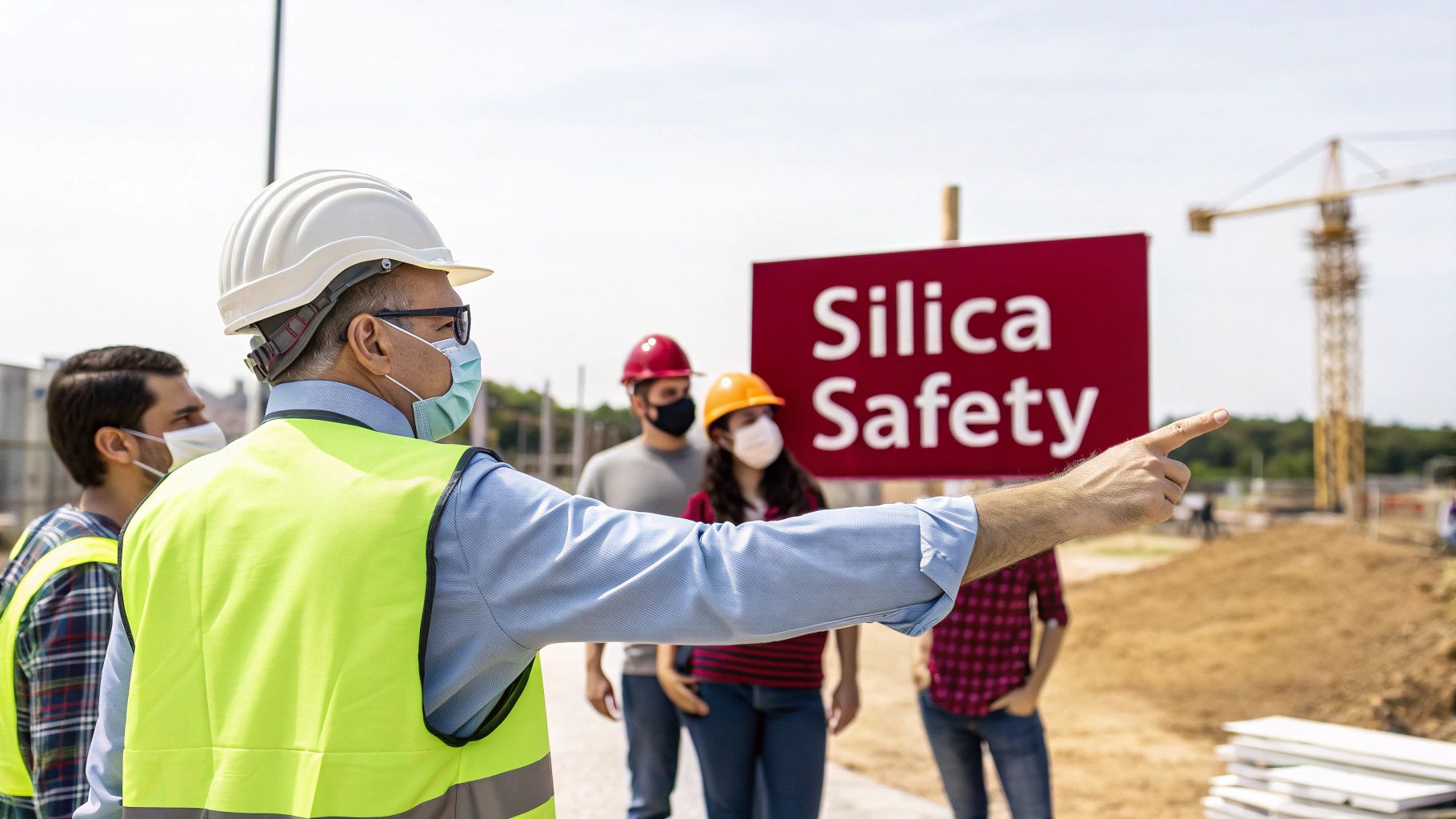
Picture a danger on your worksite that you can't see, smell, or taste. Yet, it has the power to cause a permanent and fatal lung disease. This isn't a hypothetical; it's the reality of respirable crystalline silica (RCS).
When you cut, grind, or drill common materials like concrete, stone, brick, or sand, you release microscopic dust particles. These particles are so fine they can be easily inhaled, travelling deep into the lungs where they settle and cause devastating damage.
This isn't just ordinary dust. Over time, it leads to irreversible scarring of the lung tissue—a deadly condition called silicosis. As the scarring gets worse, it becomes harder and harder to breathe, often leading to severe disability and death. There is no cure. Prevention is the only option.
The Role of Proactive Education
This is exactly why silica awareness training is a non-negotiable part of modern workplace health and safety. It's not about ticking a compliance box; it's a fundamental tool for saving lives. Proper training gives workers the power to protect themselves and their mates from this insidious threat.
A good training program will arm your team with practical, life-saving skills, including:
- Spotting high-risk materials commonly used in construction, mining, and stonemasonry.
- Understanding the health consequences of silica exposure, from silicosis and lung cancer to chronic obstructive pulmonary disease (COPD).
- Using critical safety controls correctly, like wet cutting methods, on-tool dust extraction, and the proper selection and use of personal protective equipment (PPE).
By investing in this kind of education, you're building a genuine safety culture where everyone understands the why behind the rules. They learn to see the invisible danger and respect the procedures put in place to control it.
This proactive approach is about much more than just meeting your legal duties. It's about fostering a work environment where every single person can go home safely at the end of the day. Knowledge turns compliance from a chore into a shared responsibility.
A Foundation for a Safer Workplace
Without this foundational knowledge, even the most expensive safety gear and well-written procedures can fail. Think about it: a worker who doesn't truly grasp how dangerous silica dust is will be less likely to wear their respirator correctly or take the time to ensure dust suppression systems are working properly.
Ultimately, silica awareness training is your first and most critical line of defence. It provides the "why" that makes every other safety measure stick. It's an investment in the long-term health of your people and the integrity of your business, ensuring that preventable tragedies stay that way—prevented.
The Health Risks of Silica Dust Exposure

To really grasp why silica awareness training is so critical, we first need to understand the true cost of exposure. When you cut, grind, or drill materials like concrete, stone, or brick, you release microscopic particles of respirable crystalline silica (RCS). These aren't just any dust particles. They're incredibly tiny—about 100 times smaller than a single grain of sand—which allows them to easily bypass your body's natural defences and travel deep into your lungs.
Once these particles are lodged in your lungs, they act like tiny, sharp shards of glass. Your immune system goes on the attack, trying to break them down, but it can't. This triggers a constant inflammatory response, leading to the formation of permanent scar tissue, or fibrosis, on your delicate lung tissue.
This progressive and irreversible scarring is the devastating reality of silicosis, a debilitating and often fatal lung disease. As more scar tissue builds, the lungs stiffen and lose their ability to expand properly, making it harder and harder to simply breathe. The real danger here is how slowly it all happens. Symptoms often don't show up for years, sometimes decades, lulling unprotected workers into a false sense of security.
The Different Faces of Silicosis
Silicosis isn't a one-size-fits-all disease. It can show up in different ways, depending on how much dust you've been exposed to and for how long. Knowing these variations helps paint a clearer picture of the risks workers face on site.
There are three main types of silicosis to be aware of:
- Chronic Silicosis: This is the most common form we see. It typically develops after 10 or more years of exposure to low or moderate levels of silica dust. The scarring happens gradually, and you might only notice symptoms like shortness of breath during exercise, which slowly gets worse.
- Accelerated Silicosis: As the name suggests, this version develops much faster, usually within 5 to 10 years of being around higher concentrations of silica dust. Here, the lung damage and symptoms progress far more rapidly.
- Acute Silicosis: This is the most severe and, thankfully, the rarest form. Acute silicosis can strike after just a few weeks or months of exposure to extremely high levels of silica dust. The lungs can fill with fluid, causing severe breathing difficulties and dangerously low oxygen levels. It can be fatal within months.
A Silent Epidemic with Lasting Consequences
The scale of the problem here in Australia is confronting. We know that historically, thousands of workers were exposed to unsafe levels of RCS. This has led to grim predictions of between 83,090 and 103,860 new silicosis cases emerging in the coming years, which really drives home the urgent need for better prevention and training.
With no cure for silicosis, our focus has to be squarely on prevention. This is where effective silica awareness training becomes a non-negotiable, life-saving tool. It gives workers the practical knowledge to spot the hazards and use the right controls to stop the dust at its source—before it ever gets into their lungs.
Silicosis isn't the only risk. Exposure to silica dust is also directly linked to an increased risk of lung cancer, chronic obstructive pulmonary disease (COPD), and kidney disease, making comprehensive safety protocols even more vital.
When someone develops a severe health condition like this, it often means they can no longer work. This is when they might need to look into options like a Total and Permanent Disability (TPD) claim. The devastating impact of these diseases goes far beyond the physical toll, affecting families, finances, and entire futures, which is why prevention is, and always will be, the only acceptable strategy.
A Guide to Australia's Silica Safety Regulations
When it comes to something as dangerous as silica dust, understanding your legal obligations is the absolute foundation of a safe worksite. Australia's Work Health and Safety (WHS) laws aren't just a set of guidelines; they create a legally binding framework for managing risks. Simply put, not knowing the rules is no excuse. This is about more than just avoiding hefty fines—it’s about your fundamental duty to keep your team safe.
The primary legal responsibility sits with the Person Conducting a Business or Undertaking (PCBU)—in most cases, that’s the employer. This duty is far-reaching, requiring you to do everything "reasonably practicable" to protect the health and safety of your workers. A huge part of that is providing the right information, instruction, and training, which is exactly where silica awareness training comes in.
The Role of Safe Work Australia
Safe Work Australia is the national body that sets the standard for WHS in the country. Their model Code of Practice: Managing the risks of respirable crystalline silica from engineered stone is a must-read document for anyone working with these materials.
While the model codes aren't laws in themselves, they hold serious weight. They can be presented in court as evidence of what's known about a hazard and what's considered a reasonable and practical way to control it. Following the Code is the most straightforward way to show you’re taking your legal duties seriously. It pushes for a proactive safety culture, moving far beyond the old "just wear a mask" mentality.
The entire safety framework rests on two key pillars that every PCBU needs to get right.
- Workplace Exposure Standards (WES): This is the legal limit for how much of a substance can be in the air. For respirable crystalline silica, the WES is incredibly low—just 0.05 mg/m³ averaged over an eight-hour shift. Why so low? Because the dust is that dangerous. Staying under this limit isn’t a goal; it's a legal requirement. You can dig deeper into the workplace exposure standard for respirable crystalline silica to see just how critical it is.
- The Hierarchy of Controls: Think of this as a step-by-step game plan for managing risks. It ranks safety measures from the most effective to the least, and the law requires you to start at the top and work your way down.
Understanding the Hierarchy of Controls
This isn't just a good idea; it's a mandated process. The entire point is to get rid of the hazard at the source, rather than just asking workers to protect themselves from it.
- Elimination: The best-case scenario. Can you get rid of the hazard completely? A perfect example is choosing a silica-free building material from the start.
- Substitution: If you can't eliminate it, can you swap it for something safer? This could mean using a product with a much lower silica content.
- Engineering Controls: Now we’re talking about physical changes to the work environment. Think on-tool dust extraction systems that vacuum up dust as it's made, or using water suppression (wet cutting) to keep dust out of the air.
- Administrative Controls: These are all about changing how people work. This includes things like job rotation to limit any one person's exposure time, scheduling dusty work when fewer people are around, and setting up strict exclusion zones.
- Personal Protective Equipment (PPE): This is your last line of defence, not your first. PPE, like correctly fitted respirators and safety glasses, should only be used after you've tried everything else higher up the list.
It’s critical to remember this: PPE is there to protect workers from the small amount of leftover dust that higher-level controls couldn't catch. If you’re relying only on masks, your safety system is failing, and you're directly violating the hierarchy of controls principle.
State and territory regulators like SafeWork NSW and WorkSafe Victoria are cracking down on this. They're out on sites conducting inspections, handing out on-the-spot fines, and issuing prohibition notices for non-compliance. The message from regulators is crystal clear: managing silica dust is non-negotiable, and solid training is the first real step to building a worksite that is both legally compliant and genuinely safe.
What a Comprehensive Training Program Should Cover
Let's be clear: not all silica awareness training is created equal. A tick-a-box course that just skims the surface won't cut it when people's health is on the line. A genuinely effective program gives your team the full picture—the 'what', the 'why', and the 'how'—so they can protect themselves and their mates on site.
Think of it as building a safety mindset from the ground up. You start with the fundamentals and then layer on practical skills, ensuring everyone, from the first-year apprentice to the site supervisor, knows exactly what they're dealing with and what to do about it. The aim isn't just to inform; it's to empower every single person to take an active role in workplace safety.
Laying the Groundwork: The Core Essentials
Every solid training program has to start with the basics. This isn't just background noise; it's the critical foundation for everything that follows. When your team understands why the rules exist, they're far more likely to follow them properly instead of just going through the motions.
A strong foundational module needs to cover:
- What Silica Actually Is: A straightforward explanation of crystalline silica, where it hides in common materials like concrete, bricks, and stone, and the crucial difference between nuisance dust and the invisible killer: respirable crystalline silica (RCS).
- The Unfiltered Health Risks: This part needs to be direct. We're talking about irreversible, life-altering diseases like silicosis, lung cancer, and chronic obstructive pulmonary disease (COPD). The training must drive home the sobering reality that these conditions have no cure.
- Who's Responsible for What: A clear rundown of Australian WHS laws, outlining the specific duties of the employer (PCBU) and the workers themselves. It’s vital everyone understands their legal and moral obligations to keep the site safe.
From Theory to Practice: Identifying and Assessing Risks on Site
Once everyone gets the "why," it’s time to focus on the "where" and "when." This is where the training moves out of the classroom and onto the worksite, teaching workers to develop a safety-first perspective. It's about learning to spot potential silica dust hazards before they ever become airborne.
This practical section should teach your crew how to:
- Spot Silica-Containing Materials: Good training uses real-world examples and clear visuals to help workers instantly recognise materials like engineered stone, mortar, tiles, and asphalt that pack a silica punch.
- Read a Safety Data Sheet (SDS): It's a non-negotiable skill. Workers need to know how to find an SDS for any product, pinpoint the silica content, and understand the recommended safety measures.
- Pinpoint High-Risk Tasks: The program must shine a spotlight on the jobs that generate the most dangerous dust—think cutting, grinding, drilling, jackhammering, and abrasive blasting.
It's crucial to understand just how widespread this issue is. Here in Australia, an estimated 100,000 workers are exposed to silica dust every year, with the construction, mining, and engineered stone industries being the hardest hit. This stark figure highlights why proper silica awareness training isn't just a good idea—it's an essential defence to help workers learn about silica training requirements and course recognition online.
Putting a Lid on It: Implementing Real-World Controls
This is the most critical part of the entire program. It’s where knowledge turns into action. This section must be built around the hierarchy of controls, hammering home the point that a dust mask is the absolute last resort, not the first solution.
To truly be effective, the module on controls must cover these in detail.
Every comprehensive silica awareness program needs to be built on a solid foundation of essential knowledge. The table below outlines the core modules that form the backbone of any training course worth its salt, ensuring workers are not just informed, but genuinely equipped to handle silica risks on the job.
Essential Learning Modules for Silica Awareness Training
| Module | Key Learning Outcomes |
|---|---|
| 1. Silica Fundamentals | Differentiate between nuisance dust and RCS. Identify common silica-containing materials. |
| 2. Health Hazards | Understand the incurable nature of silicosis, lung cancer, and other related diseases. |
| 3. Legal Obligations | Explain the duties of PCBUs and workers under Australian WHS legislation. |
| 4. Risk Assessment | Recognise high-risk tasks and interpret Safety Data Sheets (SDS) for silica content. |
| 5. Engineering Controls | Demonstrate the correct use of water suppression (wet cutting) and on-tool dust extraction (LEV). |
| 6. Administrative Controls | Implement safe work practices like controlled access zones and proper housekeeping procedures. |
| 7. PPE Usage | Select the correct respirator, understand the importance of fit testing, and perform proper maintenance. |
By covering these key areas, you ensure the training provides a complete safety toolkit, moving beyond simple awareness to build lasting, life-saving competencies.
- Engineering Controls: This is all about stopping dust at the source. The training needs to show the proper setup and use of systems like on-tool water feeds for wet cutting and local exhaust ventilation (LEV) units that vacuum dust right off the tool.
- Administrative Controls: Next are the smart work practices that minimise exposure. Workers should learn about things like restricting access to high-dust areas, scheduling cutting or grinding for times when fewer people are around, and the importance of using a HEPA-filtered vacuum instead of a broom.
- Personal Protective Equipment (PPE): This final line of defence demands meticulous training. It’s not enough to just hand someone a mask. The course must cover how to choose the right respirator (e.g., a P2 disposable vs. a half-face reusable), why a professional fit test is non-negotiable, and the correct procedures for using, cleaning, and storing it.
Putting Training into Practice with Dust Control Measures
Silica awareness training is fantastic, but knowledge alone doesn't stop dust. The real test is putting that learning into practice on the worksite, bridging the gap between what you know and what you do. This is where a critical safety concept comes into play: the hierarchy of controls.
Think of it as a playbook for making your site safer. It’s a step-by-step framework that prioritises the most effective and reliable safety measures first. The whole point is to build a robust, multi-layered defence system against silica dust, not just to hand someone a mask and hope for the best.
This flowchart maps out the journey from basic awareness to real-world protection.

The big takeaway here is that awareness is just the foundation. The real heavy lifting is done by engineering and administrative controls long before you even think about PPE.
Starting at the Top: Elimination and Substitution
The best way to deal with a hazard is to get rid of it entirely. Elimination is about asking the tough questions: does this task even need to be done? Can we use a material that contains no silica at all? For example, a smart designer or builder might specify composite or timber products instead of concrete or stone from the outset.
If you can't eliminate the hazard, the next best thing is substitution. This means swapping out a material high in silica for a similar one with a much lower concentration. A classic example is choosing a reconstituted stone benchtop with a low silica percentage over a natural stone that's packed with it.
Engineering Controls: Physical Barriers Against Dust
Now we get to the hands-on stuff. Engineering controls are physical changes you make to the worksite, the tools, or the process to stop dust at its source. These are incredibly effective because they work automatically, without relying on someone remembering to do something.
Here are the go-to engineering controls:
- Water Suppression: You've probably heard this called "wet cutting." It's as simple as it sounds: a steady stream of water is fed directly onto a tool's blade or cutting surface. The water instantly dampens the dust, turning it into a slurry and stopping it from ever getting into the air.
- Local Exhaust Ventilation (LEV): This is just a technical term for on-tool dust extraction. It involves hooking up an industrial-grade vacuum with a HEPA filter right onto the tool, like a grinder or saw. It sucks the dust away the second it’s created, before anyone has a chance to breathe it in.
For big jobs like demolition or excavation where you're disturbing a lot of ground, these controls aren't just a good idea—they're a legal must. You can dig deeper into the specifics in resources like the NSW Demolition Excavation Guide.
Administrative Controls: Smarter Ways of Working
Once you have your physical controls locked in, administrative controls add another layer of safety by changing how people work. These are the rules, procedures, and policies that minimise exposure even further.
Some practical examples include:
- Restricted Zones: Simply roping off areas where high-dust work is happening. If you don't have the right protection, you don't go in.
- Job Rotation: Making sure no single worker is stuck on a high-exposure task all day. Share the load to reduce individual risk.
- Housekeeping: Banning dry sweeping is a huge one. Instead, you enforce wet cleaning methods or the use of HEPA-filtered vacuums to manage dust build-up.
These measures are non-negotiable. A 2022 WorkSafe ACT project found that while most workers knew silica was dangerous, their knowledge of specific safety practices was all over the place. This gap between awareness and action resulted in 57 prohibition notices and fines totalling $30,720. It's a stark reminder that regulators are watching what you do, not just what you know.
PPE: The Final Line of Defence
Personal Protective Equipment (PPE) is your last resort. It’s the final, and least effective, layer of protection. PPE should only ever be used to protect workers from any leftover dust after all the other controls have been properly implemented. The most important piece of gear is a respirator, and it's useless unless it has been professionally fit-tested for the person wearing it.
Relying solely on a dust mask without first implementing engineering and administrative controls is a direct failure of the hierarchy of controls and a serious breach of WHS duties.
How do you know if all these measures are actually working? That’s where experts come in. Regular silica dust air monitoring is essential to get hard data, verifying that your controls are keeping exposure levels safely below the legal limit. It’s the ultimate proof that you’re not just guessing—you're genuinely protecting your team.
Common Questions About Silica Awareness Training
Even when you've got a good handle on the risks and regulations, a lot of practical questions pop up when it's time to put a silica safety program into action. Figuring out the finer points of compliance, how often to train, and who's responsible for what can feel a bit overwhelming.
Here, we'll tackle some of the most common queries we hear from employers and workers across Australia about silica awareness training. Think of this as your go-to guide for clear, straightforward answers that will help you build a safety plan that’s not just ticking a box, but genuinely keeping your team safe on the ground.
How Often Do Workers Need Refresher Training?
This is easily one of the most common questions, and for good reason. While the specifics can vary slightly across different states and territories, the accepted industry standard is clear: you should be running comprehensive refresher training at least every two years.
But don't just circle a date on the calendar and forget about it. A truly safe worksite is proactive. This means knowing when to retrain before the two-year mark.
You should get your team back in for refresher training sooner if:
- A worker's job changes, bringing them into contact with new silica hazards.
- You introduce new silica-containing materials or new types of equipment to the site.
- Something goes wrong—a safety incident, a near-miss, or a poor air monitoring result—showing there's a gap in your team's knowledge.
And remember, formal training is only part of the picture. Regular toolbox talks are absolutely essential for keeping safety top of mind. These short, sharp discussions keep the key lessons from the main training alive, turning safety into an everyday conversation, not just a once-off event.
Is Online Silica Awareness Training Sufficient?
Yes, a high-quality online course can be an excellent and perfectly valid way to cover the theory side of silica awareness. It offers great flexibility, letting people learn at their own pace and from anywhere, which is a massive plus for busy operations.
A well-designed online course can effectively teach workers how to identify silica-containing materials, understand the serious health risks, and get their heads around the hierarchy of controls. But—and this is a big but—it’s only one half of the job.
To be fully competent and compliant, any online theory must be followed up with practical, face-to-face assessment of any hands-on skills. This is especially critical for things like respirator fit-testing, where an airtight physical seal is the only thing protecting a worker from breathing in dangerous dust.
Who Is Responsible For Providing And Paying For The Training?
The law is black and white on this one. Under Australia's Work Health and Safety (WHS) regulations, the Person Conducting a Business or Undertaking (PCBU)—which is almost always the employer—is 100% responsible.
This responsibility is a non-delegable duty. That means an employer can't pass the buck. They are legally required to provide all the necessary training, information, and instruction to keep workers safe, and they must also foot the entire bill. You can never ask an employee to pay for their own mandatory safety training. This includes the course itself, any required gear like PPE, and the time the worker spends completing the training.
What Training Records Must Be Kept?
Keeping good records isn't just admin—it's a core part of your WHS compliance. It’s not enough to just do the training; you have to be able to prove you did it. Employers are legally required to keep detailed, organised, and easily accessible records of all silica awareness training that their workers have completed.
These records are your proof of compliance. They’ll be one of the first things a WorkSafe inspector asks for during an audit or site visit. Failing to provide them can lead to hefty fines.
At a minimum, your training records for each employee need to show:
- The worker’s full name and ID number.
- The date the training was completed (so you can track when refreshers are due).
- A summary of the topics covered to demonstrate the training was thorough.
- The name of the training provider or the person who ran the internal session.
- A copy of any certificate or statement of attainment issued.
Staying on top of your records protects your workers and your business, showing a clear, documented commitment to a safe work environment.


