
Quick Summary: Deciding between professional meth decontamination and a full structural replacement is a major financial crossroads. A detailed ROI calculator reveals that for most commercial properties, professional decontamination offers a vastly superior return by drastically reducing business interruption costs and initial capital outlay, making it the smarter, data-backed choice.
When your property is contaminated by a clandestine meth lab, you face two primary choices: professional decontamination or a full structural replacement. It's a massive decision with significant financial and operational consequences. This guide provides an in-depth analysis of the return on investment (ROI) for each option, helping you build an ROI calculator for professional decontamination vs. full structural replacement. We'll look beyond the initial quotes to compare direct costs, indirect losses, and long-term value, offering a solid framework for a smart, data-backed decision.
While starting fresh with a new building is tempting, it comes with enormous capital costs and extended downtime. For most businesses, professional decontamination & remediation strategies offer a far better return on investment. Why? Because they drastically cut downtime and require less initial capital. To move beyond a gut-feel decision, crunching the numbers is essential. This choice impacts your immediate budget, your ability to operate, your long-term liabilities, and your regulatory standing. It’s never as simple as comparing a cleaning quote to a demolition bill.
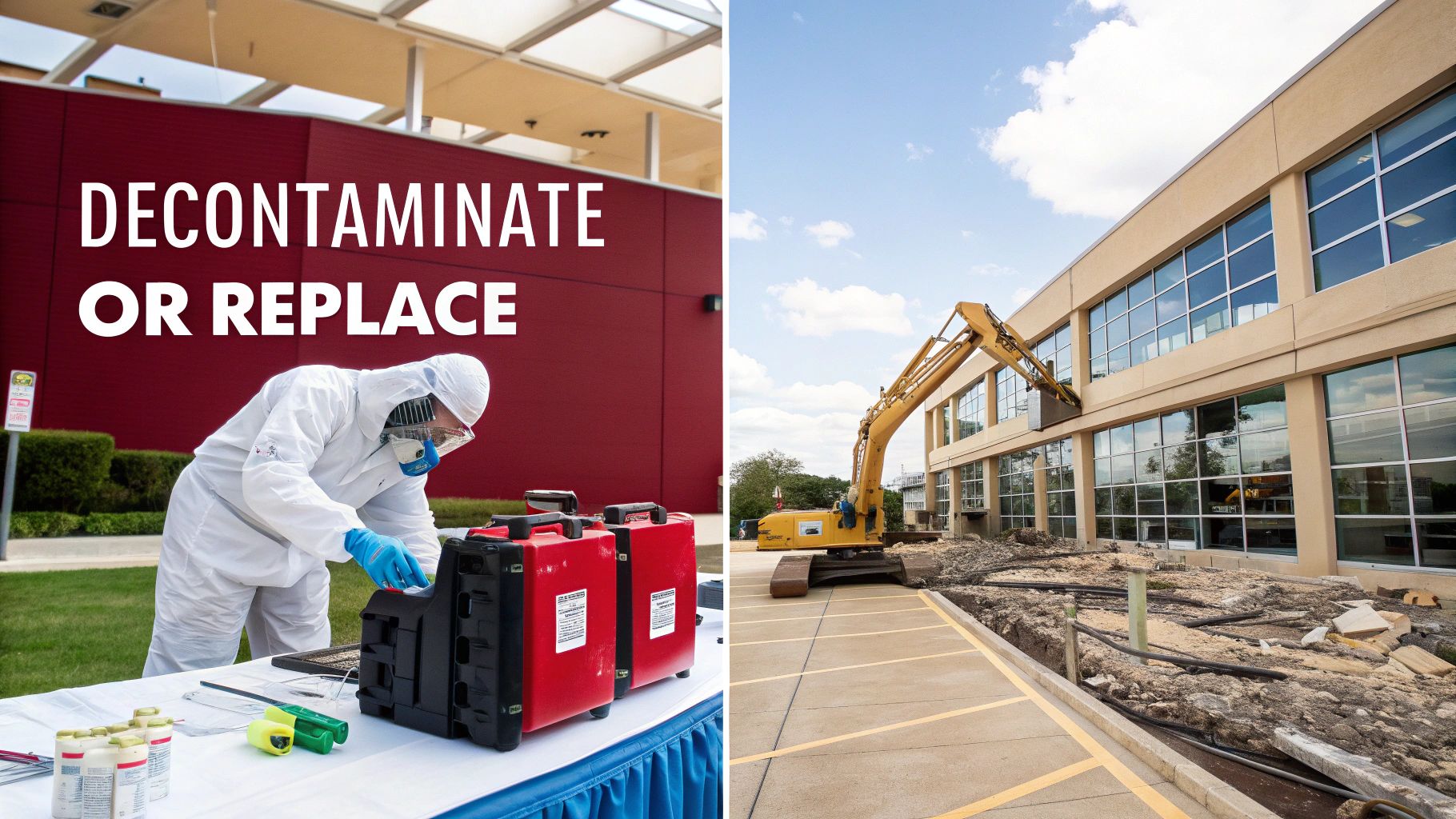
Understanding The Core Financial Trade-Offs in Meth Contamination
At its core, the decontamination vs. replacement dilemma is a financial modelling exercise. You have to weigh the total costs of each option, including all the variables that don't show up on the first invoice. For sectors like manufacturing, pharmaceuticals, or food and beverage, the cost of being shut down due to meth contamination can quickly dwarf every other expense.
That's why a proper ROI calculator for professional decontamination vs. full structural replacement is so crucial. It must account for those critical, often hidden, financial drains associated with methamphetamine remediation. It’s the only way to quantify the true cost of each path and see the complete picture.
Decontamination Vs Replacement At A Glance
To help frame the decision, let's start with a high-level comparison across the most important business metrics. This overview shows the key factors that will drive your financial analysis.
| Decision Factor | Professional Decontamination | Full Structural Replacement |
|---|---|---|
| Project Timeline | Weeks to a few months, allowing for a rapid return to operations. | Many months to over a year, causing a prolonged operational shutdown. |
| Initial Capital Outlay | Significantly lower, focusing on labour, equipment, and testing. | Extremely high, encompassing demolition, disposal, design, and construction. |
| Business Interruption | Minimal. Operations can often resume quickly post-clearance. | Catastrophic. A complete halt of revenue generation for the entire duration. |
| Asset Preservation | Preserves the existing structure and its inherent value. | Destroys the existing asset, requiring a total rebuild from scratch. |
| Regulatory Burden | Focused on clearance certificates and safe re-occupation validation. | Involves complex demolition, waste, and new construction permits. |
| Long-Term Liability | Mitigated with thorough, scientifically validated cleaning records. | Introduces new risks related to construction and potential latent defects. |
The real question isn't just, "How much will it cost?" It's, "How much will it cost me to be non-operational?" For most commercial clients, the speed of meth decontamination offers a financial advantage that demolition can never match.
This side-by-side view makes one thing clear: while a full replacement gives you a clean slate, it comes at a staggering cost in both time and money. Professional decontamination is a much more targeted approach, designed to get your asset back online efficiently after meth contamination. Now, let’s start putting some hard numbers to these factors.
Defining The Financial Variables For Your ROI Calculation
To build an accurate ROI model comparing professional meth decontamination against a full structural replacement, you need to look beyond the initial quote. A genuine financial analysis demands a thorough breakdown of every direct and indirect expense tied to each path.
This isn't just about crunching numbers; it's about shifting from a gut-feel decision to a data-driven one. Getting these variables right is the only way an ROI calculator: professional decontamination vs. full structural replacement can give you a realistic picture of your meth remediation options.

Unpacking The Costs Of Professional Decontamination
When you choose professional meth decontamination, you're dealing with a set of targeted, operational expenses. While the final bill is almost always significantly lower than a rebuild, you have to account for every component to ensure your comparison is accurate.
The goal is to restore the existing asset to a safe, compliant state with precision and speed. It’s about stopping the financial bleed from a non-operational facility as quickly as possible.
Key Direct Costs for Decontamination:
- Initial Site Assessment: A comprehensive evaluation by an occupational hygienist is the first step. This determines the extent and severity of meth contamination and forms the bedrock of the entire remediation plan.
- Remediation Labour: This covers the highly trained technicians who perform the cleanup. You're paying for their expertise and strict adherence to safety protocols.
- Specialised Equipment: Think HEPA air scrubbers, negative air pressure units, personal protective equipment (PPE), and specific cleaning agents designed for methamphetamine residues.
- Waste Disposal: Getting rid of contaminated materials is a highly regulated process. The cost covers safe and legal disposal, which is non-negotiable.
- Post-Remediation Verification: An independent, third-party test is required to legally certify that the property meets Australian safety standards for re-occupancy after meth cleanup.
Itemising The Expenses Of A Full Structural Replacement
Knocking down and rebuilding is a massive capital project with a far more complex and sprawling cost structure. The expenses go well beyond construction, pulling in demolition, regulatory hurdles, and design fees.
It’s crucial to consider every single cost associated with a full rebuild. Looking at a detailed cost breakdown for knock down rebuilds can provide a solid baseline.
Key Direct Costs for Structural Replacement:
- Demolition and Site Clearing: The cost to tear down the old structure and prepare the land.
- Hazardous Waste Disposal: Managing the disposal of potentially contaminated demolition debris can be a huge and often unpredictable expense.
- Architectural and Engineering Fees: You'll need to pay for the design of a new facility that meets current building codes.
- Permitting and Council Fees: Navigating the complex, and often slow, process of getting approvals for demolition and new construction.
- New Construction Materials and Labour: The core expense—everything needed to build a new structure from the ground up.
The most frequently underestimated variable is not a direct cost but an indirect one: business interruption. For a commercial facility, every day of downtime represents lost revenue, lost productivity, and potential market share erosion. This figure often becomes the single most influential factor in the ROI calculation.
Quantifying The Critical Indirect Costs
Indirect costs are often the most financially damaging because they're easy to overlook. These are the knock-on effects that ripple through your organisation while the main project is underway.
Accurately quantifying these is what separates a basic cost comparison from a proper financial analysis. A rebuild's longer timeline means these indirect losses grow exponentially.
These are the critical variables you must factor into your calculation:
- Business Interruption Losses: The daily, weekly, or monthly revenue you lose while the facility is out of action.
- Temporary Relocation Expenses: The cost to lease and set up an alternative workspace, if that's an option.
- Lost Productivity: The real-world impact on your team's efficiency, supply chains, and production schedules.
- Potential Regulatory Fines: Penalties for non-compliance or delays in addressing the meth contamination issue.
- Brand Reputation Damage: The intangible, but very real, cost to public perception, client trust, and market confidence.
Building Your ROI Model: Decontamination vs. Replacement
When facing significant meth contamination, gut feelings and rough estimates won't cut it. A solid financial model is needed for a clear-headed, objective decision between professional decontamination and a complete structural replacement. A good ROI calculator provides a data-driven answer.
The foundation is the classic Return on Investment (ROI) formula, which can be adapted for this comparison.
ROI (%) = [ (Net Benefit – Total Investment) / Total Investment ] x 100
This formula provides a simple percentage. A positive result indicates a good investment. The key is to define 'Net Benefit' and 'Total Investment' in the context of this specific dilemma.
Getting the Core Components of Your Formula Right
To make this formula useful, we must assign real-world values to each variable. This is where you turn the cost categories into hard numbers for your calculation.
-
Total Investment: This is the all-in cost of the professional decontamination project. This number includes everything—initial site assessment, lab work, remediation labour, specialised gear, waste disposal, and final clearance testing.
-
Net Benefit: This figure requires more thought. For our model, the 'Net Benefit' is the total cost you avoid by not tearing the building down. It’s not just construction savings; it’s the sum of every direct and indirect expense a full rebuild would force you to incur.
By setting up the calculation this way, you create a powerful tool that directly pits the two options against each other financially.
Breaking Down the Net Benefit Calculation
To determine the 'Net Benefit', you need to add up every cost associated with the demolition and rebuild path. This total becomes the financial hurdle that the decontamination investment must clear.
Make sure your Net Benefit calculation includes:
- Avoided Direct Replacement Costs: The big-ticket item. Get estimates for demolition, site clearing, architectural plans, council permits, new materials, and all associated labour.
- Avoided Business Interruption Losses: For most businesses, this is the real killer. Calculate the total revenue you'd lose during the long timeline of a complete rebuild.
- Avoided Indirect Costs: Tally up other headaches, like temporary relocation costs, lost team productivity, and the potential hit to your brand's reputation during a major shutdown.
Once you have this comprehensive number, you're ready to plug it into the ROI formula.
A Walkthrough: How The ROI Calculator Works in Practice
Let’s bring this from theory to reality. The goal is to replace abstract ideas with concrete figures from your own situation.
Imagine your commercial facility has been flagged for meth contamination. To build your ROI model, you would take these steps:
-
Calculate the Total Investment: You get a detailed, fixed-price quote from a certified occupational hygienist. This quote covers the entire decontamination process from A to Z, giving you a firm 'Total Investment' figure.
-
Calculate the Total Avoided Cost (Your Net Benefit):
- First, you work with builders to get a realistic, all-inclusive estimate for a full structural replacement.
- Next, you sit down with your finance team to project the total lost revenue based on a likely rebuild timeline (say, 12-18 months).
- Finally, you add in any other quantifiable indirect costs tied to that extended downtime.
- The sum of all these figures is your 'Net Benefit'.
-
Run the ROI Formula: Now for the easy part—plugging in the numbers. Let's say the professional decontamination cost is $150,000 (Total Investment). After doing your homework, you calculate the total avoided costs of a rebuild (construction plus downtime) to be $1,200,000 (Net Benefit).
- ROI = [ ($1,200,000 – $150,000) / $150,000 ] x 100
- ROI = [ $1,050,000 / $150,000 ] x 100
- ROI = 7 x 100
- ROI = 700%
In this example, choosing decontamination delivers a massive 700% return on investment compared to the alternative. This isn't just a number; it's a powerful, data-backed justification. It proves that for every dollar spent on decontamination, you save seven dollars you would have otherwise lost. This is the clarity a proper ROI model provides, turning a complex, stressful decision into a simple financial truth.
A Closer Look at Industry Scenarios and Break-Even Points
The financial fallout from meth contamination isn’t a one-size-fits-all problem. For some businesses, operational downtime is a headache; for others, it's a catastrophe with eye-watering financial consequences. When you apply our ROI calculator for professional decontamination vs. full structural replacement to different industry scenarios, you see just how much the right decision can protect your bottom line.
The choice isn't just about the building; it's about the business within it. A long-term shutdown in a high-turnover industry can inflict financial wounds that far exceed the cost of any remediation or new construction.
This infographic breaks down the basic ROI formula, showing how the net benefits of your choice are weighed against the total investment to figure out the real financial outcome.

As you can see, a positive ROI is all about the net benefit—the costs you avoid by choosing decontamination—being significantly larger than the upfront investment in the remediation work itself.
High-Stakes Sectors Where Decontamination Is a Clear Winner
In certain industries, the sheer speed of professional decontamination gives it an almost unassailable financial edge. These are sectors where every hour of lost production has a massive price tag.
- Pharmaceutical Manufacturing: In such a tightly regulated field, downtime can cost millions of dollars a day in lost production and contractual penalties. Getting operations back online with rapid, scientifically-proven decontamination isn't just a goal; it's essential for maintaining supply chain integrity.
- Food and Beverage Industry: Meth contamination here can cause a complete supply chain meltdown. By avoiding a full rebuild, you're not just saving on construction costs—you're preventing months of disruption, protecting your brand's reputation, and preserving vital relationships with distributors and retailers.
- Commercial Real Estate: When meth residue is discovered in a tenanted commercial property, it means an immediate vacancy and zero rental income. Decontamination gets the property back on the market quickly, minimising those financial losses and safeguarding the asset's value. If you're weighing up different remediation tactics, you can also check out our guide on encapsulation versus removal for more detailed insights.
Real-world data from the Australian manufacturing sector paints a vivid picture. Take the case of an aerospace hangar dealing with chemical exposure. A full replacement was quoted at AUD $12 million, with downtime costs hitting AUD $500,000 per week. In stark contrast, professional decontamination cost just AUD $2.4 million and delivered an incredible 400% ROI. How? By enabling an 80% faster recovery, it sidestepped the kind of productivity losses that mirror the AUD $2.44 billion annual impact of foodborne illnesses, where lost work is the primary cost driver.
Working Out Your Break-Even Point
A critical part of this analysis is figuring out your break-even point. This is the exact moment when the cumulative costs of business interruption from a full rebuild would equal the total cost of the replacement project itself.
Your break-even analysis gives you a clear decision-making threshold. It answers a simple but vital question: "At what point does waiting for a rebuild become so costly that any other option is a better financial move?"
Calculating this helps to quantify the true urgency of the situation. For example, if your daily downtime cost is $50,000 and the rebuild is estimated at $3 million, your break-even point is 60 days. This means if the decontamination process takes less than 60 days, it’s already the superior financial choice based on this metric alone—and that's before you even factor in the much lower direct costs.
Scenario Analysis: A Mining Operation
Let's put this into practice and consider a mining operation where a critical processing facility has been contaminated with methamphetamine residue. Here, structural integrity is non-negotiable, but so is keeping the operation running.
Full Structural Replacement Scenario:
- Timeline: 18-24 months for demolition, permits, and reconstruction.
- Downtime Costs: Millions in lost revenue from unprocessed ore piling up.
- Outcome: A brand-new facility, but only after a financially devastating operational halt.
Professional Decontamination Scenario:
- Timeline: 6-8 weeks for assessment, remediation, and final clearance.
- Downtime Costs: Significant, but contained within a much shorter, manageable timeframe.
- Outcome: The original, structurally sound asset is back in service swiftly, protecting cash flow and market position.
For this mining operation, the ROI on decontamination is off the charts because it directly counters an existential threat to its revenue stream. The break-even point would likely be hit in a matter of weeks, making a multi-year rebuild completely unfeasible from a financial standpoint. It’s a perfect example of why looking at the problem through an industry-specific lens is absolutely essential to making the right call.
Thinking Beyond the Numbers: Risk, Liability, and Compliance
When weighing professional decontamination against a full structural replacement for meth contamination, the conversation goes far beyond cost. This decision is a fundamental part of your business's long-term risk management strategy. It's about protecting your people, reputation, and licence to operate.
Choosing the best path means examining how each option shields you from future liability and satisfies regulatory bodies. A structured approach, like the principles in ISO 31000 risk management, provides a clear framework for managing these risks effectively.
The Power of a Defensible Record
When you engage experts for professional decontamination, you get more than just a clean facility. You get a meticulously documented process that stands up to scrutiny. This creates a clear, defensible record covering everything from initial assessment and scientific sampling to remediation methods and final clearance testing for meth residue.
This chain of custody and scientific validation is your proof that the property is safe for re-occupation. It’s essential for satisfying regulatory bodies like Safe Work Australia and local health departments, and giving your insurers complete peace of mind.
This documentation isn’t just paperwork; it’s a legal shield. Should any future legal challenges or health concerns arise, a scientifically validated decontamination report provides irrefutable evidence that you acted responsibly and effectively to eliminate the hazard.
Comparing the Risk Profiles
At first glance, a full structural replacement might seem like the ultimate clean slate. But in reality, you're not eliminating risk—you're swapping one set of problems for another, often more complex, set.
Key Risk Considerations:
- Construction Site Safety: A full demolition and rebuild introduces significant on-site safety risks. It demands stringent oversight to protect workers and the public from accidents.
- Hazardous Material Disposal: Tearing down a structure can unearth other nasty surprises like asbestos, leading to complex and expensive disposal challenges you didn't plan for.
- Building Code Navigation: New construction must meet the very latest building codes. This can be a labyrinth of regulatory hurdles, adding time and cost to the project.
- Contractor Liability: You’re entirely dependent on the performance, and even the financial stability, of your builders over a long and costly project timeline.
Professional decontamination contains the risk. It’s a specific, manageable project focused on a known hazard. The timeline is shorter, the variables are fewer, and the result is scientifically verifiable. This focused approach dramatically reduces your long-term liability by creating that all-important, defensible record—a critical factor that a simple cost comparison will always miss.
Quantifying the Regulatory and Health Impact
The value of expert meth decontamination ripples out far beyond a single property. Think about the broader economic impact of getting hygiene protocols right. Research has shown that better cleaning in Australian public hospitals could prevent 1,900 healthcare-associated infections and free up over 24,000 bed days every year.
This same principle applies directly to industrial settings. For a food manufacturing plant facing a Salmonella outbreak, expert decontamination mirrors these public health savings by preventing costly shutdowns and product recalls. With foodborne illness costing Australia an estimated AUD 2.44 billion each year, investing in targeted, professional meth decontamination delivers a clear and substantial return by protecting productivity and ensuring you remain compliant.
Turning Your Analysis into Action
You've run the numbers and the ROI model points towards a decision. That's the critical first step, but now it's time to move from the spreadsheet to the site itself. Turning your financial analysis into a safe, compliant, and successful outcome is where the real work begins.
Your first, and most important, next step is to get a professional site assessment. This isn't just a recommendation; it's a non-negotiable part of the process for dealing with meth contamination. An experienced occupational hygienist will provide the hard data you need to either validate your financial model or adjust it based on the reality on the ground.
From Data Points to a Decontamination Plan
Think of the professional site assessment as the foundation for everything that follows. It takes your project out of the realm of estimates and into a concrete, evidence-based strategy.
- Identifies the True Scope: Scientific testing pinpoints the exact type and concentration of meth contamination. This tells you where the hotspots are and what you’re truly up against.
- Sharpens Your Financials: This is the specific data needed to plug real-world figures into your ROI calculator, giving you confidence in your financial projections.
- Creates a Legal Benchmark: The assessment report is a crucial legal and regulatory document. It formally establishes the property's condition before any remediation work starts.
This isn't a one-person job. A skilled hygienist will lead a team to translate the lab results into a practical plan. This involves choosing the right meth decontamination agents, setting up proper containment, and mapping out a realistic project timeline.
The professional site assessment is the bridge between your financial model and the on-the-ground reality. It provides the objective, scientific evidence needed to confidently execute the decision your ROI analysis has highlighted.
Setting Clear Decision Thresholds
Once you combine the site assessment findings with your ROI analysis, your path forward becomes much clearer. If the assessment shows meth contamination is limited to surfaces and accessible areas, the data will almost certainly favour decontamination. Your ROI will be high, and you’ll get back to business much faster.
In some rare cases, the contamination might have seeped deep into structural materials, making effective remediation impossible. The site assessment will confirm this. Even in this scenario, your ROI model proves its worth by providing the solid financial justification for the more expensive path of a full structural replacement.
Whether the data points to decontamination or replacement, you'll need expert guidance. Bringing in a certified team ensures the plan is executed safely, efficiently, and in full compliance with Australian workplace health and safety standards. This professional oversight protects your asset, your people, and your bottom line, making sure your final actions align perfectly with your initial data-driven decision.
Frequently Asked Questions
When you're dealing with meth contamination, it’s natural to have a lot of questions. Here are a few of the most common ones we hear when people are weighing up decontamination against a full structural replacement, especially when it comes to clandestine labs.
What’s The Single Biggest Factor in the Decontamination vs Replacement ROI Calculation?
It's tempting to focus on the upfront costs, but the real game-changer is almost always downtime. For any business that actually produces something—be it in manufacturing, pharmaceuticals, or food and beverage—every single day the doors are shut means lost revenue. And it adds up fast.
A professional meth decontamination job is usually a matter of weeks. A full structural replacement? You could be looking at many months, if not a year or more. That massive difference in business interruption often makes decontamination the clear financial winner before you even start comparing the direct project costs.
Can Professional Decontamination Really Get Rid of All the Meth Contamination?
Yes, absolutely. When done properly by a qualified team, professional decontamination removes methamphetamine residue to levels well within Australian health guidelines, making the site safe to re-enter. It’s a multi-step, scientific process that includes a thorough assessment, stripping out any unsalvageable porous materials, using specialised chemical washes on all surfaces, and detailed HEPA vacuuming.
The final, critical step is post-remediation testing. An independent hygienist comes in to verify the site is clean and issues a clearance certificate. This isn't just for peace of mind; it’s your proof of legal and regulatory compliance.
A common myth is that only a full tear-down guarantees safety. The reality is that a scientifically validated decontamination process delivers a certificate of clearance, which is a legally defensible and much faster way to get your operations back on track.
How Does a Site Assessment Factor into the ROI Calculation?
A professional site assessment isn't just a preliminary step; it's the bedrock of a reliable ROI calculation. An occupational hygienist will accurately measure the type and severity of meth contamination, which tells you exactly what needs to be done.
This gives you the hard numbers for the "investment" side of the equation. Armed with that data, you can make a realistic comparison against the huge costs and extended downtime of a complete rebuild. Without it, you're just guessing, and that’s a risky way to make a multi-million dollar decision.
Is All Roof Work Considered a Capital Improvement?
This one trips a lot of people up, and the answer really depends on the scale of the work. If you're patching a leak or replacing a handful of tiles, that's almost always considered a maintenance repair and can be expensed in the current financial year.
However, a complete roof replacement is a different story. Because it materially extends the useful life of the entire building, it’s classified as a capital improvement. That means the cost has to be capitalised and depreciated over several years. It's a crucial distinction to get right when you're plugging the numbers into your ROI model.
Ready to move from rough estimates to a concrete plan? An accurate site assessment is the first real step toward making a smart, data-driven decision. The multi-disciplinary team at OCC Hygiene delivers expert occupational hygiene services across Australia, giving you the clarity needed to protect your people, your assets, and your bottom line.
Contact us today to schedule your professional assessment and start building an ROI model you can count on. Learn more about our process at https://occhygiene.com.au.


