
Think of a respirator like a scuba mask. If it doesn’t create a perfect seal against your face, water rushes in. The same principle applies to respiratory protection, but instead of water, a poor seal lets in invisible and often dangerous airborne hazards. A respirator fit test is the only way to be certain that a tight-fitting mask forms that crucial, airtight seal. In Australia, conducting a respirator fit test is not just a good idea—it’s a mandatory part of workplace safety to protect against airborne contaminants.
What is a Respirator Fit Test and Why is it Essential?
Just handing an employee a respirator isn't enough to protect them from workplace hazards. The best filter in the world is completely useless if contaminated air can simply sneak in through gaps between the mask's edge and the wearer's skin. A respirator fit test scientifically proves that a specific make, model, and size of respiratory protective equipment (RPE) fits a particular person without any leaks.
This isn’t just a quick visual check. The procedure involves a series of movements that mimic typical work activities—things like turning your head from side to side, bending over, and talking. The whole point is to challenge the seal and make sure it holds up when people are actually working, not just standing still.
Why Is a Secure Seal So Important?
A bad seal defeats the entire purpose of wearing respiratory protective equipment (RPE). Even a tiny gap, one you can't see or feel, can let a huge volume of contaminants through. For anyone working with hazards like silica dust, asbestos, chemical vapours, or infectious diseases, that leakage can lead to devastating long-term health problems or even immediate harm.
A respirator's effectiveness is not determined by its filter alone, but by the integrity of its seal to the wearer's face. Without a proven fit, workers may have a false sense of security while remaining dangerously exposed to workplace hazards.
This is exactly why authorities like Safe Work Australia and standards like AS/NZS 1715:2009 make fit testing a core requirement. For any business where employees depend on tight-fitting respirators, it's a fundamental part of keeping them safe.
An Introduction to Testing Methods
So, how do you verify the seal? There are two main methods, each with its own place depending on the type of mask and the level of risk. Getting a handle on these is the first step toward building a compliant respiratory protection program.
- Qualitative Fit Testing (QLFT): This is a simple pass/fail test based on the wearer's senses. A test agent, usually a sweet or bitter-tasting aerosol, is sprayed into a hood placed over the person's head. If they can taste or smell it while wearing the respirator, the seal has failed.
- Quantitative Fit Testing (QNFT): This method is far more precise. It uses specialised equipment to measure the exact number of microscopic particles inside and outside the mask, generating a numerical score called a 'fit factor'. It's objective, data-driven, and provides undeniable proof of a good seal.
These two approaches are the foundation of ensuring a respirator actually works. Choosing the right one for your workplace and understanding the legal duties behind them are critical. To get the bigger picture, it helps to see how fit testing fits into broader Australian Personal Protective Equipment (PPE) requirements.
Qualitative vs Quantitative Fit Testing Methods
When it comes to checking if a respirator actually works, there are two main ways to go about it: Qualitative and Quantitative fit testing. Think of it like this: one method asks for your opinion, while the other gives you a precise, scientific measurement. They both aim to make sure the mask has a good seal on your face, but they get there in completely different ways.
Knowing the difference is absolutely key. It helps you choose the right test for the specific hazards your team is up against. One is a straightforward pass/fail check, while the other provides hard numbers, making it the undisputed gold standard for high-risk jobs.
The Subjective Approach of Qualitative Fit Testing
A Qualitative Fit Test (QLFT) is basically a sensory check. It’s a simple pass/fail test that hinges on whether the person wearing the mask can taste or smell a specific substance sprayed near their face. It doesn't measure how much leakage there is; it just tells you if a leak is big enough for you to notice.
Here’s how it works. The person puts on their respirator and a test hood is placed over their head. A testing agent is then sprayed into the hood. The most common ones are:
- Saccharin: A very sweet-tasting solution.
- Bitrex™ (denatonium benzoate): An intensely bitter substance.
The individual is then asked to move around—turning their head side to side, bending over, talking out loud—to mimic the kinds of movements they’d make on the job. If they taste the sweet or bitter agent at any point, it means the mask has a leak. That’s an instant fail.
The Objective Precision of Quantitative Fit Testing
On the other hand, a Quantitative Fit Test (QNFT) is all about data. It cuts out the guesswork entirely. Instead of relying on someone's sense of taste, this method uses a specialised machine, like a TSI PortaCount, to measure the exact amount of leakage into the respirator. This is precisely why QNFT is seen as the most accurate and reliable way to test a respirator's fit.
The machine works by comparing the number of microscopic particles in the air outside the mask to the number of particles that have managed to get inside. This comparison generates a score called a 'fit factor'.
A fit factor is a number that tells you exactly how well the respirator is protecting you. For half-face masks, Australian standards demand a fit factor of at least 100. This means the air inside the mask must be at least 100 times cleaner than the air outside.
A proper seal is the difference between true protection and a false sense of security.
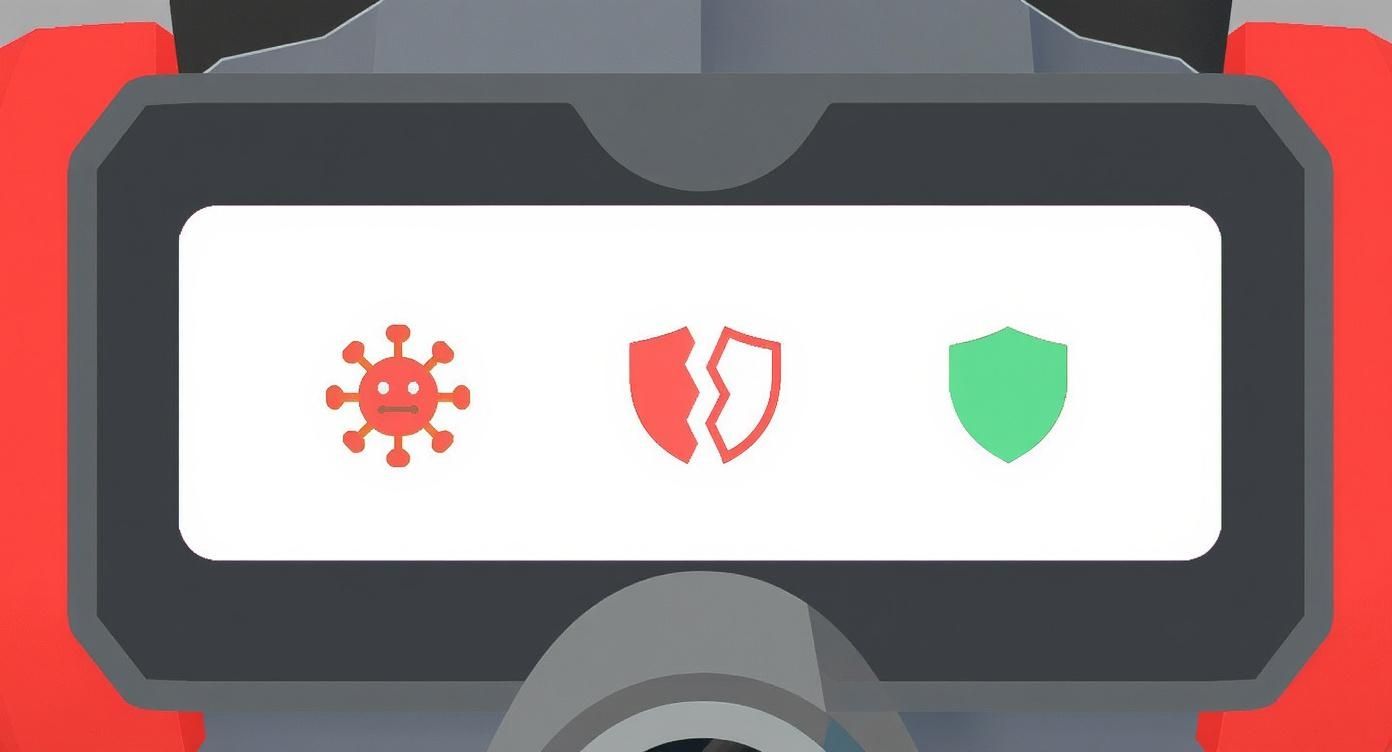
As you can see, an imperfect seal is like having a broken shield—it leaves the wearer dangerously exposed.
The real-world importance of QNFT was thrown into sharp relief during the COVID-19 pandemic. A massive Australian study by the Sydney Local Health District conducted quantitative fit testing on 6,287 healthcare workers. The findings were telling: 93.3% of them were successfully fitted to at least one N95 model, which underscores just how vital precise testing is for protecting our frontline staff. You can discover more about these large-scale Australian fit testing findings and what they mean for workplace safety.
Comparing Fit Testing Methods at a Glance
This table offers a clear side-by-side comparison of Qualitative and Quantitative fit testing, helping you quickly grasp the key differences, benefits, and applications for each.
| Feature | Qualitative Fit Test (QLFT) | Quantitative Fit Test (QNFT) |
|---|---|---|
| Principle | Pass/fail based on the wearer's sense of taste or smell. | Provides a numerical score (fit factor) based on measurement. |
| Objectivity | Subjective – relies on the user's perception. | Objective – uses a machine for precise data. |
| Accuracy | Less accurate; only detects if a leak is noticeable. | Highly accurate; measures the exact amount of leakage. |
| Best For | Lower-risk environments and for disposable half-face masks. | High-risk environments, full-face masks, and legal compliance. |
| Common Testing Agents | Saccharin (sweet) or Bitrex™ (bitter). | Ambient airborne particles (measured by a particle counter). |
| Result | Simple "Pass" or "Fail". | A specific number (e.g., Fit Factor of 100). |
Ultimately, choosing between these two methods isn't just a matter of preference; it's about matching the testing rigour to the level of risk involved.
When to Choose Quantitative Over Qualitative
While a QLFT might be perfectly adequate for some lower-risk workplaces, a QNFT is non-negotiable when the stakes are high. The data-driven results remove all doubt and provide documented proof that a respirator offers the protection it's supposed to.
QNFT is the essential—and often legally required—choice for:
- Workers handling highly toxic materials like asbestos or lead.
- Healthcare professionals who could be exposed to airborne infectious diseases.
- Anyone required to wear a full-face respirator.
- Situations where health and safety regulations specifically mandate a numerical fit factor.
The decision really boils down to risk. A QLFT can confirm a basic seal, but a QNFT provides the concrete evidence needed to guarantee maximum protection in the most hazardous environments.
Understanding Your Legal and Safety Duties in Australia
Getting your head around your legal obligations is the first step to building a truly safe workplace. When we're talking about respiratory protection in Australia, a proper respirator fit test isn't just a 'nice to have'—it's a non-negotiable legal requirement under our Work Health and Safety (WHS) laws. These rules exist for one simple reason: to make sure every worker who needs a respirator is given one that actually protects them.
The key document you need to know is AS/NZS 1715:2009, the Australian/New Zealand Standard for the Selection, use and maintenance of respiratory protective equipment. Think of this standard as the official playbook. Following its guidance is the minimum you need to do to show you're meeting your legal duties.
Ignoring these rules isn't just cutting corners on safety; it’s a clear failure to comply with the law. For any business owner or manager (a PCBU in legal terms), this can result in hefty fines. But more importantly, it leaves your people dangerously exposed to harmful dust, fumes, or chemicals in the air.
The Role of AS/NZS 1715:2009
The standard, AS/NZS 1715:2009, is crystal clear on fit testing. It explicitly states that before a worker uses any tight-fitting respirator on the job, they must undergo a fit test to confirm it can form an effective seal with their face. This isn't just a one-time check, either.
The standard requires that respirator fit testing be conducted at least annually. A re-test is also needed anytime something changes that could affect the mask's seal, like significant weight loss or gain, or major dental work.
This regular check-up ensures the protection your team relies on doesn't diminish over time. The standard is your practical guide to fulfilling your broader WHS obligations. To see the bigger picture, it helps to understand the general Australian Personal Protective Equipment (PPE) requirements, which show how respirators fit into your overall safety plan.
Connecting the Dots to WHS Legislation
Across Australia, WHS laws place a primary duty of care on the PCBU to protect the health and safety of their workers, as far as is reasonably practicable. A huge part of this is providing and maintaining Personal Protective Equipment (PPE) that is genuinely suitable for the work and its specific hazards.
The law says PPE must be a "suitable size and fit" and "reasonably comfortable" for the person wearing it. How can you prove a respirator is a suitable fit without testing it? You can't. That’s why conducting a respirator fit test is a direct and essential step in meeting your legal duties.
- Proving Suitability: A fit test gives you documented proof that the specific make, model, and size of respirator is right for that individual worker.
- Ensuring Effectiveness: It verifies the equipment can actually provide the protection it's designed for against the specific hazards in your workplace.
- Fulfilling Duty of Care: It shows you've taken real, proactive steps to control the risks from airborne contaminants.
Building a Compliant Program
At the end of the day, the law and the standard go hand-in-hand. The WHS Act tells you what you need to do (protect your workers), while AS/NZS 1715:2009 shows you how to do it for respiratory protection. This covers everything from fit testing and training to maintenance and keeping good records. Together, these are the foundations of a solid and compliant respiratory protection program.
If you're looking to build a program that ticks every box, a great place to start is this guide on implementing a Respiratory Protection Program (RPP). It walks you through how to pull all these essential pieces together into one cohesive system. Sticking to a framework like this is the surest way to not only stay compliant but, more importantly, create the safest possible environment for your team.
Your Step-by-Step Guide to the Fit Test Process
Knowing what to expect during a respirator fit test can make a world of difference. It transforms the process from a bit of an unknown into a straightforward, practical session that confirms you're properly protected. This guide will walk you through exactly what happens—before, during, and after—so you can feel confident and prepared.
The entire goal is simple: to verify that the specific respirator you'll be using on the job creates a perfect seal against airborne nasties. When you understand each stage, you can take an active part in your own safety and know precisely what the tester is looking for.

Preparing for Your Fit Test
A successful fit test actually starts before you even arrive. Getting an accurate result depends heavily on proper preparation, as a few simple things can easily interfere with the respirator's seal.
The number one rule? You must be clean-shaven where the respirator meets your skin. It’s non-negotiable. Even a single day of stubble can create tiny gaps, letting contaminated air sneak in and causing an automatic fail.
You’ll also need to hold off on a few things right before your appointment. For at least 15-30 minutes beforehand, avoid eating, drinking anything other than plain water, smoking, or chewing gum. These can leave behind residues that mess with the test agents or even alter your normal breathing pattern.
The Initial Mask Selection and Training
Once you're prepped and ready, the first real step is finding the right mask for your face. People's faces are all different, so a "one-size-fits-all" approach just doesn't work for respirators. A qualified tester will have a range of different brands, models, and sizes on hand for you to try.
The tester will guide you through the options, helping you find a respirator that feels secure and isn't uncomfortable. Don't underestimate the importance of comfort—if a mask is awkward or pinches, you're far less likely to wear it correctly for an entire shift.
After you've settled on a suitable mask, the tester will teach you how to properly don (put on) and doff (take it off). They'll show you the correct way to position it, how to adjust the straps for a snug fit without cranking them too tight, and how to perform a user seal check.
A user seal check is something you should do every single time you put on your respirator. It’s a quick personal check—either covering the filters and breathing in (a negative pressure check) or covering the exhalation valve and breathing out (a positive pressure check)—to feel for any obvious air leaks.
Performing the Fit Test Exercises
With the respirator fitted correctly, it’s time for the formal test. You'll be asked to run through a series of seven exercises, with each one lasting for about a minute. These aren't random movements; they're designed to mimic the typical activities you'd do on the job and really challenge the integrity of the mask's seal.
The standard set of exercises includes:
- Normal Breathing: Just breathing like you normally would.
- Deep Breathing: Taking slow, deliberate breaths to put the seal under a bit more stress.
- Turning Head Side to Side: Looking from one shoulder to the other to see if the movement breaks the seal.
- Moving Head Up and Down: Tilting your head up to the ceiling, then down to the floor.
- Talking: Simulating speech by reading a short text, like the "Rainbow Passage," or counting out loud.
- Bending Over: Bending at the waist as if you're going to touch your toes, an action that often changes your face shape slightly.
- Normal Breathing Again: One last check to make sure the seal is still intact after all that activity.
During these exercises, the equipment (for a quantitative test) or the test agent (for a qualitative one) will be actively checking for any leakage. If you get through the entire sequence with no leaks detected, you’ve passed! You'll receive official documentation confirming the result for that specific respirator, a critical piece of your workplace safety records.
Common Factors That Cause a Fit Test to Fail
Passing a respirator fit test isn’t just about going through the motions. It's a precise process where even the smallest details can mean the difference between a pass and a fail. Getting that perfect, airtight seal is a science, and understanding what can go wrong is the first step to making sure your respiratory protection program actually works.
A lot of people think that if a mask feels snug, it must be doing its job. But that’s a dangerous assumption. Anything from your unique facial structure to a bit of five-o'clock shadow can completely break the seal. It’s a stark reminder that when it comes to respiratory safety, a "one-size-fits-all" approach just doesn't cut it.
The Impact of Physical Characteristics
Every face is unique, which is exactly why a respirator that fits one person perfectly might be a total failure on someone else. A person's physical features play a huge role in whether a mask can form that crucial, unbroken seal against the skin.
Here are some common physical factors that can trip up a fit test:
- Face Shape and Size: A narrow face might not be wide enough for a standard respirator, leaving gaps along the sides. On the other hand, a wider face might stretch the mask, causing it to pull away from the nose or chin.
- Nose Bridge: This is a critical area. If the mask’s nosepiece can’t be moulded perfectly to the contours of the nose, you’re guaranteed to get significant leakage right where you can least afford it.
- Cheekbones and Jawline: High cheekbones or a sharp jawline can create angles and curves that prevent the edge of the respirator from sitting flush against the skin.
These subtle differences really drive home why having a variety of respirator models and sizes on hand for testing isn't just a good idea—it's an absolute must for any effective program.
The Non-Negotiable Issue of Facial Hair
Probably the most common—and most preventable—reason for a failed fit test is facial hair. Even a day's worth of stubble can act like tiny little pillars, lifting the edge of the respirator away from the skin and creating thousands of invisible pathways for contaminated air to get in.
For a tight-fitting respirator to work, its sealing surface must make direct, uninterrupted contact with smooth skin. There is no such thing as a "safe" amount of facial hair; any growth that comes between the seal and the face will compromise protection.
This is a hard and fast rule. Beards, moustaches that droop past the corners of the mouth, and even light stubble will result in a failed test. It’s critical that workers are clean-shaven every single time they put on their respirator at work, not just on the day of the fit test.
How Demographics Influence Fit Test Success
Beyond individual facial features, some broader demographic trends can give us a clue about who might struggle to get a good fit. Data consistently shows that factors like age and gender can affect pass rates, which again highlights the need for a diverse range of respirator options for a diverse workforce.
A major study of P2/N95 respirator users within a Victorian public health network uncovered some fascinating trends. Unsurprisingly, it confirmed that being clean-shaven was a huge predictor of success. Interestingly, the study found that males had much higher odds of passing a fit test. It also revealed that success rates tended to drop with age—by about 4% for every year older a person was.
This research makes it clear that respirator selection needs to account for these demographic variables to be truly effective. You can read the full research about these fit testing findings to dig into the data yourself. The study also pointed out that three-panel flat-fold models had a particularly high success rate, which underscores just how much respirator design matters when trying to fit different types of faces.
How to Choose a Professional Fit Testing Service
Picking the right partner for your respirator fit testing program is one of the most important safety decisions you'll make. It’s not just about ticking a box for compliance; it's about putting your team's health in the hands of a genuine expert. A quality provider doesn't just run the test—they become a crucial part of your safety culture, making sure your gear works and your people know how to use it confidently.
Finding that right service means looking for specific signs of quality and real-world experience. You’re looking for a partner who brings both the right equipment and, just as importantly, the right knowledge to your workplace.
Key Credentials and Capabilities
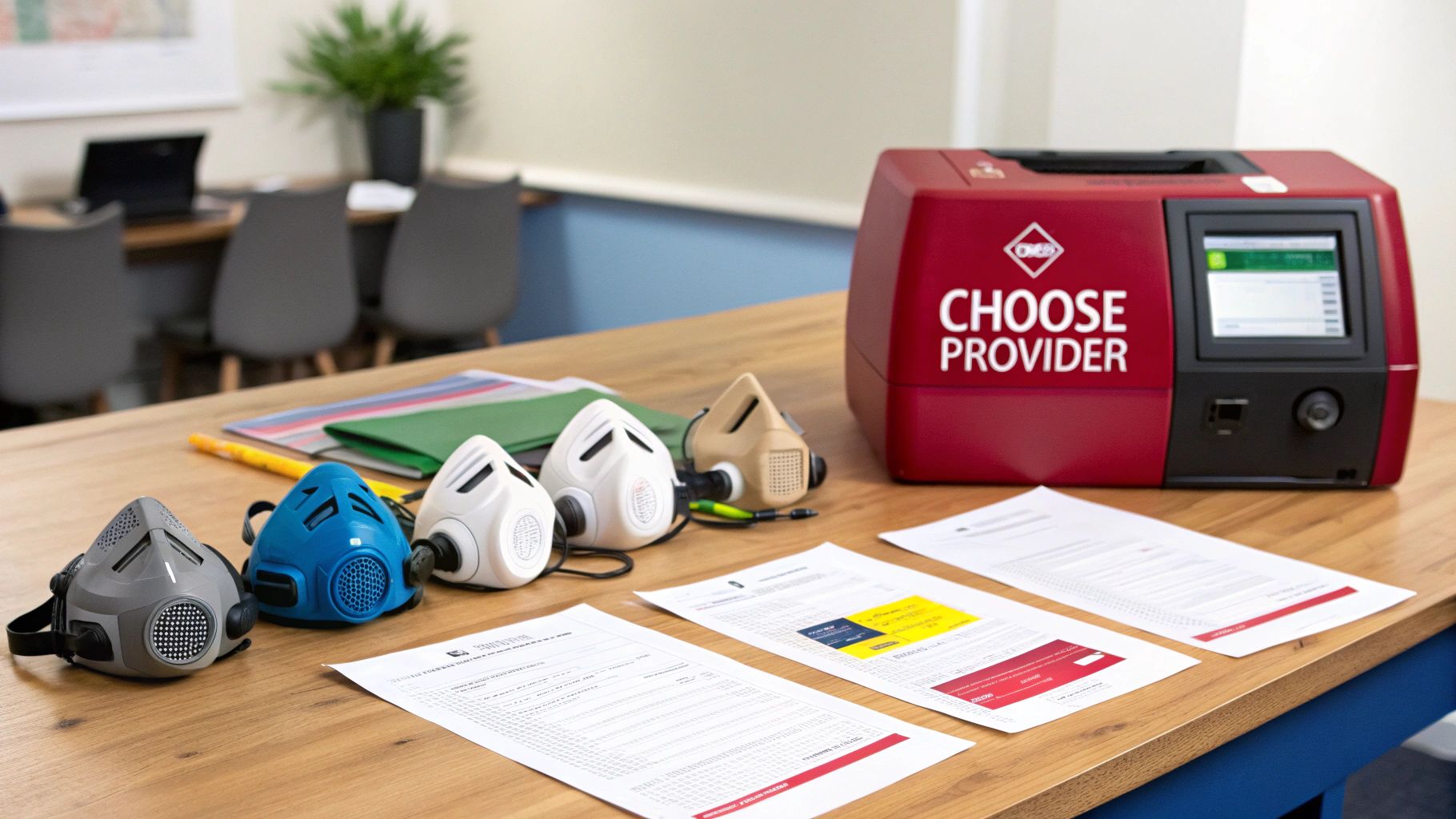
When you're sizing up potential providers, their qualifications and the tools they use are non-negotiable. Look for technicians with formal training and certification to conduct fit tests that meet Australian standards. They must be using properly maintained and calibrated quantitative testing equipment, like a TSI PortaCount, to get accurate, data-backed results.
The variety of respirators they can test is also a massive factor. An earlier Australian study on healthcare workers drove this point home, showing just how much performance can vary between different mask designs. The research found that semi-rigid cup respirators had a 65.0% pass rate, but flat-fold designs only passed 32.4% of the time. This is exactly why a provider needs to bring a range of models to find the right fit for every single person. You can learn more about these respirator design findings and what they mean for workplace safety.
What to Expect From a Quality Provider
A truly professional service goes way beyond the test itself. They should be offering comprehensive support that strengthens your entire respiratory protection program from the ground up.
Here’s a quick checklist of what to look for:
- Thorough Record-Keeping: The provider absolutely must give you detailed compliance reports for each employee. This paperwork is essential for your WHS records and should clearly show the person tested, the date, the specific respirator model and size, and the final quantitative fit factor.
- On-the-Spot Education: A great tester doesn't just test; they teach. They should be showing each worker how to correctly put on and take off their specific respirator, how to do a daily user seal check, and the basics of mask care and maintenance.
- Expert Guidance: Your provider should be able to offer professional advice on your bigger-picture respiratory safety strategy. This is where having access to a qualified professional, like an occupational hygienist in Australia, is invaluable. They can help you make sure your fit testing program aligns with your broader risk management goals.
Choosing a partner is an investment in your safety culture. A provider who educates and empowers your staff not only ensures compliance but also fosters a workplace where everyone takes an active role in their own protection.
Frequently Asked Questions About Respirator Fit Testing
When it comes to respirator fit testing, a lot of questions pop up. It's completely normal. Let's tackle some of the most common ones to clear up any confusion and make sure you're on the right track with Australian safety standards.
How Often Is a Respirator Fit Test Required?
So, how often do you need to do this? The rule of thumb, according to Australian Standard AS/NZS 1715:2009, is that a fit test is mandatory before a worker ever wears a tight-fitting respirator on the job.
After that initial test, you’re not done. A re-test is required at least once every 12 months. You'll also need to book a new test sooner if anything changes that could mess with the mask's seal—think significant weight gain or loss, or major dental work.
Can I Wear a Respirator with a Beard?
The short answer is no. For any tight-fitting respirator to work properly, it needs to form a perfect seal directly against smooth skin.
Facial hair, even just a day or two of stubble, gets in the way of that seal and guarantees a failed respirator fit test. There's simply no safe way to wear a tight-fitting mask over any amount of facial hair when an airtight seal is needed.
An airtight seal is non-negotiable for protection. Even minor stubble creates microscopic gaps that allow hazardous airborne particles to bypass the respirator's filter, rendering it ineffective.
What Is a Fit Factor?
You'll hear the term "fit factor" mentioned during a Quantitative Fit Test (QNFT). It’s essentially a score that measures how well the mask seals to your face.
The number represents a ratio: it compares the concentration of particles in the air around you to the concentration of particles that managed to leak inside the mask. In Australia, a half-face respirator needs to achieve a minimum fit factor of 100. This means the air inside your mask must be at least 100 times cleaner than the air outside.
For a deeper dive, you can find answers to other common questions in this helpful mask fit testing FAQ.
Ensuring your team is correctly protected is a critical responsibility. Anitech provides expert, onsite quantitative respirator fit testing across Australia to help you meet your legal obligations and foster a culture of safety. Contact us today to schedule your compliance testing. Learn more at https://occhygiene.com.au.


