
Picture this: dust particles so tiny they act more like a gas than a solid, slipping straight past your body's natural defences. This invisible threat is respirable dust, and it can travel into the deepest, most sensitive parts of your lungs, causing permanent harm. This is why effective respirable dust monitoring isn't just about ticking a box for compliance; it's a vital health measure to prevent devastating occupational diseases.
Getting to Grips with Respirable Dust and Its Dangers
When you think about workplace dust, you probably imagine the visible stuff that coats surfaces. The real danger, however, lies in the dust you can’t even see.
Airborne dust is classified by its particle size, a factor that single-handedly determines how deep it can get into your respiratory system and the kind of damage it can do. Not all dust is the same, and knowing the difference is the first step towards managing the risk properly.
Think of your airways as a sophisticated filter system. The biggest particles get caught early on, but the tiniest ones can sneak all the way to the end. This is where we need to understand the difference between inhalable, thoracic, and respirable dust.
The Critical Difference in Particle Sizes
To manage workplace hazards effectively, you have to know what you’re dealing with. Dust particles are sorted into three main types, and each one settles in a different part of the respiratory tract, causing very different health problems.
- Inhalable Dust: These are the biggest particles, up to 100 microns in diameter, that you breathe in through your nose and mouth. They usually get stuck in your upper airways (nose and throat) and are cleared out by coughing or sneezing.
- Thoracic Dust: A bit smaller (around 10-30 microns), these particles can make it past your throat and settle in the larger airways of your lungs, the bronchi and bronchioles.
- Respirable Dust: These are the smallest and most dangerous particles, typically under 10 microns wide. They're so microscopic that they bypass all your body's filters and lodge themselves deep inside the delicate gas-exchange region of your lungs—the alveoli.
This infographic gives a great visual of how far different-sized particles can travel into your system.

As you can see, the smaller the particle, the deeper it goes. This is precisely why respirable dust is the number one threat to long-term lung health.
To make this clearer, let's break down how these different particle types affect the body.
Airborne Dust Particles and Their Health Impact
| Particle Type | Size (Microns) | Deposition Area | Primary Health Risk |
|---|---|---|---|
| Inhalable Dust | Up to 100 µm | Nose, Pharynx, Larynx (Upper Respiratory Tract) | Irritation, Allergic Reactions (e.g., Hay Fever) |
| Thoracic Dust | 10 – 30 µm | Bronchi, Bronchioles (Mid-Respiratory Tract) | Bronchitis, Asthma Exacerbation |
| Respirable Dust | Less than 10 µm | Alveoli (Deep Lung/Gas-Exchange Region) | Fibrosis (Scarring), Silicosis, COPD, Cancer |
This table highlights a crucial point: while larger particles can cause irritation, it's the invisible, respirable fraction that leads to incurable and life-altering diseases.
The Irreversible Health Consequences
Once respirable dust particles settle in the alveoli, your body has no effective way to get rid of them. They become permanently embedded in the lung tissue. This foreign material triggers a constant inflammatory response, which leads to scarring, or fibrosis.
This damage builds up slowly and silently over years.
The health effects of respirable dust are rarely immediate. They creep up over years of exposure, often without any symptoms until the disease is advanced and irreversible. This sneaky, delayed onset is what makes proactive respirable dust monitoring so non-negotiable.
Some of the most serious conditions caused by long-term exposure include:
- Silicosis: An incurable and progressive lung disease from inhaling respirable crystalline silica. It’s a major risk for anyone in construction, mining, or stonemasonry. To understand this specific hazard better, you can read our detailed guide on the dangers of respirable crystalline silica.
- Coal Workers' Pneumoconiosis (Black Lung Disease): A debilitating condition caused by the accumulation of coal dust in the lungs, primarily affecting coal miners.
- Asbestosis: A chronic lung disease caused by inhaling asbestos fibres, resulting in severe shortness of breath and a much higher risk of developing lung cancer.
- Chronic Obstructive Pulmonary Disease (COPD): A group of progressive lung diseases that block airflow and make it difficult to breathe. Occupational dust is a major contributor.
These conditions are entirely preventable but completely incurable. That's why the focus must always be on stopping exposure before it happens, and that starts with diligent and accurate workplace monitoring.
The Shift to Modern Dust Monitoring Practices
Workplace safety has moved far beyond a simple box-ticking exercise. When it comes to invisible killers like respirable dust, the way we manage the risk is undergoing a massive shift—we’re moving from looking in the rearview mirror to actively steering away from danger. This change is being driven by a much deeper, and frankly more urgent, understanding of the devastating long-term health consequences of dust exposure.
For years, respirable dust monitoring was a pretty static affair. You'd clip a sampling pump onto a worker for their entire shift, collect the filter, send it off to a lab, and then… you'd wait. Sometimes for weeks.
While this traditional method gives you a precise, legally defensible number, its biggest downfall has always been the delay. By the time you got the report confirming someone was overexposed, they'd already spent weeks breathing contaminated air. It was a great system for record-keeping but terrible for actually preventing harm in the moment.
The Rise of Real-Time Data
The glaring gaps in the old-school approach have cleared the path for what many in the field call 'Modern Hygiene'. This isn't about throwing out traditional sampling; it's about making it smarter by adding real-time monitoring instruments to the mix. These devices give you an instant read on what’s in the air.
Having that immediate feedback is a game-changer. Suddenly, safety managers can see exactly what’s happening, as it happens. They can pinpoint the specific tasks, a faulty piece of equipment, or a breakdown in process that's pumping dangerous levels of dust into the air.
Think about it: a sudden spike in dust levels can immediately tip off a supervisor that a ventilation system has failed or a worker is using an incorrect technique. That problem can be fixed on the spot. This is a fundamental leap from analysing historical data to actively managing risk, right here and now.
A Response to Growing Health Concerns
This shift isn’t just theoretical; it’s been driven by a tragic rise in occupational diseases. Over the past decade, Australia has seen a huge uptake in real-time, fixed-point respirable dust monitoring, especially in the mining and construction industries. This has been fuelled by a heightened awareness of diseases like silicosis, particularly after the surge in cases affecting workers in the engineered stone industry. The ‘Modern Hygiene’ approach—pairing real-time data with precise scientific methods—is fast becoming the gold standard for managing dust exposure. You can learn more about the rise of real-time area monitoring and its impact.
This screenshot from Safe Work Australia really drives home the national focus on just how serious the risk of crystalline silica is.
The message here is crystal clear: silicosis is serious, it's incurable, and taking proactive steps to control and monitor dust isn't just a good idea—it's a legal and ethical obligation.
The modern approach, then, is all about combining the strengths of both worlds to build a truly comprehensive safety system.
By integrating the scientific precision of traditional, lab-based analysis with the immediacy of real-time data, organisations can build a powerful, responsive safety program that moves from documenting exposure to actively preventing it.
This hybrid model gives you the full picture. You get the legally-defensible accuracy of gravimetric sampling for compliance, plus the actionable, minute-by-minute insights from direct-reading instruments to keep your people safe day-to-day.
Combining Traditional and Modern Methods
So, what does this actually look like on the ground? It’s simply about using the right tool for the job to build a complete picture of exposure.
- Traditional Sampling: This is still your go-to for measuring a worker's average exposure over a full shift (the Time-Weighted Average). It remains the benchmark for regulatory compliance and for assessing long-term health risks.
- Real-Time Monitoring: This is your scout. You deploy it to find peak exposure tasks, check if your dust controls (like water suppression or ventilation) are actually working, and get instant alerts if dust levels creep into the danger zone.
Imagine a construction company. They might use personal sampling pumps on a couple of workers to tick their compliance boxes. At the very same time, they could have a real-time monitor set up near a concrete cutting station to make sure the water suppression is working effectively all day long. This dual approach creates a respirable dust monitoring program that is far more robust and genuinely protective than either method could ever be on its own.
Choosing Your Respirable Dust Monitoring Equipment
Picking the right tool for the job is easily the most important step in building a solid respirable dust monitoring program. You wouldn't use a ruler to measure temperature, and in the same way, different monitoring instruments are built for very different jobs. Your choice really boils down to what you’re trying to find out—are you trying to prove you’re meeting legal standards, check if your dust controls are actually working, or get a handle on the risk from a specific task?
Making the right call means getting to know the main types of equipment out there and what each one is good for. They generally fall into two main camps: personal monitors that follow a single worker around, and area monitors that keep an eye on a whole space.
Personal Dust Monitoring Equipment
Think of a personal dust monitor as a health tracker, but for the air a person breathes. It’s a small, lightweight bit of kit that a worker wears, usually clipped to their collar right in their "breathing zone," to measure exactly what they’re inhaling during their shift. This is the gold standard for figuring out an individual's actual exposure.
These devices work by using a small pump to pull air through a filter cassette at a very specific, calibrated rate. A cyclone is fitted to the cassette, which spins the air and throws the larger, less harmful dust particles aside. Only the tiny, dangerous respirable dust makes it through to be collected on the filter, which is then sent off to a lab to be weighed.
The data from personal sampling is what really matters for regulatory compliance. It gives you the Time-Weighted Average (TWA) exposure for a worker’s entire shift, which is the key number used to check against the legal Workplace Exposure Standards (WES).
Area or Static Dust Monitoring
If a personal monitor is a health tracker, then an area monitor is more like a smoke alarm for a room. Instead of being attached to a person, it’s placed in a fixed spot to measure the general dust concentration in that zone.
These monitors are incredibly handy for a few reasons:
- Checking Your Controls: You can put one near a dusty process before and after you install a new ventilation system, for example, to get hard proof of how well it's working.
- Finding Hotspots: They help you map out the high-risk zones in your workplace where dust levels are always creeping up, showing you where to focus your efforts.
- Protecting Everyone Else: They give you a baseline reading of the air quality that everyone in that area is breathing, not just the person doing the dustiest job.
When you're dealing with specific nasties like silica, you often need a more focused approach. You can get a deeper understanding of the specialised techniques involved in our guide on air monitoring for silica dust.
Direct-Reading Instruments and Real-Time Monitors
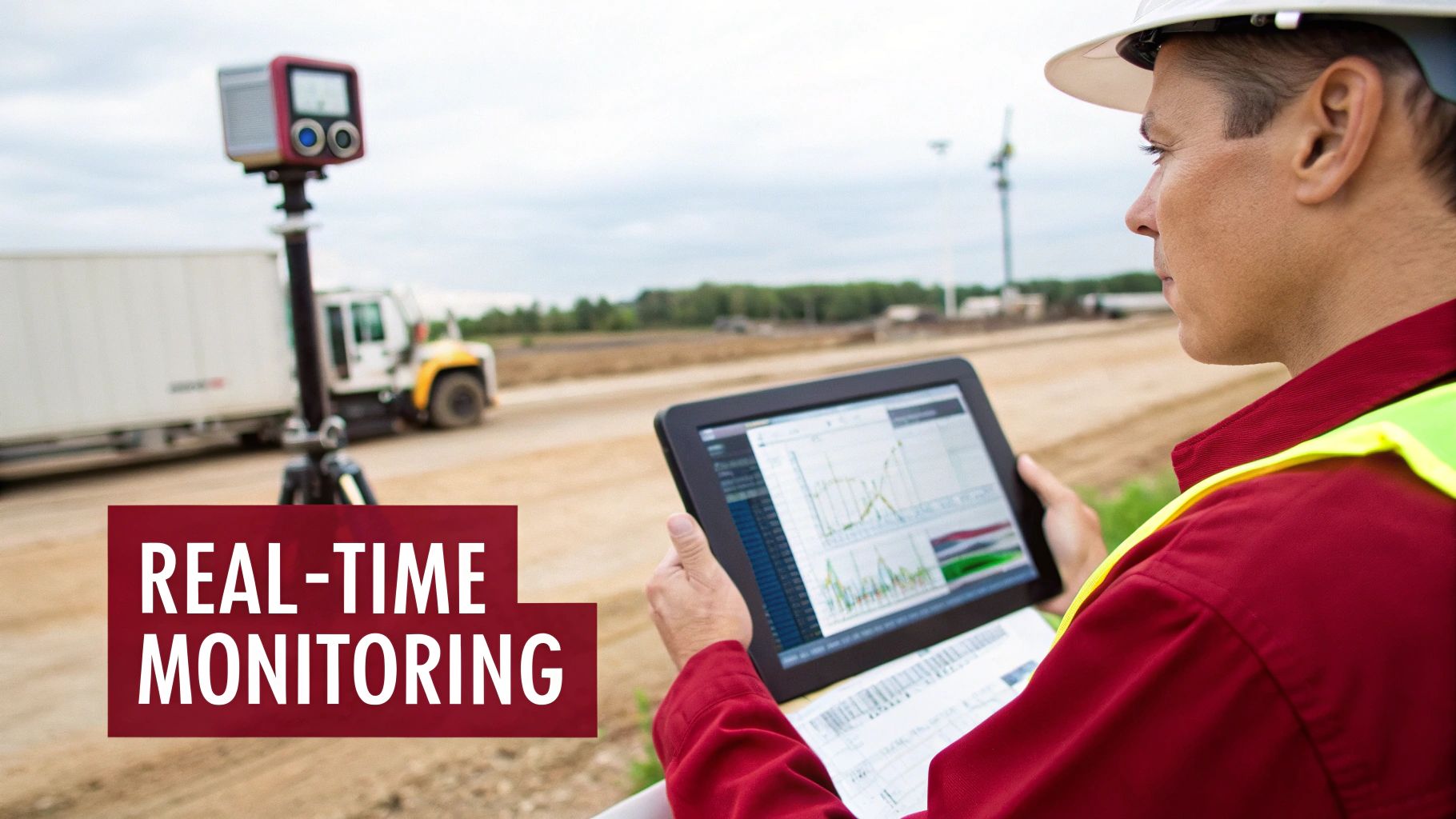
The third piece of the puzzle is direct-reading, or real-time, monitors. These instruments give you instant data on dust levels, often using light-scattering technology (photometers). Unlike the traditional samplers that need a trip to the lab, these give you a live feed of what's in the air, right now.
That immediacy is their biggest plus. A real-time monitor can sound an alarm the moment dust levels spike, letting you step in and fix the problem immediately. They are the perfect tool for pinpointing exactly which tasks or processes are kicking up the most dust.
But—and this is a big but—they don’t replace traditional gravimetric sampling. They provide a very useful estimate, not the precise, legally-defensible measurement needed for compliance. The smartest approach is often a mix of both: using real-time monitors for your day-to-day management and personal samplers for your formal compliance assessments.
Comparison of Dust Monitoring Equipment
Choosing the right equipment depends entirely on your goal. The table below breaks down the main options to help you decide which tool fits your specific respirable dust monitoring needs.
| Equipment Type | Primary Use | Data Type | Key Advantages | Key Limitations |
|---|---|---|---|---|
| Personal Samplers | Regulatory Compliance, Individual TWA Exposure | Gravimetric (Lab-Based) | High Accuracy, Legally Defensible | Delayed Results, No Instant Feedback |
| Area/Static Monitors | Assessing Control Effectiveness, Mapping Hotspots | Gravimetric or Real-Time | Provides Baseline Data for a Zone | Not Representative of Personal Exposure |
| Direct-Reading Instruments | Task Analysis, Instant Alerts, Trend Spotting | Real-Time (e.g., mg/m³) | Immediate Data, Proactive Management | Less Accurate, Not for Formal Compliance |
Ultimately, a well-rounded monitoring strategy often involves a combination of these tools. Personal samplers give you the legally required data, while real-time instruments provide the day-to-day insights you need to keep those exposure levels down in the first place.
How to Develop a Strategic Monitoring Plan
A truly effective respirable dust monitoring program is so much more than just collecting data. It's a strategic process, one that’s carefully designed to paint a complete, actionable picture of what’s happening in your workplace. When you build a robust plan from the ground up, every single sample you collect has a clear purpose. This approach is what turns raw numbers into a powerful story that drives real safety improvements.
A well-designed plan always starts with one fundamental question: what are we trying to achieve? Your objectives will dictate the entire strategy, from the equipment you choose to how often you sample. Without clear goals, you’re just shooting in the dark, collecting data that’s unfocused and ultimately useless for making meaningful safety decisions.
Defining Clear Monitoring Objectives
Before you even think about deploying a single air pump, you need to nail down what you hope to accomplish. Are you trying to meet regulatory compliance, prove a new engineering control is working, or pinpoint high-risk tasks? Each of these goals demands a completely different approach.
Common objectives for a monitoring plan often include:
- Baseline Assessment: Getting an initial snapshot of exposure levels across the entire workplace.
- Compliance Verification: Making sure worker exposures stay safely below the legal Workplace Exposure Standards (WES).
- Control Efficacy Testing: Measuring how well your dust control measures, like ventilation or water suppression systems, are actually performing on the ground.
- Task-Specific Risk Analysis: Pinpointing the specific jobs or activities that generate the highest levels of respirable dust.
Defining these goals upfront ensures your efforts are targeted and efficient. It means you’ll get clear answers to your most pressing safety questions. For instance, understanding the specific rules for different contaminants is critical. You can learn more about the workplace exposure standard for respirable crystalline silica to see just how much these regulations shape your monitoring goals.
Identifying Similar Exposure Groups
Let’s be realistic—it's often impractical and unnecessary to monitor every single worker. A much smarter way to go about it is to group employees into Similar Exposure Groups (SEGs). An SEG is simply a group of workers who do similar tasks and, as a result, are expected to have pretty similar exposure profiles.
For example, all the jackhammer operators on a construction site could form one SEG, while the welders form another. By sampling a representative portion of workers from each SEG, you can confidently apply those results to the whole group. This method makes your monitoring program far more manageable and cost-effective, all without sacrificing accuracy. When building out a plan, it's vital to consider the unique challenges of different industries, such as those found in responsible mining operations.
The Importance of Contextual Data
Simply collecting a dust sample just isn't enough. That number on the lab report is meaningless without context. To get reliable, actionable insights, you have to meticulously record what was actually happening while the sample was being collected.
A monitoring result without contextual data is just a number. A result with detailed observations is an insight. It tells you the 'why' behind the 'what', empowering you to make targeted improvements.
This contextual information is what transforms your data from a simple measurement into a powerful diagnostic tool.
Take, for example, a study of lithium mine workers in Western Australia. Researchers collected a massive 1,122 observations between 2017 and 2023. The monitoring plan was significantly bolstered from 2019 onwards with in-field observations by Mine Air Quality Officers, which massively improved the data’s reliability. The lack of detailed context from 2017-2018 was specifically noted as a limitation, highlighting just how crucial these on-the-ground observations really are.
Here’s the kind of essential data you should be recording:
- Specific Tasks Performed: Was the worker cutting, grinding, or drilling?
- Control Measures in Use: Was the local exhaust ventilation on? Was the water suppression system active?
- Environmental Conditions: Was the work happening indoors or outdoors? Was it a particularly windy day?
- Work Duration and Frequency: How long did that high-exposure task actually last?
This kind of detailed record-keeping is the absolute backbone of a successful respirable dust monitoring plan. It’s what allows you to spot patterns, troubleshoot problems, and confirm that your safety controls are doing their job in the real world.
So You've Got the Data – Now What? Turning Numbers into Action
Getting your respirable dust monitoring program up and running is a huge first step. But at the end of the day, all you have is a spreadsheet full of numbers. The real work—and the real value—starts when you turn that raw data into a clear story about what’s happening in your workplace. This is where you go from just collecting data to actually preventing harm.
Interpreting your results is much more than just a simple pass/fail check against the legal limits. A number below the Workplace Exposure Standard (WES) doesn’t automatically mean a work area is safe. And a number above it isn't just a failure—it’s your most important signal that something needs to change, right now. The real skill is digging into the why behind every measurement.
Moving Beyond a "Tick-the-Box" Mentality
Of course, the first thing you'll do is compare your results to Australia's Workplace Exposure Standards. These are the legal lines in the sand, setting the maximum acceptable level of a contaminant over an eight-hour shift. But a truly effective safety culture doesn't aim to just scrape by under the limit. The goal should always be to keep exposures As Low As Reasonably Practicable (ALARP).
Just meeting the standard is the bare minimum. Smart risk management is about looking for trends. Are dust levels slowly creeping up over time? It could be a sign that your control measures are losing their effectiveness or that work habits are slipping. This kind of proactive analysis lets you step in and fix a problem long before you get a formal exceedance.
Think of an exceedance not as a failure of your monitoring program, but as its greatest success. It has done its job perfectly by flagging a high-risk situation that needs immediate attention, giving you the chance to protect your workers before more harm is done.
This shift in thinking moves the focus from paperwork and compliance to what really matters: people's health.
Pinpointing Risky Tasks and Hot Spots
Your monitoring data, when you look closely, tells a story about the daily rhythm of dust exposure at your site. By matching the numbers with the notes you took on activities, locations, and conditions, you can start to connect the dots. You can pinpoint exactly which tasks, which areas, or even which times of day are the biggest problems.
For example, you might see that one worker's exposure levels always spike on the days they’re using a specific grinder. That’s your cue to investigate. Is the dust shroud on the tool cracked? Is the vacuum system clogged? Does the worker need a refresher on how to position themselves correctly? This is how a monitoring program becomes a powerful diagnostic tool.
Are Your Dust Controls Actually Working?
One of the best uses for your data is to get hard proof on whether your engineering controls are doing their job. Did you just spend a fortune on a new local exhaust ventilation system or switch to wet-cutting methods? Respirable dust monitoring gives you the objective evidence to show if that investment paid off.
It’s a straightforward validation process:
- Get a Baseline: Measure exposure levels before you introduce the new control. This tells you where you started.
- Make the Change: Install the new ventilation or implement the new wet method.
- Measure Again: Repeat the monitoring under the same work conditions to see what the new exposure levels are.
If you see a big drop in the numbers, you have concrete proof that your solution is working. But if the numbers barely budge? That’s an equally important signal that the control isn't performing as you’d hoped, and you need to go back to the drawing board.
This evidence-based approach helps you make smarter, more cost-effective safety decisions. We know this works on a large scale, too. A major study in Western Australia's mining industry reviewed 8,561 respirable dust samples taken between 2001 and 2012. It found a consistent drop in exposures over the decade, with only 0.9% of samples exceeding the limit. This success was chalked up to stronger regulations and better industry-wide controls. You can read more about these findings on dust exposure trends in mining.
Your Respirable Dust Monitoring Questions, Answered
Even with the best plan in place, questions always pop up when you're on the ground running a respirable dust monitoring program. It's completely normal. Whether you're a safety manager trying to get a new system off the ground or a worker wondering about the gear you're being asked to wear, getting clear answers is key. It builds trust and makes sure everyone understands why this is so important.
Let's walk through some of the most common questions heard in the field. The goal is to provide straightforward answers that will help you keep your monitoring strategy effective and robust.
How Often Should We Be Monitoring?
This is probably the number one question asked, and the truth is, there's no single answer. "Once a year" just doesn't cut it. The frequency of your monitoring has to be tied directly to the level of risk your team faces. It's not about ticking a box on a schedule; it’s a living process that adapts to your specific conditions.
A solid, risk-based approach is always the best way to go:
- High-Risk Environments: In places where people are constantly around high dust levels—think abrasive blasting or cutting concrete all day—you need to be checking much more often. That could mean quarterly, or in some cases, even monthly.
- Moderate-Risk Environments: For jobs where exposure is a bit more sporadic or at lower levels, an annual check-up is often enough to make sure your control measures are still holding up.
- When Things Change: This one is non-negotiable. You always need to monitor after a significant change. That means bringing in new machinery, tweaking a work process, or switching to a different material.
Think of it like checking the air in your car's tyres. You might glance at them regularly, but you'd absolutely do a proper pressure check before a long road trip. The same logic applies here—the bigger the risk, the more often you need to look.
Why Is Equipment Calibration Such a Big Deal?
In short, calibration is what makes your data trustworthy. It's the essential process of checking your monitoring equipment against a known standard to make sure it's giving you accurate numbers. Without proper, documented calibration, the data you collect is practically useless. Worse, it won't stand up to scrutiny if things go wrong.
It’s a bit like trying to bake a cake using measuring cups that you don't know are the right size. You could follow the recipe to the letter, but the end result will be a mess.
An uncalibrated air monitoring pump is like a dodgy speedometer. It’ll give you a number, but you have no real idea if you’re doing 60 km/h or 80 km/h. Calibration is what gives you confidence that the data you're using to protect people's health is actually correct.
Pumps need to be calibrated both before and after every single sample is taken. This confirms the flow rate didn't drift during the day, which is the only way to know the exact volume of air you sampled—a critical piece of the puzzle for calculating an accurate dust concentration.
What Do We Do If a Result Comes Back Over the Limit?
Seeing a result that exceeds the Workplace Exposure Standard (WES) is a red flag. It’s a clear signal that a worker has been exposed to a potentially harmful amount of dust and your current safety controls have failed. This requires immediate action.
When a result comes in over the WES, you need a clear plan:
- Stop the Task: If the exposure is dangerously high, the first priority might be to stop that specific job until the hazard is under control.
- Dig Into the 'Why': You have to investigate what went wrong. Did the ventilation system break down? Was someone not following the correct procedure? Was the RPE not fitted correctly?
- Fix the Problem: Based on what you find, you need to implement better controls. This could mean anything from repairing equipment and improving work practices to providing a higher level of respiratory protection.
- Check Your Fix: Once the new controls are in place, you must monitor again. This is the only way to prove that your solution has actually worked and brought exposure down to a safe level.
An exceedance isn't just a number on a page; it’s a crucial lesson that points to a weak spot in your safety system that needs to be fixed.
Can We Use Those Real-Time Monitors for Compliance?
Real-time dust monitors are fantastic tools for day-to-day management, but in Australia, they are not typically used for official compliance reporting. When it comes to legally demonstrating compliance for things like respirable silica, the gold standard is still gravimetric sampling. That’s the traditional method where we collect a sample on a filter over a full shift and send it to a lab to be weighed.
Real-time devices, which often work by scattering light off particles, are brilliant for spotting trends, doing a quick check on controls, or warning workers about a sudden spike in dust. However, their readings can be thrown off by different particle sizes and types, so they lack the pinpoint accuracy of the lab-based method that the regulations demand.
The best approach uses both. Use real-time instruments for proactive, daily management, and use formal gravimetric sampling to prove you're meeting your legal obligations.


