
Quick Summary: Failing to disclose hidden contamination, such as chemical spills, asbestos, or meth residue, can lead to severe legal and financial consequences in Australia. This regulatory FAQ guide covers the key legal liabilities, including civil lawsuits, regulatory penalties, and criminal charges, emphasizing the strict duty for property owners and company directors to investigate, manage, and disclose known or suspected contamination.
Keeping quiet about known hidden contamination on a property is a massive legal gamble that can trigger crippling financial penalties and destroy your reputation. The legal liabilities for non-disclosure of hidden contamination are woven into a complex web of Australian federal, state, and common laws. This creates a clear and strict responsibility for businesses and individuals to be transparent. This duty of disclosure and regulatory compliance applies whether you're selling a factory, leasing a warehouse, or dealing with a property affected by meth contamination.
The Foundation Of Your Disclosure Obligations
At the heart of it all is a fundamental legal principle called the duty of care. It’s a simple concept: you must take reasonable steps to avoid causing harm to others that you could have predicted.
When we're talking about hidden contamination—like old chemical spills, buried asbestos, or lingering meth residue from previous tenants—this duty becomes an active obligation. You can't just turn a blind eye; you have to actively look for and disclose these risks.
Ignoring this duty opens the door to claims of negligence. Someone who suffers loss or harm can argue you didn't act as a reasonably prudent person or company would have in the same situation. The fallout can be huge, affecting property developers, manufacturers, and even company directors who are expected to have a handle on these critical regulatory compliance issues.
Core Legal Principles At Play
So, where do these obligations actually come from? To get a grip on your responsibilities, you need to understand the main legal frameworks that regulators and courts rely on.
Here’s a quick overview of the key legal principles that create liability for not disclosing hidden contamination.
Key Legal Frameworks for Contamination Disclosure in Australia
| Legal Principle | Governing Law or Doctrine | What This Means for Your Business |
|---|---|---|
| Misleading or Deceptive Conduct | Australian Consumer Law (ACL) | You can’t mislead people, even by staying silent. If a buyer would reasonably expect to be told about soil contamination or meth residue, not mentioning it can be illegal. |
| Common Law Misrepresentation | Case Law and Precedent | If you make false statements or knowingly hide major defects like meth contamination that make a property unsafe, you can be sued separately from any consumer law breaches. |
| Statutory Duties | State Environmental & Health Acts | These laws impose direct, non-negotiable duties to report contamination to authorities like the EPA. "I didn't know" is often not a valid excuse in matters of regulatory compliance. |
These principles aren't just theoretical; they have real-world teeth and are actively enforced across the country.
A crucial part of this legal puzzle involves what you're required to reveal when selling a property. The specifics are detailed in documents like a Sellers Disclosure Of Property Condition, which directly covers material defects and hazards like hidden contamination.
What This Looks Like In The Real World
Let’s make this practical. Imagine a manufacturing company sells its old factory site to a developer but "forgets" to mention its long history of solvent spills that have seeped into the soil. When the developer inevitably discovers the contamination during excavation, the original owner is squarely in the firing line for misleading conduct and likely breach of contract.
Here's another one: a landlord rents out a house without disclosing it was previously used as a meth lab and wasn't properly decontaminated. If the new tenants get sick from meth residue, that landlord is facing a significant liability claim for the health issues caused. These examples show why being proactive with disclosure isn't just about ethics—it’s a fundamental part of managing your risk and ensuring regulatory compliance.
The Rise of Consumer-Led Class Actions
For decades, the biggest legal headache for environmental contamination came from regulators like the EPA. If you had an issue, they were the ones you’d be dealing with. But that reality is changing, and fast.
Today, some of the most significant legal liabilities for non-disclosure of hidden contamination don't come from government agencies at all. They come from organised groups of everyday people—consumers and community members—banding together. This new wave of litigation puts manufacturers and businesses squarely in the crosshairs, facing massive, financially crippling class action lawsuits. It's a powerful shift, proving that the public is now holding companies directly accountable for the hidden risks on their properties and in their products.

The 3M PFAS Case: A Landmark Shift
If you need a case study on how the game has changed, look no further than the recent consumer-led class action filed against 3M Australia. This case is a flashing red light for any business that handles potentially hazardous materials.
In December 2024, a landmark lawsuit was filed against 3M Australia Pty Ltd in the Supreme Court of Victoria. The core of the case centres on the severe legal fallout from not disclosing hidden PFAS contamination risks in their products. The allegations are serious: 3M is accused of misleading or deceptive conduct under Australian Consumer Law for selling products with PFAS without telling consumers they could contaminate water sources. The claims also cover a breach of duty of care and even public nuisance due to the widespread environmental presence of PFAS.
This lawsuit isn't just an environmental dispute; it’s been cleverly framed as a consumer rights issue. The central argument is that the company knew about the risks, kept quiet, and in doing so, misled the public and caused widespread harm.
By leaning on the Australian Consumer Law, the plaintiffs have opened a completely new front in contamination litigation. This strategy lets them sidestep the often slow and complicated regulatory channels, allowing affected people to seek direct compensation for a whole host of damages.
The Ripple Effect Across Industries
The implications of this legal approach stretch far beyond chemical manufacturers. Any industry whose operations or products could lead to undisclosed contamination needs to be paying very close attention. This includes sectors like:
- Aerospace: Using industrial solvents and chemicals that could seep into surrounding land and water.
- Pharmaceuticals: Manufacturing processes that involve compounds which, if mismanaged, could contaminate the environment.
- Agribusiness: Relying on pesticides and fertilisers that might have long-term, undisclosed effects on soil and water tables.
- Construction and Mining: Disturbing land with historical contamination or using materials that contain hidden hazardous components.
- Real Estate: Landlords and property managers who fail to disclose issues like meth contamination in residential or commercial properties.
No matter the industry, the legal argument is the same: if you sell a product or a piece of land with a hidden risk, you could be setting yourself up for an enormous legal battle.
Broadening The Scope Of Damages
These consumer-led class actions aren't just about getting money for an environmental cleanup. Their claims are often much broader, seeking compensation for a wide range of impacts.
- Property Devaluation: This is frequently the biggest ticket item. Homeowners and landowners argue their property values have tanked because of the contamination stigma and reality.
- Cleanup and Remediation Costs: Plaintiffs will also seek damages to cover the real-world cost of removing contaminants from their land and water.
- Mental Distress and Anguish: Australian courts are increasingly recognising claims for the psychological toll of living with contamination—the anxiety over health risks and the stress of financial ruin.
- Loss of Livelihood: Businesses like farms or fisheries that can no longer operate because of contamination can claim for their lost income.
This expansion of what can be claimed dramatically raises the financial stakes. For any business, understanding the regulatory faq: legal liabilities for non-disclosure of hidden contamination now means preparing for direct litigation from the public. Hiding contamination is no longer a simple compliance problem—it's a massive litigation risk that could threaten the very survival of your company.
How to Navigate State-Based Contaminated Land Acts
While consumer law and class actions are a huge risk, the most direct and potent legal trouble for not disclosing hidden contamination usually comes from state-specific laws. Each Australian state and territory has its own rulebook for managing contaminated land, creating a complex web of duties that can easily trip up the unprepared.
These aren't just gentle guidelines; they are strict legal obligations with real consequences. Getting it wrong can lead to crippling fines, legally binding clean-up orders, and even criminal charges for company directors. These laws are the main weapon regulators use to hold businesses accountable for pollution, whether it happened last week or fifty years ago.
Understanding the Core Duty to Report
At the heart of all this legislation is a mandatory duty to report. What does this mean? It's simple: if you own or manage a site and discover contamination that hits a certain threshold—usually defined as causing or threatening serious harm to people or the environment—you are legally forced to tell the relevant state authority.
This is not a passive responsibility. The law doesn't just expect you to act if you stumble across a problem. It often demands that landowners and occupiers actively look into their properties, especially if the site's history suggests a risk. To get this right, a solid grasp of broader Environmental Law principles is absolutely essential, as these state acts are built on that foundation.
The scale of this hidden risk is staggering. After a decade-long project, spatial intelligence firm Lotsearch mapped over 260,000 known and potential contamination hotspots across Australia. Think old petrol stations, forgotten factories, and former zinc manufacturers. For industries like construction and mining, these sites are ticking legal time bombs where past activities may have polluted the land without anyone telling the current owners.
The Role of State Regulators
When contamination is reported or discovered, state regulators get involved. These are powerful agencies with the authority to investigate, enforce compliance, and make life very difficult for businesses that don't cooperate.
The main players you'll deal with are:
- Environmental Protection Authority (EPA): This is the primary regulator in most states (like the NSW EPA or EPA Victoria). They're the ones who investigate, issue clean-up orders, and prosecute breaches.
- Contaminated Sites Committees: Some states, like Western Australia, have specialised bodies that classify contaminated sites and handle appeals.
- Local Councils: They often play a role in managing land use, approving developments, and dealing with less severe contamination through local planning rules.
These regulators can issue legally binding notices that force you to take action. This could mean anything from conducting detailed site investigations and carrying out expensive remediation work to restricting how the land can be used until it’s declared safe.
The most crucial lesson for any business is this: claiming you "didn't know" is almost never a valid defence. Regulators work on the assumption that a professional landowner should be aware of their site's history and the potential risks that come with it.
The Greenland Resources Case: A Stark Warning
If you need a real-world example of how these laws bite, look no further than the Western Australian case of Greenland Resources Pty Ltd v Contaminated Sites Committee. It's a powerful reminder of how even a "possible" risk can trigger very real legal duties.
In this case, the court backed a decision to classify a site as "possibly contaminated – investigation required." The critical point was that the site's history—which included activities linked to mining—was enough on its own to create a reasonable suspicion of contamination. This ruling confirms you don't need a smoking gun or definitive proof of pollution to be legally on the hook.
The mere possibility, based on historical records, is enough to force you to investigate and report. This precedent firmly places the burden on businesses in sectors like mining, manufacturing, and property development to do their homework. It highlights a critical point in the regulatory faq: legal liabilities for non-disclosure of hidden contamination—failing to investigate a credible risk is just as serious as failing to disclose a known one. This case shows that waiting for absolute certainty is a dangerously flawed strategy that regulators and courts simply won't accept.
Lessons from the Courtroom: Toxic Torts and Plummeting Property Values
While government penalties can sting, they're often just the beginning. The real knockout punch for a business that fails to disclose contamination usually comes from the community itself, through what the legal world calls 'toxic tort' lawsuits.
Think of these as civil claims brought by ordinary people who've been harmed by exposure to hazardous substances. When a business keeps contamination a secret, it’s not just breaking a rule—it’s breaking a fundamental trust with its neighbours. The legal battles that follow can cripple a company financially and destroy its reputation in ways no government fine ever could. These cases show the true price of silence.
A Sobering Example: The Williamtown PFAS Contamination Cases
If you want to see just how devastating a toxic tort claim can be, look no further than the class-action lawsuits concerning PFAS contamination from Australian Defence sites. It's a textbook example of what happens when toxic chemicals silently seep into a community.
The class actions in places like Williamtown and Richmond revealed the crushing financial reality of non-disclosure. Residents successfully sued for compensation covering everything from the nosedive their property values took to the mental anguish of living with the constant fear of health impacts. A 2021 legal geography study found that thousands of people living near RAAF bases were affected after firefighting foams containing PFAS contaminated local soil, waterways, and even their garden vegetables.
The result? Home values in the contamination zones plummeted by as much as 50%. This lawsuit wasn't just about an environmental cleanup; it was about real people suffering tangible, life-altering losses because of a problem they never knew existed.
How These Court Cases Relate to Your Business
The legal lessons from the PFAS cases aren't limited to "forever chemicals" or military bases. The core principles apply across the board. If you fail to disclose a known risk and it causes someone harm, you're opening the door to massive liability. It’s that simple.
Let’s bring this down to earth with a few examples:
- A mine operator allows water tainted with heavy metals to leak into a local river. Downstream, farmers could launch a class action for contaminated land and sick livestock.
- A property manager rents out a house without revealing it was once a meth lab. The new tenants could sue for health issues caused by the chemical residues left behind.
- A factory owner sells a site without mentioning historical solvent spills. The new developer who buys the land could sue for the sky-high cleanup costs and project delays they now face.
In every one of these scenarios, the legal trigger is the same: someone failed to disclose hidden contamination, and that failure directly caused financial loss, property devaluation, or health problems for someone else. This is the heart of toxic tort liability.
Beyond the Bottom Line: The Unseen Cost to Public Trust
The multi-million dollar settlements grab the headlines, but the long-term reputational damage can be far worse. Breaking the public's trust is easy; earning it back is incredibly difficult.
A business that gets labelled as a polluter that covered its tracks will find it tough to attract investors, win government contracts, or even keep its customers. This gets to the core of our regulatory faq: legal liabilities for non-disclosure of hidden contamination. The ultimate cost of staying quiet isn't just measured in legal fees and payouts. It's measured in the loss of your social licence—the community's unspoken permission for you to do business. Once that's gone, the future of your entire operation is at risk.
Implementing Proactive Risk Management and Disclosure Strategies
Understanding the legal minefield of non-disclosure is one thing, but actively managing those risks is what really separates a prepared business from a future lawsuit. A proactive approach isn't just about ticking compliance boxes; it’s about building a solid defence against the severe legal liabilities for non-disclosure of hidden contamination. Think of it as building a framework that protects your assets, your reputation, and your company's future.
Putting theory into practice means having a clear, strategic plan. It all starts with rigorous investigation and carries through to transparent communication, transforming what could be a crippling liability into a manageable business challenge.
The consequences of getting this wrong are severe. The decision to hide contamination can set off a disastrous chain reaction, as this diagram shows.
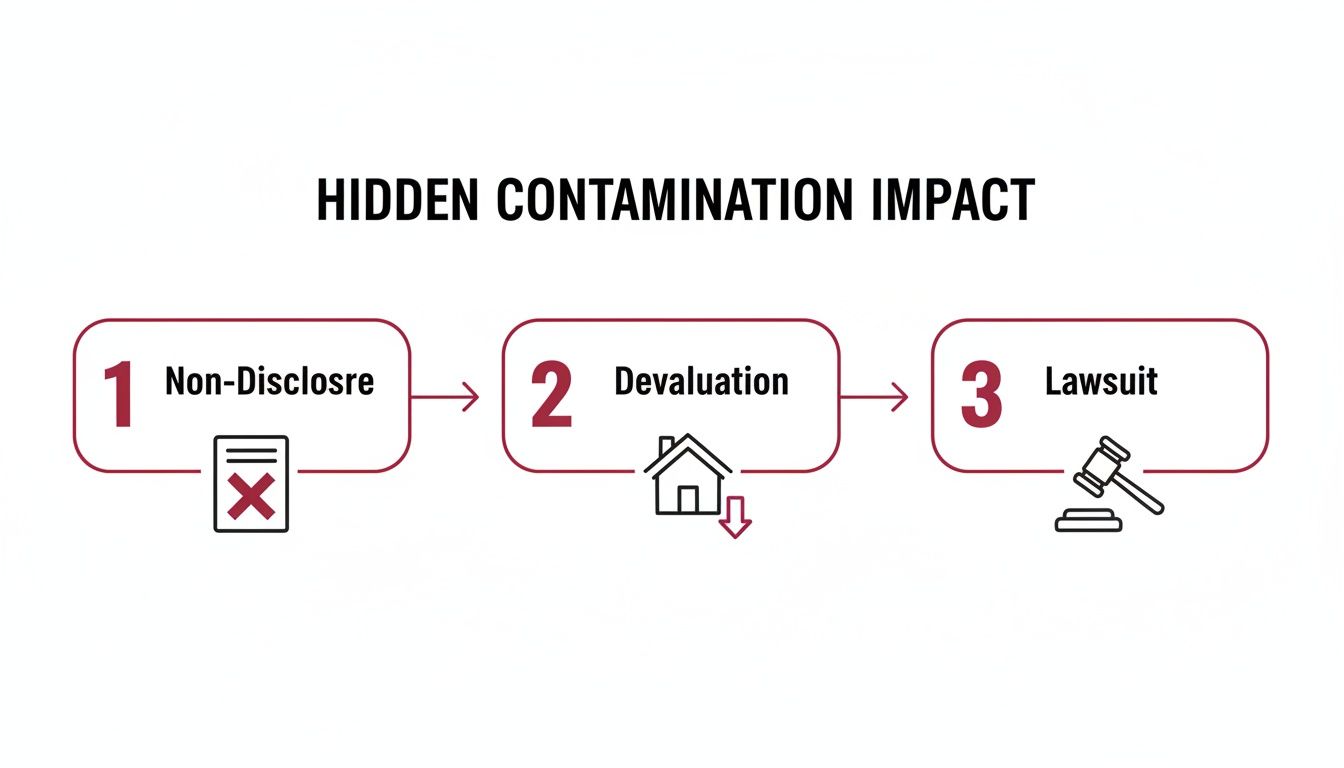
It’s a straightforward path from a single bad decision to a devalued asset and, almost inevitably, a costly legal battle.
Start with Comprehensive Due Diligence
The absolute bedrock of any smart risk management strategy is thorough due diligence. Whether you're acquiring a new commercial or industrial property or just assessing a site you already own, a detailed investigation is non-negotiable.
This goes far beyond a quick walk-around. A proper Environmental Site Assessment (ESA) is the gold standard here. It's a methodical process, usually broken down into phases:
- Phase I ESA: This is the detective work. It’s a non-intrusive review of historical records, old aerial photos, and government databases to flag potential contamination risks based on how the land was used in the past.
- Phase II ESA: If Phase I raises red flags, this is where you get your hands dirty. It involves taking physical samples of soil, groundwater, and even soil vapour and sending them to a lab to confirm what contaminants are there and how widespread they are. For properties with a risk of prior drug activity, this would include testing for meth contamination.
This due diligence gives you the hard facts you need to make informed decisions. You’ll know exactly what you’re up against.
Develop a Contamination Management Plan
Once contamination has been confirmed, your next move is to create a formal Contamination Management Plan (CMP). This isn't just an internal document; it's a strategic roadmap for tackling the problem that regulators will often expect to see.
A solid CMP needs to cover a few key areas:
- Containment Measures: What are you doing right now to stop the contamination from spreading?
- Remediation Strategy: This is the long-term cleanup plan, detailing the methods, timelines, and expected costs. This is especially crucial for meth contamination, which requires specialized cleaning protocols.
- Ongoing Monitoring: How will you prove the cleanup is working? This means a schedule for regular testing to track progress and spot new issues.
- Stakeholder Communication: Who needs to be told what, and when? This includes regulators, employees, and sometimes the public.
This plan shows authorities like the EPA that you’re taking the situation seriously and have a professional process in place to handle it.
A well-documented CMP is more than just a practical tool—it becomes a crucial piece of evidence in your legal defence. It proves you acted responsibly as soon as you discovered the problem, which can go a long way in reducing penalties and liability claims.
Understand and Fulfil Reporting Obligations
One of the biggest blunders a business can make is to drag its feet on reporting. As we've covered, every Australian state has laws that compel you to report contamination that poses a significant risk of harm. Don't delay.
Knowing who to tell and by when is critical. Your first call will almost always be to your state's Environmental Protection Authority (EPA). But depending on the situation—say, if there's a risk of workplace exposure—you might also need to notify agencies like WorkSafe. For certain property types and hazards, the rules can be very specific; it’s worth understanding the mandatory disclosures for landlords and property managers to see how these duties play out in different scenarios.
Failing to report on time is an offence in its own right and can attract hefty fines, turning a bad situation into a catastrophic one. Always get legal advice to clarify your exact deadlines. Being upfront with regulators is seen as an act of good faith and almost always leads to a more cooperative outcome than if they discover the issue on their own.
Follow these steps to proactively manage and mitigate the legal and financial risks associated with hidden contamination.
| Phase | Key Action | Primary Objective |
|---|---|---|
| Investigation | Conduct a thorough Environmental Site Assessment (ESA) – Phase I and II. | To identify and quantify the nature and extent of any contamination, including meth residue. |
| Planning | Develop a formal Contamination Management Plan (CMP). | To create a clear, documented strategy for containment, remediation, and monitoring. |
| Compliance | Identify and fulfil all mandatory reporting obligations to regulators (EPA, WorkSafe). | To comply with statutory duties and avoid penalties for non-reporting. |
| Communication | Implement a transparent disclosure strategy for all relevant stakeholders. | To manage legal duties, build trust, and protect the company's reputation. |
| Contractual | Draft clear indemnities, warranties, and liability clauses in all transactions. | To legally allocate risk and financial responsibility for contamination issues. |
By systematically working through these phases, you can transform a reactive crisis into a well-managed process, significantly reducing your legal exposure and protecting your business's long-term health.
Your Top Questions on Contamination Liability Answered
Digging into contamination law can feel like a minefield. To clear things up, we've tackled the most common questions business owners and property managers have about the legal fallout from not disclosing hidden contamination. Think of this as your practical guide to understanding your duties and keeping your business protected.
Who’s on the Hook for Disclosing Hidden Contamination in a Property Sale?
In Australia, the buck almost always stops with the seller. If you’re selling a property, you have a legal responsibility to disclose any known hidden contamination. It’s not just good practice; it's a requirement under both the Australian Consumer Law and long-standing common law.
Deliberately keeping quiet about a major issue like soil or meth contamination is seen as misleading or deceptive conduct. On top of that, state environmental laws often pile on their own strict disclosure rules for property owners. While a smart buyer will always do their own homework, the law puts the burden squarely on the seller to be upfront about known problems. It's your best defence against lawsuits and regulatory heat down the track.
What’s the First Move if My Company Suspects Historical Contamination?
If you've got a gut feeling your property might be contaminated from past activities, you need to act—fast. Your very first call should be to a qualified environmental consultant to carry out a Preliminary Site Investigation (PSI).
A PSI is essentially a historical deep-dive and a surface-level check of your property. It’s non-invasive and helps figure out the chances of contamination and what you might be dealing with. Whatever you do, don't start digging or try to cover things up. That can make your legal situation a whole lot worse. At the same time, get legal advice to understand your duty to report the suspicion to your state's environmental protection agency (EPA). Most states have tight deadlines for reporting.
Remember, the clock starts ticking the moment you have a reasonable suspicion of contamination. Hesitating or failing to report looks like you're trying to dodge your responsibilities, and that’s a surefire way to face tougher penalties.
Can Our Business Be Liable for Contamination Caused by a Previous Owner?
Yes, absolutely. Even if you didn't cause the mess, you can still be held responsible for contamination left by a previous owner. While Australia's environmental laws generally follow a 'polluter pays' principle, that’s not a get-out-of-jail-free card for the current landowner.
Think about it: if the original polluter is long gone, out of business, or can't afford the clean-up, the authorities will look to the current owner. Their main goal is to make the land safe, and they'll hold whoever is in charge now accountable. This is exactly why doing thorough environmental due diligence before you buy any commercial or industrial site is non-negotiable. It’s your only real shield against inheriting an environmental, legal, and financial nightmare.
How Does Meth Contamination Fit into All This?
Methamphetamine (meth) residue isn't just a health issue; it's a serious legal one. It's considered a significant hazard and falls directly under hidden contamination liabilities. For landlords, property managers, and sellers, failing to test for and disclose meth contamination from a property’s past is playing with fire.
The legal risks come from several directions:
- Breach of Tenancy Agreements: You have a duty to provide tenants with a safe and liveable home.
- Misleading Conduct in Property Sales: A history of meth manufacturing is a massive red flag that would definitely influence a buyer's decision.
- Negligence Claims: If someone gets sick from exposure, they can sue you for damages.
Just like with industrial chemicals, you have a clear duty of care. You must ensure the property is safe for people to live or work in and disclose any known hazards like meth contamination that could harm their health.
What Role Does Insurance Play in Managing These Risks?
Here's a critical point many businesses miss: your standard Commercial General Liability policy is likely useless here. Almost all of them have an absolute pollution exclusion, which means they will not cover claims related to contamination. This leaves a massive, and potentially business-ending, gap in your coverage.
To properly cover your bases, you need a specialised Pollution Liability Insurance policy. This is tailor-made to handle the costs that come with a contamination event, including:
- The actual clean-up and remediation work.
- Legal fees to defend yourself against lawsuits.
- Claims from third parties for property damage or health problems.
Without this specific insurance, your business would be on the hook for every single dollar of these potentially catastrophic costs. It's an essential risk management tool for any company that owns property or works with potentially hazardous materials.
At Anitech, we specialise in identifying and assessing workplace hazards, including chemical and biological contaminants. Our expert occupational hygiene services help businesses across Australia meet their regulatory obligations and ensure a safe environment. From initial site assessments to developing robust management plans, we provide the scientific expertise you need to confidently manage your contamination risks. Protect your business and your people by visiting us at https://occhygiene.com.au to learn more.


