
Quick Summary: Discovering a property was a clandestine lab triggers a severe valuation drop, often 40-60%, due to a trifecta of financial, legal, and health risks. This guide details how to quantify this loss by analysing remediation costs, adapting standard appraisal models, and calculating the persistent market stigma. Accurately assessing these factors is crucial for risk management, insurance claims, and making sound financial decisions on a compromised asset.
When you discover a property was once used as a clandestine drug lab, you're not just looking at a stain on its history—you're looking at a financial black hole. The hit to the property's value can be staggering, often slashing it by 40-60%. This isn't just about a bad reputation; it's a direct result of eye-watering remediation costs, deep-seated market stigma, and the very real health risks from chemical residues left behind. This guide will walk you through how to properly measure and quantify these financial impacts.
Figuring out the true cost of a former drug lab goes way beyond getting a few quotes for repairs. It’s a multi-layered analysis that has to account for direct clean-up costs, the long-term stigma that clings to the property, and significant legal and health liabilities. A property’s toxic past completely rewrites its value, often turning what was once a solid asset into a massive financial burden almost overnight.
Financial Risk: The Fallout of a Property's Secret Past
Let's be blunt—finding out a property housed a clandestine lab is a catastrophic event for its valuation. Forget abstract warnings; we need to dig into the real economic damage, especially within the Australian market. The value doesn't just dip; it plummets, thanks to the one-two punch of tangible clean-up bills and the intangible but equally damaging market stigma that can haunt a property for years.
For anyone in the manufacturing, mining, or industrial sectors, this kind of discovery can completely derail operations, torpedo asset values, and trigger a major occupational health and safety crisis. You absolutely need a methodical approach to quantify the financial damage. It’s not just good practice; it's essential for managing the risk effectively.
Understanding the Immediate Devaluation Drivers
A few key factors are responsible for the immediate, sharp decline in value. These aren't just theoretical possibilities; they are concrete, quantifiable costs that any appraiser, insurer, or potential buyer will bake into their assessment from day one.
Before we dive deeper, let's look at the main culprits behind the immediate drop in value. The table below summarises the primary factors and their typical financial weight.
| Factor | Average Financial Impact (AUD) | Typical % of Property Value Lost |
|---|---|---|
| Hazardous Waste Remediation | $20,000 – $150,000+ | 5-25% |
| Structural Damage & Repairs | $10,000 – $80,000 | 2-15% |
| Permanent Market Stigma | Varies (often 10-30% post-remediation) | 10-30% |
| Financing & Insurance Hurdles | N/A (Impacts buyer pool) | 5-10% |
These figures show that the damage is multifaceted, hitting the property's value from several angles simultaneously. It's a combination of direct costs and long-term market perception issues.
Here's a closer look at what's driving those numbers:
- Hazardous Waste Remediation: This is your biggest upfront expense, without a doubt. It requires specialised crews who know how to handle chemical neutralisation and the safe disposal of contaminated materials—think plasterboard, flooring, and even entire HVAC systems.
- Structural Damage Repair: The chemicals used to cook drugs are incredibly corrosive. They can eat away at plumbing, wiring, and even structural timbers, leading to extensive and expensive repairs.
- Market Stigma: This is the ghost that lingers long after the clean-up. Even with a full clearance certificate, the property's history usually has to be disclosed. This permanent black mark scares off a huge portion of the buyer pool, forcing sellers to accept painfully low offers.
- Financing Difficulties: Good luck getting a loan. Many banks and lenders are understandably wary of financing properties with a known history of contamination. This shrinks your pool of potential buyers even further, applying more downward pressure on the price.
Here in Australia, properties tainted by former 'meth labs' suffer severe valuation drops, commonly between 40-60% of what they were worth before the discovery. Take a typical suburban home in Queensland—where nearly 50% of the nation's meth lab busts occur. A house valued at AUD $600,000 could easily see its value crash to between AUD $240,000 and $360,000. That’s before you even factor in the remediation costs, which can run anywhere from $20,000 to over $100,000. To get a better sense of the public health side, it's worth reading the full enHealth guidance on clandestine drug laboratories.
The core issue is that the property is no longer just a building; it's a hazardous site. This classification fundamentally changes its standing in the real estate market, impacting everything from its insurability to its saleability.
Ultimately, putting a real number on these valuation drops isn't just an academic exercise. It’s a crucial step for legal compliance, insurance claims, and making a clear-headed financial decision about a deeply compromised asset.
Getting to Grips with the Contamination Threat
Before you can even begin to talk numbers and property values, you have to understand exactly what you’re dealing with chemically. Trying to calculate the financial hit from a former clandestine lab without a proper contamination assessment is pure guesswork. This data is the foundation for everything that follows—from remediation costs to the final valuation adjustment. Think of it less like a simple inspection and more like a forensic investigation into the property's toxic history.
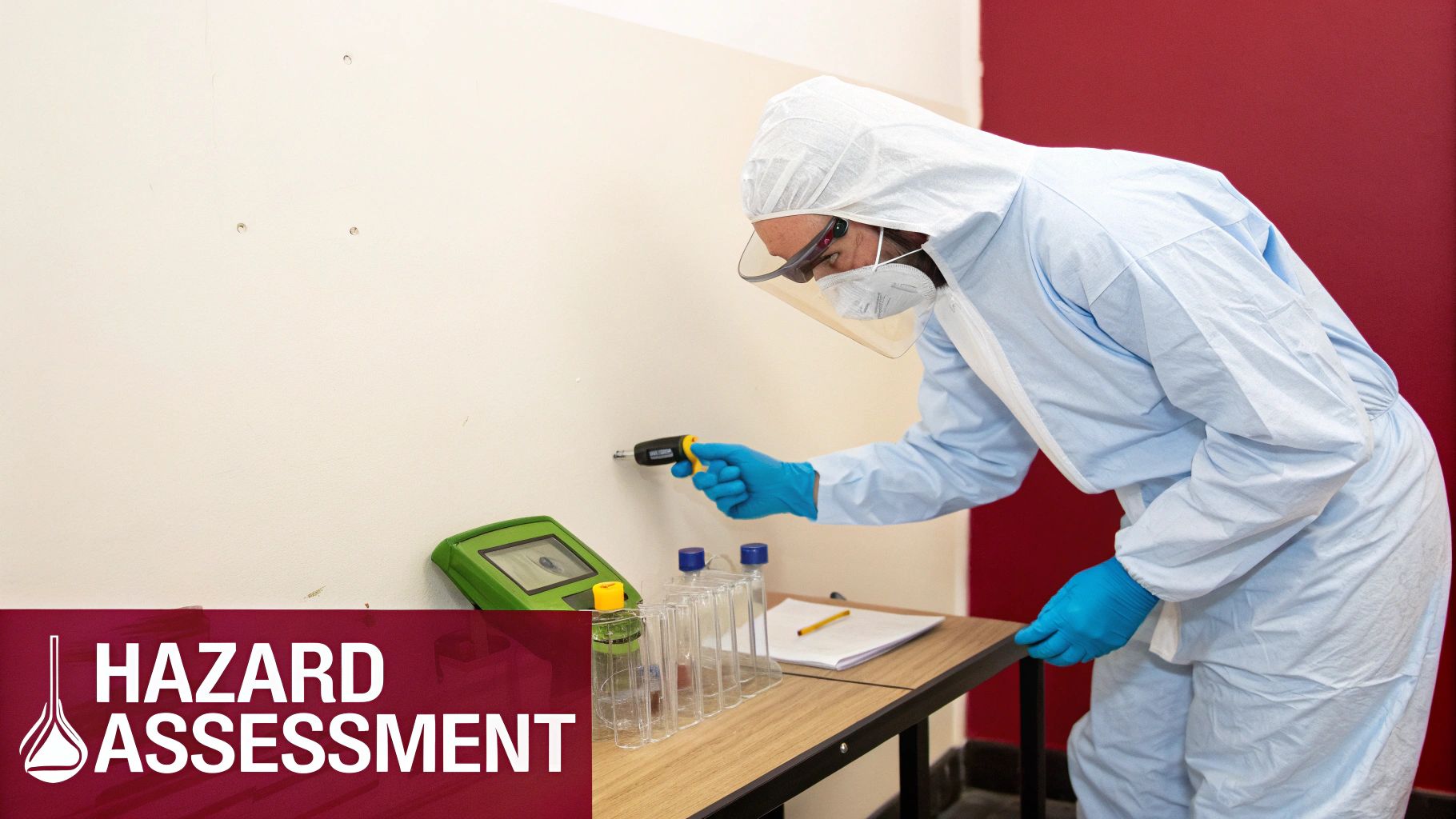
The chemical cocktail left behind changes dramatically depending on the lab's purpose. A meth lab, for example, typically leaves a nasty residue of volatile organic compounds (VOCs), acidic gases, and heavy metals that soak into anything porous. A fentanyl lab, on the other hand, poses a completely different threat from incredibly potent opioid particles that can go airborne with the slightest disturbance.
These toxins don't just sit on the surface. They seep deep into plasterboard, timber framing, and concrete. Worse, they can infiltrate the entire HVAC system, effectively turning it into a chemical distribution network.
The Initial Site Walk-Through
The first walk-through is your chance to play detective. You're not there to make a final diagnosis but to spot the red flags that will guide the professionals who follow. You need to train your eyes—and nose—to pick up on subtle clues most people would miss.
Keep an eye out for these tell-tale signs:
- Strange Stains: Look for yellow, brown, or red discolouration on walls, floors, ceilings, and especially around drains or sinks. These often point to chemical spills.
- Widespread Corrosion: The chemicals used in these labs are incredibly corrosive. Check for unusual rust on metal fixtures like pipes, door handles, and window frames.
- Odd Modifications: Be wary of bizarre ventilation systems, blacked-out windows, or reinforced doors. These are all common alterations for illegal operations.
- Lingering Smells: Even long after a lab is shut down, you might still detect faint odours of solvents, ammonia, or other sharp chemicals.
This initial survey helps you build a mental map of high-risk zones. But remember, this is just a starting point. A comprehensive Real Estate Due Diligence Checklist is essential for uncovering all the potential liabilities a property like this might hide.
The most dangerous contaminants are often the ones you can't see or smell. A property can look spotless and have no discernible odour while still harbouring hazardous levels of chemical residue. This is precisely why a professional assessment is non-negotiable.
Calling in the Professionals: The Occupational Hygienist
Engaging a qualified occupational hygienist is the single most critical step in this entire process. This isn't a job for a general contractor. Hygienists bring the scientific expertise and specialised gear needed to move beyond suspicion and into hard, quantifiable data. Their involvement is vital, not just for health and safety, but for building a legally defensible case for a property valuation drop.
A good hygienist won't just show up and start swabbing. They’ll develop a systematic sampling plan tailored to the property’s known history and physical layout, ensuring they uncover the true scope of the problem.
The Systematic Sampling Plan
A solid sampling plan gives you the concrete evidence required to justify every dollar of remediation and every percentage point of the valuation adjustment. This plan will almost always use a combination of methods to paint a complete picture of the contamination.
Key Sampling Techniques
- Surface Wipe Tests: This is the most common method. Samples are taken from walls, benchtops, floors, and other surfaces to measure the concentration of chemical residues. It's the best way to pinpoint hotspots.
- Air Quality Monitoring: Air samples are crucial for detecting airborne contaminants. This is especially important for assessing risks to future occupants and figuring out if the entire HVAC system needs to be ripped out.
- Bulk Material Sampling: Sometimes, the only way to know how deep the problem goes is to take a piece of the material itself. Small samples of plasterboard, carpet, or insulation are physically removed and sent to a lab for analysis.
Imagine the difference in approach for two scenarios. In a remote mining barracks, the hygienist might focus heavily on the shared HVAC system and common areas where contaminants could have spread easily. But in a suburban warehouse, their attention would likely turn to the concrete flooring, drainage systems, and high-contact surfaces where spills were most probable.
The end goal is a comprehensive contamination report. This document is the cornerstone of your entire financial assessment. It provides the scientific proof needed to quantify the problem, commission the right remediation work, and justify the valuation drop to insurers, lenders, and anyone else with a stake in the property.
Getting a Real Handle on Remediation Costs
When you're trying to figure out the financial hit from a former clandestine lab, getting a single "cleanup" quote just won't cut it. This is where we need to get serious about what remediation truly costs, because these expenses are the single biggest factor driving down the property's value. A proper budget has to cover every single step, from locking down the site to getting that final legal all-clear.
This isn't about a bit of surface cleaning. We're talking about a deep, invasive, and frankly, very expensive operation. The final number is a combination of many different costs, and each one is crucial for making the property safe, liveable, and legally sound again. If you don't budget for everything, you're setting yourself up for a nasty financial shock later on.
The Big Ticket Items: Breaking Down the Core Expenses
The most significant costs are, without a doubt, tied to the physical decontamination. These aren't optional extras; they're required by public health regulations and are absolutely essential to protect yourself from future liability.
Here’s what you absolutely must factor into your calculations:
- Hazardous Material Disposal: This is a world away from a standard tip run. Everything from contaminated plasterboard to carpets is classified as hazardous waste. That means specialised handling, transport, and disposal, all of which comes with a hefty price tag.
- Structural Demolition and Rebuilding: Contaminants love to soak into porous materials like timber frames, concrete, and subflooring. Often, you simply can't clean them. The only real option is to tear out the affected structures and rebuild.
- Specialised Surface Cleaning: For surfaces that aren't porous, a multi-stage cleaning process is needed, using specific chemical neutralising agents. It's slow, painstaking work done by certified technicians wearing full personal protective equipment (PPE).
- HVAC System Replacement: Think of the heating, ventilation, and air conditioning (HVAC) system as a contamination superhighway. It can easily spread airborne chemicals throughout the entire property. In most cases, the whole system, including all the ductwork, has to be ripped out and replaced.
- Post-Remediation Verification (PRV) Testing: Once the cleanup crew is done, an independent occupational hygienist has to come in and do extensive testing. Their job is to confirm that contamination levels are safely below the legal limits. You don't get a clearance certificate without this step – it's non-negotiable.
The scale of the lab and the chemicals involved are the two biggest wildcards. A small, 'user-based' setup might leave you with a manageable bill. But a large industrial operation using sophisticated chemicals can easily send remediation costs soaring into the six-figure range, completely changing the financial picture of the property.
How the Lab Type and Property Itself Change the Game
The specific "cooking" method used in the lab dramatically impacts the final cost. For instance, labs that used the hypophosphorous acid method tend to leave behind a more widespread and stubborn contamination compared to the older Nazi/Birch methods.
The building itself plays a massive role, too. Trying to decontaminate a timber-frame house with lots of porous surfaces is a far more complicated and expensive job than cleaning a steel-frame warehouse with a simple concrete slab floor.
The numbers from Australian authorities paint a pretty stark picture. The data on quantified impacts from former meth labs shows that remediation expenses alone can gut a property's value by 10-30%. Throw in the inevitable buyer stigma, and that total devaluation can easily top 50%.
In places like Queensland and Western Australia, where lab discoveries shot up after 2012, the average cleanup bill for a small residential property is around AUD $30,000. But for a medium-scale lab—especially one using those hypophosphorous methods, which make up 60.9% of addict-based labs—the costs can quickly blow past AUD $150,000. You can dig deeper into these numbers and explore trends in Australian drug lab statistics to get a better sense of the landscape.
To put this into perspective, here’s a sample breakdown of how costs can escalate depending on the size of the operation.
Sample Remediation Cost Breakdown by Lab Scale
This table gives a comparative look at estimated remediation costs for different types of clandestine lab discoveries, from small residential setups to larger industrial operations.
| Remediation Activity | Small Residential Lab (Estimate AUD) | Medium Industrial Unit (Estimate AUD) | Large-Scale Operation (Estimate AUD) |
|---|---|---|---|
| Initial Site Assessment & Testing | $3,000 – $7,000 | $5,000 – $12,000 | $10,000 – $25,000 |
| Hazardous Waste Removal | $5,000 – $15,000 | $20,000 – $40,000 | $50,000+ |
| Structural Decontamination | $10,000 – $25,000 | $40,000 – $70,000 | $100,000+ |
| HVAC System Replacement | $8,000 – $15,000 | $25,000 – $50,000 | $60,000+ |
| Post-Remediation Verification | $2,000 – $5,000 | $4,000 – $10,000 | $8,000 – $20,000 |
| Total Estimated Range | $28,000 – $67,000 | $94,000 – $182,000 | $228,000+ |
As you can see, the costs don't just increase linearly; they grow exponentially as the operation gets bigger and more complex. These figures are estimates, of course, but they highlight why a thorough, site-specific assessment is so critical.
Don't Forget the Hidden Ancillary Costs
The direct cleanup bill is only one piece of the puzzle. A truly complete financial picture has to include all the ancillary costs—the ones people often forget about but which can add up to a significant amount. These secondary expenses are just as real and contribute directly to your total loss.
Make sure you've budgeted for these easily missed items:
- Site Security: A contaminated property is a massive liability. You have to secure it to keep people out, which means paying for fencing, warning signs, and sometimes even security patrols.
- Lost Rental Income: Remediation isn't a weekend job; it can drag on for months. If it's an investment property, that's a huge chunk of lost revenue while the cleanup and verification are happening.
- Increased Insurance Premiums: Even after you've got the all-clear, insurers will see the property as a higher risk. That means you can expect to pay steeper premiums for years to come.
- Legal and Administrative Fees: You'll need professional help to navigate the maze of environmental regulations, health department rules, and legal disclosures. Those legal and consulting fees all add to the bottom line.
Putting together a complete and realistic remediation budget is one of the most important things you can do. It gives you the hard data you need for any property valuation adjustment and is your best tool for managing the financial risk.
Adjusting Property Valuation Models for a Harsh Reality
Once you have a handle on the extent of the contamination and a firm estimate of the cleanup costs, the real work begins: figuring out just how much value the property has lost. This isn't just theory; it involves plugging those hard, often shocking, numbers into standard property valuation models. The problem is, standard appraisal techniques were never designed for something this extreme, so they need significant, well-defended adjustments to paint an accurate picture.
The challenge lies in adapting the three main appraisal approaches—Sales Comparison, Cost, and Income—to reflect the unique financial fallout from a clandestine lab. To get this right, a solid grasp of Mastering Real Estate Property Valuation Methods is non-negotiable. Each model requires a specific set of modifications to produce a valuation that will hold up under the intense scrutiny of insurers, lenders, and lawyers.
The Sales Comparison Approach Under Duress
The Sales Comparison Approach, the bread and butter of residential valuation, is usually the first place to start. It’s also where you hit your first major roadblock. This method relies on finding recent sales of similar properties, but the truth is, it's nearly impossible to find a truly "comparable" sale for a property with a documented history of drug manufacturing. It's fundamentally different from its neighbours, even if it looks identical from the outside.
Because a straight, apples-to-apples comparison is off the table, appraisers have to make some hefty negative adjustments. These fall into two main buckets:
- Direct Remediation Costs: This is the most straightforward part. You take the total estimated cost to fix the problem—every last dollar for testing, cleaning, and disposal—and subtract it directly from the value of what the property would be worth if it were clean.
- Market Stigma Discount: This is where the art meets the science. A property that was a former meth lab carries a permanent scar. You have to apply an additional percentage-based reduction to account for this lingering stigma, which spooks buyers and hurts marketability long after the chemicals are gone.
Factoring Contamination into the Cost Approach
Next up is the Cost Approach, which values a property based on what it would cost to build it again from scratch, minus depreciation. For a contaminated property, we have to introduce a major form of obsolescence, what we in the industry call functional obsolescence. The contamination is a defect so severe it renders the property functionally useless until it's fixed.
The key adjustment here is the "cost to cure." This is the total, all-in cost of the remediation. So, the calculation looks something like this: replacement cost of the building, minus physical depreciation, plus the land value, and then minus the entire cost to cure the contamination. You're essentially treating the contamination as a massive repair bill that has to be paid before the property has any real-world value.
This flowchart breaks down how those remediation costs accumulate, directly informing the adjustments you need to make.
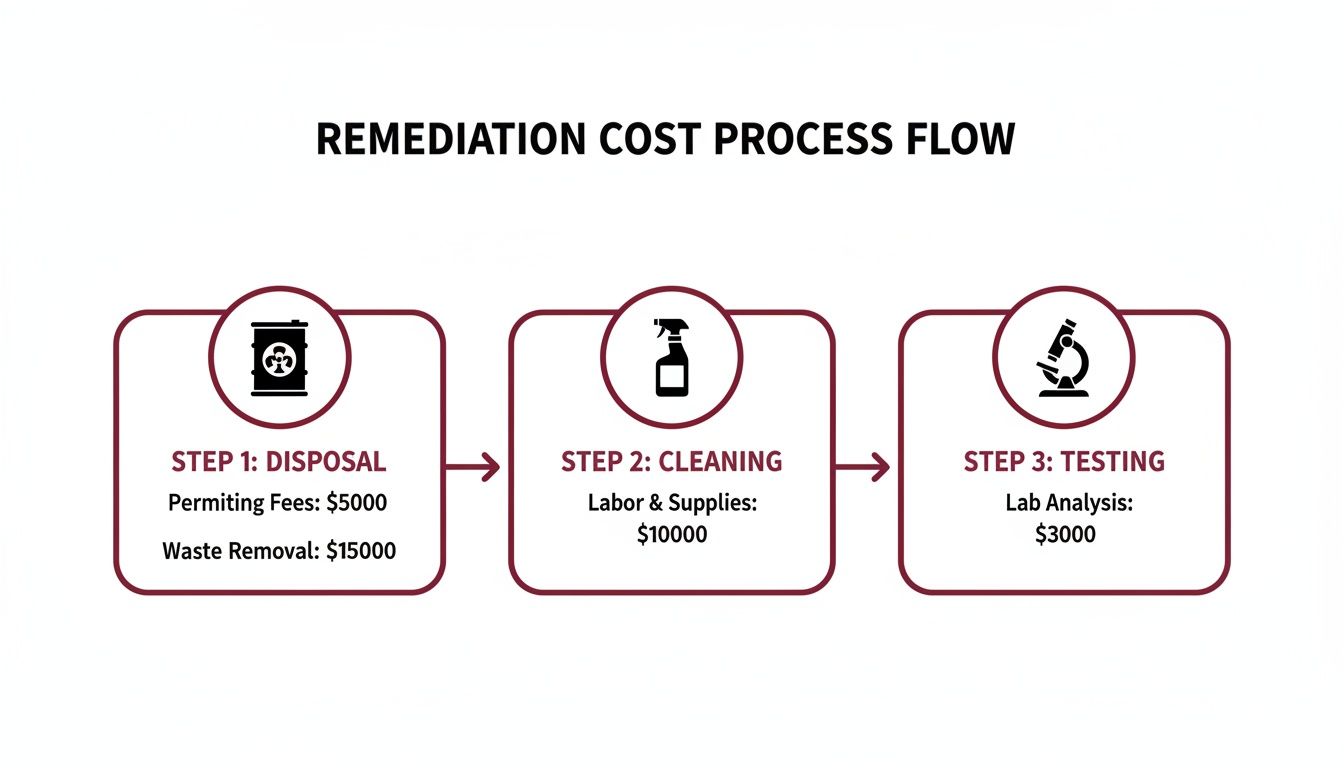
As you can see, remediation isn't a single expense. It's a multi-stage financial bleed, starting with hazardous waste disposal and ending only after final verification testing gives the all-clear.
Re-evaluating the Income Approach
For any commercial or rental property, the Income Approach is king. This method values a property based on its power to generate cash flow. A history of contamination absolutely devastates that potential, forcing some serious downward revisions to your numbers.
A former clandestine lab doesn't just reduce a property's sale price; it cripples its earning capacity. The financial damage extends to lost rent, higher operational costs, and a smaller pool of willing tenants, all of which must be mathematically factored into any credible valuation.
Here's what you need to adjust:
- Increased Vacancy Rates: First, the property will be empty during the entire remediation process. Even after it's certified clean, the stigma can lead to higher-than-average vacancy for years to come. You have to bake this extended downtime into your calculations.
- Reduced Rental Rates: To convince tenants to move into a stigmatised property, landlords often have no choice but to offer rent at a significant discount compared to untainted properties down the street.
- Higher Operating Expenses: Getting insurance for a property with this kind of history is a nightmare. Premiums are often substantially higher, which takes a direct bite out of the Net Operating Income (NOI).
The numbers coming out of Australian law enforcement reports are stark. Post-discovery valuations can plummet by 30-70%, a brutal combination of mandated cleanup costs and that persistent market stigma. Residential properties get hit the hardest—a staggering 68% of the 575 labs found in 2015-16 were in homes, which now face an average value drop of 50%.
Think about it in real terms. In Queensland, which was home to half the nation's labs between 2003 and 2012, a standard AUD $500,000 Brisbane rental could easily see its value slashed to AUD $250,000 after a AUD $40,000 cleanup. That kind of devaluation could slash its annual rental yield by as much as AUD $25,000. By applying these specific, data-driven adjustments, you move beyond a theoretical "market value" and arrive at a realistic, defensible valuation that tells the true story of a property's toxic past.
Putting a Price on Market Stigma
Once you’ve tallied up the tangible costs of remediation, you’re left with the biggest wildcard: market stigma. This is the invisible but very real cloud that hangs over a property, spooking potential buyers and dragging down its value, often long after the physical mess is gone. Trying to put a dollar figure on this psychological baggage is one of the toughest but most critical parts of getting to a realistic market value.
Unlike a leaky roof that has a clear repair cost, stigma is a penalty imposed by the market itself. Even with a certificate saying the property is perfectly clean, its history is now part of its story, and that story directly influences what people are willing to pay.
Digging into the Data to Measure Stigma
So, how do you measure something you can't see? You have to look for its footprints in the market data. The goal is to see how properties with a known history of contamination stack up against their "clean" neighbours. This isn't just about the final sale price; you need to look at the marketability indicators.
Two of the most telling metrics I always turn to are:
- Days on Market (DOM): A stigmatised property almost always takes longer to sell. If the local average DOM is 30 days but a property sits for 120 days, that’s a clear sign of market hesitation. You can practically feel the drag.
- Sale Price to Listing Price Ratio: This little number tells you how much the seller had to bend on price. A typical home might sell for 98% of the asking price, but a former lab site might only fetch 85%. That gap is where the stigma lives, forcing sellers to slash their price to get a deal done.
To do this properly, you need solid real estate data and a very careful selection of comparable properties. It’s about comparing apples with apples, just one of them has a bruise.
The Impact of Legal Disclosure
In Australia, disclosure laws are what give stigma its real teeth. While the rules vary slightly between states, the core principle is consistent: sellers must disclose any "material facts" that could sway a buyer's decision. A property's past life as a clandestine lab is, without a doubt, a material fact.
This legal requirement means the stigma isn't just a rumour—it's written into the property's official record. This formal disclosure solidifies the psychological barrier for every potential buyer, giving them a powerful reason to make a lower offer.
Even after a full, certified remediation, that history must be shared. For many buyers, it’s a dealbreaker, no matter how thorough the cleanup was.
Financing Hurdles and a Shrinking Buyer Pool
Another massive headache is getting a bank to lend on the property. Most lenders are incredibly wary of properties with a contamination history. They worry about their own liability and the property's weakened resale value, which makes it poor security for a loan.
This reluctance to lend has a direct, chilling effect on value:
- It dramatically shrinks the pool of potential buyers. When you cut out everyone who needs a standard home loan, you're left with a tiny market of cash buyers and hardened investors.
- It forces a "cash-only" dynamic. And cash buyers know they're in a position of power. They expect a steep discount for taking on the risk and hassle.
This drop-off in demand is a huge part of the overall stigma discount.
Calculating a Percentage-Based Stigma Discount
After you've accounted for the full cost of remediation, the final step is to apply a percentage-based discount for the stigma itself. This discount is always calculated against the property's "as if clean" value—what it would be worth if the lab had never been there in the first place.
There’s no magic number here, but based on industry experience and countless case studies, a pattern emerges.
A Framework for Stigma Discounts
- Right After Remediation (0-3 Years): This is when the stigma is rawest. It’s not uncommon to see discounts of 15-30% on top of the remediation costs.
- A Few Years Down the Track (3-7 Years): As time passes and the property builds a new, clean track record, the stigma starts to fade. The discount might soften to around 10-15%.
- Long-Term (>7 Years): The stain may never wash out completely, but it becomes less of a focus. A lingering discount of 5-10% might still hang around, especially if the market is slow.
Let’s run a quick scenario. Imagine a house with an "as if clean" value of AUD $700,000. Remediation set the owner back AUD $80,000. Applying a 20% stigma discount would break down like this:
- Clean Value: $700,000
- Less Remediation Cost: $700,000 – $80,000 = $620,000
- Calculate Stigma Discount: $700,000 x 20% = $140,000
- Less Stigma Discount: $620,000 – $140,000 = $480,000
That final figure of $480,000 is a defensible market value. It honestly accounts for both the physical cost of the cleanup and the lasting psychological scar on the property. By blending hard market data with a structured discount model, you can turn the vague idea of stigma into a concrete, justifiable number.
Pulling It All Together: Communicating Your Findings for Legal and Financial Peace of Mind
Once you've done the hard yards of testing and analysis, the final step is to package everything into a clear, defensible report. This isn't just a formality; it's the cornerstone of your risk management strategy and your primary tool for communicating with insurers, lawyers, lenders, and even potential buyers.
Think of this document as the evidence file that backs up your valuation adjustment. It needs to tell a complete story, translating complex scientific and financial data into a narrative that a non-expert can understand and trust. The goal is to build an unshakeable case for the calculated drop in the property's value.
What Your Report Must Contain
A report that stands up to scrutiny leaves no stone unturned. Every piece of the puzzle needs to be documented, otherwise you're leaving the door open for challenges down the line.
At a minimum, your report should include:
- The Initial Site Assessment: A detailed summary of what was found during the first walk-through, highlighting visual red flags and pinpointing the suspected contamination hot spots.
- Full Laboratory Results: The complete, unedited report from the accredited lab. This should show the specific contaminant levels for every single sample taken.
- Detailed Remediation Quotes: Don't just get one quote. Include at least two or three itemised quotes from certified remediation companies, breaking down the costs for everything from waste disposal to structural repairs and the final clean-up.
- Your Adjusted Valuation workings: You need to show your math. Provide a transparent breakdown of how you modified the Sales Comparison, Cost, and Income approaches. Clearly detail the specific dollar-figure adjustments you made for both remediation and stigma.
- Market Stigma Analysis: Include the local market data you used to justify your stigma discount. This means showing relevant Days on Market figures and sale price ratios for similar, unaffected properties versus your subject property.
The whole point of this documentation is to provide undeniable, third-party proof for every financial adjustment. It shifts your valuation from a professional opinion to a conclusion grounded in solid facts—something that's absolutely critical when you're managing serious legal and financial risk.
How to Present the Data
Simply handing over a stack of lab reports and spreadsheets will only create confusion. The real skill is in translating the technical jargon into clear financial consequences.
For instance, don't just state a methamphetamine reading. Frame it with context. Explain that "the contamination level of 5.8 µg/100cm² is over 10 times the Australian guideline limit, which requires the complete strip-out and replacement of all plasterboard in the main bedroom." This connects a number to a real-world action and a tangible cost.
This report is your master key for navigating insurance claims, justifying asset write-downs, or simply making a smart, strategic call on the property’s future. For a more detailed look at the bigger picture, our guide on the executive framework for managing meth-contaminated real estate assets provides a higher-level view. A well-built report gives you the clarity and evidence you need to protect your position, no matter what happens next.
Got Questions About Contaminated Properties? You're Not Alone.
When you discover a property has been used as a clandestine lab, a flood of questions immediately comes to mind. It's a complex and often overwhelming situation, so let's tackle some of the most common concerns we hear from property owners and investors.
Does a Clearance Certificate Make the Stigma Disappear?
Not entirely. Getting a professional remediation and clearance certificate is a non-negotiable first step — it’s your proof that the property is physically safe. But the psychological impact, the "stigma," often lingers.
Under Australian disclosure laws, you’ll likely need to inform potential buyers of the property’s history. Even with a clean bill of health, some buyers will simply walk away, while others will expect a discount. This is precisely why we factor in a stigma adjustment, even after a perfect cleanup.
Will My Insurance Policy Cover Contamination Damage?
It's a definite "maybe." Standard, off-the-shelf property insurance policies often have clauses that specifically exclude damage from illegal activities. It’s one of those fine-print items many people overlook until it's too late.
However, some specialised commercial policies might offer some level of coverage. The first thing you should do is pull out your policy document and speak directly with your insurer. You'll need a detailed, evidence-based report from a qualified occupational hygienist to have any chance of a successful claim.
How Long Will the Property’s Value Be Affected?
The impact on value comes in two parts, and they behave differently over time.
- Remediation Costs: This is a direct, one-off hit to the property's value. That money is spent, and it's a permanent reduction.
- Stigma: This is the more fluid part. The biggest drop in perceived value happens immediately after the discovery. Over the years, as the event fades into the property's history, the stigma lessens.
But will it ever completely vanish? Probably not. The property's documented history will always be there, meaning it might never quite reach the same market value as a comparable, untainted property right next door.
At Anitech, we specialise in providing the clear, scientific evidence you need to navigate the remediation and valuation maze. Getting an accurate assessment from an expert occupational hygienist is the first step towards protecting your asset and ensuring a safe environment. Visit us at https://occhygiene.com.au to see how we can help you manage the risk.


