
When a property has been used for methamphetamine consumption or production, a highly specialised process is required to make it safe again. This involves far more than just surface cleaning; it demands scientific property meth testing and decontamination cleaning to detect toxic chemical residues. If these residues are found above acceptable safety levels, a multi-stage decontamination is carried out to neutralise and remove all hazardous materials, ensuring the home is safe for habitation and protecting future occupants from serious health risks.
The Unseen Health Risk in Australian Properties
Discovering your property might be contaminated with methamphetamine residue is a daunting thought for any homeowner. The first step is understanding the source of the problem. While many picture clandestine drug labs, the reality is often more mundane. The most common issue arises from casual meth use inside the home, which leaves behind an invisible but toxic legacy known as third-hand exposure.
This residue is incredibly persistent, clinging to nearly every surface imaginable—walls, floors, carpets, and even deep within ventilation systems. You can't see it, smell it, or remove it with standard household cleaners. For the most vulnerable, such as children, the elderly, or individuals with compromised immune systems, the health impacts can be severe.

Why Meth 'Smoke Houses' Are the Bigger Threat
The true scale of meth contamination is far larger than official statistics on seized drug labs suggest. Research from Western Australia paints a sobering picture, revealing a significant gap between public perception and reality. In WA alone, an estimated 30,000 households may have been affected by meth smoke in just five years, a number that completely overshadows the handful of labs identified by authorities.
This data provides critical insight into the real nature of the problem:
- An overwhelming 80% of positive tests are traced back to in-home consumption, not manufacturing.
- Extrapolated nationally, this suggests around 140,000 properties across Australia could be affected.
- "Smoke houses" are likely over 100 times more common than seized meth labs.
These figures serve as a wake-up call for property owners and managers. The risk isn't confined to properties that look suspicious; it can be present in any home with a history of unknown occupants.
Recognising the Subtle Dangers of Meth Residue
While meth contamination is a specific and serious threat, it falls under the wider umbrella of indoor environmental hazards that can impact health. For instance, being aware of general health issues related to indoor air quality is a core responsibility for any property owner. The symptoms from meth exposure often mimic common illnesses, making it incredibly difficult to identify the root cause without professional testing.
The real challenge with third-hand meth exposure is that its symptoms—headaches, respiratory problems, and behavioural changes in kids—are so often blamed on something else. This invisibility is what makes professional property meth testing more than just a precaution; it's a vital step in guaranteeing a safe living space.
Because Australia lacks a consistent national regulatory framework, the onus falls on homeowners, investors, and property managers to take the initiative. Your awareness is the best defence for protecting both your property and the health of the people inside it.
Picking the Right Meth Testing Method for Your Property
Figuring out which meth test you need can feel overwhelming, but it boils down to your specific situation. You wouldn't call in a full forensic team for a minor suspicion, but you also don't want to rely on a cheap kit when the stakes are high.
Whether you're a landlord performing a routine check between tenants, a potential homebuyer, or you have a serious concern about a property's history, understanding the different testing methods is key. This is about obtaining clear, reliable information so you can protect your health and your investment.

Starting Point: Initial Screening With DIY Kits
Do-it-yourself (DIY) meth test kits are your first, most basic line of defence. These are "presumptive tests"—they’re designed to give you a simple 'yes' or 'no' result for the presence of meth residue. They're an affordable and easy way to conduct a quick preliminary check.
Think of a DIY kit like a smoke alarm. It will alert you that there might be a problem, but it won’t tell you how big the fire is or where it’s coming from.
For instance, a property manager might use one of these kits as a quick screening tool between tenancies. If it comes back negative, it provides a degree of peace of mind. But if it's positive, that’s your red flag to bring in professionals for a much closer look.
Keep in Mind: DIY kits are for screening only. The results aren't quantifiable and won't hold up in a legal dispute or for an insurance claim. A positive result from a DIY kit always needs to be confirmed with professional laboratory analysis.
Getting a Clearer Picture: Lab-Based Composite Sampling
When you need a more reliable answer without breaking the bank, composite sampling is the logical next step. This is a huge leap in accuracy from a DIY kit because the samples are analysed by a NATA-accredited laboratory. In Australia, NATA (National Association of Testing Authorities) accreditation is the gold standard, guaranteeing your results are scientifically sound.
Here’s how the process works:
- A qualified technician takes multiple swabs from various areas throughout the property.
- Back at the lab, all these individual swabs are combined into a single sample (the "composite").
- This single sample is then tested to determine the average contamination level across all the swabbed areas.
This method is perfect for an initial professional investigation. It will tell you definitively if meth contamination is present and if it's above the national guidelines. It provides a clear answer without the higher cost of testing every single room individually. While you can find a full breakdown of the meth testing home inspection cost on our site, composite sampling strikes a great balance between accuracy and affordability.
The Full Story: Discrete Sampling for Detailed Analysis
If a composite test flags a problem, or if you already have good reason to suspect heavy use in certain areas, then you must move to discrete sampling. This is the most detailed and precise type of property meth testing and decontamination cleaning available, and it’s what we use to build a remediation plan.
Unlike composite sampling where everything is averaged out, here every single swab is analysed individually. This doesn't just tell you if there's contamination—it tells you exactly where it is and how severe it is. For example, a discrete test could show a minor reading of 2 µg/100cm² in a hallway but a dangerously high level of 50 µg/100cm² in the main bedroom.
This kind of granular detail is absolutely vital for several reasons:
- It allows remediation experts to create a targeted, cost-effective cleaning strategy.
- The results are legally defensible and can be used for insurance claims or tenancy tribunals.
- It provides the crucial evidence needed for post-remediation testing to certify the property is safe again.
For a homebuyer, a positive result from a screening test should always be followed by discrete sampling. It gives you the hard data needed to negotiate remediation costs or, if necessary, to walk away from the purchase knowing you made an informed decision.
Making Sense of Your Meth Test Results
Getting a lab report back can feel overwhelming at first glance. It's often filled with technical terms and numbers that don't mean much on their own. But this document is your single most important tool in the property meth testing and decontamination cleaning journey. It’s the roadmap that tells you exactly what you're dealing with—not just if there's a problem, but precisely where and how bad it is.
The critical number you’re looking for is the Australian National Guideline: 0.5 micrograms (µg) per 100 square centimetres (100 cm²). This isn't just a recommendation; it's the official safety threshold. Any reading above this level is considered a potential health risk and legally triggers the need for professional remediation.
What Do µg and 100 cm² Actually Mean?
Let's break down what 0.5 µg/100 cm² really looks like. A microgram (µg) is one-millionth of a gram. We're talking about a microscopic amount of residue, completely invisible to the naked eye. This residue is measured within a 100 cm² area, which is a small 10cm by 10cm square.
So, if the lab finds more than that tiny trace amount of meth residue in a 10cm x 10cm patch of a wall, floor, or benchtop, the property is officially contaminated. It's a very strict standard for a good reason—it’s designed to protect the most vulnerable, like young children who spend their time crawling and touching surfaces.
Reading a Real-World Lab Report
Imagine you're a property manager and you've just received the report from discrete sampling at a three-bedroom rental. The real value of a good report is that it doesn't just give you a single "pass" or "fail." It provides a detailed, room-by-room breakdown, which is essential for planning a targeted and cost-effective cleanup.
Here’s what a typical report might show:
- Living Room: 10 µg/100 cm²
- Hallway: 2 µg/100 cm²
- Bedroom 1 (Master): 1000 µg/100 cm²
- Bedroom 2: 25 µg/100 cm²
- Kitchen: 5 µg/100 cm²
This isn't just a list of numbers; it tells a story. The entire property is contaminated, but not evenly. The master bedroom reading is extremely high, strongly suggesting this was the epicentre of heavy use or possibly even small-scale production.
Turning Data into Action
These results directly inform your next steps and highlight the risks involved. A reading of 10 µg/100 cm² in the living room is already 20 times the acceptable limit. That's a serious health concern.
But the master bedroom, at 1000 µg/100 cm², is a shocking 2,000 times the guideline. This level points to severe contamination that requires an immediate and highly specialised decontamination plan.
Research on former meth labs in Australia supports this, showing about half of tested sites had contamination up to 10 µg/100 cm², while the other half skyrocketed to as high as 4000 µg/100 cm². You can read more about the meth lab contamination levels in Australia in published studies. It’s these high levels that make professional intervention non-negotiable.
Key Takeaway: A detailed, room-by-room report is your most powerful tool. It allows decontamination specialists to focus their efforts where they are needed most, preventing unnecessary costs while ensuring the most hazardous areas receive the intensive treatment required to make the property safe again.
Ultimately, interpreting your meth test results comes down to one simple truth: any reading above 0.5 µg/100 cm² is a clear call to action. As a property owner, it legally obligates you to bring in experts to perform a thorough decontamination. This isn't just about compliance; it's about fulfilling your duty of care and restoring the home to a safe, healthy state for its next occupants.
The Meth Decontamination Cleaning Process Explained
When a property tests positive for methamphetamine residue, professional remediation isn't just an option—it's the only safe way forward. This is not a simple deep clean; it is a meticulous, science-based operation designed to track down and eliminate hazardous chemical residues from every part of a building.
The goal isn't just to make a home look clean. It’s about restoring it to a verifiably safe state for people to live in. This requires specialised equipment, industrial-strength chemicals, and rigid safety protocols that protect both the cleaning crew and the home's future occupants. Attempting to tackle this yourself without the right training and equipment is not only ineffective but incredibly dangerous.
The First Steps: Securing and Stripping the Property
Before any cleaning solution is used, the property must be properly prepared. The first step is to secure the site. This means restricting access to unauthorized personnel to prevent cross-contamination or accidental exposure, typically with clear signage and physical barriers.
Once the site is locked down, the critical "strip-out" phase begins. Methamphetamine residue is notoriously stubborn and readily absorbs into porous materials. These items act like chemical sponges, trapping contamination and making them impossible to clean effectively.
Our technicians will systematically remove and bag all soft and porous items for specialised disposal. This typically includes:
- Carpets and Underlay: These are always major contamination hotspots.
- Curtains and Blinds: Fabric window coverings are magnets for airborne residue.
- Untreated Wood Furniture: Porous wood can trap meth particles deep within its grain.
- Mattresses and Soft Furnishings: Items like sofas, chairs, and beds are always considered a total loss.
This initial, aggressive removal is non-negotiable. It eliminates a significant percentage of the contamination load from the start, setting the stage for a successful remediation.
The Science of Chemical Decontamination
With the property stripped back to its structural elements, the chemical wash-down can begin. This is a multi-stage process that uses powerful, industry-approved cleaning agents formulated specifically to break down methamphetamine molecules. It’s crucial to understand that household cleaners like bleach are ineffective. In fact, they can react with meth residues and create even more toxic chemical compounds.
We generally use a triple-cleaning method:
- Initial Wash: The first round involves a surfactant-based solution to lift and suspend the bulk of the contamination from surfaces.
- Neutralisation: Next, a more potent chemical agent is applied to break down and neutralise the stubborn meth particles that remain.
- Final Rinse: The last step is a thorough rinse with clean water, which removes any leftover cleaning agents and leaves the surfaces completely clear.
This is a top-to-bottom, wall-to-wall effort. Every non-porous surface—from ceilings and light fittings down to benchtops and floors—is meticulously cleaned.
Advanced Air and System Purification
Methamphetamine contamination isn't just on surfaces you can touch; it also exists in the air as microscopic particles. During cleaning, these particles can become airborne, creating a serious inhalation risk. To combat this, professional teams use specialised air management equipment.
High-Efficiency Particulate Air (HEPA) vacuums are essential. We use them throughout the process to capture the finest particles from every surface without re-dispersing them into the room. Simultaneously, industrial air scrubbers run constantly, filtering the air to trap any airborne contaminants and maintain a safe environment for our technicians.
This focus on air quality is a vital part of any comprehensive property meth testing and decontamination cleaning strategy. It ensures that invisible threats are addressed as thoroughly as visible ones.
Addressing Hidden Contamination Hotspots
Some of the most challenging areas to decontaminate are the systems hidden within the property. HVAC (heating, ventilation, and air conditioning) systems and plumbing are notorious for trapping and spreading meth residues long after the initial clean.
An HVAC system acts as the property's lungs—it draws in contaminated air and circulates it to every room. Simply cleaning the vents is insufficient. The entire system, including all ductwork, fans, and filters, requires professional decontamination to prevent it from re-contaminating the house later on.
The same applies to plumbing. Traps under sinks and drains can collect contaminated wastewater, creating a hidden reservoir of meth residue. These areas need specialised flushing and cleaning protocols to ensure every trace is removed. Ignoring these systems is a common reason for failed post-remediation clearance tests.
Finally, every contaminated item removed during the strip-out is classified as hazardous waste. It cannot be disposed of in a standard skip bin. Technicians must follow strict containment and disposal protocols, a process we cover in our guide to hazmat waste management. This final step ensures the contamination is removed for good—from the site and the wider environment.
Finding a Reputable Decontamination Company
When your property tests positive for meth contamination, one of the most critical decisions you'll face is choosing the right team for the cleanup. This isn't a task for your regular cleaning service; it demands specialists who grasp the complex science behind effective meth remediation. The quality of the property meth testing and decontamination cleaning is what stands between you and a safe, liveable home.
Unfortunately, the decontamination industry in Australia lacks consistent national regulation. This means the skill, methods, and even the integrity of providers can vary wildly. Selecting the wrong company can easily lead to a failed clearance test, wasted money, and lingering health risks for anyone who enters the property.
Vetting Your Decontamination Service Provider
To avoid a negative outcome, you must do your homework and vet any potential company before signing a contract. A professional, trustworthy provider will be transparent, knowledgeable, and ready to provide clear documentation to back up their qualifications. Your goal isn't just to find the cheapest quote; it's to find a team with proven expertise.
Before hiring anyone, it's essential to ask some tough questions. The table below outlines what you need to know to make an informed choice.
| Verification Area | Key Questions to Ask |
|---|---|
| Training & Certification | What specific training do your technicians have? Are they certified by a recognised body like the IICRC? |
| Specialised Insurance | Can you provide a certificate of currency for public liability insurance that explicitly covers hazardous material and meth decontamination? |
| Documented Process | Can you walk me through your step-by-step methodology, from site lockdown to the final clean? Can I get that in writing? |
| Proven Track Record | Are you able to provide references from past clients who dealt with similar levels of contamination? |
This isn't the time to cut corners. While meth cleanup is highly specialised, the basic principles of due diligence still apply. You can find helpful tips for choosing a professional cleaner that reinforce the importance of checking reputation, methods, and client satisfaction.
Spotting Red Flags From Untrustworthy Operators
Knowing what to look for is only half the battle; you also need to know what to avoid. A shocking study from Flinders University revealed that less than 10% of suspected meth contaminations are ever reported to local councils. This lack of oversight creates a perfect environment for unscrupulous operators to thrive. The researchers rightly call for industry-wide accreditation, much like what exists for asbestos removal.
Keep an eye out for these warning signs:
- Vague or Unusually Low Quotes: If a price seems too good to be true, it almost certainly is. A proper decontamination is a meticulous, labour-intensive process that requires expensive, specialised equipment and chemicals.
- Guarantees of Passing Clearance Tests: No ethical company can guarantee a pass before the work is done and independently tested. A professional guarantees their process, not the result.
- Reluctance to Provide Documentation: Any hesitation to show you proof of insurance, certifications, or a detailed work plan is a massive red flag.
- Offering to Both Clean and Retest: This is a huge conflict of interest. The company that performs the cleaning should never be the one that verifies their own work.
The best operators follow a clear, systematic process.
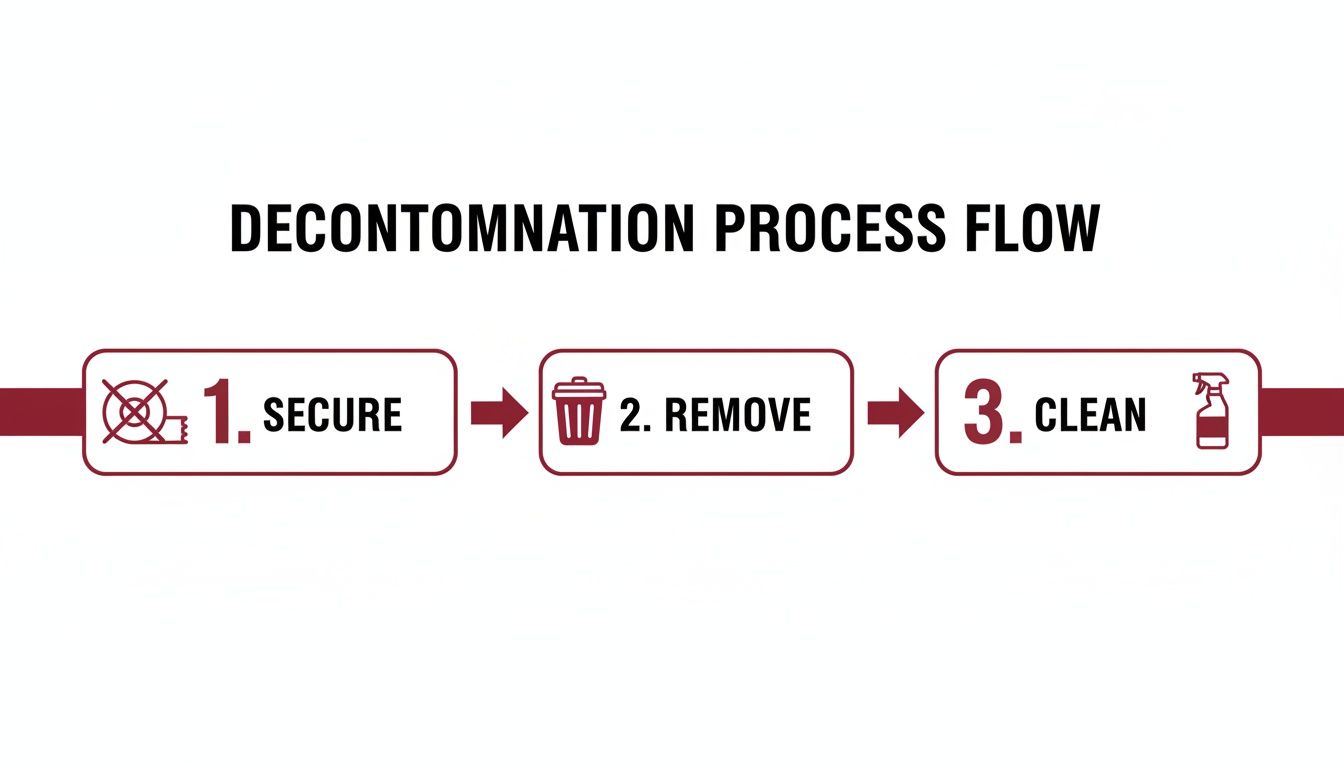
This illustrates the core stages they should follow: securing the site to prevent cross-contamination, removing porous and unsalvageable materials, and then executing a multi-stage chemical cleaning protocol.
The Critical Role of Independent Verification
After the cleaning crew has completed their work, there is one final, non-negotiable step: post-remediation verification testing. This must be conducted by an independent third party, like the occupational hygiene consultants who specialise in this type of environmental testing.
This independent re-testing is your only guarantee that the job was done properly. It provides objective, scientific proof that methamphetamine residue has been brought down below the national guideline of 0.5 µg/100 cm².
Without that final clearance report, you have no official confirmation that the property is safe. This document is vital for your legal records, for insurance purposes, and most importantly, for your peace of mind. It is the certificate that proves your duty of care has been met and the property is finally ready for habitation.
Common Questions About Meth Testing and Decontamination
When dealing with potential meth contamination in a property, it's natural to have many questions. As a property owner, landlord, or prospective buyer, getting clear answers is the first step toward making an informed decision. Let's address some of the most common queries we receive from clients.
What’s the Real Cost of Meth Testing and Cleanup in Australia?
The financial aspect is usually the first question on everyone's mind. The truth is, costs can vary significantly depending on your property's size, the type of testing required, and the level of contamination found.
Here's a realistic breakdown of the numbers:
- DIY Screening Kits: These are available online for between $100 and $200. They provide a basic "yes" or "no" result but are not suitable for official or legal purposes.
- Professional Composite Testing: For a more reliable initial check, a lab-based composite test for a typical home will likely cost $400 to $800. This method gives you a solid average reading of contamination levels.
- Discrete (Room-by-Room) Testing: If the initial test flags contamination, a detailed, room-by-room analysis is needed to plan a cleanup strategy. Expect this to cost anywhere from $1,500 to over $3,000, based on the number of areas sampled.
- Decontamination Services: This is where costs can escalate. For light contamination from meth use, a bill might start around $5,000. More commonly, a full remediation for a contaminated home lands between $10,000 and $25,000. If the property was a former clandestine lab, the cost could easily exceed $50,000.
Can I Just Clean a Meth-Contaminated Property Myself?
We are often asked this, and our answer is always a firm and absolute no. Attempting to clean a meth-affected property yourself is not just a waste of time—it's incredibly dangerous.
Standard household cleaners, even strong ones like bleach, cannot break down the chemical residue left by methamphetamine. Worse, mixing them with meth residue can sometimes create even more toxic compounds, exacerbating the hazard.
Professional decontamination is a highly specialised field. It requires specific industrial-grade chemicals, commercial HEPA-filtered vacuums, and full personal protective equipment (PPE) to handle hazardous materials safely. A DIY job will never pass a post-remediation verification test, which is the only way to prove a property is safe.
Furthermore, everything removed from a contaminated property—carpets, curtains, furniture—is considered hazardous waste. It requires special handling and disposal according to strict environmental regulations, which only a licensed professional is equipped to manage.
As a Landlord or Seller, What Are My Legal Obligations?
While Australia is still working towards a single national standard for meth contamination, every state and territory has laws that require landlords to provide tenants with a safe and healthy home.
If you knowingly rent out a property with meth residue above the Australian National Guideline of 0.5 µg/100 cm², you are in serious breach of your duty of care. This could lead to action from tenancy tribunals, resulting in orders to refund rent or pay compensation.
When selling a property, disclosure rules can differ slightly by state. However, the core principle is always honesty. Concealing known meth contamination from a buyer could lead to the cancellation of the sale and leave you vulnerable to being sued for damages.
The legal landscape can be complex, so seeking advice for your specific state is a wise move. The safest and most ethical path is always to disclose any known issues and ensure the property is professionally remediated and certified before you lease or sell it.
At Anitech Pty Ltd, we provide expert occupational hygiene services to ensure your property is verifiably safe. Our team offers scientifically-backed testing and guidance to help you navigate every step of the process. For professional support and peace of mind, visit us at occhygiene.com.au.
📚 More in This Series: Property & Real Estate
Need Professional Meth Testing?
Anitech Group provides NATA-accredited meth testing and decontamination services across Australia. Our qualified occupational hygienists deliver legally defensible results with fast turnaround.
Get a Free Quote

