
When you type "occupational hygienist near me" into a search bar, you're doing more than just ticking a compliance box. You’re looking for a local expert who can spot the hidden, long-term health risks in your workplace—and help you manage them before they become serious problems for your team. This detailed guide will walk you through everything from understanding their critical role to finding, vetting, and engaging a professional who can make a genuine difference in the health and safety of your workplace.
Why Finding a Local Occupational Hygienist Is Critical
Think about it. If you manage a busy manufacturing plant where a faint chemical smell won't go away, or you're a construction site foreman worried about silica dust from all the concrete cutting, you need an expert on the ground. You need someone who understands how to anticipate, recognise, evaluate, and control the very workplace hazards that lead to illness and injury. A local professional ensures a quicker response, better understanding of regional regulations, and more accessible follow-up support, making them an invaluable partner in maintaining a safe work environment.
This goes far beyond just meeting basic safety standards. It's about preventing the chronic, debilitating illnesses that can develop from what seems like low-level exposure over time. A qualified hygienist is trained to see past the obvious physical dangers and get to the root of these invisible risks, creating a comprehensive safety strategy that protects your employees from both immediate and long-term harm. Their expertise provides peace of mind and a solid foundation for a proactive health and safety culture within your organisation.
Protecting Your Team from Invisible Dangers
So many workplace hazards don't cause an immediate injury. Instead, they quietly contribute to serious health issues over months, years, or even decades. An occupational hygienist is professionally trained to detect these threats long before they show up as a long-term health problem. Their scientific approach allows them to identify and quantify risks that are often imperceptible to the untrained eye, offering a crucial layer of protection for your workforce.
They’re focused on investigating key areas like:
- Airborne Contaminants: Assessing levels of dust, fumes, fibres (like asbestos), and vapours that are notorious for causing respiratory diseases. This involves sophisticated sampling and analysis to ensure air quality meets or exceeds regulatory standards.
- Noise Exposure: Measuring sound levels to prevent permanent, irreversible hearing loss for employees working around loud machinery. They can map noise levels across your facility and recommend specific controls.
- Chemical Hazards: Evaluating exposure to solvents, acids, and other substances that can cause everything from skin conditions to serious systemic illnesses. This includes reviewing Safety Data Sheets (SDS) and observing work practices.
- Biological Agents: Identifying risks from mould, bacteria, or viruses, particularly in environments like healthcare, agriculture, or water-damage restoration.
- Physical Hazards: Assessing risks related to vibration, radiation, and extreme temperatures, which can have significant long-term health impacts if not properly managed.
- Ergonomics: Analysing workstations and manual handling tasks to prevent musculoskeletal disorders, which are a leading cause of workplace injury and absenteeism.
This focus on preventative science is absolutely essential. Consider the Safe Work Australia statistics highlighted by the Australian Institute of Occupational Hygienists (AIOH). In Australia, there are over 2,000 deaths each year attributed to occupational diseases. That figure completely overshadows the roughly 250 annual fatalities from workplace injuries. This stark difference really drives home why the expertise of a hygienist is so vital. Their work directly addresses the silent killers in the workplace.
The Strategic Business Advantage
Beyond the obvious moral obligation to protect your workers, bringing in a local hygienist is just plain good business. A quick read on the importance of local SEO makes it clear why proximity matters when you're hiring any professional service. A local expert means faster response times for urgent issues, better knowledge of state-specific regulations, and a much more accessible working relationship. This proximity fosters a partnership that can adapt quickly to your evolving needs.
By proactively identifying and controlling health hazards, you don't just ensure WHS compliance; you build a rock-solid foundation of trust with your employees. This approach directly leads to reduced absenteeism, lower insurance premiums, and vital protection from potentially devastating future health claims.
Ultimately, finding the right "occupational hygienist near me" is a powerful investment in your company's long-term resilience and reputation. A safe and healthy workplace is a productive one, and demonstrating a commitment to employee wellbeing can also enhance your brand and make you an employer of choice. If you want a deeper dive into their specific duties, you can learn more about what an occupational hygienist does in our detailed article.
Where to Find Qualified Local Hygienists
Typing "occupational hygienist near me" into a search engine is a bit of a lucky dip. You'll get plenty of results, but figuring out who's genuinely qualified versus who just has a slick website can be tough. What you need is a more targeted approach to connect with a certified professional whose expertise you can trust from the get-go. Relying on verified sources ensures that you are engaging someone with the necessary skills and ethical standards to properly assess your workplace.
Your best bet is to start with the official industry bodies. This is the quickest way to find someone who has already passed rigorous certification and adheres to a strict code of conduct, giving you immediate confidence in their abilities. These organisations act as gatekeepers for the profession, upholding standards of excellence.
After that, it's time to tap into your own professional network. You'd be surprised how often a colleague or industry peer can recommend a specialist they’ve worked with before—someone who already understands the unique challenges of your sector. A personal referral often comes with valuable insights into the consultant's communication style and practical effectiveness.
This infographic breaks down the three most effective ways to find a properly vetted occupational hygienist in your local area.
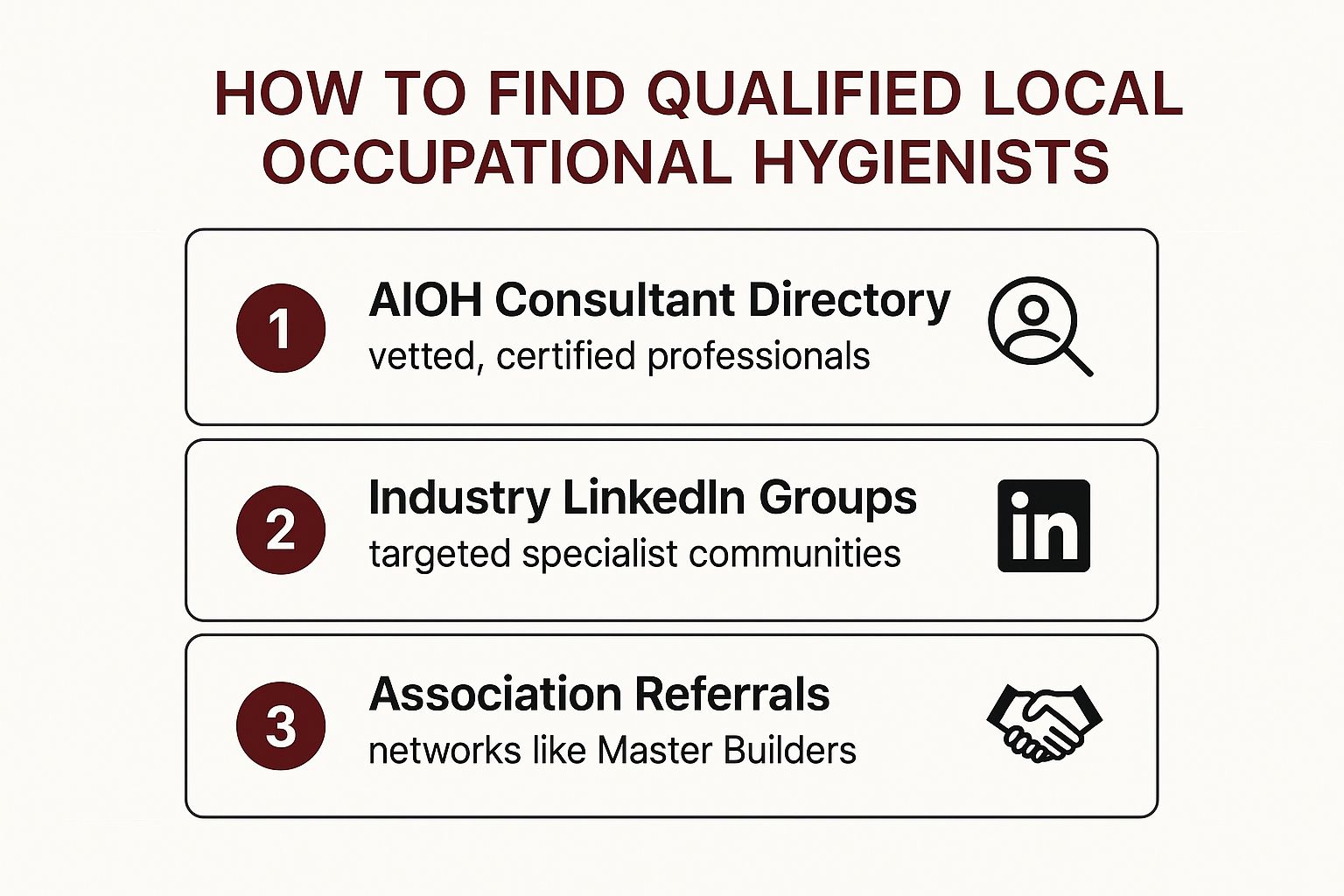
As you can see, blending official directories with professional networking and industry referrals gives you the best chance of finding not just any hygienist, but the right one for your specific workplace needs. This multi-pronged strategy is far more reliable than a simple online search and helps ensure a successful outcome for your business and your employees.
Start with the AIOH Directory
In Australia, the Australian Institute of Occupational Hygienists (AIOH) is the peak professional body. Their consultant directory should always be your first stop. It’s a curated list, meaning everyone on it is a vetted and certified member. No guesswork involved. This resource is specifically designed to connect businesses with qualified professionals, saving you significant time and effort in the vetting process.
The real advantage of the AIOH directory is the ability to filter by location and area of specialisation. This is incredibly helpful when you have a specific hazard in mind. Instead of a vague search, you can pinpoint exactly what you need, like an expert in 'asbestos assessment in Brisbane' or 'noise monitoring in Perth', and get a short, relevant list of candidates. This targeted functionality ensures you find an expert with the precise skills required for your situation.
Tap into Professional Networks
Official lists are great, but don't underestimate the power of your own network. The professional circles you move in are full of people who have probably faced similar challenges and have already hired a hygienist. A recommendation from a trusted peer carries significant weight and can provide a level of assurance that an online profile cannot.
Here are a couple of goldmines for solid recommendations:
- LinkedIn Groups: Look for groups specific to your field, like the Australian Manufacturing Forum or Construction Safety Professionals. Posing a question here can get you direct recommendations for local experts who already know the ins and outs of your industry’s risks. These platforms provide access to a wide pool of experienced professionals.
- Industry Associations: Your membership with bodies like Master Builders Australia or the National Safety Council of Australia can be a huge asset. They often have member forums or can provide referrals, and a recommendation from a respected industry association is as good as gold. These organisations are committed to promoting best practices, and their referrals are usually highly reliable.
When you ask for a referral, be specific. Don't just ask for a "good hygienist." Mention the hazard you're dealing with (chemical exposure, mould, ergonomics) and your location. You’ll get far more helpful and targeted suggestions from your peers.
By using these channels, you skip the endless scrolling and get straight to connecting with proven experts. It's a much more efficient and reliable way to find the right person for the job. This strategic approach ensures you invest your time and resources wisely from the very beginning of your search. For more tips on making the final decision, have a look at our guide to selecting the best occupational hygiene consultants for your business.
How to Vet and Shortlist Your Top Candidates
You've got a list of potential consultants. Good. Now, the real work begins. Your search for an "occupational hygienist near me" is no longer about just finding names; it’s about finding the right competence for your specific situation. This is where you separate the generalists from the true specialists who understand the unique risks your team faces every day. A thorough vetting process is crucial to ensure you hire an expert who can deliver actionable, effective solutions.

It's tempting to just look at a degree and call it a day, but that's a mistake. You need to dig deeper. The goal is to find someone whose expertise directly maps to your workplace hazards. A hygienist brilliant at assessing chemical fumes in a high-tech lab might be out of their depth trying to evaluate silica dust on a construction site. The context of your industry and specific workplace environment is paramount when selecting the right professional.
Scrutinising Credentials and Experience
First things first, let's talk qualifications. A relevant science or engineering degree is the starting point, the foundation. But what really separates the experts from the crowd is professional certification. These credentials are a testament to their dedication, experience, and adherence to professional standards, providing a reliable benchmark for their competence.
Here’s what you should be looking for:
- Certified Occupational Hygienist (COH): This is the gold standard in Australia, awarded by the AIOH. Earning a COH designation means they've proven their knowledge, logged significant practical experience, and are bound by a strict code of ethics. It's a non-negotiable for me.
- Industry-Specific Experience: Don't settle for a vague "yes, I have experience." Ask for concrete examples. Have they actually walked the floor of a manufacturing plant like yours? Do they understand the realities of a mining operation or a food processing facility? Relevant experience ensures they understand your processes and can provide practical solutions.
- Specialised Training: If you're dealing with a specific headache like asbestos, mould, or complex ergonomic issues, you need a specialist. Ask directly about any extra training or certifications they hold in that exact area. Niche problems require niche expertise.
- Communication Skills: Beyond technical skills, assess their ability to communicate complex information clearly. The best hygienist can explain their findings and recommendations in a way that is understandable and actionable for your management team and employees.
This level of scrutiny isn't about being difficult; it's about being diligent. It ensures you’re bringing in someone with practical, hands-on experience who won't be learning on your dime.
Analysing Proposals With a Critical Eye
When the proposals start rolling in, it’s time to read between the lines. A vague, one-page quote is a massive red flag. A truly professional hygienist will provide a detailed proposal that shows they've actually listened and understood your problem. The proposal is your first real glimpse into their working style and thoroughness.
A strong proposal should feel less like a simple price list and more like a strategic plan. It should clearly outline the problem, the proposed methodology for investigation, and the expected outcomes, showing they've truly listened to your concerns.
Let's say you need a comprehensive mould assessment for a water-damaged office building.
You get two proposals. Consultant A gives you a cheap quote for "air sampling." That’s it. Consultant B, on the other hand, outlines a multi-stage approach: visual inspection, moisture mapping to find the source, surface sampling in problem areas, and then air sampling. They even name the NATA-accredited lab they'll be using for analysis.
Which one inspires more confidence? Consultant B’s approach is methodical and scientifically sound. They're looking at the whole picture, not just chasing the most obvious symptom. This is the kind of detailed thinking that gets you accurate results and a clear path to fixing the problem. By comparing their proposed methods and the promised detail of their final report, you can make a decision based on genuine competence, not just a low price.
To make this easier, here's a quick reference table to help you decode those qualifications.
Key Credentials for an Occupational Hygienist
This quick-reference guide will help you verify the qualifications and expertise of potential occupational hygienists.
| Credential / Qualification | What It Signifies | Why It's Important for Your Business |
|---|---|---|
| Certified Occupational Hygienist (COH) | This is the highest professional certification from the AIOH, indicating extensive experience, peer review, and a commitment to ongoing professional development. | Guarantees you are working with a top-tier expert whose competence has been independently verified. It's your best assurance of quality. |
| Full Member of the AIOH (MAIOH) | The individual has met specific educational and experience requirements and is recognised as a professional practitioner by their peak industry body. | Shows a commitment to the profession and adherence to ethical standards. A strong indicator of a serious, career-focused professional. |
| NATA Accreditation (for labs) | This applies to the laboratory analysing the samples, not the hygienist. It means the lab meets strict Australian standards for technical competence. | Ensures the data your decisions are based on is accurate, reliable, and legally defensible. Always ask which lab they use. |
| Industry-Specific Certifications | Additional qualifications in areas like asbestos assessment, clandestine lab remediation, or ergonomics. | Crucial if you have a niche problem. It proves they have specialised knowledge beyond general hygiene principles. |
Looking for these credentials isn't just a box-ticking exercise. It's the most effective way to ensure the advice you receive is credible, the solutions are practical, and your workplace is genuinely safer.
What to Expect From the Consultation Process
Engaging an occupational hygienist for the first time can feel a bit daunting, but it’s actually a straightforward, collaborative process. It's less like a one-off inspection and more like bringing in a specialist to help you solve a puzzle. The whole journey is about working together to identify risks and build a safer workplace, and it all starts with that first conversation. Understanding the process from start to finish will help you prepare and maximise the value of their expertise.
When you first reach out after searching for an "occupational hygienist near me," the initial chat will focus on the scope of work. This is your chance to lay it all out. Are you worried about the constant loud noise from the workshop machinery? Maybe you suspect chemical exposure in the paint booth or have concerns about airborne dust on your construction site.
The more detail you can provide, the better. A vague request like "we need an air quality test" will only get you a generic plan. But if you say, "our welders in bay three are complaining of respiratory irritation," the hygienist can immediately start building a targeted assessment. This initial dialogue is critical for shaping an effective investigation.
Preparing for the On-Site Assessment
To really get the most out of your investment, a little prep work goes a long way. When a client is organised, the hygienist can get straight to the important work, making the whole assessment more efficient and cost-effective. Your active participation in this preparatory phase is key to a smooth and productive site visit.
Before they even set foot on your site, try to pull together any relevant documents. This gives them a head start and allows them to build a full picture of your workplace's history and current challenges.
Think of it like a visit to a specialist doctor. The more background information you provide, the faster and more accurately they can diagnose the issue. Your preparation directly impacts the quality of the outcome.
Here’s a quick checklist of what’s genuinely helpful to have on hand:
- Safety Data Sheets (SDS): Pull the SDS for any chemicals or substances used in the area you're concerned about. This provides crucial information on hazards and handling.
- Previous Risk Assessments: If you have any old reports on noise, air quality, or chemical exposure, they're pure gold. They provide historical context and can highlight trends.
- Workplace Layouts: Even a simple floor plan showing where different processes and machinery are located can be incredibly useful for planning the assessment.
- Employee Health Feedback: Anonymised notes on any health complaints or concerns raised by your team can provide vital clues and direct the hygienist's focus to key areas.
- Incident Reports: Any documentation of past incidents or near-misses related to the hazard in question can offer valuable insights.
Getting this information together beforehand means the hygienist can spend their on-site time focusing on observations and testing, not chasing paperwork.
What Happens During and After the Visit
The on-site assessment is where the real science happens. The hygienist will arrive with specialised equipment to measure whatever hazards you’re targeting—they might be taking air samples, monitoring noise decibels with a sound level meter, or swabbing surfaces for contaminants. You can also expect them to observe work processes and chat with employees to get a real-world understanding of their day-to-day tasks. This combination of quantitative data and qualitative observation is essential.
It's also good to have realistic expectations for timelines. A straightforward noise survey might be done in a day, but a complex investigation involving multiple air samples that need lab analysis could take several weeks before you see the final report. Your hygienist should be able to give you a clear timeline from the outset.
Once the analysis is done, you’ll receive a detailed report. This isn't just a dense document filled with numbers; it's your roadmap to a safer workplace. A good report will clearly explain the findings in plain English, show how they stack up against Australian exposure standards, and give you prioritised recommendations to control the hazards.
These recommendations might range from engineering controls (like installing a new ventilation system) to administrative changes (like rotating staff through a noisy area) or specifying certain Personal Protective Equipment (PPE). Ensuring that gear is used correctly is just as important, and our guide on respirator fit testing importance and compliance covers why this is non-negotiable. Ultimately, this final report is the most valuable part of the whole exercise—it’s the expert guidance you need to protect your team.
Getting to Grips with the Cost and ROI of an Expert
Let's talk money. When you start searching for an "occupational hygienist near me," it’s easy to get fixated on the initial quote. But I’ve learned from years in the field that this isn't just another line item on your expense sheet. It’s a genuine investment in the health, safety, and long-term stability of your entire operation. Viewing this as an investment rather than a cost is a fundamental shift in perspective that highlights its true value.
Of course, the final bill can vary quite a bit. A simple noise survey for a small joinery workshop is a completely different beast to a complex chemical exposure assessment across a sprawling manufacturing plant, and the price will reflect that. Understanding the factors that influence cost will help you budget appropriately and appreciate the value you receive.
What Goes into the Final Price?
You’ll typically see fees structured as either a day rate or a fixed price for the whole project. What you end up paying really comes down to the specifics of the job. A transparent consultant will break down their costs so you know exactly what you are paying for.
Here are the main things that shape the cost:
- The Complexity of the Assessment: It’s one thing to monitor for a single, known hazard like silica dust. It’s another thing entirely to investigate multiple, unknown airborne contaminants. More complex scenarios require more time and more specialised equipment.
- The Scope of the Project: The size of your workplace and the number of people or areas needing assessment directly influence the time and resources required. A larger scope naturally entails a higher cost.
- Laboratory Analysis: This can be a big part of the cost. The number and type of samples that have to be sent off to a NATA-accredited lab for analysis will be a major factor. Each sample represents a cost for processing and analysis.
- Reporting and Consultation: The time spent analysing data and preparing a comprehensive, easy-to-understand report, along with any follow-up consultations, is also factored into the overall price.
Don’t forget the hygienist’s own level of expertise, too. The average base salary for an occupational hygienist is around AU$77,476, but highly experienced specialists can command up to AU$125,000 a year. That deep knowledge and experience is what you're paying for. This detailed salary research from PayScale gives a good insight into the benchmarks that influence their professional fees.
Thinking About It as a Return on Investment
If you only see the upfront fee, you're missing the whole point. The real value is in the massive financial risks you sidestep and the operational perks you gain. This is where you start seeing a clear return on your investment. To get a handle on this properly, it helps to understand how to calculate ROI in a business context. The ROI of occupational hygiene is both financial and cultural.
A good hygienist’s work feeds directly back to your bottom line in some very tangible ways.
An expert assessment isn't a cost centre; it's a powerful risk management tool. The initial outlay is tiny compared to the potential cost of a serious incident, a massive regulatory fine, or years of litigation.
Hiring a professional delivers some serious financial wins by helping you:
- Dodge Hefty Fines: Staying ahead of hazards keeps you on the right side of WHS regulations, steering clear of eye-watering penalties. Proactive compliance is always cheaper than reactive penalties.
- Lower Your Insurance Premiums: When you can show your insurer that you're proactively managing risk, they often look on you more favourably. A documented safety program can lead to significant savings.
- Slash Employee Absenteeism: It’s simple—a healthier workplace means fewer sick days, which means better productivity. Healthy employees are present and engaged.
- Guard Against Litigation: Having documented, expert-led hazard controls is your best defence if a health-related claim ever comes your way. This robust documentation can be invaluable.
- Boost Morale and Productivity: When employees see that you are investing in their health and safety, it builds trust and loyalty, which can lead to higher productivity and lower staff turnover.
Once you start adding up these savings, that initial fee doesn't look like an expense anymore. It looks like one of the smartest financial moves you can make for the future of your business.
Tying Up the Loose Ends: Your Questions Answered
Even when you're sure you need an expert, a few practical questions can pop up and cause hesitation. Bringing in an occupational hygienist is a big decision, so it's completely normal to want all your ducks in a row before you move forward. Let's tackle some of the most common queries we hear from business owners to provide clarity and build confidence in the process.
Getting these details sorted now helps everyone know what to expect. It smooths out the entire process and ensures you get the absolute most out of the hygienist’s time and expertise. It’s all about feeling confident you’re making the right call for your workplace.
So, How Often Do We Need to Do This?
This is probably the most common question, and the straight answer is: it really depends on the hazard. There's no single timetable for monitoring. How often you need to test is directly tied to the specific risk, how much exposure your team has, and what the WHS regulations demand. A risk-based approach is key.
For instance, if your work involves silica dust, you'll likely need a regular, ongoing monitoring schedule to make sure your control measures are holding up. On the other hand, a one-time noise assessment in a standard office probably won't need a follow-up unless you overhaul the layout or bring in loud new machinery. Your hygienist will spell out a clear recommendation in their report based on their findings and the relevant laws, providing a customised schedule for your business.
What Do I Need to Do During the Assessment?
Your main job is to open doors—both literally and figuratively. You don’t need to be a scientist, but your cooperation is the key to a successful assessment. Your role is to facilitate the process and provide the hygienist with the information and access they need to do their job effectively.
Think of yourself as the facilitator. This usually means:
- Making sure the hygienist can get into all the relevant areas of your site.
- Giving your team a heads-up about who is coming and why, to ensure their cooperation and minimise disruption.
- Being ready to answer questions about how things work, shift schedules, and any issues you're already aware of. Your operational knowledge is invaluable.
- Arranging for key personnel, like supervisors or long-serving employees, to be available for interviews if needed.
The more you can share, the more accurate and genuinely useful the final report will be.
Just remember, the hygienist is on your side. They aren't there to point fingers or find fault. Think of them as an independent partner whose only goal is to give you the objective data you need to make your workplace safer for everyone.
What Happens If the Report Uncovers a Big Problem?
First off, don't panic. Finding a problem is actually the first step to solving it. A good hygienist won't just hand you a report full of bad news and walk away. They’ll provide a clear, practical plan with prioritised recommendations to help you get the risk under control. Their goal is to empower you with solutions, not just to identify problems.
Their role often goes beyond just flagging issues. They can help you put in place proactive measures—what we call leading health performance indicators—that focus on building skills and getting your team involved in managing risks before they cause harm. A recent study found that while most businesses track accidents after they happen, only 18% of their proactive health indicators were considered high quality. It's a huge gap. You can read the full research on health performance indicators for a deeper dive. Your hygienist is the expert who can help you close that gap, turning complex data into a real-world safety strategy that protects your people and your business. They become a long-term partner in your health and safety journey.
At Anitech Ltd Pty, we believe in providing clear answers and expert guidance to protect your workplace. Our certified occupational hygienists are ready to partner with you to identify, evaluate, and control hazards effectively. https://occhygiene.com.au


