
In Australia, an occupational hygienist is a scientist, but you could also call them a proactive health detective. Their entire job is to protect workers from getting sick by finding and managing health hazards on the job, well before they cause serious or long-term harm. They're the experts who ensure people in every industry—from construction sites to hospital wards—get to go home healthy every day.
Understanding The Role Of A Workplace Health Detective

Think of a workplace as a complex environment. A safety officer is typically focused on immediate, obvious dangers—a wet floor, a missing guard on a machine. An occupational hygienist, on the other hand, hunts for the invisible threats.
They're looking for the silent hazards that cause damage over months or years, like microscopic dust particles, damaging noise levels, or repetitive physical tasks that slowly wear a body down. Their mission is to safeguard the long-term wellbeing of your team.
This scientific field is built on a simple but powerful four-stage process: Anticipate, Recognise, Evaluate, and Control (AREC). It’s a methodical way to investigate and neutralise potential health risks before they ever lead to chronic illness or injury.
Anticipating and Recognising Hidden Dangers
The first stage is all about foresight. A good occupational hygienist anticipates health issues that could pop up from new work processes, materials, or equipment. For instance, if a factory introduces a new solvent, the hygienist is the one asking: what are the potential risks? Could it cause skin irritation? Are there respiratory dangers?
Recognition is where the detective work really begins. It involves getting out on the floor, walking through the site, talking to employees, and observing how work is actually done. They’re trained to spot the kinds of hazards that often become "part of the background" in daily operations.
Evaluating and Controlling Workplace Hazards
Once a potential hazard is identified, it needs to be measured. This is where the hard science comes in. The hygienist uses specialised instruments to quantify exposure levels and get real data. This isn't guesswork.
This evaluation phase can involve a few different techniques:
- Air Sampling: To measure the exact concentration of dust, fumes, or chemical vapours in the air.
- Noise Dosimetry: To find out precisely how much noise a worker is exposed to throughout their entire shift.
- Vibration Monitoring: To assess the risks that come from using power tools or operating heavy machinery.
- Ergonomic Assessments: To pinpoint physical strains that could eventually lead to musculoskeletal disorders.
The core principle is simple: if you don’t measure it, you are blind to the hazard. Scientific data provides the evidence needed to understand the true level of risk and design effective solutions.
Finally, the control phase is all about putting practical solutions in place. Using a framework called the hierarchy of controls, the hygienist will recommend changes to either eliminate the hazard or reduce the risk. This could be as simple as suggesting a less toxic chemical (elimination), installing a better ventilation system (engineering controls), or, as a final resort, recommending specific personal protective equipment (PPE).
This table summarises the key areas where an occupational hygienist applies their expertise to protect Australian workers.
Primary Functions Of An Occupational Hygienist
| Responsibility Area | Description | Example Hazard |
|---|---|---|
| Chemical Hazards | Identifying and measuring airborne contaminants like dusts, gases, and vapours. | Silica dust from cutting concrete, solvent fumes in a paint shop. |
| Physical Hazards | Assessing risks from noise, vibration, radiation, and temperature extremes. | Excessive noise in a manufacturing plant, whole-body vibration for truck drivers. |
| Biological Hazards | Evaluating exposure to mould, bacteria, and other microorganisms. | Mould growth in a water-damaged office, airborne pathogens in healthcare. |
| Ergonomic Hazards | Analysing physical tasks that can lead to strains and musculoskeletal injuries. | Repetitive lifting in a warehouse, poor workstation setup causing back pain. |
These are just a few examples, but they show the breadth of expertise required to keep a modern workplace safe from a health perspective.
For a deeper dive into their duties, you can learn more about what an occupational hygienist does and how they can support your business. Training and research bodies like The Rocky Mountain Center for Occupational and Environmental Health (RMCOEH) are also vital, continuously advancing the field and preparing the next generation of professionals to safeguard our workplaces.
The Evolution of Workplace Hygiene in Australia
The highly specialised field we now call occupational hygiene didn't just appear out of thin air. Its journey in Australia has been a slow burn, shaped by everything from economic downturns and new workplace laws to the hard work of forward-thinking professionals who knew worker health needed a scientific backbone.
It really started to take shape in the late 1980s and early 1990s as workplace health and safety laws became more serious. Back then, many Occupational Health and Safety (OHS) roles were all about compliance—just ticking boxes and keeping records straight to satisfy the legislation. The approach was more about reacting to problems than preventing them in the first place.
Then, the recession of the 1990s hit, and everything changed. Businesses were forced to tighten their belts, which often meant downsizing those big, dedicated OHS departments. This shake-up was a real turning point, sparking the rise of external safety consultants and specialists who could provide expert advice as needed, on a contract basis.
From Technical Experts to Multifaceted Professionals
That economic pressure had another effect: it forced safety professionals to become more versatile. People who had previously focused solely on the technical side of worker health suddenly found their roles expanding. They were now juggling quality control, environmental management, risk assessment, and a whole host of other compliance duties that went far beyond traditional hygiene.
An occupational hygienist in Australia had to adapt fast. They morphed from a pure scientist into a well-rounded advisor, someone who could blend deep technical knowledge with the day-to-day realities of running a business. This period really forged the resilience and adaptability that defines the profession today. To see how these early shifts shaped today's landscape, it's worth exploring Australia’s holistic approach to OHS.
This challenging time was absolutely crucial. It pushed hygienists to prove their worth not just as compliance box-tickers, but as vital partners in a business's operational health, risk management, and long-term sustainability.
As the years went on, the profession matured. A deeper understanding of long-latency diseases grew, and the connection between a healthy workforce and a productive business became impossible to ignore. The focus shifted from simply managing safety incidents to proactively stopping occupational illnesses before they could start, using scientific assessment and control.
Building a Scientific and Regulatory Foundation
The real heavy lifting was done by pioneering individuals and the professional bodies that began to form. They worked relentlessly to build the scientific credibility and regulatory frameworks that underpin the industry today. They were the ones who pushed for standardised exposure limits, proper measurement techniques, and formal qualifications.
This was a game-changer. It helped carve out a clear distinction between the specialised, scientific work of an occupational hygienist and the more general duties of a safety officer. This cemented their role as the true experts for complex health hazards like chemical exposure, airborne dust, and noise.
Because of this history, the profession now has a clear identity and structure. The struggles of the past actually made the field stronger, shaping it into the respected and essential discipline it is today—one that's absolutely vital for protecting the long-term health of Australia’s workforce. For a more detailed look, you can find great insights into the evolution of the Australian OHS profession and its development over the decades.
The Journey To Becoming A Certified Hygienist
Becoming an occupational hygienist in Australia isn't something you decide to do overnight; it all begins with a strong scientific grounding. Think of it like building a house – you need a solid foundation, and for a hygienist, that foundation is usually built with a degree in science, engineering, or health sciences.
This early training is what hones your critical thinking and gives you the practical skills needed to start investigating and managing the complex hazards found in modern workplaces.
Getting The Right Education
There are a few well-trodden paths you can take at university to get started. Each one gives you a slightly different lens through which to view workplace health.
Most aspiring hygienists will kick things off with one of three undergraduate degrees:
- Bachelor of Science: This gives you a fantastic, broad understanding of physics, chemistry, and biology – perfect for spotting chemical and biological risks that others might miss.
- Bachelor of Engineering: If you're more interested in how things are built and run, this degree focuses on process design and controls, setting you up to engineer hazards out of a system from the very beginning.
- Bachelor of Health Sciences: This pathway zooms in on public health, epidemiology, and the art of risk assessment, giving you the tools to understand health trends on a larger scale.
From there, many will go on to deepen their expertise with postgraduate studies. A Graduate Diploma is great for targeted skills, while a Master's degree broadens your strategic understanding.
| Course | Duration | Focus Area |
|---|---|---|
| Graduate Diploma in Occupational Hygiene | 1 year | Advanced exposure assessment and controls |
| Master of Public Health | 1.5–2 years | Epidemiology and risk policy |
This whole degree phase is crucial. It’s where you develop your analytical mind and get your first taste of lab work or fieldwork. But make no mistake, your university certificate is just the ticket to the main event.
Earning Your Stripes with the AIOH
In Australia, the gold standard for professional recognition is set by the Australian Institute of Occupational Hygienists (AIOH). The ultimate goal for any serious professional is to achieve the Certified Occupational Hygienist (COH) designation. It’s the industry’s way of saying, "This person truly knows their stuff and is committed to ethical practice."
“Anthony ‘Tony’ Findlay’s work helped establish our national exposure standards and postgraduate training programs, shaping occupational hygiene as a core discipline in Australia.”
Discover more insights about Tony Findlay on the AIOH Hall of Fame.
To even be considered for COH certification, you need to prove your mastery across several core areas:
- Hazard identification: The ability to walk onto a site and spot the chemical, physical, and biological risks.
- Risk assessment: Not just seeing the risk, but being able to measure exposure and figure out what’s safe and what isn’t.
- Exposure monitoring: Getting hands-on with equipment like air samplers and noise dosimeters to gather hard data.
- Control design: The creative part – designing clever engineering and administrative solutions to fix the problems you find.
These aren't skills you just learn from a textbook. They become second nature through hands-on, mentored work and getting stuck into real-world projects, like mapping airborne dust in a busy manufacturing plant.
The Importance of Practical Experience
Theory is one thing, but you can’t become a COH without getting your hands dirty. Certification requires a minimum of 3 years of supervised, practical work, usually under the watchful eye of a senior COH.
This is where the real learning happens. In this phase, you'll be expected to:
- Apply the Anticipate, Recognise, Evaluate, and Control (AREC) methodology on live worksites.
- Get comfortable recording and interpreting monitoring data.
- Draft clear, technical reports that clients can actually understand and act on.
- Confidently present your findings to management teams.
A great way to fast-track your learning is by volunteering for research projects – it’s a brilliant way to expand your practical toolkit.
For instance, a junior hygienist I know led a trial for a new silica dust control method that slashed airborne levels by 80%. That kind of real-world impact is what this is all about.
Once you've ticked off the experience requirements, you're eligible to sit the COH examination. It's a tough test designed to rigorously assess both your technical knowledge and your ability to apply it under pressure. Passing is a huge achievement and a clear signal of your competence.
Learning Never Stops: Continuing Professional Development
Becoming certified isn't the finish line; it’s the start of a lifelong commitment to learning. COH holders are required to keep their skills sharp and stay on top of their game.
This means you’ll be expected to earn 20 CPD points every year. You might do this by:
- Attending workshops on new monitoring techniques.
- Going to the annual AIOH National Conference to hear about the latest research.
- Publishing articles or case studies to share what you’ve learned.
- Mentoring the next generation of hygienists coming through the ranks.
This ongoing development ensures you're always up-to-date with new regulations, emerging workplace hazards, and the latest control technologies.
Building Your Professional Network
In this field, who you know is just as important as what you know. Connecting with your peers is one of the best ways to deepen your expertise and open up new career opportunities.
You can start building your network by getting involved with:
- AIOH regional chapters, which host local events.
- Online forums and LinkedIn groups for daily chats and problem-solving.
- Mentorship programs that pair newcomers with experienced COH mentors.
A strong network is more than just a list of contacts; it's a support system and a launchpad for exciting new collaborations.
Specialisations and Future Trends
Once you're established, you can really start to carve out your own niche. Many COH professionals choose to specialise in specific areas like chemical process hygiene or dive into emerging hazards like nanomaterials or pandemic-related air quality.
Some exciting specialist tracks include:
- Chemical process hygiene: Focussing on the advanced control of solvents and industrial gases in complex environments.
- Workplace epidemiology: Studying the patterns of occupational illness within populations over time to identify root causes.
These specialisations often align with major government research priorities, opening up even more avenues for impactful work.
Your Next Steps
If this sounds like the career for you, the path is clear. Start by planning your degree and actively look for internships with accredited hygiene firms. There's no substitute for that early real-world exposure to help you understand the daily puzzles that hygienists get to solve.
To get a better idea of what a career in this field looks like, check out our guide on Certified Occupational Hygienists at Anitech.
The Hazard Management Process From Start To Finish
You might think an occupational hygienist just shows up with a bunch of fancy equipment and starts taking measurements. But their work is far more deliberate. It's a methodical, scientific process designed to uncover potential health threats and put effective, long-term solutions in place.
Think of it as dismantling workplace health risks, piece by piece. This structured approach ensures nothing is left to chance, transforming a potentially hazardous environment into a genuinely safer place to work. It’s all about getting ahead of the problem.
Phase 1: Anticipation and Recognition
This first phase is pure detective work. A good hygienist uses their experience and foresight to anticipate problems long before they cause any harm. It all starts with a deep dive into your work processes, the materials you use, and the equipment you run on-site.
They'll walk the floor, observe tasks, and, most importantly, talk to your employees to understand what the job actually looks like day-to-day. This is the recognition stage—where potential hazards are first flagged. These could be chemical (like solvent vapours), physical (like excessive noise), biological, or ergonomic.
For example, they might spot that a new stone-cutting process could be kicking up fine silica dust, or that machinery in a certain corner of the workshop produces a high-pitched, damaging noise.
Phase 2: Evaluation
Once a potential hazard is on the radar, the next step is to measure it. This is the evaluation phase, and it's where the hard science comes into play. After all, you can't control a risk you haven't accurately quantified.
A hygienist uses specialised, calibrated equipment to get precise data on what your workers are actually being exposed to.
This might involve:
- Air Sampling: Clipping a small personal pump onto a worker’s collar to measure the exact concentration of dust or chemical fumes they inhale over a full shift.
- Noise Dosimetry: Placing a small device on a worker's shoulder to record their total noise dose throughout the day, capturing the loud and quiet periods.
- Vibration Monitoring: Attaching sensors to hand-held power tools or heavy machinery to assess the risk of long-term nerve or musculoskeletal damage.
The data collected is then benchmarked against the official Australian workplace exposure standards set by Safe Work Australia. This comparison tells us whether a significant risk exists and just how urgently we need to act.
This infographic gives you an idea of the rigorous professional journey required to gain the expertise for this kind of detailed scientific work.
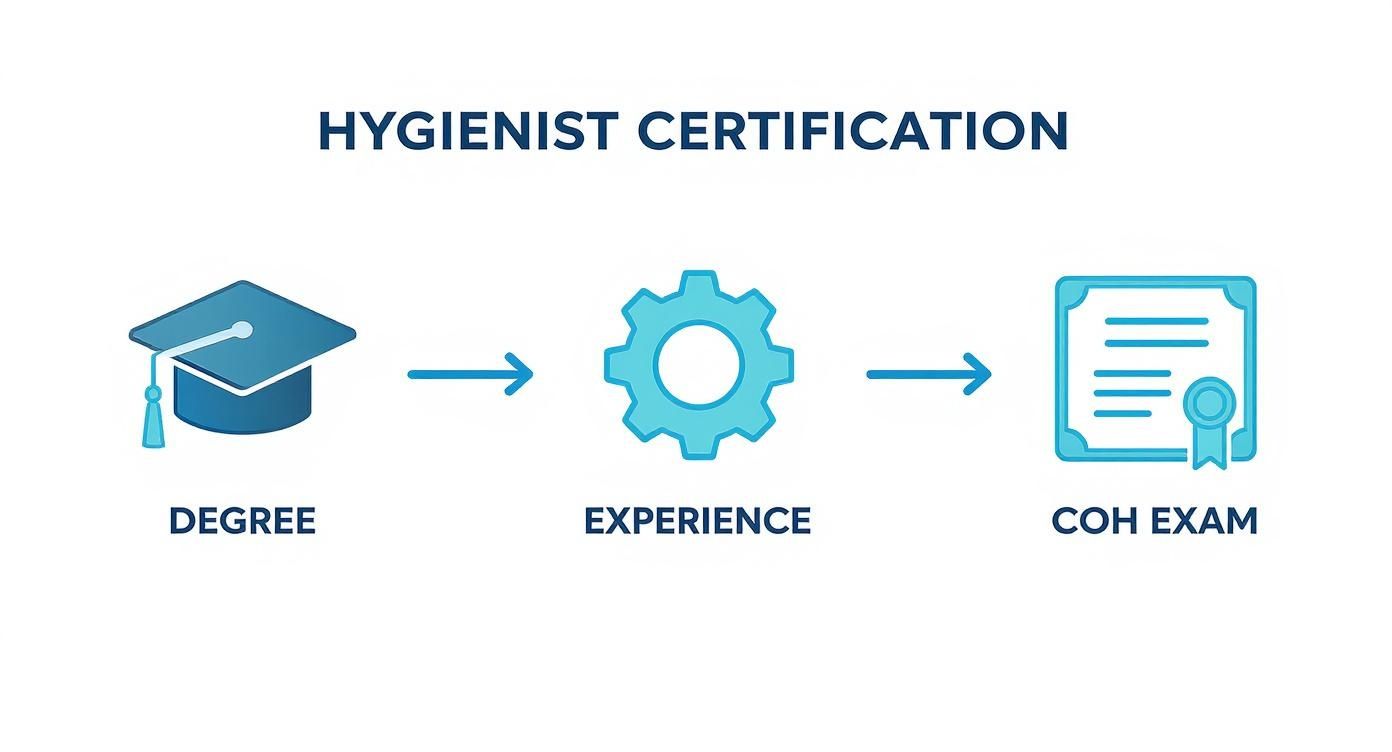
The path through university, years of hands-on experience, and a final, challenging exam ensures that certified professionals have the scientific chops to perform these critical evaluations accurately.
Phase 3: Control
With clear data in hand, the final and most critical phase is all about implementing controls. A professional hygienist won't just throw a box of dust masks at the problem and call it a day. Instead, they follow a proven system known as the hierarchy of controls.
The goal is always to eliminate or reduce the hazard at its source, making personal protective equipment (PPE) the absolute last line of defence. This hierarchy provides a reliable framework for creating the most effective and sustainable safety solutions.
The control hierarchy is a top-down approach, starting with the most effective solutions:
- Elimination: Can we get rid of the hazardous process entirely? A great example is ordering pre-cut materials to avoid creating dangerous dust on-site in the first place.
- Substitution: Can we swap out a hazardous chemical for a safer alternative? Switching from a solvent-based paint to a water-based one is a classic substitution.
- Engineering Controls: Can we physically change the workplace to shield workers from the hazard? Installing a powerful local exhaust ventilation system to capture fumes at the source is a common and highly effective engineering solution.
- Administrative Controls: Can we change how people work to reduce their exposure? This could involve rotating staff through high-exposure jobs, scheduling more breaks, or implementing specific training on safer work practices.
- Personal Protective Equipment (PPE): This is the final safety net. If the hazard can't be controlled by any other means, workers must be provided with the correct, properly fitted respirators, gloves, or hearing protection.
This systematic journey—from initial recognition to final control—ensures every hazard is managed properly, building a solid foundation for a genuinely safe and healthy workplace.
The True Cost Of Unsafe Workplaces

When we think about workplace accidents, it’s easy to picture the immediate, visible events—a fall, a cut, a spill. But some of the costliest workplace incidents are the ones you can't see happening. They are the slow-burning occupational illnesses that creep up over years, stemming from hazards that went unnoticed or unmanaged.
These hidden costs are where the real damage lies, going far beyond the initial medical bills. Think about the knock-on effects: skyrocketing insurance premiums, major dips in productivity, and the profound financial and personal toll on employees and their families. This is precisely where an occupational hygienist in Australia stops being a compliance checkbox and becomes a critical business investment.
By digging deep to find and fix the root causes of long-term illness, they’re not just protecting people—they're protecting the financial health and reputation of the entire company. Investing in proactive hygiene is one of the smartest things a business can do to shield its bottom line from these slow, preventable drains.
The Staggering Economic Burden
The scale of this issue in Australia is massive. Work-related injuries and diseases place a huge economic weight on the country, highlighting just how crucial prevention is. Back in 2012–13, the total cost was pegged at an eye-watering A$61.8 billion, which was about 4.1% of Australia’s GDP. Fast forward to 2019, and that figure was projected to hit around A$77.9 billion, with almost half of that coming from preventable occupational illnesses alone. For a deeper dive into these numbers, you can read the findings presented to the Australian Treasury.
These figures completely reframe occupational hygiene. It's not a cost centre; it's a powerful tool for economic preservation. Every dollar spent to scientifically assess and control hazards like silica dust or chemical vapours is an investment against future costs that could easily cripple a business.
Beyond The Balance Sheet: The Human Benefits
While the financial case is rock-solid, the human side of the equation is even more important. A workplace that genuinely puts health first is simply a better place to be, and that creates a ripple effect of benefits that fuel business success.
When people feel confident that their long-term wellbeing is a priority, it builds a powerful culture of trust and respect. This translates directly into tangible results:
- Improved Employee Morale: A safe workplace provides psychological security, which cuts down on stress and boosts job satisfaction. People are happier and more switched-on when they know they're valued.
- Higher Productivity: It's simple: healthy workers are present and focused. By preventing chronic illness, businesses slash absenteeism and "presenteeism"—that common problem where employees show up but are too unwell to perform at their best.
- Reduced Staff Turnover: Companies known for their unwavering commitment to worker health become employers of choice. This makes it far easier to attract and keep top talent, saving a fortune on recruitment and training.
Proactive occupational hygiene is more than just a regulatory box to tick. It’s a clear statement that you see your people as your most important asset. This commitment is the bedrock of a resilient, ethical, and highly productive workforce.
Ultimately, bringing in an occupational hygienist is a strategic move with a powerful return. It satisfies the legal and ethical duty of care every employer has, but its impact goes so much further. It safeguards the business from devastating financial liabilities, strengthens the company culture, and paves the way for a more sustainable and responsible future.
In a competitive market, a genuine commitment to health and safety makes you stand out. It signals strong governance and a smart, forward-thinking approach to risk, making the entire business more resilient and profitable for years to come.
Your Questions Answered: Working With an Occupational Hygienist
Diving into the world of workplace health can feel a bit overwhelming, especially when it comes to the highly specialised field of occupational hygiene. To cut through the complexity, we’ve put together clear answers to the questions we hear most often from business owners and managers across Australia.
This is all about giving you the practical information you need to understand when to call in an expert, how to find the right one, and what to expect when you do.
When Should My Business Hire an Occupational Hygienist?
The time to bring in an occupational hygienist is when your workplace hazards go beyond the obvious physical risks. It’s not just about preventing slips and falls; it's about protecting your team from the invisible dangers that can lead to serious, long-term illness.
Think about calling in an expert if your work involves:
- Using chemicals or solvents that release vapours people might breathe in.
- Generating dust, particularly from materials like concrete, stone, or engineered products that contain silica.
- Running noisy machinery that could put your team's hearing at risk.
- Dealing with biological agents, like mould in a water-damaged building.
- Renovating older buildings where you might disturb hazardous materials like asbestos or lead paint.
Even better, the absolute best time to engage a hygienist is during the design phase of a new facility or before you introduce a new process. Why? Because you can design the hazards out from the very beginning. That’s always smarter, safer, and far more cost-effective than trying to retrofit a solution later on.
And if your employees are reporting health issues that might be work-related—like a persistent cough, skin irritation, or hearing problems—getting a professional assessment is a critical part of your duty of care.
How Do I Find a Qualified Occupational Hygienist in Australia?
Finding a genuinely qualified professional is non-negotiable, and the most reliable place to start is the Australian Institute of Occupational Hygienists (AIOH). As the peak professional body in Australia, they set and maintain the industry's highest standards.
The AIOH website has a public directory where you can search for consultants by location and specialty. The key qualification you’re looking for is Certified Occupational Hygienist (COH). This is the gold standard. It tells you the professional has met incredibly strict criteria for education, proven hands-on experience, and ethical practice.
Hiring a COH gives you confidence that you’re working with a true expert. Their certification isn’t just a piece of paper; it’s a guarantee of competence, backed by a commitment to continuous learning to stay on top of the latest science and regulations.
Other good ways to find a reputable specialist include:
- Getting referrals from your industry association.
- Asking your state's WHS regulator (like SafeWork NSW or WorkSafe Victoria) for recommendations.
- Checking with your workers' compensation insurer, who often keep a list of approved experts.
Always make sure the person you choose has proven experience in your specific industry, whether that’s construction, manufacturing, mining, or healthcare.
What’s the Difference Between an Occupational Hygienist and a WHS Officer?
While both roles aim to create a safe workplace, their focus and expertise are quite different. It helps to think of it like the difference between your local GP and a specialist surgeon—both are essential for your health, but they play distinct roles.
A Workplace Health and Safety (WHS) Officer usually manages the broader safety systems for a business. Their work often centres on immediate physical dangers and ensuring overall compliance.
A WHS Officer’s day-to-day might include:
- Managing physical risks like slips, trips, and falls.
- Checking that machine guarding is in place and effective.
- Developing and overseeing emergency and fire safety plans.
- Conducting general risk assessments and incident investigations.
An occupational hygienist, on the other hand, is a scientist who specialises in health hazards. They use scientific methods to anticipate, recognise, evaluate, and control exposures to harmful agents.
Their specific expertise is in:
- Using calibrated equipment to precisely measure what workers are exposed to—be it chemicals, noise, or dust.
- Applying toxicology and exposure science to understand complex health risks.
- Designing technical solutions, like targeted ventilation systems or process changes, to control those risks.
- Assessing invisible threats like silica dust, asbestos fibres, solvent vapours, and excessive noise.
Put simply, a WHS Officer makes sure the workplace is safe today. An occupational hygienist makes sure it won’t make you sick in ten, twenty, or thirty years. The two roles are incredibly complementary and work best when they work together.
What Does it Cost to Hire an Occupational Hygienist?
The cost of engaging an occupational hygienist in Australia really depends on the scope and complexity of the job. There’s no standard price list.
Several factors will influence the final cost:
- The type of assessment: A straightforward noise survey is a lot simpler and cheaper than a comprehensive chemical exposure assessment that involves taking multiple air samples.
- Laboratory analysis fees: If samples of air, dust, or surfaces need to be sent to a lab, those costs are usually passed on. Lab fees can run from tens to hundreds of dollars for each sample.
- The hygienist’s experience: A highly experienced COH might have a higher daily rate, but their expertise can often get you to a better solution faster.
- Your location: If a hygienist needs to travel to a remote or regional site, travel time and expenses will be part of the cost.
- The report: A simple summary of data is one thing; a detailed technical report with specific, engineered control recommendations takes more time and will be costed accordingly.
Most consultants charge a daily rate plus expenses. To give you a rough idea, a single-day site visit for a basic noise survey might be a few thousand dollars. A more involved project, like a week-long assessment of airborne contaminants in a large factory, could cost significantly more.
The best approach is always to get detailed, itemised quotes from several AIOH-certified consultants. A professional quote should clearly spell out the proposed work, the number of samples, the type of report you'll receive, and a full breakdown of all costs. That transparency means no surprises and helps you compare your options properly.
At Anitech Ltd Pty, our team of certified professionals is dedicated to helping Australian businesses build safer, healthier workplaces. We provide expert occupational hygiene services nationwide, applying scientific rigour to protect your most valuable asset—your people. To discuss your specific needs and learn how we can support your business, visit us at https://occhygiene.com.au.


