
When you consider workplace safety, personal protective equipment like hard hats and safety glasses probably come to mind. But what about the risks you can't see? Occupational hygienist air monitoring is a crucial scientific process focused on identifying, measuring, and controlling the invisible airborne hazards that can put your team's health at risk.
This guide provides an in-depth look at the science of air quality assessment and why it is a cornerstone of any effective Workplace Health and Safety (WHS) strategy. It involves measuring the concentration of contaminants—like dust, chemical fumes, vapours, and gases—that workers might be breathing in day after day. The primary goal is to ensure these exposure levels stay well below legally required safety limits, preventing serious occupational illnesses and keeping your workplace compliant and safe.
What Is Occupational Air Monitoring and Why Does It Matter?
Think of an occupational hygienist as a lifeguard for your workplace's air. A lifeguard doesn't wait for someone to get into trouble; they're constantly scanning the water, spotting potential dangers before they turn into an emergency. That's exactly what air monitoring does. It's not about waiting for people to get sick—it’s a proactive science designed to stop that from ever happening.

This process requires a qualified professional, an occupational hygienist, to step in and act like a 'health detective' for your business. Their job is to anticipate, recognise, evaluate, and control airborne contaminants that could harm your people. These unseen threats could be anything from respirable crystalline silica dust on a construction site to chemical vapours in a manufacturing plant.
To get a better handle on their role, you can explore our detailed guide on what an occupational hygienist does and see the full scope of their expertise.
The Core Purpose of Air Monitoring
At its heart, air monitoring gives you cold, hard data about what's actually in the air your employees are breathing. This isn't guesswork; it's science. And that data is crucial for a few key reasons:
- Protecting Worker Health: It’s the only way to know for sure if your team is being exposed to harmful substances at dangerous levels. This helps prevent devastating long-term health problems like lung disease, neurological damage, or even cancer.
- Ensuring Legal Compliance: In Australia, every business has a legal duty to provide a safe workplace. Air monitoring gives you the documented proof you need to show you’re meeting Safe Work Australia’s Workplace Exposure Standards (WES).
- Validating Control Measures: Have you spent money on a new ventilation system or changed a work process to make it safer? Air monitoring is how you scientifically prove that your investment is actually working and protecting your team.
- Informing Risk Assessments: The data collected makes your health and safety risk assessments far more accurate. You move from making educated guesses to building data-driven strategies that really work.
Without precise measurement, workplace safety is based on assumptions. Occupational air monitoring replaces those assumptions with facts, providing a clear pathway to a healthier, safer, and more productive workforce.
Ultimately, occupational hygienist air monitoring is a cornerstone of modern Workplace Health and Safety (WHS). It provides the critical insights you need to manage invisible risks, protect your most valuable asset—your people—and build a strong safety culture. It turns safety from a reactive, box-ticking exercise into a proactive strategy that safeguards both your team and your business from preventable harm.
Understanding the Science Behind Air Quality Assessment
To really get a handle on workplace air quality, an occupational hygienist uses a set of scientific principles that form the bedrock of exposure assessment. Think of these core concepts as the language they use to measure and make sense of airborne hazards, turning complex data into clear, practical safety plans. Getting to know these terms is the first step in pulling back the curtain on any occupational hygienist air monitoring program.
The whole process is built around exposure limits. These are essentially the ‘safe’ levels for airborne contaminants set by regulators. They aren't just numbers pulled out of thin air; they are health-based guidelines that tell us how much of a substance a worker can be exposed to over different timeframes without it harming them.
Time-Weighted Average: The Marathon Pace
The most common yardstick is the Time-Weighted Average (TWA). The easiest way to think about the TWA is as the average exposure someone gets over a standard eight-hour workday. It’s a lot like tracking a marathon runner's average pace over the entire race.
A runner might sprint for some parts and slow right down for others, but what really matters is their average pace across the whole 42 kilometres. In the same way, a worker’s exposure to a chemical can spike and dip all day, but the TWA smooths it all out into an overall average. This helps us ensure their exposure stays below the safe limit for a typical shift, which is crucial for managing the long-term health risks that come from prolonged exposure.
STEL and Peak Limits: The Sprinting Rules
While the TWA has the long haul covered, some chemicals can cause damage even in short, sharp bursts. That’s where Short-Term Exposure Limits and Peak Limitations come into the picture.
- Short-Term Exposure Limit (STEL): This is a 15-minute TWA that should never be crossed during the day, even if the eight-hour TWA is looking good. It’s the 'sprint' limit. A worker can handle a brief, higher level of exposure, but it has to be controlled and not happen too often to prevent immediate effects like irritation or tissue damage.
- Peak Limitation: This is the hard ceiling—the absolute maximum concentration that must never, ever be exceeded, not even for a second. It’s for those nasty, fast-acting substances that can cause harm instantly. This is the non-negotiable red line for air safety.
The tragic resurgence of silicosis in Australia is a stark reminder of why these limits are so critical. The National Dust Disease Taskforce's final report made it clear that the re-emergence of this preventable lung disease is tied to major failures in controlling airborne hazards like respirable crystalline silica. It’s a powerful lesson that rigorous monitoring isn’t just about ticking a compliance box; it's about saving lives.
The Breathing Zone: Why Location is Everything
Beyond what is in the air and for how long, an occupational hygienist is obsessed with where the sample is taken from. The most important spot is the breathing zone—a small bubble of air extending about 30cm from a worker’s nose and mouth.
The air in the breathing zone gives us the most accurate picture of what a worker is actually inhaling. Sampling from anywhere else gives you general environmental data, but only breathing zone measurements tell you about true personal exposure.
It’s like trying to figure out what a chef is experiencing by smelling the air at the restaurant’s front door instead of right over the sizzling pan. The readings would be worlds apart. By clipping a small sampling device right onto a worker's collar, hygienists capture the data that matters most for protecting their health. This scientific assessment involves understanding complex environments and how to control them, including detailed processes like analysing airborne contaminants and applying criteria for clean room classifications, ISO standards, and particle count monitoring.
Exploring Different Air Sampling Methods and Tools
To get a true picture of what’s in the air, an occupational hygienist has to choose the right tool for the job. Selecting from a range of specialised air sampling methods isn't a random decision; it's a strategic one, driven by the specific goals of the occupational hygienist air monitoring program. The whole point is to capture data that genuinely reflects what a worker is exposed to.
There are three main ways to sample the air, and each gives us a unique piece of the puzzle. A really thorough assessment will often use a combination of these methods to build a complete, multi-layered understanding of any potential airborne hazards.
Personal Monitoring: The Gold Standard for Exposure
When we need to know exactly what a specific worker is breathing in, we turn to personal monitoring. This is widely considered the gold standard for measuring direct exposure. It involves fitting a worker with a small, lightweight air sampling pump, which is usually clipped to their belt.
A flexible tube connects the pump to a special collection device—like a filter cassette or a sorbent tube—which is fastened to the worker's collar. Placing it here is crucial, as it samples air from the "breathing zone," the immediate area around a person's nose and mouth.
By capturing a sample directly from the breathing zone throughout an entire work shift, personal monitoring gives us the most accurate data on what an individual is actually inhaling. This is essential for comparing their exposure levels directly against the legal Australian Workplace Exposure Standards.
Static or Area Monitoring: Getting the Lay of the Land
While personal monitoring zeros in on an individual, static monitoring (or area monitoring) gives us the bigger picture. It assesses the general air quality in a specific location. Instead of being attached to a worker, the sampling gear is set up in a fixed spot.
This approach is incredibly handy for a few key tasks:
- Checking if controls are working: Placing a static monitor near a ventilation system can confirm if it's actually capturing contaminants at the source.
- Finding the source of the problem: Setting up monitors in different spots can help us pinpoint where a contaminant is coming from.
- Establishing a baseline: It tells us the background level of contaminants in an area, which helps put personal exposure data into context.
- Monitoring site boundaries: We can place monitors at the edge of a work area to make sure contaminants aren't escaping into other parts of the facility or the outside environment.
This type of assessment is a core part of our comprehensive air quality testing services, where we analyse environmental conditions to ensure overall site safety.
The different monitoring methods are designed to measure against various exposure limits, as shown below.
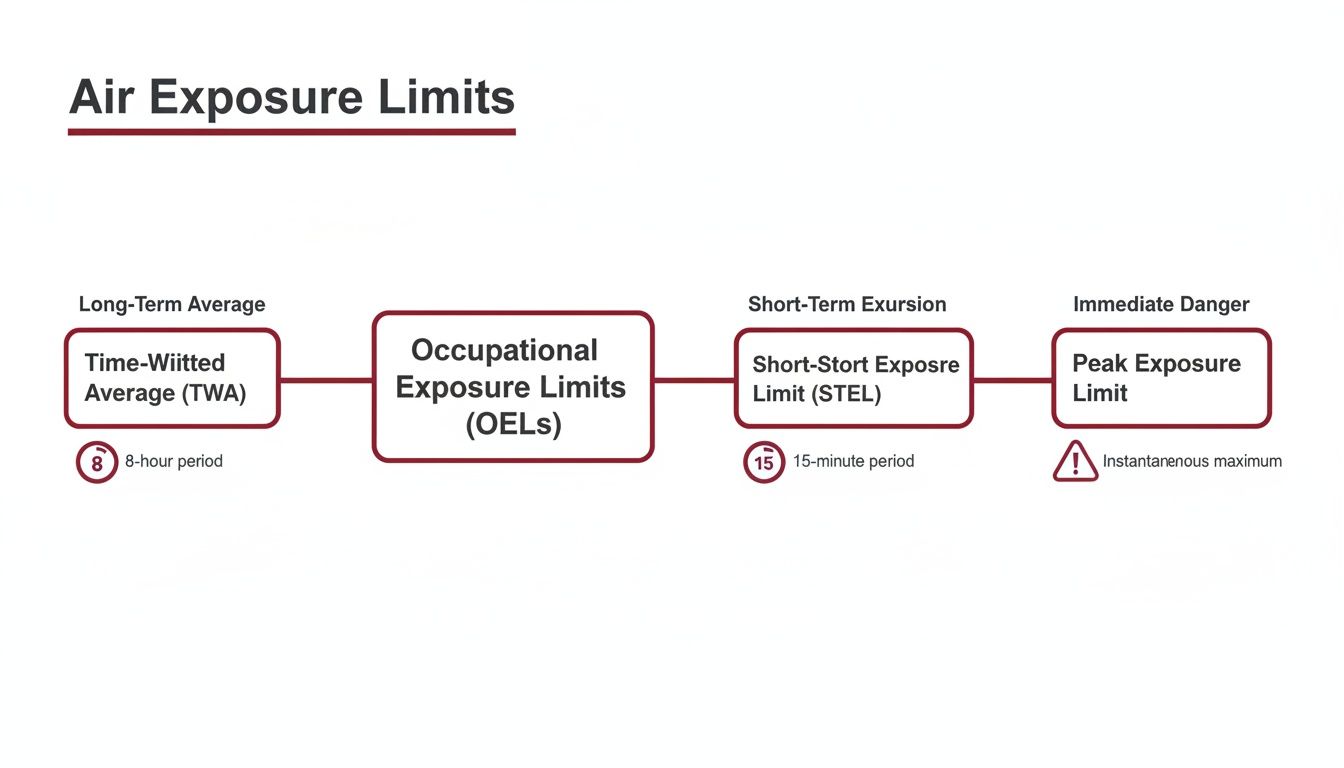
This flowchart breaks down the relationship between the long-term Time-Weighted Average (TWA), the shorter 15-minute Short-Term Exposure Limit (STEL), and the absolute Peak limit. Each one is designed to protect workers from different types of health risks, from chronic illness to acute effects.
Real-Time Monitoring: Instant Answers When They Matter Most
The third key method is real-time monitoring. Unlike personal and static sampling that require sending samples off to a lab, real-time instruments give you an immediate reading on airborne contaminant levels. Think of it as getting instant feedback.
These devices are absolutely vital in situations where you can't afford to wait for results. We use them for emergency responses, before anyone enters a confined space, or during jobs where exposure levels can spike without warning. They often have built-in alarms that go off if concentrations hit a preset danger level, giving workers the chance to evacuate or take protective action immediately.
A Comparison of Air Monitoring Methods
To make sense of these different approaches, it helps to see them side-by-side. The following table breaks down the primary air monitoring methods, explaining what they're for, where they're used, and what their main advantage is.
| Monitoring Method | Primary Purpose | Common Applications | Key Advantage |
|---|---|---|---|
| Personal Monitoring | To measure an individual worker's direct exposure to a contaminant over their shift. | Assessing compliance with TWA exposure standards for substances like silica dust, asbestos fibres, or solvent vapours. | Provides the most accurate, legally defensible data on an individual's inhaled dose. |
| Static / Area Monitoring | To assess general air quality in a fixed location and evaluate control effectiveness. | Checking ventilation performance, identifying emission sources, and monitoring site boundaries. | Excellent for understanding contaminant sources and distribution in the workplace. |
| Real-Time Monitoring | To get immediate, live data on airborne contaminant concentrations. | Confined space entry clearance, emergency spill response, and monitoring tasks with highly variable exposures. | Delivers instant feedback and alarms, allowing for immediate safety interventions. |
By skillfully combining these methods, an occupational hygienist can build a robust and defensible dataset. This information is the foundation for making critical decisions that protect worker health, ensure regulatory compliance, and create a safer workplace for everyone.
Meeting Australian Compliance and Exposure Standards
Navigating Australia’s workplace safety laws can feel complex, but when it comes to air quality, the rules are there for a very good reason: to protect people. Occupational hygiene air monitoring isn't just about ticking a box; it's a legal requirement, and the entire process has to follow a strict set of national standards to be considered valid.
At the heart of it all are the Workplace Exposure Standards (WES), published by Safe Work Australia. These aren't just recommendations. They are the legally enforceable limits on the amount of an airborne hazardous substance a worker can be exposed to over their shift. Every single result from your air monitoring program is measured against these official benchmarks.
The Central Role of Workplace Exposure Standards
Think of the WES as the legal speed limit for airborne contaminants in your workplace. An occupational hygienist’s job is to act as the speed camera, giving you an accurate picture of the exposure levels to make sure you’re not breaking the law and, more importantly, not putting your team at risk.
These standards are the bedrock of compliance. They set clear, non-negotiable thresholds for hundreds of different substances, from common industrial solvents to dangerous dusts like silica. A huge part of a hygienist's expertise is keeping up with these standards, as they’re regularly updated with the latest scientific evidence. Staying informed on relevant industry trends is essential for keeping your compliance practices current and effective.
Why NATA-Accredited Analysis is Non-Negotiable
Collecting a sample is just the first step. The real test is what happens next, and in Australia, there’s a firm expectation that samples are sent to a laboratory accredited by the National Association of Testing Authorities (NATA).
So, why does this matter so much?
- Credibility and Accuracy: NATA accreditation is a big deal. It means the lab has passed rigorous audits, proving it has the technical chops and precision to get the results right.
- Legal Standing: If there's ever a workplace incident or a dispute with a regulator, results from a NATA-accredited lab hold serious legal weight. They provide objective, third-party proof that your monitoring was done by the book.
- Consistency: It guarantees that results are reliable and comparable, no matter where in Australia the testing takes place.
Trying to cut costs with a non-accredited lab might seem tempting, but it's a huge gamble. It can invalidate your entire monitoring program, leaving your business legally exposed and your workers unprotected.
Stringent Protocols for Data Collection
The way samples are collected is just as important as how they're analysed. Australian occupational hygienists adhere to strict protocols set by Safe Work Australia to get a true picture of what a worker is breathing in.
This means measuring the air in their breathing zone throughout a full work shift, breaks included. Personal samplers, which are calibrated by NATA-accredited labs, are usually attached to a worker’s belt, with the collection head positioned about 300mm from their nose and mouth. Data is typically collected for at least half a shift—though a full 8 hours is always the goal—to compare against time-weighted average (TWA) limits. For substances with short-term exposure limits (STELs), sampling is done over a 15-minute period.
The 30-Year Rule for Record Keeping
Compliance doesn't stop when you get the final report. Australian WHS regulations are crystal clear about keeping records for the long haul, especially when it comes to health and air monitoring data.
Businesses are legally required to keep air monitoring records and results for a minimum of 30 years. The reason is simple: many occupational diseases, like those from asbestos or silica exposure, can take decades to show up.
These records aren't just for your files; they must be accessible to both your current and former employees. This long-term duty highlights just how serious exposure risks are and ensures that critical historical data is available for any future health assessments or claims. You can learn more about the specifics in our guide to Australian Workplace Safety Standards.
Ultimately, working with a qualified occupational hygienist moves air monitoring from a simple compliance task to a core part of your risk management strategy. They make sure every step is done right—from sampling to analysis and reporting—to create a robust, legally defensible program that genuinely protects your people.
Making Sense of the Numbers: What to Do With Your Air Monitoring Results
Getting the air quality data back is a big step, but the real work starts now. The numbers on the page don't protect anyone on their own; it's how you use that information that makes a difference. An experienced occupational hygienist won't just dump a spreadsheet on your desk. They’ll deliver a comprehensive report that translates the complex science into a clear, practical plan of action.
Think of this report as your roadmap. It's designed to guide you from understanding the initial findings to putting effective controls in place—safeguarding your team's health and ensuring you're meeting your legal duties.

What's Inside a Professional Occupational Hygiene Report?
While every report is customised for the specific workplace, they nearly always follow a logical flow. They start with the big-picture summary, then dive into the technical details, and finish with a clear set of recommendations.
Here are the key sections you should expect to see:
- Executive Summary: This is your cheat sheet. It gives you the most critical findings and recommendations right up front, perfect for busy managers who need the main takeaways fast.
- Methodology: This section is all about the "how." It explains the sampling strategies used (like personal or static monitoring), the equipment involved, how long samples were collected, and which NATA-accredited lab did the analysis. This transparency is crucial for the report's credibility.
- Results: Here’s where you find the hard data. The results are usually laid out in a clean table, showing the measured concentration of each airborne contaminant for every single sample.
- Discussion and Recommendations: This is the core of the report. The hygienist connects the dots, explains what the numbers mean for your workers, and provides a prioritised list of actions to take.
Measuring Up: Comparing Results to Exposure Standards
The most critical part of the analysis is comparing your results to Australia’s official Workplace Exposure Standards (WES). This is where the data turns into a straightforward pass-or-fail test. The hygienist will clearly point out if any samples breached the Time-Weighted Average (TWA), Short Term Exposure Limit (STEL), or Peak exposure limits.
An exceedance is a red flag. It means at least one worker was exposed to a hazardous substance at a level considered unsafe and non-compliant with Australian WHS law. This isn't just a number to watch; it's a trigger for immediate action.
An exceedance of a Workplace Exposure Standard isn't just a data point—it's a direct indicator of unacceptable risk. It provides the objective evidence needed to justify and implement immediate, effective control measures to protect worker health.
From Data to Action: Applying the Hierarchy of Controls
The real value of a hygienist's report is in the recommendations, which are always structured around the hierarchy of controls. This is a fundamental risk management principle that prioritises the most effective and reliable safety solutions. Instead of jumping straight to suggesting more masks, a good hygienist uses the data to build a solid case for more permanent fixes.
Here’s how monitoring results can drive specific actions across the hierarchy:
- Elimination/Substitution (Most Effective): If monitoring reveals high levels of a toxic solvent, the top recommendation won't be about ventilation; it will be to find a safer, water-based alternative and get rid of the hazard entirely.
- Engineering Controls: If the results show silica dust levels are above the WES near cutting stations, that data becomes the justification to invest in a local exhaust ventilation (LEV) system or water suppression tools to capture dust at the source.
- Administrative Controls: The data might show that workers on longer shifts have higher TWA exposures. This could lead to practical recommendations like rotating jobs or changing work schedules to limit how long any one person spends in a high-exposure area.
- Personal Protective Equipment (PPE) (Least Effective): When higher-level controls can't be put in place right away, the monitoring data is essential for choosing the right PPE. The results determine the required protection factor for respirators, making sure they are actually up to the job.
Ultimately, occupational hygienist air monitoring gives you the scientific proof you need to make smart, data-driven decisions. It shifts your safety strategy from guesswork to a targeted approach, ensuring your time and money are spent on controls that genuinely reduce risk and create a healthier, safer, and compliant workplace.
Got Questions About Air Monitoring? We've Got Answers.
Even after you get the hang of the basics, there are always a few specific questions that pop up when it comes to occupational hygienist air monitoring. This is perfectly normal. Here, we'll tackle some of the most common queries we hear from business owners, safety managers, and even the workers on the floor. Our aim is to give you clear, straightforward answers to help you manage your workplace air quality with confidence.
How Often Should We Be Doing This?
This is easily the most common—and most critical—question we get asked. The honest answer is: it depends. There’s no magic number or a single "one-size-fits-all" schedule. The right frequency is tied directly to the level of risk in your specific workplace.
A good occupational hygienist will work with you to figure out a schedule, but it’s usually guided by these key moments:
- To Get a Starting Point: Every workplace with potential airborne nasties needs a thorough, initial assessment. This gives you a clear baseline of what exposure levels look like on a normal day.
- When Something Changes: Rolled out a new chemical? Tweaked a production line? Installed new ventilation? Any of these changes could affect your air quality, so it's time to monitor again.
- After a Mishap: If you have a spill, a leak, or any other kind of incident, you’ll need follow-up monitoring. It’s the only way to be certain the area is safe for your team to return.
- For High-Risk Jobs: When you’re dealing with serious hazards like silica dust or asbestos, regular monitoring (often annually) isn’t just best practice—it’s frequently a legal requirement.
- If Your Team is Worried: When workers report symptoms or raise concerns, it's a clear signal to investigate. Air monitoring is the best way to get to the bottom of their claims.
Ultimately, your risk assessment should be your guide. A low-risk, stable environment might only need a check-up every few years. A high-risk one will need a much closer, more frequent watch.
Can We Just Do the Air Monitoring Ourselves?
It’s tempting to think about handling air monitoring in-house to save a bit of cash, but this approach is fraught with risk. It’s so much more than just waving a handheld gadget around. Proper monitoring demands a deep understanding of sampling strategies, meticulous equipment calibration, and the complex science behind interpreting the results against Australian Workplace Exposure Standards.
Handing this task to an unqualified person often leads to dodgy results, a false sense of security, and can land you in hot water with WHS regulators. A qualified occupational hygienist ensures the data you get is scientifically valid and can stand up to scrutiny.
Bringing in a professional means you can be sure the sampling is done right, the analysis is handled by a NATA-accredited laboratory, and the results are properly interpreted in a legal context. That professional oversight is a crucial shield, protecting both your workers and your business.
What's the Difference Between Air Monitoring and Air Testing?
People often use these terms interchangeably, but in the world of occupational hygiene, they mean two different things. Getting the distinction right helps clarify why you’re doing what you’re doing.
- Air Monitoring: Think of this as a long-term health check. It’s the systematic, ongoing process of sampling air to measure what a worker is exposed to over a full shift or a specific task. The whole point is to manage and control health risks over time by comparing the data against legal limits like the TWA and STEL.
- Air Testing: This is more like a snapshot. It’s usually a one-off check to see if a specific contaminant is present at a single point in time. Good examples include testing for mould spores after a flood or checking for carbon monoxide in a confined space just before someone enters.
So, monitoring is your proactive, long-game strategy for risk management. Testing is your quick, diagnostic tool for a specific, immediate question. A solid occupational hygienist air monitoring program is the foundation for keeping your team safe for the long haul.
How Long Until We Get the Results?
The waiting time really depends on the kind of sampling that was done.
If we’re using direct-reading instruments for real-time monitoring, you get the answers instantly. This is perfect for situations where you need immediate feedback, like getting the all-clear for a confined space entry.
For the more common personal and static monitoring—where samples are collected on things like filter cassettes or sorbent tubes and sent to a lab—it takes a bit longer. Generally, you should expect to see the lab analysis and the final, comprehensive report from the hygienist within one to two weeks of the sampling day. This gives us the necessary time for the lab to do its work and for us to interpret the data and write up clear, actionable recommendations for you.
At Anitech Ltd Pty, we live and breathe occupational hygiene. We provide expert services across Australia, delivering the robust scientific data and practical advice you need to build a safe, compliant, and healthy workplace. Our team is here to help you cut through the complexity of air quality management with total confidence.
Protect your people and your business. Make sure your air quality is up to standard. Contact us today to schedule a consultation.


