
At its core, noise testing is the process of methodically measuring sound levels to figure out their real-world impact on people and the environment. It's a critical practice that relies on specialised equipment to gather hard data, ensuring businesses and sites comply with Australian regulations, protect community health, and avoid noise-related disputes.
Why Noise Testing Is More Than Just Measuring Sound
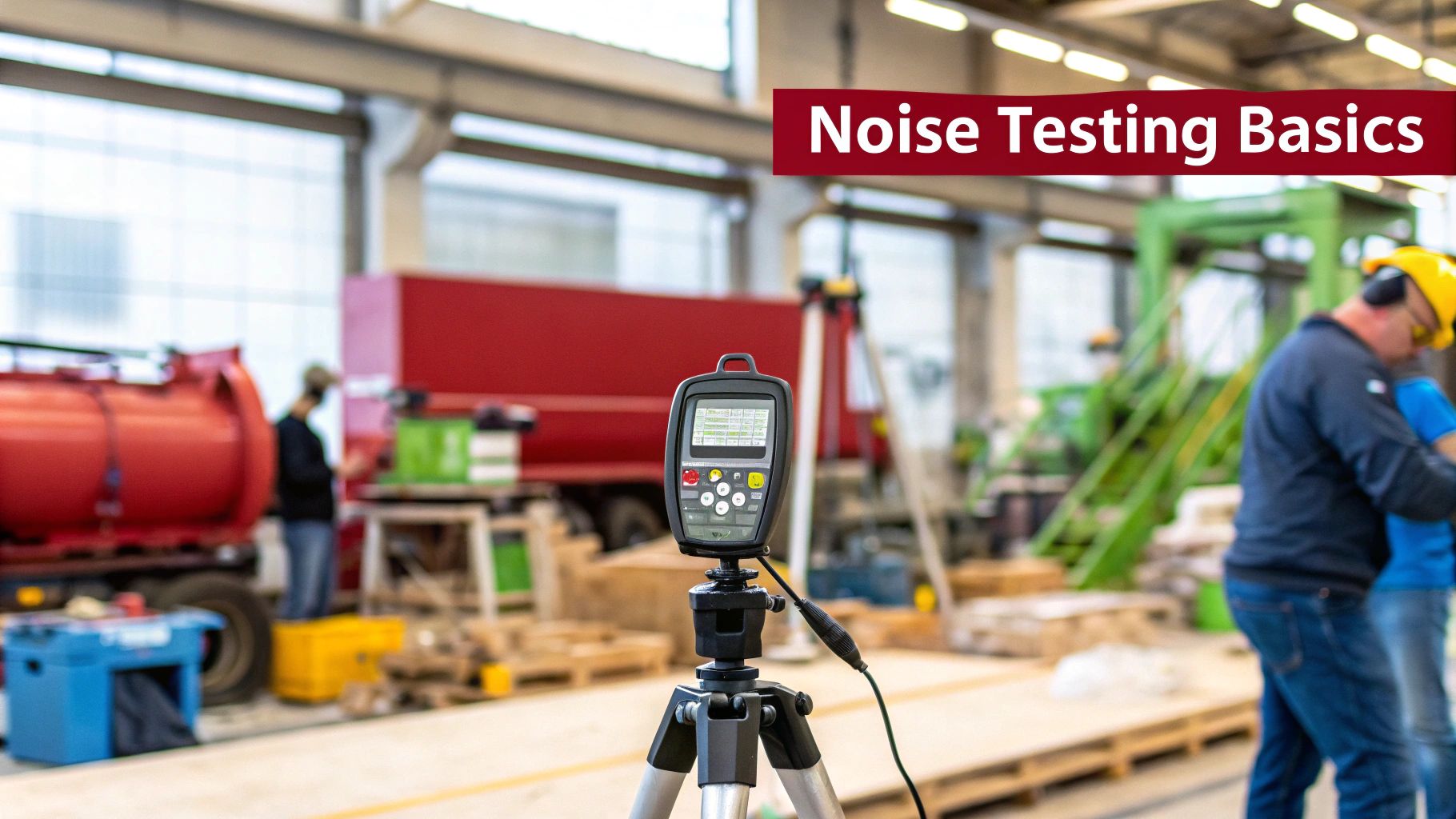
It’s easy to think of noise testing as simply holding up a microphone to see how loud something is. But it’s much more sophisticated than that. Think of it as a health check-up for a community's soundscape—a diagnostic tool that takes the subjective feeling of being "annoyed by a loud noise" and turns it into objective, actionable data.
Without this process, "noise pollution" is just a vague complaint. With it, it becomes a measurable problem with clear-cut solutions. This is fundamental for maintaining community wellbeing across Australia, because persistent, excessive noise isn't just a nuisance. It’s a genuine health hazard linked to everything from stress and sleep disruption to high blood pressure and poor concentration.
Understanding the Basics of Sound Measurement
The language of noise testing is built around the decibel (dB). This is the unit we use to measure sound intensity, but it works a bit differently than you might expect. The decibel scale is logarithmic, which is a technical way of saying a small increase in the number represents a huge jump in sound energy. For example, an increase of just 10 dB is actually perceived by our ears as a doubling of loudness.
Beyond raw volume, we also need to understand the character of the noise, as different types have very different effects:
- Continuous Noise: This is your steady, background hum—think of a large factory fan or an office air conditioning unit that never switches off.
- Intermittent Noise: A sound that comes and goes, like traffic passing by a house or a piece of machinery that runs in cycles.
- Impulsive Noise: These are the sudden, sharp sounds that really make you jump, like a nail gun on a construction site or a loud bang from a workshop.
Making these distinctions is crucial. Regulations often have much stricter limits for sharp, impulsive sounds because they have a far greater potential to startle, annoy, and cause distress.
An acoustic assessment provides the complete story. It includes noise testing data but also involves analysing that data, comparing it against regulations, and providing recommendations for noise control.
Who Needs Professional Noise Testing?
The need for precise, professional noise measurement touches almost every sector. It’s an essential service for any organisation whose daily operations could affect the acoustic comfort of its neighbours or the hearing health of its employees.
Here are a few key groups who rely on it:
- Property Developers: They need to prove new apartment buildings meet acoustic standards, ensuring residents are shielded from traffic, trains, and other external noise.
- Industrial Operators: Essential for complying with environmental licences and managing the noise from heavy machinery that might impact nearby residential areas.
- Construction Companies: To monitor sound levels from building activities, stick to local council rules, and keep disruption to a minimum.
- Entertainment Venues: For managing music levels to ensure they aren't creating a public nuisance, finding a balance between a vibrant atmosphere and residential peace.
Ultimately, proper noise testing provides the objective evidence needed to make informed decisions. It protects businesses from baseless complaints, safeguards community health, and helps everyone understand the unseen hazards of occupational hearing loss, a massive issue for Australian workers. This proactive approach is the first step toward creating quieter, healthier, and more harmonious environments for us all.
Decoding Australian Noise Regulations and Standards
Trying to get your head around Australia's noise laws can feel a bit like untangling a fishing line. The rules often shift between states, territories, and even local councils, creating a complex web of obligations. These aren't just suggestions; they are serious legal frameworks designed to strike a balance between a thriving industry and a peaceful community.
For any business, developer, or project manager, understanding these standards isn't optional. It's the key to avoiding hefty fines, frustrating project delays, and souring relationships with neighbours. Getting on top of this legal landscape starts with proactive noise testing, ensuring everything you do is above board from day one.
The Foundation of Australian Noise Control
At its core, Australia's approach to noise is all about minimising the impact on people and the environment. The main piece of legislation guiding this is the Environment Protection Act 2017 (EPA), which sets the rules for everything from traffic and construction to industrial operations. This act is the bedrock of noise control across the country.
A really clever concept embedded in these regulations is the ‘Agent of Change’ principle. This flips the script on who's responsible for managing noise. It puts the onus for soundproofing and mitigation directly on the party introducing the change—not the pre-existing noise source.
The 'Agent of Change' principle is a game-changer. It means if you build new homes near an existing factory or music venue, it’s your job as the developer to soundproof the homes, not the factory's job to go quiet.
This common-sense approach stops a long-standing business from being penalised just because a new apartment block popped up next door without proper acoustic design.
To get a clearer picture of these regulations, here's a quick breakdown of the core concepts you'll encounter.
Table: Key Australian Noise Regulation Concepts
| Concept/Regulation | Description | Primary Application |
|---|---|---|
| EPA 2017 | The foundational state-level act establishing the framework for managing pollution, including noise, and setting broad obligations. | Industrial sites, commercial operations, infrastructure projects, and construction activities. |
| Agent of Change Principle | The new development (the "agent of change") is responsible for mitigating the impact of pre-existing environmental noise. | Urban planning, residential developments near existing commercial or industrial noise sources. |
| Zoning Regulations | Different noise limits are applied based on land use categories (e.g., residential, commercial, industrial). | Local council development applications, environmental impact assessments. |
| Time-Based Restrictions | Stricter noise limits are enforced during sensitive periods, typically categorised as evening (6 PM–10 PM) and night (10 PM–7 AM). | All noise-generating activities, especially construction, entertainment, and transport. |
| Acoustic Reports | A mandatory assessment submitted during development applications to prove a project will comply with relevant noise standards. | New developments, changes to existing operations, and resolving noise complaints. |
This table highlights how the rules are designed to be both comprehensive and context-specific, protecting community amenity without unfairly restricting industry.
Zoning and Time-Based Noise Limits
Australian noise laws aren't a blunt instrument; they're incredibly nuanced. The acceptable noise level changes dramatically depending on where you are and what time it is. Think about it: a sound that’s perfectly normal in an industrial park at noon would be a major problem in a quiet street at 2 AM.
To manage this, authorities use a layered system:
- Residential Zones: These have the tightest restrictions, especially at night, to protect people's right to sleep and rest.
- Commercial Zones: Limits here are more relaxed to accommodate the hustle and bustle of business during the day.
- Industrial Zones: These areas have the most lenient standards to allow for heavy machinery and round-the-clock operations, but they still have to manage their noise spill into neighbouring zones.
The day is usually sliced into three distinct periods, each with its own decibel limit:
- Day: Usually 7 AM to 6 PM.
- Evening: Typically 6 PM to 10 PM.
- Night: From 10 PM to 7 AM, when the rules are strictest.
The Agent of Change Principle in Action
So, how does the 'Agent of Change' principle work in the real world? Imagine a classic city scenario: a developer wants to build a slick new apartment building right next to a beloved live music venue that’s been part of the cultural fabric for decades.
In the past, once new residents moved in, their noise complaints could have spelled doom for the venue, potentially forcing it to close or spend a fortune it didn't have on soundproofing.
The 'Agent of Change' principle completely changes this dynamic. The developer of the new apartments is now responsible for making sure the building is designed to shield its residents from the venue's music. This could mean installing high-performance acoustic windows, beefing up wall insulation, or using clever layouts to keep bedrooms away from the noise source.
This is where a professional noise assessment becomes absolutely essential. It provides the hard data needed to engineer these solutions effectively, allowing new residents and the old venue to coexist happily. It’s a proactive approach that protects our vibrant cultural hubs while still making room for growth. At the end of the day, compliance is about more than just avoiding fines—it's about being a good neighbour.
The Acoustic Consultant’s Toolkit for Accurate Measurement
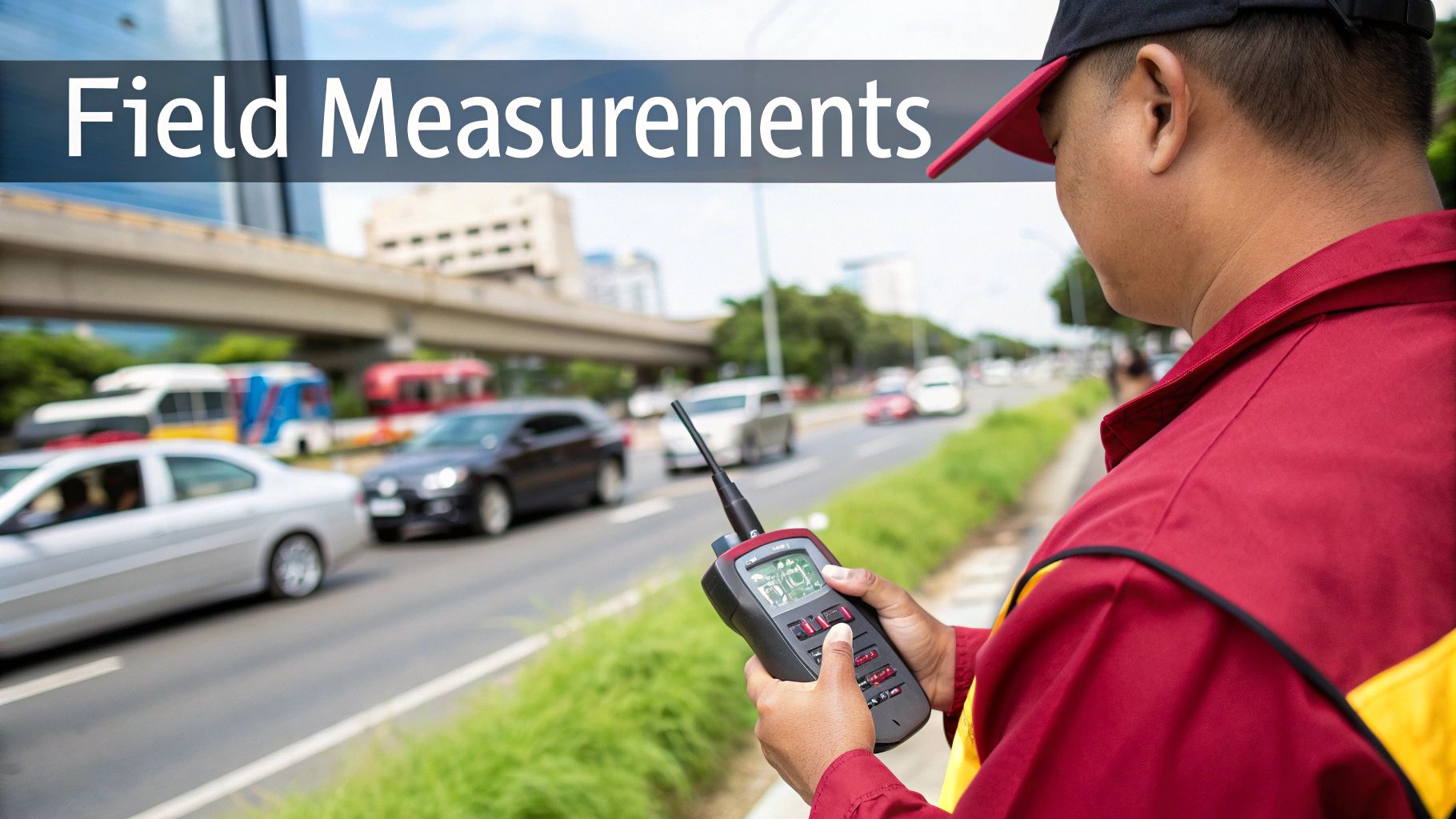
To get precise, legally defensible results, you need a lot more than just a good ear. An acoustic consultant's gear is like a professional photographer’s camera bag—each piece has a specific job, and they all work together to capture an exact 'picture' of the soundscape. Using the right tools isn't just best practice; it's the only way to generate data that stands up to scrutiny from regulators like the EPA.
This is exactly why a smartphone app, while fun for a quick check, is completely out of its depth for professional work. The microphones aren't built for precision, they can't be calibrated to Australian Standards, and the readings are easily thrown off. For any serious noise assessment, specialised, high-fidelity equipment is non-negotiable.
At the heart of any professional kit is the Sound Level Meter (SLM). This is the star of the show, but it's crucial to understand that not all SLMs are created equal. They're categorised into classes based on their precision, and picking the right one is critical.
The Two Classes of Sound Level Meters
When we talk about professional SLMs, we're almost always talking about Type 1 or Type 2. The real difference between them comes down to their level of accuracy and what kind of job they're suited for.
-
Type 1 SLM (Precision Grade): This is the gold standard. A Type 1 meter has the tightest tolerance for error, making it the go-to for situations where maximum accuracy is essential. Think laboratory settings, legal disputes, or high-stakes environmental compliance reports.
-
Type 2 SLM (General Purpose Grade): While still incredibly accurate, a Type 2 meter has slightly wider tolerances. It's perfectly suited for a huge range of applications, like general workplace noise surveys, initial site walk-throughs, and monitoring construction noise where the compliance margins aren't razor-thin.
It's not a case of one being "good" and the other "bad." It's about matching the tool to the specific demands of the job to ensure the data is both reliable and cost-effective.
Essential Accessories for Reliable Data
An SLM on its own is rarely enough. A consultant's toolkit is packed with accessories that protect the integrity of the data. Think of them as the support crew making sure the star performer gives a flawless show.
An acoustic consultant's goal is to measure the source noise, not the 'noise' created by the measurement process itself. Every accessory is designed to eliminate variables and isolate the sound that truly matters.
Here are the must-have companions for any professional SLM:
-
Acoustic Calibrator: This is arguably the most critical accessory. Before and after every single measurement, the SLM's microphone is placed into the calibrator. This device produces a precise, known sound level (like 94 dB at 1 kHz), allowing the consultant to verify the meter is reading correctly and hasn't drifted. Without this step, the data is essentially meaningless.
-
Windscreen: That simple foam ball on the end of the microphone is vital. It's designed to stop the sound of wind rushing past, which can create artificially high readings and corrupt the data. For any outdoor noise testing, a windscreen is absolutely essential to separate the actual environmental noise from weather-related interference.
-
Data Logger: Often built into modern SLMs, a data logger is key for long-term monitoring. A single spot measurement rarely tells the whole story. Data logging allows for unattended monitoring over hours or even days, which is vital for building a complete picture of the sound environment—a common requirement for a thorough noise survey.
These tools all work in concert, ensuring every decibel reading is a true and accurate reflection of the acoustic environment. This methodical approach is what separates a professional assessment from a casual one.
A Step-by-Step Guide to Professional Noise Testing
A professional noise test isn't just about pointing a microphone at something and writing down a number. It's a structured investigation. Getting it right is the difference between guessing and gathering legally defensible data.
Let's walk through the five essential stages that professionals follow. This playbook turns a complex task into a clear set of actions, ensuring every reading is accurate, contextualised, and genuinely useful.
Stage 1: Define Clear Objectives
Before any equipment even comes out of its case, we have to answer one simple question: "What are we actually trying to find out?" Without a clear goal, you're just collecting random numbers. This objective drives the entire methodology.
What might your objective be?
- Compliance Check: Making sure a factory's night-time operations don't breach the local council's noise limits.
- Complaint Investigation: Getting an objective measurement of a neighbour's new air conditioning unit to see if it's legally considered a nuisance.
- Workplace Health and Safety: Assessing how much noise machinery is exposing workers to, ensuring it stays under the national safe exposure standard of 85 dB(A) averaged over an eight-hour shift.
- Pre-development Planning: Measuring baseline noise levels at a site for a proposed childcare centre. This data is vital for informing the building's acoustic design.
Nailing down the purpose from the start ensures you measure the right noise, at the right time, and in the right place.
Stage 2: Perform a Thorough Site Assessment
With your objective locked in, it’s time for a detailed site walk-through. This is much more than just finding a good spot for the tripod; it's about getting to know the entire acoustic environment. You need to map out every potential noise source and every sensitive spot.
During this assessment, an acoustic consultant will identify and map:
- Key Noise Sources: This could be a specific exhaust fan on a roof, a busy loading bay, a construction zone, or traffic from a major road.
- Sensitive Receivers: These are the critical locations where the noise actually matters—think the bedroom window of the closest house, a school playground, or an office boardroom.
- Background Noise: You have to identify the constant, ambient hum of the area. This could be distant traffic, the general thrum of a city, or even the wind in the trees. This "acoustic floor" is the baseline that other specific noises are measured against.
This reconnaissance phase allows you to create a smart, strategic measurement plan that will capture the full story of the site's soundscape.
Stage 3: Set Up and Calibrate Your Equipment
In noise testing, accuracy is everything. Before you take a single official measurement, all your gear must be set up correctly and—most importantly—calibrated. This is a non-negotiable step that guarantees the integrity of every piece of data you collect.
Calibration is done using a specialised acoustic calibrator. It's a small, handheld device that produces a tone of a very precise and stable level (for example, 94 dB at 1 kHz). You place the sound level meter's microphone inside the calibrator and adjust the meter until its reading perfectly matches the known tone.
This pre-test calibration is your critical quality control check. It confirms the instrument is working perfectly and gives you a verifiable reference point for all your measurements. We always repeat this process after the test as well, just to make sure the meter hasn't drifted.
The core process of noise testing boils down to three key actions, which are laid out nicely in this infographic.
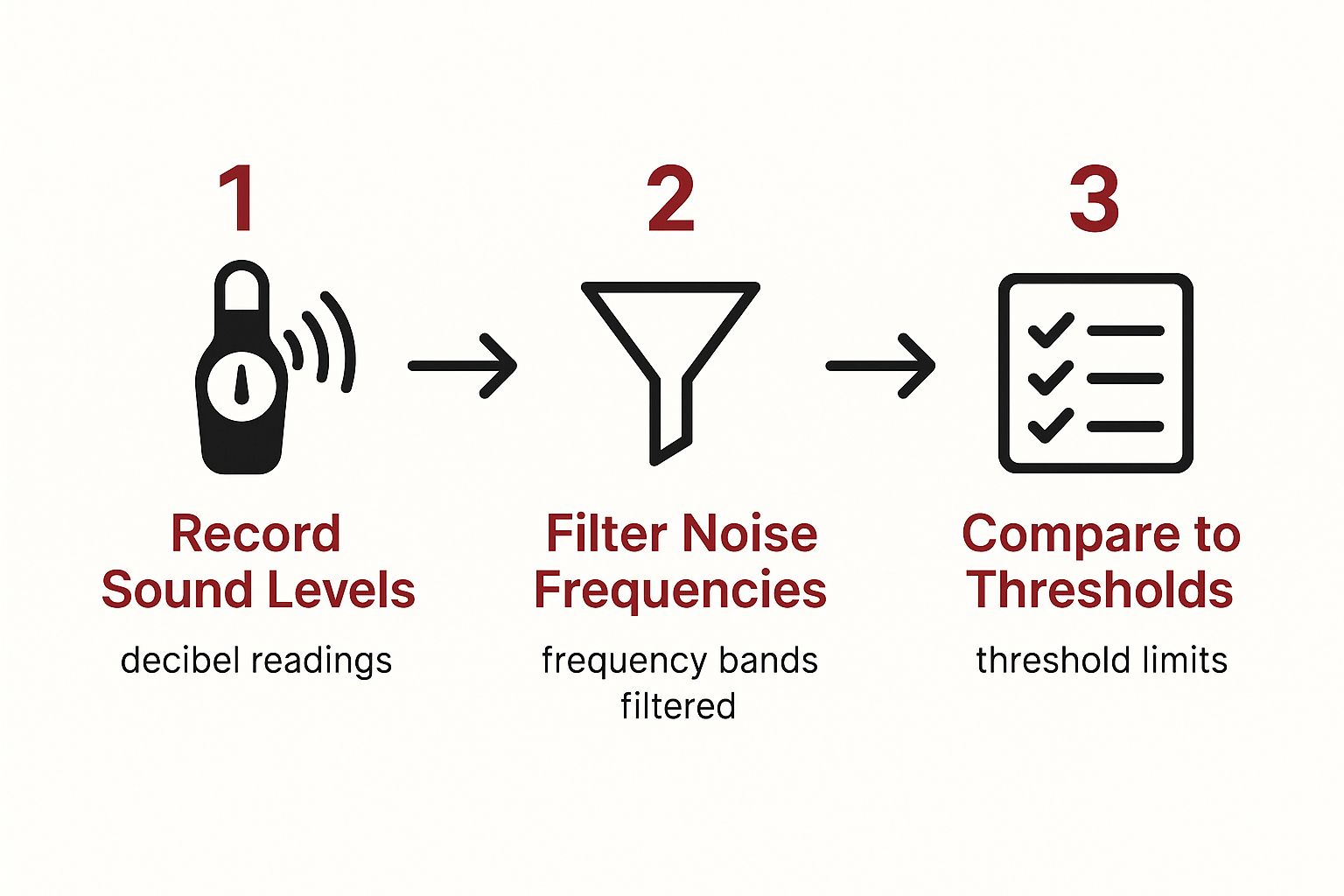
As you can see, it’s a logical flow: capture the raw sound, filter it to focus on what matters, and then compare it against the rules.
Stage 4: Execute the Measurement
Alright, it’s time to collect the data. But it's not as simple as hitting 'record'. The actual measurement process has to be managed carefully, as several variables can throw your results off.
Here are the key factors to control during the measurement:
- Duration: How long do you need to measure for? It has to be long enough to get a representative sample of the noise. This could be a quick 15-minute spot check or full 24/7 monitoring over several days.
- Weather Conditions: Wind and rain are the enemies of accurate noise readings. Wind blowing across the microphone creates its own noise, and rain is just loud. We typically avoid measuring in bad weather and always record the wind speed.
- Extraneous Noise: The consultant must be on the ball, noting any other sounds that aren't part of what you're trying to measure. A passing ambulance, a barking dog, or a plane flying overhead all need to be logged so they can be filtered out later.
Stage 5: Log Data Meticulously
The final step in the field is to write everything down. The decibel readings are just one part of the puzzle. It’s the detailed notes that provide the crucial context, allowing for a proper interpretation back in the office.
For every single measurement, a professional log will always include:
- Date, Time, and Location: The absolute specifics of when and where the reading was taken.
- Equipment Details: The model and serial numbers for both the sound level meter and the calibrator.
- Weather Observations: Notes on wind speed, direction, cloud cover, and any rain.
- Site Observations: Detailed notes on what was happening. For example, "compressor running at full load" or "site operating with only 50% of staff today." Any unusual background events get noted here too.
This meticulous record-keeping is what makes the whole process transparent, repeatable, and able to stand up to scrutiny. It's the solid foundation that a credible acoustic report is built on.
Turning Raw Data Into Meaningful Noise Insights
A list of decibel readings from a noise test is really just a bunch of numbers. On their own, they don't mean much. To make sense of an acoustic report, you need to understand the story the data is telling. It’s less about a single "loudness" number and more about painting a complete picture of the soundscape, revealing its character and true impact.
Let's use an analogy. Say you’re looking at the noise from a busy road near a proposed childcare centre. Just measuring the loudest passing truck doesn’t give you the full story. What about the average noise level? The quietest moments between traffic? How often do those loud interruptions actually happen?
Decoding the Key Acoustic Metrics
To get this complete picture, acoustic consultants focus on a few key statistical metrics. You'll often see them written with an 'L' (for level) and a subscript, like L_Aeq or L_A90. They might look technical, but the concepts behind them are actually pretty straightforward.
-
L_Aeq (Equivalent Continuous Sound Level): Think of this as the average noise level over a set period. It’s a bit like calculating your average speed on a long car trip that had stretches of motorway driving and moments stuck in traffic. It gives you a single, representative value for the overall acoustic energy by smoothing out all the peaks and troughs. For our childcare centre, this tells us the general, constant hum from the traffic.
-
L_A90 (Background Noise Level): This number represents the noise level that is present for at least 90% of the time. In simple terms, it’s the quietest the environment generally gets. This is your "acoustic floor"—the underlying ambient sound when no specific, loud events are happening. It could be the distant rumble of the city or the gentle rustle of leaves. On our childcare site, this would be the sound level in between passing cars.
-
L_A10 (Intrusive Noise Level): This is the flip side—the noise level that is exceeded for only 10% of the time. This metric is great for capturing the louder, more noticeable events that jump out from the background, like a heavy truck rumbling past or a sudden burst of construction noise. It’s crucial for assessing how annoying a sound is, because these are the sounds that really grab our attention.
When an acoustic consultant looks at L_Aeq, L_A90, and L_A10 together, they can start to build a narrative. A huge gap between the L_A90 (the quiet floor) and the L_A10 (the loud peaks) points to a very dynamic environment with frequent, disruptive noises—a massive red flag for a peaceful setting like a childcare centre.
Spotting Red Flags in the Data
Beyond these core metrics, a huge part of noise testing is listening for specific acoustic characteristics that make a sound particularly irritating or even harmful. Australian regulations often apply penalties for sounds with these qualities, meaning they’re treated more strictly than simple, steady noise.
This is where the human side of noise perception comes in. Noise testing in Australia isn't just about the technical measurement of decibels; it also involves assessing community response, acknowledging the complex link between objective sound and human health. You can learn more about how environmental noise affects health from this Australian Government guide.
There are two big red flags we always look for:
-
Tonal Noise: This is any sound with a distinct, recognisable pitch—a whine, a hum, a buzz, or a screech. Think of a faulty air-conditioner, a reversing alarm on a truck, or a particular piece of machinery. Our ears are incredibly sensitive to tones, so these sounds are far more annoying than broad-spectrum noise, even if they're at the same decibel level.
-
Impulsive Noise: This refers to sudden, sharp sounds like a bang, a crash, or a clang. The rapid, jarring onset of these noises can be startling and highly disruptive. Common examples include a nail gun on a construction site, a metal stamping press in a factory, or shipping containers being dropped.
When these characteristics show up, a good acoustic report will highlight them. This ensures that any noise management plan tackles not just the volume, but the character of the sound, which ultimately leads to much more effective and meaningful solutions.
From Annoyance to Action: Common Noise Complaints and Testing Scenarios
At the end of the day, noise testing is almost always triggered by a very human problem: a complaint. This is where the precise science of acoustics bumps up against real-world frustration. Objective data is what builds a bridge between someone's annoyance and a workable solution, turning a heated dispute into a manageable issue with a clear path forward.
Across Australia, certain noise problems pop up again and again, creating friction in communities and workplaces. Whether it’s a suburban backyard or a busy industrial site, these common complaints are the main reason people call in the experts for a professional noise test. Each scenario, of course, needs a tailored approach to get the right evidence.
Residential Noise Hotspots
Nothing sparks tension between neighbours quite like noise that invades our homes, disrupting our peace and quiet. It's no surprise that domestic sounds are a huge source of environmental noise issues. A study on Australian community noise complaints found that barking dogs were the single biggest culprit, with 6,727 recorded cases. That one statistic really highlights how much neighbourhood sounds can affect our lives.
Here are a few classic residential scenarios:
- Air Conditioning Units: That constant, tonal hum from a neighbour’s old or badly-placed air conditioner can easily drift into a bedroom window. It’s the kind of noise that becomes a major headache, especially when you’re trying to sleep.
- Pool and Spa Pumps: Just like air-cons, these pumps can run for hours on end. Their low-frequency drone can completely ruin the tranquillity of a quiet backyard.
- Late-Night Parties: We’ve all been there. The loud music and chatter from a party is a classic complaint, and because it's so unpredictable, it’s particularly frustrating for neighbours.
For these kinds of issues, a targeted noise test usually means placing a sound level meter right on the complainant's property line. We often leave it overnight to capture the average noise (L_Aeq) and listen for any specific tonal qualities. The data we collect is then compared directly against the local council's time-of-day noise limits.
The Buzz and Bump of Commercial Venues
If you run a business that serves the public, you’re constantly walking a tightrope between creating a vibrant atmosphere and keeping the peace with your neighbours. Entertainment and hospitality venues are often at the heart of noise disputes, particularly when they're close to residential areas.
A proactive noise testing plan isn't just about compliance; it's the mark of a well-run venue. It shows you’re committed to being a good neighbour and gives you the objective data needed to solve complaints fairly before they escalate into a regulatory nightmare.
A few typical commercial challenges include:
- Live Music Venues: The biggest problem here is almost always the low-frequency bass. It travels through walls and floors with ease, creating a thumping vibration that people feel just as much as they hear.
- Pubs and Bars with Outdoor Areas: The sound of patrons in a beer garden or on a rooftop terrace can become a real issue late at night, especially as the evening wears on.
- Gyms and Fitness Centres: That sudden, impulsive thud of dropped weights in a 24-hour gym can be a serious sleep-wrecker for anyone living in the apartments next door or overhead.
In these cases, noise testing zeroes in on measuring sound levels at the nearest home—or "sensitive receiver," as we call it—while the venue is in full swing. The assessment often involves analysing specific frequency bands to pinpoint exactly where that problematic bass noise is coming from.
Keeping Industry and Construction in Check
By their very nature, industrial facilities and construction sites generate a lot of noise. For these operations, noise testing isn't just a reaction to complaints; it's a fundamental part of holding onto their environmental licence and proving they're meeting their legal obligations.
Here are some frequent industrial testing scenarios:
- Installing New Machinery: Before a massive new piece of equipment is switched on for good, a noise test is done to make sure its operational hum won't push the entire site over its legal limit.
- Managing Construction Noise: For big projects, ongoing noise monitoring is often a condition of the development approval. This ensures that loud activities like rock breaking or pile driving stick to the strict time restrictions set by the council.
- Annual Compliance Reporting: Many industrial sites are legally required to conduct an annual noise assessment. This is how they prove to the EPA that their operations are still within the noise limits laid out in their licence.
The testing here is far more thorough. It often involves setting up multiple measurement points around the site's perimeter, sometimes for a full 24-hour period, to build a complete acoustic picture of the facility's impact. This data is absolutely essential for planning noise reduction strategies and, ultimately, for staying in business.
Your Noise Testing Questions, Answered
Even when you understand the basics, some practical questions always pop up when it's time to actually commission or interpret a noise test. Let's tackle some of the most common queries I hear, giving you the direct answers you need to move forward with confidence.
How Often Do I Really Need to Do Noise Testing?
There’s no single, one-size-fits-all answer here. The right frequency for noise testing really hinges on your specific situation and any regulations you fall under.
For industrial sites or construction projects with an environmental licence, it’s often a scheduled requirement – think quarterly or annually. You'll also need to test any time there's a significant change, like installing a powerful new piece of machinery or extending your operating hours. Of course, testing is also a must if a complaint is made. For new developments, it's a critical step during both the planning and post-construction phases to prove you're meeting building code requirements.
Can I Just Use a Smartphone App to Check the Noise?
Look, for satisfying your own curiosity, a smartphone app can be interesting. But for any kind of professional or regulatory purpose, it's a hard no. The microphone in your phone just isn't built for precision acoustic measurement. More importantly, it can't be calibrated to meet Australian Standards, which is a non-negotiable requirement.
For any data to stand up in a legal setting or be accepted by a council or the EPA, it must come from a certified and calibrated Type 1 or Type 2 Sound Level Meter. An app gives you a rough idea, but its results are simply not reliable enough for compliance.
Remember, a professional acoustic assessment is so much more than just a measurement. It’s the expert analysis, the comparison against specific regulations, the evaluation of site context, and the practical recommendations for what to do next.
What’s the Difference Between Noise Testing and an Acoustic Assessment?
This is a really important distinction to grasp. Think of it this way: noise testing is the hands-on work of actually measuring sound levels out in the field with specialised gear. It’s the data collection part of the puzzle – it gives us the raw numbers.
An acoustic assessment (or acoustic report) is the comprehensive evaluation that brings those numbers to life. It takes the noise testing data and gives it context and meaning. This report is where the real expertise comes in, involving:
- Analysing the data that was collected.
- Comparing the results against all the relevant standards and council rules.
- Modelling potential noise impacts from any proposed changes.
- Providing clear, expert recommendations for noise control.
Simply put, noise testing answers, "How loud is it?", while an acoustic assessment answers, "Okay, what does that level of noise actually mean, and what do we need to do about it?".
What’s the Ballpark Cost for Professional Noise Testing in Australia?
The cost can swing pretty wildly, as it all comes down to the project's complexity, how long the testing takes, and exactly what you need. A quick, straightforward check for a residential noise issue might only be a few hundred dollars.
On the other end of the spectrum, a detailed environmental impact assessment for a major industrial facility—one that requires long-term, unattended monitoring and a seriously in-depth report—could run into the tens of thousands. The price is shaped by factors like the type of equipment needed, the number of measurement locations, the depth of data analysis, and the level of detail required in the final report. Your best bet is always to get a detailed quote from a qualified acoustic consultant who can properly assess your specific needs.
Getting noise management right is a crucial part of both workplace safety and environmental compliance. To make sure your operations are up to standard, it pays to partner with experts. The team at Anitech Ltd Pty provides comprehensive occupational hygiene services, including professional noise testing and assessments, right across Australia. Visit us at https://occhygiene.com.au to see how we can help you build a safer, more compliant work environment.


